Positive Self-Perception of Aging and Quality of Life in People Living with HIV: The Role of Cultural Stereotype Internalization
 , ,
, ,
Highlights
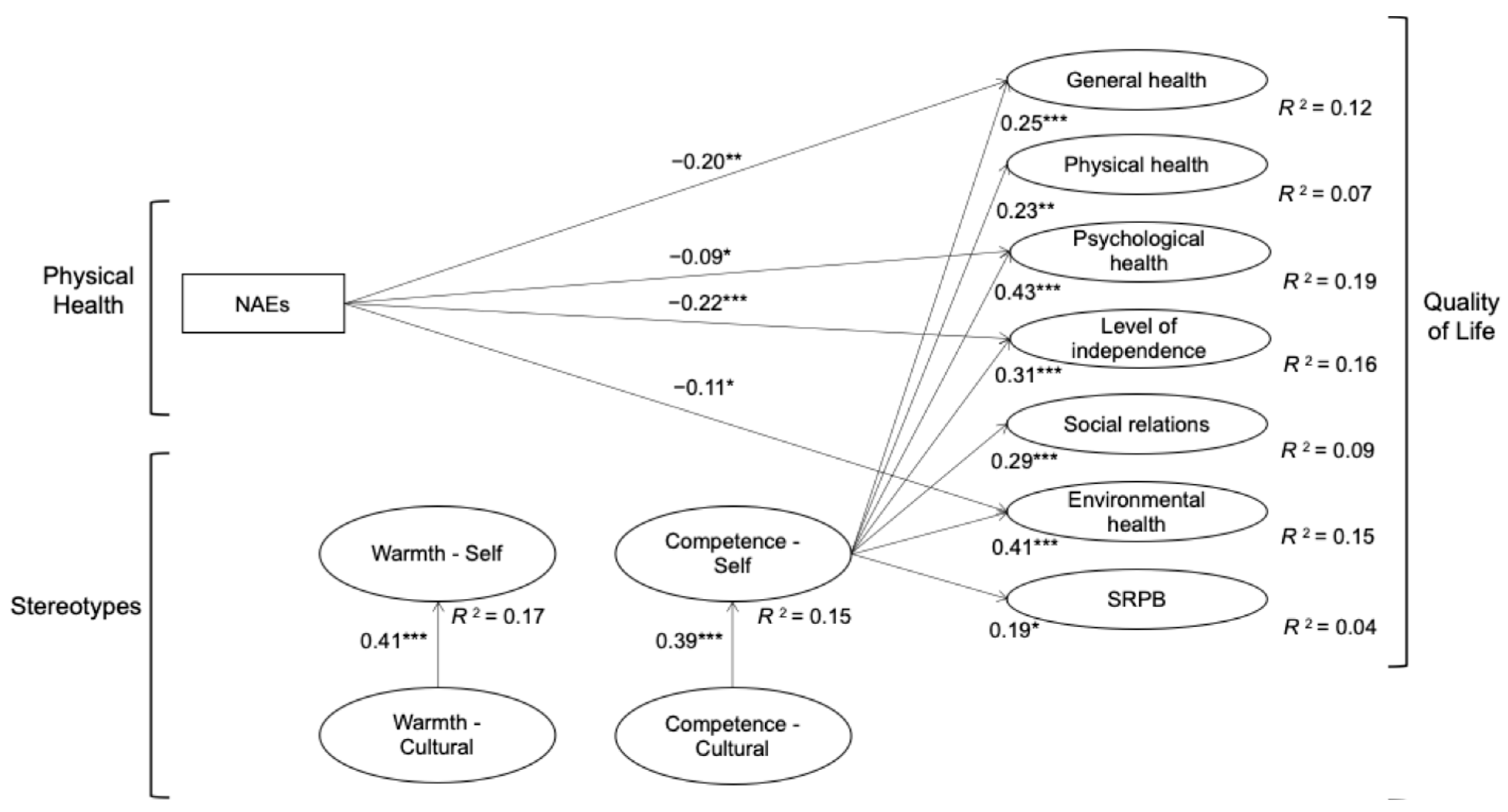
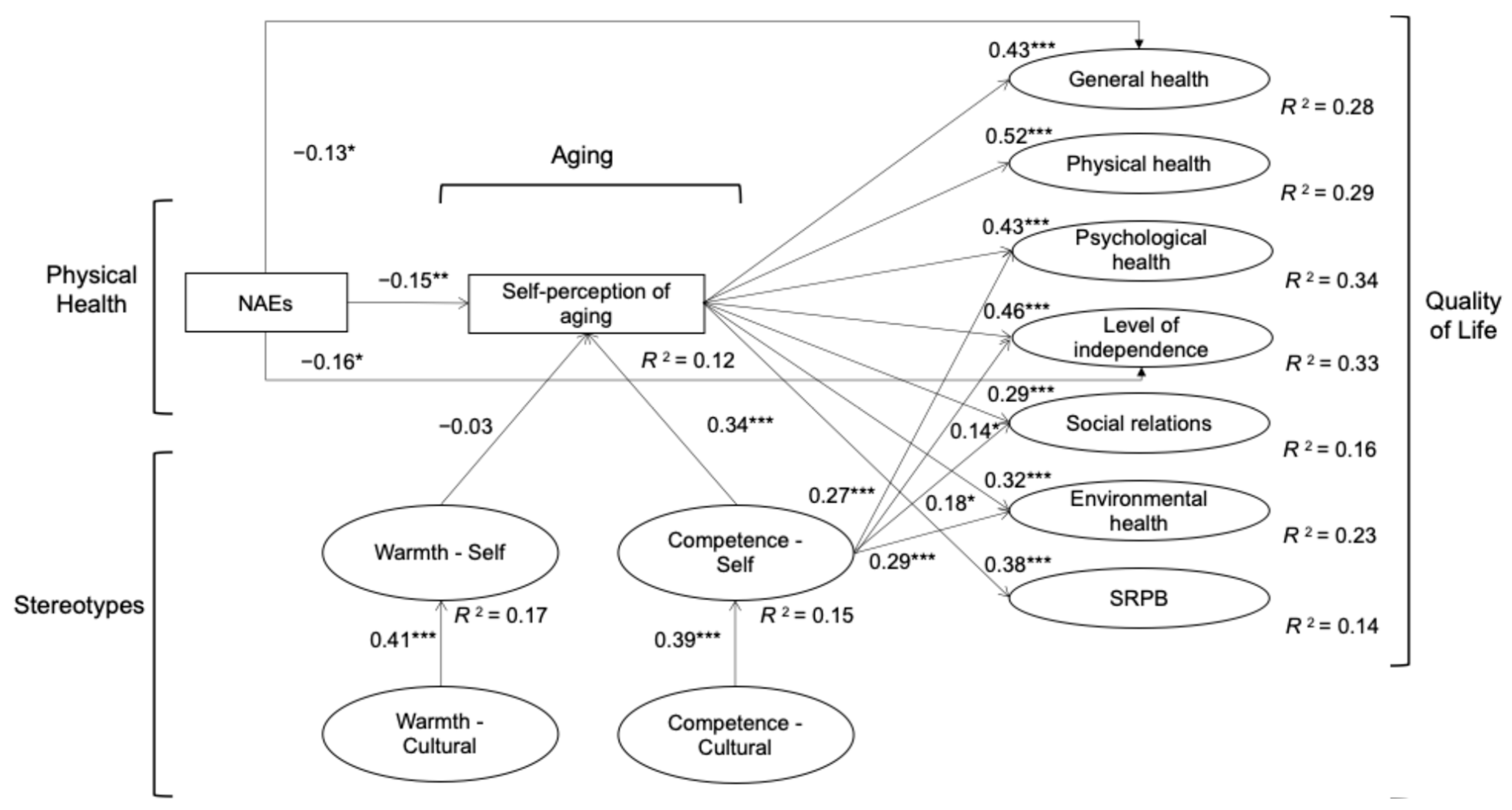
- The internalization of cultural stereotypes about older adults’ competence is shown to have a significant effect in ameliorating the negative effect of comorbidities.
- Chronological age of the sample was not related to any of the stereotypical measures, self-perception of aging, or the health events assessed retrospectively over the previous two years.
- These findings suggest important new avenues for interventions aimed at improving the quality of life of people living with HIV, in addition to treating comorbidities, by addressing a positive internalization of cultural stereotypes.
- A better knowledge of stereotype internalization could help design interventions aimed at both patients and their caregivers that improve the perception of aging and reduce the harmful effects of stereotypes associated with their condition as older PLHIV.
Abstract
1. Introduction
The Present Research
2. Materials and Methods
2.1. Study Design and Participants
2.2. Measures
2.2.1. Validated Self-Reported Measures
2.2.2. Clinical Health Data
2.3. Data Analysis
3. Results
3.1. Participants’ Characteristics
3.2. Descriptive Analyses and Bivariate Associations
3.3. Model Testing
3.3.1. Measurement Models
3.3.2. Structural Model
4. Discussion
Limitations
5. Conclusions
Author Contributions
Funding
Institutional Review Board Statement
Informed Consent Statement
Data Availability Statement
Acknowledgments
Conflicts of Interest
Abbreviations
| AIDS | Acquired Immune Deficiency Syndrome |
| ART | Antiretroviral Therapy |
| AVE | Average Variance Extracted |
| HIV | Human Immunodeficiency Virus |
| HRQoL | Health-Related Quality of Life |
| NAEs | Number of Non-AIDS Health Events 2 Years Before |
| PLHIV | People Living with HIV |
| SRPB | Spirituality, Religion, and Personal Beliefs |
| VIF | Variance Inflation Factors |
References
- Joint United Nations Programme on HIV/AIDS (UNAIDS). UNAIDS Data. 2024. Available online: https://www.unaids.org/en/resources/fact-sheet (accessed on 22 May 2026).
- División de Control de VIH, ITS, Hepatitis Virales y Tuberculosis (DCVIHT). Plan de Prevención y Control de la Infección por el VIH y las ITS 2021-2030 en España [2021–2030 Plan for the Prevention and Control of HIV and STI Infections in Spain]; Madrid. 2021. Available online: https://www.sanidad.gob.es/areas/DCVIHT/vihSida/planEstrategico/vigente/docs/Plan_de_Prevencion_y_Control1.pdf (accessed on 15 June 2026).
- Ministerio de Sanidad. Centro Nacional de Epidemiología [Spanish Ministry of Health. National Center for Epidemiology]. Vigilancia Epidemiológica del VIH y Sida en España 2024 [Epidemiological Surveillance of HIV and AIDS in Spain 2024]; Spanish Ministry of Health: Madrid, Spain, 2025. Available online: https://cne.isciii.es/documents/d/cne/informe-vih_sida_2024_nov-2025 (accessed on 15 June 2026).
- Guaraldi, G.; Milic, J.; Wu, A.W. What Is the Measure of Success in HIV? The Fourth 90: Quality of Life or Healthy Aging? Eur. Geriatr. Med. 2019, 10, 267–274. [Google Scholar] [CrossRef] [PubMed]
- Berenguer, J.; Álvarez, D.; Dodero, J.; Azcoaga, A. Modelo de Seguimiento, Organización y Gestión de La Infección Por VIH. Enferm. Infecc. Microbiol. Clin. 2018, 36, 45–49. [Google Scholar] [CrossRef]
- Smit, M.; Brinkman, K.; Geerlings, S.; Smit, C.; Thyagarajan, K.; van Sighem, A.V.; de Wolf, F.; Hallett, T.B. Future Challenges for Clinical Care of an Ageing Population Infected with HIV: A Modelling Study. Lancet Infect. Dis. 2015, 15, 810–818. [Google Scholar] [CrossRef] [PubMed]
- Joint United Nations Programme on HIV/AIDS (UNAIDS). HIV and Aging: A Special Supplement to the UNAIDS Report on the Global AIDS Epidemic; UNAIDS: Geneva, Switzerland, 2013; Available online: https://www.unaids.org/sites/default/files/media_asset/20131101_JC2563_hiv-and-aging_en_0.pdf (accessed on 15 June 2026).
- Lazarus, J.V.; Safreed-Harmon, K.; Barton, S.E.; Costagliola, D.; Dedes, N.; del Amo Valero, J.; Gatell, J.M.; Baptista-Leite, R.; Mendão, L.; Porter, K.; et al. Beyond Viral Suppression of HIV—The New Quality of Life Frontier. BMC Med. 2016, 14, 94. [Google Scholar] [CrossRef] [PubMed]
- Lazarus, J.V.; Safreed-Harmon, K.; Kamarulzaman, A.; Anderson, J.; Leite, R.B.; Behrens, G.; Bekker, L.G.; Bhagani, S.; Brown, D.; Brown, G.; et al. Consensus Statement on the Role of Health Systems in Advancing the Long-Term Well-Being of People Living with HIV. Nat. Commun. 2021, 12, 4450. [Google Scholar] [CrossRef] [PubMed]
- de Boer-van der Kolk, I.M.; Sprangers, M.A.G.; Prins, J.M.; Smit, C.; de Wolf, F.; Nieuwkerk, P.T. Health-related Quality of Life and Survival among HIV-infected Patients Receiving Highly Active Antiretroviral Therapy: A Study of Patients in the AIDS Therapy Evaluation in the Netherlands (ATHENA) Cohort. Clin. Infect. Dis. 2010, 50, 255–263. [Google Scholar] [CrossRef] [PubMed]
- Emuren, L.; Welles, S.; Polansky, M.; Evans, A.A.; Macalino, G.; Agan, B.K. Lower Health-Related Quality of Life Predicts All-Cause Hospitalization among HIV-Infected Individuals. Health Qual. Life Outcomes 2018, 16, 107. [Google Scholar] [CrossRef] [PubMed]
- Safreed-Harmon, K.; Fuster-RuizdeApodaca, M.J.; Pastor de la Cal, M.; Lazarus, J.V. Problems Undermining the Health-Related Quality of Life of People Living with HIV in Spain: A Qualitative Study to Inform the Development of a Novel Clinic Screening Tool. Health Qual. Life Outcomes 2022, 20, 84. [Google Scholar] [CrossRef] [PubMed]
- Cardoso, S.W.; Torres, T.S.; Santini-Oliveira, M.; Marins, L.M.S.; Veloso, V.G.; Grinsztejn, B. Aging with HIV: A Practical Review. Braz. J. Infect. Dis. 2013, 17, 464–479. [Google Scholar] [CrossRef] [PubMed]
- Brañas, F.; Torralba, M.; Antela, A.; Vergas, J.; Ramírez, M.; Ryan, P.; Dronda, F.; Galindo, M.J.; Machuca, I.; Bustinduy, M.J.; et al. Effects of Frailty, Geriatric Syndromes, and Comorbidity on Mortality and Quality of Life in Older Adults with HIV. BMC Geriatr. 2023, 23, 4. [Google Scholar] [CrossRef] [PubMed]
- Mayer, K.H.; Casau, N.C. Perspective on HIV Infection and Aging: Emerging Research on the Horizon. Clin. Infect. Dis. 2005, 41, 855–863. [Google Scholar] [CrossRef] [PubMed]
- Calcagno, A.; Nozza, S.; Muss, C.; Celesia, B.M.; Carli, F.; Piconi, S.; De Socio, G.V.; Cattelan, A.M.; Orofino, G.; Ripamonti, D.; et al. Ageing with HIV: A Multidisciplinary Review. Infection 2015, 43, 509–522. [Google Scholar] [CrossRef] [PubMed]
- Hsieh, E.; Polo, R.; Qian, H.Z.; Fuster-RuizdeApodaca, M.J.; del Amo, J. Intersectionality of Stigmas and Health-Related Quality of Life in People Ageing with HIV in China, Europe, and Latin America. Lancet Healthy Longev. 2022, 3, e206–e215. [Google Scholar] [CrossRef] [PubMed]
- Emlet, C.A. Experiences of Stigma in Older Adults Living with HIV/AIDS: A Mixed-Methods Analysis. AIDS Patient Care STDS 2007, 21, 740–752. [Google Scholar] [CrossRef] [PubMed]
- Emlet, C.A.; Brennan-Ing, M. Is There No Place for Us? The Psychosocial Challenges and Rewards of Aging with HIV. J. Elder Policy 2020, 1, 69–95. [Google Scholar] [CrossRef]
- Rubtsova, A.A.; Kempf, M.-C.; Taylor, T.N.; Konkle-Parker, D.; Wingood, G.M.; Holstad, M.M. Healthy Aging in Older Women Living with HIV Infection: A Systematic Review of Psychosocial Factors. Curr. HIV/AIDS Rep. 2017, 14, 17–30. [Google Scholar] [CrossRef] [PubMed]
- Levy, B.R.; Bavishi, A. Survival Advantage Mechanism: Inflammation as a Mediator of Positive Self-Perceptions of Aging on Longevity. J. Gerontol. B Psychol. Sci. Soc. Sci. 2018, 73, 409–412. [Google Scholar] [CrossRef] [PubMed]
- Fiske, S.T.; Cuddy, A.J.; Glick, P.; Xu, J. A Model of (Often Mixed) Stereotype Content: Competence and Warmth Respectively Follow from Perceived Status and Competition. J. Pers. Soc. Psychol. 2002, 82, 878–902. [Google Scholar] [CrossRef]
- Cuddy, A.J.C.; Fiske, S.T. Doddering but Dear: Process, Content, and Function in Stereotyping of Elderly People. In Ageism: Stereotyping and Prejudice Against Older Persons; Nelson, T., Ed.; MIT Press: Cambridge, MA, USA, 2002; pp. 3–26. [Google Scholar]
- Levy, B.R.; Slade, M.D.; Kunkel, S.R.; Kasl, S.V. Longevity Increased by Positive Self-Perceptions of Aging. J. Pers. Soc. Psychol. 2002, 83, 261–270. [Google Scholar] [CrossRef] [PubMed]
- Levy, B.R. Stereotype Embodiment Theory. In Encyclopedia of Gerontology and Population Aging; Springer International Publishing: Cham, Switzerland, 2021; pp. 4763–4767. [Google Scholar]
- Wurm, S.; Diehl, M.; Kornadt, A.E.; Westerhof, G.J.; Wahl, H.-W. How Do Views on Aging Affect Health Outcomes in Adulthood and Late Life? Explanations for an Established Connection. Dev. Rev. 2017, 46, 27–43. [Google Scholar] [CrossRef] [PubMed]
- Devine, P.G. Stereotypes and Prejudice: Their Automatic and Controlled Components. J. Pers. Soc. Psychol. 1989, 56, 5–18. [Google Scholar] [CrossRef]
- Fernández-Ballesteros, R.; Caprara, M.; Schettini, R.; Bustillos, A.; Mendoza-Nunez, V.; Orosa, T.; Kornfeld, R.; Rojas, M.; López, M.D.; Santacreu, L.M.; et al. Effects of University Programs for Older Adults: Changes in Cultural and Group Stereotype, Self-Perception of Aging, and Emotional Balance. Educ. Gerontol. 2013, 39, 119–131. [Google Scholar] [CrossRef]
- Fuster-RuizdeApodaca, M.J.; Laguía, A.; Safreed-Harmon, K.; Lazarus, J.V.; Cenoz, S.; Del Amo, J. Assessing Quality of Life in People with HIV in Spain: Psychometric Testing of the Spanish Version of WHOQOL-HIV-BREF. Health Qual. Life Outcomes 2019, 17, 144. [Google Scholar] [CrossRef] [PubMed]
- O’Connell, K.A.; Skevington, S.M. An International Quality of Life Instrument to Assess Wellbeing in Adults Who Are HIV-Positive: A Short Form of the WHOQOL-HIV (31 Items). AIDS Behav. 2012, 16, 452–460. [Google Scholar] [CrossRef] [PubMed]
- Fernandez-Ballesteros, R.; Olmos, R.; Santacreu, M.; Bustillos, A.; Molina, M.A. The Role of Perceived Discrimination on Active Aging. Arch. Gerontol. Geriatr. 2017, 71, 14–20. [Google Scholar] [CrossRef] [PubMed]
- Hair, J.F.; Hult, G.T.M.; Ringle, C.M.; Sarstedt, M. A Primer on Partial Least Squares Structural Equation Modeling (PLS-SEM), 2nd ed.; SAGE: Los Angeles, CA, USA, 2017. [Google Scholar]
- Faul, F.; Erdfelder, E.; Buchner, A.; Lang, A.-G. Statistical Power Analyses Using G*Power 3.1: Tests for Correlation and Regression Analyses. Behav. Res. Methods 2009, 41, 1149–1160. [Google Scholar] [CrossRef] [PubMed]
- IBM Corp. IBM SPSS Statistics; Version 27.0; IBM Corp.: Armonk, NY, USA, 2020. [Google Scholar]
- Ringle, C.M.; Wende, S.; Will, S. SmartPLS 3; SmartPLS GmbH: Bönningstedt, Germany, 2015; Available online: https://smartpls.com (accessed on 15 June 2026).
- Bustillos, A.; Fernández Ballesteros, R. Attributions of Competence Mediate the Behaviors of Caregivers and Older Adults. GeroPsych 2013, 26, 211–217. [Google Scholar] [CrossRef]
- Fernandez-Ballesteros, R.; Bustillos, A.; Schettini, R.; Diaz-Veiga, P.; Huici, C.; Santacreu, M. Is Older Adult Care Mediated by Caregivers’ Cultural Stereotypes? The Role of Competence and Warmth Attribution. Clin. Interv. Aging 2016, 11, 545–552. [Google Scholar] [CrossRef] [PubMed]
- van der Heijden, I.; Abrahams, N.; Sinclair, D. Psychosocial Group Interventions to Improve Psychological Well-Being in Adults Living with HIV. Cochrane Database Syst. Rev. 2017, 2017, CD010806. [Google Scholar] [CrossRef] [PubMed]
- Low, G.; Molzahn, A.E.; Schopflocher, D. Attitudes to Aging Mediate the Relationship between Older Peoples’ Subjective Health and Quality of Life in 20 Countries. Health Qual. Life Outcomes 2013, 11, 146. [Google Scholar] [CrossRef] [PubMed]
- Velaithan, V.; Tan, M.-M.; Yu, T.-F.; Liem, A.; Teh, P.-L.; Su, T.T. The Association of Self-Perception of Aging and Quality of Life in Older Adults: A Systematic Review. Gerontologist 2024, 64, gnad041. [Google Scholar] [CrossRef] [PubMed]
- Wurm, S.; Benyamini, Y. Optimism Buffers the Detrimental Effect of Negative Self-Perceptions of Ageing on Physical and Mental Health. Psychol. Health 2014, 29, 832–848. [Google Scholar] [CrossRef] [PubMed]
- AIDS United. HIV & Aging: Older Adults Living and Thriving with HIV; AIDS United: Washington, DC, USA, 2020; Available online: https://aidsunited.org/hiv-aging-older-adults-living-and-thriving-with-hiv/ (accessed on 15 June 2026).
- ONUSIDA. Reducir el Estigma y la Discriminación por el VIH: Una Herramienta Práctica para la Acción; ONUSIDA: Geneva, Switzerland, 2009. [Google Scholar]
- Joint United Nations Programme on HIV/AIDS (UNAIDS). Practical Guide to Ending HIV-Related Stigma and Discrimination: Best Practices and Innovative Approaches to Reduce Stigma and Discrimination at the Country Level. 2023. Available online: https://www.unaids.org/sites/default/files/media_asset/GlobalPartnershipStigmaDiscrimination_PracticalGuide_en.pdf (accessed on 15 June 2026).
- Centers for Disease Control (CDC). AIDS among Persons Aged Greater than or Equal to 50 Years—United States, 1991–1996. JAMA 1998, 47, 21–27. [Google Scholar]
- Caro-Murillo, A.M.; Castilla, J.; Pérez-Hoyos, S.; Miró, J.M.; Podzamczer, D.; Rubio, R.; Riera, M.; Viciana, P.; López Aldeguer, J.; Iribarren, J.A.; et al. Cohorte RIS de Pacientes Con Infección Por VIH Sin Tratamiento Antirretroviral Previo (CoRIS): Metodología y Primeros Resultados. Enferm. Infecc. Microbiol. Clin. 2007, 25, 23–31. [Google Scholar] [CrossRef] [PubMed]
- Ministerio de Sanidad [Spanish Ministry of Health]. Spain almost Halves Rate of Undiagnosed HIV Infections. 2023. Available online: https://www.lamoncloa.gob.es/lang/en/gobierno/news/paginas/2023/20230526_hiv-infections.aspx (accessed on 15 June 2026).
- Asociación Médica Mundial (AMM). Declaración de Helsinki de la AMM—Principios Éticos para las Investigaciones Médicas en Seres Humanos. Available online: https://pubmed.ncbi.nlm.nih.gov/25951678/ (accessed on 15 June 2026).



| Sociodemographic and Clinical Variables | % (n) | |
|---|---|---|
| Gender | Male | 77.9 (222) |
| Female | 21.4 (61) | |
| Transgender | 0.7 (2) | |
| Education level | No studies | 7.0 (20) |
| Elementary School | 39.3 (112) | |
| High School | 28.8 (82) | |
| University degree | 24.6 (70) | |
| Other | 0.3 (1) | |
| Work situation | Employee | 51.2 (146) |
| Unemployed | 25.6 (73) | |
| Retired | 9.1 (26) | |
| Impaired | 13.0 (37) | |
| Not answer | 1.1 (3) | |
| Socioeconomic status | Low | 17.2 (49) |
| Medium-Low | 46.6 (133) | |
| Medium-High | 34.0 (97) | |
| High | 2.1 (6) | |
| Marital status | Married or living together | 41.1 (117) |
| Divorced or separated | 17.5 (50) | |
| Single | 35.4 (101) | |
| Widowed | 5.6 (16) | |
| Not answer | 0.4 (1) | |
| Ethnic group | Caucasian/European | 81.7 (233) |
| Hispanic/Latin American | 16.5 (47) | |
| Asian | 0.4 (1) | |
| African | 0.7 (2) | |
| Other/Not answer | 0.7 (2) | |
| Sexual behavior | Heterosexual | 49.5 (141) |
| Homosexual | 35.4 (101) | |
| Bisexual | 10.5 (30) | |
| No answer | 4.6 (13) | |
| Health status | Very bad | 0.7 (2) |
| Bad | 3.5 (10) | |
| Neither bad nor good | 21.1 (60) | |
| Good | 58.6 (167) | |
| Very good | 16.1 (46) | |
| Currently sick | Yes | 17.9 (51) |
| No | 75.8 (216) | |
| No answer | 6.3 (18) | |
| Age, years, mean (M ± SD) | 57.4 ± 7.1 [49–83 years old] | |
| Duration of infection, years, mean (M ± SD) | 8.86 ± 5.7 [Min = 1; Max = 35] | |
| Years taking antiretroviral therapy (M ± SD) | 7.2 ± 3.8 [Min = 1; Max = 26] | |
| Undetectable plasma viral load | 95.8 (273) |
| M | SD | 1 | 2 | 3 | 4 | 5 | 6 | 7 | 8 | 9 | 10 | 11 | 12 | 13 | |
|---|---|---|---|---|---|---|---|---|---|---|---|---|---|---|---|
| 1. Competence—Cultural stereotype | 5.07 | 1.04 | 1 | ||||||||||||
| 2. Warmth—Cultural stereotype | 5.18 | 1.11 | 0.59 *** | 1 | |||||||||||
| 3. Competence—Self-stereotype | 5.57 | 0.92 | 0.38 *** | 0.37 *** | 1 | ||||||||||
| 4. Warmth—Self-stereotype | 6.11 | 0.79 | 0.37 *** | 0.40 *** | 0.60 *** | 1 | |||||||||
| 5. Self-perception of aging | 0.67 | 0.37 | 0.20 *** | 0.10 | 0.33 *** | 0.18 ** | 1 | ||||||||
| 6. WHOQOL—General health | 14.82 | 3.29 | 0.10 | 0.13 * | 0.28 *** | 0.20 *** | 0.50 *** | 1 | |||||||
| 7. WHOQOL—Physical health | 15.84 | 3.13 | 0.15 * | 0.14 * | 0.22 *** | 0.15 ** | 0.49 *** | 0.52 *** | 1 | ||||||
| 8. WHOQOL—Psychological health | 15.13 | 2.82 | 0.12 * | 0.11 | 0.41 *** | 0.24 *** | 0.52 *** | 0.65 *** | 0.53 *** | 1 | |||||
| 9. WHOQOL—Level of independence | 15.51 | 3.12 | 0.13 * | 0.17 ** | 0.36 *** | 0.26 *** | 0.50 *** | 0.55 *** | 0.65 *** | 0.57 *** | 1 | ||||
| 10. WHOQOL—Social relations | 14.28 | 3.46 | 0.08 | 0.07 | 0.25 *** | 0.15 ** | 0.36 *** | 0.52 *** | 0.39 *** | 0.67 *** | 0.38 *** | 1 | |||
| 11. WHOQOL—Environmental health | 15.84 | 2.24 | 0.10 | 0.16 ** | 0.34 *** | 0.21 *** | 0.38 *** | 0.59 *** | 0.47 *** | 0.60 *** | 0.49 *** | 0.65 *** | 1 | ||
| 12. WHOQOL—SRPB | 14.40 | 3.92 | 0 0.15 * | −0.00 | 0.18 ** | 0.06 | 0.43 *** | 0.33 *** | 0.34 *** | 0.52 *** | 0.22 *** | 0.50 *** | 0.33 *** | 1 | |
| 13. Non-AIDS clinical events (NAEs) | 0.29 | 0.60 | −0.01 | −0.12 * | −0.06 | −0.06 | −0.17 ** | −0.21 *** | −0.13 * | −0.12 * | −0.18 ** | −0.12 | −0.16 ** | −0.02 | 1 |
| 14. Age | 57.38 | 7.15 | 0.04 | 0.08 | 0.03 | −0.01 | −0.06 | −0.01 | 0.02 | −0.01 | −0.15 * | −0.06 | 0.05 | 0.15 * | 0.10 |
| Latent Variable | Item | λ | rc | a | AVE |
|---|---|---|---|---|---|
| NAEs | Number of non-AIDS clinical events 2 years before | 1.00 | 1.00 | 1.00 | 1.00 |
| Self-perception of aging | 1.00 | 1.00 | 1.00 | 1.00 | |
| Competence—self | 0.86 | 0.79 | 0.55 | ||
| Competence | 0.75 | ||||
| Self-confidence | 0.84 | ||||
| Independence | 0.66 | ||||
| Competitive | 0.72 | ||||
| Intelligent | 0.72 | ||||
| Competence—cultural | 0.87 | 0.82 | 0.58 | ||
| Competence | 0.77 | ||||
| Self-confidence | 0.81 | ||||
| Independence | 0.67 | ||||
| Competitive | 0.77 | ||||
| Intelligent | 0.78 | ||||
| Warmth—self | 0.85 | 0.76 | 0.58 | ||
| Tolerant | 0.71 | ||||
| Warmth | 0.86 | ||||
| With good intentions | 0.81 | ||||
| Sincere | 0.66 | ||||
| Warmth—cultural | 0.90 | 0.84 | 0.68 | ||
| Tolerant | 0.81 | ||||
| Warmth | 0.85 | ||||
| With good intentions | 0.85 | ||||
| Sincere | 0.80 | ||||
| WHOQOL—General health | 0.90 | 0.77 | 0.81 | ||
| QOL | 0.88 | ||||
| Satisfaction | 0.92 | ||||
| WHOQOL—Physical health | 0.81 | 0.65 | 0.59 | ||
| Pain and discomfort | 0.68 | ||||
| Energy and fatigue | 0.85 | ||||
| Sleep and rest | 0.76 | ||||
| WHOQOL—Psychological health | 0.87 | 0.82 | 0.54 | ||
| Positive feelings | 0.80 | ||||
| Concentration ability | 0.60 | ||||
| Bodily image self-acceptance | 0.64 | ||||
| Self-satisfaction | 0.83 | ||||
| Negative feelings | 0.68 | ||||
| Religion, spirituality and personal beliefs (personal life meaning) | 0.82 | ||||
| WHOQOL—Level of independence | 0.86 | 0.76 | 0.68 | ||
| Mobility | 0.60 | ||||
| Activities of daily living | 0.91 | ||||
| Work capacity | 0.93 | ||||
| WHOQOL—Social relations | 0.88 | 0.82 | 0.65 | ||
| Social inclusion | 0.77 | ||||
| Personal relationships | 0.87 | ||||
| Sexual satisfaction | 0.76 | ||||
| Social support | 0.81 | ||||
| WHOQOL—Environmental health | 0.83 | 0.76 | 0.46 | ||
| Physical safety and security | 0.76 | ||||
| Physical environment | 0.63 | ||||
| Financial resources | 0.65 | ||||
| Information for daily living | 0.62 | ||||
| Participation in leisure activities | 0.74 | ||||
| Home environment | 0.63 | ||||
| WHOQOL—Spirituality, religion and personal beliefs | 0.79 | 0.61 | 0.56 | ||
| Forgiveness and blame | 0.62 | ||||
| Concerns about the future | 0.90 | ||||
| Death and dying | 0.71 |
| Confidence Interval | ||||
|---|---|---|---|---|
| Mediation Path | Original Sample (b) | p-Value | LLCI (Lower Limit) | ULCI (Upper Limit) |
| NAEs → Self-perception of aging → General health | −0.065 | 0.008 | −0.113 | −0.023 |
| NAEs → Self-perception of aging → Physical health | −0.078 | 0.008 | −0.131 | −0.026 |
| NAEs → Self-perception of aging → Psychological health | −0.065 | 0.009 | −0.114 | −0.022 |
| NAEs → Self-perception of aging → Level of independence | −0.068 | 0.007 | −0.117 | −0.024 |
| NAEs → Self-perception of aging → Social relations | −0.044 | 0.014 | −0.082 | −0.016 |
| NAEs → Self-perception of aging → Environmental health | −0.049 | 0.012 | −0.087 | −0.017 |
| NAEs → Self-perception of aging → SRPB | −0.058 | 0.016 | −0.106 | −0.018 |
| Competence—Cultural → Competence—Self → Psychological health | 0.106 | 0.002 | 0.053 | 0.171 |
| Competence—Cultural → Competence—Self → Level of independence | 0.055 | 0.042 | 0.009 | 0.114 |
| Competence—Cultural → Competence—Self → Social relations | 0.071 | 0.019 | 0.017 | 0.128 |
| Competence—Cultural → Competence—Self → Environmental health | 0.113 | 0.001 | 0.061 | 0.175 |
| Competence—Cultural → Competence—Self → Self-perception of aging | 0.133 | 0.000 | 0.076 | 0.203 |
| Competence—Cultural → Competence—Self → Self-perception of aging → General health | 0.058 | 0.001 | 0.032 | 0.093 |
| Competence—Cultural → Competence—Self → Self-perception of aging → Physical health | 0.069 | 0.001 | 0.039 | 0.109 |
| Competence—Cultural → Competence—Self → Self-perception of aging → Psychological health | 0.058 | 0.001 | 0.032 | 0.092 |
| Competence—Cultural → Competence—Self → Self-perception of aging → Level of independence | 0.061 | 0.001 | 0.035 | 0.095 |
| Competence—Cultural → Competence—Self → Self-perception of aging → Social relations | 0.039 | 0.004 | 0.020 | 0.069 |
| Competence—Cultural → Competence—Self → Self-perception of aging → Environmental health | 0.043 | 0.002 | 0.023 | 0.073 |
| Competence—Cultural → Competence—Self → Self-perception of aging → SRPB | 0.051 | 0.002 | 0.027 | 0.084 |
| Competence—Self → Self-perception of aging → General health | 0.146 | 0.000 | 0.094 | 0.210 |
| Competence—Self → Self-perception of aging → Physical health | 0.175 | 0.000 | 0.113 | 0.243 |
| Competence—Self → Self-perception of aging → Psychological health | 0.146 | 0.000 | 0.093 | 0.207 |
| Competence—Self → Self-perception of aging → Level of independence | 0.154 | 0.000 | 0.101 | 0.217 |
| Competence—Self → Self-perception of aging → Social relations | 0.099 | 0.000 | 0.058 | 0.155 |
| Competence—Self → Self-perception of aging → Environmental health | 0.109 | 0.000 | 0.066 | 0.164 |
| Competence—Self → Self-perception of aging → SRPB | 0.130 | 0.000 | 0.077 | 0.192 |
Disclaimer/Publisher’s Note: The statements, opinions and data contained in all publications are solely those of the individual author(s) and contributor(s) and not of MDPI and/or the editor(s). MDPI and/or the editor(s) disclaim responsibility for any injury to people or property resulting from any ideas, methods, instructions or products referred to in the content. |
© 2026 by the authors. Licensee MDPI, Basel, Switzerland. This article is an open access article distributed under the terms and conditions of the Creative Commons Attribution (CC BY) license.
Share and Cite
Laguía, A.; Bustillos, A.; Moreno, C.; Jarrín, I.; Fuster-RuizdeApodaca, M.J. Positive Self-Perception of Aging and Quality of Life in People Living with HIV: The Role of Cultural Stereotype Internalization. Healthcare 2026, 14, 2011. https://doi.org/10.3390/healthcare14132011
Laguía A, Bustillos A, Moreno C, Jarrín I, Fuster-RuizdeApodaca MJ. Positive Self-Perception of Aging and Quality of Life in People Living with HIV: The Role of Cultural Stereotype Internalization. Healthcare. 2026; 14(13):2011. https://doi.org/10.3390/healthcare14132011
Chicago/Turabian StyleLaguía, Ana, Antonio Bustillos, Cristina Moreno, Inmaculada Jarrín, and María José Fuster-RuizdeApodaca. 2026. "Positive Self-Perception of Aging and Quality of Life in People Living with HIV: The Role of Cultural Stereotype Internalization" Healthcare 14, no. 13: 2011. https://doi.org/10.3390/healthcare14132011
APA StyleLaguía, A., Bustillos, A., Moreno, C., Jarrín, I., & Fuster-RuizdeApodaca, M. J. (2026). Positive Self-Perception of Aging and Quality of Life in People Living with HIV: The Role of Cultural Stereotype Internalization. Healthcare, 14(13), 2011. https://doi.org/10.3390/healthcare14132011