Accessibility Recommendations of Interfaces Designed for Individuals with Mental and Physical Disabilities: A Systematic Review


Highlights
- Many healthcare interfaces lack proper compliance with accessibility standards (e.g., WCAG), limiting usability for individuals with disabilities.
- There is a clear digital divide, with individuals with disabilities using eHealth services less and facing more challenges.
- Effective accessibility depends on user-centered design, including intuitive navigation, personalization, and integration of assistive technologies.
- Developers must treat accessibility as a core design requirement, integrating adaptive and inclusive features from the start.
- Policymakers should enforce stronger regulations and standardization to ensure equitable access across healthcare platforms.
- Future research should focus on evaluating real-world usability and advancing AI-driven accessibility solutions.
Abstract
1. Introduction
2. Methodology
2.1. Research Questions
- What are the current interface design recommendations for people with disabilities?
- 2.
- What are the current healthcare portals and mobile apps design recommendations for people with disabilities?
2.2. Search Strategy
2.3. Articles Inclusion and Exclusion Criteria
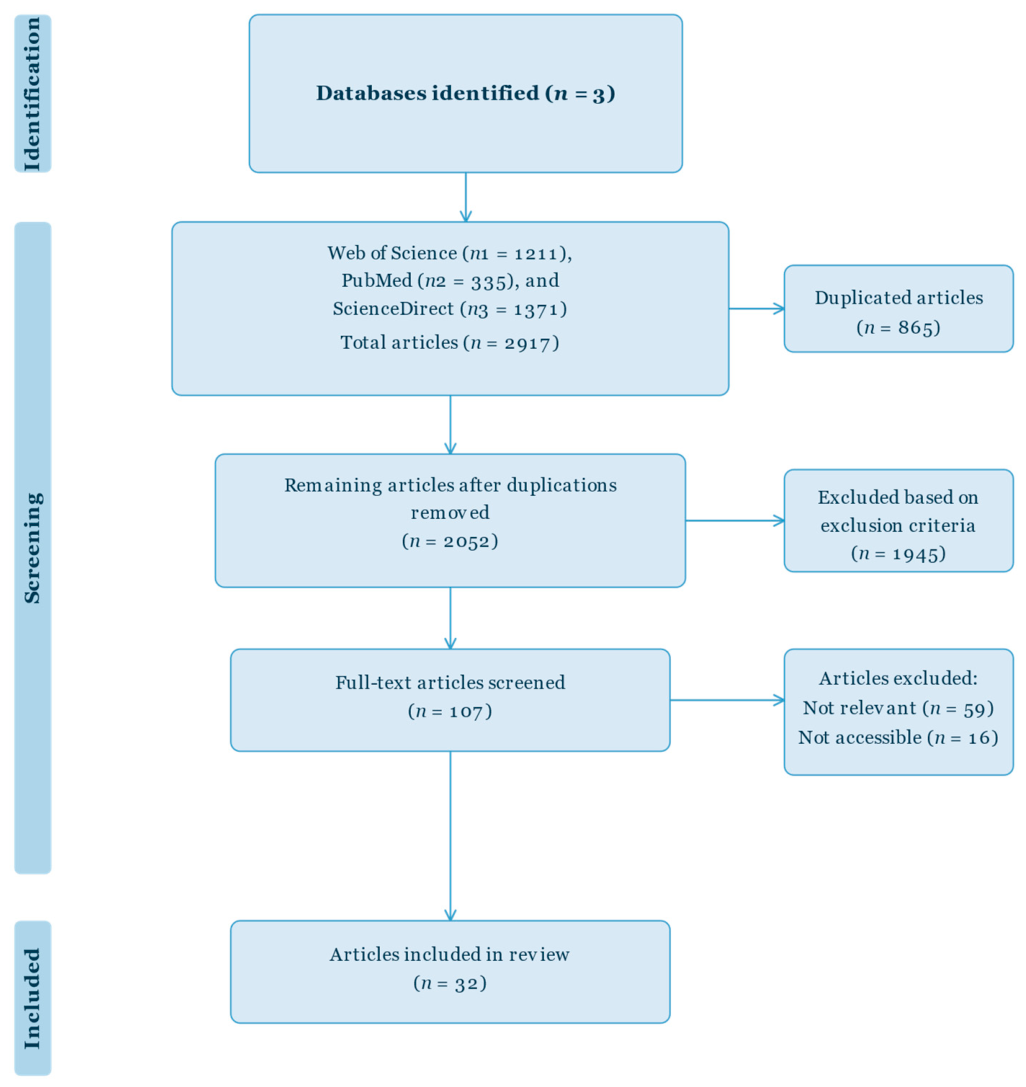
2.4. Screening Articles
2.5. Data Analysis and Theme Development
2.6. Quality Assessment and Risk of Bias
3. Results and Discussion
3.1. Accessibility Features
3.2. User Experience
3.3. Design Principles
3.4. Technical Recommendations
3.5. User Feedback and Participation
4. Implications
5. Emerging Trends and Recommendations for Future Interface Design
6. Limitations
7. Conclusions
8. Disclosure Statement
Author Contributions
Funding
Institutional Review Board Statement
Informed Consent Statement
Data Availability Statement
Conflicts of Interest
Appendix A. Full Database Search Strategies
Appendix A.1. PubMed
- English language
- Journal articles
- Publication date from 1 January 2014 to 31 December 2024
Appendix A.2. Web of Science
- English language
- Article document type
- Publication years 2014–2024
Appendix A.3. ScienceDirect
- Research articles
- English language
- Publication years 2014–2024
References
- Centers for Disease Control and Prevention. Disability Impacts All of us Infographic; Centers for Disease Control and Prevention: Atlanta, GA, USA, 2025. Available online: https://www.cdc.gov/disability-and-health/articles-documents/disability-impacts-all-of-us-infographic.html (accessed on 16 June 2026).
- World Health Organization. Disability; World Health Organization: Geneva, Switzerland, 2023; Available online: https://www.who.int/news-room/fact-sheets/detail/disability-and-health (accessed on 16 June 2026).
- Dobransky, K.; Hargittai, E. The disability divide in internet access and use. Inf. Commun. Soc. 2006, 9, 313–334. [Google Scholar] [CrossRef]
- Pettersson, L.; Johansson, S.; Demmelmaier, I.; Gustavsson, C. Disability digital divide: Survey of accessibility of eHealth services as perceived by people with and without impairment. BMC Public Health 2023, 23, 181. [Google Scholar] [CrossRef] [PubMed]
- Fortune, J.; Manikandan, M.; Harrington, S.; Hensey, O.; Kerr, C.; Koppe, S.; Kroll, T.; Lavelle, G.; Long, S.; MacLachlan, M.; et al. Understanding the use of digital technologies to provide disability services remotely during the COVID-19 pandemic; a multiple case study design. BMC Health Serv. Res. 2024, 24, 323. [Google Scholar] [CrossRef] [PubMed]
- U.S. Department of Health and Human Services. Your Rights Under Section 504 of the Rehabilitation Act; U.S. Department of Health and Human Services: Washington, DC, USA, 2006. Available online: https://www.hhs.gov/sites/default/files/ocr/civilrights/resources/factsheets/504.pdf (accessed on 16 June 2026).
- Lyles, C.R.; Fruchterman, J.; Youdelman, M.; Schillinger, D. Legal, practical, and ethical considerations for making online patient portals accessible for all. Am. J. Public Health 2017, 107, 1608–1611. Available online: https://www.ncbi.nlm.nih.gov/pmc/articles/PMC5607665/#bib27 (accessed on 16 June 2026). [CrossRef] [PubMed]
- Ara, J.; Sik-Lanyi, C.; Kelemen, A. Accessibility Engineering in web evaluation process: A systematic literature review. Univers. Access Inf. Soc. 2023, 23, 653–686. [Google Scholar] [CrossRef] [PubMed]
- Lazar, J.; Olalere, A.; Wentz, B. Investigating the accessibility and usability of Job Application Web sites for blind users. J. Usability Stud. 2012, 7, 68–87. Available online: https://uxpajournal.org/investigating-the-accessibility-and-usability-of-job-application-web-sites-for-blind-users/ (accessed on 16 June 2026).
- Gilbert, R.M. Inclusive Design for a Digital World: Designing with Accessibility in Mind; Apress: Berkeley, CA, USA, 2019. [Google Scholar]
- Van Cleave, J.; Stille, C.; Hall, D.E. Child health, vulnerability, and complexity: Use of telehealth to enhance care for children and youth with special health care needs. Acad. Pediatr. 2022, 22, S34–S40. [Google Scholar] [CrossRef] [PubMed]
- Garling, K.A.; Stewart, M.P. A new framework for elevating and updating clinical language: Raised patient-centric communication. JAPhA Pract. Innov. 2024, 1, 100001. [Google Scholar] [CrossRef]
- Hemsley, B.; Rollo, M.; Georgiou, A.; Balandin, S.; Hill, S. The health literacy demands of Electronic Personal Health Records (e-phrs): An integrative review to inform Future Inclusive Research. Patient Educ. Couns. 2018, 101, 2–15. [Google Scholar] [CrossRef] [PubMed]
- Onyeaka, H.; Ajayi, K.V.; Muoghalu, C.; Eseaton, P.O.; Azuike, C.O.; Anugwom, G.; Oladunjoye, F.; Aneni, K.; Firth, J.; Torous, J. Access to online patient portals among individuals with depression and anxiety. Psychiatry Res. Commun. 2022, 2, 100073. [Google Scholar] [CrossRef]
- Ramos, G.; Ponting, C.; Labao, J.P.; Sobowale, K. Considerations of Diversity, equity, and inclusion in mental health apps: A scoping review of evaluation frameworks. Behav. Res. Ther. 2021, 147, 103990. [Google Scholar] [CrossRef] [PubMed]
- Senjam, S.S.; Primo, S.A. Challenges and enablers for smartphone use by persons with vision loss during the COVID-19 pandemic: A report of two case studies. Front. Public Health 2022, 10, 912460. [Google Scholar] [CrossRef] [PubMed]
- Buning, G.E.; James, T.G.; Richards, B.; McKee, M.M. Self-reported accommodation needs for patients with disabilities in primary care. Jt. Comm. J. Qual. Patient Saf. 2024, 50, 59–65. [Google Scholar] [CrossRef] [PubMed]
- Jo, G.; Habib, D.; Varadaraj, V.; Smith, J.; Epstein, S.; Zhu, J.; Yenokyan, G.; Ayers, K.; Swenor, B.K. Covid-19 vaccine website accessibility dashboard. Disabil. Health J. 2022, 15, 101325. [Google Scholar] [CrossRef] [PubMed]
- Berkowsky, R.W.; Czaja, S.J. Challenges associated with online health information seeking among older adults. In Aging, Technology and Health; Academic Press: Cambridge, MA, USA, 2018; pp. 31–48. [Google Scholar] [CrossRef]
- Van Holstein, E.; Wiesel, I.; Bigby, C.; Gleeson, B. People with intellectual disability and the digitization of services. Geoforum 2021, 119, 133–142. [Google Scholar] [CrossRef]
- Cosgrove, B.; Knafl, K.; Van Riper, M. A mixed methods analysis of care coordination needs and desirable features of an M-health application to support caregivers of children with down syndrome. J. Pediatr. Health Care 2023, 37, 30–39. [Google Scholar] [CrossRef] [PubMed]
- Zhou, L.; Saptono, A.; Setiawan, I.M.; Parmanto, B. Making self-management mobile health apps accessible to people with disabilities: Qualitative single-subject study. JMIR mHealth uHealth 2020, 8, e15060. [Google Scholar] [CrossRef] [PubMed]
- Jabour, A.M.; Alamoudi, A.S.; Alarifi, M.; Almansour, H.; Varghese, J.; Ghailan, K.; Almalki, M.J.; Moafa, H.N.; Alotaibi, A.A. Patients ranking e-health improvement initiatives in primary care centers. Inform. Med. Unlocked 2022, 31, 100972. [Google Scholar] [CrossRef]
- Fabius, C.D.; Wec, A.; Saylor, M.A.; Smith, J.M.; Gallo, J.J.; Wolff, J.L. “caregiving is teamwork…” information sharing in home care for older adults with disabilities living in the community. Geriatr. Nurs. 2023, 54, 171–177. [Google Scholar] [CrossRef] [PubMed]
- Shamsujjoha, M.; Grundy, J.; Khalajzadeh, H.; Lu, Q.; Li, L. Developer and end-user perspectives on addressing human aspects in mobile ehealth apps. Inf. Softw. Technol. 2024, 166, 107353. [Google Scholar] [CrossRef]
- Sit, H.F.; Hong, I.W.; Burchert, S.; Sou, E.K.L.; Wong, M.; Chen, W.; Lam, A.I.F.; Hall, B.J. A feasibility study of the WHO Digital Mental Health Intervention Step-by-step to address depression among chinese young adults. Front. Psychiatry 2021, 12, 812667. Available online: https://www.frontiersin.org/journals/psychiatry/articles/10.3389/fpsyt.2021.812667/full (accessed on 16 June 2026). [PubMed]
- Bakker, D.; Kazantzis, N.; Rickwood, D.; Rickard, N. A randomized controlled trial of three smartphone apps for Enhancing Public Mental Health. Behav. Res. Ther. 2018, 109, 75–83. [Google Scholar] [CrossRef] [PubMed]
- Arean, P.A.; Hallgren, K.A.; Jordan, J.T.; Gazzaley, A.; Atkins, D.C.; Heagerty, P.J.; Anguera, J.A. The use and effectiveness of mobile apps for depression: Results from a fully remote clinical trial. J. Med. Internet Res. 2016, 18, e330. [Google Scholar] [CrossRef] [PubMed]
- Choi, S.; Chlebek, C.J. Exploring mhealth design opportunities for blind and visually impaired older users. mHealth 2024, 10, 17. [Google Scholar] [CrossRef] [PubMed]
- Salgado, T.M.; Fedrigon, A.; Riccio Omichinski, D.; Meade, M.A.; Farris, K.B. Identifying medication management smartphone app features suitable for young adults with developmental disabilities: Delphi consensus study. JMIR mHealth uHealth 2018, 6, e129. [Google Scholar] [CrossRef] [PubMed]
- Steele Gray, C.; Miller, D.; Kuluski, K.; Cott, C. Tying ehealth tools to patient needs: Exploring the use of eHealth for community-dwelling patients with complex chronic disease and disability. JMIR Res. Protoc. 2014, 3, e67. [Google Scholar] [CrossRef] [PubMed]
- Maloney, C.A.; Abel, W.D.; McLeod, H.J. Jamaican adolescents’ receptiveness to Digital Mental Health Services: A cross-sectional survey from rural and urban communities. Internet Interv. 2020, 21, 100325. [Google Scholar] [CrossRef] [PubMed]
- Yang, M.; Fraser, S.; O’Sullivan, T. Recommendations to support pandemic resilience among persons with mobility disabilities. Int. J. Disaster Risk Reduct. 2024, 100, 104147. [Google Scholar] [CrossRef]
- Campbell, C.L.; Besselli, C. Impacting healthcare outcomes: Connecting Digital Health within the Veteran’s Health Administration home-based Primary Care (HBPC) program. In Three Facets of Public Health and Paths to Improvements; Academic Press: Cambridge, MA, USA, 2020; pp. 95–126. [Google Scholar] [CrossRef]
- Malik, N.; Arya, N.; Gupta, S. The metaverse in Healthcare: The emerging future of the next generation. In The Metaverse for the Healthcare Industry; Springer Nature: Cham, Switzerland, 2024; pp. 33–58. [Google Scholar] [CrossRef]
- Du, Y.; Salen Tekinbas, K. Bridging the gap in Mobile Interaction Design for children with disabilities: Perspectives from a pediatric speech language pathologist. Int. J. Child-Comput. Interact. 2020, 23–24, 100152. [Google Scholar] [CrossRef]
- Kairy, D.; Mostafavi, M.A.; Blanchette-Dallaire, C.; Belanger, E.; Corbeil, A.; Kandiah, M.; Wu, T.Q.; Mazer, B. A mobile app to optimize social participation for individuals with physical disabilities: Content validation and usability testing. Int. J. Environ. Res. Public Health 2021, 18, 1753. [Google Scholar] [CrossRef] [PubMed]
- Ha, S.; Ho, S.H.; Bae, Y.-H.; Lee, M.; Kim, J.H.; Kim, J.H.; Lee, J. Digital Health Equity and Tailored Health Care Service for people with disability: User-centered design and usability study. J. Med. Internet Res. 2023, 25, e50029. [Google Scholar] [CrossRef] [PubMed]
- Jiam, N.T.; Hoon, A.H.; Hostetter, C.F.; Khare, M.M. IIAM (important information about me): A patient portability profile app for adults, children and families with Neurodevelopmental Disabilities. Disabil. Rehabil. Assist. Technol. 2016, 12, 599–604. [Google Scholar] [CrossRef] [PubMed]
- Erickson, S.R. In-home comprehensive medication reviews for adults with intellectual or developmental disability: A pilot study. J. Am. Pharm. Assoc. 2020, 60, e279–e291. [Google Scholar] [CrossRef] [PubMed]
- Madrigal-Cadavid, J.; Amariles, P.; Pino-Marín, D.; Granados, J.; Giraldo, N. Design and development of a mobile app of drug information for people with visual impairment. Res. Soc. Adm. Pharm. 2020, 16, 62–67. [Google Scholar] [CrossRef] [PubMed]
- Connolly, S.L.; Etingen, B.; Shimada, S.L.; Hogan, T.P.; Nazi, K.; Stroupe, K.; Smith, B.M. Patient portal use among veterans with depression: Associations with symptom severity and demographic characteristics. J. Affect. Disord. 2020, 275, 255–259. [Google Scholar] [CrossRef] [PubMed]
- Charalambous, A. Assessing and ensuring accessibility of digital tools for underserved populations: A comprehensive examination of global digital equity barriers and solutions. Meas. Eval. Cancer Care 2026, 4, 100034. [Google Scholar] [CrossRef]
- Jain, P.; Jain, B.; Doshi, R.; Jain, U.; Claypool, H.; Aboulafia, A.; Swenor, B.K. Digital health: An opportunity to advance health equity for people with disabilities. Milbank Q. 2025, 103, 966–987. [Google Scholar] [CrossRef] [PubMed]
- Ramírez-Saltos, D.; Acosta-Vargas, P.; Acosta-Vargas, G.; Santórum, M.; Carrion-Toro, M.; Ayala-Chauvin, M.; Ortiz-Prado, E.; Maldonado-Garcés, V.; González-Rodríguez, M. Enhancing sustainability through accessible health platforms: A scoping review. Sustainability 2023, 15, 15916. [Google Scholar] [CrossRef]
- Elechi, U.; Orobator, E.T.; Udoh, K.; Ngozi, E.O.; Uzoma, C.A.E.; Forson, K.A.A.M.; Akanbi, O.O.; Tarawallie, M.A. Artificial Intelligence in Healthcare: A Narrative Review of Recent Clinical Applications, Implementation Strategies, and Challenges. J. Healthc. Leadersh. 2025, 17, 863–876. [Google Scholar] [CrossRef] [PubMed]



| Search Strings |
|---|
| ((“Disability” OR “Disable” OR “Disabilities” OR “Disabled” OR “Impairments” OR “Special needs”) AND (“Health” OR “Healthapps” OR “Health platforms” OR “Health portals” OR “Medical apps” OR “Patient portals”) AND (“User interface” OR “UI” OR “Interface design”) |
| Inclusion Criteria | Exclusion Criteria |
|---|---|
| Accessibility of full texts. Published in the English language. Published any time after 1 January 2014. Peer reviewed articles. | Articles that are not directly related. Full texts of the articles were not accessible. |
| Rating | Description |
|---|---|
| High | The study strongly meets the criterion and provides clear, directly useful evidence for the review. |
| Moderate | The study partially meets the criterion or provides useful evidence with some limits in scope, detail, or generalizability. |
| Low | The study weakly meets the criterion or provides limited detail or only indirect evidence for the review. |
| Article Author | Relevance | Methodological Clarity | Contribution |
|---|---|---|---|
| Van Cleave et al., 2022 [11] | High | High | High |
| Garling & Stewart, 2024 [12] | High | Moderate | Moderate |
| Hemsley et al., 2018 [13] | High | Moderate | Moderate |
| Onyeaka et al., 2022 [14] | High | High | High |
| Ramos et al., 2021 [15] | High | Moderate | Moderate |
| Senjam & Primo, 2022 [16] | High | Moderate | Moderate |
| Buning et al., 2024 [17] | High | High | High |
| Jo et al., 2021 [18] | High | Moderate | Moderate |
| Berkowsky & Czaja, 2018 [19] | High | High | High |
| Van Holstein et al., 2021 [20] | High | High | High |
| Cosgrove et al., 2023 [21] | High | High | High |
| Zhou et al., 2020 [22] | High | High | High |
| Jabour et al., 2022 [23] | High | High | High |
| Fabius et al., 2023 [24] | High | High | High |
| Shamsujjoha et al., 2024 [25] | High | High | High |
| Sit et al., 2021 [26] | High | Moderate | Moderate |
| Bakker et al., 2018 [27] | High | High | High |
| Arean et al., 2016 [28] | High | High | High |
| Choi & Chlebek, 2024 [29] | High | Moderate | Moderate |
| Salgado et al., 2018 [30] | High | High | High |
| Steele Gray et al., 2014 [31] | High | High | High |
| Maloney et al., 2020 [32] | High | High | High |
| Yang et al., 2024 [33] | High | High | High |
| Campbell & Besselli, 2020 [34] | High | Moderate | Moderate |
| Malik et al., 2024 [35] | Moderate | Moderate | Moderate |
| Du & Salen Tekinbas, 2020 [36] | High | Moderate | High |
| Kairy et al., 2021 [37] | High | High | High |
| Ha et al., 2023 [38] | High | High | High |
| Jiam et al., 2016 [39] | High | Moderate | Moderate |
| Erickson, 2020 [40] | High | Moderate | Moderate |
| Madrigal-Cadavid et al., 2020 [41] | High | High | High |
| Connolly et al., 2020 [42] | High | High | High |
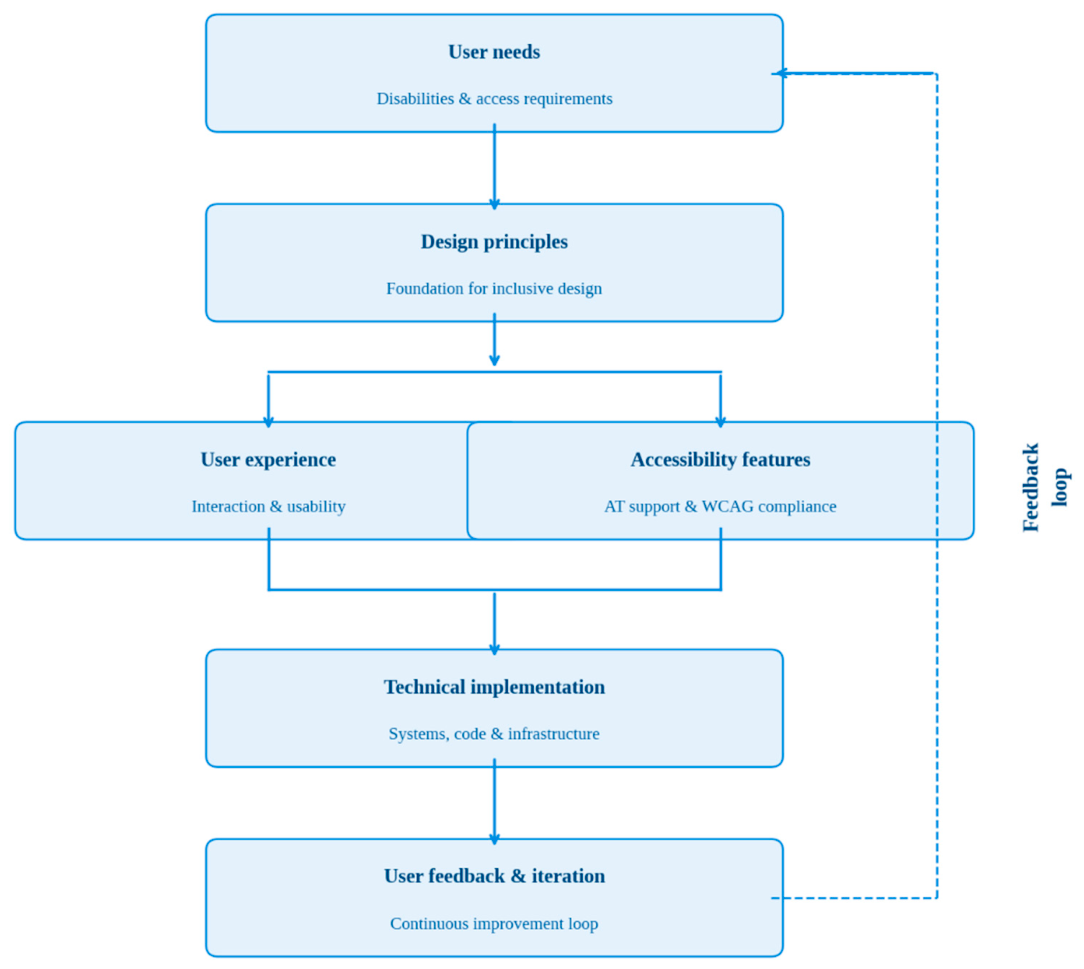
| Accessibility Features | ||
| Ensure Compliance with Accessibility Standards | Following established accessibility guidelines such as WCAG (Web Content Accessibility Guidelines) ensures interfaces are usable by people with various disabilities. | [11,12,13,14,15,16,18,22,25,26,29,31,32,33,37,38,39,41,42] |
| User-Friendly Designs | Designing interfaces that are simple, clear, and easy to navigate, with features like large buttons, high-contrast text, and alternative text for images. | [17,18,19] |
| Support for Assistive Technologies | Interfaces should be compatible with screen readers, voice recognition software, and other assistive technologies to facilitate access for users with disabilities | [18,19,20,21,22] |
| User Experience | ||
| Intuitive Navigation | Interfaces should be designed with intuitive navigation, ensuring users can easily find the information they need without unnecessary complexity. | [11,12,14,16,18,20,21,22,23,24,25,26,27,28,29,30,31,34,37,38,39,40,41,42] |
| Personalization Options | Providing users with the ability to customize their interface (e.g., font size, color schemes) to suit their preferences and needs can greatly enhance the user experience. | [13,14,15,17,19,21,32,33,36,41] |
| Feedback Mechanisms | Including mechanisms for users to provide feedback on their experience can help identify areas for continuous improvement. | [12,15,16,22,23,25,26,27,28,29,32,37,39] |
| Design Principles | ||
| User-Centered Design | Incorporating user-centered design principles ensures that the needs and preferences of end-users, especially those with disabilities, are considered throughout the design process. | [11,12,13,14,15,16,18,19,20,21,22,24,25,26,27,28,29,30,31,32,33,34,35,36,37,38,39,40,41,42] |
| Consistent Layouts | Consistent use of layouts, icons, and terminology helps users understand and navigate the portal more easily. | [21] |
| Clear Instructions and Help Options | Providing clear, concise instructions and accessible help options can reduce user frustration and improve overall satisfaction. | [11,12,14,15,16,18,19,22,23,24,25,26,27,28,29,30,31,32,33,34,36,37,38,39,40,41] |
| Technical Recommendations | ||
| Adaptive Interfaces | Designing adaptive interfaces that can adjust to different devices and user preferences ensures accessibility. | [11,14,15,16,19,20,21,22,23,25,26,27,28,29,30,31,32,33,35,36,37,38,39] |
| Robust Error Handling | Implementing robust error handling mechanisms can help users recover from mistakes. | [21,24,34,35] |
| Secure and Confidential | Ensuring that the portal is secure and maintains user confidentiality, especially given the sensitive nature of health information, is paramount. | [14,15,24,25,26,30,31,33,34,35,39] |
| User Feedback and Participation | ||
| Involve Users in Design Process | Actively involving users, particularly those with disabilities, in the design and testing phases can help identify potential issues and ensure the portal meets their needs. | [13,14,15,16,17,18,20,21,22,23,24,25,26,27,28,29,30,31,32,33,34,35,36,37,39,40,41,42] |
| User Testing and Iteration | Conducting user testing sessions and iterating on the design based on user feedback. | [11,15,16,22,24,25,26,27,28,29,30,31,32,33,34,35,36,37,38,39,41] |
Disclaimer/Publisher’s Note: The statements, opinions and data contained in all publications are solely those of the individual author(s) and contributor(s) and not of MDPI and/or the editor(s). MDPI and/or the editor(s) disclaim responsibility for any injury to people or property resulting from any ideas, methods, instructions or products referred to in the content. |
© 2026 by the authors. Licensee MDPI, Basel, Switzerland. This article is an open access article distributed under the terms and conditions of the Creative Commons Attribution (CC BY) license.
Share and Cite
Ali, H.; Zarei, B.; Kullen, C.; Ali, D. Accessibility Recommendations of Interfaces Designed for Individuals with Mental and Physical Disabilities: A Systematic Review. Healthcare 2026, 14, 1968. https://doi.org/10.3390/healthcare14131968
Ali H, Zarei B, Kullen C, Ali D. Accessibility Recommendations of Interfaces Designed for Individuals with Mental and Physical Disabilities: A Systematic Review. Healthcare. 2026; 14(13):1968. https://doi.org/10.3390/healthcare14131968
Chicago/Turabian StyleAli, Haneen, Bahar Zarei, Charles Kullen, and Duha Ali. 2026. "Accessibility Recommendations of Interfaces Designed for Individuals with Mental and Physical Disabilities: A Systematic Review" Healthcare 14, no. 13: 1968. https://doi.org/10.3390/healthcare14131968
APA StyleAli, H., Zarei, B., Kullen, C., & Ali, D. (2026). Accessibility Recommendations of Interfaces Designed for Individuals with Mental and Physical Disabilities: A Systematic Review. Healthcare, 14(13), 1968. https://doi.org/10.3390/healthcare14131968