Why Older Adults Resist Mobile Health Information Services: A Conceptual Model Based on the Technology–Personal–Environment Framework



Abstract
1. Introduction
2. Literature Review
2.1. Mobile Health Information Services
2.2. Technology–Person–Environment Model
2.2.1. Technology Access Barriers and Technology Usage Barriers
2.2.2. Declining Physiological Conditions and Resistance to Change
2.2.3. Perceived Institutional Effort and Social Legitimacy Power
2.2.4. Technology Anxiety and Perceived Autonomy
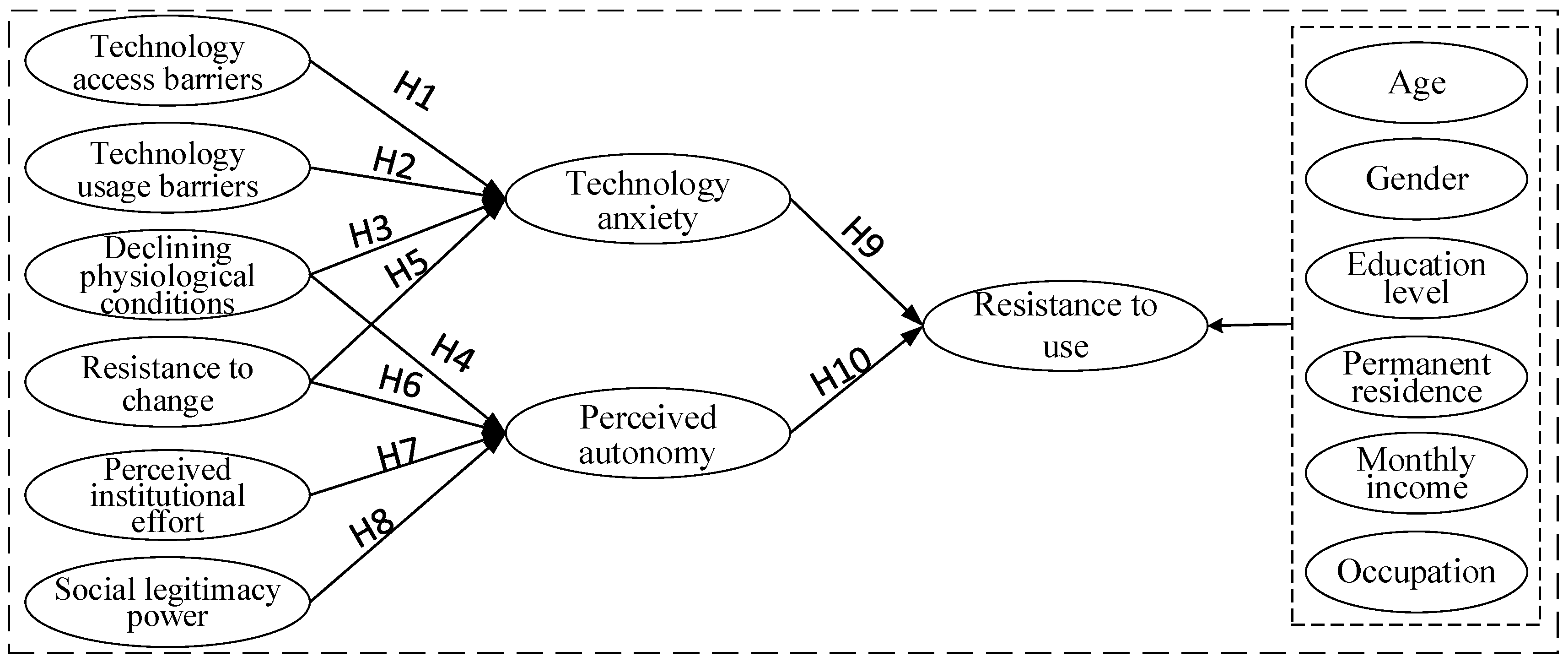
3. Research Model and Hypothesis Development
3.1. The Roles of Technology Access Barriers and Technology Usage Barriers
3.2. The Roles of Declining Physiological Conditions and Resistance to Change
3.3. The Roles of Perceived Institutional Effort and Social Legitimacy Power
3.4. The Role of Technology Anxiety
3.5. The Role of Perceived Autonomy
4. Methodology
4.1. Research Design
4.2. Data Collection
5. Result Analysis
5.1. Demographic Characteristics
5.2. Reliability and Validity Analysis
5.3. Multicollinearity and Common Method Bias Tests
5.4. Model Fit Indices
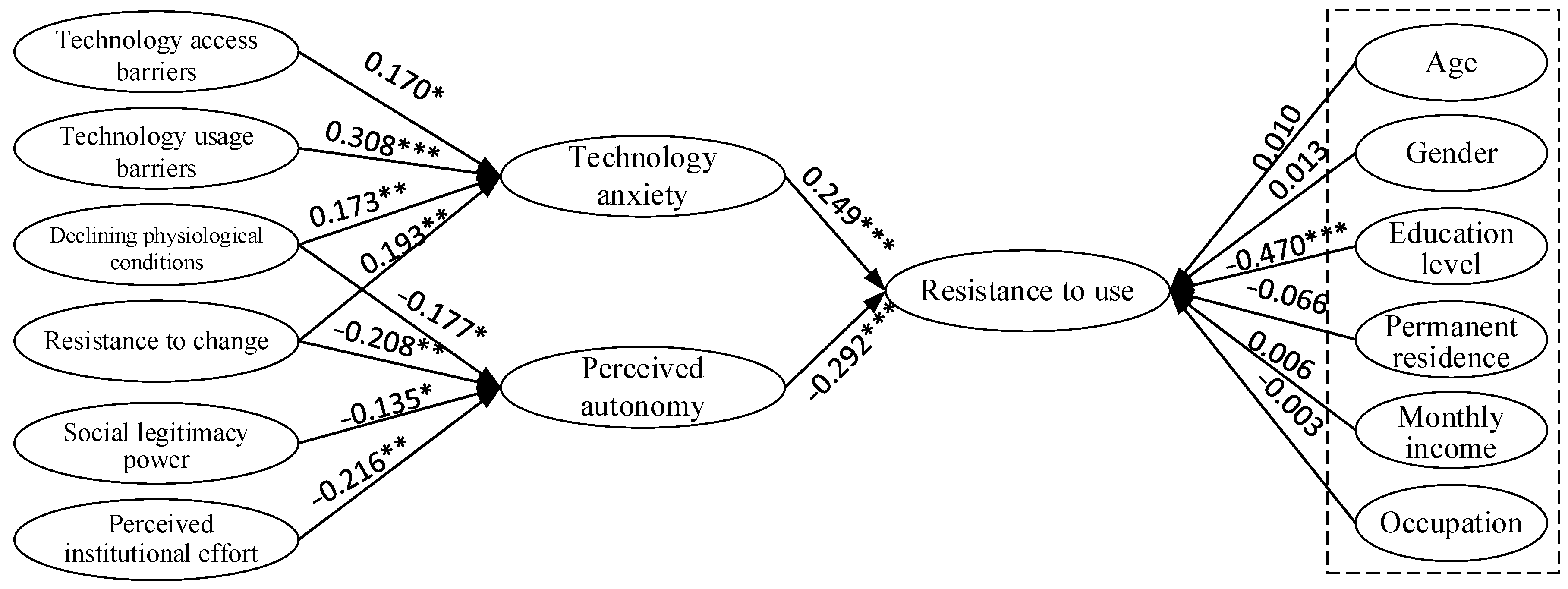
5.5. Hypotheses Test
5.6. Mediating Effects
6. Discussion
6.1. Key Findings
6.2. Theoretical Implications
6.3. Practical Implications
7. Conclusions, Limitations and Future Research
7.1. Conclusions
7.2. Limitations and Future Research
Author Contributions
Funding
Institutional Review Board Statement
Informed Consent Statement
Data Availability Statement
Acknowledgments
Conflicts of Interest
References
- Chauhan, P.; Bali, A.; Kaur, S. Breaking barriers for accessible health programs: The role of telemedicine in a global healthcare transformation. In Transformative Approaches to Patient Literacy and Healthcare Innovation; IGI Global: Hershey, PA, USA, 2024; pp. 283–307. [Google Scholar]
- Ma, Q.; Han, Y.; Chen, M.; Hu, F.; Zhou, H. The impact of a large-scale chronic disease prevention and control program on the health benefits of older adults: Evidence from a natural experiment in China. China Econ. Rev. 2025, 95, 102632. [Google Scholar]
- WHO. Total Health Expenditure as % of GDP. 2024. Available online: https://gateway.euro.who.int/en/indicators/hfa_566-6711-total-health-expenditure-as-of-gdp/#id=19661 (accessed on 22 June 2026).
- Istepanian, R.S. Mobile health (m-Health) in retrospect: The known unknowns. Int. J. Environ. Res. Public Health 2022, 19, 3747. [Google Scholar]
- Calegari, L.P.; Tortorella, G.L.; Fettermann, D.C. Getting connected to M-health technologies through a Meta-analysis. Int. J. Environ. Res. Public Health 2023, 20, 4369. [Google Scholar]
- Hasan, N.; Bao, Y. A mixed-method approach to assess users’ intention to use mobile health (mHealth) using PLS-SEM and fsQCA. Aslib J. Inf. Manag. 2022, 74, 589–630. [Google Scholar]
- Palas, J.U.; Sorwar, G.; Hoque, M.R.; Sivabalan, A. Factors influencing the elderly’s adoption of mHealth: An empirical study using extended UTAUT2 model. BMC Med. Inform. Decis. Mak. 2022, 22, 191. [Google Scholar]
- Zhang, X.; Guo, X.; Guo, F.; Lai, K.-H. Nonlinearities in personalization-privacy paradox in mHealth adoption: The mediating role of perceived usefulness and attitude. Technol. Health Care 2014, 22, 515–529. [Google Scholar]
- Wang, L.; Wu, T.; Guo, X.; Zhang, X.; Li, Y.; Wang, W. Exploring mHealth monitoring service acceptance from a service characteristics perspective. Electron. Commer. Res. Appl. 2018, 30, 159–168. [Google Scholar]
- Zhang, X.; Han, X.; Dang, Y.; Meng, F.; Guo, X.; Lin, J. User acceptance of mobile health services from users’ perspectives: The role of self-efficacy and response-efficacy in technology acceptance. Inform. Health Soc. Care 2017, 42, 194–206. [Google Scholar]
- Guo, X.; Zhang, X.; Sun, Y. The privacy–personalization paradox in mHealth services acceptance of different age groups. Electron. Commer. Res. Appl. 2016, 16, 55–65. [Google Scholar]
- Liu, Y.; Zhang, X.; Liu, L.; Lai, K.-H. Does voice matter? Investigating patient satisfaction on mobile health consultation. Inf. Process. Manag. 2023, 60, 103362. [Google Scholar]
- Dong, W.; Zhu, J.; Dong, Y.; Zhao, Y.; Wang, N. Linking mobility-supportive neighborhood environment to social relationships in older adults: The roles of social interaction and community type. J. Transp. Health 2025, 45, 102204. [Google Scholar]
- Ali, M.; Zhou, L.; Miller, L.; Ieromonachou, P. User resistance in IT: A literature review. Int. J. Inf. Manag. 2016, 36, 35–43. [Google Scholar]
- Karsen, M.; Chandra, Y.U.; Juwitasary, H. Technological factors of mobile payment: A systematic literature review. Procedia Comput. Sci. 2019, 157, 489–498. [Google Scholar]
- Wu, P.; Zhang, R.; Luan, J.; Zhu, M. Factors affecting physicians using mobile health applications: An empirical study. BMC Health Serv. Res. 2022, 22, 24. [Google Scholar]
- Yang, M.; Al Mamun, A.; Gao, J.; Rahman, M.K.; Salameh, A.A.; Alam, S.S. Predicting m-health acceptance from the perspective of unified theory of acceptance and use of technology. Sci. Rep. 2024, 14, 339. [Google Scholar]
- Guo, X.; Sun, Y.; Wang, N.; Peng, Z.; Yan, Z. The dark side of elderly acceptance of preventive mobile health services in China. Electron. Mark. 2013, 23, 49–61. [Google Scholar]
- Hsiao, C.-H.; Tang, K.-Y. Examining a model of mobile healthcare technology acceptance by the elderly in Taiwan. J. Glob. Inf. Technol. Manag. 2015, 18, 292–311. [Google Scholar]
- Klaver, N.S.; Van de Klundert, J.; Askari, M. Relationship between perceived risks of using mHealth applications and the intention to use them among older adults in the Netherlands: Cross-sectional study. JMIR mHealth uHealth 2021, 9, e26845. [Google Scholar]
- Deng, Z.; Mo, X.; Liu, S. Comparison of the middle-aged and older users’ adoption of mobile health services in China. Int. J. Med. Inform. 2014, 83, 210–224. [Google Scholar]
- Quaosar, G.A.A.; Hoque, M.R.; Bao, Y. Investigating factors affecting elderly’s intention to use m-health services: An empirical study. Telemed. E-Health 2018, 24, 309–314. [Google Scholar]
- Bao, Y.; Hoque, R.; Wang, S. Investigating the determinants of Chinese adult children’s intention to use online health information for their aged parents. Int. J. Med. Inform. 2017, 102, 12–20. [Google Scholar]
- Cimperman, M.; Brenčič, M.M.; Trkman, P. Analyzing older users’ home telehealth services acceptance behavior—Applying an Extended UTAUT model. Int. J. Med. Inform. 2016, 90, 22–31. [Google Scholar]
- Hoque, R.; Sorwar, G. Understanding factors influencing the adoption of mHealth by the elderly: An extension of the UTAUT model. Int. J. Med. Inform. 2017, 101, 75–84. [Google Scholar]
- Li, Y.; Ma, Y.; Wang, Y.; Hong, W. The adoption of smart health services by older adults in retirement communities: Analysis with the technology acceptance model (TAM). Univers. Access Inf. Soc. 2024, 24, 1105–1121. [Google Scholar]
- Guerra, K.; Koh, C.; Prybutok, V.; Johnson, V. WIoT Adoption Among Young Adults in Healthcare Crises. J. Comput. Inf. Syst. 2023, 63, 1316–1331. [Google Scholar]
- Tamara, D.; Widjaja, C.; Elista, F.; Yassar, S. Millenials endorse environment factors as continuance intention of the mobile payment technology during COVID-19 in Indonesia. J. Res. Bus. Econ. Educ. 2021, 3, 126–144. [Google Scholar]
- Al-Bashayreh, M.; Almajali, D.; Al-Okaily, M.; Masa’deh, R.; Samed Al-Adwan, A. Evaluating electronic customer relationship management system success: The mediating role of customer satisfaction. Sustainability 2022, 14, 12310. [Google Scholar]
- Charness, N.; Boot, W.R. Aging and information technology use: Potential and barriers. Curr. Dir. Psychol. Sci. 2009, 18, 253–258. [Google Scholar]
- Czaja, S.J.; Charness, N.; Fisk, A.D.; Hertzog, C.; Nair, S.N.; Rogers, W.A.; Sharit, J. Factors predicting the use of technology: Findings from the Center for Research and Education on Aging and Technology Enhancement (CREATE). Psychol. Aging 2006, 21, 333. [Google Scholar]
- Mitzner, T.L.; Boron, J.B.; Fausset, C.B.; Adams, A.E.; Charness, N.; Czaja, S.J.; Dijkstra, K.; Fisk, A.D.; Rogers, W.A.; Sharit, J. Older adults talk technology: Technology usage and attitudes. Comput. Hum. Behav. 2010, 26, 1710–1721. [Google Scholar]
- Zaid, N.N.M.; Ahmad, N.A.; Abd Rauf, M.F.; Zainal, A.; Razak, F.H.A.; Shahdan, T.S.T.; Pek, L.S. Elderly and their barriers to accepting and learning to use technology: A scoping review. Masy. Kebud. Polit. 2023, 36, 1–17. [Google Scholar]
- Tummermann, S. The role of information technology in older adult learning. New Dir. Adult Contin. Educ. 1998, 1998, 61. [Google Scholar]
- Ryu, M.-H.; Kim, S.; Lee, E. Understanding the factors affecting online elderly user’s participation in video UCC services. Comput. Hum. Behav. 2009, 25, 619–632. [Google Scholar]
- Peek, S.T.; Wouters, E.J.; Van Hoof, J.; Luijkx, K.G.; Boeije, H.R.; Vrijhoef, H.J. Factors influencing acceptance of technology for aging in place: A systematic review. Int. J. Med. Inform. 2014, 83, 235–248. [Google Scholar]
- Preston, J.; Biddell, B. The physiology of ageing and how these changes affect older people. Medicine 2021, 49, 1–5. [Google Scholar]
- Di Giacomo, D.; Ranieri, J.; D’Amico, M.; Guerra, F.; Passafiume, D. Psychological barriers to digital living in older adults: Computer anxiety as predictive mechanism for technophobia. Behav. Sci. 2019, 9, 96. [Google Scholar]
- Javdan, M.; Ghasemaghaei, M.; Abouzahra, M. Psychological barriers of using wearable devices by seniors: A mixed-methods study. Comput. Hum. Behav. 2023, 141, 107615. [Google Scholar]
- Al-Hajjaj, H.; Ahmed, A.M.K. Impact of environmental drivers and trust on Fintech service adoption in Jordan. J. Islam. Entrep. /Majallatu Riyadati Al-Aamali Al-Islam. 2023, 8, 12. [Google Scholar]
- Taherdoost, H. A review of technology acceptance and adoption models and theories. Procedia Manuf. 2018, 22, 960–967. [Google Scholar]
- Gagnon, M.-P.; Ngangue, P.; Payne-Gagnon, J.; Desmartis, M. m-Health adoption by healthcare professionals: A systematic review. J. Am. Med. Inform. Assoc. 2016, 23, 212–220. [Google Scholar]
- Dellmuth, L.M.; Tallberg, J. The social legitimacy of international organisations: Interest representation, institutional performance, and confidence extrapolation in the United Nations. Rev. Int. Stud. 2015, 41, 451–475. [Google Scholar]
- Higgins, N.; Ferri, D.; Donnellan, K. Enhancing access to digital culture for vulnerable groups: The role of public authorities in breaking down barriers. Int. J. Semiot. Law.-Rev. Int. Sémiot. Jurid. 2023, 36, 2087–2114. [Google Scholar]
- Jiang, Y.; Chen, D.; Lai, F. Technological-personal-environmental (TPE) framework: A conceptual model for technology acceptance at the individual level. J. Int. Technol. Inf. Manag. 2010, 19, 5. [Google Scholar]
- Tsai, J.-M.; Cheng, M.-J.; Tsai, H.-H.; Hung, S.-W.; Chen, Y.-L. Acceptance and resistance of telehealth: The perspective of dual-factor concepts in technology adoption. Int. J. Inf. Manag. 2019, 49, 34–44. [Google Scholar]
- Rajak, M.; Shaw, K. An extension of technology acceptance model for mHealth user adoption. Technol. Soc. 2021, 67, 101800. [Google Scholar]
- Falk, M.A. Causes and Coping Strategies for Technology Anxiety Among the Elderly in the Digital Age. J. Res. Soc. Sci. Humanit. 2024, 3, 6–11. [Google Scholar]
- Van Dijk, J. Digital divide: Impact of access. Int. Encycl. Media Eff. 2017, 1, 1–11. [Google Scholar]
- Kwong, Y.K. Digital divide: Computer and Internet use by elderly people in Hong Kong. Asian J. Gerontol. Geriatr. 2015, 10, 5–9. [Google Scholar]
- Cooper, J. The digital divide: The special case of gender. J. Comput. Assist. Learn. 2006, 22, 320–334. [Google Scholar]
- Jung, Y.; Peng, W.; Moran, M.; Jin, S.-A.A.; McLaughlin, M.; Cody, M.; Jordan-Marsh, M.; Albright, J.; Silverstein, M. Low-income minority seniors’ enrollment in a cybercafé: Psychological barriers to crossing the digital divide. Educ. Gerontol. 2010, 36, 193–212. [Google Scholar]
- Meuter, M.L.; Ostrom, A.L.; Bitner, M.J.; Roundtree, R. The influence of technology anxiety on consumer use and experiences with self-service technologies. J. Bus. Res. 2003, 56, 899–906. [Google Scholar]
- Xue, L.; Yen, C.C.; Chang, L.; Chan, H.C.; Tai, B.C.; Tan, S.B.; Duh, H.B.L.; Choolani, M. An exploratory study of ageing women’s perception on access to health informatics via a mobile phone-based intervention. Int. J. Med. Inform. 2012, 81, 637–648. [Google Scholar]
- Covinsky, K.E.; Palmer, R.M.; Fortinsky, R.H.; Counsell, S.R.; Stewart, A.L.; Kresevic, D.; Burant, C.J.; Landefeld, C.S. Loss of independence in activities of daily living in older adults hospitalized with medical illnesses: Increased vulnerability with age. J. Am. Geriatr. Soc. 2003, 51, 451–458. [Google Scholar]
- Mubarak, F.; Suomi, R. Elderly forgotten? Digital exclusion in the information age and the rising grey digital divide. Inq. J. Health Care Organ. Provis. Financ. 2022, 59, 00469580221096272. [Google Scholar]
- Kim, M. Exploring Autonomy as a Design Principle: Theoretical Review of Autonomy and Case Studies of Service Design for Seniors. Des. Cult. 2024, 16, 83–107. [Google Scholar]
- Watson, G. Resistance to change. Am. Behav. Sci. 1971, 14, 745–766. [Google Scholar]
- Oreg, S. Resistance to change: Developing an individual differences measure. J. Appl. Psychol. 2003, 88, 680. [Google Scholar]
- Tsai, T.-H.; Lin, W.-Y.; Chang, Y.-S.; Chang, P.-C.; Lee, M.-Y. Technology anxiety and resistance to change behavioral study of a wearable cardiac warming system using an extended TAM for older adults. PLoS ONE 2020, 15, e0227270. [Google Scholar]
- Pardo del Val, M.; Martinez Fuentes, C. Resistance to change: A literature review and empirical study. Manag. Decis. 2003, 41, 148–155. [Google Scholar]
- Battistelli, A.; Montani, F.; Odoardi, C. The impact of feedback from job and task autonomy in the relationship between dispositional resistance to change and innovative work behaviour. Eur. J. Work Organ. Psychol. 2013, 22, 26–41. [Google Scholar]
- Söderlund, M.; Colliander, J.; Karsberg, J.; Liljedal, K.T.; Modig, E.; Rosengren, S.; Sagfossen, S.; Szugalski, S.; Åkestam, N. The allure of the bottle as a package: An assessment of perceived effort in a packaging context. J. Prod. Brand Manag. 2017, 26, 91–100. [Google Scholar]
- Homer, P.M. Ad size as an indicator of perceived advertising costs and effort: The effects on memory and perceptions. J. Advert. 1995, 24, 1–12. [Google Scholar]
- Cobo, C.M.S. The influence of institutionalization on the perception of autonomy and quality of life in old people. Rev. Esc. Enferm. USP 2014, 48, 1013–1019. [Google Scholar]
- Adams, R.N. Energy and Structure: A Theory of Social Power; University of Texas Press: Austin, TX, USA, 1975. [Google Scholar]
- Kim, H.-N.; Freddolino, P.P.; Greenhow, C. Older adults’ technology anxiety as a barrier to digital inclusion: A scoping review. Educ. Gerontol. 2023, 49, 1021–1038. [Google Scholar]
- Mokyr, J.; Vickers, C.; Ziebarth, N.L. The history of technological anxiety and the future of economic growth: Is this time different? J. Econ. Perspect. 2015, 29, 31–50. [Google Scholar]
- NuriAbdalla, S.A. Extend of TAM model with technology anxiety and self-efficacy to accept course websites at University Canada West. Int. J. Inf. Technol. Lang. Stud. 2019, 3, 1–7. [Google Scholar]
- Gunasinghe, A.; Nanayakkara, S. Role of technology anxiety within UTAUT in understanding non-user adoption intentions to virtual learning environments: The state university lecturers’ perspective. Int. J. Technol. Enhanc. Learn. 2021, 13, 284–308. [Google Scholar]
- Wakefield, L.T.; Wakefield, R.L. Anxiety and ephemeral social media use in negative eWOM creation. J. Interact. Mark. 2018, 41, 44–59. [Google Scholar]
- Sun, Y.; Nakajima, T. Mitigating Technological Anxiety through the Application of Natural Interaction in Mixed Reality Systems. Future Internet 2023, 15, 216. [Google Scholar]
- Frishammar, J.; Essén, A.; Bergström, F.; Ekman, T. Digital health platforms for the elderly? Key adoption and usage barriers and ways to address them. Technol. Forecast. Soc. Change 2023, 189, 122319. [Google Scholar]
- Jung, Y. Understanding the role of sense of presence and perceived autonomy in users’ continued use of social virtual worlds. J. Comput.-Mediat. Commun. 2011, 16, 492–510. [Google Scholar]
- Collopy, B.J. Autonomy in long term care: Some crucial distinctions. Gerontologist 1988, 28, 10–17. [Google Scholar]
- Moilanen, T.; Kangasniemi, M.; Papinaho, O.; Mynttinen, M.; Siipi, H.; Suominen, S.; Suhonen, R. Older people’s perceived autonomy in residential care: An integrative review. Nurs. Ethics 2021, 28, 414–434. [Google Scholar]
- Briand, M.; De Nadaï, T.; Balardy, L.; Rolland, Y.; Nourhashemi, F.; Sourdet, S.; Vellas, B. Autonomy and dependence in the elderly. Rev. Prat. 2020, 70, e97–e105. [Google Scholar]
- Porter, C.E.; Donthu, N. Using the technology acceptance model to explain how attitudes determine Internet usage: The role of perceived access barriers and demographics. J. Bus. Res. 2006, 59, 999–1007. [Google Scholar]
- Laukkanen, P.; Sinkkonen, S.; Laukkanen, T. Consumer resistance to internet banking: Postponers, opponents and rejectors. Int. J. Bank. Mark. 2008, 26, 440–455. [Google Scholar]
- Lian, J.-W.; Yen, D.C. To buy or not to buy experience goods online: Perspective of innovation adoption barriers. Comput. Hum. Behav. 2013, 29, 665–672. [Google Scholar]
- Phang, C.W.; Sutanto, J.; Kankanhalli, A.; Li, Y.; Tan, B.C.; Teo, H.-H. Senior citizens’ acceptance of information systems: A study in the context of e-government services. IEEE Trans. Eng. Manag. 2006, 53, 555–569. [Google Scholar]
- Modig, E.; Dahlén, M.; Colliander, J. Consumer-perceived signals of ‘creative’ versus ‘efficient’advertising: Investigating the roles of expense and effort. Int. J. Advert. 2014, 33, 137–154. [Google Scholar]
- Raven, B.H.; Schwarzwald, J.; Koslowsky, M. Conceptualizing and measuring a power/interaction model of interpersonal influence. J. Appl. Soc. Psychol. 1998, 28, 307–332. [Google Scholar]
- Tong, Y.; Tan, C.-H.; Teo, H.-H. Direct and indirect information system use: A multimethod exploration of social power antecedents in healthcare. Inf. Syst. Res. 2017, 28, 690–710. [Google Scholar]
- Thatcher, J.B.; Perrewe, P.L. An empirical examination of individual traits as antecedents to computer anxiety and computer self-efficacy. MIS Q. 2002, 26, 381–396. [Google Scholar]
- Sørebø, Ø.; Halvari, H.; Gulli, V.F.; Kristiansen, R. The role of self-determination theory in explaining teachers’ motivation to continue to use e-learning technology. Comput. Educ. 2009, 53, 1177–1187. [Google Scholar]
- Kim, H.-W.; Kankanhalli, A. Investigating user resistance to information systems implementation: A status quo bias perspective. MIS Q. 2009, 33, 567–582. [Google Scholar]
- Gorsuch, R.L.; McPherson, S.E. Intrinsic/extrinsic measurement: I/E-revised and single-item scales. J. Sci. Study Relig. 1989, 28, 348–354. [Google Scholar]
- Fabrigar, L.R.; Wegener, D.T.; MacCallum, R.C.; Strahan, E.J. Evaluating the use of exploratory factor analysis in psychological research. Psychol. Methods 1999, 4, 272. [Google Scholar]
- O’brien, R.M. A caution regarding rules of thumb for variance inflation factors. Qual. Quant. 2007, 41, 673–690. [Google Scholar]
- Hu, L.t.; Bentler, P.M. Cutoff criteria for fit indexes in covariance structure analysis: Conventional criteria versus new alternatives. Struct. Equ. Model. Multidiscip. J. 1999, 6, 1–55. [Google Scholar]
- Preacher, K.J.; Hayes, A.F. Asymptotic and resampling strategies for assessing and comparing indirect effects in multiple mediator models. Behav. Res. Methods 2008, 40, 879–891. [Google Scholar]
- Vaportzis, E.; Giatsi Clausen, M.; Gow, A.J. Older adults perceptions of technology and barriers to interacting with tablet computers: A focus group study. Front. Psychol. 2017, 8, 1687. [Google Scholar]
- Perrig-Chiello, P.; Perrig, W.J.; Uebelbacher, A.; Stähelin, H.B. Impact of physical and psychological resources on functional autonomy in old age. Psychol. Health Med. 2006, 11, 470–482. [Google Scholar]
- Yap, Y.-Y.; Tan, S.-H.; Choon, S.-W. Elderly’s intention to use technologies: A systematic literature review. Heliyon 2022, 8, e08765. [Google Scholar]
- Hwang, H.-L.; Lin, H.-S.; Tung, Y.-L.; Wu, H.-C. Correlates of perceived autonomy among elders in a senior citizen home: A cross-sectional survey. Int. J. Nurs. Stud. 2006, 43, 429–437. [Google Scholar]
- Kumar, V.; Venkatesan, R.; Reinartz, W. Performance implications of adopting a customer-focused sales campaign. J. Mark. 2008, 72, 50–68. [Google Scholar]



| Construct | Item | Questions | References |
|---|---|---|---|
| Technology Access Barriers | TAB1 | It is difficult for me to get information about technology | [78] |
| TAB2 | I hardly ever use a smartphone or other smart device (e.g., iPad, computer, etc.) | ||
| TAB3 | I think it is difficult to use the Internet whenever I want | ||
| Technology Usage Barriers | TUB1 | I find it challenging to browse information on smart devices (like small font, complex interfaces, etc.) | [79,80] |
| TUB2 | I often do not know how to solve it when I make a mistake while operating them | ||
| TUB3 | I often forget certain steps to operate the smart device | ||
| TUB4 | I do not quite understand the meaning of some symbols or buttons in mobile health apps | ||
| TUB5 | I find it difficult to use smart devices because the interface always changes (like pop-ups, screen transitions, etc.) | ||
| Declining Physiological Conditions | DPC1 | My physical condition requires me to put in more effort for daily activities | [81] |
| DPC2 | My physical condition limits the types of activities I can do | ||
| DPC3 | My physical condition makes my daily activities difficult | ||
| Resistance To Change | RTC1 | I do not want mobile health apps to change the way I deal with health-related issues (like switching from in-person appointments to online scheduling, or from receiving notifications via phone or text to checking and getting information through mobile health services) | [18,21] |
| RTC2 | I do not want mobile health apps to change the way I maintain my health | ||
| RTC3 | I do not want mobile health apps to change the way I interact with others | ||
| RTC4 | Overall, I do not want mobile health apps to change my current lifestyle | ||
| Perceived Institutional Effort | PIE1 | In the promotion of Mobile health information services, the staff of medical institutions have paid a lot of energy | [63,82] |
| PIE2 | In the promotion of Mobile health information services, the staff of medical institutions are persistent | ||
| PIE3 | In the promotion of Mobile health information services, the staff of medical institutions spend a lot of time in the service process | ||
| PIE4 | In the promotion of Mobile health information services, the staff of medical institutions have made great efforts in the service process | ||
| Social Legitimacy Power | SLP1 | Based on my standpoint, I can ask others for help with mobile health information services | [83,84] |
| SLP2 | I have the right to ask others to offer me help with mobile information health services | ||
| SLP3 | As an elderly person, I believe it is reasonable to expect support from others when I need it, so that I am not completely dependent on myself using mhealth apps for information and services | ||
| Technology Anxiety | TA1 | Using mobile health information services makes me anxious | [54,85] |
| TA2 | I get scared when I think about the negative consequences that might result from a mistaken operation on smart devices | ||
| TA3 | I am unwilling to use technology because I fear making mistakes that I cannot correct | ||
| TA4 | Using mobile health information services makes me nervous | ||
| Perceived Autonomy | PA1 | I can decide independently when to use mobile information health services | [74,86] |
| PA2 | I can decide independently where to use mobile information health services | ||
| PA3 | I can decide independently which services to use with mobile health information services | ||
| PA4 | I can decide for myself which services provided by mobile health information services to use | ||
| PA5 | I can autonomously use the mobile information health service to get the services I need | ||
| Resistance To Use | RTU1 | I prefer to receive medical help or health information services through other means rather than using mobile information health services | [87] |
| RTU2 | I do not have any plans to use mobile information health services for now | ||
| RTU3 | I do not want to use mobile health information services to deal with my health issues |
| Variables | Category | Frequency | Percentage (%) |
|---|---|---|---|
| Age | 65–69 | 137 | 31.9 |
| 70–74 | 115 | 26.7 | |
| 75–79 | 80 | 18.6 | |
| 80–84 | 59 | 13.7 | |
| 85–89 | 28 | 6.6 | |
| 61 or older | 11 | 2.6 | |
| Gender | Male | 206 | 47.9 |
| Female | 224 | 52.1 | |
| Education level | High school or lower | 388 | 90.2 |
| College | 42 | 9.8 | |
| Permanent residence | Urban | 180 | 41.9 |
| Rural | 250 | 58.1 | |
| Monthly income | Less than 500 | 133 | 30.9 |
| 501–1000 | 67 | 15.6 | |
| 1001–1500 | 41 | 9.5 | |
| 1501–2000 | 36 | 8.4 | |
| 2001–2500 | 22 | 5.1 | |
| 2501–3000 | 19 | 4.4 | |
| 3001–3500 | 26 | 6.0 | |
| 3501–4000 | 28 | 6.5 | |
| above than 4000 | 58 | 13.5 | |
| Occupation | Scientific, educational, cultural, medical and health professionals | 33 | 7.7 |
| Leading cadres of state organs, Party and mass organizations, state-owned enterprises and public institutions | 21 | 4.9 | |
| Ordinary public officials in state organs, Party and mass organizations, state-owned enterprises and public institutions | 45 | 10.5 | |
| soldier | 5 | 1.2 | |
| Peasant | 247 | 57.4 | |
| Worker | 37 | 8.6 | |
| Business and service workers | 12 | 2.8 | |
| Freelance work | 20 | 4.7 | |
| other | 10 | 2.3 |
| Construct | Item | Cronbach’s Alpha | Std | AVE | CR |
|---|---|---|---|---|---|
| TAB | TAB1 | 0.843 | 0.810 | 0.912 | 0.675 |
| TAB2 | 0.845 | ||||
| TAB3 | 0.752 | ||||
| TUB | TUB1 | 0.926 | 0.804 | 0.882 | 0.713 |
| TUB2 | 0.870 | ||||
| TUB3 | 0.858 | ||||
| TUB4 | 0.843 | ||||
| TUB5 | 0.853 | ||||
| DPC | DPC1 | 0.860 | 0.832 | 0.860 | 0.672 |
| DPC2 | 0.827 | ||||
| DPC3 | 0.800 | ||||
| RTC | RTC1 | 0.900 | 0.826 | 0.901 | 0.694 |
| RTC2 | 0.812 | ||||
| RTC3 | 0.855 | ||||
| RTC4 | 0.838 | ||||
| PIE | PIE1 | 0.901 | 0.825 | 0.902 | 0.696 |
| PIE2 | 0.813 | ||||
| PIE3 | 0.835 | ||||
| PIE4 | 0.864 | ||||
| SLP | SLP1 | 0.775 | 0.754 | 0.774 | 0.534 |
| SLP2 | 0.701 | ||||
| SLP3 | 0.736 | ||||
| TA | TA1 | 0.887 | 0.779 | 0.887 | 0.663 |
| TA2 | 0.842 | ||||
| TA3 | 0.843 | ||||
| TA4 | 0.790 | ||||
| PA | PA1 | 0.911 | 0.818 | 0.911 | 0.673 |
| PA2 | 0.831 | ||||
| PA3 | 0.856 | ||||
| PA4 | 0.824 | ||||
| PA5 | 0.769 | ||||
| RTU | RTU1 | 0858 | 0.751 | 0.858 | 0.669 |
| RTU2 | 0.872 | ||||
| RTU3 | 0.826 |
| TAB | TUB | DPC | RTC | PIE | SLP | TA | PA | RTU | |
|---|---|---|---|---|---|---|---|---|---|
| TAB | 0.822 | ||||||||
| TUB | 0.678 | 0.844 | |||||||
| DPC | 0.554 | 0.567 | 0.820 | ||||||
| RTC | 0.562 | 0.56 | 0.642 | 0.833 | |||||
| PIE | 0.62 | 0.681 | 0.606 | 0.557 | 0.834 | ||||
| SLP | 0.543 | 0.527 | 0.476 | 0.547 | 0.553 | 0.731 | |||
| TA | 0.585 | 0.63 | 0.567 | 0.573 | 0.528 | 0.443 | 0.814 | ||
| PA | −0.423 | −0.436 | −0.506 | −0.516 | −0.514 | −0.454 | −0.394 | 0.820 | |
| RTU | 0.312 | 0.329 | 0.336 | 0.342 | 0.329 | 0.284 | 0.417 | −0.463 | 0.818 |
| RTU | TA | TAB | TUB | DPC | RTC | PIE | PA | SLP | |
|---|---|---|---|---|---|---|---|---|---|
| RTU | |||||||||
| TA | 1.246 | ||||||||
| TAB | 1.735 | ||||||||
| TUB | 1.806 | ||||||||
| DPC | 1.654 | 1.685 | |||||||
| RTC | 1.700 | 1.701 | |||||||
| PIE | 1.624 | ||||||||
| PA | 1.245 | ||||||||
| SLP | 1.399 |
| Indicators | RTU | TA | TAB | TUB | DPC | RTC | PIE | PA |
|---|---|---|---|---|---|---|---|---|
| Fitting indicators | 1.302 | 0.027 | 0.919 | 0.904 | 0.936 | 0.929 | 0.984 | 0.984 |
| Reference standard | 1–3 | <0.05 | >0.90 | >0.90 | >0.90 | >0.90 | >0.90 | >0.90 |
| Paths | Total Effects | Direct Effects | 95% Confidence Interval | Indirect Effect | 95% Confidence Interval | ||
|---|---|---|---|---|---|---|---|
| Lower | Upper | Lower | Upper | ||||
| Technology access barriers → technology anxiety → resistance to use | 0.348 *** | 0.274 *** | 0.176 | 0. 392 | 0.073 * | 0.017 | 0.142 |
| Technology usage barriers → technology anxiety → resistance to use | 0.409 *** | 0.357 *** | 0.255 | 0.467 | 0.051 | −0.013 | 0.124 |
| Declining physiological conditions → technology anxiety → resistance to use | 0.295 *** | 0.177 *** | 0.07 | 0.307 | 0.118 *** | 0.06 | 0.191 |
| Resistance to change → technology anxiety → resistance to use | 0.280 *** | 0.158 ** | 0.045 | 0.281 | 0.122 *** | 0.062 | 0.201 |
| Declining physiological conditions → perceived autonomy → resistance to use | 0.292 *** | 0.156 ** | 0.055 | 0.266 | 0.136 *** | 0.085 | 0.203 |
| Resistance to change → perceived autonomy → resistance to use | 0.279 *** | 0.139 ** | 0.037 | 0.245 | 0.140 *** | 0.087 | 0.211 |
| Social legitimacy power → perceived autonomy → resistance to use | 0.341 *** | 0.200 *** | 0.092 | 0.327 | 0.141 *** | 0.087 | 0.209 |
| Perceived institutional effort → perceived autonomy → resistance to use | 0.359 *** | 0.215 *** | 0.105 | 0.330 | 0.144 *** | 0.085 | 0.218 |
Disclaimer/Publisher’s Note: The statements, opinions and data contained in all publications are solely those of the individual author(s) and contributor(s) and not of MDPI and/or the editor(s). MDPI and/or the editor(s) disclaim responsibility for any injury to people or property resulting from any ideas, methods, instructions or products referred to in the content. |
© 2026 by the authors. Licensee MDPI, Basel, Switzerland. This article is an open access article distributed under the terms and conditions of the Creative Commons Attribution (CC BY) license.
Share and Cite
Zhao, Y.; Wang, Z.; Ke, F.; Ma, X. Why Older Adults Resist Mobile Health Information Services: A Conceptual Model Based on the Technology–Personal–Environment Framework. Healthcare 2026, 14, 1892. https://doi.org/10.3390/healthcare14131892
Zhao Y, Wang Z, Ke F, Ma X. Why Older Adults Resist Mobile Health Information Services: A Conceptual Model Based on the Technology–Personal–Environment Framework. Healthcare. 2026; 14(13):1892. https://doi.org/10.3390/healthcare14131892
Chicago/Turabian StyleZhao, Ying, Ziwei Wang, Fan Ke, and Xiumei Ma. 2026. "Why Older Adults Resist Mobile Health Information Services: A Conceptual Model Based on the Technology–Personal–Environment Framework" Healthcare 14, no. 13: 1892. https://doi.org/10.3390/healthcare14131892
APA StyleZhao, Y., Wang, Z., Ke, F., & Ma, X. (2026). Why Older Adults Resist Mobile Health Information Services: A Conceptual Model Based on the Technology–Personal–Environment Framework. Healthcare, 14(13), 1892. https://doi.org/10.3390/healthcare14131892