The Impact of Patient and Professional Users’ Involvement in Implementation for Virtual Reality in Hospitalised Palliative Cancer Patients in a German Cancer Centre—A Qualitative Analysis
 , ,
, ,  ,
,
Highlights
- The study underlines the importance of patients’, relatives’, and healthcare professionals’ perspectives in the implementation strategy for individualised VR.
- Staff attitudes can pose challenges, though various strategies were discussed to overcome rejectionist perspectives.
- High organisational demands and staff deployment were identified as major weaknesses in implementation.
- Patients and relatives expressed concerns about data protection when using private VR content.
- Despite limited evidence in previous studies, concerns about the potential emotional burden on patients persisted.
- Concerns among patients, relatives, and clinical staff should be addressed through active listening and clear information, as unaddressed worries may otherwise obscure evidence and hinder implementation
- Individualised VR cannot be implemented in palliative care without additional staff resources and consideration of data security.
Abstract
1. Introduction
2. Methods
2.1. Methodological Orientation and Theory
2.2. Sample and Setting
2.3. Data Collection
2.4. Data Analysis
3. Results
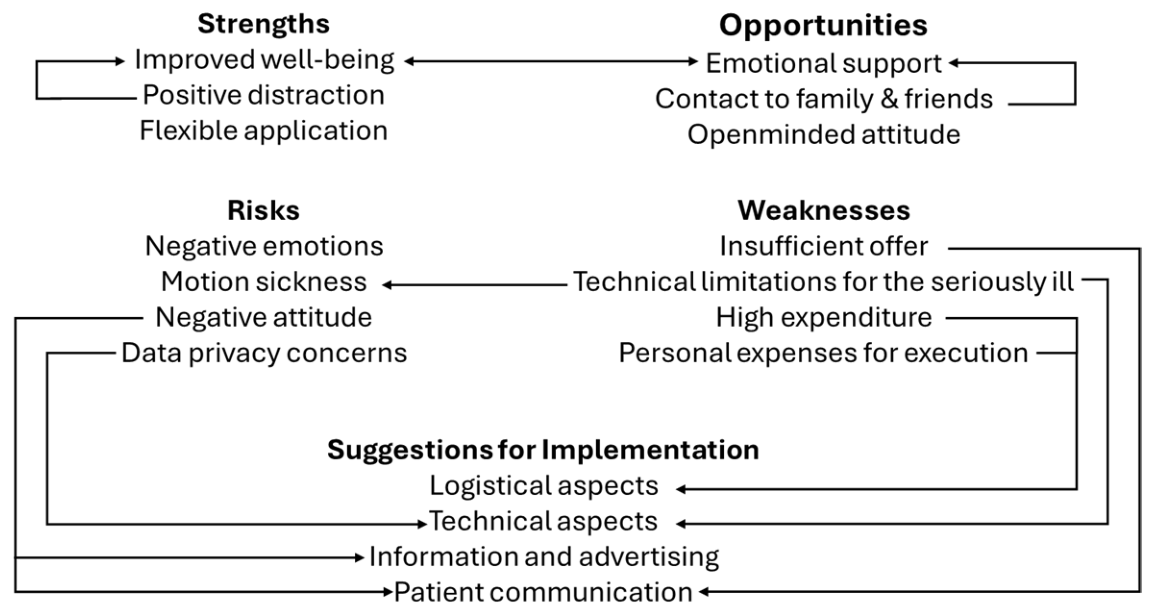
3.1. Strengths of Individualised VR
“So, on my ward, based on what the patients definitely told me afterwards, the experience was entirely positive. Everyone was happy to have seen these images.”(physician)
“That wasn’t so bad as support at all. […] And also, what was well received was that the films are a bit longer, it’s now less about the individualised at-home aspect, but actually more about this distraction aspect, seeing something different, getting out a bit, exactly. So, overall, the experiences weren’t bad.”(nurse 3)
3.2. Weaknesses of Individualised VR
“The problem was simply that the patients are with us for a very long time, that means, the first time it was okay, the second time there was nothing left to offer. That was very unfortunate, because a bit of variety would of course have been nice.”(nurse 3)
“But the fact is really that what you see depends on your position. That means, if I see a beautiful landscape here and then lie down, I see the blue sky above, which is very nice, but it doesn’t really distract me.”(nurse 1)
“What I also experienced as a weakness was the great effort involved. So, I was involved in it, and also the relatives, and on my ward, there are definitely often patients who come from far away or whose relatives come from far away. And if it’s supposed to be individualised, that was often a problem. So first, someone comes to visit who could make the video, then the camera had to be there, which was also logistically difficult, and then it also took quite a long time until it was ready.”(physician)
3.3. Opportunities for Individualised VR
“I also think that this [VR] can really help.”(nurse 3)
“So, I can imagine definitely that the patients would benefit from it and accept it. Especially those who are there for a long time, sometimes weeks or even months.”(nurse 2)
“It could also lead to relaxing. […] So, I do believe it, I can understand that this is a great approach, a great situation, that you can positively influence things with such methods.”(patient, leukemia aid 2)
3.4. Risks of Individualised VR
“For example, on my ward, the nursing staff is very, very critical of the whole thing […] They say it worsens the longing […] There is actually no view of the possibilities it offers.”(physician)
“Perhaps the longing is intensified, and one might become especially sad when seeing home and not being able to be there.”(nurse 2)
“I rather see the risk that this stress level simply increases. […] I also see the situation with things that come from the home environment as something that could potentially be a burden.”(patient, leukemia aid 2)
“With motion sickness, I also had a patient who said from the start that he had already tried a VR headset and it makes him feel sick.”(physician)
“One should really also talk to the relatives, who know the person, to ask whether this would be more of a burden or trust their judgement.”(patient, leukaemia aid 2)
“Someone makes a video of my home and gives it somewhere, and I’m not entirely sure what could theoretically happen with it? Who gets this video in their hands?”(nurse 1)
3.5. Suggestions for Implementation of Individualised VR
“So, I can only think of it if you want to make it faster, that you explain it to the people and also say that the video can be uploaded to a Dropbox or something. So that the transfer would be easier […]”(nurse 1)
“Why don’t you organize an event for the colleagues on the ward, show the results, also show a bit from the literature, what other people have already done, it doesn’t necessarily have to be related to oncology patients, but what opportunities are in it.”(nurse 1)
4. Discussion
4.1. Strengths
4.2. Weaknesses
4.3. Opportunities
4.4. Risks
4.5. Suggestions for Implementation
4.6. Limitations
4.7. Implication for Future Practice/Research
5. Conclusions
Author Contributions
Funding
Institutional Review Board Statement
Informed Consent Statement
Data Availability Statement
Acknowledgments
Conflicts of Interest
References
- Alexander, K.; Goldberg, J.; Korc-Grodzicki, B. Palliative Care and Symptom Management in Older Patients with Cancer. Clin. Geriatr. Med. 2016, 32, 45–62. [Google Scholar] [CrossRef] [PubMed]
- Chou, W.-Y.S.; Tiner, J.; Senft, N. Emerging Challenges in Advanced Cancer Care: Opportunities for Enhancing Patient-Centered Communication. In Psychological Aspects of Cancer; Steel, J.L., Carr, B.I., Eds.; Springer International Publishing: Cham, Switzerland, 2022; pp. 207–218. [Google Scholar] [CrossRef]
- Mehnert, A.; Hartung, T.J.; Friedrich, M.; Vehling, S.; Brähler, E.; Härter, M.; Keller, M.; Schulz, H.; Wegscheider, K.; Weis, J.; et al. One in two cancer patients is significantly distressed: Prevalence and indicators of distress. Psycho-Oncology 2018, 27, 75–82. [Google Scholar] [CrossRef] [PubMed]
- Van Lancker, A.; Velghe, A.; Van Hecke, A.; Verbrugghe, M.; Van Den Noortgate, N.; Grypdonck, M.; Verhaeghe, S.; Bekkering, G.; Beeckman, D. Prevalence of Symptoms in Older Cancer Patients Receiving Palliative Care: A Systematic Review and Meta-Analysis. J. Pain Symptom Manag. 2014, 47, 90–104. [Google Scholar] [CrossRef] [PubMed]
- Jaiswal, R.; Alici, Y.; Breitbart, W. A comprehensive review of palliative care in patients with cancer. Int. Rev. Psychiatry 2014, 26, 87–101. [Google Scholar] [CrossRef] [PubMed]
- Tennant, M.; Youssef, G.J.; McGillivray, J.; Clark, T.-J.; McMillan, L.; McCarthy, M.C. Exploring the use of Immersive Virtual Reality to enhance Psychological Well-Being in Pediatric Oncology: A pilot randomized controlled trial. Eur. J. Oncol. Nurs. 2020, 48, 101804. [Google Scholar] [CrossRef] [PubMed]
- Gomes, B.; Calanzani, N.; Gysels, M.; Hall, S.; Higginson, I.J. Heterogeneity and changes in preferences for dying at home: A systematic review. BMC Palliat. Care 2013, 12, 7. [Google Scholar] [CrossRef] [PubMed]
- Van Der Padt-Pruijsten, A.; Oostergo, T.; Leys, M.B.L.; Van Der Rijt, C.C.D.; Van Der Heide, A. Hospitalisations of patients with cancer in the last stage of life. Reason to improve advance care planning? Eur. J. Cancer Care 2022, 31, e13720. [Google Scholar] [CrossRef] [PubMed]
- Weiss, P.L.; Kizony, R.; Feintuch, U.; Katz, N. Virtual reality in neurorehabilitation. Textb. Neural Repair Rehabil. 2006, 51, 182–197. [Google Scholar] [CrossRef]
- Wu, Y.; Wang, N.; Zhang, H.; Sun, X.; Wang, Y.; Zhang, Y. Effectiveness of Virtual Reality in Symptom Management of Cancer Patients: A Systematic Review and Meta-Analysis. J. Pain Symptom Manag. 2023, 65, e467–e482. [Google Scholar] [CrossRef] [PubMed]
- Mo, J.; Vickerstaff, V.; Minton, O.; Tavabie, S.; Taubert, M.; Stone, P.; White, N. How effective is virtual reality technology in palliative care? A systematic review and meta-analysis. Palliat. Med. 2022, 36, 1047–1058. [Google Scholar] [CrossRef] [PubMed]
- Moloney, M.; Doody, O.; O’Reilly, M.; Lucey, M.; Callinan, J.; Exton, C.; Colreavy, S.; O’Mahony, F.; Meskell, P.; Coffey, A. Virtual reality use and patient outcomes in palliative care: A scoping review. Digit. Health 2023, 9, 20552076231207574. [Google Scholar] [CrossRef] [PubMed]
- Scates, D.; Dickinson, J.I.; Sullivan, K.; Cline, H.; Balaraman, R. Using Nature-Inspired Virtual Reality as a Distraction to Reduce Stress and Pain Among Cancer Patients. Environ. Behav. 2020, 52, 895–918. [Google Scholar] [CrossRef]
- Indovina, P.; Barone, D.; Gallo, L.; Chirico, A.; De Pietro, G.; Giordano, A. Virtual Reality as a Distraction Intervention to Relieve Pain and Distress During Medical Procedures: A Comprehensive Literature Review. Clin. J. Pain 2018, 34, 858–877. [Google Scholar] [CrossRef] [PubMed]
- Ioannou, A.; Papastavrou, E.; Avraamides, M.N.; Charalambous, A. Virtual Reality and Symptoms Management of Anxiety, Depression, Fatigue, and Pain: A Systematic Review. SAGE Open Nurs. 2020, 6, 2377960820936163. [Google Scholar] [CrossRef] [PubMed]
- Martin, J.L.; Saredakis, D.; Hutchinson, A.D.; Crawford, G.B.; Loetscher, T. Virtual Reality in Palliative Care: A Systematic Review. Healthcare 2022, 10, 1222. [Google Scholar] [CrossRef] [PubMed]
- Tian, Q.; Xu, M.; Yu, L.; Yang, S.; Zhang, W. The Efficacy of Virtual Reality–Based Interventions in Breast Cancer–Related Symptom Management: A Systematic Review and Meta-analysis. Cancer Nurs. 2023, 46, E276–E287. [Google Scholar] [CrossRef] [PubMed]
- Chochinov, H.M.; McClement, S.; Hack, T.; Thompson, G.; Dufault, B.; Harlos, M. Eliciting Personhood Within Clinical Practice: Effects on Patients, Families, and Health Care Providers. J. Pain Symptom Manag. 2015, 49, 974–980.e2. [Google Scholar] [CrossRef] [PubMed]
- Lloyd, A.; Haraldsdottir, E. Virtual reality in hospice: Improved patient well-being. BMJ Support. Palliat. Care 2021, 11, 344–350. [Google Scholar] [CrossRef] [PubMed]
- Niki, K.; Okamoto, Y.; Maeda, I.; Mori, I.; Ishii, R.; Matsuda, Y.; Takagi, T.; Uejima, E. A Novel Palliative Care Approach Using Virtual Reality for Improving Various Symptoms of Terminal Cancer Patients: A Preliminary Prospective, Multicenter Study. J. Palliat. Med. 2019, 22, 702–707. [Google Scholar] [CrossRef] [PubMed]
- Nwosu, A.C.; Mills, M.; Roughneen, S.; Stanley, S.; Chapman, L.; Mason, S.R. Virtual reality in specialist palliative care: A feasibility study to enable clinical practice adoption. BMJ Support. Palliat. Care 2024, 14, 47–51. [Google Scholar] [CrossRef] [PubMed]
- Pittara, M.; Matsangidou, M.; Stylianides, K.; Petkov, N.; Pattichis, C.S. Virtual Reality for Pain Management in Cancer: A Comprehensive Review. IEEE Access 2020, 8, 225475–225489. [Google Scholar] [CrossRef]
- Perna, L.; Lund, S.; White, N.; Minton, O. The Potential of Personalized Virtual Reality in Palliative Care: A Feasibility Trial. Am. J. Hosp. Palliat. Med. 2021, 38, 1488–1494. [Google Scholar] [CrossRef] [PubMed]
- Gerlach, C.; Greinacher, A.; Alt-Epping, B.; Wrzus, C. My virtual home: Needs of patients in palliative cancer care and content effects of individualized virtual reality—A mixed methods study protocol. BMC Palliat. Care 2023, 22, 167. [Google Scholar] [CrossRef] [PubMed]
- Greinacher, A.; Alt-Epping, B.; Gerlach, C.; Wrzus, C. Expected benefits and concerns regarding virtual reality in caring for terminally ill cancer patients—A qualitative interview study. BMC Palliat. Care 2024, 23, 254. [Google Scholar] [CrossRef] [PubMed]
- Gerlach, C.; Haas, L.; Greinacher, A.; Lantelme, J.; Guenther, M.; Thiesbonenkamp-Maag, J.; Alt-Epping, B.; Wrzus, C. My virtual escape from patient life: A feasibility study on the experiences and benefits of individualized virtual reality for inpatients in palliative cancer care. BMC Palliat. Care 2024, 23, 247. [Google Scholar] [CrossRef] [PubMed]
- Rehfus, W.D. Handwörterbuch Philosophie; Vandenhoeck & Ruprecht: Göttingen, Germany, 2003. [Google Scholar]
- Ritchie, J.; Lewis, J.; Nicholls, C.M.; Ormston, R. Qualitative Research Practice: A Guide for Social Science Students and Researchers; SAGE: Thousand Oaks, CA, USA, 2013. [Google Scholar]
- Bagley, H.J.; Short, H.; Harman, N.L.; Hickey, H.R.; Gamble, C.L.; Woolfall, K.; Young, B.; Williamson, P.R. A patient and public involvement (PPI) toolkit for meaningful and flexible involvement in clinical trials—A work in progress. Res. Involv. Engagem. 2016, 2, 15. [Google Scholar] [CrossRef] [PubMed]
- Staniszewska, S.; Brett, J.; Mockford, C.; Barber, R. The GRIPP checklist: Strengthening the quality of patient and public involvement reporting in research. Int. J. Technol. Assess. Health Care 2011, 27, 391–399. [Google Scholar] [CrossRef] [PubMed]
- Rädiker, S.; Kuckartz, U. Analyse qualitativer Daten mit MAXQDA. In Text, Audio und Video; Springer Fachmedien Wiesbaden: Wiesbaden, Germany, 2019. [Google Scholar] [CrossRef]
- Spencer, L.; Ritchie, J.; O’Connor, W.; Morrell, G.; Ormston, R. Analysis in practice. In Qualitative Research Practice; SAGE Publications Ltd.: Thousand Oaks, CA, USA, 2013; pp. 295–345. [Google Scholar]
- Gale, N.K.; Heath, G.; Cameron, E.; Rashid, S.; Redwood, S. Using the framework method for the analysis of qualitative data in multi-disciplinary health research. BMC Med. Res. Methodol. 2013, 13, 117. [Google Scholar] [CrossRef] [PubMed]
- Tong, A.; Sainsbury, P.; Craig, J. Consolidated criteria for reporting qualitative research (COREQ): A 32-item checklist for interviews and focus groups. Int. J. Qual. Health Care 2007, 19, 349–357. [Google Scholar] [CrossRef] [PubMed]
- Steyer, R.; Schwenkmezger, P.; Notz, P.; Eid, M. Entwicklung des Mehrdimensionalen Befindlichkeitsfragebogens (MDBF). Primärdatensatz (Version 1.0.0) [Datensatz]; ZPID Leibniz Institute for Psychology: Trier, Germany, 2003. [Google Scholar] [CrossRef]
- Steyer, R.; Schwenkmezger, P.; Notz, P.; Eid, M. Mehrdimensionalen Befindlichkeitsfragebogen [Datensatz]. 2017. Available online: https://psycnet.apa.org/doiLanding?doi=10.1037%2Ft12446-000 (accessed on 17 June 2026).
- Murtagh, F.E.; Ramsenthaler, C.; Firth, A.; Groeneveld, E.I.; Lovell, N.; Simon, S.T.; Denzel, J.; Guo, P.; Bernhardt, F.; Schildmann, E.; et al. A brief, patient- and proxy-reported outcome measure in advanced illness: Validity, reliability and responsiveness of the Integrated Palliative care Outcome Scale (IPOS). Palliat. Med. 2019, 33, 1045–1057. [Google Scholar] [CrossRef] [PubMed]
- Kennedy, R.S.; Lane, N.E.; Berbaum, K.S.; Lilienthal, M.G. Simulator Sickness Questionnaire: An Enhanced Method for Quantifying Simulator Sickness. Int. J. Aviat. Psychol. 1993, 3, 203–220. [Google Scholar] [CrossRef] [PubMed]
- Hartmann, T.; Wirth, W.; Schramm, H.; Klimmt, C.; Vorderer, P.; Gysbers, A.; Böcking, S.; Ravaja, N.; Laarni, J.; Saari, T.; et al. The Spatial Presence Experience Scale (SPES): A Short Self-Report Measure for Diverse Media Settings. J. Media Psychol. 2016, 28, 1–15. [Google Scholar] [CrossRef]
- Zhang, X.; Yao, S.; Wang, M.; Yin, X.; Bi, Z.; Jing, Y.; Cheng, H. The Impact of VR-CALM Intervention Based on VR on Psychological Distress and Symptom Management in Breast Cancer Survivors. J. Oncol. 2022, 2022, 1–10. [Google Scholar] [CrossRef] [PubMed]
- Mukai, T.; Tsukiyama, Y.; Yamada, S.; Nishikawa, A.; Hayami, S.; Noguchi, R.; Yoshida, J.; Kashiwada, M.; Ohta, S.; Shimokawa, T.; et al. Virtual Reality Images of the Home Are Useful for Patients With Hospital-Based Palliative Care: Prospective Observational Study With Analysis by Text Mining. Palliat. Med. Rep. 2023, 4, pmr.2023.0017. [Google Scholar] [CrossRef] [PubMed]
- Kabir, M.; Rice, J.L.; Bush, S.H.; Lawlor, P.G.; Webber, C.; Grassau, P.A.; Ghaedi, B.; Dhuper, M.; Hackbusch, R. A mixed-methods pilot study of ‘LIFEView’ audiovisual technology: Virtual travel to support well-being and quality of life in palliative and end-of-life care patients. Palliat. Med. 2020, 34, 954–965. [Google Scholar] [CrossRef] [PubMed]
- Deming, J.R.; Dunbar, K.J.; Lueck, J.F.; Oh, Y. Virtual Reality Videos for Symptom Management in Hospice and Palliative Care. Mayo Clin. Proc. Digit. Health 2024, 2, 477–485. [Google Scholar] [CrossRef] [PubMed]
- Gaina, A.M.; Stefanescu, C.; Szalontay, A.S.; Gaina, M.A.; Poroch, V.; Mosoiu, D.V.; Stefanescu, B.V.; Axinte, M.; Tofan, C.M.; Magurianu, L.A. A Systematic Review of Virtual Reality’s Impact on Anxiety During Palliative Care. Healthcare 2024, 12, 2517. [Google Scholar] [CrossRef] [PubMed]
- Calman, K.C. Quality of life in cancer patients--an hypothesis. J. Med. Ethics 1984, 10, 124–127. [Google Scholar] [CrossRef] [PubMed]
- Brungardt, A.; Wibben, A.; Tompkins, A.F.; Shanbhag, P.; Coats, H.; LaGasse, A.B.; Boeldt, D.; Youngwerth, J.; Kutner, J.S.; Lum, H.D. Virtual Reality-Based Music Therapy in Palliative Care: A Pilot Implementation Trial. J. Palliat. Med. 2021, 24, 736–742. [Google Scholar] [CrossRef] [PubMed]
- Dang, M.; Noreika, D.; Ryu, S.; Sima, A.; Ashton, H.; Ondris, B.; Coley, F.; Nestler, J.; Fabbro, E.D. Feasibility of Delivering an Avatar-Facilitated Life Review Intervention for Patients with Cancer. J. Palliat. Med. 2021, 24, 520–526. [Google Scholar] [CrossRef] [PubMed]
- Austin, P.D.; Siddall, P.J.; Lovell, M.R. Feasibility and acceptability of virtual reality for cancer pain in people receiving palliative care: A randomised cross-over study. Support. Care Cancer 2022, 30, 3995–4005. [Google Scholar] [CrossRef] [PubMed]
- Tan, Y.; Liang, X.; Ming, W.; Xing, H.; Wang, Y.; Gao, Y. A scoping review of digital technology applications in palliative care. BMC Palliat. Care 2024, 23, 290. [Google Scholar] [CrossRef] [PubMed]
- Murray, E.; Treweek, S.; Pope, C.; MacFarlane, A.; Ballini, L.; Dowrick, C.; Finch, T.; Kennedy, A.; Mair, F.; O’Donnell, C.; et al. Normalisation process theory: A framework for developing, evaluating and implementing complex interventions. BMC Med. 2010, 8, 63. [Google Scholar] [CrossRef] [PubMed]


| No. | min | Programme | Performed by |
|---|---|---|---|
| 1. | 10′ | Welcome and introduction of all participants and moderators | All |
| 2. | 5′ | Written informed consent | Participants |
| 3. | 3′ | Rationale and aims of the VR study | MOD 1 + 2 |
| 4. | 15′ | 1st SWOT brainstorming on VR for hospitalised palliative patients - Collection and visualisation of the contributions on flip charts | Participants MOD 1,3,4 |
| 5. | 7′ | Presentation of the study results: prior patients’ and relatives’ wishes and concerns regarding VR in hospital [25] and their actual experiences with the intervention [26] - Well-being (MDBF) [35,36] - Symptoms (IPOS) [37] - VR-related symptoms (SSQ; SPES) [38,39] - Subjective VR benefit [26] - Patients’ statements about the VR experience supplementing the quantitative study results [26] | MOD 2 |
| 6. | 40′ | 2nd SWOT brainstorming on VR for hospitalised palliative patients with a focus on questions, ideas, and suggestions for implementation - Collection and visualisation of the contributions on flip charts | Participants MOD 1,3,4 |
| 7. | 3′ | Acknowledgement and farewell | MOD 1 |
| Speaker | Occupation | Role |
|---|---|---|
| PHYS | Physician (Palliative Care) | Participant |
| CAR1 | Nurse (Visceral Surgery) | Participant |
| CAR2 | Nurse (Radiology) | Participant |
| CAR3 | Nurse (Haematology) | Participant |
| PAB1 | Patient Advisory Board | Participant (online) |
| PAB2 | Patient Advisory Board | Participant |
| LEU1 | Leukaemia Aid | Participant (online) |
| LEU2 | Leukaemia Aid | Participant (online) |
| MOD1 | Physician (Palliative Care) | Moderator: mediation, keeping the conversation going |
| MOD2 | Scientific assistant | Moderator: presentation of results, audio recording |
| MOD3 | Doctoral student | Moderator: SWOT assistance |
| MOD4 | Scientific coordinator | Moderator: Field notes |
Disclaimer/Publisher’s Note: The statements, opinions and data contained in all publications are solely those of the individual author(s) and contributor(s) and not of MDPI and/or the editor(s). MDPI and/or the editor(s) disclaim responsibility for any injury to people or property resulting from any ideas, methods, instructions or products referred to in the content. |
© 2026 by the authors. Licensee MDPI, Basel, Switzerland. This article is an open access article distributed under the terms and conditions of the Creative Commons Attribution (CC BY) license.
Share and Cite
Gerlach, C.; Haas, L.; Guenther, M.; Binnie, K.; Lantelme, J.; Thiesbonenkamp-Maag, J.; Alt-Epping, B.; Wrzus, C. The Impact of Patient and Professional Users’ Involvement in Implementation for Virtual Reality in Hospitalised Palliative Cancer Patients in a German Cancer Centre—A Qualitative Analysis. Healthcare 2026, 14, 1876. https://doi.org/10.3390/healthcare14131876
Gerlach C, Haas L, Guenther M, Binnie K, Lantelme J, Thiesbonenkamp-Maag J, Alt-Epping B, Wrzus C. The Impact of Patient and Professional Users’ Involvement in Implementation for Virtual Reality in Hospitalised Palliative Cancer Patients in a German Cancer Centre—A Qualitative Analysis. Healthcare. 2026; 14(13):1876. https://doi.org/10.3390/healthcare14131876
Chicago/Turabian StyleGerlach, Christina, Laura Haas, Melanie Guenther, Kate Binnie, Jonah Lantelme, Julia Thiesbonenkamp-Maag, Bernd Alt-Epping, and Cornelia Wrzus. 2026. "The Impact of Patient and Professional Users’ Involvement in Implementation for Virtual Reality in Hospitalised Palliative Cancer Patients in a German Cancer Centre—A Qualitative Analysis" Healthcare 14, no. 13: 1876. https://doi.org/10.3390/healthcare14131876
APA StyleGerlach, C., Haas, L., Guenther, M., Binnie, K., Lantelme, J., Thiesbonenkamp-Maag, J., Alt-Epping, B., & Wrzus, C. (2026). The Impact of Patient and Professional Users’ Involvement in Implementation for Virtual Reality in Hospitalised Palliative Cancer Patients in a German Cancer Centre—A Qualitative Analysis. Healthcare, 14(13), 1876. https://doi.org/10.3390/healthcare14131876