Systematic Review

Effectiveness and Safety of Budesonide/Formoterol in Asthma: A Systematic Review

1
Faculty of Pharmacy, Ton Duc Thang University, Ho Chi Minh City 700000, Vietnam
2
Faculty of Pharmacy, Le Van Thinh Hospital, Ho Chi Minh City 700000, Vietnam
*
Author to whom correspondence should be addressed.
Healthcare 2026, 14(13), 1864; https://doi.org/10.3390/healthcare14131864
Submission received: 24 May 2026 / Revised: 22 June 2026 / Accepted: 24 June 2026 / Published: 26 June 2026

Abstract

Background/Objectives: Asthma’s preventable burden is heavily driven by severe exacerbations (SE). Replacing standalone short-acting β2-agonists (SABAs), which risk reducing patient tolerance, with inhaled corticosteroid/long-acting β2-agonist combinations optimizes care through maintenance, reliever, and maintenance-and-reliever therapy (MART). This systematic review and meta-analysis evaluated the efficacy, effectiveness, and safety of Budesonide/Formoterol (B/F). Methods: PubMed, Cochrane, and Embase were searched for randomized controlled trials (RCTs) and non-randomized controlled trials (non-RCTs) through May 15, 2026. Bias was assessed via the Cochrane Risk of Bias tool version 2 (RoB 2) and the Risk ff Bias in Non-randomized Studies of Interventions (ROBINS-I) version 2.0. Primary outcomes (time to first SE, annual SE rate) were pooled using a random-effects meta-analysis, yielding hazard ratios (HRs) and rate ratios (RRs). Results: We included 19 studies (15 RCTs, 4 non-RCTs) comprising 104,600 patients (primarily aged ≥12 years with mild-to-severe asthma). Most RCTs had a low risk of bias, whereas the non-RCTs had a high risk of bias. B/F MART significantly delayed the first SE and reduced annual rates versus Budesonide + SABA (HR = 0.57; RR = 0.55), B/F + SABA (HR = 0.62; RR = 0.58), and Fluticasone/Salmeterol + SABA (HR = 0.75; RR = 0.72). As-needed B/F reduced first SE hazard and annual rates versus SABA alone (HR = 0.43; RR = 0.42). Compared with Budesonide + SABA, it delayed the first SE (HR = 0.85) but showed non-significant rate reductions (RR = 0.90). Adverse events were balanced between groups over 12–52 weeks. Conclusions: B/F MART demonstrates high efficacy in mitigating the risk of the first SE. However, limited trial data leave the evidence for maintenance or reliever regimens controversial. Across all regimens, B/F is well-tolerated within 6 to 12 months.

1. Introduction

Asthma is a common chronic inflammatory airway disease characterized by variable respiratory symptoms, including wheezing, chest tightness, shortness of breath, and cough, as well as expiratory airflow changes [1]. According to the Global Burden of Disease 2019 data, asthma affected an estimated 262 million people globally across all age groups [2]. While childhood asthma has a high incidence and prevalence rate [2], the burden of asthma is increasingly shifting towards adolescents and adults. Many contemporary studies estimate that approximately 40–60% of adolescents and adults with asthma have uncontrolled disease [3,4,5,6]. Research on young adults (15–39 years old) shows that mortality and Disability-Adjusted Life Years increased from 1990 to 2019 [2], and the Global Burden of Disease 2021 findings indicate that this substantial health loss is concentrated in older age groups [7,8]. The burden of asthma in adolescents and adults is further compounded by the complexity of individual airway impairments [9,10] and comorbidities [11,12]. However, the most concerning burden of asthma remains acute exacerbations, with up to one in five patients experiencing a severe exacerbation (SE) or hospitalization each year, and over 8–12% of all patients have an exacerbation annually [13,14]. Furthermore, exacerbations are the leading cause of preventable death and frequent hospitalizations [15,16] and account for a large proportion of total medical costs [17,18]. In US adults with moderate or severe persistent asthma, patients with ≥ 1 exacerbation had nearly double the annual asthma-related costs ($1740 vs. $847) and significantly higher total costs ($9223 vs. $5011) compared to patients without exacerbations [18].
According to GINA, the primary goal in asthma management comprises not only the control of current symptoms but also the minimization of future risks (e.g., exacerbations, airflow limitation, and drug side effects) [1]. In clinical practice, however, achieving these goals has historically been impeded by traditional treatment paradigms. For many years, GINA guidelines recommended as-needed short-acting beta-agonists (SABAs) as the initial treatment for mild asthma (Step 1) and as the standard reliever alongside inhaled corticosteroid (ICS)-based maintenance therapy for more severe disease (Steps 2–5) [19]. This approach inadvertently created a patient misconception that rapid symptomatic relief equates to effective disease control. Consequently, patients often overuse SABAs while neglecting maintenance anti-inflammatory therapy [20,21], which increases the risk of disease progression and death. Across larger cohorts, the use of ≥3 SABA inhalers/year was associated with approximately a 1.5- to 2-fold higher risk of severe exacerbations and up to a 2- to 2.4-fold higher risk of death, compared to the use of ≤2 inhalers/year [22,23,24,25]. For that reason, treatment guidelines have undergone a major shift, prioritizing the initiation of ICS-containing therapies to target underlying inflammation and prevent exacerbations [26]. Crucially, evidence consistently demonstrates that adding a long-acting β2-agonist (LABA) to an ICS regimen provides superior improvements in lung function and symptom control compared to ICS alone [27,28]. In this context, Budesonide/Formoterol (B/F) occupies a central role in modern treatment strategies [29,30,31,32], leveraging the synergistic benefits of Budesonide’s anti-inflammatory action and Formoterol’s rapid, sustained bronchodilation [33]. This allows for the flexible use of B/F in both maintenance and reliever therapy (MART) and a fixed maintenance regimen [34].
Maintenance and reliever therapy (MART), often referred to as single maintenance and reliever therapy (SMART), is an asthma management strategy in which a single inhaler containing a combination of an inhaled corticosteroid (ICS) and the fast-acting, long-acting β2-agonist (LABA) Formoterol is used for both regular daily maintenance and as-needed relief of breakthrough symptoms [35,36,37,38]. This approach leverages the rapid onset of Formoterol—which provides symptom relief as quickly as short-acting β2-agonists (SABAs)—to ensure that every reliever actuation also delivers an anti-inflammatory dose, directly targeting underlying airway inflammation as symptoms arise [39,40,41]. Clinical evidence consistently demonstrates that MART significantly reduces the risk of severe exacerbations and provides equal or better asthma control with a lower total daily steroid load than conventional fixed-dose regimens [35,36]. However, while MART is approved in over 120 countries and is the preferred treatment track in the Global Initiative for Asthma (GINA) guidelines, the U.S. Food and Drug Administration (FDA) has not approved Budesonide/Formoterol for as-needed or MART usage [37,42]. This regulatory status in the United States is primarily due to the FDA’s rejection of data from the dry-powder inhaler (Turbuhaler) used in the majority of MART clinical trials, resulting in U.S. product labeling that remains restricted to maintenance indications only [37].
Modern asthma management has undergone a significant transformation through the application of personalized medicine and biologic therapies, specifically for patients with severe asthma who remain uncontrolled despite high-dose inhaled corticosteroids and secondary controllers [43]. This paradigm shift moves away from a traditional “one-size-fits-all” approach toward strategies tailored to specific inflammatory endotypes, primarily categorized as Type 2 (T2)-high or T2-low inflammation [44]. Biologic precision medicine has revolutionized the treatment landscape by offering monoclonal antibodies that target specific molecular drivers of airway inflammation [43,44]. These advanced therapies are now essential for individuals failing to respond to conventional maintenance treatments, aiming to eliminate the heavy burden of chronic symptoms and frequent, potentially life-threatening exacerbations [44,45]. By integrating clinical features with molecular biology, personalized medicine seeks to achieve optimal control and significantly improve the lives of those with the most severe forms of the disease [43].
Although the benefits of B/F are clear for adolescents and adults, several gaps remain that require further investigation. The evidence base of the B/F is dominated by RCTs, with most systematic reviews and meta-analyses focusing mainly on the efficacy outcomes of a specific B/F regimen, such as as-needed B/F versus maintenance ICS + SABA [46], MART versus fixed-dose ICS/LABA + SABA [47], or B/F versus other ICS/LABA [48]. Consequently, there is limited evidence regarding the effectiveness and safety of B/F in real-world clinical settings. By synthesizing evidence from both RCTs and non-RCTs, this systematic review aims to evaluate the efficacy, effectiveness, and safety of B/F regimens (e.g., reliever, maintenance, and MART) over at least 12 weeks in adolescents and adults, thereby identifying the benefits of B/F in a clinical context versus real-world conditions to support future asthma management guidelines.

2. Materials and Methods

2.1. Searching Strategy

This systematic review was conducted following the guidance of the Preferred Reporting Items for Systematic Reviews and Meta-Analyses 2020 (PRISMA 2020) guidelines [49]. The protocol was registered in the Open Science Framework (OSF): https://osf.io/w8r9g (accessed on 9 April 2026).
We used three electronic databases, including PubMed, Cochrane, and Embase, to identify relevant trials from database inception until 15 May 2026. The preliminary search was constructed based on the PICO criteria: (P) asthmatic patients, covering adolescents and adults; (I) Budesonide/Formoterol metered-dose inhaler; (C) other asthma regimens; and (O) time to first severe exacerbation for RCTs, or exacerbation outcomes for non-RCT studies.
Based on these primary criteria, related topic keywords were selected and used as search terms in the search bar, including “asthma”, “budesonide”, “formoterol”, “exacerbation”, “efficacy”, or “safety”. Multiple search attempts were conducted to identify the most appropriate terms and ensure sufficient coverage of relevant trials, as listed in Table S1 (supplemental data). The full search strategy covering all publications is as follows: (Asthma) AND ((Budesonide) AND ((Formoterol) OR (Formoterol fumarate))) AND ((Efficacy) OR (Effectiveness) OR (Safety)).

2.2. Inclusion and Exclusion Criteria

Trials were qualified if they met the following inclusion criteria: (1) the study design fell into the RCT (for efficacy assessment) or non-RCT (for effectiveness evaluation, such as retrospective cohort or other observational studies) category; (2) the trials reported at least one intervention arm using a fixed-dose B/F combination, with a clearly specified regimen (MART, maintenance, or reliever use); (3) the comparators belonged to an approved asthma regimen with a clear regimen type (for instance, ICS/LABA as maintenance therapy, a SABA as-needed strategy, etc.) and the specific active ingredients of the comparator were clearly stated; (4) the patients were diagnosed with asthma, including adolescents and adults (preferably ≥12 years of age), and were at risk of developing exacerbations; (5) the outcomes focused on exacerbation endpoints, including the time to the first SE for RCTs, or SE outcomes for real-world/non-RCT studies, with a clear endpoint assessment/definition; and (6) full-text access was available, and papers were written in English.
In contrast, trials were excluded if they met any of the following conditions: (1) studies were out of the RCT/non-RCT scope or beyond the efficacy/effectiveness question (e.g., cross-over studies, pharmacokinetic studies, trial-based cost-effectiveness analyses, etc.); (2) B/F was not used as a fixed-dose combination inhaler, including use in separate devices, titrated doses, or used only as an add-on component in triple therapy; (3) the comparators were B/F at different doses only; (4) the patients had asthma with major comorbidities such as COPD, or the study population was restricted to children only; (5) the outcomes did not report sufficient statistical results for the time to the first SE in RCTs or SE in non-RCT studies (e.g., effect estimates were not available); or (6) the full text could not be retrieved and/or the publication language was not English.

2.3. Data Extraction

The following information was extracted after retrieving the full text: the first author, year of publication, study design, trial ID/registry number, participants’ age, asthma severity, baseline forced expiratory volume in one second (FEV1%), B/F indication/regimen, comparator regimen, dose, sample size for the efficacy analysis, study setting (place of conduct), and sponsor/funding.
Our primary outcomes focus on exacerbation efficacy/effectiveness. For RCTs, the primary efficacy outcome is the time to the first severe exacerbation (reported as a hazard ratio [HR], when available). Time to the first SE is defined as a deterioration in asthma symptoms that necessitates a hospitalization/emergency department visit, or the use of oral corticosteroids (OCS) for at least 3 days [50,51].
The number of patients experiencing at least one severe exacerbation, the total number of severe exacerbation events, and the annual severe exacerbation rate were also collected as supporting efficacy data for Budesonide/Formoterol. The annual severe exacerbation rate is expressed as events per patient-year and reported as a rate ratio (RR) or hazard ratio (HR), depending on the study reporting. Regarding non-RCT studies, because the time to the first severe exacerbation is often unavailable in real-world studies and the definition of a severe exacerbation is not fully standardized across studies, the exacerbation rate was used to assess Budesonide/Formoterol effectiveness. Secondary outcomes focus on safety, including the incidence of adverse events and the most common symptoms reported. Serious adverse events and the discontinuation rate were also collected.

2.4. Data Synthesis

The research applied both a meta-analysis and a narrative synthesis. First, the included studies were classified into an RCT-based synthesis and an observational trial-based synthesis. Then, the studies were grouped by Budesonide/Formoterol (B/F) clinical use, whether as a MART, maintenance, or reliever regimen. Within each B/F indication, comparators were further stratified by pharmacological regimen type, such as ICS/LABA + SABA, ICS-only, or ICS + SABA. This helped distinguish the magnitude of the B/F benefit in controlled versus real-world settings.
For efficacy (RCTs), the time to the first SE and annual SE rates were meta-analyzed using diamond forest plots based on comparator subgroups within each B/F regimen. In studies that did not report 95% CIs or sufficient compatible data for pooling, the results were displayed in tables, reporting HRs/RRs and p-values where available.
As severe exacerbation reduction is the central measure to assess Budesonide/Formoterol efficacy, in cohort studies, where time-to-event estimates are often unavailable, the exacerbation rate (events/patient/year) was used as the primary measure of effectiveness. Additionally, exacerbation-related hospitalizations were summarized as supportive evidence. Moreover, the overall clinical status of patients was evaluated based on the mean baseline values and the mean changes in FEV1 and ACQ-5/ACT. SDs were included where available. In terms of safety, the incidence and the most common adverse events were noted and compared across trials to assess consistency. The prevalence of serious adverse events and the discontinuation rate due to AEs were summarized to determine the tolerability of B/F and the comparators. All numerical values were presented in summary tables for visual comparison.

2.5. Statistical Analysis

A meta-analysis was performed when at least two studies per subgroup reported HRs for the time to the first severe exacerbation or rate ratios/RRs for the annual severe exacerbation rate, along with the corresponding 95% CIs. For studies reporting only a percentage risk reduction with 95% CI ranges, the values were converted to rate ratios to allow their inclusion in the meta-analysis where appropriate. For both outcomes, the input HRs/RRs were log-transformed, and standard errors (SEs) were calculated from the reported 95% CIs, from which the variances were obtained by squaring the SEs. A random-effects model using the DerSimonian and Laird method was applied to calculate all pooled estimates to account for potential between-study variance. All pooled results were presented as HRs or RRs with 95% CIs using Microsoft Excel.
Statistical heterogeneity among the trials was quantified using Cochran’s Q and I2 statistics. All statistical tests were two-sided, with a p-value < 0.05 considered statistically significant.

2.6. Risk of Bias Evaluation

2.6.1. For RCTs

To ensure a comprehensive methodological assessment of the RCTs, we used the Cochrane Risk of Bias tool version 2 (RoB 2) [52]. We selected RoB 2 over the previous version (RoB 2) [53] because it provides a more detailed evaluation through domain-specific signaling questions. The RoB 2 checklist comprises five domains to assess different sources of bias in included randomized controlled trials. Each domain is judged at one of three levels of risk of bias: low risk of bias, some concerns, and high risk of bias. To conclude each domain judgment, the researchers answer the signaling questions within each domain and then apply the prespecified algorithm provided by the RoB 2 tool. The overall risk-of-bias judgment for each study outcome is determined using the RoB 2 algorithm and is primarily driven by the highest level of bias identified across the five domains.

2.6.2. For Non-RCTs

The risk of bias in the three included non-randomized studies (non-RCTs) was evaluated using the ROBINS-I tool (Risk Of Bias In Non-randomized Studies of Interventions), version 2.0 (2024 update) [54]. This tool assesses bias across seven domains. The domains were rated on a four-point scale ranging from low to high risk of bias: low, moderate, serious, and critical. Similar to the risk-of-bias assessment for the RCTs, the domain-level judgments were graded using the ROBINS-I algorithm for each outcome. The overall methodological risk-of-bias judgment for that outcome was determined by the worst (highest) judgment among the seven domains. Notably, for Domain 1 (bias due to confounding), we applied Variant A (baseline confounding). This approach was appropriate for the observational nature of the included studies, which compared treatment effectiveness based on initial group assignment, where key confounders were present before the intervention started. The assessment was performed independently by two reviewers. Any disagreement was resolved through discussion or by a third reviewer.

3. Results

3.1. Selecting Studies

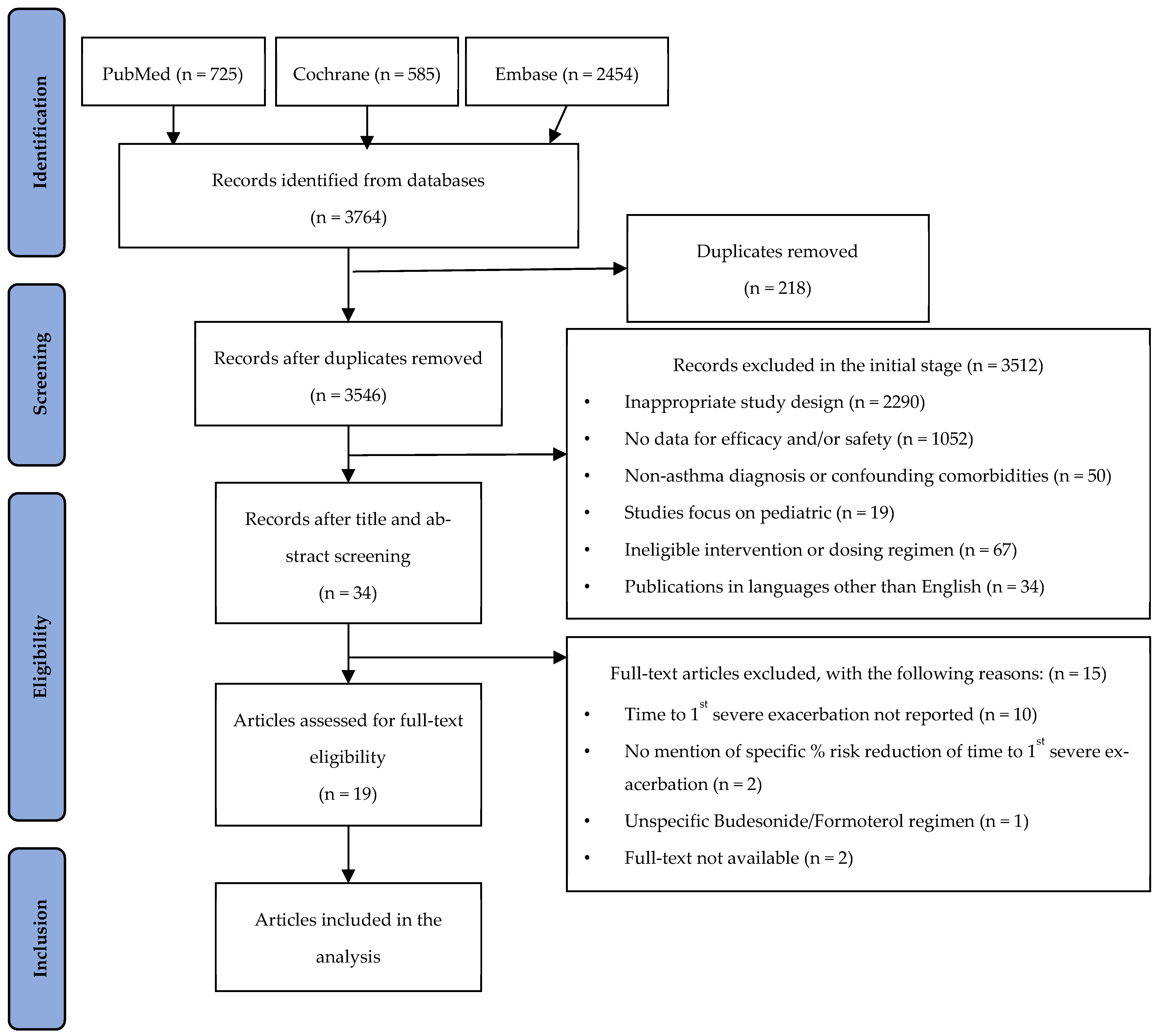
A comprehensive search across the relevant databases identified 3764 studies, including 725 from PubMed, 585 from Cochrane, and 2454 from Embase (Figure 1). After removing 218 duplicate records, 3764 publications remained for title and abstract screening. Of these, 3546 studies were excluded for failing to meet the selection and exclusion criteria. Consequently, the remaining 34 studies underwent further full-text review. Ten RCTs mentioning asthma exacerbation were initially prioritized as potentially relevant during the title and abstract screening, suggesting that they might report the primary outcome of interest (e.g., the time to the first severe exacerbation). However, the subsequent full-text assessment revealed that none provided specific data on the time to the first severe exacerbation. Among these ten, six RCTs focused solely on the exacerbation rate [55,56,57,58,59,60], while the remaining four assessed the time to the first mild [61,62] or mixed severities [63], or recorded no severe events [64]. Two other RCTs reported only the p-value for the time to the first severe exacerbation, without providing hazard ratios or the percentage reduction in the risk of an SE [65,66]. Two articles were not accessible in full text [67,68]. The remaining article was excluded because the B/F regimen (e.g., fixed-dose, MART) could not be determined due to limitations in database coding [69]. Ultimately, 19 articles that fully met the criteria were included in the final dataset.

3.2. Characteristics of Included Trials

The overall features of the eligible trials are summarized in Table 1. A total of 19 studies met the inclusion criteria, comprising 15 RCTs [35,39,40,50,51,70,71,72,73,74,75,76,77,78,79] and four non-RCT studies [41,80,81,82]. The RCTs generally evaluated both the efficacy and safety of Budesonide/Formoterol (B/F), whereas the real-world trials focused primarily on comparative effectiveness.
The majority of the included trials (17/19) restricted inclusion to adolescents and adults aged 12 years and older [35,39,40,41,50,51,70,71,72,74,75,77,78,79,80,81,82]. One study did not explicitly report the age range of its participants [80]. While O’Byrne et al. (2005) was the only trial to include children aged 4–11 years, this subgroup accounted for only 12% of the total cohort (341/2760 patients) [73]. Furthermore, the study design employed a pre-specified stratification ratio of 8:1 for adults to children [73]. Consequently, the pooled results remain predominantly representative of the adult and adolescent population [73]. Regarding asthma severity, 13/19 studies (68.4%) enrolled patients with moderate-to-severe persistent asthma, mostly in trials evaluating B/F as maintenance and reliever therapy (MART) or as maintenance treatment [35,39,40,41,50,72,73,76,77,78,80,81,82]. The remaining six trials (31.6%) focused on mild-to-moderate asthma and predominantly assessed B/F as an as-needed reliever [51,70,71,79], with a smaller number examining B/F as maintenance [75] or as the MART regimen [74]. In addition, the baseline lung function tended to be better in the mild-to-moderate group, with the mean %FEV1 generally between 75% and 89% predicted [51,70,71,74,75,79]. Trials enrolling patients with moderate-to-severe disease showed a wider range of airflow limitation, with the mean baseline FEV1 typically between 41% and 91.6% [35,39,40,41,50,72,73,76,78,81].
With respect to treatment strategies, B/F used as MART was the most common approach, reported in 11/19 studies. The remaining studies used B/F either as an as-needed reliever (4/19 studies, 21.05%) [51,70,71,79], or as maintenance therapy (4/19 studies, 21.05%) [75,77,81,82]. Among MARTs, the most frequent comparators were fixed-dose ICS/LABA maintenance + SABA as-needed (7/11 MART studies, 63.6% [35,39,40,50,73,76,78]), whereas a smaller number compared B/F to ICS maintenance + SABA as-needed [72,73,74]. In the reliever trials, B/F was compared either with SABA-only regimens or ICS + SABA [51,70,71,79]. For the maintenance-only studies, B/F was compared with other ICS/LABA combinations [81,82] or with Budesonide monotherapy (ICS-only regimen) [75].
Across all included trials, the B/F formulations were limited to 80/4.5 µg, 160/4.5 µg, and 200/6 µg per inhalation. Among these, B/F 160/4.5 μg was the most frequently used strength, reported in 6/19 studies (31.6%) [35,39,40,50,72,78]. Sample sizes ranged from over 100 to over 50,000 patients.
The efficacy of Budesonide/Formoterol (B/F) demonstrates a nuanced relationship with dosage and regimen across various studies. Maintenance and reliever therapy (MART) has consistently shown superior efficacy in reducing severe exacerbations compared to higher-dose fixed-maintenance regimens, such as Budesonide alone or Fluticasone/Salmeterol [39,50,74,78]. Crucially, the sources indicate that this superior control is often achieved with a significantly lower total daily dose of inhaled corticosteroids (ICS) than traditional fixed-dose strategies [39,46,50,72,74,78]. While higher ICS doses are generally associated with greater improvements in lung function and reductions in airway inflammation, the timing of administration in response to symptoms (as seen in MART) appears to be a more critical factor for preventing exacerbations than simply increasing the fixed maintenance dose [46,73,79]. The heterogeneity in treatment protocols across studies—ranging from low-dose maintenance (80/4.5 µg) to medium-dose (160/4.5 µg) twice daily—reflects the diverse baseline clinical needs and asthma severities of the studied populations [35,73,74,75,78].
Regarding safety, B/F is generally well-tolerated at both low and medium doses, with adverse event (AE) profiles comparable to those of short-acting beta-agonists or fixed-dose ICS/LABA combinations [39,50]. However, the sources highlight a potential dose-dependent increase in side effects, particularly with long-term high-dose ICS exposure [71]. Systemic side effects, such as cortisol suppression, are more frequently observed at higher doses (e.g., >800 µg/day), whereas lower doses (200–400 µg/day) maintain a higher therapeutic index with minimal systemic activity [71]. Local adverse effects, including oropharyngeal candidiasis and dysphonia, also show a dose–response relationship, although their overall incidence remains low (ranging from 0.5% to 2.0%) in many trials [71,74,78]. Despite the variability in study designs and dosages, the collective evidence suggests that B/F-based strategies effectively balance efficacy and risk when tailored to individual patient needs and asthma severity [50,74,78,81].
In terms of sponsorship, most trials were sponsored by pharmaceutical companies, with AstraZeneca being the predominant funder (15/19 articles, 78.95%) [35,39,40,50,51,70,71,72,73,74,75,77,78,80,82]. Additional industry sponsors included GSK [75,81], and Merck [75]. Public and academic funding bodies were also represented, such as the Health Research Council of New Zealand [51,76,79]. Only one study did not specify any information related to funding sources [41].

3.3. Risk of Bias Assessment

3.3.1. RoB 2.0 Tool for Evaluating RCT

The risk-of-bias assessment following the RoB 2.0 criteria is presented in Figure S1 [83]. In general, 12/15 (80%) trials were assessed as a low risk of bias [35,40,50,70,71,72,73,74,76,77,78,79]. The remaining studies did not meet the criteria for a low risk of bias, mainly due to concerns in Domain 4, “Bias in measurement of the outcome.” [39,51]. Fewer concerns were identified in Domain 2 [39] and Domain 5 [35]. As a result, three studies (16.5%) were judged as having a moderate risk of bias [39,51,75].
For the studies with an overall judgment of a moderate risk of bias, the choice of an open-label design (Domain 2) and the possibility that outcome assessors may have influenced the efficacy outcomes (Domain 4) contributed to increased concerns regarding overall study validity [39,51]. In another trial, although the study complied with several methodological standards, insufficient information about a prespecified protocol led to a moderate-risk judgment in Domain 5 [75].

3.3.2. ROBINS-I Tool for Evaluating Non-RCT

The methodological quality assessment of the included non-randomized controlled trials (non-RCTs) is visually summarized as a traffic-light plot in Figure S2 [83]. In general, all reported non-RCTs were judged to have a serious risk of bias [41,80,81,82]. Most trials published in recent years (¾ articles) failed to adequately control baseline confounding (e.g., asthma severity and exacerbation history), leading to an overall judgment of Domain 1 as Serious [41,80,81]. In Tunceli et al.’s research, the overall serious judgment was mainly driven by selection bias because switchers were excluded from the efficacy analysis during follow-up. Consequently, Domain 3 was graded as Serious [82].

3.4. Efficacy

3.4.1. Maintenance and Reliever Therapy (MART)

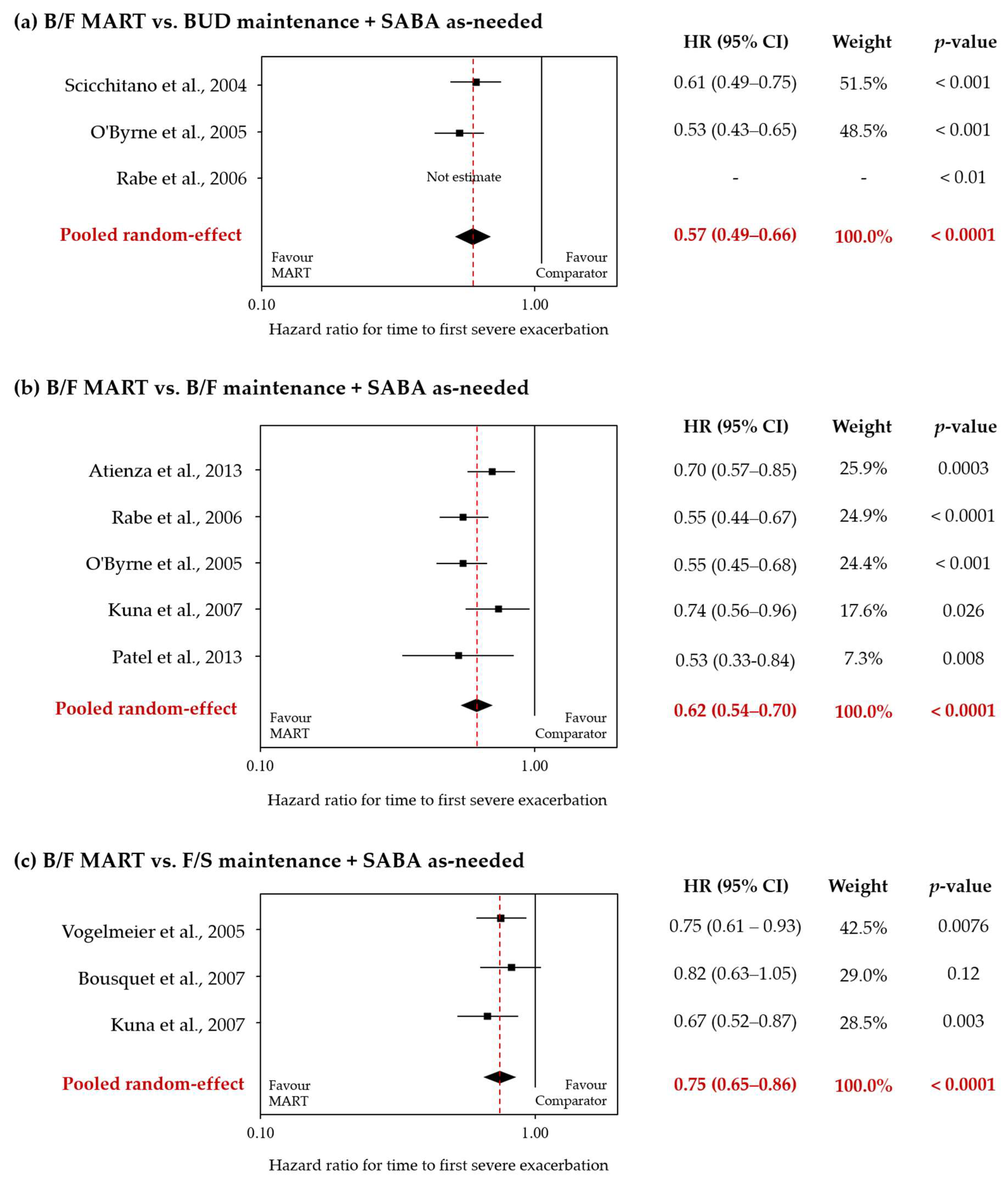
The efficacy of B/F as MART regarding the time to the first severe exacerbation is illustrated in Figure 2. Overall, B/F as MART significantly prolonged the time to the first severe exacerbation across all comparators, including the ICS/LABA maintenance + SABA as-needed regimen and the ICS maintenance + SABA as-needed subgroups. The greatest reduction was observed in the subgroup comparing B/F MART with Budesonide maintenance plus SABA as-needed, where B/F MART reduced the hazard of the first severe exacerbation by 43% (HR = 0.57, 95% CI 0.49–0.66, p < 0.0001, I2 = 0.0%) (Figure 2a).
In comparison with the ICS/LABA maintenance + SABA as-needed regimen, B/F MART was associated with a 38% reduction in the hazard of the first severe exacerbation compared with B/F maintenance plus SABA as-needed (pooled HR = 0.62, 95% CI 0.54–0.70, p < 0.0001, I2 = 33.6%) (Figure 2b). The efficacy of B/F MART was lower in the subgroup compared with Fluticasone/Salmeterol maintenance + SABA as-needed, although B/F MART still significantly reduced the hazard of the first severe exacerbation by 25% (pooled HR = 0.75, 95% CI 0.65–0.86, p < 0.0001, I2 = 0.0%) (Figure 2c).
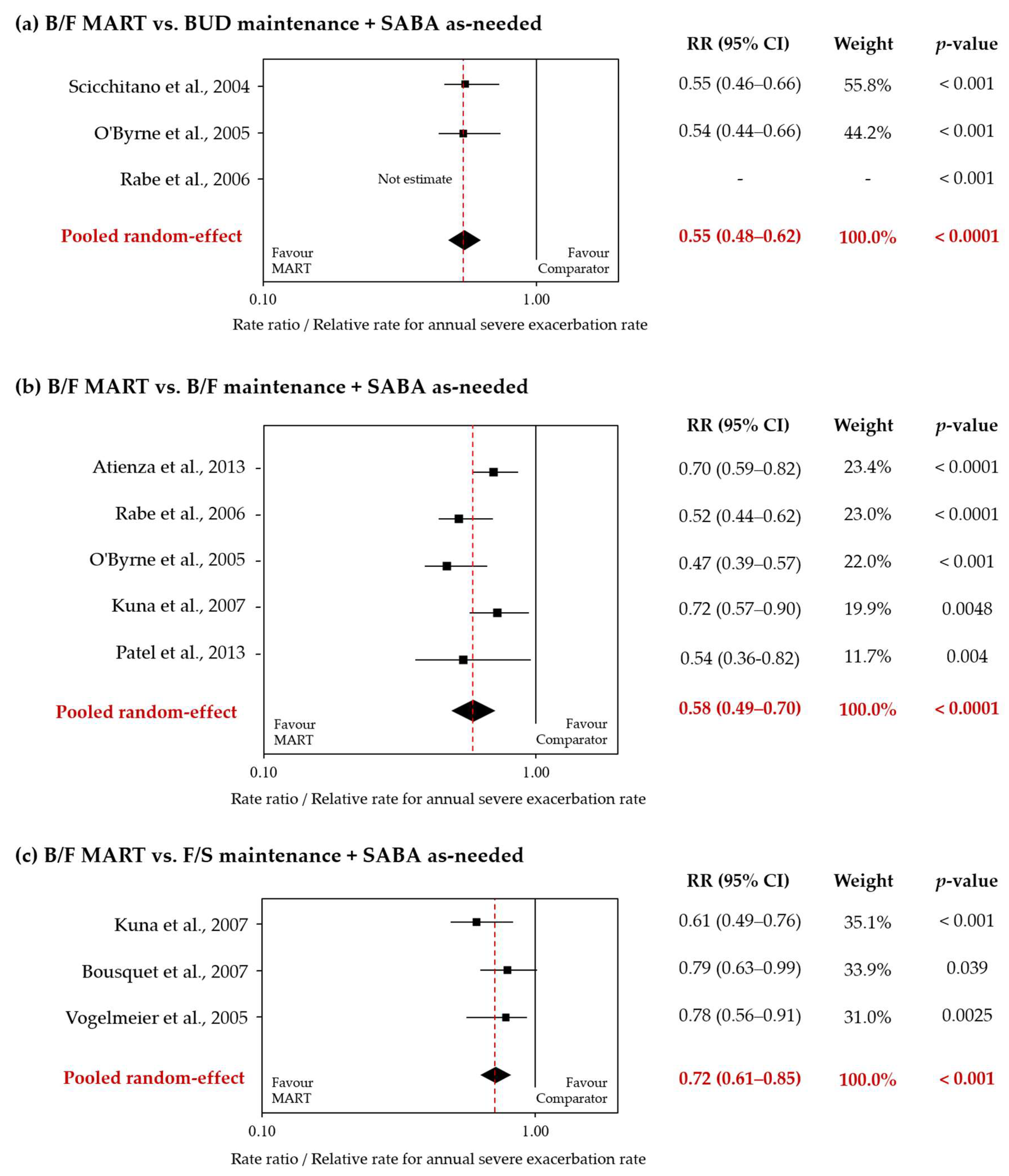
The pooled estimate of B/F as MART for the annual severe exacerbation rate is illustrated in Figure 3. Regarding the annual severe exacerbation rate, B/F MART generally resulted in fewer severe exacerbations than the comparator regimens included, namely ICS/LABA maintenance + SABA as-needed [35,39,40,50,73,76,78] and ICS maintenance + SABA as-needed [72,73,74]. The greatest reduction was recorded in the subgroup comparing B/F MART with Budesonide maintenance + SABA as-needed, where B/F MART reduced the annual severe exacerbation rate by 45% (pooled RR = 0.55 (95% CI 0.48–0.62), p < 0.0001, I2 = 0.0%) (Figure 3c).
Compared with the strategy using Budesonide/Formoterol maintenance + SABA as-needed, B/F MART demonstrated a 42% decrease in annual severe exacerbation rate (pooled RR = 0.58, 95% CI 0.49–0.70, p < 0.0001, I2 = 73.0%) (Figure 3b). When the comparator was changed to Fluticasone/Salmeterol maintenance plus SABA as-needed, B/F MART showed a 28% reduction in annual severe exacerbation rate (pooled RR = 0.72, 95% CI 0.61–0.85, p < 0.0001, I2 = 38.5%) (Figure 3a). Similarly, the number of patients experiencing severe exacerbations and the total number of severe exacerbation episodes were consistently lower in the B/F MART groups across the three comparator subgroups (Table S2).

3.4.2. Reliever Monotherapy

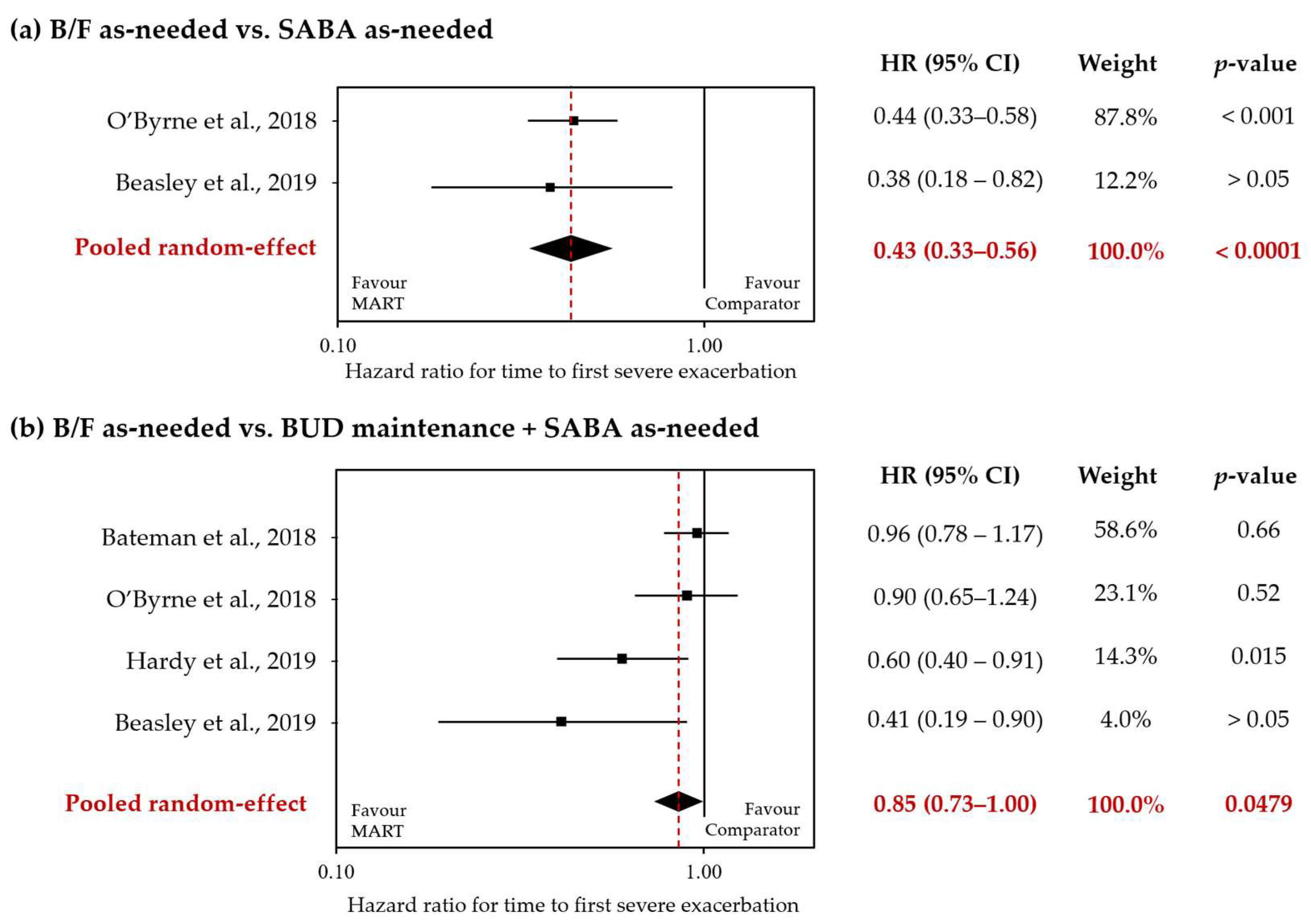
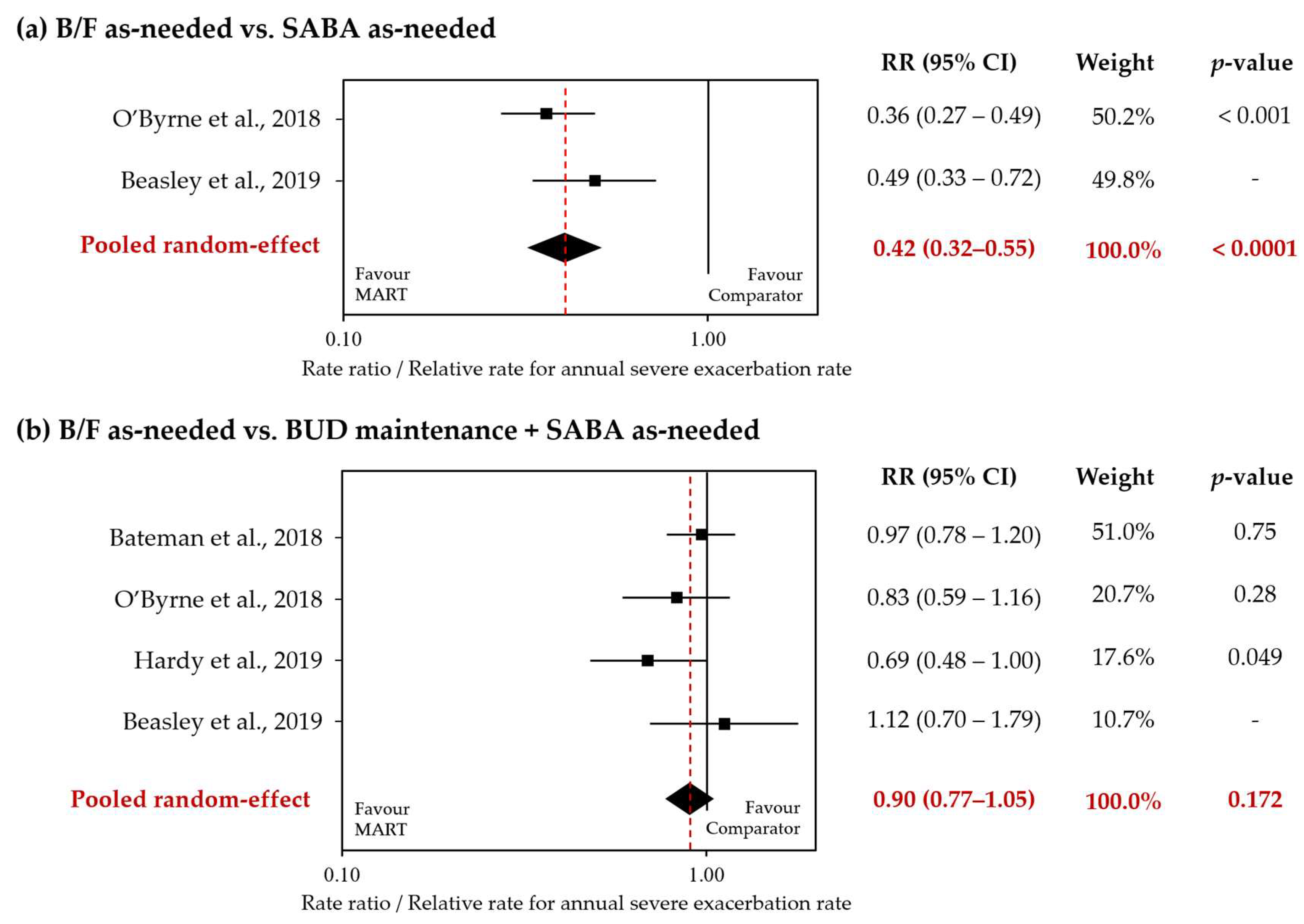
The efficacy of B/F as a reliever in prolonging the time to the first exacerbation is summarized in Figure 4. Patients using B/F as-needed had a 57% lower hazard of experiencing the first severe exacerbation compared with SABA as-needed during the 52-week treatment period (pooled HR = 0.43, 95% CI 0.33–0.56, p < 0.0001, I2 = 0.0%) (Figure 4a). In the subgroup compared with ICS maintenance plus SABA as-needed, B/F as-needed was associated with a 15% lower hazard of the first severe exacerbation after 52 weeks, with borderline statistical significance (pooled HR = 0.85, 95% CI 0.73–1.00, p = 0.0479, I2 = 60.7%) (Figure 4b).
Moreover, the pooled estimate of the annual severe exacerbation rate for B/F as-needed, compared with other regimens, is summarized in Figure 5. In the subgroup compared with the SABA-only reliever, B/F as-needed was associated with a statistically significant 58% lower annual SE rate (Pooled RR = 0.42, 95% CI 0.32–0.55, p < 0.0001, I2 = 34.0%) (Figure 5a). However, the pooled effect of B/F as-needed compared with the ICS maintenance + SABA arms did not reach significance (pooled ratio = 0.90, 95% CI 0.77–1.05, p = 0.172, I2 = 15.1%) (Figure 5b). Across the two subgroups, fewer patients had at least one SE episode, and fewer SE cases were reported in the B/F as-needed regimen (Table S3).

3.4.3. Maintenance Monotherapy

The efficacy of B/F as maintenance therapy is displayed in Table S4. In comparison with the ICS maintenance-only regimen, only one of the two trials reported a statistically significant reduction in the time to the first severe exacerbation. Peters et al. showed that B/F maintenance was associated with a 16% lower hazard of the first severe exacerbation during 26 weeks of treatment [77], whereas the 12-week trial by Lalloo et al. did not reach statistical significance [75]. Peters et al. also reported fewer patients experiencing at least one severe exacerbation and fewer total severe exacerbation events in the B/F maintenance group compared with the ICS maintenance-only group [77].

3.5. Effectiveness

The effectiveness of B/F as MART and maintenance therapy in a real-world studies is illustrated in Table 2. Overall, the exacerbation outcomes were mostly comparable between B/F and the comparators: no statistically significant differences were reported in 3/4 studies [41,80,81] while one study showed a significantly lower exacerbation rate with B/F compared with FP/SAL (p = 0.0255) [82].
The B/F MART regimen showed no significant difference in the severe exacerbation rate or the hospitalization rate due to exacerbations compared with ICS/LABA + SABA [80]. Huang et al. similarly found no significant difference in the mean change in annual acute exacerbations between B/F MART and FF/VIL MART [41]. Moreover, B/F maintenance provided a comparable exacerbation rate to the ICS/LABA option (Fluticasone/Salmeterol) over a 12-month follow-up [74,75], with ½ of the trial results being not statistically different [81]. Taken together, these real-world data suggest that B/F, as MART or maintenance, provides comparable effectiveness in reducing exacerbations.
Regarding lung function, the changes in FEV1 were small and not significantly different between the groups in both MART cohorts [41,80]. Asthma symptom control varied between the studies: Cheng et al. observed a statistically greater improvement in ACQ-5 with B/F than with F/S (p = 0.027), although the between-group difference did not reach the minimal clinically important difference (MCID) [80], while Huang et al. reported a larger increase in the ACT score in the FF/VIL MART group than in the B/F MART group (p < 0.001) [41].

3.6. Safety

3.6.1. Maintenance and Reliever Therapy (MART)

The most common adverse event of Budesonide/Formoterol as MART are demonstrated in Table 3. Overall, B/F, used as a MART strategy at doses of 80/4.5 μg and 160/4.5 μg, is well tolerated over a 6- to 12-month treatment period. The incidence of side effects between B/F and comparators was comparable across trials, ranging from 38% to 61.4% for B/F and from 40% to 57.5% for ICS/LABA maintenance + SABA as-needed [39,64,65,68] and ICS maintenance + SABA as-needed [72,73,74]. The most common AEs were mild-to-moderate and focused on respiratory infections, including upper respiratory tract infections, nasopharyngitis, bronchitis, pharyngitis [35,40,72,74,76]. Less frequently reported AEs were candidiasis and hoarseness, which were noted in Rabe et al.’s research [78].
Serious adverse events were less than 8.2% and comparable between B/F and the comparators [35,39,40,50,73,76,78]. Similarly, the discontinuation rate due to AE was relatively low, as observed in trials evaluating B/F MART vs. ICS/LABA + SABA [76,78] and B/F maintenance vs. ICS + SABA [72].

3.6.2. Reliever or Maintenance Monotherapy

Detailed data related to the adverse events of B/F for either reliever or maintenance purposes is shown in Table 4. Similar to MART, B/F used for relief purposes is well-tolerated, as it has an AE rate comparable to those of the SABA option and ICS maintenance + SABA as-needed therapy. The incidence varied among studies, ranging from 38% to 88% for B/F and 39.9% to 83.7% for the comparators [51,70,71,79].
The most common side effects of B/F (for reliever purposes or maintenance purposes) and the comparators are upper respiratory tract infection, nasopharyngitis, and asthma [51,70,71,79]. The discontinuation rate due to AEs was low (less than 3%) and not significant between the intervention groups [70,71,77]. In addition, the prevalence of SAEs is also comparable between B/F and the comparators in the majority of trials [51,70,77]. Notably, only the study by Beasley et al. [51] recorded a double SAE rate in the B/F relief group compared to Albuterol as-needed over 52 weeks. [51].

4. Discussion

4.1. Efficacy

Our findings reveal that using B/F as MART prolongs the time to the first SE and reduces the annual SE rate more effectively than regimens involving SABA as a reliever, such as ICS/LABA maintenance + SABA as-needed or ICS maintenance + SABA as-needed. The reduction in the risk of first SE with B/F MART was most pronounced compared with ICS maintenance + SABA as-needed, at 43%. In a previous systematic review, Jenkin et al. estimated around a 36–40% reduction in SE compared to high-dose ICS/LABA + SABA in patients treated with GINA step 3–4 [36], which is broadly aligned with our findings. Similarly, the network meta-analysis of RCTs by Rogliani et al. also reported a 46% reduction in SE risk in the B/F MART groups among individuals with moderate-to-severe asthma [84]. Our findings extend this evidence by further evaluating whether the choice of maintenance ICS/LABA comparator influences the estimated benefit of B/F MART. When stratified by comparator regimen, B/F MART reduced the risk of SE by 38% compared with B/F maintenance + SABA as-needed and by 25% compared with F/S maintenance + SABA as-needed.
Among ICS/LABA combinations, both Formoterol and Salmeterol are the most widely prescribed LABAs in more than 30 countries [70]. But Formoterol has pharmacological properties that make it more suitable for reliever-based use. Formoterol has been shown to be a near–full β2-agonist whereas salmeterol shows the lowest intrinsic efficacy among LABAs, consistent with its partial agonism [38]. Translating to bronchodilation, at the receptor level, Formoterol is likely to exert a greater capacity to relax airway smooth muscle than salmeterol, which may be advantageous during acute bronchoconstrictive episodes. In addition, Formoterol has a rapid onset of bronchodilation (approximately 1–3 min), whereas salmeterol has a slower onset (15–20 min) [85]. As a result, the B/F inhaler can be used for both maintenance and reliever purposes, while F/S is primarily used for maintenance therapy. Another positive finding from an in vitro study is that Formoterol portrayed a greater ability to modulate neutrophil activity than salmeterol, suggesting potential additional immunomodulatory effects when used in both maintenance and reliever regimens [86]. Although B/F MART has demonstrated favorable efficacy in reducing the risk of severe exacerbations and is widely used in many countries, B/F is approved in the U.S. as a maintenance therapy but not for as-needed or MART use [37,87]. This regulatory discrepancy may partly contribute to its variable real-world implementation. In a U.S. survey assessing MART adoption, approximately 87% of patients recommended MART were still prescribed SABA, while less than 60% of clinicians had recommended MART, suggesting persistent implementation gaps [88]. Another study evaluated the implementation of asthma regimens for moderate-to-severe asthma in the Italian healthcare system and found that although ICS-Formoterol was the most frequently reported treatment, only 21.6% of ICS-Formoterol users adopted the correct MART approach [89]. These findings suggest that, despite the clinical efficacy of B/F MART, the implementation of MART in real-world practice remains suboptimal.
For symptom relief, at present, there are only two single-inhaler therapies that combine ICS with β2-agonists: ICS adjunct with either fomoterol (LABA) or albuterol (SABA) [90,91]. Specifically, reliever-based treatment is used in mild asthma at Steps 1–2, whereas MART treatment is applied for moderate-to-severe conditions in Steps 3, 4, and 5 [92]. A 2024 review found that using ICS/Formoterol as a rescue medication reduced severe exacerbations by approximately half compared with SABA [93]. Consistently, in our study, although B/F, used as a reliever, did not reach statistical significance for the time to the first severe exacerbation or the annual severe exacerbation rate, it was associated with a ~50–60% numerical reduction over 52 weeks compared with a SABA-only strategy. It is well established that persistent asthma is underpinned by three mechanisms: T2 inflammation, airway hyper-responsiveness, and reversible airway constriction. When patients are exposed to triggers, the T2 inflammatory cascade is activated, with cytokines such as IL-4, IL-5, and IL-13 driving eosinophilic airway inflammation. As a result, airway smooth muscle becomes twitchier and more hypersensitive, making the airways increasingly prone to bronchoconstriction and hyperresponsive even to small subsequent stimuli. Accordingly, administering Budesonide whenever bronchospasm occurs may contribute to improved future bronchoprotection [94]. Given that single-inhaler B/F in our study reduced total SE episodes to a greater extent than the same dose of ICS used separately with a SABA reliever, our findings are in line with the GINA preference for the anti-inflammatory reliever (AIR) approach, where the reliever contains an ICS component combined with a bronchodilator in a single inhaler [1].
Another reason supporting the inclusion of ICS into reliever therapy is that the concurrent use of β2-agonists, such as LABAs or SABAs, has been associated with the development of tachyphylaxis [95]. In simpler terms, the repeated use of a LABA or SABA reduces the availability of β2-adrenergic receptors (β2AR), diminishing the bronchodilatory effects. In contrast, combining β2-agonists with an ICS may offset this limitation through synergistic mechanisms: the ICS can increase pulmonary β2AR expression, while β2AR activation can, in turn, enhance the anti-inflammatory effects of corticosteroids [95]. However, this should not be interpreted as encouraging patients to “switch” from SABA to B/F and then rely on it frequently, because increased reliever use is consistently associated with a higher exacerbation risk and a more persistent asthma phenotype, regardless of whether the reliever contains an ICS [96]. Thus, the key to treatment success is to minimize the frequency with which patients rely on reliever medication. Within this context, Budesonide/Formoterol has received regulatory approval as AIR therapy in individuals aged ≥12 years in over 35 countries [93], whereas the FDA has not approved B/F for as-needed treatment or MART [37,97].
As maintenance therapy, our analysis included only one of the two available RCTs, suggesting that B/F may reduce the exacerbation risk to a greater extent than Budesonide-only ICS treatment. Notably, the magnitude of evidence is relatively limited compared to the previous review [98]. Mukhopadhyay et al.’s research analyzed the B/F maintenance but on a broader scale, including 24 trials, and extended to many comparators, including ICS/LABA, B/F maintenance [98]. However, the primary outcomes assessed in that review differed from those examined in our study. Mukhopadhyay et al. focused primarily on clinical outcomes such as FEV1 improvement and asthma control, whereas we prioritized severe exacerbations, which are a key determinant in selecting the appropriate long-term regimen [98].

4.2. Effectiveness

While B/F MART has been shown to be superior to other therapeutic regimens in randomized trials, real-world evidence suggests it is more comparable in effectiveness to ICS/LABA + SABA. Differences in patient selection and study protocols between RCTs and non-RCTs, which also led to different risk-of-bias profiles, may have contributed to this divergent trend. It has been reported that around 5% of the real-world asthma population would meet typical RCT eligibility criteria [86,99]. RCTs tend to include a very narrow patient population, as patients are standardized during a run-in phase and required to use SABA for 5–7 days before randomization [50,70]. By enriching for patients more likely to experience exacerbations, the treatment effect of B/F versus the comparator can be captured more easily. On the other hand, non-RCTs require patients to remain under observation for at least 12 months to be included in the effectiveness analysis [41,80]. Under these conditions, the analyzed populations in both the B/F and comparator groups are less prone to exacerbations and tolerate the treatment well. Ultimately, the differences in exacerbation reduction between the two interventions become harder to discern. Moreover, in Cheng et al.’s trial, the baseline exacerbation history differed significantly between the groups [80], indicating confounding by indication. Patients receiving the comparator were initially more vulnerable to exacerbations, which could blur the true impact of B/F on exacerbation outcomes and make the results appear more comparable.
Another difference in B/F efficacy between RCTs and non-RCTs is that findings from randomized trials compare the efficacy of treatment strategies, rather than isolating the intrinsic effectiveness of individual therapeutic components. This contrast is less apparent in non-RCTs, where B/F was compared with other ICS/LABA options within clinical use (maintenance vs. maintenance, MART vs. MART). Recent studies have observed greater efficacy in reducing exacerbation rates with FF/VIL than with B/F as a maintenance strategy [100,101,102]. Our findings extend this evidence by suggesting that this apparent advantage does not necessarily translate to the MART setting, where the two interventions showed comparable efficacy. This observation is notable given that, to date, only two regimens are authorized for MART usage: Budesonide/Formoterol and Beclomethasone/Formoterol [92,103]. Nevertheless, the interpretation should be taken with caution as only one trial was synthesized. Within the ICS class, fluticasone furoate has been proven to have the highest anti-inflammatory effect [94,104,105]. Its effect is up to 24h, allowing sustained bronchoprotection and once-daily dosing, in contrast to the twice-daily regimen typically required for Budesonide. Furthermore, Vilanterol is among the ultra-long-acting LABAs; thus, its combination with fluticasone furoate is expected to provide greater reductions in exacerbations and reliever use, potentially supporting better treatment adherence compared to B/F [100,106,107].
A simulation study comparing B/F twice daily and FF/VIL once daily in moderate-to-severe asthma found that B/F MART would require an additional 3 to 7.25 inhalations compared with FF/VIL [101]. Lower levels of cortisol suppression were also observed in the FF/VIL group, indicating potentially reduced systemic corticosteroid exposure [101]. The dosing simplicity, as well as the prolonged bronchodilatory profile of Fluticasone furoate/Vilanterol, may help FF/VIL numerically improve overall asthma control compared to B/F (higher ACT scores, but not reaching the minimal clinically important difference) [41]. Furthermore, MART regimens have been associated with a high rate of uncontrolled asthma symptoms, with approximately 44.3% of patients remaining uncontrolled. Despite reported adherence, patients receiving MART may still experience severe exacerbations within the first year after treatment initiation [108]. In a 12-week post-marketing study in India evaluating FF/VI as a maintenance therapy in patients uncontrolled on conventional treatment, most patients had previously been treated with ICS/LABA, with B/F SMART being the most common baseline regimen. Treatment with FF/VI led to significant improvement in asthma symptoms, as reflected by a reduction in the ACQ-5 score. Notably, no severe exacerbations were recorded during the 12-week treatment period [108]. Thus, although FF/VIL is not approved for MART use, it may serve as a complementary once-daily maintenance option for selected patients who remain uncontrolled on MART.
The increasing role of biologics is defined by their ability to provide targeted interventions based on predictive biomarkers and specific clinical phenotypes [44]. Anti-IgE therapy (omalizumab) was the first biologic approved for asthma, specifically targeting perennial allergen sensitization and reducing seasonal viral exacerbations [43,44]. For patients with severe eosinophilic asthma, anti-interleukin-5 (anti-IL-5) agents like mepolizumab and reslizumab, or the receptor blocker benralizumab, effectively reduce severe exacerbations by depleting blood and tissue eosinophils [43,44]. Anti-IL-4/13 (dupilumab) blocks the IL-4Rα subunit, demonstrating high efficacy in reducing oral corticosteroid (OCS) dependence and managing Type 2 comorbidities such as nasal polyps and atopic dermatitis [43,44]. A major advancement is the introduction of anti-TSLP (tezepelumab), which targets epithelial alarmins and maintains clinical efficacy irrespective of T2 biomarker status, providing a vital option for T2-low patients [44]. Selecting the optimal biologic is a highly individualized process that requires clinicians to integrate blood eosinophil counts, fractional exhaled nitric oxide (FeNO), and total IgE with a patient’s unique comorbidities and OCS requirements [43,44]. Through these personalized mechanisms, modern therapy now strives toward achieving clinical remission and minimizing the long-term adverse effects associated with high-dose steroid use [43,44].

4.3. Safety

Our findings indicated that Budesonide/Formoterol is well tolerated as a maintenance, reliever, or combined therapy (MART), with comparable incidences of AEs, SAEs, and discontinuation rates across comparisons. This was observed at both the low dose (200–400 µg/day) and the medium dose (>400–800 µg/day) of B/F, with dosage levels determined based on the total daily dose of ICS (e.g., Budesonide) for adolescents and adults [109]. The most common AEs in the B/F groups were upper respiratory tract issues (e.g., infections, nasopharyngitis, and influenza), with no significant differences compared with the other groups. These symptoms are known to be associated with ICS use [110,111] and align with the findings from previous studies on the safety of B/F [48,98].
Regarding the safety of B/F MART, although the overall AEs rates were substantial, B/F MART demonstrated lower AE-related discontinuation rates than conventional ICS-containing maintenance plus as-needed SABA regimens over 24–52 weeks [39,72,76,78]. The observed gap of around 20% in AE rates between B/F MART (38–61.4%) and B/F reliever (38–88%) over 52 weeks is expected, given the mandatory daily maintenance dose in the MART regimen. However, this regular ICS exposure with B/F MART does not necessarily translate into higher cumulative corticosteroid toxicity. Following our included RCTs, compared to ICS-containing therapies (ICS maintenance; ICS/LABA + SABA), the mean total daily ICS dose was 25–62.5% lower in the B/F MART group over a 6- to 12-month treatment period [35,50,72,73]. This observation appears to be closely linked to the reduction in severe exacerbations (SE). A lower frequency of exacerbation events with B/F MART may reduce the subsequent need for rescue medications, thereby lowering cumulative corticosteroid exposure. This trend is compatible with previous studies, which suggest an association between B/F MART and a decreased requirement for oral corticosteroids [42,45].
Adherence still significantly affects treatment efficacy in adolescent and adult patients with asthma, especially since concerns about adverse events are a primary barrier to adherence [112,113]. Real-world data indicate that non-adherence to ICS was significantly higher in lower GINA steps, peaking at 82% in Step 2, with approximately one-third of patients with mild asthma (Steps 1–2) reporting poor adherence [114,115]. In the current review, our analysis revealed that the AEs and AE-related discontinuation rates were similar between as-needed B/F and alternative regimens (e.g., as-needed SABA or ICS maintenance plus as-needed SABA using two separate inhalers) in patients with mild asthma [51,70,71], although slightly lower in the B/F group [51,70,71]. Based on these findings and the comparable efficacy across regimens, using as-needed B/F from the outset (Step 1) simplifies device use, thereby improving adherence and reducing the need for OCS by lowering the risk of exacerbation. These observations further support the current treatment regimen in adolescents and adults, specifically the recommendation for as-needed B/F in Steps 1–2 of Track 1 [109].
Additionally, our results did not show any abnormal AEs or mortality due to B/F use, thereby supporting previous studies on the consistent safety of B/F compared to SABA alone or the ICS plus as-needed SABA regimen [46,116]. However, there was substantial evidence indicating that the overuse of SABA is a significant risk factor for exacerbations and asthma-related mortality [24,25]. To mitigate this risk, B/F offers a distinct pharmacological advantage over the SABA reliever regimen. While SABA only provides bronchodilation [117], which potentially leaves the underlying inflammation uncontrolled, as-needed B/F ensures that airway inflammation is addressed simultaneously with every symptom-relief actuation. Previous studies also highlighted that the MART strategy effectively reduces SABA reliance and helps prevent the progression of severe asthma exacerbations [42,118]. Overall, these observations further validate the recommendation to use B/F MART in Steps 3–4 [109] This strategy effectively eliminates the overuse of SABA, ensuring that any increase in symptoms is met with the necessary anti-inflammatory intervention.
Furthermore, in line with previous studies [77,119], our analysis found an extremely low incidence (ranging 0.5–2.0%) of both Formoterol-related cardiovascular adverse events (e.g., tachycardia, palpitations, arrhythmogenic potential) and ICS-associated complications (e.g., oropharyngeal candidiasis, dysphonia). However, a comprehensive review by Rayner et al. (2024) [120] on ICS/Formoterol therapy still reported a non-significant incidence of severe CDV events and pneumonia over a 6- to 54-week period, whereas our analysis did not identify any treatment-related events of this nature [51,70]. This discrepancy is likely attributable to methodological constraints, as the RCTs included in our study generally had modest sample sizes and were not adequately powered to detect these rare harms within a limited 52-week timeframe. Therefore, these cumulative risks still require careful monitoring in routine practice.
Clinically relevant cardiovascular adverse effects associated with long-acting β2-agonist (LABA)-containing therapies are recognized as pharmacologically predictable class effects of β2-adrenoceptor stimulation [72,74,75,78]. These adverse events primarily manifest as tachycardia, palpitations, and arrhythmias, including specific reports of atrial fibrillation [72,74,78]. Systematic reviews and randomized controlled trials consistently demonstrate an extremely low incidence of these events, typically ranging from 0.5% to 2.0% in patients treated with combinations such as Budesonide/Formoterol [72,73,74,78]. Despite their rarity, cardiovascular symptoms like palpitations are among the most frequently cited class-related reasons for treatment discontinuation in clinical studies [50,73,76]. There is a theoretical concern that the use of highly efficacious agonists could lead to greater cardiotoxicity—specifically tachyarrhythmias—during episodes of extreme overuse, particularly when exacerbated by the hypoxia present during a severe asthma attack [38,42,76]. However, comprehensive pooled analyses and network meta-analyses of large-scale clinical trials have confirmed that LABAs, when used in fixed-dose combinations with inhaled corticosteroids, do not significantly increase the risk of serious cardiovascular adverse events or mortality compared with short-acting β2-agonists or inhaled corticosteroids alone [36,98,120].
Inhaled corticosteroids (ICS) are fundamental to asthma management and are generally well-tolerated, though they are associated with several specific local and systemic adverse effects [110]. The most common side effects are respiratory-related, specifically upper respiratory tract infections (URTIs), nasopharyngitis, pharyngitis, and bronchitis [35,40,48,51,110]. Local complications resulting from drug deposition in the throat include oropharyngeal candidiasis (oral thrush) and dysphonia (hoarseness or voice changes), which typically occur at a low incidence of 0.5% to 2.0% but can increase with higher doses [72,73,74,78]. Other frequently reported symptoms include a sore throat, a cough, pharyngolaryngeal pain, and dysgeusia (adverse taste) [51,72,98,112]. Although the systemic effects are more prevalent with oral corticosteroids, long-term or high-dose ICS exposure can lead to cortisol suppression, skin thinning, bruising, and potentially increased risks of cataracts, glaucoma, and diabetes (hyperglycemia) [101,104,110,112]. Furthermore, at very high cumulative doses, there are concerns regarding bone mass attrition and an increased risk of fractures [98,101]. To minimize these risks, clinicians recommend preventive measures such as using spacer devices or rinsing the mouth with water after inhalation to reduce local drug deposition [98,112].

4.4. Implications, Strengths, and Limitations

The findings from our study suggest relevant clinical implications, particularly for patients with moderate-to-severe asthma. Regarding asthma control, B/F therapy is superior to ICS/LABA + SABA regimens in RCTs, although efficacy is often comparable in real-world settings (non-RCTs). Specifically, in RCTs, our analysis highlights the superior efficacy of the B/F MART regimen compared with maintenance therapies (either B/F or F/S) combined with as-needed SABA. Concurrently, safety data reinforce that B/F has a well-tolerated profile, demonstrating non-inferiority to current ICS/LABA + SABA regimens. Drawing upon these three key observations, B/F might be an effective and safe alternative over a 12-month period for patients with moderate-to-severe asthma, particularly those with poor treatment adherence or at an elevated risk of severe exacerbations. For patients with more severe symptoms associated with T2 inflammation who remain uncontrolled despite dual therapy, more potent approaches such as biologic-based precision medicine may be appropriate [121,122,123]. However, treatment responses remain variable, and many patients remain uncontrolled. T2-low disease lacks good options, and cost/access and biomarker limitations prevent it from being a universal or standalone solution for broad asthma management [43,44].
This systematic review’s main strength is its comprehensive focus on long-term clinical trials (e.g., 6–12 months), evaluating both B/F MART and B/F as maintenance or reliever monotherapy. Including studies with up to 12 months of follow-up, such as recent RCTs and real-world data, provides a thorough evaluation of the severe exacerbation risk across diverse treatment strategies. To the best of our knowledge, this is one of the few comprehensive studies to evaluate the AE-related factors of B/F across all three regimens. This helps clarify earlier assessments of the safety and potential to reduce the risk of adverse events associated with B/F compared with other ICS/LABA or SABA-only regimens [46,116,120]. While the systematic review indicates that Budesonide/Formoterol (B/F) is “well-tolerated,” this conclusion is limited by the 6- to 12-month duration of the included clinical trials. Because asthma is a lifelong chronic condition, these randomized controlled trials (RCTs) have inherent limitations and may not accurately reflect the chronic safety profile or very long-term tolerability of a treatment that patients often utilize for many years [116]. Most available outcome data do not extend beyond 52 weeks, so the cumulative effects of decades of maintenance therapy remain under-researched for these specific regimens analyzed in this meta-analysis [46,116]. Consequently, the potential for long-term adverse events associated with chronic ICS or Formoterol exposure—such as cumulative systemic effects or impacts on lung function decline—still requires vigilant monitoring in real-world clinical practice. Short-term study designs are often insufficient to evaluate complex, slowly progressing outcomes like airway remodeling or sustained changes in lung function [36,116]. To bridge this gap, future research must prioritize large-scale longitudinal studies and real-world registry data to fully assess the chronic tolerability and sustainability of B/F-based strategies over a patient’s entire lifespan [36,46,116].
However, our review also has certain limitations. Most trials focus on adolescent and adult populations. Although numerous studies have evaluated the efficacy of B/F in asthma management, the real-world effectiveness of B/F in children under 11 years of age remains limited. This gap can complicate the determination of the optimal initial treatment strategy for this younger demographic. Compared to the MART strategy, the evidence supporting the use of B/F as needed or as maintenance monotherapy in this review is considerably less robust. While 14 RCTs support the efficacy of MART, only four studies have examined B/F as-needed monotherapy, and only two reports have compared maintenance B/F with Budesonide alone. This limited amount of data may not be sufficient to draw clear or comprehensive conclusions about the long-term effectiveness and safety of these monotherapy regimens compared with other treatment options. Therefore, more extensive future studies are necessary to thoroughly assess B/F’s treatment profile outside the MART context.
Nonetheless, our conclusions are based solely on RCTs, which have inherent limitations in representing a lifelong chronic condition such as asthma. Because the majority of the included trials had a limited follow-up of 6- to 12-month periods, our ability to definitively assess the chronic safety profile and very long-term tolerability of B/F remains limited, as these short-term studies may not accurately reflect real-world safety. Therefore, long-term observational studies and real-world registry data remain essential for monitoring the chronic tolerability of B/F over time.

5. Conclusions

Budesonide/Formoterol as a MART regimen is the most effective for preventing severe exacerbations compared with ICS/LABA + SABA, ICS + SABA, and is not inferior to conventional best practice. In longer-duration studies, as-needed B/F remained favorable over a SABA-only reliever therapy in reducing the severe exacerbation risk, although this advantage was not statistically significant when compared with ICS maintenance + as-needed SABA. Evidence comparing B/F as a maintenance dose vs. an ICS-only strategy remained limited. Real-world studies, although limited, suggest that B/F demonstrates effectiveness in reducing exacerbation rates comparable to that of comparators. Over 6- to 12-month treatment, Budesonide/Formoterol is well tolerated. Nevertheless, considering the lifelong trajectory of asthma, the treatment and AEs associated with long-term ICS or Formoterol still require regular monitoring in a real-world clinical context.

6. Future Directions

Future research on Budesonide/Formoterol (B/F) in asthma should prioritize narrowing the gap between randomized controlled trial (RCT) efficacy and real-world effectiveness through pragmatic trials and large-scale longitudinal studies, particularly given the current evidence supporting the superiority of B/F as maintenance and reliever therapy (MART) in reducing severe exacerbations while still demonstrating heterogeneity across patient populations. A key direction involves advancing phenotype- and biomarker-driven approaches to better stratify patients by inflammatory endotypes (e.g., type 2-high vs. type 2-low asthma), thereby optimizing the selection among MART, fixed maintenance, or reliever-based strategies. In parallel, further pharmacokinetic–pharmacodynamic (PK/PD) investigations and real-world adherence analyses are essential to refine dosing flexibility and inhaler use, particularly in populations with suboptimal inhalation technique or adherence, which remain critical determinants of clinical outcomes. Beyond efficacy, future work should integrate health economic evaluations to assess the cost-effectiveness relative to emerging therapies such as biologics and triple therapies, especially in the context of exacerbation-driven healthcare expenditures. The incorporation of digital health technologies, including smart inhalers and real-time monitoring systems, may further enhance treatment effectiveness by optimizing adherence and enabling the early detection of exacerbations. Finally, long-term safety surveillance and comparative effectiveness studies across diverse and underrepresented populations are necessary to ensure the generalizability and sustainability of B/F-based strategies within evolving global asthma management frameworks.

Supplementary Materials

The following supporting information can be downloaded at: https://www.mdpi.com/article/10.3390/healthcare14131864/s1.

Author Contributions

Conceptualization, N.X.V. and T.T.B.; methodology, N.X.V.; software, T.T.B. and H.L.P.; validation, N.X.V. and T.T.B.; formal analysis, T.T.B. and H.L.P.; investigation, N.X.V.; resources, H.L.P., H.T.H., K.Q.C. and T.T.B.; data curation, H.L.P., H.T.H., K.Q.C., T.T.B. and N.X.V.; writing—original draft preparation, H.L.P., H.T.H., K.Q.C. and T.T.B.; writing—review and editing, N.X.V., H.L.P., H.T.H., K.Q.C. and T.T.B.; visualization, N.X.V. and T.T.B.; supervision, N.X.V.; project administration, N.X.V. All authors have read and agreed to the published version of the manuscript.

Funding

This research received no external funding.

Institutional Review Board Statement

Not applicable.

Informed Consent Statement

Not applicable.

Data Availability Statement

The data were collected from PubMed, Embase, and Cochrane.

Conflicts of Interest

The authors declare no conflicts of interest.

References

  1. Global Initiative for Asthma. Global Strategy for Asthma Management and Prevention. 15 November 2025. Available online: https://ginasthma.org/2025-gina-strategy-report/ (accessed on 28 January 2026).
  2. Shin, Y.H.; Hwang, J.; Kwon, R.; Lee, S.W.; Kim, M.S.; GBD 2019 Allergic Disorders Collaborators; Shin, J.I.; Yon, D.K. Global, regional, and national burden of allergic disorders and their risk factors in 204 countries and territories, from 1990 to 2019: A systematic analysis for the Global Burden of Disease Study 2019. Allergy 2023, 78, 2232–2254. [Google Scholar] [CrossRef] [Scilit] [PubMed]
  3. Flores, P.; Teixeira, J.E.; Leal, A.K.; Branquinho, L.; Fonseca, R.B.; Silva-Santos, S.; Batista, A.; Encarnação, S.; Monteiro, A.M.; Ribeiro, J.; et al. Asthma Prevalence in Adolescent Students from a Portuguese Primary and Secondary School. Adolescents 2022, 2, 381–388. [Google Scholar] [CrossRef] [Scilit]
  4. Freels, L.; Herman, A.; Lukas, S.; Chan, A.H.Y.; Pearce, C.J.; Arackal, J.; Beyene, K. Asthma control and associated risk factors among adults with current asthma: Findings from 2019 behavioral risk factor surveillance system asthma call-back survey. Respir. Med. 2024, 221, 107479. [Google Scholar] [CrossRef] [Scilit] [PubMed]
  5. Garcia-Marcos, L.; Chiang, C.Y.; Asher, M.I.; Marks, G.B.; El Sony, A.; Masekela, R.; Bissell, K.; Ellwood, E.; Ellwood, P.; Pearce, N.; et al. Asthma management and control in children, adolescents, and adults in 25 countries: A Global Asthma Network Phase I cross-sectional study. Lancet Glob. Health 2023, 11, e218–e228. [Google Scholar] [CrossRef] [Scilit] [PubMed]
  6. Neffen, H.; Chahuan, M.; Hernandez, D.D.; Vallejo-Perez, E.; Bolivar, F.; Sanchez, M.H.; Galleguillos, F.; Castanos, C.; S. Silva, R.; Giugno, E.; et al. Key factors associated with uncontrolled asthma—The Asthma Control in Latin America Study. J. Asthma 2020, 57, 113–122. [Google Scholar] [CrossRef] [Scilit] [PubMed]
  7. Pan, Z.; Yang, H.; Jin, Y.; Zhou, Q.; Wang, Q.; Hao, C.; Li, L. Analysis of gender- and age-stratified asthma burden: Forecasting prevalence trends in 2030. Front. Med. 2025, 12, 1612688. [Google Scholar] [CrossRef] [Scilit] [PubMed]
  8. Yuan, L.; Tao, J.; Wang, J.; She, W.; Zou, Y.; Li, R.; Ma, Y.; Sun, C.; Bi, S.; Wei, S.; et al. Global, regional, national burden of asthma from 1990 to 2021, with projections of incidence to 2050: A systematic analysis of the global burden of disease study 2021. EClinicalMedicine 2025, 80, 103051. [Google Scholar] [CrossRef] [Scilit] [PubMed]
  9. McDowell, P.J.; Heaney, L.G. Different endotypes and phenotypes drive the heterogeneity in severe asthma. Allergy 2020, 75, 302–310. [Google Scholar] [CrossRef] [Scilit] [PubMed]
  10. James, A.L.; Donovan, G.M.; Green, F.H.Y.; Mauad, T.; Abramson, M.J.; Cairncross, A.; Noble, P.B.; Elliot, J.G. Heterogeneity of Airway Smooth Muscle Remodeling in Asthma. Am. J. Respir. Crit. Care Med. 2023, 207, 452–460. [Google Scholar] [CrossRef] [Scilit] [PubMed]
  11. Scelo, G.; Torres-Duque, C.A.; Maspero, J.; Tran, T.N.; Murray, R.; Martin, N.; Menzies-Gow, A.N.; Hew, M.; Peters, M.J.; Gibson, P.G.; et al. Analysis of comorbidities and multimorbidity in adult patients in the International Severe Asthma Registry. Ann. Allergy Asthma Immunol. 2024, 132, 42–53. [Google Scholar] [CrossRef] [Scilit] [PubMed]
  12. Listyoko, A.S.; Okazaki, R.; Harada, T.; Inui, G.; Yamasaki, A. Exploring the association between asthma and chronic comorbidities: Impact on clinical outcomes. Front. Med. 2024, 11, 1305638. [Google Scholar] [CrossRef] [Scilit] [PubMed]
  13. FitzGerald, J.M.; Barnes, P.J.; Chipps, B.E.; Jenkins, C.R.; O’Byrne, P.M.; Pavord, I.D.; Reddel, H.K. The burden of exacerbations in mild asthma: A systematic review. ERJ Open Res. 2020, 6, 00359–2019. [Google Scholar] [CrossRef] [Scilit] [PubMed]
  14. Suruki, R.Y.; Daugherty, J.B.; Boudiaf, N.; Albers, F.C. The frequency of asthma exacerbations and healthcare utilization in patients with asthma from the UK and USA. BMC Pulm. Med. 2017, 17, 74. [Google Scholar] [CrossRef] [Scilit] [PubMed]
  15. Tomisa, G.; Santa, B.; Horvath, A.; Nemeth, L.; Tamas, B.; Galffy, G.; Tamasi, L.; Eszes, N. Risk of exacerbation and mortality in asthma: A 10-year retrospective financial database analysis of the Hungarian Health Insurance Fund. BMJ Open Respir. Res. 2024, 11, e002006. [Google Scholar] [CrossRef] [Scilit] [PubMed]
  16. Engelkes, M.; de Ridder, M.A.; Svensson, E.; Berencsi, K.; Prieto-Alhambra, D.; Lapi, F.; Giaquinto, C.; Picelli, G.; Boudiaf, N.; Albers, F.C.; et al. Multinational cohort study of mortality in patients with asthma and severe asthma. Respir. Med. 2020, 165, 105919. [Google Scholar] [CrossRef] [Scilit] [PubMed]
  17. Lassenius, M.I.; Aakko, J.; Hallberg, S.; Dillon, M.; Nieminen, K.; Kankaanranta, H.; Viinanen, A.; Kauppi, P.; Lehtimaki, L. Impact of Asthma Severity and Exacerbation Frequency on Burden of Disease Related Costs in Finland. J. Asthma Allergy 2025, 18, 1425–1437. [Google Scholar] [CrossRef] [Scilit] [PubMed]
  18. Ivanova, J.I.; Bergman, R.; Birnbaum, H.G.; Colice, G.L.; Silverman, R.A.; McLaurin, K. Effect of asthma exacerbations on health care costs among asthmatic patients with moderate and severe persistent asthma. J. Allergy Clin. Immunol. 2012, 129, 1229–1235. [Google Scholar] [CrossRef] [Scilit] [PubMed]
  19. GINA. Global Strategy for Asthma Management and Prevention. 2018. Available online: https://ginasthma.org/wp-content/uploads/2019/01/2018-GINA.pdf (accessed on 22 May 2026).
  20. Canonica, G.W.; Paggiaro, P.; Blasi, F.; Musarra, A.; Richeldi, L.; Rossi, A.; Papi, A. Manifesto on the overuse of SABA in the management of asthma: New approaches and new strategies. Ther. Adv. Respir. Dis. 2021, 15, 17534666211042534. [Google Scholar] [CrossRef] [Scilit] [PubMed]
  21. Kupczyk, M.; Barg, W.; Bochenek, G.; Brożek, G.; Dąbrowiecki, P.; Brzostek, D.; Dąbrowski, A.; Dobek, R.; Gawlik, R.; Kucharczyk, A.; et al. Predictors of excessive short-acting beta(2)-agonist use and asthma exacerbations: A retrospective analysis of a Polish prescription database. Postep. Dermatol. Alergol. 2023, 40, 790–797. [Google Scholar] [CrossRef] [Scilit] [PubMed]
  22. To, T.; Zhu, J.; Terebessy, E.; Zhang, K.; Gershon, A.S.; Licskai, C. Is overreliance on short-acting β2-agonists associated with health risks in the older asthma population? ERJ Open Res. 2022, 8, 00032–2022. [Google Scholar] [CrossRef] [Scilit] [PubMed]
  23. Noorduyn, S.G.; Qian, C.; Johnston, K.M.; Soliman, M.; Talukdar, M.; Walker, B.L.; Hernandez, P.; Penz, E. SABA use as an indicator for asthma exacerbation risk: An observational cohort study (SABINA Canada). ERJ Open Res. 2022, 8, 00140–2022. [Google Scholar] [CrossRef] [Scilit] [PubMed]
  24. Nwaru, B.I.; Ekstrom, M.; Hasvold, P.; Wiklund, F.; Telg, G.; Janson, C. Overuse of short-acting β2-agonists in asthma is associated with increased risk of exacerbation and mortality: A nationwide cohort study of the global SABINA programme. Eur. Respir. J. 2020, 55, 1901872. [Google Scholar] [CrossRef] [Scilit] [PubMed]
  25. Tsao, C.L.; Chan, S.Y.; Lee, M.H.; Hsieh, T.Y.J.; Phipatanakul, W.; Ruran, H.B.; Ma, K.S. Adverse Outcomes Associated with Short-Acting Beta-Agonist Overuse in Asthma: A Systematic Review and Meta-Analysis. Allergy 2025, 80, 1629–1646. [Google Scholar] [CrossRef] [Scilit] [PubMed]
  26. Reddel, H.K.; FitzGerald, J.M.; Bateman, E.D.; Bacharier, L.B.; Becker, A.; Brusselle, G.; Buhl, R.; Cruz, A.A.; Fleming, L.; Inoue, H.; et al. GINA 2019: A fundamental change in asthma management: Treatment of asthma with short-acting bronchodilators alone is no longer recommended for adults and adolescents. Eur. Respir. J. 2019, 53, 1901046. [Google Scholar] [CrossRef] [Scilit] [PubMed]
  27. Oba, Y.; Anwer, S.; Patel, T.; Maduke, T.; Dias, S. Addition of long-acting beta2 agonists or long-acting muscarinic antagonists versus doubling the dose of inhaled corticosteroids (ICS) in adolescents and adults with uncontrolled asthma with medium dose ICS: A systematic review and network meta-analysis. Cochrane Database Syst. Rev. 2023, 8, CD013797. [Google Scholar] [CrossRef] [Scilit] [PubMed]
  28. Chipps, B.; Taylor, B.; Bayer, V.; Shaikh, A.; Mosnaim, G.; Trevor, J.; Rogers, S.; Del Aguila, M.; Paek, D.; Wechsler, M.E. Relative efficacy and safety of inhaled corticosteroids in patients with asthma: Systematic review and network meta-analysis. Ann. Allergy Asthma Immunol. 2020, 125, 163–170.e3. [Google Scholar] [CrossRef] [Scilit] [PubMed]
  29. Vazquez-Mourelle, R.; Carracedo-Martinez, E.; Figueiras, A. Impact of a change of bronchodilator medications in a hospital drug formulary on intra- and out-of-hospital drug prescriptions: Interrupted time series design with comparison group. Implement. Sci. 2020, 15, 33. [Google Scholar] [CrossRef] [Scilit] [PubMed]
  30. Noble, J.; Hatter, L.; Eathorne, A.; Hills, T.; Bean, O.; Bruce, P.; Weatherall, M.; Beasley, R. Patterns of asthma medication use and hospital discharges in New Zealand. J. Allergy Clin. Immunol. Glob. 2024, 3, 100258. [Google Scholar] [CrossRef] [Scilit] [PubMed]
  31. Eathorne, A.; Noble, J.; Hatter, L.; Hills, T.; Te Paa, S.; Harwood, M.; Weatherall, M.; Beasley, R. Reducing ethnic inequities: Patterns of asthma medication use and hospital discharges in Maori in Aotearoa New Zealand. Respirology 2025, 30, 206–216. [Google Scholar] [CrossRef] [Scilit] [PubMed]
  32. Janson, C.; Melen, E.; de Fine Licht, S.; Telg, G.; Maslova, E.; Tran, T.N.; Surmont, F.; Wiklund, F.; Olsson, U.; Nwaru, B.I.; et al. Prescribing patterns of budesonide/formoterol maintenance and reliever therapy in patients with asthma in Sweden. Allergy 2023, 78, 2311–2314. [Google Scholar] [CrossRef] [Scilit] [PubMed]
  33. Brattsand, R.; Selroos, O. Budesonide Attains Its Wide Clinical Profile by Alternative Kinetics. Pharmaceuticals 2024, 17, 503. [Google Scholar] [CrossRef] [Scilit] [PubMed]
  34. Levy, M.L.; Bacharier, L.B.; Bateman, E.; Boulet, L.P.; Brightling, C.; Buhl, R.; Brusselle, G.; Cruz, A.A.; Drazen, J.M.; Duijts, L.; et al. Key recommendations for primary care from the 2022 Global Initiative for Asthma (GINA) update. NPJ Prim. Care Respir. Med. 2023, 33, 7. [Google Scholar] [CrossRef] [Scilit] [PubMed]
  35. Kuna, P.; Peters, M.J.; Manjra, A.I.; Jorup, C.; Naya, I.P.; Martínez-Jimenez, N.E.; Buhl, R. Effect of budesonide/formoterol maintenance and reliever therapy on asthma exacerbations. Int. J. Clin. Pract. 2007, 61, 725–736. [Google Scholar] [CrossRef] [Scilit] [PubMed]
  36. Jenkins, C.R.; Bateman, E.D.; Sears, M.R.; O’Byrne, P.M. What have we learnt about asthma control from trials of budesonide/formoterol as maintenance and reliever? Respirology 2020, 25, 804–815. [Google Scholar] [CrossRef] [Scilit] [PubMed]
  37. Cardet, J.C.; Papi, A.; Reddel, H.K. “As-Needed” Inhaled Corticosteroids for Patients with Asthma. J. Allergy Clin. Immunol. Pract. 2023, 11, 726–734. [Google Scholar] [CrossRef] [Scilit] [PubMed]
  38. Proudman, R.G.W.; Baker, J.G. A Comparison of the Molecular Pharmacological Properties of Current Short, Long, and Ultra-Long-Acting β2-Agonists Used for Asthma and COPD. Pharmacol. Res. Perspect. 2025, 13, e70154. [Google Scholar] [CrossRef] [Scilit] [PubMed]
  39. Vogelmeier, C.; D’Urzo, A.; Pauwels, R.; Merino, J.M.; Jaspal, M.; Boutet, S.; Naya, I.; Price, D. Budesonide/formoterol maintenance and reliever therapy: An effective asthma treatment option? Eur. Respir. J. 2005, 26, 819–828. [Google Scholar] [CrossRef] [Scilit] [PubMed]
  40. Atienza, T.; Aquino, T.; Fernández, M.; Boonsawat, W.; Kawai, M.; Kudo, T.; Ekelund, J.; Ivanov, S.; Carlsson, L.G. Budesonide/formoterol maintenance and reliever therapy via Turbuhaler versus fixed-dose budesonide/formoterol plus terbutaline in patients with asthma: Phase III study results. Respirology 2013, 18, 354–363. [Google Scholar] [CrossRef] [Scilit] [PubMed]
  41. Huang, W.C.; Cheng, W.C.; Chen, C.Y.; Liao, W.C.; Wu, B.R.; Chen, W.C.; Tu, C.Y.; Chen, C.H.; Hsu, W.H. Comparison of Budesonide/formoterol versus Fluticasone furoate/vilanterol as maintenance and reliever therapy for asthma control: A real-world observational study. BMC Pulm. Med. 2024, 24, 374. [Google Scholar] [CrossRef] [Scilit] [PubMed]
  42. Beasley, R.; Bruce, P.; Houghton, C.; Hatter, L. The ICS/Formoterol Reliever Therapy Regimen in Asthma: A Review. J. Allergy Clin. Immunol. Pract. 2023, 11, 762–772.e1. [Google Scholar] [CrossRef] [Scilit] [PubMed]
  43. Wenzel, S.E. Severe Adult Asthmas: Integrating Clinical Features, Biology, and Therapeutics to Improve Outcomes. Am. J. Respir. Crit. Care Med. 2021, 203, 809–821. [Google Scholar] [CrossRef] [Scilit] [PubMed]
  44. Rogers, L.; Jesenak, M.; Bjermer, L.; Hanania, N.A.; Seys, S.F.; Diamant, Z. Biologics in severe asthma: A pragmatic approach for choosing the right treatment for the right patient. Respir. Med. 2023, 218, 107414. [Google Scholar] [CrossRef] [Scilit] [PubMed]
  45. Cusack, R.P.; Satia, I.; O’Byrne, P.M. Asthma maintenance and reliever therapy: Should this be the standard of care? Ann. Allergy Asthma Immunol. 2020, 125, 150–155. [Google Scholar] [CrossRef] [Scilit] [PubMed]
  46. Hatter, L.; Bruce, P.; Braithwaite, I.; Holliday, M.; Fingleton, J.; Weatherall, M.; Beasley, R. ICS-formoterol reliever versus ICS and short-acting β2-agonist reliever in asthma: A systematic review and meta-analysis. ERJ Open Res. 2021, 7, 00701–2020. [Google Scholar] [CrossRef] [Scilit] [PubMed]
  47. Beasley, R.; Harrison, T.; Peterson, S.; Gustafson, P.; Hamblin, A.; Bengtsson, T.; Fageras, M. Evaluation of Budesonide-Formoterol for Maintenance and Reliever Therapy Among Patients with Poorly Controlled Asthma: A Systematic Review and Meta-analysis. JAMA Netw. Open 2022, 5, e220615. [Google Scholar] [CrossRef] [Scilit] [PubMed]
  48. Tong, X.; Liu, T.; Li, Z.; Liu, S.; Fan, H. Is It Really Feasible to Use Budesonide-Formoterol as Needed for Mild Persistent Asthma? A Systematic Review and Meta-Analysis. Front. Pharmacol. 2021, 12, 644629. [Google Scholar] [CrossRef] [Scilit] [PubMed]
  49. Page, M.J.; McKenzie, J.E.; Bossuyt, P.M.; Boutron, I.; Hoffmann, T.C.; Mulrow, C.D.; Shamseer, L.; Tetzlaff, J.M.; Akl, E.A.; Brennan, S.E.; et al. The PRISMA 2020 statement: An updated guideline for reporting systematic reviews. BMJ 2021, 372, n71. [Google Scholar] [CrossRef] [Scilit] [PubMed]
  50. Bousquet, J.; Boulet, L.P.; Peters, M.J.; Magnussen, H.; Quiralte, J.; Martinez-Aguilar, N.E.; Carlsheimer, A. Budesonide/formoterol for maintenance and relief in uncontrolled asthma vs. high-dose salmeterol/fluticasone. Respir. Med. 2007, 101, 2437–2446. [Google Scholar] [CrossRef] [Scilit] [PubMed]
  51. Beasley, R.; Holliday, M.; Reddel, H.K.; Braithwaite, I.; Ebmeier, S.; Hancox, R.J.; Harrison, T.; Houghton, C.; Oldfield, K.; Papi, A.; et al. Controlled Trial of Budesonide-Formoterol as Needed for Mild Asthma. N. Engl. J. Med. 2019, 380, 2020–2030. [Google Scholar] [CrossRef] [Scilit] [PubMed]
  52. Sterne, J.A.C.; Savović, J.; Page, M.J.; Elbers, R.G.; Blencowe, N.S.; Boutron, I.; Cates, C.J.; Cheng, H.Y.; Corbett, M.S.; Eldridge, S.M.; et al. RoB 2: A revised tool for assessing risk of bias in randomised trials. BMJ 2019, 366, l4898. [Google Scholar] [CrossRef] [Scilit] [PubMed]
  53. Higgins, J.P.; Altman, D.G.; Gøtzsche, P.C.; Jüni, P.; Moher, D.; Oxman, A.D.; Savovic, J.; Schulz, K.F.; Weeks, L.; Sterne, J.A. The Cochrane Collaboration’s tool for assessing risk of bias in randomised trials. BMJ 2011, 343, d5928. [Google Scholar] [CrossRef] [Scilit] [PubMed]
  54. The ROBINS-I Group. Risk of Bias in Non-randomized Studies-of Interventions, Version 2 (ROBINS-I V2). Archived Draft Version from November 2024. Available online: https://www.riskofbias.info/welcome/robins-i-v2 (accessed on 15 February 2026).
  55. Hardy, J.; Tewhaiti-Smith, J.; Baggott, C.; Fingleton, J.; Semprini, A.; Holliday, M.; Hancox, R.J.; Weatherall, M.; Harwood, M. Combination budesonide/formoterol inhaler as sole reliever therapy in Maori and Pacific people with mild and moderate asthma. N. Z. Med. J. 2020, 133, 61–72. [Google Scholar] [PubMed]
  56. Ringdal, N.; Chuchalin, A.; Chovan, L.; Tudoric, N.; Maggi, E.; Whitehead, P.J.; Edict Investigators. Evaluation of different inhaled combination therapies (EDICT): A randomised, double-blind comparison of Seretide (50/250 microg bd Diskus vs. formoterol (12 microg bd) and budesonide (800 microg bd) given concurrently (both via Turbuhaler) in patients with moderate-to-severe asthma. Respir. Med. 2002, 96, 851–861. [Google Scholar] [CrossRef] [Scilit] [PubMed]
  57. Dahl, R.; Chuchalin, A.; Gor, D.; Yoxall, S.; Sharma, R. EXCEL: A randomised trial comparing salmeterol/fluticasone propionate and formoterol/budesonide combinations in adults with persistent asthma. Respir. Med. 2006, 100, 1152–1162. [Google Scholar] [CrossRef] [Scilit] [PubMed]
  58. Patel, M.; Pilcher, J.; Reddel, H.K.; Qi, V.; Mackey, B.; Tranquilino, T.; Shaw, D.; Black, P.; Weatherall, M.; Beasley, R.; et al. Predictors of severe exacerbations, poor asthma control, and β-agonist overuse for patients with asthma. J. Allergy Clin. Immunol. Pract. 2014, 2, 751–758. [Google Scholar] [CrossRef] [Scilit] [PubMed]
  59. Pauwels, R.A.; Lofdahl, C.G.; Postma, D.S.; Tattersfield, A.E.; O’Byrne, P.; Barnes, P.J.; Ullman, A. Effect of inhaled formoterol and budesonide on exacerbations of asthma. Formoterol and Corticosteroids Establishing Therapy (FACET) International Study Group. N. Engl. J. Med. 1997, 337, 1405–1411. [Google Scholar] [CrossRef] [Scilit] [PubMed]
  60. Cukier, A.; Jacob, C.M.; Rosario Filho, N.A.; Fiterman, J.; Vianna, E.O.; Hetzel, J.L.; Neis, M.A.; Fiss, E.; Castro, F.F.; Fernandes, A.L.; et al. Fluticasone/formoterol dry powder versus budesonide/formoterol in adults and adolescents with uncontrolled or partly controlled asthma. Respir. Med. 2013, 107, 1330–1338. [Google Scholar] [CrossRef] [Scilit] [PubMed]
  61. Bateman, E.D.; Bantje, T.A.; Joao Gomes, M.; Toumbis, M.G.; Huber, R.M.; Naya, I.; Eliraz, A. Combination therapy with single inhaler budesonide/formoterol compared with high dose of fluticasone propionate alone in patients with moderate persistent asthma. Am. J. Respir. Med. 2003, 2, 275–281. [Google Scholar] [CrossRef] [Scilit] [PubMed]
  62. Buhl, R.; Creemers, J.P.; Vondra, V.; Martelli, N.A.; Naya, I.P.; Ekstrom, T. Once-daily budesonide/formoterol in a single inhaler in adults with moderate persistent asthma. Respir. Med. 2003, 97, 323–330. [Google Scholar] [CrossRef] [Scilit] [PubMed]
  63. Takeyama, K.; Kondo, M.; Tagaya, E.; Kirishi, S.; Ishii, M.; Ochiai, K.; Isono, K.; Tamaoki, J. Budesonide/formoterol maintenance and reliever therapy in moderate-to-severe asthma: Effects on eosinophilic airway inflammation. Allergy Asthma Proc. 2014, 35, 141–147. [Google Scholar] [CrossRef] [Scilit] [PubMed]
  64. Papi, A.; Paggiaro, P.L.; Nicolini, G.; Vignola, A.M.; Fabbri, L.M. Inhaled Combination Asthma Treatment Versus SYmbicort (ICAT SY) Study Group. Beclomethasone/formoterol versus budesonide/formoterol combination therapy in asthma. Eur. Respir. J. 2007, 29, 682–689. [Google Scholar] [CrossRef] [Scilit] [PubMed]
  65. Brown, R.W.; O’Brien, C.D.; Martin, U.J.; Uryniak, T.; Lampl, K.L. Long-term safety and asthma control measures with a budesonide/formoterol pressurized metered-dose inhaler in African American asthmatic patients: A randomized controlled trial. J. Allergy Clin. Immunol. 2012, 130, 362–367.e9. [Google Scholar] [CrossRef] [Scilit] [PubMed]
  66. Peters, S.P.; Prenner, B.M.; Mezzanotte, W.S.; Martin, P.; O’Brien, C.D. Long-term safety and asthma control with budesonide/formoterol versus budesonide pressurized metered-dose inhaler in asthma patients. Allergy Asthma Proc. 2008, 29, 499–516. [Google Scholar] [CrossRef] [Scilit] [PubMed]
  67. Kim, C.; Lee, Y.; Lee, E.; Chan You, S.; Jang, J.H.; Park, R.W.; Park, H.S. Effectiveness of Maintenance and Reliever Therapy Using Inhaled Corticosteroid-Formoterol in Asthmatics. J. Allergy Clin. Immunol. Pract. 2022, 10, 2638–2645.e3. [Google Scholar] [CrossRef] [Scilit] [PubMed]
  68. Jenkins, C.; Kolarikova, R.; Kuna, P.; Caillaud, D.; Sanchis, J.; Popp, W.; Pettersson, E. Efficacy and safety of high-dose budesonide/formoterol (Symbicort) compared with budesonide administered either concomitantly with formoterol or alone in patients with persistent symptomatic asthma. Respirology 2006, 11, 276–286. [Google Scholar] [CrossRef] [Scilit] [PubMed]
  69. Woodcock, A.; Blakey, J.; Bourdin, A.; Canonica, G.W.; Domingo, C.; Ford, A.; Hulme, R.; Tritton, T.; Palomares, I.; Sadhu, S.; et al. Real-world Comparative Effectiveness in Patients with Asthma Newly Initiating Fluticasone Furoate/Vilanterol or Budesonide/Formoterol: A United Kingdom General Practice Cohort Study. Pulm. Ther. 2025, 11, 705–722. [Google Scholar] [CrossRef] [Scilit] [PubMed]
  70. O’Byrne, P.M.; FitzGerald, J.M.; Bateman, E.D.; Barnes, P.J.; Zhong, N.; Keen, C.; Jorup, C.; Lamarca, R.; Ivanov, S.; Reddel, H.K. Inhaled Combined Budesonide-Formoterol as Needed in Mild Asthma. N. Engl. J. Med. 2018, 378, 1865–1876. [Google Scholar] [CrossRef] [Scilit] [PubMed]
  71. Bateman, E.D.; Reddel, H.K.; O’Byrne, P.M.; Barnes, P.J.; Zhong, N.; Keen, C.; Jorup, C.; Lamarca, R.; Siwek-Posluszna, A.; FitzGerald, J.M. As-Needed Budesonide-Formoterol versus Maintenance Budesonide in Mild Asthma. N. Engl. J. Med. 2018, 378, 1877–1887. [Google Scholar] [CrossRef] [Scilit] [PubMed]
  72. Scicchitano, R.; Aalbers, R.; Ukena, D.; Manjra, A.; Fouquert, L.; Centanni, S.; Boulet, L.P.; Naya, I.P.; Hultquist, C. Efficacy and safety of budesonide/formoterol single inhaler therapy versus a higher dose of budesonide in moderate to severe asthma. Curr. Med. Res. Opin. 2004, 20, 1403–1418. [Google Scholar] [CrossRef] [Scilit] [PubMed]
  73. O’Byrne, P.M.; Bisgaard, H.; Godard, P.P.; Pistolesi, M.; Palmqvist, M.; Zhu, Y.; Ekström, T.; Bateman, E.D. Budesonide/formoterol combination therapy as both maintenance and reliever medication in asthma. Am. J. Respir. Crit. Care Med. 2005, 171, 129–136. [Google Scholar] [CrossRef] [Scilit] [PubMed]
  74. Rabe, K.F.; Pizzichini, E.; Ställberg, B.; Romero, S.; Balanzat, A.M.; Atienza, T.; Lier, P.A.; Jorup, C. Budesonide/formoterol in a single inhaler for maintenance and relief in mild-to-moderate asthma: A randomized, double-blind trial. Chest 2006, 129, 246–256. [Google Scholar] [CrossRef] [Scilit] [PubMed]
  75. Lalloo, U.G.; Malolepszy, J.; Kozma, D.; Krofta, K.; Ankerst, J.; Johansen, B.; Thomson, N.C. Budesonide and formoterol in a single inhaler improves asthma control compared with increasing the dose of corticosteroid in adults with mild-to-moderate asthma. Chest 2003, 123, 1480–1487. [Google Scholar] [CrossRef] [Scilit] [PubMed]
  76. Patel, M.; Pilcher, J.; Pritchard, A.; Perrin, K.; Travers, J.; Shaw, D.; Holt, S.; Harwood, M.; Black, P.; Weatherall, M.; et al. Efficacy and safety of maintenance and reliever combination budesonide-formoterol inhaler in patients with asthma at risk of severe exacerbations: A randomised controlled trial. Lancet Respir. Med. 2013, 1, 32–42. [Google Scholar] [CrossRef] [Scilit] [PubMed]
  77. Peters, S.P.; Bleecker, E.R.; Canonica, G.W.; Park, Y.B.; Ramirez, R.; Hollis, S.; Fjallbrant, H.; Jorup, C.; Martin, U.J. Serious Asthma Events with Budesonide plus Formoterol vs. Budesonide Alone. N. Engl. J. Med. 2016, 375, 850–860. [Google Scholar] [CrossRef] [Scilit] [PubMed]
  78. Rabe, K.F.; Atienza, T.; Magyar, P.; Larsson, P.; Jorup, C.; Lalloo, U.G. Effect of budesonide in combination with formoterol for reliever therapy in asthma exacerbations: A randomised controlled, double-blind study. Lancet 2006, 368, 744–753. [Google Scholar] [CrossRef] [Scilit] [PubMed]
  79. Hardy, J.; Baggott, C.; Fingleton, J.; Reddel, H.K.; Hancox, R.J.; Harwood, M.; Corin, A.; Sparks, J.; Hall, D.; Sabbagh, D.; et al. Budesonide-formoterol reliever therapy versus maintenance budesonide plus terbutaline reliever therapy in adults with mild to moderate asthma (PRACTICAL): A 52-week, open-label, multicentre, superiority, randomised controlled trial. Lancet 2019, 394, 919–928. [Google Scholar] [CrossRef] [Scilit] [PubMed]
  80. Cheng, S.L.; Ho, M.L.; Lai, Y.F.; Wang, H.C.; Hsu, J.Y.; Liu, S.F.; Huang, M.S.; Lee, C.H.; Lin, C.H.; Hang, L.W.; et al. Budesonide/Formoterol Anti-Inflammatory Reliever and Maintenance or Fluticasone Propionate/Salmeterol Plus As-Needed, Short-Acting β2 Agonist: Real-World Effectiveness in pAtients Without Optimally Controlled asThma (REACT) Study. Drug Des. Dev. Ther. 2020, 14, 5441–5450. [Google Scholar] [CrossRef] [Scilit] [PubMed]
  81. Hanania, N.A.; Stanford, R.; Rendon, A.; Gemicioglu, B.; Fritscher, L.; Boonsawat, W.; Mamjudar, A.; Odo, N.; Hamouda, M. Comparative effectiveness of inhaled fluticasone propionate/salmeterol and budesonide/formoterol fixed-dose combinations in asthma control—A retrospective United States database analysis. Respir. Med. 2025, 245, 108172. [Google Scholar] [CrossRef] [Scilit] [PubMed]
  82. Tunceli, O.; Williams, S.A.; Kern, D.M.; Elhefni, H.; Pethick, N.; Wessman, C.; Zhou, S.; Trudo, F. Comparative effectiveness of budesonide-formoterol combination and fluticasone-salmeterol combination for asthma management: A United States retrospective database analysis. J. Allergy Clin. Immunol. Pract. 2014, 2, 719–726. [Google Scholar] [CrossRef] [Scilit] [PubMed]
  83. McGuinness, L.A.; Higgins, J.P.T. Risk-of-bias VISualization (robvis): An R package and Shiny web app for visualizing risk-of-bias assessments. Res. Synth. Methods 2021, 12, 55–61. [Google Scholar] [CrossRef] [Scilit] [PubMed]
  84. Rogliani, P.; Beasley, R.; Cazzola, M.; Calzetta, L. SMART for the treatment of asthma: A network meta-analysis of real-world evidence. Respir. Med. 2021, 188, 106611. [Google Scholar] [CrossRef] [Scilit] [PubMed]
  85. Szlenk, C.T.; Gc, J.B.; Natesan, S. Membrane-Facilitated Receptor Access and Binding Mechanisms of Long-Acting β2-Adrenergic Receptor Agonists. Mol. Pharmacol. 2021, 100, 406–427. [Google Scholar] [CrossRef] [Scilit] [PubMed]
  86. Papi, A.; Qasuri, M.; Chung, E.; Abdelbaset, M.; Aly Moussa, M.; Backer, V.; Schmidt, O.; Usmani, O. Fixed-dose combination fluticasone/formoterol for asthma treatment in a real-world setting: Meta-analysis of exacerbation rates and asthma control. Eur. Clin. Respir. J. 2023, 10, 2174642. [Google Scholar] [CrossRef] [Scilit] [PubMed]
  87. FDA. FDA Approves Drug Combination Treatment for Adults with Asthma. 2023. Available online: https://www.fda.gov/drugs/news-events-human-drugs/fda-approves-drug-combination-treatment-adults-asthma (accessed on 22 May 2026).
  88. Zaeh, S.E.; Zimmerman, Z.E.; Eakin, M.N.; Chupp, G. Adoption and implementation of maintenance and reliever therapy for adults with moderate-to-severe asthma. Ann. Allergy Asthma Immunol. 2024, 133, 318–324. [Google Scholar] [CrossRef] [Scilit] [PubMed]
  89. Braido, F.; Bonini, M.; Castellani, W.; Comel, A.C.; Lombardo, F.P.; Spanevello, A.; Vatrella, A.; Contoli, M. Real-World Use of MART in Moderate-Severe Asthma: Results from the Italian WAMP Survey Among Healthcare Professionals and Patients. Pulm. Ther. 2025, 11, 475–489. [Google Scholar] [CrossRef] [Scilit] [PubMed]
  90. Finkel, K.A.; Patadia, R.; Baptist, A.P.; Cardet, J.C. Controversies in Allergy: Should I Combine an ICS with a SABA or with Formoterol for Reliever Therapy? J. Allergy Clin. Immunol. Pract. 2025, 13, 1599–1604. [Google Scholar] [CrossRef] [Scilit] [PubMed]
  91. Lipworth, B.; Kuo, C.R.; Stewart, K.; Chan, R. Budesonide/Formoterol or Budesonide/Albuterol as Anti-Inflammatory Reliever Therapy for Asthma. J. Allergy Clin. Immunol. Pract. 2024, 12, 889–893. [Google Scholar] [CrossRef] [Scilit] [PubMed]
  92. Braido, F.; Arnaboldi, E.; Barile, S.; Cavalieri, L.; Ingrassia, E.; Russo, M.; Piraino, A. BDP/FF NEXThaler to Improve Asthma Control Status in the Real World: The NEWTON Study. J. Asthma Allergy 2023, 16, 1177–1186. [Google Scholar] [CrossRef] [Scilit] [PubMed]
  93. Krings, J.G.; Beasley, R. The Role of ICS-Containing Rescue Therapy Versus SABA Alone in Asthma Management Today. J. Allergy Clin. Immunol. Pract. 2024, 12, 870–879. [Google Scholar] [CrossRef] [Scilit] [PubMed]
  94. Park, H.J.; Jeon, S.; Lee, H.S.; Kim, B.Y.; Chae, Y.J.; Kim, G.O.; Park, J.W.; Lee, J.H. A Comparison of the Effectiveness of Asthma Medications on Asthma Exacerbations in Real World National Cohort. J. Asthma Allergy 2022, 15, 1155–1165. [Google Scholar] [CrossRef] [Scilit] [PubMed]
  95. Manti, S.; Gambadauro, A.; Galletta, F.; Ruggeri, P.; Piedimonte, G. Update on the Role of β2AR and TRPV1 in Respiratory Diseases. Int. J. Mol. Sci. 2024, 25, 10234. [Google Scholar] [CrossRef] [Scilit] [PubMed]
  96. van Dijkman, S.C.; Yorgancıoğlu, A.; Pavord, I.; Brusselle, G.; Pitrez, P.M.; Oosterholt, S.; Fumali, S.; Majumdar, A.; Della Pasqua, O. Effect of Individual Patient Characteristics and Treatment Choices on Reliever Medication Use in Moderate-Severe Asthma: A Poisson Analysis of Randomised Clinical Trials. Adv. Ther. 2024, 41, 1201–1225. [Google Scholar] [CrossRef] [Scilit] [PubMed]
  97. McInturff, L.M.; Smith, S. Evaluating the uptake of a Global Initiative for Asthma guideline update in a commercially insured, value-based care population. J. Manag. Care Spec. Pharm. 2025, 31, 245–252. [Google Scholar] [CrossRef] [PubMed]
  98. Mukhopadhyay, A.; Waked, M.; Gogtay, J.; Gaur, V. Comparing the efficacy and safety of formoterol/budesonide pMDI versus its mono-components and other LABA/ICS in patients with asthma. Respir. Med. 2020, 170, 106055. [Google Scholar] [CrossRef] [Scilit] [PubMed]
  99. Toh, M.R.; Ng, G.X.Z.; Goel, I.; Lam, S.W.; Wu, J.T.; Lee, C.F.; Ong, M.E.H.; Matchar, D.B.; Tan, N.C.; Loo, C.M.; et al. Asthma prescribing trends, inhaler adherence and outcomes: A Real-World Data analysis of a multi-ethnic Asian Asthma population. NPJ Prim. Care Respir. Med. 2024, 34, 35. [Google Scholar] [CrossRef] [Scilit] [PubMed]
  100. Paggiaro, P.; Garcia, G.; Roche, N.; Verma, M.; Plank, M.; Oosterholt, S.; Duong, J.K.; Majumdar, A.; Della Pasqua, O. Baseline Characteristics and Maintenance Therapy Choice on Symptom Control, Reliever Use, Exacerbation Risk in Moderate-Severe Asthma: A Clinical Modelling and Simulation Study. Adv. Ther. 2024, 41, 4065–4088. [Google Scholar] [CrossRef] [Scilit] [PubMed]
  101. Daley-Yates, P.; Singh, D.; Igea, J.M.; Macchia, L.; Verma, M.; Berend, N.; Plank, M. Assessing the Effects of Changing Patterns of Inhaled Corticosteroid Dosing and Adherence with Fluticasone Furoate and Budesonide on Asthma Management. Adv. Ther. 2023, 40, 4042–4059. [Google Scholar] [CrossRef] [Scilit] [PubMed]
  102. Averell, C.M.; Laliberté, F.; Germain, G.; Duh, M.S.; Lima, R.; Mahendran, M.; Slade, D.J. Symptom control in patients with asthma using inhaled corticosteroids/long-acting β2-agonists (fluticasone furoate/vilanterol or budesonide/formoterol) in the US: A retrospective matched cohort study. J. Asthma 2022, 59, 1805–1818. [Google Scholar] [CrossRef] [Scilit] [PubMed]
  103. Woodcock, A.; Blakey, J.; Bourdin, A.; Canonica, G.W.; Domingo, C.; Ford, A.; Hulme, R.; Tritton, T.; Palomares, I.; Sadhu, S.; et al. Real-World Comparative Effectiveness Study in Patients with Asthma Initiating Fluticasone Furoate/Vilanterol or Beclometasone Dipropionate/Formoterol Fumarate in General Practice in England. Adv. Ther. 2025, 42, 5960–5977. [Google Scholar] [CrossRef] [Scilit] [PubMed]
  104. Park, H.S.; Lee, J.; Kim, H.; Woo, S.D. Comparative analysis of real-world data on the efficacy and safety of and adherence to ICS/LABA combinations in asthma management. Respir. Res. 2025, 26, 12. [Google Scholar] [CrossRef] [Scilit] [PubMed]
  105. Furuhashi, K.; Fujisawa, T.; Hashimoto, D.; Kamiya, Y.; Yasui, H.; Karayama, M.; Suzuki, Y.; Hozumi, H.; Enomoto, N.; Nakamura, Y.; et al. Once-daily fluticasone furoate/vilanterol combination versus twice-daily budesonide/formoterol combination in the treatment of controlled stable asthma: A randomized crossover trial. J. Asthma Allergy 2019, 12, 253–261. [Google Scholar] [CrossRef] [Scilit] [PubMed]
  106. Kung, T.J.; Weng, C.F.; Wu, S.C.; Lin, F.J. Comparative effectiveness of fixed-dose inhaled corticosteroid/long-acting beta-agonist therapy in adult patients with asthma. Ann. Allergy Asthma Immunol. 2026, 136, 75–84.e10. [Google Scholar] [CrossRef] [Scilit] [PubMed]
  107. Sicras-Mainar, A.; Gómez Rodríguez, B.; Traseira-Lugilde, S.; Fernández-Sánchez, T.; Velasco Garrido, J.L. Treatment persistence and exacerbations in patients with asthma initiating treatment with inhaled corticosteroids and beta-adrenergic agonists: Retrospective cohort study. BMJ Open 2022, 12, e053964. [Google Scholar] [CrossRef] [Scilit] [PubMed]
  108. Kumar, A.; Gupta, S.; Jhawar, P.K.; Raparthy, S.; Sahoo, S.; Raghumanda, S.K.; Bhojwani, D.; Bhagat, S.; Bhushan, S.; Patil, S.; et al. An Open-Label, Single-Arm, Multicenter, Prospective, Post-Marketing Study to Evaluate the Effectiveness and Safety of Fluticasone Furoate/Vilanterol (FF/VI) Dry Powder Inhaler (DPI) in the Management of Asthma Patients (PROMISE-OD). Cureus 2026, 18, e104295. [Google Scholar] [CrossRef] [Scilit] [PubMed]
  109. Global Initiative for Asthma. Asthma Management and Prevention for Adults, Adolescents and Children 6–11 Years (2025). A Summary Guide for Healthcare Providers. 2025. Available online: https://ginasthma.org/ (accessed on 12 January 2026).
  110. Yang, M.; Zhang, Y.; Chen, H.; Lin, J.; Zeng, J.; Xu, Z. Inhaled corticosteroids and risk of upper respiratory tract infection in patients with asthma: A meta-analysis. Infection 2019, 47, 377–385. [Google Scholar] [CrossRef] [Scilit] [PubMed]
  111. Shang, W.; Wang, G.; Wang, Y.; Han, D. The safety of long-term use of inhaled corticosteroids in patients with asthma: A systematic review and meta-analysis. Clin. Immunol. 2022, 236, 108960. [Google Scholar] [CrossRef] [Scilit]
  112. Cooper, V.; Metcalf, L.; Versnel, J.; Upton, J.; Walker, S.; Horne, R. Patient-reported side effects, concerns and adherence to corticosteroid treatment for asthma, and comparison with physician estimates of side-effect prevalence: A UK-wide, cross-sectional study. NPJ Prim. Care Respir. Med. 2015, 25, 15026. [Google Scholar] [CrossRef] [Scilit] [PubMed]
  113. Amin, S.; Soliman, M.; McIvor, A.; Cave, A.; Cabrera, C. Understanding Patient Perspectives on Medication Adherence in Asthma: A Targeted Review of Qualitative Studies. Patient Prefer. Adherence 2020, 14, 541–551. [Google Scholar] [CrossRef] [Scilit] [PubMed]
  114. Ding, B.; Small, M. Disease Burden of Mild Asthma: Findings from a Cross-Sectional Real-World Survey. Adv. Ther. 2017, 34, 1109–1127. [Google Scholar] [CrossRef] [Scilit] [PubMed]
  115. Packham, S.; Odling, M.; Bossios, A.; Konradsen, J.R.; Stridsman, C. Adherence to inhaled corticosteroid therapy and treatment escalation in the Swedish adult asthma population. Respir. Med. 2024, 231, 107714. [Google Scholar] [CrossRef] [Scilit]
  116. Crossingham, I.; Turner, S.; Ramakrishnan, S.; Fries, A.; Gowell, M.; Yasmin, F.; Richardson, R.; Webb, P.; O’Boyle, E.; Hinks, T.S. Combination fixed-dose beta agonist and steroid inhaler as required for adults or children with mild asthma. Cochrane Database Syst. Rev. 2021, 5, CD013518. [Google Scholar] [CrossRef] [Scilit] [PubMed]
  117. Nannini, L.J.; Luhning, S.; Rojas, R.A.; Antunez, J.M.; Miguel Reyes, J.L.; Cano Salas, C.; Stelmach, R. Position statement: Asthma in Latin America. IS short-acting beta-2 agonist helping or compromising asthma management? J. Asthma 2021, 58, 991–994. [Google Scholar] [CrossRef] [Scilit] [PubMed]
  118. O’Byrne, P.M.; Reddel, H.K.; Beasley, R. The management of mild asthma. Eur. Respir. J. 2021, 57, 2003051. [Google Scholar] [CrossRef] [Scilit] [PubMed]
  119. FitzGerald, J.M.; O’Byrne, P.M.; Bateman, E.D.; Barnes, P.J.; Zheng, J.; Ivanov, S.; Lamarca, R.; Larsdotter, U.; Emerath, U.; Jansen, G.; et al. Safety of As-Needed Budesonide-Formoterol in Mild Asthma: Data from the Two Phase III SYGMA Studies. Drug Saf. 2021, 44, 467–478. [Google Scholar] [CrossRef] [Scilit] [PubMed]
  120. Rayner, D.G.; Ferri, D.M.; Guyatt, G.H.; O’Byrne, P.M.; Brignardello-Petersen, R.; Foroutan, F.; Chipps, B.; Sumino, K.; Perry, T.T.; Nyenhuis, S.; et al. Inhaled Reliever Therapies for Asthma: A Systematic Review and Meta-Analysis. JAMA 2025, 333, 143–152. [Google Scholar] [CrossRef] [Scilit] [PubMed]
  121. Chan, R.; Horn, N.E.; Siddiqui, S. Precision Medicine for Asthma: Tailored to its Severity and Endotype/Phenotype. Allergy Asthma Immunol. Res. 2026, 18, 19–38. [Google Scholar] [CrossRef] [Scilit] [PubMed]
  122. Varut, R.M.; Dalia, D.; Radivojevic, K.; Trasca, D.M.; Stoica, G.A.; Adrian, N.S.; Carmen, N.E.; Singer, C.E. Targeted Biologic Therapies in Severe Asthma: Mechanisms, Biomarkers, and Clinical Applications. Pharmaceuticals 2025, 18, 1021. [Google Scholar] [CrossRef] [Scilit] [PubMed]
  123. Chen, C.Y.; Wu, K.H.; Guo, B.C.; Lin, W.Y.; Chang, Y.J.; Wei, C.W.; Lin, M.J.; Wu, H.P. Personalized Medicine in Severe Asthma: From Biomarkers to Biologics. Int. J. Mol. Sci. 2023, 25, 182. [Google Scholar] [CrossRef] [Scilit]
Figure 1. PRISMA flow diagram for identifying and selecting articles.
Healthcare 14 01864 g001
Figure 2. Forest plots displaying the hazard ratio (HR) for the time to first severe exacerbation in patients receiving Budesonide/Formoterol (B/F) MART compared with alternative therapies. The meta-analyses are stratified by comparator regimens: (a) B/F MART versus Budesonide (BUD) maintenance plus SABA as-needed [72,73,74]; (b) B/F MART versus B/F maintenance plus SABA as-needed [35,40,73,76,78]; and (c) B/F MART versus Fluticasone/Salmeterol (F/S) maintenance plus SABA as-needed [35,39,50]. Abbreviations: B/F = Budesonide/Formoterol, F/S = Fluticasone/Salmeterol, BUD = Budesonide, MART = maintenance and reliever therapy, SABA = short-acting β2-agonist, CI = confidence interval.
Healthcare 14 01864 g002
Figure 3. Forest plots displaying the risk ratio (RR) for annual severe exacerbations in patients receiving Budesonide/Formoterol (B/F) MART compared with alternative therapies. The meta-analyses are stratified by comparator regimens: (a) B/F MART versus Budesonide (BUD) maintenance plus SABA as-needed [72,73,74]; (b) B/F MART versus B/F maintenance plus SABA as-needed [35,40,73,76,78]; and (c) B/F MART versus Fluticasone/Salmeterol (F/S) maintenance plus SABA as-needed [35,39,50]. Abbreviations: B/F = Budesonide/Formoterol, F/S = Fluticasone/Salmeterol, BUD = Budesonide, MART = maintenance and reliever therapy, SABA = short-acting β2-agonist, CI = confidence interval.
Healthcare 14 01864 g003
Figure 4. Forest plots displaying the hazard ratio (HR) for the time to first severe exacerbation in patients receiving Budesonide/Formoterol (B/F) as-needed therapy compared with alternative therapies. The meta-analyses are stratified by comparator regimens: (a) B/F as-needed versus SABA as-needed [51,70]; and (b) B/F as-needed versus Budesonide (BUD) maintenance plus SABA as-needed [51,70,71,79]. Abbreviations: B/F = Budesonide/Formoterol, BUD = Budesonide, SABA = short-acting β2-agonist, CI = confidence interval.
Healthcare 14 01864 g004
Figure 5. Forest plots displaying the risk ratio (RR) for annual severe exacerbations in patients receiving Budesonide/Formoterol (B/F) MART compared with alternative therapies. The meta-analyses are stratified by comparator regimens: (a) B/F as-needed versus SABA as-needed [51,70]; and (b) B/F as-needed versus Budesonide (BUD) maintenance plus SABA as-needed [51,70,71,79]. Abbreviations: B/F = Budesonide/Formoterol, BUD = Budesonide, SABA = short-acting β2-agonist, CI = confidence interval.
Healthcare 14 01864 g005
Table 1. Characteristics of qualified studies.
NoAuthor, Year, Ref.Study DesignTrial IDAgeAsthma Severity, %FEV1 Requirement and Mean BaselineB/F IndicationComparisonMetered DoseEfficacy SampleType of OutcomeConduction PlaceFunding
1O’Byrne et al., 2018 [70]RCTNCT02149199≥12Mild, mean FEV1 = 84%RelieverPLB + B/F vs. PLB + TEB vs. BUD + TEBPLB + 200/6 μg vs. PLB + 0.5 mg vs. 200 μg + 0.5 mg3836Efficacy, Safety18 countriesAstraZeneca
2Beasley et al., 2019 [51]RCTACTRN1261500099953818–75Mild, mean FEV1 = 89%RelieverB/F vs. ALB vs. BUD + ALB200/6 μg vs. 100 μg vs. 200 μg + 100 μg668Efficacy, SafetyNew Zealand, the United Kingdom, Italy, and AustraliaAstraZeneca and the Health Research Council of New Zealand
3Bateman et al., 2018 [71]RCTNCT02224157≥12Mild, mean FEV1 = 84.3%RelieverPLB + B/F vs. BUD + TEB PLB + 200/6 μg vs. 200 μg + 0.5 mg4176Efficacy, Safety25 countriesAstraZeneca
4Hardy et al., 2019 [79]RCTACTRN1261600037743718–75Mild-to-moderate, mean FEV1 = 87–88%RelieverB/F vs. BUD + TEB200/6 μg vs. 200 μg + 250 μg885Efficacy, SafetyNew ZealandHealth Research Council of New Zealand
5Lalloo et al., 2003 [75]RCT-≥18Mild-to-moderate,
FEV1 60–90%, mean FEV1= 82%
MaintenanceB/F vs. BUD80/4.5 μg vs. 200 μg467Efficacy, Safety7 countries *AstraZeneca, GSK, Novartis, and Merck
6Peters et al., 2016 [77]RCTNCT01444430≥12Moderate-to-severeMaintenanceB/F vs. BUD80/4.5 μg vs. 80 μg
160/4.5 μg vs. 160 μg
11,693Efficacy, Safety25 countriesAstraZeneca
7Bousquet et al., 2007 [50]RCTD589 0C00002≥12Moderate-to-severe persistent,
FEV1 ≥ 50%, mean FEV1 = 70%
MARTB/F vs. F/S + TEB160/4.5 μg vs. 50/500 μg + 0.4 mg2304Efficacy, Safety17 countriesAstraZeneca
8Vogelmeier et al., 2005 [39]RCT-≥12Moderate persistent, FEV1 40–90%, mean FEV1 = 73%MARTB/F vs. F/S + SAB 160/4.5 μg vs. 250/50 μg + 100 μg2135Efficacy, Safety16 countriesAstraZeneca
9Kuna et al., 2007 [35]RCTSD-039-0735≥12Moderate-to-severe
FEV1 ≥ 50%, mean FEV1 = 72–73%
MARTB/F vs. F/S + TEB vs. B/F + TEB 160/4.5 μg vs. 125/25 μg + 0.4 mg vs. 320/9 μg + 0.4 mg3335Efficacy, Safety16 countriesAstraZeneca
10O’Byrne et al., 2005 [73]RCT-4–80Moderate-to-severe, FEV1 60–100%, mean FEV1 = 73%MARTB/F vs. B/F + TEB vs. BUD + TEB 80/4.5 μg vs. 80/4.5 μg + 0.4 mg vs.
320 μg + 0.4 mg
2760Efficacy, Safety22 countriesAstraZeneca
11Atienza et al., 2013 [40]RCTNCT00839800≥16Moderate-to-severe,
FEV1 ≥ 50%, mean FEV1 = 70%
MARTB/F vs. B/F + TEB 160/4.5 μg vs. 160/4.5 μg + 0.4 mg2091Efficacy, Safety13 countriesAstraZeneca
12Patel et al., 2013 [76]RCTACTRN1261000051509916–65Moderate-to-severe asthma, mean FEV1 = 82%MARTB/F vs. B/F+ SAB200/6 μg BID vs. 200/6 μg BID + 100 μg303Efficacy, SafetyNew ZealandHealth Research Council of New Zealand
13Scicchitano et al., 2004 [72]RCT-12–80Moderate-to-severe, FEV1 50–90%, mean FEV1 = 70%MARTB/F vs. BUD + TEB160/4.5 μg vs. + 160 μg + 0.4 mg1890Efficacy, Safety18 countriesAstraZeneca
14Rabe et al., 2006 [74]RCT-12–80Mild-to-moderate,
FEV1 60–100%, mean FEV1 = 75%
MARTB/F vs. BUD + TEB80/4.5 μg vs. 160 μg + 0.4 mg695Efficacy, Safety16 countriesAstraZeneca
15Rabe et al., 2006 [78]RCT-≥12Moderate-to-severe, FEV1 50–100%, mean FEV1 = 72%MARTB/F vs. B/F + FOR vs. B/F + TEB160/4.5 μg vs. 160/4.5 μg +4.5 μg vs. 160/4.5 μg +0.4 mg 3392Efficacy, Safety20 countriesAstraZeneca
16Huang et al., 2024 [41]Non-RCT-≥20Moderate-to-severe (step 3,4 GINA), mean FEV1 = 88.8–91.6%MARTB/F vs.
FF/VIL MART
B/F vs. 92/22 μg or 184/22 μg 161EffectivenessTaiwan-
17Cheng et al., 2020 [80]Non-RCTNCT00784953-Moderate-to-severe MARTB/F vs. F/S + SABA-723EffectivenessTaiwanAstraZeneca
18Hanania et al., 2025 [81]Non-RCT-≥18Moderate-to-severe, mean FEV1 = 85–86%MaintenanceB/F vs. F/S80/4.5 μg, 160/4.5 μg vs. 100/50 μg, 250/50 μg57,000EffectivenessUSAGSK
19Tunceli et al., 2014 [82]Non-RCTNCT0162354412–64Moderate-to-severeMaintenanceB/F vs. F/S80/4.5 μg, 160/4.5 μg BID vs. BIDdose6086EffectivenesUSAAstraZeneca
Abbreviation: ALB: Albuterol; BUD: Budesonide; B/F: Budesonide/Formoterol; F/S: Fluticasone propionate/Salmeterol; FF/VIL: Fluticasone furoate/Vilanterol; FEV1: Forced Expiratory Volume in 1 s; GINA: Global Initiative for Asthma; MART: Maintenance and Reliever Therapy; Non-RCT: Non-randomized Controlled Trial; RCT: Randomized Controlled Trial; PLB: Placebo; SAB: Salbutamol; SABA: Short-Acting β2-Agonist; TEB: Terbutaline; *: The Czech Republic, Hungary, Norway, Poland, South Africa, Sweden, and the United Kingdom; dose: 100/50 μg, 250/50 μg, 500/50 μg for powder, 45/21 μg, 115/21 μg, 230/21 μg for aerosol.
Table 2. Severe exacerbation events and FEV1, ACQ-5/ACT assessment between Budesonide/Formoterol as MART or maintenance therapy in a non-RCT.
Author, YearDurationComparisonAnnual Exacerbation Rate ***Hospitalization Rate Due to Exacerbation ***FEV1 in LiterAsthma Control Score
(ACQ-5/ACT)
Conclusion
Mean Baseline (SD)Mean Change (SD)Mean BaselineMean Change
MART: B/F vs. ICS/LABA + SABA
Cheng et al., 2020 [80]16 weeksB/F vs. F/S + SABA as-needed0.373 vs. 0.349 *, p > 0.050.036 vs. 0.027, p > 0.051.82 ± 0.77
vs. 1.54 ± 0.72
0.09 ± 0.36
vs. −0.01 ± 0.48, p = 0.420
1.54 ± 1.06 vs. 1.46 ± 1.28−0.91 ± 1.11
vs. −0.69 ± 1.27, p = 0.027
B/F improves lung function and asthma control, not inferior to F/S+SABA
MART: B/F vs. ICS/LABA+ ICS/LABA
Huang et al., 2024 [41]52 weeksB/F BID vs. FF/VIL 92/22 μg, 184/22 μg OD + FF/VIL as-needed−0.14 vs. −0.04, p = 0.492 **-88.8 (81.9, 95.7)
vs. 91.6 (88.5, 94.9) p
−0.06 (−4.35, 4.23)
vs. 1.26 (–1.58, 4.11), p = 0.186
23 vs. 220.88 vs. 1.57, p < 0.001B/F is as effective as F/V in MART
Maintenance: B/F vs. ICS/LABA
Hanania et al., 2025 [81]12 monthsB/F 80/4.5 μg, 160/4.5 μg BID vs. F/S 100/50 μg, 250/50 μg BID0.40 vs. 0.38, p = 0.092-----B/F is effective as F/S in reducing exacerbation rate
Tunceli et al., 2014 [82]12 monthsB/F 80/4.5 μg, 160/4.5 μg BID vs. F/S BID dose0.85 vs. 0.93, p = 0.02550.01 vs. 0.01, p = 0.6390----B/F is more effective than F/S in reducing exacerbation rate
Abbreviation: ACQ-5: Asthma Control Questionnaire; ACT: Asthma Control Test; MART: Maintenance and Reliever Therapy; B/F: Budesonide/Formoterol; F/S: Fluticasone propionate/Salmeterol; FF/VIL: Fluticasone furoate/Vilanterol; BID: Twice-Daily; OD: Once-daily; inh: inhalation; ICS: Inhaled Corticosteroids; LABA: Long-Acting β2-Agonist; SE: Severe exacerbation; SABA: Short-Acting β2-Agonist; *: derived value; **: mean change in annual exacerbation; ***: value displayed as event/patient/year.
Table 3. Adverse event associated with Budesonide/Formoterol as MART.
Authors, Year, NDurationMaintenance DoseAEsSAEs (%)
Incidence (%)SeverityMost Common SymptomsDiscontinuation Rate (%)
vs. ICS/LABA maintenance + SABA as-needed
O’Byrne et al., 2005, 922 vs. 906 [73]52 weeksB/F 80/4.5 μg BID vs. B/F 80/4.5 μg BID + TEB as-needed 54 vs. 52Mild-to-moderate--5 vs. 7
Rabe et al., 2006, 1107 vs. 1137 vs. 1138 [78]52 weeksB/F 160/4.5 μg × 1 inh BID vs. B/F 160/4.5 μg + FOR as-needed vs. B/F 160/4.5 μg + TEB as-needed --Candidosis, hoarseness, palpitation, tremor1.1 vs. 1.9 vs. 1.71 vs. 2 vs. 2 *
Atienza et al., 2013, 1049 vs. 1042 [40]52 weeksB/F 160/4.5 μg × 1 inh BID vs. B/F 160/4.5 μg × 1 inh BID + TEB as-needed 57.4 vs. 57.5Mild-to-moderateNasopharyngitis, bronchitis, and viral upper respiratory tract infection in both groups-4.0 vs. 7.1
Kuna et al., 2007, 1105 vs. 1123 [35]26 weeksB/F 160/4.5 μg × 1 inh BID vs. B/F 320/9 μg × 1 inh BID + TEB as-needed --Upper respiratory tract infection, pharyngitis, and nasopharyngitis in all groups-3 vs. 4
B/F 160/4.5 μg × 1 inh BID vs. F/S 125/25 μg × 2 inh BID + TEB as-needed---3 vs. 3
Vogelmeier et al., 2005, 1067 vs. 1076 [39]52 weeksB/F 160/4.5 μg × 2 inh BID vs. F/S 250/50 μg BID + SAB as-needed---2.53 vs. 2.60 **7.5 vs. 8.18 **
Bousquet et al., 2007, 1144 vs. 1145 [50]26 weeksB/F 160/4.5 μg × 2 inh BID vs. F/S 250/50 μg BID + TEB as-needed39 vs. 40---3 vs. 3
Patel et al., 2013, 151 vs. 152 [76]24 weeksB/F 160/4.5 μg × 2 inh BID vs. B/F 160/4.5 μg × 2 inh BID + SAB as-neededSimilar between groups-Upper respiratory tract infection, adverse taste<1 vs. 15.3 vs. 4.6
B/F vs. ICS maintenance + SABA as-needed
Rabe et al., 2006, 354 vs. 342 [74]26 weeksBF 80/4.5 μg × 2 inh OD vs. BUD 160 μg × 2 inh OD + TEB as-needed 38 vs. 41Mild-to-moderateRespiratory infection in both groups--
O’Byrne et al., 2005, 922 vs. 925 [73]52 weeksBF 80/4.5 μg BID vs. BUD 320 μg BID + TEB as-needed 54 vs. 57Mild-to-moderate--5 vs. 5
Scicchitano et al., 2004, 947 vs. 943 [72]52 weeksBF 160/4.5 μg × 2 inhs OD vs. BUD 160 μg × 2 inh BID + TEB as-needed56 vs. 57Mild-to-moderateRespiratory infection, bronchitis,
Aggravated asthma in both groups
3 vs. 4-
Abbreviation: MART: Maintenance and Reliever Therapy; B/F: Budesonide/Formoterol; F/S: Fluticasone propionate/Salmeterol; BUD: Budesonide; TEB: Terbutaline; FOR: Formoterol; SAB: Salbutamol; OD: Once-Daily; BID: Twice-Daily; AE: Adverse Event; SAE: Serious Adverse Event; ICS: Inhaled Corticosteroids; inh: inhalation; SABA: Short-Acting β2-Agonist; LABA: Long-Acting β2-Agonist. * SAE related to asthma; **: derived value.
Table 4. Adverse event between Budesonide/Formoterol as Reliever or Maintenance therapy.
Authors, YearDurationComparisonNAEsSAEs (%)
Incidence (%)Most CommonDiscontinue Rate (%)
Reliever:B/F vs. SABA
O’Byrne et al., 2018 [70]52 weeksPLB BID + B/F 200/6 μg as-needed
vs. PLB BID + TEB 0.5 mg as-needed
1277 vs. 127738.0 vs. 42.7Upper respiratory tract infection, viral upper respiratory tract infection, and asthma in all groups0.8 vs. 2.93.0 vs. 3.9
Beasley et al., 2019 [51]52 weeksB/F 200/6 μg as-needed
vs. ALB 100 μg × 2 inh as-needed
220 vs. 22378.4 vs. 81.9Upper respiratory infection, nasopharyngitis, influenza
vs. Upper respiratory tract infection, nasopharyngitis, asthma
-5.5 vs. 2.7
Reliever:B/F vs. ICS maintenance + SABA
Beasley et al., 2019, 220 vs. 225 [51]52 weeksB/F 200/6 μg as-needed
vs. BUD 200 μg BID + ALB 100 μg × 2 inh as-needed
220 vs. 22578.4 vs. 83.7Upper respiratory infection, nasopharyngitis, influenza
vs. Upper respiratory tract infection, nasopharyngitis, asthma
-5.5 vs. 2.6
O’Byrne et al., 2018 [70]52 weeksPLB BID + B/F 200/6 μg as-needed
vs. BUD 200 μg BID + TEB 0.5 mg as-needed
1277 vs. 128238.0 vs. 39.9Upper respiratory tract infection, viral upper respiratory tract infection, and asthma in all groups0.8 vs. 1.23.0 vs. 2.9
Bateman et al., 2018 [71]52 weeksPLB BID + B/F 160/4.5 μg as-needed vs. BUD 200 μg BID + TEB 0.5 mg as-needed2089 vs. 208742.5 vs. 44.0Viral upper respiratory tract infection, asthma,
upper respiratory tract infection in both groups
0.7 vs. 1.13.2 vs. 3.5
Hardy et al., 2019 [79]52 weeksB/F 160/4.5 μg as-needed
vs. BUD 200 μg BID + TEB 0.5 mg as-needed
437 vs. 44888 vs. 83Nasopharyngitis in both groups--
Maintenance: B/F vs. ICS
Lalloo et al., 2003 [75]12 weeksB/F 80/4.5 μg BID
vs. BUD 200 μg BID
--Respiratory infection, pharyngitis, and rhinitis in both groups--
Peters et al., 2016 [77]26 weeksB/F 80/4.5–160/4.5 μg vs. BUD 80–160 μg5486 vs. 5487--1.6 vs. 2.32.1 vs. 2.1
Abbreviation: AE: Adverse Event, ALB: Albuterol; B/F: Budesonide/Formoterol; F/S: Fluticasone propionate/Salmeterol; BUD: Budesonide; TEB: Terbutaline; FOR: Formoterol; BID: Twice-Daily; PLB: Placebo; SAE: Serious Adverse Event; ICS: Inhaled Corticosteroids; inh: inhalation; SABA: Short-Acting β2-Agonist; LABA: Long-Acting β2-Agonist.
Disclaimer/Publisher’s Note: The statements, opinions and data contained in all publications are solely those of the individual author(s) and contributor(s) and not of MDPI and/or the editor(s). MDPI and/or the editor(s) disclaim responsibility for any injury to people or property resulting from any ideas, methods, instructions or products referred to in the content.