Physical Activity Habit Automaticity, Psychological Distress, and Quality of Life Among Chinese University Students: A Three-Wave Longitudinal Moderated Mediation Study
Abstract
1. Introduction
2. Materials and Methods
2.1. Study Design and Participants
2.2. Measures
2.2.1. Physical Activity Habit Automaticity
2.2.2. Exercise Identity
2.2.3. Psychological Distress
2.2.4. Quality of Life
2.2.5. Covariates
2.3. Data Cleaning and Statistical Analysis
2.4. Ethics Approval
3. Results
3.1. Sample Flow, Participant Characteristics, and Attrition
3.2. Reliability, Distributional Characteristics, and Common Method Bias
3.3. Correlation Analysis
3.4. Longitudinal Mediation Analysis
3.5. Moderated Mediation Analysis
4. Discussion
5. Conclusions
Author Contributions
Funding
Institutional Review Board Statement
Informed Consent Statement
Data Availability Statement
Acknowledgments
Conflicts of Interest
Abbreviations
References
- Auerbach, R.P.; Mortier, P.; Bruffaerts, R.; Alonso, J.; Benjet, C.; Cuijpers, P.; Demyttenaere, K.; Ebert, D.D.; Green, J.G.; Hasking, P.; et al. WHO World Mental Health Surveys International College Student Project: Prevalence and distribution of mental disorders. J. Abnorm. Psychol. 2018, 127, 623–638. [Google Scholar] [CrossRef] [Scilit]
- Bruffaerts, R.; Mortier, P.; Kiekens, G.; Auerbach, R.P.; Cuijpers, P.; Demyttenaere, K.; Green, J.G.; Nock, M.K.; Kessler, R.C. Mental health problems in college freshmen: Prevalence and academic functioning. J. Affect. Disord. 2018, 225, 97–103. [Google Scholar] [CrossRef] [Scilit] [PubMed]
- Kessler, R.C.; Berglund, P.; Demler, O.; Jin, R.; Merikangas, K.R.; Walters, E.E. Lifetime prevalence and age-of-onset distributions of DSM-IV disorders in the National Comorbidity Survey Replication. Arch. Gen. Psychiatry 2005, 62, 593–602. [Google Scholar] [CrossRef] [Scilit] [PubMed]
- Quek, T.T.C.; Tam, W.W.S.; Tran, B.X.; Zhang, M.; Zhang, Z.; Ho, C.S.H.; Ho, R.C.M. The global prevalence of anxiety among medical students: A meta-analysis. Int. J. Environ. Res. Public Health 2019, 16, 2735. [Google Scholar] [CrossRef] [Scilit] [PubMed]
- Gao, L.; Xie, Y.; Jia, C.; Wang, W. Prevalence of depression among Chinese university students: A systematic review and meta-analysis. Sci. Rep. 2020, 10, 15897. [Google Scholar] [CrossRef] [Scilit] [PubMed]
- Skevington, S.M.; Lotfy, M.; O’Connell, K.A. The World Health Organization’s WHOQOL-BREF quality of life assessment: Psychometric properties and results of the international field trial. Qual. Life Res. 2004, 13, 299–310. [Google Scholar] [CrossRef] [Scilit] [PubMed]
- The WHOQOL Group. Development of the World Health Organization WHOQOL-BREF quality of life assessment. Psychol. Med. 1998, 28, 551–558. [Google Scholar] [CrossRef] [Scilit] [PubMed]
- Bull, F.C.; Al-Ansari, S.S.; Biddle, S.; Borodulin, K.; Buman, M.P.; Cardon, G.; Carty, C.; Chaput, J.-P.; Chastin, S.; Chou, R.; et al. World Health Organization 2020 guidelines on physical activity and sedentary behaviour. Br. J. Sports Med. 2020, 54, 1451–1462. [Google Scholar] [CrossRef] [Scilit] [PubMed]
- Biddle, S.J.H.; Ciaccioni, S.; Thomas, G.; Vergeer, I. Physical activity and mental health in children and adolescents: An updated review of reviews and an analysis of causality. Psychol. Sport Exerc. 2019, 42, 146–155. [Google Scholar] [CrossRef] [Scilit]
- Schuch, F.B.; Vancampfort, D.; Firth, J.; Rosenbaum, S.; Ward, P.B.; Silva, E.S.; Hallgren, M.; De Leon, A.P.; Dunn, A.L.; Deslandes, A.C.; et al. Physical activity and incident depression: A meta-analysis of prospective cohort studies. Am. J. Psychiatry 2018, 175, 631–648. [Google Scholar] [CrossRef] [Scilit] [PubMed]
- McDowell, C.P.; Dishman, R.K.; Gordon, B.R.; Herring, M.P. Physical activity and anxiety: A systematic review and meta-analysis of prospective cohort studies. Am. J. Prev. Med. 2019, 57, 545–556. [Google Scholar] [CrossRef] [Scilit] [PubMed]
- White, R.L.; Vella, S.; Biddle, S.; Sutcliffe, J.; Guagliano, J.M.; Uddin, R.; Burgin, A.; Apostolopoulos, M.; Nguyen, T.; Young, C.; et al. Physical activity and mental health: A systematic review and best-evidence synthesis of mediation and moderation studies. Int. J. Behav. Nutr. Phys. Act. 2024, 21, 134. [Google Scholar] [CrossRef] [Scilit] [PubMed]
- Abrantes, L.C.S.; de Souza de Morais, N.; Gonçalves, V.S.S.; Ribeiro, S.A.V.; de Oliveira Sediyama, C.M.N.; do Carmo Castro Franceschini, S.; Amorim, P.R.d.S.; Priore, S.E. Physical activity and quality of life among college students without comorbidities for cardiometabolic diseases: Systematic review and meta-analysis. Qual. Life Res. 2022, 31, 1933–1962. [Google Scholar] [CrossRef] [Scilit] [PubMed]
- Lubans, D.; Richards, J.; Hillman, C.; Faulkner, G.; Beauchamp, M.; Nilsson, M.; Kelly, P.; Smith, J.; Raine, L.; Biddle, S. Physical activity for cognitive and mental health in youth: A systematic review of mechanisms. Pediatrics 2016, 138, e20161642. [Google Scholar] [CrossRef] [Scilit] [PubMed]
- Scroggs, G.J.; Battista, R.A.; Kappus, R.M. Bridging the gap: Promoting physical activity in college-aged students. Prev. Chronic Dis. 2025, 22, 250118. [Google Scholar] [CrossRef] [Scilit] [PubMed]
- Wood, W.; Neal, D.T. A new look at habits and the habit-goal interface. Psychol. Rev. 2007, 114, 843–863. [Google Scholar] [CrossRef] [Scilit] [PubMed]
- Verplanken, B.; Aarts, H. Habit, attitude, and planned behaviour: Is habit an empty construct or an interesting case of goal-directed automaticity? Eur. Rev. Soc. Psychol. 1999, 10, 101–134. [Google Scholar] [CrossRef] [Scilit]
- Verplanken, B.; Orbell, S. Reflections on past behavior: A self-report index of habit strength. J. Appl. Soc. Psychol. 2003, 33, 1313–1330. [Google Scholar] [CrossRef] [Scilit]
- Gardner, B.; Abraham, C.; Lally, P.; de Bruijn, G.J. Towards parsimony in habit measurement: Testing the convergent and predictive validity of an automaticity subscale of the Self-Report Habit Index. Int. J. Behav. Nutr. Phys. Act. 2012, 9, 102. [Google Scholar] [CrossRef] [Scilit] [PubMed]
- Gardner, B. A review and analysis of the use of ‘habit’ in understanding, predicting and influencing health-related behaviour. Health Psychol. Rev. 2015, 9, 277–295. [Google Scholar] [CrossRef] [Scilit] [PubMed]
- Lally, P.; van Jaarsveld, C.H.M.; Potts, H.W.W.; Wardle, J. How are habits formed: Modelling habit formation in the real world. Eur. J. Soc. Psychol. 2010, 40, 998–1009. [Google Scholar] [CrossRef] [Scilit]
- Neal, D.T.; Wood, W.; Wu, M.; Kurlander, D. The pull of the past: When do habits persist despite conflict with motives? Pers. Soc. Psychol. Bull. 2011, 37, 1428–1437. [Google Scholar] [CrossRef] [Scilit] [PubMed]
- Hagger, M.S. Non-conscious processes and dual-process theories in health psychology. Health Psychol. Rev. 2016, 10, 375–380. [Google Scholar] [CrossRef] [Scilit] [PubMed]
- Brand, R.; Ekkekakis, P. Affective-reflective theory of physical inactivity and exercise. Ger. J. Exerc. Sport Res. 2018, 48, 48–58. [Google Scholar] [CrossRef] [Scilit]
- Rhodes, R.E.; de Bruijn, G.J. How big is the physical activity intention-behaviour gap? A meta-analysis using the action control framework. Br. J. Health Psychol. 2013, 18, 296–309. [Google Scholar] [CrossRef] [Scilit] [PubMed]
- Kroenke, K.; Spitzer, R.L.; Williams, J.B.W.; Löwe, B. An ultra-brief screening scale for anxiety and depression: The PHQ-4. Psychosomatics 2009, 50, 613–621. [Google Scholar] [CrossRef] [Scilit] [PubMed]
- Löwe, B.; Wahl, I.; Rose, M.; Spitzer, C.; Glaesmer, H.; Wingenfeld, K.; Schneider, A.; Brähler, E. A 4-item measure of depression and anxiety: Validation and standardization of the Patient Health Questionnaire-4 in the general population. J. Affect. Disord. 2010, 122, 86–95. [Google Scholar] [CrossRef] [Scilit] [PubMed]
- Meng, R.; Jiang, C.; Dzierzewski, J.M.; Zhu, Y.; Wang, M.; Yang, N.; Liu, X.; Guo, L.; Ping, Y.; Zhou, C.; et al. Longitudinal measurement invariance and psychometric properties of the Patient Health Questionnaire-Four in China. BMC Psychiatry 2024, 24, 517. [Google Scholar] [CrossRef] [Scilit] [PubMed]
- Spitzer, R.L.; Kroenke, K.; Williams, J.B.W.; Löwe, B. A brief measure for assessing generalized anxiety disorder: The GAD-7. Arch. Intern. Med. 2006, 166, 1092–1097. [Google Scholar] [CrossRef] [Scilit] [PubMed]
- Kroenke, K.; Spitzer, R.L.; Williams, J.B.W. The PHQ-9: Validity of a brief depression severity measure. J. Gen. Intern. Med. 2001, 16, 606–613. [Google Scholar] [CrossRef] [Scilit] [PubMed]
- Schmidt, S.; Mühlan, H.; Power, M. The EUROHIS-QOL 8-item index: Psychometric results of a cross-cultural field study. Eur. J. Public Health 2006, 16, 420–428. [Google Scholar] [CrossRef] [Scilit] [PubMed]
- da Rocha, N.S.; Power, M.J.; Bushnell, D.M.; Fleck, M.P. The EUROHIS-QOL 8-item index: Comparative psychometric properties to its parent WHOQOL-BREF. Value Health 2012, 15, 449–457. [Google Scholar] [CrossRef] [Scilit] [PubMed]
- Skevington, S.M.; McCrate, F.M. Expecting a good quality of life in health: Assessing people with diverse diseases and conditions using the WHOQOL-BREF. Health Expect. 2012, 15, 49–62. [Google Scholar] [CrossRef] [Scilit] [PubMed]
- Anderson, D.F.; Cychosz, C.M. Development of an exercise identity scale. Percept. Mot. Ski. 1994, 78, 747–751. [Google Scholar] [CrossRef] [Scilit] [PubMed]
- Stryker, S.; Burke, P.J. The past, present, and future of an identity theory. Soc. Psychol. Q. 2000, 63, 284–297. [Google Scholar] [CrossRef] [Scilit]
- Burke, P.J.; Stets, J.E. Identity Theory; Oxford University Press: New York, NY, USA, 2009. [Google Scholar]
- Stets, J.E.; Burke, P.J. Identity theory and social identity theory. Soc. Psychol. Q. 2000, 63, 224–237. [Google Scholar] [CrossRef] [Scilit]
- Strachan, S.M.; Brawley, L.R. Reactions to a perceived challenge to identity: A focus on exercise and healthy eating. J. Health Psychol. 2008, 13, 575–588. [Google Scholar] [CrossRef] [Scilit] [PubMed]
- Wilson, P.M.; Muon, S. Psychometric properties of the Exercise Identity Scale in a university sample. Int. J. Sport Exerc. Psychol. 2008, 6, 115–131. [Google Scholar] [CrossRef] [Scilit]
- Rhodes, R.E.; Kaushal, N.; Quinlan, A. Is physical activity a part of who I am? A review and meta-analysis of identity, schema and physical activity. Health Psychol. Rev. 2016, 10, 204–225. [Google Scholar] [CrossRef] [Scilit] [PubMed]
- Strachan, S.M.; Kullman, S.M.; Rhodes, R.E. Building and strengthening physical activity identity: A theory-informed user-guide. Health Psychol. Rev. 2026, 20, 172–196. [Google Scholar] [CrossRef] [Scilit] [PubMed]
- Li, M.; Yang, J.; Ren, Y. Test of Chinese exercise identity scale in college students. Chin. J. Clin. Psychol. 2019, 27, 63–66. [Google Scholar] [CrossRef]
- Hayes, A.F. An index and test of linear moderated mediation. Multivar. Behav. Res. 2015, 50, 1–22. [Google Scholar] [CrossRef] [Scilit] [PubMed]
- Hayes, A.F. Introduction to Mediation, Moderation, and Conditional Process Analysis: A Regression-Based Approach, 3rd ed.; Guilford Press: New York, NY, USA, 2022. [Google Scholar]
- Preacher, K.J.; Rucker, D.D.; Hayes, A.F. Addressing moderated mediation hypotheses: Theory, methods, and prescriptions. Multivar. Behav. Res. 2007, 42, 185–227. [Google Scholar] [CrossRef] [Scilit] [PubMed]
- Hayes, A.F.; Rockwood, N.J. Regression-based statistical mediation and moderation analysis in clinical research: Observations, recommendations, and implementation. Behav. Res. Ther. 2017, 98, 39–57. [Google Scholar] [CrossRef] [Scilit] [PubMed]
- Fritz, M.S.; MacKinnon, D.P. Required sample size to detect the mediated effect. Psychol. Sci. 2007, 18, 233–239. [Google Scholar] [CrossRef] [Scilit] [PubMed]
- Cohen, J. Statistical Power Analysis for the Behavioral Sciences, 2nd ed.; Lawrence Erlbaum Associates: Hillsdale, MI, USA, 1988. [Google Scholar]
- Aguinis, H.; Beaty, J.C.; Boik, R.J.; Pierce, C.A. Effect size and power in assessing moderating effects of categorical variables using multiple regression. J. Appl. Psychol. 2005, 90, 94–107. [Google Scholar] [CrossRef] [Scilit] [PubMed]
- Podsakoff, P.M.; MacKenzie, S.B.; Lee, J.Y.; Podsakoff, N.P. Common method biases in behavioral research: A critical review and recommended remedies. J. Appl. Psychol. 2003, 88, 879–903. [Google Scholar] [CrossRef] [Scilit] [PubMed]
- Little, R.J.A. A test of missing completely at random for multivariate data with missing values. J. Am. Stat. Assoc. 1988, 83, 1198–1202. [Google Scholar] [CrossRef]
- Faul, F.; Erdfelder, E.; Lang, A.G.; Buchner, A. G*Power 3: A flexible statistical power analysis program for the social, behavioral, and biomedical sciences. Behav. Res. Methods 2007, 39, 175–191. [Google Scholar] [CrossRef] [Scilit] [PubMed]
- Peng, J.; Liu, M.; Wang, Z.; Xiang, L.; Liu, Y. Anxiety and sleep hygiene among college students: A moderated mediating model. BMC Public Health 2025, 25, 3233. [Google Scholar] [CrossRef] [Scilit] [PubMed]
- Jiang, Z.; Xu, H.; Li, S.; Liu, Y.; Jin, Z.; Li, R.; Tao, X.; Wan, Y. Childhood maltreatment and depressive symptoms among Chinese college students: A moderated mediation model of adult attachment styles and physical activity. J. Affect. Disord. 2022, 309, 63–70. [Google Scholar] [CrossRef] [Scilit] [PubMed]
- Zuo, X.; Zhao, L.; Li, Y.; He, W.; Yu, C.; Wang, Z. Psychological mechanisms of English academic stress and academic burnout: The mediating role of rumination and moderating effect of neuroticism. Front. Psychol. 2024, 15, 1309210. [Google Scholar] [CrossRef] [Scilit] [PubMed]
- Peng, J.; Wang, J.; Chen, J.; Li, G.; Xiao, H.; Liu, Y.; Zhang, Q.; Wu, X.; Zhang, Y. Mobile phone addiction was the mediator and physical activity was the moderator between bullying victimization and sleep quality. BMC Public Health 2025, 25, 1577. [Google Scholar] [CrossRef] [Scilit] [PubMed]
- Peng, J.; Liu, Y.; Wang, X.; Yi, Z.; Xu, L.; Zhang, F. Physical and emotional abuse with internet addiction and anxiety as a mediator and physical activity as a moderator. Sci. Rep. 2025, 15, 2305. [Google Scholar] [CrossRef] [Scilit] [PubMed]
- Su, W.; Chen, C. The mediating role of academic engagement and the moderating role of academic self-efficacy in the relationship between critical thinking and academic competence: Evidence from Chinese college students. BMC Psychol. 2026, 14, 700. [Google Scholar] [CrossRef] [Scilit] [PubMed]
- Wang, J.; Tang, L.; Liu, Y.; Wu, X.; Zhou, Z.; Zhu, S. Physical activity moderates the mediating role of depression between experiential avoidance and Internet addiction. Sci. Rep. 2025, 15, 20704. [Google Scholar] [CrossRef] [Scilit] [PubMed]
- Peng, J.; Quan, Z.; Yan, C.; Dong, J.; Chen, Z.; Liu, P. Physical exercise moderated the mediating role of anxiety between experiential avoidance and the teenagers BrainRot. Sci. Rep. 2025, 15, 40737. [Google Scholar] [CrossRef] [Scilit] [PubMed]
- Zhang, L.; Xu, J. The paradox of self-efficacy and technological dependence: Unraveling generative AI’s impact on university students’ task completion. Internet High. Educ. 2025, 65, 100978. [Google Scholar] [CrossRef] [Scilit]
- Baron, R.M.; Kenny, D.A. The moderator-mediator variable distinction in social psychological research: Conceptual, strategic, and statistical considerations. J. Pers. Soc. Psychol. 1986, 51, 1173–1182. [Google Scholar] [CrossRef] [PubMed]
- MacKinnon, D.P.; Fairchild, A.J.; Fritz, M.S. Mediation analysis. Annu. Rev. Psychol. 2007, 58, 593–614. [Google Scholar] [CrossRef] [Scilit] [PubMed]
- VanderWeele, T.J. Explanation in Causal Inference: Methods for Mediation and Interaction; Oxford University Press: New York, NY, USA, 2015. [Google Scholar]
- Pearl, J. Causality: Models, Reasoning, and Inference, 2nd ed.; Cambridge University Press: Cambridge, UK, 2009. [Google Scholar]
- von Elm, E.; Altman, D.G.; Egger, M.; Pocock, S.J.; Gotzsche, P.C.; Vandenbroucke, J.P. The Strengthening the Reporting of Observational Studies in Epidemiology (STROBE) statement: Guidelines for reporting observational studies. J. Clin. Epidemiol. 2008, 61, 344–349. [Google Scholar] [CrossRef] [Scilit] [PubMed]
- Hernan, M.A.; Robins, J.M. Causal Inference: What If; Chapman & Hall/CRC: Boca Raton, FL, USA, 2020. [Google Scholar]



| Item | n |
|---|---|
| T1 returned questionnaires | 1532 |
| T1 initially valid questionnaires | 1351 |
| T1 records eligible for matching in the harmonized analytic file | 1282 |
| T2 returned questionnaires | 1444 |
| T2 valid questionnaires | 1329 |
| T3 returned questionnaires | 1270 |
| T3 valid questionnaires | 1089 |
| Final three-wave matched analytic sample | 1024 |
| Variable | Category/Statistic | Value |
|---|---|---|
| Sex | Male | 420 (41.02%) |
| Female | 604 (58.98%) | |
| Age | Mean ± SD | 19.93 ± 1.60 |
| Range | 18–27 | |
| Grade | First year | 324 (31.64%) |
| Second year | 283 (27.64%) | |
| Third year | 246 (24.02%) | |
| Fourth year | 122 (11.91%) | |
| Postgraduate | 49 (4.79%) | |
| Physical activity frequency | Mean ± SD | 2.63 ± 1.46 days/week |
| Sleep quality | Mean ± SD | 3.29 ± 0.77 |
| Variable | M | SD | Min | Max | Skew | Kurtosis | α |
|---|---|---|---|---|---|---|---|
| Age | 19.93 | 1.60 | 18.00 | 27.00 | 1.76 | 4.83 | - |
| Grade | 2.31 | 1.17 | 1.00 | 5.00 | 0.55 | −0.61 | - |
| Physical activity frequency | 2.63 | 1.46 | 0.00 | 7.00 | 0.19 | −0.34 | - |
| Sleep quality | 3.29 | 0.77 | 1.00 | 5.00 | 0.02 | −0.16 | - |
| T1 physical activity habit automaticity | 3.69 | 0.85 | 1.50 | 6.75 | 0.05 | −0.33 | 0.833 |
| T1 exercise identity | 4.28 | 0.83 | 1.56 | 7.00 | 0.01 | −0.19 | 0.932 |
| T1 psychological distress | 5.03 | 2.96 | 0.00 | 12.00 | 0.16 | −0.59 | 0.863 |
| T2 psychological distress | 3.93 | 2.66 | 0.00 | 12.00 | 0.39 | −0.45 | 0.834 |
| T1 quality of life | 3.56 | 0.71 | 1.50 | 5.00 | −0.05 | −0.37 | 0.916 |
| T3 quality of life | 3.44 | 0.72 | 1.12 | 5.00 | −0.03 | −0.29 | 0.923 |
| Variable | 1 | 2 | 3 | 4 | 5 | 6 | 7 | 8 | 9 | 10 | 11 |
|---|---|---|---|---|---|---|---|---|---|---|---|
| 1. Sex (male = 1) | - | ||||||||||
| 2. Age | −0.018 | - | |||||||||
| 3. Grade | −0.016 | 0.882 *** | - | ||||||||
| 4. PA frequency | 0.078 * | 0.011 | 0.018 | - | |||||||
| 5. Sleep quality | 0.006 | −0.009 | −0.019 | 0.081 ** | - | ||||||
| 6. SRBAI | 0.111 *** | 0.032 | 0.064 * | 0.401 *** | 0.177 *** | - | |||||
| 7. EIS | 0.050 | 0.073 * | 0.079 * | 0.383 *** | 0.159 *** | 0.486 *** | - | ||||
| 8. T1 PHQ-4 | −0.106 *** | −0.014 | −0.001 | −0.177 *** | −0.390 *** | −0.327 *** | −0.305 *** | - | |||
| 9. T2 PHQ-4 | −0.098 ** | −0.019 | −0.011 | −0.208 *** | −0.300 *** | −0.367 *** | −0.296 *** | 0.605 *** | - | ||
| 10. T1 QOL | 0.073 * | 0.052 | 0.048 | 0.164 *** | 0.226 *** | 0.309 *** | 0.230 *** | −0.539 *** | −0.390 *** | - | |
| 11. T3 QOL | 0.070 * | 0.031 | 0.011 | 0.211 *** | 0.273 *** | 0.405 *** | 0.283 *** | −0.591 *** | −0.606 *** | 0.675 *** | - |
| Outcome/Effect | Predictor/Path | Coefficient/Effect | SE | p | 95% CI |
|---|---|---|---|---|---|
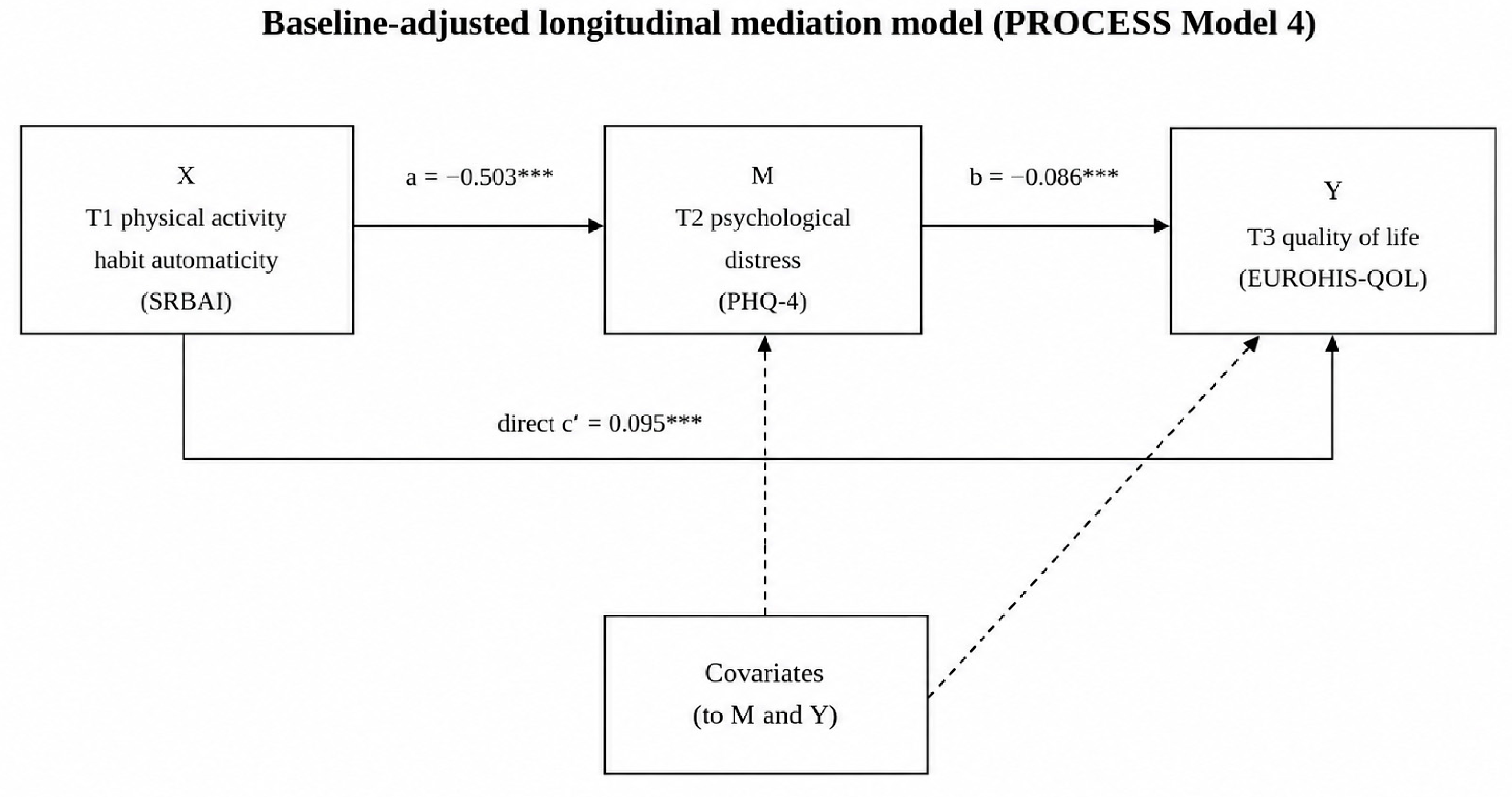
| T2 psychological distress | T1 SRBAI | −0.503 | 0.088 | <0.001 | [−0.675, −0.331] |
| T3 quality of life | T2 psychological distress | −0.086 | 0.007 | <0.001 | [−0.099, −0.072] |
| T3 quality of life | T1 SRBAI direct effect | 0.095 | 0.020 | <0.001 | [0.057, 0.134] |
| T3 quality of life | T1 SRBAI total effect | 0.139 | 0.021 | <0.001 | [0.098, 0.179] |
| Indirect effect | SRBAI → PHQ-4 → QOL | 0.043 | - | - | [0.028, 0.059] |
| Outcome | Predictor | B | SE | t | p | 95% CI |
|---|---|---|---|---|---|---|
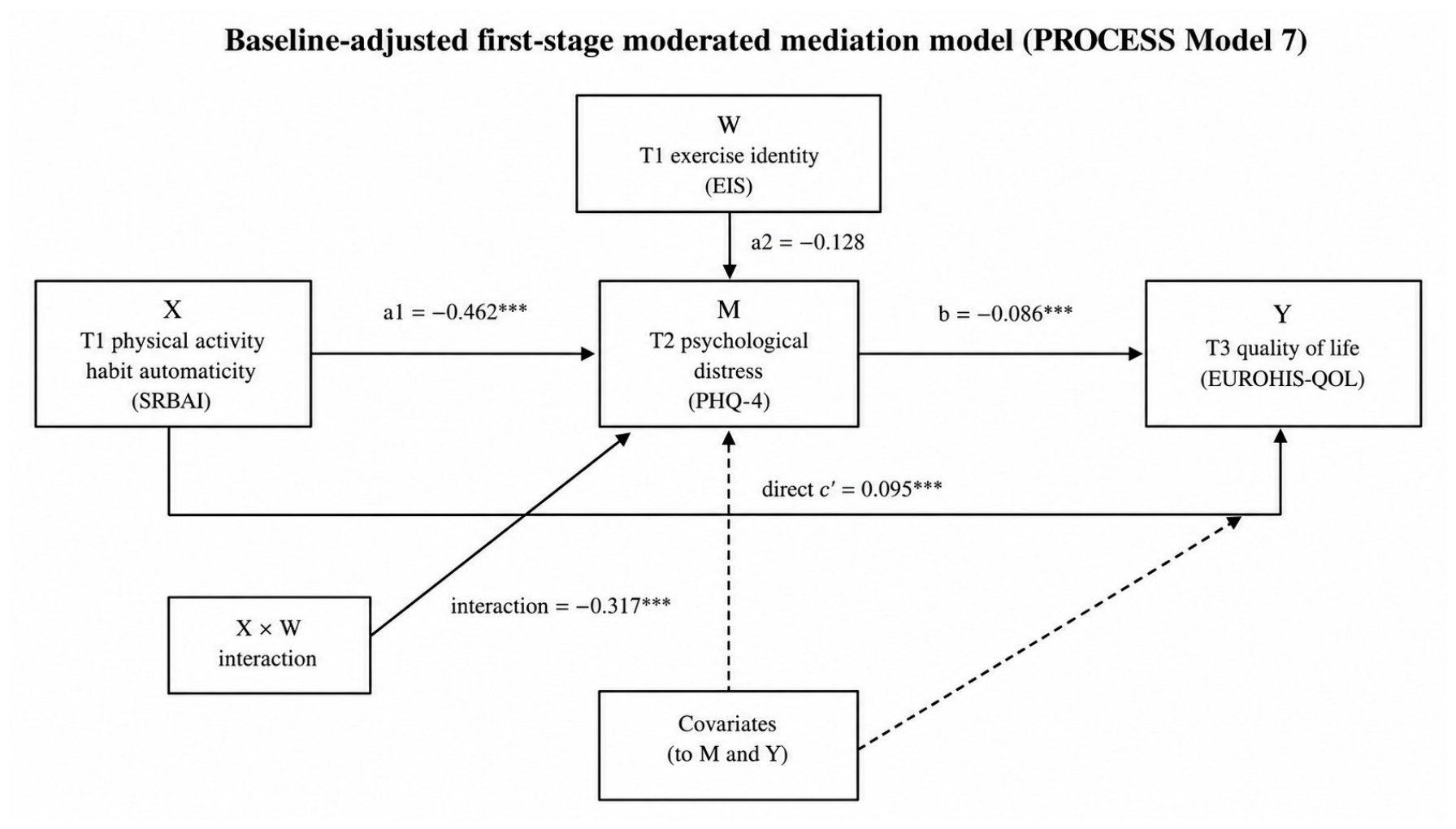
| T2 psychological distress | T1 habit automaticity | −0.462 | 0.092 | −4.999 | <0.001 | [−0.643, −0.281] |
| T2 psychological distress | T1 exercise identity | −0.128 | 0.092 | −1.393 | 0.164 | [−0.308, 0.052] |
| T2 psychological distress | T1 habit automaticity × T1 exercise identity | −0.317 | 0.084 | −3.782 | <0.001 | [−0.482, −0.153] |
| T3 quality of life | T1 habit automaticity | 0.095 | 0.020 | 4.879 | <0.001 | [0.057, 0.134] |
| T3 quality of life | T2 PHQ-4 | −0.086 | 0.007 | −12.48 | <0.001 | [−0.099, −0.072] |
| Effect | Path | Coefficient/Effect | SE/BootSE | p | 95% CI |
|---|---|---|---|---|---|
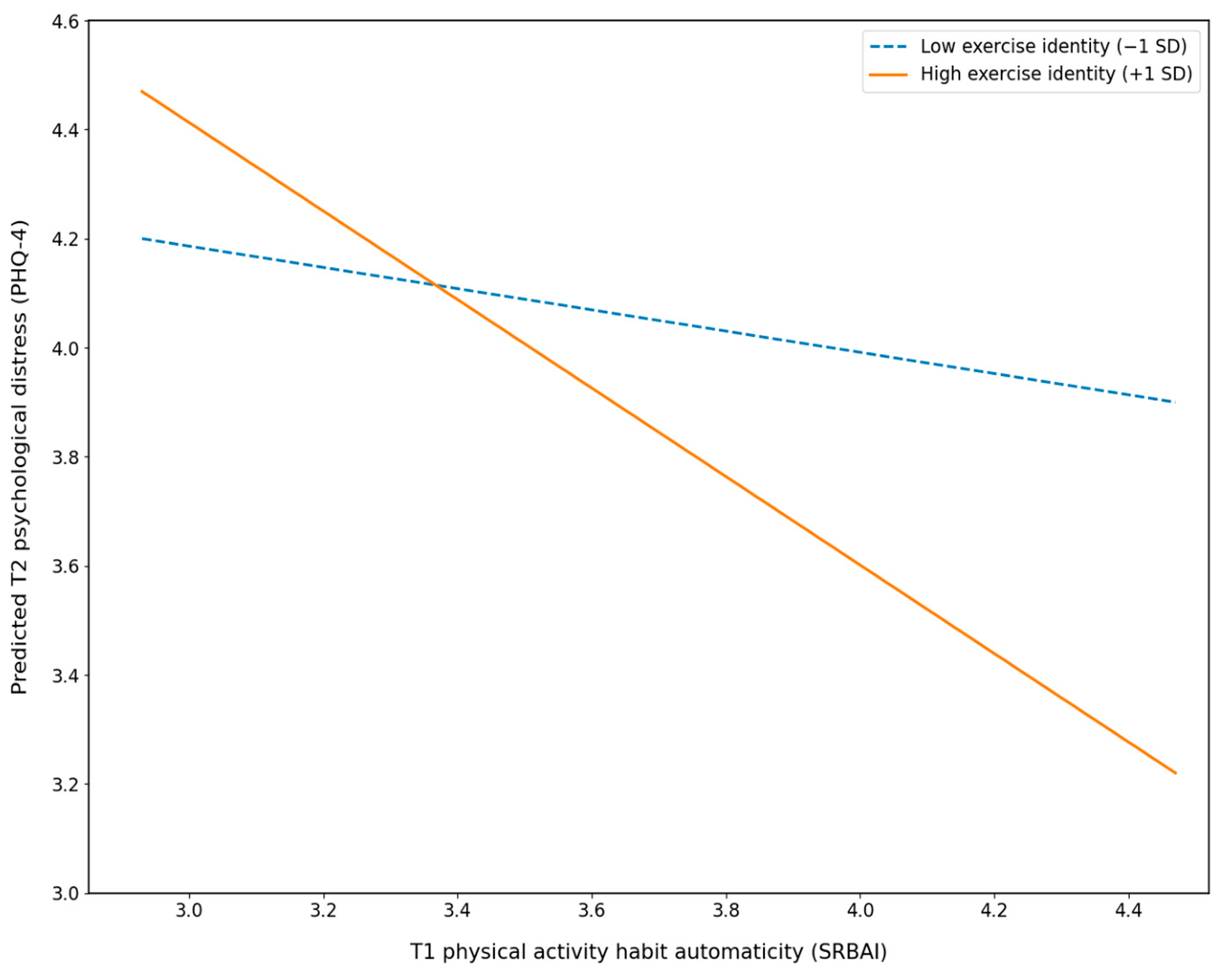
| Simple slope: low EIS (−1 SD) | T1 habit automaticity → T2 psychological distress | −0.197 | 0.115 | 0.088 | [−0.424, 0.029] |
| Simple slope: mean EIS | T1 habit automaticity → T2 psychological distress | −0.462 | 0.092 | <0.001 | [−0.643, −0.281] |
| Simple slope: high EIS (+1 SD) | T1 habit automaticity → T2 psychological distress | −0.726 | 0.116 | <0.001 | [−0.955, −0.498] |
| Indirect effect: low EIS (−1 SD) | T1 habit automaticity → T2 psychological distress → T3 quality of life | 0.017 | 0.010 | - | [−0.003, 0.038] |
| Indirect effect: mean EIS | T1 habit automaticity → T2 psychological distress → T3 quality of life | 0.040 | 0.008 | - | [0.024, 0.057] |
| Indirect effect: high EIS (+1 SD) | T1 habit automaticity → T2 psychological distress → T3 quality of life | 0.063 | 0.011 | - | [0.043, 0.084] |
| Index of moderated mediation | Conditional indirect association | 0.027 | 0.008 | - | [0.012, 0.043] |
Disclaimer/Publisher’s Note: The statements, opinions and data contained in all publications are solely those of the individual author(s) and contributor(s) and not of MDPI and/or the editor(s). MDPI and/or the editor(s) disclaim responsibility for any injury to people or property resulting from any ideas, methods, instructions or products referred to in the content. |
© 2026 by the authors. Licensee MDPI, Basel, Switzerland. This article is an open access article distributed under the terms and conditions of the Creative Commons Attribution (CC BY) license.
Share and Cite
Tan, Y.; Liu, S.; Zang, L. Physical Activity Habit Automaticity, Psychological Distress, and Quality of Life Among Chinese University Students: A Three-Wave Longitudinal Moderated Mediation Study. Healthcare 2026, 14, 1863. https://doi.org/10.3390/healthcare14131863
Tan Y, Liu S, Zang L. Physical Activity Habit Automaticity, Psychological Distress, and Quality of Life Among Chinese University Students: A Three-Wave Longitudinal Moderated Mediation Study. Healthcare. 2026; 14(13):1863. https://doi.org/10.3390/healthcare14131863
Chicago/Turabian StyleTan, Yanli, Shiqi Liu, and Liuhong Zang. 2026. "Physical Activity Habit Automaticity, Psychological Distress, and Quality of Life Among Chinese University Students: A Three-Wave Longitudinal Moderated Mediation Study" Healthcare 14, no. 13: 1863. https://doi.org/10.3390/healthcare14131863
APA StyleTan, Y., Liu, S., & Zang, L. (2026). Physical Activity Habit Automaticity, Psychological Distress, and Quality of Life Among Chinese University Students: A Three-Wave Longitudinal Moderated Mediation Study. Healthcare, 14(13), 1863. https://doi.org/10.3390/healthcare14131863