A Virtual Tai Chi Intervention for Older Adults with Mobility Disabilities: Results from a Single-Arm Clinical Trial with the TechSAge Tele Tai Chi Program

Highlights
- An 8-week evidence-based in-person Tai Chi program for older adults, Tai Chi for Arthritis and Fall Prevention, was successfully translated to a virtual intervention with a social component for people aging with mobility disabilities.
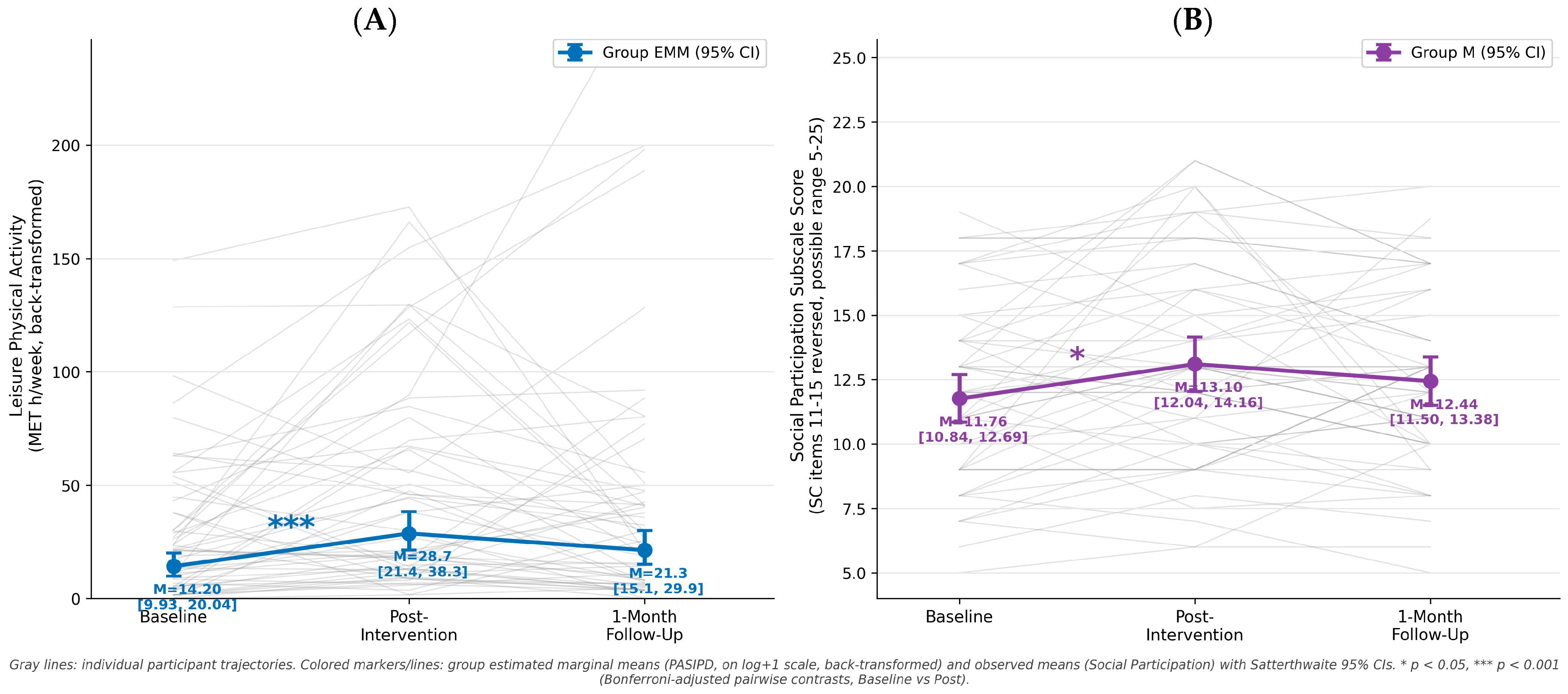
- The virtual translation was feasible, rated as acceptable and enjoyable by participants, and was associated with increases in physical activity and social participation.
- The TechSAge Tele Tai Chi program has the potential to reduce barriers to physical activity and social participation for people who are aging with mobility disabilities.
- The results support the feasibility of translating in-person health and wellness interventions to virtual platforms to increase the reach of those programs, particularly to those who have significant barriers to in-person attendance.
Abstract
1. Introduction
2. Materials and Methods
2.1. Participants and Recruitment
2.2. Procedure
2.3. Intervention Components
2.4. Intervention Fidelity
2.5. Outcome Measures
2.6. Statistical Analyses
3. Results
3.1. Sociodemographic and Health Characteristics
3.2. Technology Experience
3.3. Feasibility
3.4. Outcomes
3.4.1. Primary Outcomes
3.4.2. Secondary Outcomes
3.4.3. Technology Experience and Class Satisfaction
4. Discussion
5. Conclusions
Supplementary Materials
Author Contributions
Funding
Institutional Review Board Statement
Informed Consent Statement
Data Availability Statement
Acknowledgments
Conflicts of Interest
Abbreviations
| TCAFP | Tai Chi for Arthritis and Fall Prevention |
| LMM | Linear mixed models (LMMs) |
| PASIPD | Physical Activity Scale for Individuals with Physical Disabilities |
| CI | Confidence interval |
| PA | Physical activity |
| EMM | Estimated marginal means |
| REML | Restricted maximum likelihood |
| ESES | Exercise Self-Efficacy Scale |
| FES | Falls Efficacy Scale |
References
- Toledano-Shubi, A.; Shapira, A.L.; Fuchsman, R.; Marco, R.; Hel-Or, H.; Sarig Bahat, H. Feasibility and effectiveness of physical exercise for older adults delivered remotely via videoconferencing—Systematic review and meta analysis. Age Ageing 2025, 54, afaf171. [Google Scholar] [CrossRef] [PubMed]
- Erickson, W.; Lee, C.; von Schrader, S. Disability Statistics from the American Community Survey (ACS); Cornell University Yang-Tan Institute (YTI): Ithaca, NY, USA, 2026. [Google Scholar]
- Wang, G.; Zhou, Y.; Zhang, L.; Li, J.; Liu, P.; Li, Y.; Ma, L. Prevalence and incidence of mobility limitation in Chinese older adults: Evidence from the China health and retirement longitudinal study. J. Nutr. Health Aging 2024, 28, 100038. [Google Scholar] [CrossRef] [PubMed]
- Manns, P.; Ezeugwu, V.; Armijo-Olivo, S.; Vallance, J.; Healy, G.N. Accelerometer-derived pattern of sedentary and physical activity time in persons with mobility disability: National Health and Nutrition Examination Survey 2003 to 2006. J. Am. Geriatr. Soc. 2015, 63, 314–323. [Google Scholar] [CrossRef] [PubMed]
- Scher, L.M.d.L.; Guarda, F.R.B.d.; Barros, M.V.l.G.d.; Chen, Z.; Anton, S.D. Sedentary time and disability in older adults: A systematic review and meta-analysis. J. Aging Sci. 2019, 7, 206. [Google Scholar] [CrossRef][Green Version]
- Hollis, N.D.; Zhang, Q.C.; Cyrus, A.C.; Courtney-Long, E.; Watson, K.; Carroll, D.D. Physical activity types among US adults with mobility disability, Behavioral Risk Factor Surveillance System, 2017. Disabil. Health J. 2020, 13, 100888. [Google Scholar] [CrossRef] [PubMed]
- Gerlach, L.B.; Solway, E.S.; Malani, P.N. Social isolation and loneliness in older adults. JAMA 2024, 331, 2058. [Google Scholar] [CrossRef] [PubMed]
- Tomida, K.; Shimoda, T.; Nakajima, C.; Kawakami, A.; Shimada, H. Classification of social isolation and factors related to loneliness and life satisfaction among socially isolated individuals. Geriatr. Nurs. 2023, 54, 163–170. [Google Scholar] [CrossRef] [PubMed]
- Malani, P.; Singer, D.; Kirch, M.; Solway, E.; Roberts, S.; Smith, E.; Hutchens, L.; Kullgren, J. Trends in Loneliness Among Older Adults from 2018–2023; University of Michigan National Poll on Healthy Aging: Ann Arbor, MI, USA, 2023. [Google Scholar]
- Shimada, H.; Doi, T.; Tsutsumimoto, K.; Makino, K.; Harada, K.; Tomida, K.; Morikawa, M.; Arai, H. Combined effects of social isolation and loneliness on disability incidence in older adults. Arch. Gerontol. Geriatr. 2025, 131, 105749. [Google Scholar] [CrossRef] [PubMed]
- Beer, J.M.; Stuck, R.E.; Mitzner, T.L.; Rogers, W.A. Design considerations for technology interventions to support social and physical wellness for older adults with disability. Int. J. Autom. Smart Technol. 2015, 5, 249–264. [Google Scholar] [CrossRef]
- Rice, L.A.; Mitzner, T.L.; Sanford, J.A.; Remillard, E.T.; Rogers, W.A. Designing for the intersection of aging and disability: Application of the TechSAge Technology Intervention Model. Gerontologist 2025, 65, gnaf109. [Google Scholar] [CrossRef] [PubMed]
- Rimmer, J.H.; Riley, B.; Wang, E.; Rauworth, A.; Jurkowski, J. Physical activity participation among persons with disabilities: Barriers and facilitators. Am. J. Prev. Med. 2004, 26, 419–425. [Google Scholar] [CrossRef]
- Rimmer, J.H.; Padalabalanarayanan, S.; Malone, L.A.; Mehta, T. Fitness facilities still lack accessibility for people with disabilities. Disabil. Health J. 2017, 10, 214–221. [Google Scholar] [CrossRef] [PubMed]
- Nikolajsen, H.; Sandal, L.F.; Juhl, C.B.; Troelsen, J.; Juul-Kristensen, B. Barriers to, and facilitators of, exercising in fitness centres among adults with and without physical disabilities: A scoping review. Int. J. Environ. Res. Public Health 2021, 18, 7341. [Google Scholar] [CrossRef] [PubMed]
- Harris, M.T.; Rogers, W.A. Social participation challenges and response strategies identified by adults aging with a disability. J. Elder Policy 2024, 3, 95–109. [Google Scholar] [CrossRef]
- Khamzina, M.; Mejia, S.T.; Rogers, W.A. Successful aging among older adults with and without disability. Exp. Gerontol. 2025, 212, 112964. [Google Scholar] [CrossRef] [PubMed]
- Morgan, K.A.; Desai, R.H.; Trocinski, C.W.; Hollingsworth, H.; Dashner, J.; Putnam, M.; Stark, S.L. The relationship of exercise, psychosocial factors, and social participation among adults aging with long-term physical disability: A cross-sectional study. Am. J. Health Promot. (AJHP) 2024, 38, 683–691. [Google Scholar] [CrossRef] [PubMed]
- Müller, R.; Peter, C.; Cieza, A.; Geyh, S. The role of social support and social skills in people with spinal cord injury: A systematic review of the literature. Spinal Cord 2012, 50, 94–106. [Google Scholar] [CrossRef] [PubMed]
- Pahor, M.; Guralnik, J.M.; Ambrosius, W.T.; Blair, S.; Bonds, D.E.; Church, T.S.; Espeland, M.A.; Fielding, R.A.; Gill, T.M.; Groessl, E.J.; et al. Effect of structured physical activity on prevention of major mobility disability in older adults: The LIFE study randomized clinical trial. JAMA 2014, 311, 2387–2396. [Google Scholar] [CrossRef] [PubMed]
- de Vries, N.M.; van Ravensberg, C.D.; Hobbelen, J.S.; Olde Rikkert, M.G.; Staal, J.B.; Nijhuis-van der Sanden, M.W. Effects of physical exercise therapy on mobility, physical functioning, physical activity and quality of life in community-dwelling older adults with impaired mobility, physical disability and/or multi-morbidity: A meta-analysis. Ageing Res. Rev. 2012, 11, 136–149. [Google Scholar] [CrossRef] [PubMed]
- Kotwal, A.A.; Fuller, S.M.; Myers, J.J.; Hill, D.; Tha, S.H.; Smith, A.K.; Perissinotto, C.M. A peer intervention reduces loneliness and improves social well-being in low-income older adults: A mixed-methods study. J. Am. Geriatr. Soc. 2021, 69, 3365–3376. [Google Scholar] [CrossRef] [PubMed]
- Mois, G.; Lydon, E.A.; Danilovich, M.K.; Myers, D.; Chen, X.S.; Mudar, R.A.; Rogers, W.A. A social engagement technology-based randomized controlled trial for older adults: Outcomes and lessons learned. Contemp. Clin. Trials Commun. 2025, 47, 101529. [Google Scholar] [CrossRef] [PubMed]
- Capalb, D.J.; O'Halloran, P.; Liamputtong, P. Why older people engage in physical activity: An exploratory study of participants in a community-based walking program. Aust. J. Prim. Health 2014, 20, 74–78. [Google Scholar] [CrossRef] [PubMed]
- Hwang, J.; Wang, L.; Siever, J.; Medico, T.D.; Jones, C.A. Loneliness and social isolation among older adults in a community exercise program: A qualitative study. Aging Ment. Health 2019, 23, 736–742. [Google Scholar] [CrossRef] [PubMed]
- Sebastião, E.; Mirda, D. Group-based physical activity as a means to reduce social isolation and loneliness among older adults. Aging Clin. Exp. Res. 2021, 33, 2003–2006. [Google Scholar] [CrossRef] [PubMed]
- Burke, S.M.; Carron, A.V.; Eys, M.A.; Ntoumanis, N.; Estabrooks, P.A.; Burke, S.M. Group versus individual approach? A meta-analysis of the effectiveness of interventions to promote physical activity. Sport Exerc. Psychol. Rev. 2006, 2, 19–35. [Google Scholar] [CrossRef]
- Fraser, S.N.; Spink, K.S. Examining the role of social support and group cohesion in exercise compliance. J. Behav. Med. 2002, 25, 233–249. [Google Scholar] [CrossRef] [PubMed]
- Pietila, R.; Olson, D. The Impact of Individual Exercise Versus Large and Small Group Exercise in Community-Dwelling Adults. Wis. Med. J. 2025, 124, 475. [Google Scholar]
- Corbett, D.B.; Rejeski, W.J.; Tudor-Locke, C.; Glynn, N.W.; Kritchevsky, S.B.; McDermott, M.M.; Church, T.S.; Fielding, R.A.; Gill, T.M.; King, A.C.; et al. Social participation modifies the effect of a structured physical activity program on major mobility disability among older adults: Results from the LIFE study. J. Gerontol. Ser. B Psychol. Sci. Soc. Sci. 2017, 73, 1501–1513. [Google Scholar] [CrossRef] [PubMed]
- Ashworth, N.L.; Chad, K.E.; Harrison, E.L.; Reeder, B.A.; Marshall, S.C. Home versus center based physical activity programs in older adults. Cochrane Database Syst. Rev. 2005, 2010, CD004017. [Google Scholar] [CrossRef] [PubMed]
- de Mello Franco, F.G.; Santos, A.C.; Rondon, M.U.P.; Trombetta, I.C.; Strunz, C.; Braga, A.M.W.; Middlekauff, H.; Negrão, C.E.; Barretto, A.C.P. Effects of home-based exercise training on neurovascular control in patients with heart failure. Eur. J. Heart Fail. 2006, 8, 851–855. [Google Scholar] [CrossRef] [PubMed]
- Wu, G.; Keyes, L.; Callas, P.; Ren, X.; Bookchin, B. Comparison of Telecommunication, Community, and Home-Based Tai Chi Exercise Programs on Compliance and Effectiveness in Elders at Risk for Falls. Arch. Phys. Med. Rehabil. 2010, 91, 849–856. [Google Scholar] [CrossRef] [PubMed]
- Liang, I.J.; Perkin, O.J.; McGuigan, P.M.; Spellanzon, B.; Robb, M.; Liu, C.Y.; Lin, L.L.; Thompson, D.; Western, M.J. The effectiveness of unsupervised home-based exercise for improving lower extremity physical function in older adults in Western and Eastern cultures: A systematic review and meta-analysis. BMC Geriatr. 2024, 24, 800. [Google Scholar] [CrossRef] [PubMed]
- Li, F.; Harmer, P.; Fisher, K.J.; McAuley, E.; Chaumeton, N.; Eckstrom, E.; Wilson, N.L. Tai Chi and fall reductions in older adults: A randomized controlled trial. J. Gerontol. Ser. A Biol. Sci. Med. Sci. 2005, 60, 187–194. [Google Scholar] [CrossRef] [PubMed]
- Voukelatos, A.; Cumming, R.G.; Lord, S.R.; Rissel, C. A randomized, controlled trial of tai chi for the prevention of falls: The Central Sydney tai chi trial. J. Am. Geriatr. Soc. 2007, 55, 1185–1191. [Google Scholar] [CrossRef] [PubMed]
- Huang, C.-Y.; Mayer, P.K.; Wu, M.-Y.; Liu, D.-H.; Wu, P.-C.; Yen, H.-R. The effect of Tai Chi in elderly individuals with sarcopenia and frailty: A systematic review and meta-analysis of randomized controlled trials. Ageing Res. Rev. 2022, 82, 101747. [Google Scholar] [CrossRef] [PubMed]
- Taylor, E.; Taylor-Piliae, R.E. The effects of Tai Chi on physical and psychosocial function among persons with multiple sclerosis: A systematic review. Complement. Ther. Med. 2017, 31, 100–108. [Google Scholar] [CrossRef] [PubMed]
- Chen, Y.; Jin, C.; Tang, H.; Yu, J.; Wang, Y.; Chen, S.; Miao, W.; Zhang, S.; Wang, X. Effects of sedentary behaviour and long-term regular Tai Chi exercise on dynamic stability control during gait initiation in older women. Front. Bioeng. Biotechnol. 2024, 12, 1353270. [Google Scholar] [CrossRef] [PubMed]
- Ge, Y.; Liu, H.; Wu, Q.; Chen, A.; Gao, Z.; Xing, F.; Liu, G. Effects of a short eight Tai Chi-forms for the pre-frail elderly people in senior living communities. Physiother. Theory Pract. 2022, 38, 1928–1936. [Google Scholar] [CrossRef] [PubMed]
- Bubela, D.; Sacharko, L.; Chan, J.; Brady, M. Balance and Functional Outcomes for Older Community-Dwelling Adults Who Practice Tai Chi and Those Who Do Not: A Comparative Study. J. Geriatr. Phys. Ther. 2019, 42, 209–215. [Google Scholar] [CrossRef] [PubMed]
- Siu, P.M.; Yu, A.P.; Tam, B.T.; Chin, E.C.; Yu, D.S.; Chung, K.-F.; Hui, S.S.; Woo, J.; Fong, D.Y.; Lee, P.H.; et al. Effects of Tai Chi or Exercise on Sleep in Older Adults With Insomnia: A Randomized Clinical Trial. JAMA Netw. Open 2021, 4, e2037199. [Google Scholar] [CrossRef] [PubMed]
- Li, Y.; Doan, T.T.-T.; Zhao, R.; Cho, Y.; Fan, X.; Zhang, Z.; Hou, T.; Song, R. Tai Chi and Qigong to Enhance Cognitive Function in Community-Dwelling Older Adults: Evidence from a Systematic Review and Meta-Analysis. J. Appl. Gerontol. 2026. online ahead of print. [Google Scholar] [CrossRef] [PubMed]
- Wayne, P.M.; Walsh, J.N.; Taylor-Piliae, R.E.; Wells, R.E.; Papp, K.V.; Donovan, N.J.; Yeh, G.Y. Effect of Tai Chi on Cognitive Performance in Older Adults: Systematic Review and Meta-Analysis. J. Am. Geriatr. Soc. (JAGS) 2014, 62, 25–39. [Google Scholar] [CrossRef] [PubMed]
- Zhao, X.; Liu, D.; Wang, J. Association of Tai Chi and Square Dance with Cognitive Function in Chinese Older Adults. Healthcare 2024, 12, 1878. [Google Scholar] [CrossRef] [PubMed]
- Au-Yeung, S.S.Y.; Hui-Chan, C.W.Y.; Tang, J.C.S. Short-form Tai Chi Improves Standing Balance of People With Chronic Stroke. Neurorehabilit. Neural Repair 2009, 23, 515–522. [Google Scholar] [CrossRef] [PubMed]
- Siu, P.M.; Yu, A.P.; Chin, E.C.; Yu, D.S.; Hui, S.S.; Woo, J.; Fong, D.Y.; Wei, G.X.; Irwin, M.R. Effects of Tai Chi or Conventional Exercise on Central Obesity in Middle-Aged and Older Adults: A Three-Group Randomized Controlled Trial. Ann. Intern. Med. 2021, 174, 1050–1057. [Google Scholar] [CrossRef] [PubMed]
- Tam, H.L.; Leung, L.Y.L.; Chan, A.S.W. Effectiveness of Tai Chi in Patients With Hypertension: An Overview of Meta-analyses. J. Cardiovasc. Nurs. 2023, 38, 443–453. [Google Scholar] [CrossRef] [PubMed]
- Fu, S.; Yang, F.; Hou, M.; Ma, Y.; Liu, B.; Lin, Z.; Wang, X. Comparative efficacy of Tai Chi versus balance training on functional performance and postural control during sit and stand transitions in individuals with knee osteoarthritis: A randomized trial. J. Sci. Med. Sport 2026, 29, 281–288. [Google Scholar] [CrossRef] [PubMed]
- Branscom, G.A.; Vama, B.; Bane, B.; Sun, M.; Liu, J. Tai Chi Interventions for Slowing Cognitive Decline in Mild Cognitive Impairment: A Review of Randomized Controlled Trials. Curēus 2026, 18, e103588. [Google Scholar] [CrossRef] [PubMed]
- Siu, M.y.; Lee, D.T.F. Is Tai Chi an effective intervention for enhancing health-related quality of life in older people with mild cognitive impairment? An interventional study. Int. J. Older People Nurs. 2021, 16, e12400. [Google Scholar] [CrossRef] [PubMed]
- Yang, Q.; Li, L.; Sun, M.; Luo, H.; Zhuang, C. A study on the role of Tai Chi training in improving type 2 diabetes mellitus. Front. Public Health 2026, 14, 1730335. [Google Scholar] [CrossRef] [PubMed]
- Yang, X.C.; Gao, Q.; Yin, T.; Zhou, J.; Chaturvedi, R. A Meta-Analysis on the Efficacy of Tai Chi in Patients with Parkinson’s Disease between 2008 and 2014. Evid.-Based Complement. Altern. Med. 2015, 2015, 593263. [Google Scholar] [CrossRef] [PubMed]
- Chen, W.; Li, M.; Li, H.; Lin, Y.; Feng, Z. Tai Chi for fall prevention and balance improvement in older adults: A systematic review and meta-analysis of randomized controlled trials. Front. Public Health 2023, 11, 1236050. [Google Scholar] [CrossRef] [PubMed]
- Callahan, L.F.; Cleveland, R.J.; Altpeter, M.; Hackney, B. Evaluation of tai chi program effectiveness for people with arthritis in the community: A randomized controlled trial. J. Aging Phys. Act. 2016, 24, 101–110. [Google Scholar] [CrossRef] [PubMed]
- Fransen, M.; Nairn, L.; Winstanley, J.; Lam, P.; Edmonds, J. Physical activity for osteoarthritis management: A randomized controlled clinical trial evaluating hydrotherapy or Tai Chi classes. Arthritis Rheum. 2007, 57, 407–414. [Google Scholar] [CrossRef] [PubMed]
- Wang, M.; Ma, H.; Shi, Y.; Ni, H.; Qin, C.; Ji, C. Single-arm clinical trials: Design, ethics, principles. BMJ Support. Palliat. Care 2024, 15, 46–54. [Google Scholar] [CrossRef] [PubMed]
- Adams, R. Revised Physical Activity Readiness Questionnaire. Can. Fam. Physician 1999, 45, 992, 995, 1004–1005. [Google Scholar]
- Brandt, J.; Folstein, M.F. Telephone Interview for Cognitive Status (TICS), 1st ed.; Routledge: London, UK, 2010; pp. 174–176. [Google Scholar]
- Remillard, E.T.; Mitzner, T.L.; Mumma, K.T. Tele Tai Chi for people aging with mobility disabilities: Novel methodology and structured adaptation approach. Contemp. Clin. Trials Commun. 2025, 47, 101543. [Google Scholar] [CrossRef] [PubMed]
- Jeannerod, M. Neural Simulation of Action: A Unifying Mechanism for Motor Cognition. NeuroImage 2001, 14, S103–S109. [Google Scholar] [CrossRef] [PubMed]
- Gentili, R.; Han, C.E.; Schweighofer, N.; Papaxanthis, C. Motor Learning Without Doing: Trial-by-Trial Improvement in Motor Performance During Mental Training. J. Neurophysiol. 2010, 104, 774–783. [Google Scholar] [CrossRef] [PubMed]
- Washburn, R.A.; Zhu, W.; McAuley, E.; Frogley, M.; Figoni, S.F. The physical activity scale for individuals with physical disabilities: Development and evaluation. Arch. Phys. Med. Rehabil. 2002, 83, 193–200. [Google Scholar] [CrossRef] [PubMed]
- Hays, R.D.; DiMatteo, M.R. A Short-Form Measure of Loneliness. J. Personal. Assess. 1987, 51, 69–81. [Google Scholar] [CrossRef] [PubMed]
- Lubben, J.E. Assessing social networks among elderly populations. Fam. Community Health 1988, 11, 42–52. [Google Scholar] [CrossRef]
- Cornwell, E.Y.; Waite, L.J. Social disconnectedness, perceived isolation, and health among older adults. J. Health Soc. Behav. 2009, 50, 31–48. [Google Scholar] [CrossRef] [PubMed]
- Cornwell, E.Y.; Waite, L.J. Measuring social isolation among older adults using multiple indicators from the NSHAP study. J. Gerontol. Ser. B Psychol. Sci. Soc. Sci. 2009, 64B, I38–I46. [Google Scholar] [CrossRef] [PubMed]
- Kroll, T.; Kehn, M.; Ho, P.-S.; Groah, S. The SCI Exercise Self-Efficacy Scale (ESES): Development and psychometric properties. Int. J. Behav. Nutr. Phys. Act. 2007, 4, 34. [Google Scholar] [CrossRef] [PubMed]
- Tinetti, M.E.; Richman, D.; Powell, L. Falls Efficacy as a Measure of Fear of Falling. J. Gerontol. 1990, 45, P239–P243. [Google Scholar] [CrossRef] [PubMed]
- Finlayson, M.; Peterson, E.W.; Cho, C. Pilot study of a fall risk management program for middle aged and older adults with MS. NeuroRehabilitation 2009, 25, 107–115. [Google Scholar] [CrossRef] [PubMed]
- Walker, J.E.; Howland, J. Falls and Fear of Falling Among Elderly Persons Living in the Community: Occupational Therapy Interventions. Am. J. Occup. Ther. 1991, 45, 119–122. [Google Scholar] [CrossRef] [PubMed]
- Pilkonis, P.A.; Choi, S.W.; Reise, S.P.; Stover, A.M.; Riley, W.T.; Cella, D. Item Banks for Measuring Emotional Distress From the Patient-Reported Outcomes Measurement Information System (PROMIS®): Depression, Anxiety, and Anger. Assessment 2011, 18, 263–283. [Google Scholar] [CrossRef] [PubMed]
- Siebens, H.C.; Tsukerman, D.; Adkins, R.H.; Kahan, J.; Kemp, B. Correlates of a Single-Item Quality-of-Life Measure in People Aging with Disabilities. Am. J. Phys. Med. Rehabil. 2015, 94, 1065–1074. [Google Scholar] [CrossRef] [PubMed]
- Amtmann, D.; Cook, K.F.; Jensen, M.P.; Chen, W.-H.; Choi, S.; Revicki, D.; Cella, D.; Rothrock, N.; Keefe, F.; Callahan, L.; et al. Development of a PROMIS item bank to measure pain interference. Pain 2010, 150, 173–182. [Google Scholar] [CrossRef] [PubMed]
- Davis, F.D. Perceived Usefulness, Perceived Ease of Use, and User Acceptance of Information Technology. MIS Q. 1989, 13, 319–340. [Google Scholar] [CrossRef] [PubMed]
- Venkatesh, V. Determinants of Perceived Ease of Use: Integrating Control, Intrinsic Motivation, and Emotion into the Technology Acceptance Model. Inf. Syst. Res. 2000, 11, 342–365. [Google Scholar] [CrossRef]
- Venkatesh, V.; Bala, H. Technology Acceptance Model 3 and a Research Agenda on Interventions. Decis. Sci. 2008, 39, 273–315. [Google Scholar] [CrossRef]
- Cunningham, G.B. Development of the Physical Activity Class Satisfaction Questionnaire (PACSQ). Meas. Phys. Educ. Exerc. Sci. 2007, 11, 161–176. [Google Scholar] [CrossRef]
- Mumma, K.; Remillard, E.T.; Cochran, L.; Mitzner, T.L. Rehabilitation Engineering Research Center on Technologies to Support Aging-in-Place for People with Long-Term Disabilities (RERC TechSAge). In Tele Tai Chi Study—Overview of Assessments (TechSAge-TR-2102); Rehabilitation Engineering Research Center on Technologies to Support Aging-in-Place for People with Long-Term Disabilities (RERC TechSAge): Atlanta, GA, USA, 2021; pp. 1–74. [Google Scholar]
- Mitzner, T.L. TechSAge Tele Tai Chi Clinical Trial; Inter-University Consortium for Political and Social Research: Ann Arbor, MI, USA, 2025. [Google Scholar]
- Cumming, G. Understanding the New Statistics: Effect Sizes, Confidence Intervals, and Meta-Analysis; Routledge: New York, NY, USA, 2012. [Google Scholar]
- Bliese, P.D. Within-group agreement, non-independence, and reliability: Implications for data aggregation and analysis. In Multilevel Theory, Research, and Methods in Organizations; Klein, K.J., Kozlowski, S.W., Eds.; Jossey-Bass: San Francisco, CA, USA, 2000; pp. 349–381. [Google Scholar]
- Hox, J.J.; Moerbeek, M.; van de Schoot, R. Multilevel Analysis. Techniques and Applications, 3rd ed.; Routledge: New York, NY, USA, 2018. [Google Scholar]
- Snijders, T.A.B.; Bosker, R.J. Multilevel Analysis: An Introduction to Basic and Advanced Multilevel Modeling, 2nd ed.; Sage: Thousand Oaks, CA, USA, 2012. [Google Scholar]
- United States Department of Health and Human Services. Physical Activity Guidelines for Americans; United States Department of Health and Human Services: Washington, DC, USA, 2018.
- Liu-Ambrose, T.Y.; Ashe, M.C.; Marra, C. Independent and inverse association of healthcare utilisation with physical activity in older adults with multiple chronic conditions. Br. J. Sports Med. 2010, 44, 1024–1028. [Google Scholar] [CrossRef] [PubMed]
- Nettleton, L.; Hassett, L.; Scheibe, F.; Price, R.; Kirkham, C.; Sherrington, C. Sport and physical activity participation among people with disabilities reported at a sports exhibition and six months later. Ther. Recreat. J. 2017, 51, 206–220. [Google Scholar] [CrossRef]
- Feys, P.; Tytgat, K.; Gijbels, D.; De Groote, L.; Baert, I.; Van Asch, P. Effects of an 1-day education program on physical functioning, activity and quality of life in community living persons with multiple sclerosis. NeuroRehabilitation 2013, 33, 439–448. [Google Scholar] [CrossRef] [PubMed]
- Easwaran, K.; Gopalasingam, Y.; Green, D.D.; Lach, V.; Melnyk, J.A.; Wan, C.; Bartlett, D.J. Effectiveness of Tai Chi for health promotion for adults with health conditions: A scoping review of Meta-analyses. Disabil. Rehabil. 2021, 43, 2978–2989. [Google Scholar] [CrossRef] [PubMed]
- Zhao, J.; Chau, J.P.C.; Zang, Y.; Lo, S.H.S.; Choi, K.C.; Liang, S. The effects of sitting Tai Chi on physical and psychosocial health outcomes among individuals with impaired physical mobility. Medicine 2020, 99, e21805. [Google Scholar] [CrossRef] [PubMed]
- Melenhorst, A.-S.; Rogers, W.A.; Bouwhuis, D.G. Older Adults’ Motivated Choice for Technological Innovation: Evidence for Benefit-Driven Selectivity. Psychol. Aging 2006, 21, 190–195. [Google Scholar] [CrossRef] [PubMed]
- Creighton, R.M.; Blackburn, N.E.; Paradis, K.F.; Tully, M.A. O.1.2-2 Delivering enjoyable group-based physical activity programmes to older adults: A qualitative exploration of the views of exercise instructors. Eur. J. Public Health 2023, 33, ckad133.089. [Google Scholar] [CrossRef]
- Boulton, E.R.; Horne, M.; Todd, C. Multiple influences on participating in physical activity in older age: Developing a social ecological approach. Health Expect. Int. J. Public Particip. Health Care Health Policy 2018, 21, 239–248. [Google Scholar] [CrossRef]
- Farrance, C.; Tsofliou, F.; Clark, C. Adherence to community based group exercise interventions for older people: A mixed-methods systematic review. Prev. Med. 2016, 87, 155–166. [Google Scholar] [CrossRef] [PubMed]
- Pew Research Center. Tech Adoption Climbs Among Older Adults; Pew Research Center: Washington, DC, USA, 2017. [Google Scholar]
- Abraham, A.; Duncan, R.P.; Earhart, G.M. The Role of Mental Imagery in Parkinson’s Disease Rehabilitation. Brain Sci. 2021, 11, 185. [Google Scholar] [CrossRef] [PubMed]
- Mitra, M.; Long-Bellil, L.; Moura, I.; Miles, A.; Kaye, H.S. Advancing health equity and reducing health disparities for people with disabilities in the United States. Health Aff. 2022, 41, 1379–1386. [Google Scholar] [CrossRef] [PubMed]
- Kaye, H.S.; Yeager, P.; Reed, M. Disparities in usage of assistive technology among people with disabilities. Assist. Technol. 2008, 20, 194–203. [Google Scholar] [CrossRef] [PubMed]
- Choi, J.H.; Moon, J.-S.; Song, R. Effects of Sun-style Tai Chi exercise on physical fitness and fall prevention in fall-prone older adults. J. Adv. Nurs. 2005, 51, 150–157. [Google Scholar] [CrossRef] [PubMed]
- Ma, Y.; Gow, B.J.; Song, R.; Rist, P.M.; Hausdorff, J.M.; Lipsitz, L.A.; Manor, B.; Wayne, P.M. Long-term Tai Chi practice in older adults is associated with “younger” functional abilities. Aging Cell 2024, 23, e14023. [Google Scholar] [CrossRef] [PubMed]
- Yue, C.; Zou, L.; Mei, J.; Moore, D.; Herold, F.; Müller, P.; Yu, Q.; Liu, Y.; Lin, J.; Tao, Y.; et al. Tai Chi Training Evokes Significant Changes in Brain White Matter Network in Older Women. Healthcare 2020, 8, 57. [Google Scholar] [CrossRef] [PubMed]
- Des Jarlais, D.C.; Lyles, C.; Crepaz, N.; the Trend Group. Improving the reporting quality of nonrandomized evaluations of behavioral and public health interventions: The TREND statement. Am. J. Public Health 2004, 94, 361–366. [Google Scholar] [CrossRef] [PubMed]



| Outcome (Scale)—log+1 Analyzed; Reported Back-Transformed | Timepoint | n | M (EMM) | Median [Q1, Q3] | Min, Max | 95% CI of EMM (Back-Transformed) | F (df1, df2) | p | Partial η2 (Cohen’s f) |
| PASIPD leisure total (MET h/wk) | Baseline | 60 | 14.2 | 21.2 [5.2, 37.9] | 0.0, 148.9 | [9.93, 20.04] | 9.30 (2, 54.4) | <0.001 | 0.255 (0.58) |
| Post | 56 | 28.7 | 33.8 [13.0, 67.7] | 1.6, 173.2 | [21.37, 38.34] | ||||
| Follow-up | 55 | 21.3 | 26.9 [7.9, 48.9] | 0.0, 272.1 | [15.08, 29.95] | ||||
| PASIPD—walking/wheeling (MET h/wk) | Baseline | 59 | 4.2 | 3.7 [1.6, 11.1] | 0.0, 37.9 | [2.88, 5.88] | 6.87 (2, 54.4) | 0.002 | 0.202 (0.50) |
| Post | 56 | 8.4 | 9.5 [3.7, 19.7] | 0.0, 63.1 | [6.03, 11.46] | ||||
| Follow-up | 54 | 6.6 | 4.7 [3.7, 18.9] | 0.0, 63.1 | [4.71, 9.20] | ||||
| PASIPD—light sport (MET h/wk) | Baseline | 59 | 2.7 | 2.3 [0.0, 6.8] | 0.0, 89.9 | [1.64, 4.06] | 14.63 (2, 54.9) | <0.0001 | 0.348 (0.73) |
| Post | 55 | 7.4 | 9.0 [5.2, 15.8] | 0.0, 89.9 | [5.34, 10.19] | ||||
| Follow-up | 53 | 4.0 | 5.2 [0.0, 13.4] | 0.0, 54.1 | [2.59, 5.93] | ||||
| PASIPD—moderate sport (MET h/wk) | Baseline | 59 | 0.7 | 0.0 [0.0, 0.0] | 0.0, 31.5 | [0.31, 1.18] | 4.25 (2, 54.9) | 0.019 | 0.134 (0.39) |
| Post | 55 | 1.4 | 0.0 [0.0, 6.9] | 0.0, 54.1 | [0.62, 2.44] | ||||
| Follow-up | 55 | 1.8 | 0.0 [0.0, 10.5] | 0.0, 180.3 | [0.97, 3.12] | ||||
| PASIPD—strenuous (MET h/wk) | Baseline | 59 | 0.5 | 0.0 [0.0, 0.0] | 0.0, 134.6 | [0.12, 0.87] | 1.52 (2, 55.3) | 0.228 | 0.052 (0.23) |
| Post | 56 | 0.8 | 0.0 [0.0, 0.4] | 0.0, 78.8 | [0.34, 1.44] | ||||
| Follow-up | 55 | 0.9 | 0.0 [0.0, 1.1] | 0.0, 134.6 | [0.35, 1.58] | ||||
| PASIPD—muscle strength (MET h/wk) | Baseline | 60 | 1.7 | 0.0 [0.0, 9.6] | 0.0, 49.4 | [0.92, 2.75] | 3.78 (2, 55.2) | 0.029 | 0.120 (0.37) |
| Post | 56 | 3.2 | 4.1 [0.0, 9.6] | 0.0, 99.5 | [2.00, 5.02] | ||||
| Follow-up | 55 | 2.0 | 0.0 [0.0, 9.6] | 0.0, 57.6 | [1.13, 3.36] | ||||
| Outcome (Scale) | Timepoint | n | M (SD) | Median [Q1, Q3] | Min, Max | 95% CI of EMM | F (df1, df2) | p | Partial η2 (Cohen’s f) |
| Social Connectedness (composite, 15–67) | Baseline | 60 | 42.85 (8.10) | 43.00 [38.00, 49.25] | 18.00, 57.00 | [40.75, 44.94] | 2.43 (2, 53.5) | 0.098 | 0.083 (0.30) |
| Post | 55 | 44.67 (7.61) | 44.00 [39.00, 50.00] | 28.00, 59.00 | [42.08, 46.34] | ||||
| Follow-up | 54 | 43.52 (7.85) | 43.42 [39.25, 48.75] | 25.00, 60.00 | [40.90, 45.32] | ||||
| UCLA Loneliness (ULS-8) (composite, 8–32) | Baseline | 58 | 15.17 (5.17) | 14.50 [10.46, 20.00] | 8.00, 26.00 | [13.92, 16.60] | 0.49 (2, 53.0) | 0.613 | 0.018 (0.14) |
| Post | 56 | 14.68 (4.87) | 14.00 [10.75, 18.00] | 8.00, 25.14 | [13.59, 16.17] | ||||
| Follow-up | 54 | 14.86 (5.20) | 14.00 [10.00, 19.75] | 8.00, 26.00 | [13.76, 16.54] | ||||
| Exercise Self-Efficacy (composite, 10–40) | Baseline | 57 | 29.80 (6.92) | 31.00 [27.00, 34.44] | 10.00, 40.00 | [27.89, 31.47] | 1.39 (2, 54.9) | 0.257 | 0.048 (0.23) |
| Post | 56 | 30.91 (4.35) | 31.00 [28.00, 34.00] | 22.00, 39.00 | [29.70, 31.99] | ||||
| Follow-up | 55 | 30.34 (5.28) | 31.00 [28.00, 34.00] | 15.56, 40.00 | [28.92, 31.69] | ||||
| Falls Efficacy (composite, 10–100) | Baseline | 56 | 31.06 (22.55) | 20.50 [13.00, 46.53] | 10.00, 85.00 | [26.35, 39.30] | 1.79 (2, 51.0) | 0.178 | 0.065 (0.27) |
| Post | 52 | 27.71 (18.31) | 21.00 [14.75, 35.00] | 10.00, 90.00 | [24.28, 34.20] | ||||
| Follow-up | 51 | 28.48 (18.33) | 20.00 [15.00, 39.50] | 10.00, 72.00 | [24.97, 35.69] | ||||
| Fear of Falling Severity (ordinal, 0–3) | Baseline | 59 | 1.20 (1.06) | 1.00 [0.00, 2.00] | 0.00, 3.00 | [0.93, 1.48] | 0.39 (2, 53.7) | 0.681 | 0.014 (0.12) |
| Post | 53 | 1.23 (0.99) | 1.00 [0.00, 2.00] | 0.00, 3.00 | [0.93, 1.46] | ||||
| Follow-up | 54 | 1.26 (0.99) | 1.00 [1.00, 2.00] | 0.00, 3.00 | [1.00, 1.52] | ||||
| Fear of Falling Activity Restriction (binary, 0/1) | Baseline | 59 | 0.51 (0.50) | 1.00 [0.00, 1.00] | 0.00, 1.00 | [0.37, 0.63] | 2.05 (2, 52.6) | 0.139 | 0.072 (0.28) |
| Post | 52 | 0.62 (0.49) | 1.00 [0.00, 1.00] | 0.00, 1.00 | [0.46, 0.73] | ||||
| Follow-up | 55 | 0.62 (0.49) | 1.00 [0.00, 1.00] | 0.00, 1.00 | [0.49, 0.75] | ||||
| Emotional Distress (PROMIS T-score) | Baseline | 60 | 50.01 (8.44) | 51.20 [46.20, 55.52] | 37.10, 68.30 | [47.83, 52.19] | 0.01 (2, 55.2) | 0.993 | 0.000 (0.02) |
| Post | 56 | 49.74 (8.80) | 50.50 [43.30, 56.43] | 37.10, 69.30 | [47.74, 52.26] | ||||
| Follow-up | 55 | 50.01 (8.65) | 52.30 [44.75, 55.75] | 37.10, 67.40 | [47.82, 52.31] | ||||
| Quality of Life (single item, 1–7) | Baseline | 60 | 5.35 (1.34) | 5.50 [4.75, 6.00] | 1.00, 7.00 | [5.00, 5.70] | 0.45 (2, 56.7) | 0.643 | 0.015 (0.12) |
| Post | 56 | 5.48 (1.32) | 6.00 [5.00, 6.25] | 2.00, 7.00 | [5.12, 5.81] | ||||
| Follow-up | 55 | 5.42 (1.12) | 6.00 [5.00, 6.00] | 3.00, 7.00 | [5.12, 5.71] | ||||
| Pain Interference (PROMIS T-score) | Baseline | 58 | 58.91 (8.66) | 59.90 [55.60, 65.20] | 41.60, 75.60 | [56.65, 61.13] | 0.29 (2, 54.4) | 0.748 | 0.011 (0.10) |
| Post | 53 | 58.07 (9.47) | 58.50 [53.90, 65.20] | 41.60, 75.60 | [55.80, 60.81] | ||||
| Follow-up | 55 | 58.03 (9.38) | 59.90 [52.95, 63.80] | 41.60, 75.60 | [55.70, 60.59] |
| Subscale | Items | Baseline M (SD) | Post-Intervention M (SD) | Follow-Up M (SD) | LR χ2 | Pairwise |
|---|---|---|---|---|---|---|
| Network Size | 1–4 | 16.57 (3.36) | 16.86 (3.23) | 16.51 (3.21) | 1.32 | — |
| Social Support | 5–7 ᴿ | 7.17 (1.49) | 7.29 (1.45) | 7.18 (1.51) | 0.59 | — |
| Loneliness & Isolation | 8–10 | 7.23 (1.81) | 7.25 (1.73) | 7.46 (1.73) | 1.42 | — |
| Social Participation | 11–15 ᴿ | 11.76 (3.54) | 13.10 (3.92) | 12.44 (3.46) | 8.55 * | Pre vs. Post * |
Disclaimer/Publisher’s Note: The statements, opinions and data contained in all publications are solely those of the individual author(s) and contributor(s) and not of MDPI and/or the editor(s). MDPI and/or the editor(s) disclaim responsibility for any injury to people or property resulting from any ideas, methods, instructions or products referred to in the content. |
© 2026 by the authors. Licensee MDPI, Basel, Switzerland. This article is an open access article distributed under the terms and conditions of the Creative Commons Attribution (CC BY) license.
Share and Cite
Mitzner, T.L.; Remillard, E.T.; Mumma, K.T.; Boyce, M.W. A Virtual Tai Chi Intervention for Older Adults with Mobility Disabilities: Results from a Single-Arm Clinical Trial with the TechSAge Tele Tai Chi Program. Healthcare 2026, 14, 1756. https://doi.org/10.3390/healthcare14121756
Mitzner TL, Remillard ET, Mumma KT, Boyce MW. A Virtual Tai Chi Intervention for Older Adults with Mobility Disabilities: Results from a Single-Arm Clinical Trial with the TechSAge Tele Tai Chi Program. Healthcare. 2026; 14(12):1756. https://doi.org/10.3390/healthcare14121756
Chicago/Turabian StyleMitzner, Tracy L., Elena T. Remillard, Kara T. Mumma, and Michael W. Boyce. 2026. "A Virtual Tai Chi Intervention for Older Adults with Mobility Disabilities: Results from a Single-Arm Clinical Trial with the TechSAge Tele Tai Chi Program" Healthcare 14, no. 12: 1756. https://doi.org/10.3390/healthcare14121756
APA StyleMitzner, T. L., Remillard, E. T., Mumma, K. T., & Boyce, M. W. (2026). A Virtual Tai Chi Intervention for Older Adults with Mobility Disabilities: Results from a Single-Arm Clinical Trial with the TechSAge Tele Tai Chi Program. Healthcare, 14(12), 1756. https://doi.org/10.3390/healthcare14121756