_MD__MPH_PhD.png)

The Association Between Sitting Delivery During the Second Stage of Labor and Pelvic Floor Function in Primiparas: A Prospective Cohort Study

Highlights
- Sitting delivery was associated with a higher rate of spontaneous vaginal delivery.
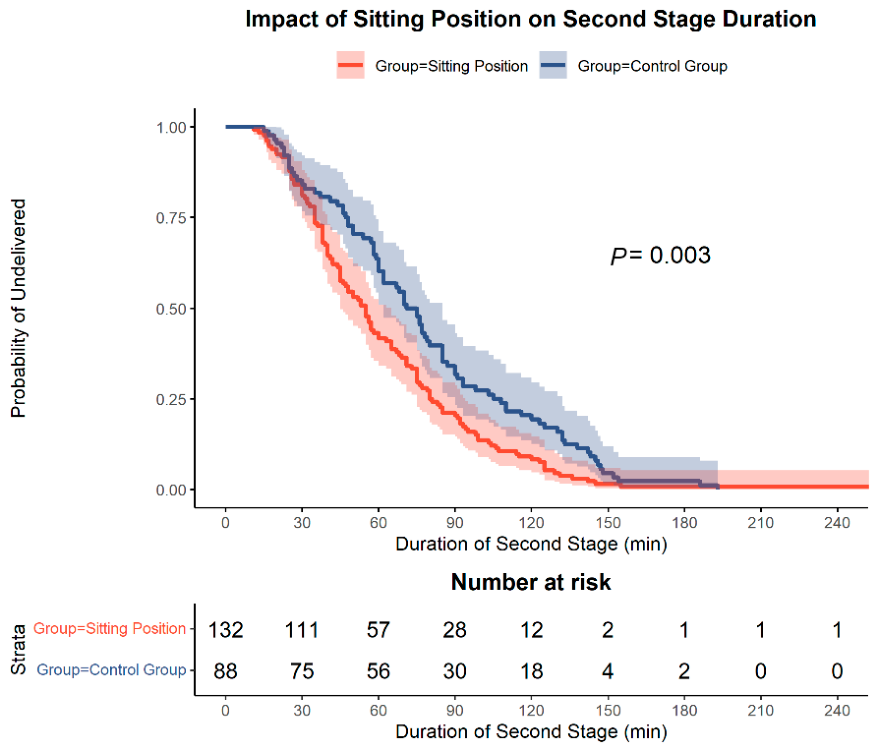
- Sitting delivery was associated with a shorter duration of the second stage of labor.
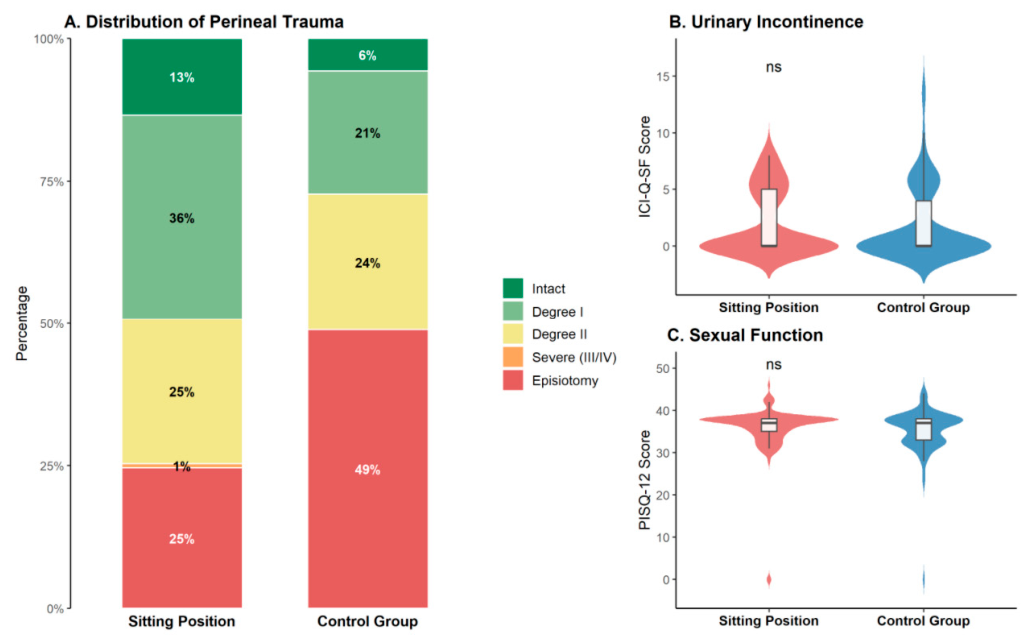
- It did not increase the incidence of urinary incontinence at one year postpartum.
- It did not increase the incidence of sexual dysfunction at one year postpartum.
Abstract
1. Introduction
2. Materials and Methods
Statistical Methods
3. Results
3.1. Patient Characteristics
3.2. Comparison of Perineal Integrity


| Sitting Group | Control Group | Adjusted Effect Measure(95% CI) | p Value | |
|---|---|---|---|---|
| Natural childbirth | 122 (91%) | 64 (72.7%) | 3.65 (1.68–8.34) | 0.001 |
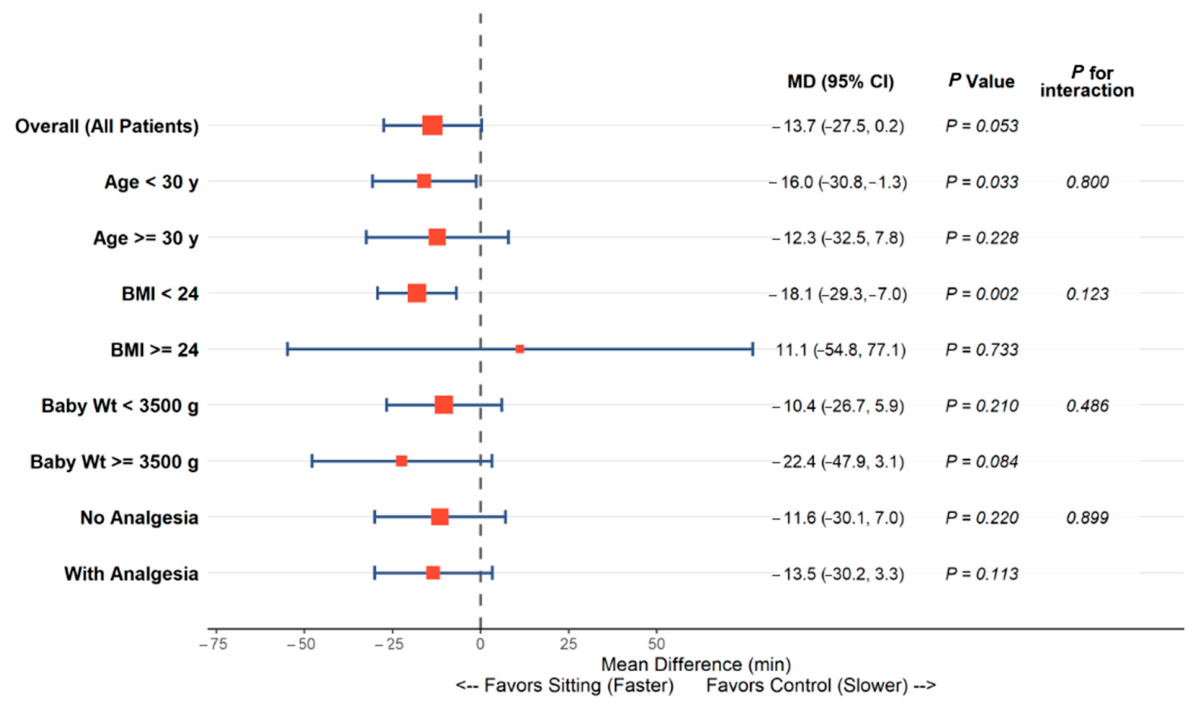
| Duration of the second stage (min), Median [IQR] | 55.0 [35.0–80.2] | 73.0 [47.8–105.8] | −11.65 (−25.35–2.05) | 0.095 * |
| Perineal lateral incision | 33 (24.6%) | 43 (48.9%) | 0.37 (0.20–0.67) | <0.001 |
| Total perineal laceration | 83 (61.9%) | 40 (45.5%) | 1.89 (1.08–3.32) | 0.027 |
| I degree laceration | 48 (35.8%) | 19 (21.6%) | 1.97 (1.04–3.82) | 0.040 |
| II degree laceration | 34 (25.4%) | 21 (23.9%) | 1.10 (0.58–2.11) | 0.775 |
| III degree laceration | 1 (0.7%) | 0 (0%) | - | - |
| IV degree laceration | 0 (0%) | 0 (0%) | - | - |
| Postpartum hemorrhage (≥500 mL) | 12 (9%) | 7 (8%) | 1.29 (0.47–3.75) | 0.628 |

3.3. Comparison of Pelvic Floor Tissue Ischemia/Tension Time
3.3.1. Comparison of the Duration of the Second Stage of Labor
3.3.2. Subgroup Analysis of the Duration of the Second Stage of Labor
3.4. Comparison of Urinary Incontinence Incidence Rates
3.5. Comparison of the Incidence of Sexual Dysfunction
3.6. Adverse Events Reporting the Following
4. Discussion
4.1. Sitting Delivery Was Associated with Enhanced Perineal Integrity and a Lower Episiotomy Rate
4.2. Association Between Sitting Delivery and Duration of the Second Stage of Labor
4.3. Association Between Sitting Delivery and Natural Delivery Rate
4.4. Sitting Delivery Does Not Increase the Incidence of Postpartum Urinary Incontinence
4.5. Sitting Delivery Does Not Increase the Incidence of Maternal Sexual Dysfunction
4.6. Appraising Randomized Evidence
4.7. Limitations
5. Conclusions
Author Contributions
Funding
Institutional Review Board Statement
Informed Consent Statement
Data Availability Statement
Acknowledgments
Conflicts of Interest
References
- Kopas, M.L. A review of evidence-based practices for management of the second stage of labor. J. Midwifery Women’s Health 2014, 59, 264–276. [Google Scholar] [CrossRef]
- Shen, Y. Effects of free-position delivery combined with perineal massage on reducing sensitive indicators of care quality in high-risk pregnant women. Front. Med. 2025, 12, 1661126. [Google Scholar] [CrossRef]
- Huang, B.; Lu, Y.; Zhang, Y.; Zhang, W.; Wang, X. Application of natural shoulder delivery combined with free position delivery in maternal delivery. Am. J. Transl. Res. 2021, 13, 14168–14175. [Google Scholar]
- WHO Recommendations: Intrapartum Care for a Positive Childbirth Experience; World Health Organization: Geneva, Switzerland, 2018.
- Lee, L.; Dy, J.; Azzam, H. Management of Spontaneous Labour at Term in Healthy Women. J. Obstet. Gynaecol. Can. 2016, 38, 843–865. [Google Scholar] [CrossRef]
- DeLancey, J.O.L.; Masteling, M.; Pipitone, F.; LaCross, J.; Mastrovito, S.; Ashton-Miller, J.A. Pelvic floor injury during vaginal birth is life-altering and preventable: What can we do about it? Am. J. Obstet. Gynecol. 2024, 230, 279–294.e2. [Google Scholar] [CrossRef] [PubMed]
- Winograd, J.; Punyala, A.; Sze, C.; Codelia-Anjum, A.; Elterman, D.; Zorn, K.C.; Bhojani, N.; Chughtai, B. Urge Urinary Incontinence and Pregnancy: A Systematic Review. Curr. Urol. Rep. 2025, 26, 32. [Google Scholar] [CrossRef] [PubMed]
- Hagen, S.; Sellers, C.; Elders, A.; Glazener, C.; MacArthur, C.; Toozs-Hobson, P.; Hemming, C.; Herbison, P.; Wilson, D. Urinary incontinence, faecal incontinence and pelvic organ prolapse symptoms 20-26 years after childbirth: A longitudinal cohort study. BJOG Int. J. Obstet. Gynaecol. 2024, 131, 1815–1823. [Google Scholar] [CrossRef]
- Ackerman, A.L.; Wise-Fuchs, A. Myofascial pelvic floor dysfunction as a hidden contributor to urinary symptoms. Minerva Obstet. Gynecol. 2026, 78, 250–260. [Google Scholar] [CrossRef] [PubMed]
- Yadav, M.; Poudel, S.; Adhikari, S.P. Pelvic Floor Dysfunction in Postpartum Nepalese Women: An Observational Study. J. Nepal Med. Assoc. 2026, 64, 20–24. [Google Scholar] [CrossRef]
- Huang, L.; Zhang, S.; Wu, S.; Ma, L.; Deng, X. The Chinese version of ICIQ: A useful tool in clinical practice and research on urinary incontinence. Neurourol. Urodyn. 2008, 27, 522–524. [Google Scholar] [CrossRef]
- Rogers, R.G.; Coates, K.W.; Kammerer-Doak, D.; Khalsa, S.; Qualls, C. A short form of the Pelvic Organ Prolapse/Urinary Incontinence Sexual Questionnaire (PISQ-12). Int. Urogynecol. J. Pelvic Floor Dysfunct. 2003, 14, 164–168. [Google Scholar] [CrossRef]
- Meng, X. Effect of Modified Semi-Recumbent Delivery on Maternal and Infant Outcomesin the Second Stage of Labor. Master’s Thesis, Soochow University, Suzhou, China, 2020. [Google Scholar]
- Yan, S.; Li, Y.; Fu, Y. Effects of different sitting deliveries on the maternal and infant outcomes in the second stage of labor for primiparous women. J. Nurs. Sci. 2025, 40, 21–24+30. [Google Scholar]
- Risløkken, J.; Macedo, M.D.; Bø, K.; Engh, M.E.; Siafarikas, F. The severity of second-degree perineal tears and dyspareunia during one year postpartum: A prospective cohort study. Acta Obstet. Gynecol. Scand. 2025, 104, 968–975. [Google Scholar] [CrossRef] [PubMed]
- Moraloglu, O.; Kansu-Celik, H.; Tasci, Y.; Karakaya, B.K.; Yilmaz, Y.; Cakir, E.; Yakut, H.I. The influence of different maternal pushing positions on birth outcomes at the second stage of labor in nulliparous women. J. Matern. Fetal Neonatal Med. 2017, 30, 245–249. [Google Scholar] [CrossRef]
- Simarro, M.; Espinosa, J.A.; Salinas, C.; Ojea, R.; Salvadores, P.; Walker, C.; Schneider, J. A Prospective Randomized Trial of Postural Changes vs Passive Supine Lying during the Second Stage of Labor under Epidural Analgesia. Med. Sci. 2017, 5, 5. [Google Scholar] [CrossRef]
- Roth, C.; Dent, S.A.; Parfitt, S.E.; Hering, S.L.; Bay, R.C. Randomized Controlled Trial of Use of the Peanut Ball During Labor. MCN. Am. J. Matern. Child Nurs. 2016, 41, 140–146. [Google Scholar] [CrossRef]
- Hemmerich, A.; Bandrowska, T.; Dumas, G.A. The effects of squatting while pregnant on pelvic dimensions: A computational simulation to understand childbirth. J. Biomech. 2019, 87, 64–74. [Google Scholar] [CrossRef]
- McKenzie, C.M.; Woolfolk, C.L.; Rieger, M.M.M.; White, A.B.; Tuuli, M.G.M.; Srinivas, S.K.M.; Caughey, A.B.; Tita, A.; Gregory, W.T.; Richter, H.E.; et al. Impact of the Duration of the Second Stage of Labor on Postpartum Pelvic Floor Symptoms. Urogynecology 2024, 30, 381–387. [Google Scholar] [CrossRef]
- Satone, P.D.; Tayade, S.A. Alternative Birthing Positions Compared to the Conventional Position in the Second Stage of Labor: A Review. Cureus 2023, 15, e37943. [Google Scholar] [CrossRef]
- Chang, S.; Chou, M.-M.; Lin, K.-C.; Lin, L.-C.; Lin, Y.-L.; Kuo, S.-C. Effects of a pushing intervention on pain, fatigue and birthing experiences among Taiwanese women during the second stage of labour. Midwifery 2011, 27, 825–831. [Google Scholar] [CrossRef] [PubMed]
- Gupta, J.K.; Sood, A.; Hofmeyr, G.J.; Vogel, J.P. Position in the second stage of labour for women without epidural anaesthesia. Cochrane Database Syst. Rev. 2017, 5, CD002006. [Google Scholar] [CrossRef]
- Fu, L.; Huang, J.; Li, D.; Wang, H.; Xing, L.; Wei, T.; Hou, R.; Lu, H. Effects of Using Sitting Position versus Lithotomy Position during the Second Stage of Labour on Maternal and Neonatal Outcomes and the Childbirth Experience of Chinese Women: A Prospective Cohort Study. Healthcare 2023, 11, 2996. [Google Scholar] [CrossRef]
- Dénakpo, J.; Lokossou, A.; Tonato-Bagnan, J.A.; Alao, J.; Hounkpatin, B.; Komongui, D.G.; A Tamou-Tabé, D.; Perrin, R.-X. Delivery in free position perhaps a solution to change delivery in traditional position in delivery rooms in Africa: Results of a prospective study in Cotonou in Bénin. J. Obstet. Gynaecol. Can. 2012, 34, 947–953. [Google Scholar] [CrossRef]
- Schofield, C.; Newton, R.U.; Cohen, P.A.; Galvão, D.A.; McVeigh, J.A.; Mohan, G.R.; Tan, J.; Salfinger, S.G.; Straker, L.M.; Peddle-McIntyre, C.J. Health-related quality of life and pelvic floor dysfunction in advanced-stage ovarian cancer survivors: Associations with objective activity behaviors and physiological characteristics. Support. Care Cancer 2018, 26, 2239–2246. [Google Scholar] [CrossRef]
- Lugo, T.; Leslie, S.W.; Mikes, B.A.; Riggs, J. Stress Urinary Incontinence. In StatPearls; StatPearls Publishing: Treasure Island, FL, USA, 2026. [Google Scholar]
- Lukacz, E.S.; Santiago-Lastra, Y.; Albo, M.E.; Brubaker, L. Urinary Incontinence in Women: A Review. JAMA 2017, 318, 1592–1604. [Google Scholar] [CrossRef] [PubMed]
- Rathore, A.; Suri, J.; Agarwal, S.; Mittal, P. Antenatal and postnatal assessment of pelvic floor muscles in continent and incontinent primigravida women. Int. Urogynecol. J. 2021, 32, 1875–1882. [Google Scholar] [CrossRef]
- Danforth, K.N.; Townsend, M.K.; Lifford, K.; Curhan, G.C.; Resnick, N.M.; Grodstein, F. Risk factors for urinary incontinence among middle-aged women. Am. J. Obstet. Gynecol. 2006, 194, 339–345. [Google Scholar] [CrossRef] [PubMed]
- Harland, N.; Walz, S.; Eberli, D.; Schmid, F.A.; Aicher, W.K.; Stenzl, A.; Amend, B. Stress Urinary Incontinence: An Unsolved Clinical Challenge. Biomedicines 2023, 11, 2486. [Google Scholar] [CrossRef]
- Taştekin Ouyaba, A.; Infal Kesim, S. The prevalence of sexual dysfunctions in pregnant women and the correlated factors: A systematic review and meta-analysis. J. Sex. Med. 2023, 20, 475–487. [Google Scholar] [CrossRef]
- Alimi, R.; Marvi, N.; Azmoude, E.; Miri, H.H.; Zamani, M. Sexual function after childbirth: A meta-analysis based on mode of delivery. Women Health 2023, 63, 83–96. [Google Scholar] [CrossRef] [PubMed]

| Project | Sitting Group (n = 134) | Control Group (n = 88) | Total (n = 222) | p |
|---|---|---|---|---|
| Age (Mean ± SD) | 30.58 ± 2.79 | 30.59 ± 2.79 | 30.59 ± 2.79 | 0.982 |
| Gestational weeks (Mean ± SD) | 39.26 ± 1.08 | 39.34 ± 1.00 | 39.29 ± 1.05 | 0.581 |
| Maternal BMI during pregnancy (Mean ± SD) | 21.19 ± 2.83 | 21.68 ± 2.87 | 21.38 ± 2.85 | 0.203 |
| Newborn birth weight (g) (Mean ± SD) | 3203.34 ± 331.60 | 3172.03 ± 332.19 | 3251.02 ± 326.82 | 0.083 |
| Duration of the first stage of labor (Median [IQR]) | 410.00 [290.00, 525.00] | 420.00 [300.00, 652.50] | 20.00 [290.00, 560.00] | 0.142 |
| Number of pregnancies (Median [IQR]) | 1.00 [1.00, 1.00] | 1.00 [1.00, 1.00] | 1.00 [1.00, 1.00] | 0.504 |
| Educational attainment(%) | 0.460 | |||
| High school and below | 0 (0.0%) | 1 (1.1%) | 1 (0.5%) | |
| Associate degree/undergraduate degree | 88 (65.7%) | 58 (65.9%) | 146 (65.7%) | |
| Postgraduate degree and above | 46 (34.3%) | 29 (33.0%) | 75 (33.8%) | |
| Whether to use labor analgesia | 0.315 | |||
| No | 86 (64.2%) | 63 (71.6%) | 149 (67.1%) | |
| Yes | 48 (35.8%) | 25 (28.4%) | 73 (32.9%) |
Disclaimer/Publisher’s Note: The statements, opinions and data contained in all publications are solely those of the individual author(s) and contributor(s) and not of MDPI and/or the editor(s). MDPI and/or the editor(s) disclaim responsibility for any injury to people or property resulting from any ideas, methods, instructions or products referred to in the content. |
© 2026 by the authors. Licensee MDPI, Basel, Switzerland. This article is an open access article distributed under the terms and conditions of the Creative Commons Attribution (CC BY) license.
Share and Cite
Gong, J.; Xie, B.; Wei, Y.; Fu, L.; Xing, L.; Liu, X.; Li, X. The Association Between Sitting Delivery During the Second Stage of Labor and Pelvic Floor Function in Primiparas: A Prospective Cohort Study. Healthcare 2026, 14, 1681. https://doi.org/10.3390/healthcare14121681
Gong J, Xie B, Wei Y, Fu L, Xing L, Liu X, Li X. The Association Between Sitting Delivery During the Second Stage of Labor and Pelvic Floor Function in Primiparas: A Prospective Cohort Study. Healthcare. 2026; 14(12):1681. https://doi.org/10.3390/healthcare14121681
Chicago/Turabian StyleGong, Jingjing, Bing Xie, Yuxuan Wei, Li Fu, Lili Xing, Xiaonan Liu, and Xiaodan Li. 2026. "The Association Between Sitting Delivery During the Second Stage of Labor and Pelvic Floor Function in Primiparas: A Prospective Cohort Study" Healthcare 14, no. 12: 1681. https://doi.org/10.3390/healthcare14121681
APA StyleGong, J., Xie, B., Wei, Y., Fu, L., Xing, L., Liu, X., & Li, X. (2026). The Association Between Sitting Delivery During the Second Stage of Labor and Pelvic Floor Function in Primiparas: A Prospective Cohort Study. Healthcare, 14(12), 1681. https://doi.org/10.3390/healthcare14121681