Alarm Fatigue and Nursing Performance Among Hospital Nurses in South Korea: A Cross-Sectional Study of Indirect Association Through Perceived Stress and Moderating Role of Patient Safety Culture

Highlights
- Alarm fatigue was associated with lower performance and higher perceived stress among hospital nurses.
- Perceived stress was indirectly associated with alarm fatigue and nursing performance, and patient safety culture buffered the stress–performance link.
- Alarm-related problems should be addressed through technical alarm management and support for nurses’ stress responses.
- Strengthening patient safety culture may help protect nursing performance under high job demands, although its buffering effect was modest.
Abstract
1. Introduction
2. Materials and Methods
2.1. Study Design
2.2. Participants and Data Collection
2.3. Measures
2.3.1. Alarm Fatigue
2.3.2. Perceived Stress
2.3.3. Nursing Performance
2.3.4. Patient Safety Culture
2.4. Statistical Analysis
3. Results
3.1. Participant Characteristics and Descriptive Statistics
3.2. Correlations Among Study Variables
3.3. Indirect Association Through Perceived Stress
3.4. Moderating Effect of Patient Safety Culture and Moderated Indirect Association
4. Discussion
4.1. Main Findings and Interpretation
4.2. Perspectives for Clinical and Assistive Nursing Practice
4.3. Limitations
5. Conclusions
Supplementary Materials
Author Contributions
Funding
Institutional Review Board Statement
Informed Consent Statement
Data Availability Statement
Conflicts of Interest
References
- ECRI. ECRI’s Top 10 Patient Safety Concerns for 2024; Emergency Care Research Institute: Fort Washington, PA, USA, 2024. [Google Scholar]
- The Joint Commission. National Patient Safety Goals. Available online: https://www.jointcommission.org/standards/national-patient-safety-goals/ (accessed on 13 October 2025).
- American Association of Critical-Care Nurses. Practice Alert: Managing Alarms in Acute Care Across the Life Span. Available online: https://www.aacn.org/newsroom/practice-alert-outlines-alarm-management-strategies (accessed on 19 December 2025).
- Albanowski, K.; Burdick, K.J.; Bonafide, C.P.; Kleinpell, R.; Schlesinger, J.J. Ten Years Later, Alarm Fatigue Is Still a Safety Concern. AACN Adv. Crit. Care 2023, 34, 189–197. [Google Scholar] [CrossRef] [PubMed]
- Michels, E.A.M.; Gilbert, S.; Koval, I.; Wekenborg, M.K. Alarm fatigue in healthcare: A scoping review of definitions, influencing factors, and mitigation strategies. BMC Nurs. 2025, 24, 664. [Google Scholar] [CrossRef]
- Wunderlich, M.M.; Amende-Wolf, S.; Krampe, H.; Kruppa, J.; Spies, C.; Weiß, B.; Memmert, B.; Balzer, F.; Poncette, A.S. A brief questionnaire for measuring alarm fatigue in nurses and physicians in intensive care units. Sci. Rep. 2023, 13, 13860. [Google Scholar] [CrossRef] [PubMed]
- Jackson, J.; Vandall-Walker, V.; Vanderspank-Wright, B.; Wishart, P.; Moore, S.L. Burnout and resilience in critical care nurses: A grounded theory of Managing Exposure. Intensive Crit. Care Nurs. 2018, 48, 28–35. [Google Scholar] [CrossRef]
- Salameh, B.; Abdallah, J.; Alkubati, S.A.; Albashtawy, M. Alarm fatigue and perceived stress among critical care nurses in the intensive care units: Palestinian perspectives. BMC Nurs. 2024, 23, 261. [Google Scholar] [CrossRef] [PubMed]
- Ding, S.; Huang, X.; Sun, R.; Yang, L.; Yang, X.; Li, X.; Liu, J.; Yang, H.; Zhou, H.; Huang, X.; et al. The relationship between alarm fatigue and burnout among critical care nurses: A cross-sectional study. Nurs. Crit. Care 2023, 28, 940–947. [Google Scholar] [CrossRef]
- Doroc, K.; Yadav, N.; Murawski, C. Acute stress impairs decision-making at varying levels of decision complexity. Commun. Psychol. 2025, 3, 179. [Google Scholar] [CrossRef]
- Niri, M.A.M.; Khademian, Z.; Rivaz, M. Nurses’ Performance as a Mediator Between Nurses’ Fatigue and Patient Safety Culture: A Structural Equation Model Analysis. Nurs. Open 2025, 12, e70168. [Google Scholar] [CrossRef]
- Demir, Y.; Dağ, E.; Nal, B.; Nal, M.; Bektaş, G. Determinants of nurses’ job performance: The interaction of perceived occupational stress, psychological safety, and digital fatigue. BMC Nurs. 2025, 24, 1443. [Google Scholar] [CrossRef]
- Lewandowska, K.; Weisbrot, M.; Cieloszyk, A.; Mędrzycka-Dąbrowska, W.; Krupa, S.; Ozga, D. Impact of Alarm Fatigue on the Work of Nurses in an Intensive Care Environment—A Systematic Review. Int. J. Environ. Res. Public Health 2020, 17, 8409. [Google Scholar] [CrossRef]
- Baye, Y.; Demeke, T.; Birhan, N.; Semahegn, A.; Birhanu, S. Nurses’ work-related stress and associated factors in governmental hospitals in Harar, Eastern Ethiopia: A cross-sectional study. PLoS ONE 2020, 15, e0236782. [Google Scholar] [CrossRef]
- Alanazi, F.K.; Lapkin, S.; Molloy, L.; Sim, J. Safety culture, quality of care, missed care, nurse staffing and their impact on pressure injuries: A cross-sectional multi-source study. Int. J. Nurs. Stud. Adv. 2023, 5, 100125. [Google Scholar] [CrossRef]
- Babapour, A.R.; Gahassab-Mozaffari, N.; Fathnezhad-Kazemi, A. Nurses’ job stress and its impact on quality of life and caring behaviors: A cross-sectional study. BMC Nurs. 2022, 21, 75. [Google Scholar] [CrossRef]
- World Health Organization. Burn-Out an “Occupational Phenomenon”: International Classification of Diseases. Available online: https://www.who.int/news/item/28-05-2019-burn-out-an-occupational-phenomenon-international-classification-of-diseases (accessed on 17 May 2026).
- Qi, X.; Fu, C.; Wang, X.; Wang, Y.; Liu, W. Alarm Fatigue and Job Burnout Among Intensive Care Unit Nurses: A Cross-Sectional Study in a Tertiary Hospital in China. Nurs. Crit. Care 2025, 30, e70175. [Google Scholar] [CrossRef]
- Petrelli, F.; Cangelosi, G.; Scuri, S.; Davidici, C.; Lavoragna, F.; Debernardi, G.; Benni, A.; Veprini, A.; Nguyen, C.T.T.; Caraffa, A.; et al. Burnout syndrome: A preliminary study of a population of nurses in italian prisons. Clin. Ter. 2020, 171, e304–e309. [Google Scholar] [CrossRef] [PubMed]
- Butler, S. Understanding burnout in nurses: Identification and coping strategies. Br. J. Nurs. 2025, 34, 220–224. [Google Scholar] [CrossRef] [PubMed]
- Friganović, A.; Selič, P. Where to Look for a Remedy? Burnout Syndrome and its Associations with Coping and Job Satisfaction in Critical Care Nurses—A Cross-Sectional Study. Int. J. Environ. Res. Public Health 2021, 18, 4390. [Google Scholar] [CrossRef]
- Velando-Soriano, A.; Ortega-Campos, E.; Gómez-Urquiza, J.L.; Ramírez-Baena, L.; De La Fuente, E.I.; Cañadas-De La Fuente, G.A. Impact of social support in preventing burnout syndrome in nurses: A systematic review. Jpn. J. Nurs. Sci. 2020, 17, e12269. [Google Scholar] [CrossRef]
- Zumstein-Shaha, M.; Grace, P.J. Competency frameworks, nursing perspectives, and interdisciplinary collaborations for good patient care: Delineating boundaries. Nurs. Philos. 2023, 24, e12402. [Google Scholar] [CrossRef]
- Lu, L.; Ko, Y.M.; Chen, H.Y.; Chueh, J.W.; Chen, P.Y.; Cooper, C.L. Patient Safety and Staff Well-Being: Organizational Culture as a Resource. Int. J. Environ. Res. Public Health 2022, 19, 3722. [Google Scholar] [CrossRef]
- Lewandowska, K.; Mędrzycka-Dąbrowska, W.; Tomaszek, L.; Wujtewicz, M. Determining Factors of Alarm Fatigue among Nurses in Intensive Care Units—A Polish Pilot Study. J. Clin. Med. 2023, 12, 3120. [Google Scholar] [CrossRef]
- Sarioğlu, E.; Amarat, M. The Relationship Between Alarm Fatigue and Medical Error Tendency in Intensive Care Unit Nurses: The Mediating Affect of Role Overload. Nurs. Crit. Care 2025, 30, e70121. [Google Scholar] [CrossRef]
- Ruppel, H.; Funk, M.; Whittemore, R. Measurement of Physiological Monitor Alarm Accuracy and Clinical Relevance in Intensive Care Units. Am. J. Crit. Care 2018, 27, 11–21. [Google Scholar] [CrossRef]
- Bakker, A.B.; Demerouti, E. Job demands-resources theory: Taking stock and looking forward. J. Occup. Health Psychol. 2017, 22, 273–285. [Google Scholar] [CrossRef]
- Bakker, A.B.; Demerouti, E. The Job Demands-Resources model: State of the art. J. Manag. Psychol. 2007, 22, 309–328. [Google Scholar] [CrossRef]
- Bani Hani, S.; Abu Aqoulah, E.A. Relationship Between Alarm Fatigue and Stress Among Acute Care Nurses: A Cross-Sectional Study. SAGE Open Nurs. 2024, 10, 23779608241292584. [Google Scholar] [CrossRef]
- Faul, F.; Erdfelder, E.; Buchner, A.; Lang, A.G. Statistical power analyses using G*Power 3.1: Tests for correlation and regression analyses. Behav. Res. Methods 2009, 41, 1149–1160. [Google Scholar] [CrossRef]
- Lee, S.-H.; Choi, J.-Y. Factors influencing Alert Fatigue in Clinical Nurses. J. Muscle Jt. Health 2025, 32, 29–38. [Google Scholar] [CrossRef]
- Cohen, S.; Williamson, G.M. Perceived Stress in a Probability Sample of the United States; Sage: Newbury Park, CA, USA, 1988; pp. 31–67. [Google Scholar]
- Park, J.-O.; Seo, Y.-S. Validation of the Perceived Stress Scale (PSS) on Samples of Korean University Students. Korean J. Psychol. Gen. 2010, 29, 611–629. [Google Scholar]
- Schwirian, P.M. Evaluating the performance of nurses: A multidimensional approach. Nurs. Res. 1978, 27, 347–351. [Google Scholar] [CrossRef]
- Park, K.-O.; Ahn, Y.-M.; Kang, N.-R.; Lee, M.-J.; Sohn, M.-S. Psychometric Evaluation of the Six-Dimension Scale of Nursing Performance and Student Nurse Stress Index Using an Objective Structured Clinical Examination: Focus on Asthma and Type 1 Diabetes Modules. Child Health Nurs. Res. 2013, 19, 85–93. [Google Scholar] [CrossRef]
- AHRQ. Alert Fatigue. Available online: https://psnet.ahrq.gov/primer/alert-fatigue (accessed on 20 March 2026).
- Kim, J.; Kang, M.; Ahn, K.-A.; Sung, Y. A Survey of Nurses’ Perception of Patient Safety Related to Hospital Culture and Reports of Medical Errors. J. Korean Clin. Nurs. Res. 2007, 13, 169–179. [Google Scholar]
- Hayes, A.F. PROCESS: A Versatile Computational Tool for Observed Variable Mediation, Moderation, and Conditional Process Modeling; The Ohio State University: Columbus, OH, USA, 2012. [Google Scholar]
- Almarwani, A.M.; Alzahrani, N.S. Factors affecting the development of clinical nurses’ competency: A systematic review. Nurse Educ. Pract. 2023, 73, 103826. [Google Scholar] [CrossRef]
- Krijgsheld, M.; Tummers, L.G.; Scheepers, F.E. Job performance in healthcare: A systematic review. BMC Health Serv. Res. 2022, 22, 149. [Google Scholar] [CrossRef]
- Haile, K.E.; Amsalu, A.A.; Kassie, G.A.; Asgedom, Y.S.; Chema, T.Z.; Gebrekidan, A.Y.; Azeze, G.A. Missed nursing care and associated factors among Ethiopian nurses: A systematic review and meta-analysis. BMC Nurs. 2025, 24, 1043. [Google Scholar] [CrossRef]
- Hayes, A.F. Introduction to Mediation, Moderation, and Conditional Process Analysis: A Regression-Based Approach, 2nd ed.; Guilford Publications: New York, NY, USA, 2017. [Google Scholar]
- Subih, M.; Al-Amer, R.; Bani Saleh, E.G.; Thultheen, I.N. Predictors of Clinical Performance Among Emergency Nurses: A Cross-Sectional Study. SAGE Open Nurs. 2024, 10, 23779608241281468. [Google Scholar] [CrossRef]
- Cohen, S.; Kamarck, T.; Mermelstein, R. A global measure of perceived stress. J. Health Soc. Behav. 1983, 24, 385–396. [Google Scholar]
- Campbell, D.T.; Fiske, D.W. Convergent and discriminant validation by the multitrait-multimethod matrix. Psychol. Bull. 1959, 56, 81–105. [Google Scholar] [CrossRef]
- Brown, T.A. Confirmatory Factor Analysis for Applied Research, 2nd ed.; Guilford Publications: New York, NY, USA, 2015. [Google Scholar]
- Henseler, J.; Ringle, C.M.; Sarstedt, M. A new criterion for assessing discriminant validity in variance-based structural equation modeling. J. Acad. Mark. Sci. 2015, 43, 115–135. [Google Scholar] [CrossRef]
- Bakker, A.B.; Demerouti, E.; Euwema, M.C. Job resources buffer the impact of job demands on burnout. J. Occup. Health Psychol. 2005, 10, 170–180. [Google Scholar] [CrossRef]
- Hall, K.K.; Shoemaker-Hunt, S.; Hoffman, L.; Richard, S.; Gall, E.; Schoyer, E.; Costar, D.; Gale, B.; Schiff, G.; Miller, K.; et al. Making Healthcare Safer III: A Critical Analysis of Existing and Emerging Patient Safety Practices; Agency for Healthcare Research and Quality: Rockville, MD, USA, 2020.
- Bach, T.A.; Berglund, L.M.; Turk, E. Managing alarm systems for quality and safety in the hospital setting. BMJ Open Qual. 2018, 7, e000202. [Google Scholar] [CrossRef]
- Cameron, H.L.; Little, B. Nurses’ Perceptions and Practices Related to Alarm Management: A Quality Improvement Initiative. J. Contin. Educ. Nurs. 2018, 49, 207–215. [Google Scholar] [CrossRef]
- Lee, S.E.; Dahinten, V.S.; Lee, J.H. Testing the association between the enabling and enacting factors of patient safety culture and patient safety: Structural equation modelling. BMC Nurs. 2023, 22, 32. [Google Scholar] [CrossRef]
- Brás, C.; Ferreira, M.M.C.; Figueiredo, M.; Duarte, J.C. Patient safety culture in nurses’ clinical practice. Rev. Lat. Am. Enferm. 2023, 31, e3837. [Google Scholar] [CrossRef]



| Variable | n (%) | M ± SD | Min–Max | |
|---|---|---|---|---|
| Gender | Man | 10 (4.6) | ||
| Woman | 208 (95.4) | |||
| Age (year) | 34.97 ± 8.06 | 22–55 | ||
| Education level | 3-year college graduate | 37 (17.0) | ||
| 4-year college graduate | 171 (78.4) | |||
| Master’s degree or higher | 10 (4.6) | |||
| Total clinical experience (months) | 132.72 ± 98.88 | 6–480 | ||
| Current ward experience (months) | 34.59 ± 31.03 | 2–198 | ||
| Position | Staff nurse | 188 (86.2) | ||
| Charge nurse | 22 (10.1) | |||
| Manager | 8 (3.7) | |||
| Monthly income (Won) | 2,500,000–3,499,999 | 67 (30.7) | ||
| 3,500,000–4,499,999 | 71 (32.5) | |||
| ≥4,500,000 | 80 (36.7) | |||
| Marital status | Single | 116 (53.2) | ||
| Married | 102 (46.8) | |||
| Having children | Yes | 79 (36.2) | ||
| No | 139 (63.8) | |||
| Current ward | Comprehensive nursing care unit | 74 (33.9) | ||
| General ward | 55 (25.2) | |||
| Intensive care unit | 51 (23.4) | |||
| Emergency room | 23 (10.6) | |||
| Operation room | 9 (4.1) | |||
| Hemodialysis unit | 4 (1.8) | |||
| Other | 2 (0.9) | |||
| Shift work | Yes | 189 (86.7) | ||
| No | 29 (13.3) | |||
| Perceived health | Good | 87 (39.9) | ||
| Fair | 128 (58.7) | |||
| Poor | 3 (1.4) | |||
| Alarm fatigue | 31.98 ± 8.18 | 9–44 | ||
| Perceived stress | 26.09 ± 9.11 | 2–40 | ||
| Patient safety culture | 152.92 ± 37.50 | 64–204 | ||
| Nursing performance | 180.41 ± 48.53 | 78–259 | ||
| Variables | 1 | 2 | 3 | 4 | 5 |
|---|---|---|---|---|---|
| r (p) | r (p) | r (p) | r (p) | r (p) | |
| 1. Alarm Fatigue | 1 | ||||
| 2. Perceived Stress | 0.876 | 1 | |||
| (<0.001) | |||||
| 3. Nursing Performance | −0.665 | −0.697 | 1 | ||
| (<0.001) | (<0.001) | ||||
| 4. Patient Safety Culture | −0.087 | −0.041 | 0.506 | 1 | |
| (0.199) | (0.550) | (<0.001) | |||
| 5. Total Clinical Experience | −0.356 | −0.404 | 0.524 | 0.432 | 1 |
| (<0.001) | (<0.001) | (<0.001) | (<0.001) |
| Perceived Stress (M) | Nursing Performance (Y) | |||||||
|---|---|---|---|---|---|---|---|---|
| B | SE | t | p | B | SE | t | p | |
| Alarm Fatigue (X) | 0.865 | 0.040 | 21.853 | p < 0.001 | −0.511 | 0.438 | −1.165 | 0.245 |
| Perceived Stress (M) | −3.060 | 0.447 | −6.865 | p < 0.001 | ||||
| Patient Safety Culture (W) | 0.430 | 0.075 | 5.716 | p < 0.001 | ||||
| M × W | F = 7.680, p = 0.006 | |||||||
| R2 | 0.803 | 0.736 | ||||||
| Patient Safety Culture Level | B | SE | t | p | LLCI | ULCI |
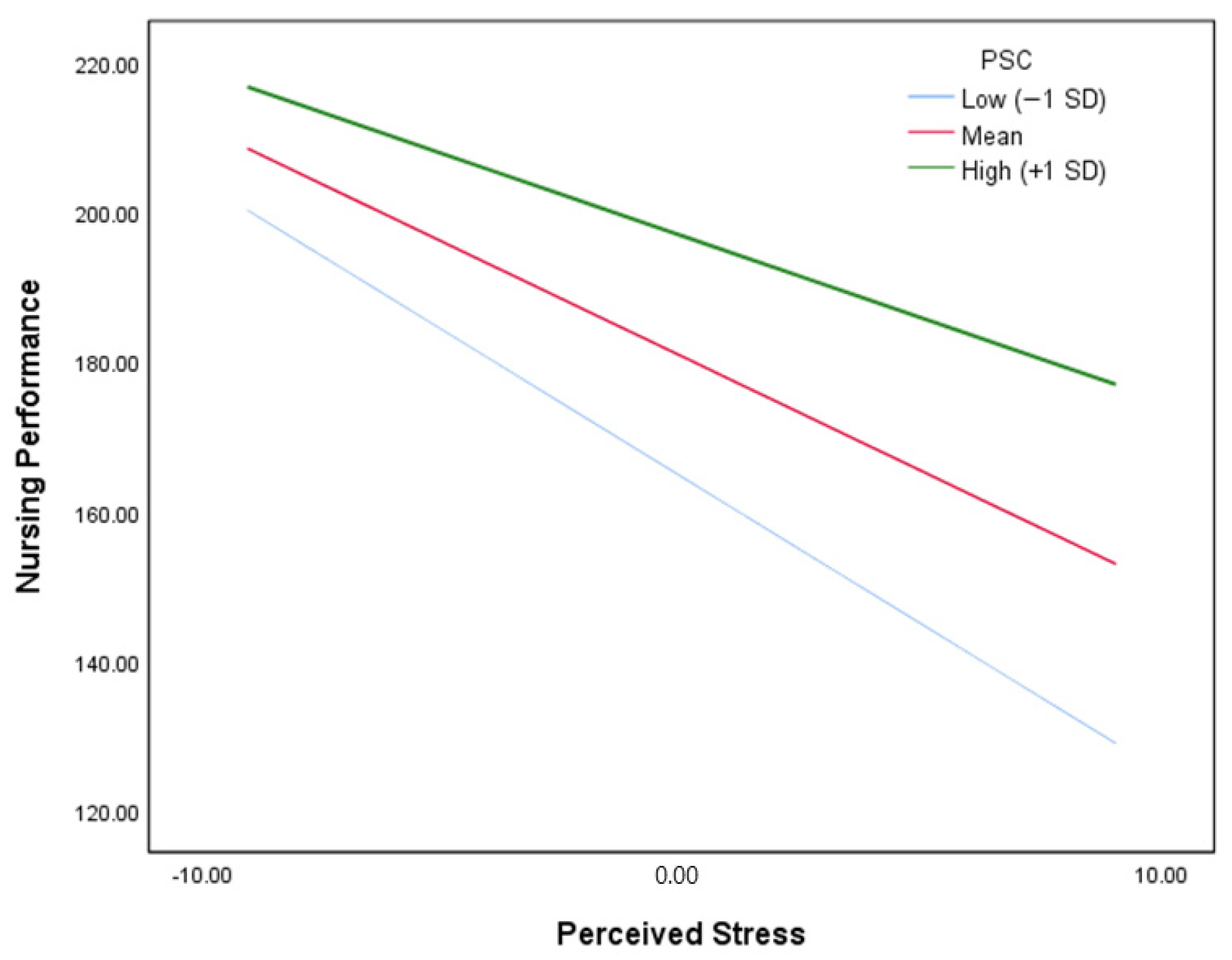
| −37.496 (−1 SD) | −3.935 | 0.597 | −6.593 | p < 0.001 | −5.111 | −2.758 |
| 0.000 (M) | −3.066 | 0.447 | −6.865 | p < 0.001 | −3.946 | −2.185 |
| 37.496 (+1 SD) | −2.197 | 0.489 | −4.491 | p < 0.001 | −3.161 | −1.232 |
| Conditional indirect effect | Index | BootSE | LLCI | ULCI | ||
| X → M → Y | 0.023 | 0.007 | 0.007 | 0.037 | ||
Disclaimer/Publisher’s Note: The statements, opinions and data contained in all publications are solely those of the individual author(s) and contributor(s) and not of MDPI and/or the editor(s). MDPI and/or the editor(s) disclaim responsibility for any injury to people or property resulting from any ideas, methods, instructions or products referred to in the content. |
© 2026 by the authors. Licensee MDPI, Basel, Switzerland. This article is an open access article distributed under the terms and conditions of the Creative Commons Attribution (CC BY) license.
Share and Cite
Kwon, J.; Kim, Y. Alarm Fatigue and Nursing Performance Among Hospital Nurses in South Korea: A Cross-Sectional Study of Indirect Association Through Perceived Stress and Moderating Role of Patient Safety Culture. Healthcare 2026, 14, 1650. https://doi.org/10.3390/healthcare14121650
Kwon J, Kim Y. Alarm Fatigue and Nursing Performance Among Hospital Nurses in South Korea: A Cross-Sectional Study of Indirect Association Through Perceived Stress and Moderating Role of Patient Safety Culture. Healthcare. 2026; 14(12):1650. https://doi.org/10.3390/healthcare14121650
Chicago/Turabian StyleKwon, Jungmi, and Yoonjoo Kim. 2026. "Alarm Fatigue and Nursing Performance Among Hospital Nurses in South Korea: A Cross-Sectional Study of Indirect Association Through Perceived Stress and Moderating Role of Patient Safety Culture" Healthcare 14, no. 12: 1650. https://doi.org/10.3390/healthcare14121650
APA StyleKwon, J., & Kim, Y. (2026). Alarm Fatigue and Nursing Performance Among Hospital Nurses in South Korea: A Cross-Sectional Study of Indirect Association Through Perceived Stress and Moderating Role of Patient Safety Culture. Healthcare, 14(12), 1650. https://doi.org/10.3390/healthcare14121650