Free Riding in Healthcare Through a Game-Theoretic Lens: A Cross-Domain Narrative Review and Conceptual Synthesis



Abstract
1. Introduction
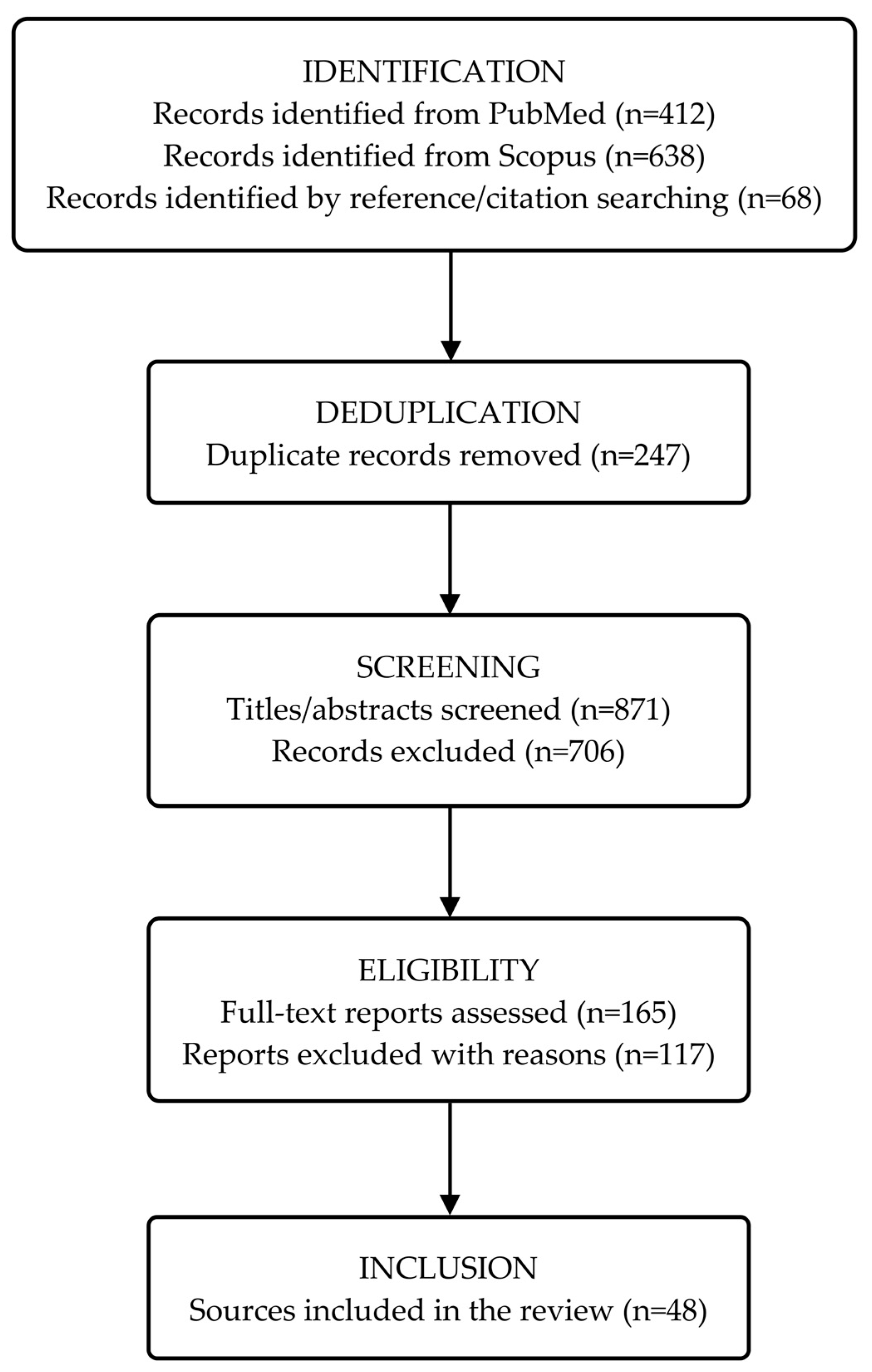
2. Materials and Methods
3. Source Mapping and Integrated Analytical Framework
4. Domain-Specific Game-Theoretic Analysis
4.1. Vaccination Uptake
4.2. Health Insurance and Universal Healthcare Coverage
4.3. Antimicrobial Resistance
4.4. Organ Donation and Transplant Allocation
4.5. Global Health Initiatives
5. Discussion
6. Limitations
7. Future Directions
8. Conclusions
Author Contributions
Funding
Institutional Review Board Statement
Informed Consent Statement
Data Availability Statement
Conflicts of Interest
References
- Hayashi, T. Public goods and the free-rider problem. In Microeconomic Theory for the Social Sciences; Springer: Berlin/Heidelberg, Germany, 2021; pp. 437–450. [Google Scholar] [CrossRef] [Scilit]
- Kim, O.; Walker, M. The free rider problem: Experimental evidence. Public Choice 1984, 43, 3–24. [Google Scholar] [CrossRef] [Scilit]
- Ostrom, E. Governing the Commons: The Evolution of Institutions for Collective Action; Cambridge University Press: Cambridge, UK, 1990. [Google Scholar]
- Uchida, S.; Sasaki, T.; Yamamoto, H.; Okada, I. Evolution of “Pay-It-Forward” in the Presence of the Temptation to Free-Ride. Games 2024, 15, 16. [Google Scholar] [CrossRef] [Scilit]
- Djulbegovic, B.; Hozo, I.; Ioannidis, J.P.A. Modern health care as a game theory problem. Eur. J. Clin. Investig. 2015, 45, 1–12. [Google Scholar] [CrossRef] [Scilit]
- Bauch, C.T.; Earn, D.J.D. Vaccination and the theory of games. Proc. Natl. Acad. Sci. USA 2004, 101, 13391–13394. [Google Scholar] [CrossRef] [Scilit]
- Shim, E.; Grefenstette, J.J.; Albert, S.M.; Cakouros, B.E.; Burke, D.S. A game dynamic model for vaccine skeptics and vaccine believers: Measles as an example. J. Theor. Biol. 2012, 295, 194–203. [Google Scholar] [CrossRef] [Scilit] [PubMed]
- Ibuka, Y.; Li, M.; Vietri, J.; Chapman, G.B.; Galvani, A.P. Free-riding behavior in vaccination decisions: An experimental study. PLoS ONE 2014, 9, e87164. [Google Scholar] [CrossRef] [Scilit]
- Korn, L.; Böhm, R.; Meier, N.W.; Betsch, C. Vaccination as a social contract. Proc. Natl. Acad. Sci. USA 2020, 117, 14890–14899. [Google Scholar] [CrossRef] [Scilit] [PubMed]
- Colman, A.M.; Krockow, E.M.; Chattoe-Brown, E.; Tarrant, C. Medical prescribing and antibiotic resistance: A game-theoretic analysis of a potentially catastrophic social dilemma. PLoS ONE 2019, 14, e0215480. [Google Scholar] [CrossRef] [Scilit] [PubMed]
- Cutler, D.M.; Zeckhauser, R.J. The anatomy of health insurance. In Handbook of Health Economics; Elsevier: Amsterdam, The Netherlands, 2000; Volume 1, pp. 563–643. [Google Scholar] [CrossRef] [Scilit]
- Pauly, M.V. Taxation, health insurance, and market failure in the medical economy. J. Econ. Lit. 1986, 24, 629–675. [Google Scholar]
- Rothschild, M.; Stiglitz, J. Equilibrium in competitive insurance markets: An essay on the economics of imperfect information. Q. J. Econ. 1976, 90, 629–649. [Google Scholar] [CrossRef] [Scilit]
- Hackmann, M.B.; Kolstad, J.T.; Kowalski, A.E. Adverse selection and an individual mandate: When theory meets practice. Am. Econ. Rev. 2015, 105, 1030–1066. [Google Scholar] [CrossRef] [Scilit]
- Einav, L.; Finkelstein, A. Selection in insurance markets: Theory and empirics in pictures. J. Econ. Perspect. 2011, 25, 115–138. [Google Scholar] [CrossRef] [Scilit] [PubMed]
- Skaro, A.I.; Hazen, G.; Ladner, D.; Kaplan, B. Organ Transplantation: An Introduction to Game Theory. Transplantation 2015, 99, 1316–1320. [Google Scholar] [CrossRef] [Scilit] [PubMed]
- Abásolo, I.; Tsuchiya, A. Blood donation as a public good: An empirical investigation of the free rider problem. Eur. J. Health Econ. 2014, 15, 313–321. [Google Scholar] [CrossRef] [Scilit]
- Glannon, W. Free riding and organ donation. J. Med. Ethics 2009, 35, 590–591. [Google Scholar] [CrossRef] [Scilit]
- Johnson, E.J.; Goldstein, D. Do defaults save lives? Science 2003, 302, 1338–1339. [Google Scholar] [CrossRef] [Scilit] [PubMed]
- McAdams, D.; McDade, K.K.; Ogbuoji, O.; Johnson, M.; Dixit, S.; Yamey, G. Incentivising wealthy nations to participate in the COVID-19 Vaccine Global Access Facility (COVAX): A game theory perspective. BMJ Glob. Health 2020, 5, e003627. [Google Scholar] [CrossRef] [Scilit]
- Page, M.J.; McKenzie, J.E.; Bossuyt, P.M.; Boutron, I.; Hoffmann, T.C.; Mulrow, C.D.; Shamseer, L.; Tetzlaff, J.M.; Akl, E.A.; Brennan, S.E.; et al. The PRISMA 2020 statement: An updated guideline for reporting systematic reviews. BMJ 2021, 372, n71. [Google Scholar] [CrossRef] [Scilit]
- Greenhalgh, T.; Thorne, S.; Malterud, K. Time to challenge the spurious hierarchy of systematic over narrative reviews? Eur. J. Clin. Investig. 2018, 48, e12931. [Google Scholar] [CrossRef] [Scilit]
- Hardin, G. The tragedy of the commons. Science 1968, 162, 1243–1248. [Google Scholar] [CrossRef] [Scilit]
- Laxminarayan, R.; Duse, A.; Wattal, C.; Zaidi, A.K.M.; Wertheim, H.F.L.; Sumpradit, N.; Vlieghe, E.; Hara, G.L.; Gould, I.M.; Goossens, H.; et al. Antibiotic resistance—The need for global solutions. Lancet Infect. Dis. 2013, 13, 1057–1098. [Google Scholar] [CrossRef] [Scilit]
- World Health Organization. Global Action Plan on Antimicrobial Resistance; WHO: Geneva, Switzerland, 2015; Available online: https://www.who.int/publications/i/item/9789241509763 (accessed on 25 May 2026).
- Childress, J.F.; Faden, R.R.; Gaare, R.D.; Gostin, L.O.; Kahn, J.; Bonnie, R.J.; Kass, N.E.; Mastroianni, A.C.; Moreno, J.D.; Nieburg, P. Public health ethics: Mapping the terrain. J. Law Med. Ethics 2002, 30, 170–178. [Google Scholar] [CrossRef] [Scilit]
- D’Onofrio, A.; Manfredi, P.; Salinelli, E. Vaccinating behaviour and the dynamics of vaccine preventable infections. In Modeling the Interplay Between Human Behavior and the Spread of Infectious Diseases; Springer: Berlin/Heidelberg, Germany, 2013. [Google Scholar] [CrossRef] [Scilit]
- Verelst, F.; Kessels, R.; Willem, L.; Beutels, P. No Such Thing as a Free-Rider? Understanding Drivers of Childhood and Adult Vaccination through a Multicountry Discrete Choice Experiment. Vaccines 2021, 9, 264. [Google Scholar] [CrossRef] [Scilit] [PubMed]
- Caserotti, M.; Gavaruzzi, T.; Girardi, P.; Tasso, A.; Buizza, C.; Candini, V.; Zarbo, C.; Chiarotti, F.; Brescianini, S.; Calamandrei, G.; et al. Who is likely to vacillate in their COVID-19 vaccination decision? Free-riding intention and post-positive reluctance. Prev. Med. 2021, 154, 106885. [Google Scholar] [CrossRef] [Scilit] [PubMed]
- Kelsall, J. COVID-19 vaccine refusal as unfair free-riding. Med. Health Care Philos. 2024, 27, 107–119. [Google Scholar] [CrossRef] [Scilit] [PubMed]
- Lazić, A.; Kalinova, K.N.; Packer, J.; Pae, R.; Petrović, M.B.; Popović, D.; Sievert, D.E.C.; Stafford-Johnson, N. Social nudges for vaccination: How communicating herd behaviour influences vaccination intentions. Br. J. Health Psychol. 2021, 26, 1219–1237. [Google Scholar] [CrossRef] [Scilit]
- Reñosa, M.D.C.; Landicho, J.; Wachinger, J.; Dalglish, S.L.; Bärnighausen, K.; Bärnighausen, T.; McMahon, S.A. Nudging toward vaccination: A systematic review. BMJ Glob. Health 2021, 6, e006237. [Google Scholar] [CrossRef] [Scilit]
- Gale, D.; Shapley, L.S. College Admissions and the Stability of Marriage. Am. Math. Mon. 1962, 69, 9–15. [Google Scholar] [CrossRef] [Scilit]
- Roth, A.E.; Sönmez, T.; Utku Ünver, M. Efficient Kidney Exchange: Coincidence of Wants in Markets with Compatibility-Based Preferences. Am. Econ. Rev. 2007, 97, 828–851. [Google Scholar] [CrossRef] [Scilit]
- Villa, S.; Patrone, F. Incentive compatibility in kidney exchange problems. Health Care Manag. Sci. 2009, 12, 351–362. [Google Scholar] [CrossRef] [Scilit]
- Tuomela, R. On the structural aspects of collective action and free-riding. Theory Decis. 1992, 32, 165–202. [Google Scholar] [CrossRef] [Scilit]
- Jecker, N.S. Cash incentives, ethics, and COVID-19 vaccination. Science 2021, 374, 819–820. [Google Scholar] [CrossRef] [Scilit]
- Largent, E.A.; Miller, F.G. Problems With Paying People to Be Vaccinated Against COVID-19. JAMA 2021, 325, 534–535. [Google Scholar] [CrossRef] [Scilit]
- Daga, G.; Kossuth, L.; Boruchowicz, C.; Boo, F.L.; Beer, N.L. Behaviorally informed digital campaigns and their association with social media engagement and COVID-19 vaccine uptake in Belize. BMC Glob. Public Health 2024, 2, 71. [Google Scholar] [CrossRef] [Scilit]
- Norman, G.; Kletter, M.; Dumville, J. Interventions to increase vaccination in vulnerable groups: Rapid overview of reviews. BMC Public Health 2024, 24, 1479. [Google Scholar] [CrossRef] [Scilit]
- Keppeler, F.; Sievert, M.; Jilke, S. Increasing COVID-19 vaccination intentions: A field experiment on psychological ownership. Behav. Public Policy 2025, 9, 16–35. [Google Scholar] [CrossRef] [Scilit]
- Podder, S.; Righi, S.; Pancotto, F. Reputation and punishment sustain cooperation in the optional public goods game. Philos. Trans. R. Soc. Lond. B Biol. Sci. 2021, 376, 20200293. [Google Scholar] [CrossRef] [Scilit]
- Johnson, T.; Ndlovu, L.; Baiyegunhi, O.O.; Lora, W.S.; Desmond, N. Coercive public health policies need context-specific ethical justifications. Monash Bioeth. Rev. 2025, 43, 350–371. [Google Scholar] [CrossRef] [Scilit]
- Daniels, N. Just Health: Meeting Health Needs Fairly; Cambridge University Press: Cambridge, UK, 2008. [Google Scholar]
- Vike, N.L.; Bari, S.; Stefanopoulos, L.; Lalvani, S.; Kim, B.W.; Maglaveras, N.; Block, M.; Breiter, H.C.; Katsaggelos, A.K. Predicting COVID-19 Vaccination Uptake Using a Small and Interpretable Set of Judgment and Demographic Variables: Cross-Sectional Cognitive Science Study. JMIR Public Health Surveill. 2024, 10, e47979. [Google Scholar] [CrossRef] [Scilit]
- Huang, L.C.; Eiden, A.L.; He, L.; Annan, A.; Wang, S.; Wang, J.; Manion, F.J.; Wang, X.; Du, J.; Yao, L. Natural Language Processing–Powered Real-Time Monitoring Solution for Vaccine Sentiments and Hesitancy on Social Media: System Development and Validation. JMIR Med. Inform. 2024, 12, e57164. [Google Scholar] [CrossRef] [Scilit]
- Pinto-de-Sá, R.; Sousa-Pinto, B.; Costa-de-Oliveira, S. Brave New World of Artificial Intelligence: Its Use in Antimicrobial Stewardship—A Systematic Review. Antibiotics 2024, 13, 307. [Google Scholar] [CrossRef] [Scilit]
- Panteli, D.; Adib, K.; Buttigieg, S.; Goiana-da-Silva, F.; Ladewig, K.; Azzopardi-Muscat, N.; Figueras, J.; Novillo-Ortiz, D.; McKee, M. Artificial intelligence in public health: Promises, challenges, and an agenda for policy makers and public health institutions. Lancet Public Health 2025, 10, e428–e432. [Google Scholar] [CrossRef] [Scilit]


| Domain | Representative Source Types | Key Analytical Contribution | Limitations Noted |
|---|---|---|---|
| Vaccination | Game-theoretic models, experiments, behavioral and social-norm studies | Threshold public-good dynamics; private versus social vaccination benefits; empirical role of trust and norms | Payoffs vary by disease, perceived risk, vaccine access, contraindications and misinformation |
| Insurance/UHC 1 | Health economics, adverse-selection theory, mandate and risk-pool literature | Strategic participation and risk-pool stability; opt-out incentives among lower-risk individuals | Not a pure public good; affordability and institutional design are central |
| AMR 2 | Common-pool-resource theory, prescribing models, stewardship policy | Private short-term treatment benefit versus diffuse future resistance cost | Diagnostic uncertainty and provider constraints complicate simple overuse models |
| Organ donation | Ethics, donor registration, defaults, matching markets, kidney exchange | Free riding applies mainly to donor participation; allocation is a market-design problem | Donor supply, family consent and allocation efficiency are distinct mechanisms |
| Global health | Collective-action and repeated-game analyses, pandemic cooperation literature | Underinvestment and inequitable distribution in cross-border public goods | Power asymmetries and weak enforcement limit simple cooperation models |
| Domain | Players and Strategies | Free-Rider Mechanism | Equilibrium/Inefficiency | Policy Levers |
|---|---|---|---|---|
| Vaccination | Individuals choose vaccinate/not; governments choose communication, mandates, access policies | Non-vaccinated individuals benefit from others’ contribution to herd immunity | Voluntary uptake may fall below social threshold | Reduce cost, increase access, social-norm messaging, mandates in high-risk contexts |
| Insurance/UHC 1 | Individuals enroll/opt out; payers and states set premiums, subsidies, penalties | Lower-risk actors may avoid contributions while relying on future access or emergency care | Adverse selection and unstable risk pools | Automatic enrollment, subsidies, individual mandates, risk adjustment |
| AMR 2 | Prescribers/patients use antibiotics prudently/liberally; institutions monitor or do not | Immediate private benefit while resistance costs are externalized | Antibiotic overuse and declining effectiveness | Stewardship, diagnostics, audit-feedback, prescribing restrictions |
| Organ donation | Potential donors register/not; families consent/refuse; centers participate in exchanges | Potential recipients may support access without registering or contributing to donor supply | Insufficient donor pool; matching inefficiency if participation incentives are weak | Defaults, registry design, public trust, exchange algorithms, transparency |
| Global health | States fund/share/coordinate or underinvest/hoard; organizations monitor and coordinate | States benefit from global preparedness while shifting cost to others | Under-provision of surveillance, preparedness and equitable access | Treaties, pooled procurement, financing rules, reputation, side payments |
| Domain | Formal Condition for Free Riding or Under-Cooperation | Equilibrium Implication |
|---|---|---|
| Vaccination | Private benefit of vaccination < perceived cost, while private + external benefit > cost | Voluntary coverage below social optimum unless beliefs, costs, or mandates change |
| Insurance/UHC 1 | Premium/contribution > perceived expected benefit + risk-protection value + penalty | Lower-risk opt-out and adverse selection unless pooling rules or subsidies change |
| AMR 2 | Private benefit of antibiotic use − private cost > 0 while social net benefit < 0 after resistance externality | Overuse in one-shot or weakly monitored settings |
| Organ donation | Expected benefit from transplant system > private/social motivation to register or consent | Donor supply below socially desired level; matching algorithms address allocation but not supply alone |
| Global health | National payoff from under-contribution/hoarding > national payoff from cooperative contribution given others’ actions | Underinvestment and inequitable access unless repeated-game and enforcement mechanisms are credible |
| Mechanism Category | Game-Theoretic Function | Healthcare Examples | Risks/Cautions |
|---|---|---|---|
| Alter payoffs | Changes the private return from cooperation or defection | Subsidies, penalties, mandates, premium support, stewardship restrictions, donor incentives | Crowding out intrinsic motivation, inequitable burdens, public resistance |
| Alter information and beliefs | Changes perceived risk, benefits, expectations, or trust | Risk communication, social-norm messages, audit-feedback, diagnostic tools, digital reminders | Misinformation, low trust, unequal access to reliable information |
| Change structure/repetition/enforcement | Makes cooperation repeated, monitored, defaulted, or institutionally enforceable | Automatic enrollment, opt-out donor defaults, registries, reputation, treaties, pooled procurement | Privacy, legitimacy, enforcement capacity, power asymmetries |
Disclaimer/Publisher’s Note: The statements, opinions and data contained in all publications are solely those of the individual author(s) and contributor(s) and not of MDPI and/or the editor(s). MDPI and/or the editor(s) disclaim responsibility for any injury to people or property resulting from any ideas, methods, instructions or products referred to in the content. |
© 2026 by the authors. Licensee MDPI, Basel, Switzerland. This article is an open access article distributed under the terms and conditions of the Creative Commons Attribution (CC BY) license.
Share and Cite
Ntais, C.; Talias, M.A. Free Riding in Healthcare Through a Game-Theoretic Lens: A Cross-Domain Narrative Review and Conceptual Synthesis. Healthcare 2026, 14, 1651. https://doi.org/10.3390/healthcare14121651
Ntais C, Talias MA. Free Riding in Healthcare Through a Game-Theoretic Lens: A Cross-Domain Narrative Review and Conceptual Synthesis. Healthcare. 2026; 14(12):1651. https://doi.org/10.3390/healthcare14121651
Chicago/Turabian StyleNtais, Christos, and Michael A. Talias. 2026. "Free Riding in Healthcare Through a Game-Theoretic Lens: A Cross-Domain Narrative Review and Conceptual Synthesis" Healthcare 14, no. 12: 1651. https://doi.org/10.3390/healthcare14121651
APA StyleNtais, C., & Talias, M. A. (2026). Free Riding in Healthcare Through a Game-Theoretic Lens: A Cross-Domain Narrative Review and Conceptual Synthesis. Healthcare, 14(12), 1651. https://doi.org/10.3390/healthcare14121651