Mapping Long-Term Care Needs in Person-Centred Interventions for Older People with Multimorbidity: A WHO Framework-Guided Secondary Analysis



Highlights
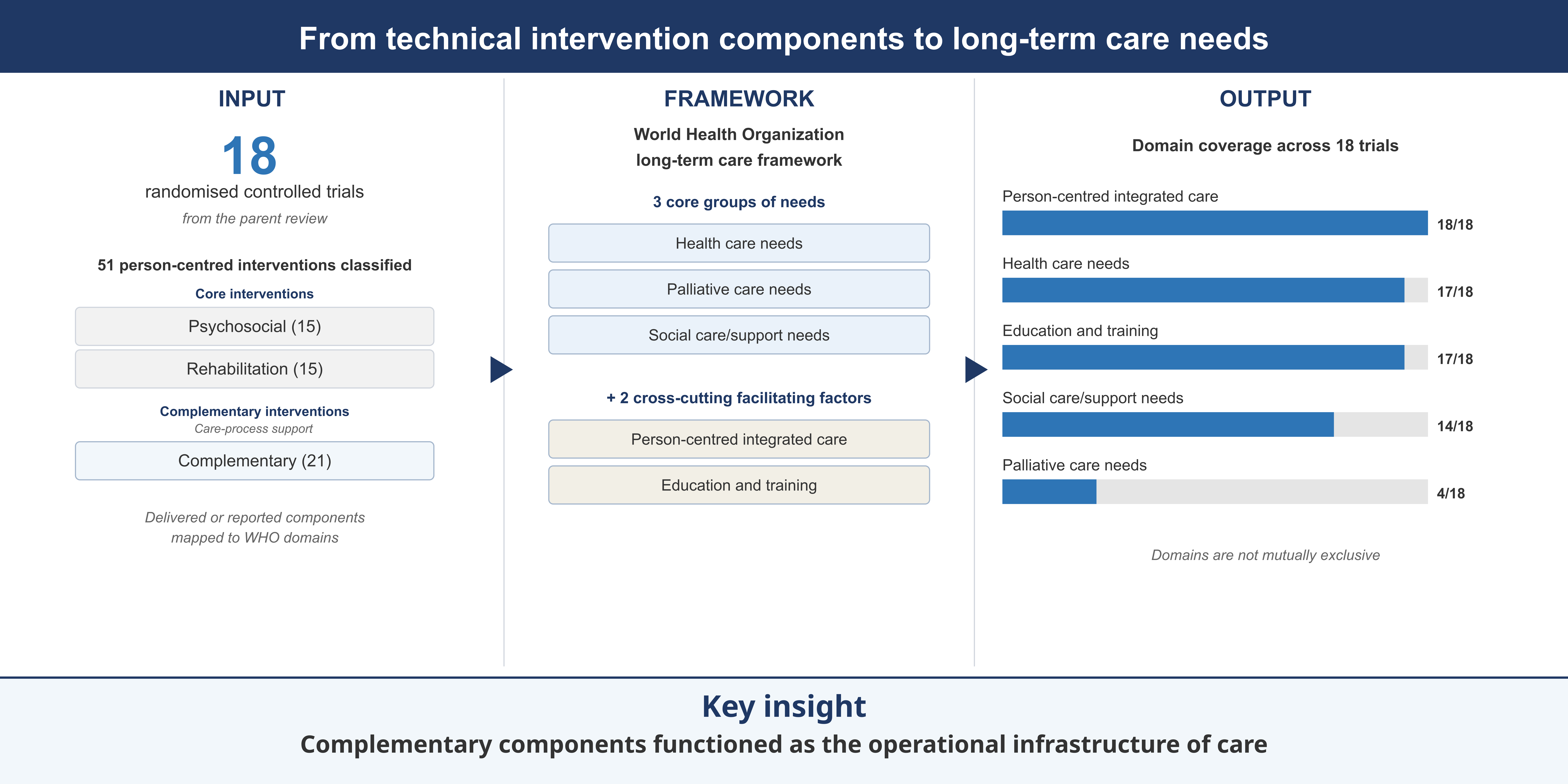
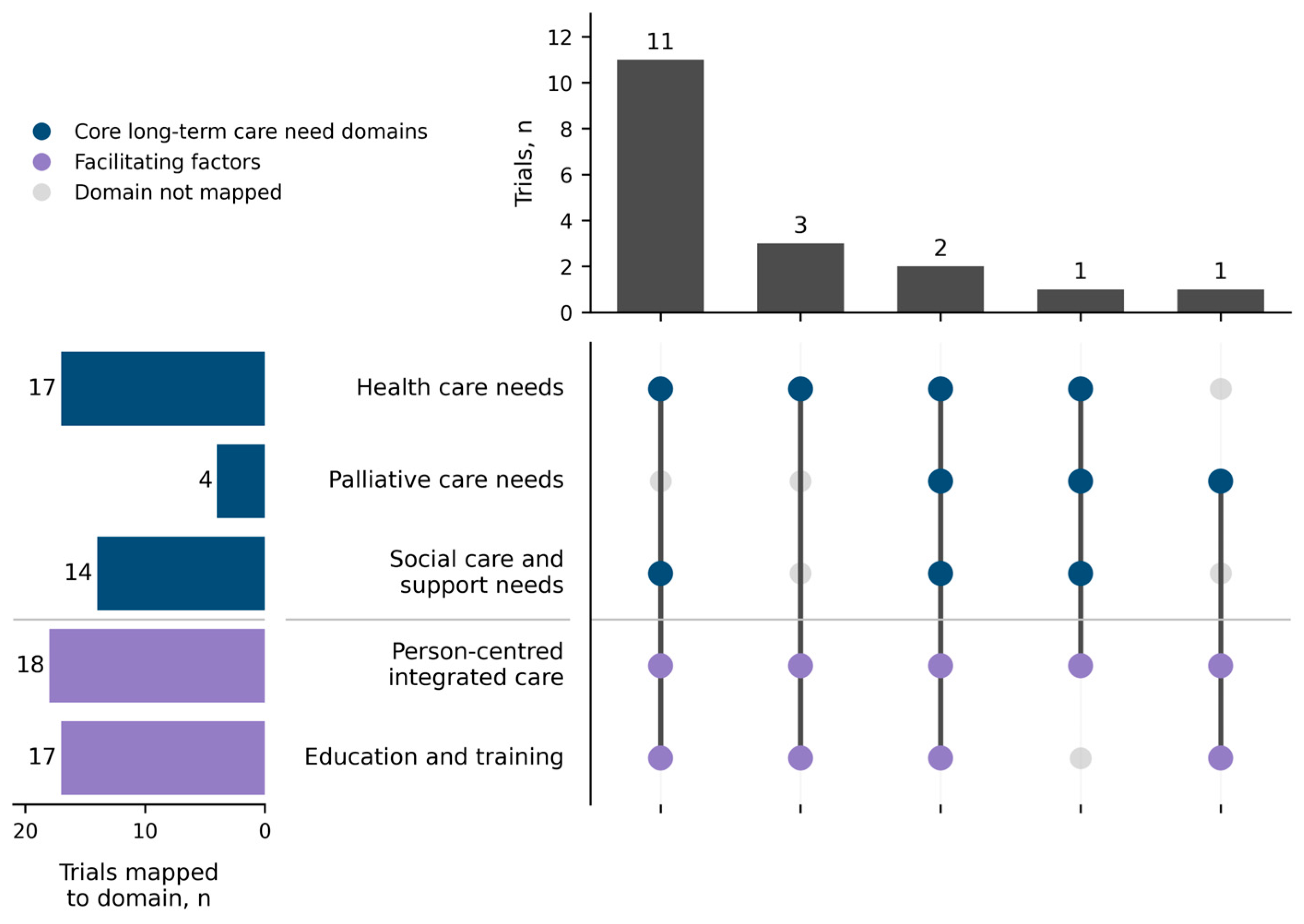
- Person-centred integrated care (18/18 trials), health care needs (17/18), and education and training (17/18) were broadly represented, whereas palliative care needs appeared in only four trials.
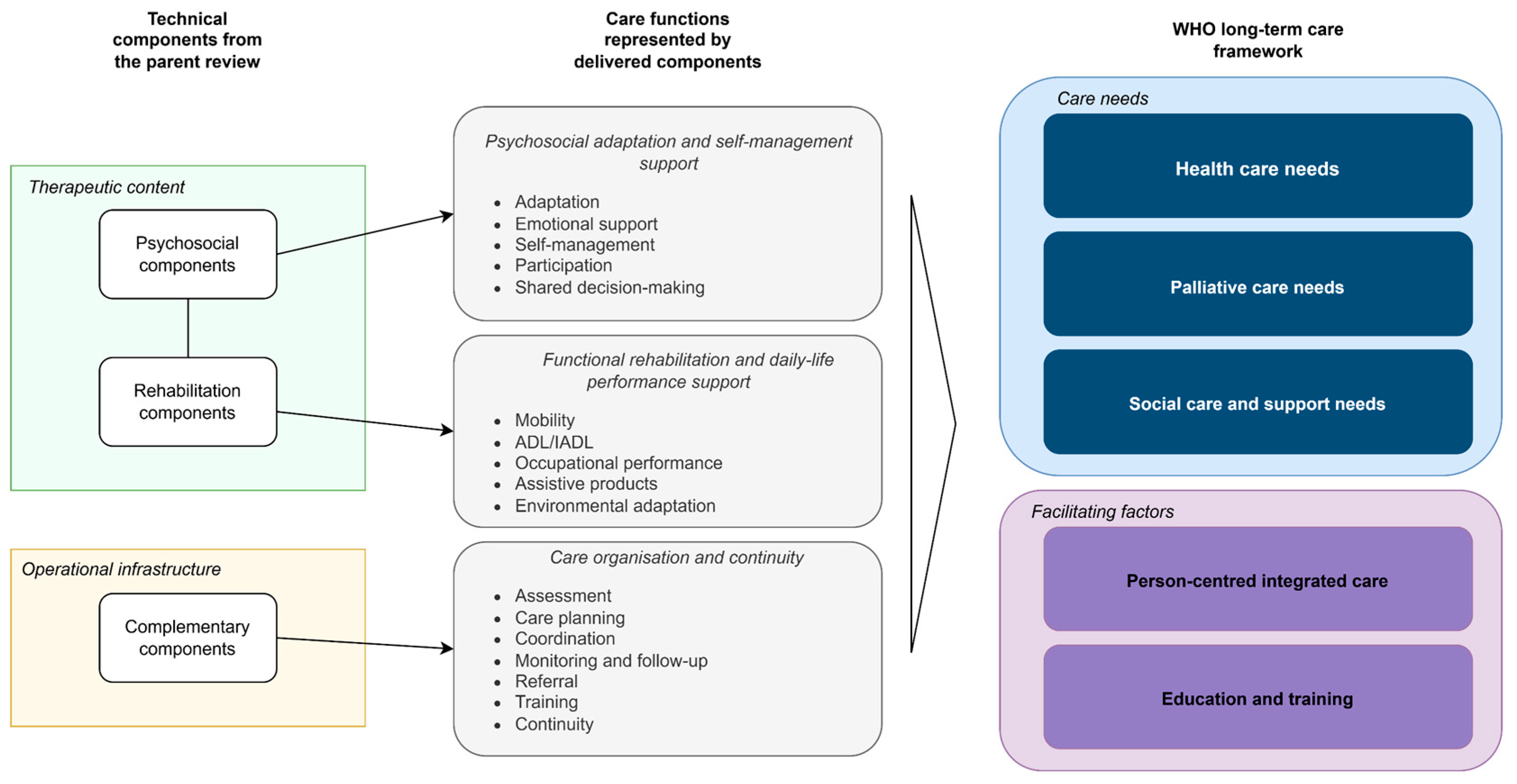
- Complementary components were interpreted as supporting the operational infrastructure of care, including assessment, planning, coordination, monitoring, referral, documentation, training, and continuity across intervention packages.
- Mapping person-centred interventions to long-term care needs highlights uneven domain coverage and suggests that needs-oriented frameworks add information not captured by technical intervention classifications alone.
- Future trials should explicitly align targeted long-term care needs, delivered components, and outcome selection, including caregiver, palliative, continuity, social, and person-centred care experience outcomes.
Abstract
1. Introduction
2. Materials and Methods
2.1. Study Design
2.2. Included Studies
2.3. Organising Framework
2.4. Data Sources and Extracted Material
2.5. Framework Mapping Procedure
2.6. Decision Log and Second-Reviewer Check
2.7. Data Synthesis
3. Results
3.1. Characteristics of Included Trials and Interventions
3.2. Mapping to the WHO Long-Term Care Framework
3.3. Outcome Domains Assessed in Trials Mapped to WHO Long-Term Care Domains
4. Discussion
4.1. Reframing Person-Centred Interventions Through Long-Term Care Needs
4.2. Complementary Components as Operational Infrastructure of Care
4.3. Making Palliative Care Needs Explicit in LTC
4.4. Aligning Intervention Components and Outcome Assessment
4.5. Implications for Long-Term Care Models and Nursing
4.6. Strengths and Limitations
5. Conclusions
Supplementary Materials
Author Contributions
Funding
Institutional Review Board Statement
Informed Consent Statement
Data Availability Statement
Acknowledgments
Conflicts of Interest
References
- Cylus, J.; Wharton, G.; Carrino, L.; Ilinca, S.; Huber, M.; Barber, S.L. (Eds.) The Care Dividend: Why and How Countries Should Invest in Long-Term Care, 1st ed.; Cambridge University Press: Cambridge, UK, 2025. [Google Scholar]
- World Health Organization. Long-Term Care for Older People: Package for Universal Health Coverage; World Health Organization: Geneva, Switzerland, 2024. [Google Scholar]
- Bao, J.; Chua, K.-C.; Prina, M.; Prince, M. Multimorbidity and Care Dependence in Older Adults: A Longitudinal Analysis of Findings from the 10/66 Study. BMC Public Health 2019, 19, 585. [Google Scholar] [CrossRef] [Scilit]
- Storeng, S.H.; Vinjerui, K.H.; Sund, E.R.; Krokstad, S. Associations between Complex Multimorbidity, Activities of Daily Living and Mortality among Older Norwegians. A Prospective Cohort Study: The HUNT Study, Norway. BMC Geriatr. 2020, 20, 21. [Google Scholar] [CrossRef] [Scilit]
- Hu, B.; Cartagena-Farias, J.; Brimblecombe, N. Functional Disability and Utilisation of Long-Term Care in the Older Population in England: A Dual Trajectory Analysis. Eur. J. Ageing 2022, 19, 1363–1373. [Google Scholar] [CrossRef] [Scilit]
- World Health Organization. World Report on Ageing and Health; World Health Organization: Geneva, Switzerland, 2015; 246p. [Google Scholar]
- Lopes, M. Desafios de Inovação Em Saúde: Repensar Os Modelos de Cuidados; University of Évora Press: Évora, Portugal, 2021. [Google Scholar]
- Wodchis, W.P.; Dixon, A.; Anderson, G.M.; Goodwin, N. Integrating Care for Older People with Complex Needs: Key Insights and Lessons from a Seven-Country Cross-Case Analysis. Int. J. Integr. Care 2015, 15, e021. [Google Scholar] [CrossRef] [Scilit] [PubMed]
- Bayly, J.; Bone, A.E.; Ellis-Smith, C.; Tunnard, I.; Yaqub, S.; Yi, D.; Nkhoma, K.B.; Cook, A.; Combes, S.; Bajwah, S.; et al. Common Elements of Service Delivery Models That Optimise Quality of Life and Health Service Use among Older People with Advanced Progressive Conditions: A Tertiary Systematic Review. BMJ Open 2021, 11, e048417. [Google Scholar] [CrossRef] [Scilit] [PubMed]
- Lista, A.J.; de Pinho, L.G.; Correia, T.; Afonso, C.; Cardoso, I.; Fonseca, C. Psychosocial and Rehabilitation Interventions and Health Gains in Older Persons in Long-Term Care: A Systematic Review. Int. J. Nurs. Stud. 2025, 172, 105219. [Google Scholar] [CrossRef] [Scilit]
- Balqis-Ali, N.Z.; Jawahir, S.; Chan, Y.M.; Lim, A.W.-Y.; Azlan, U.W.; Shaffie, S.S.M.; Fun, W.H.; Lee, S.W.H. The Impact of Long-Term Care Interventions on Healthcare Utilisation among Older Persons: A Scoping Review of Reviews. BMC Geriatr. 2024, 24, 484. [Google Scholar] [CrossRef] [Scilit] [PubMed]
- Gale, N.K.; Heath, G.; Cameron, E.; Rashid, S.; Redwood, S. Using the Framework Method for the Analysis of Qualitative Data in Multi-Disciplinary Health Research. BMC Med. Res. Methodol. 2013, 13, 117. [Google Scholar] [CrossRef] [Scilit]
- Carroll, C.; Booth, A.; Cooper, K. A Worked Example of “Best Fit” Framework Synthesis: A Systematic Review of Views Concerning the Taking of Some Potential Chemopreventive Agents. BMC Med. Res. Methodol. 2011, 11, 29. [Google Scholar] [CrossRef] [Scilit]
- Carroll, C.; Booth, A.; Leaviss, J.; Rick, J. “Best Fit” Framework Synthesis: Refining the Method. BMC Med. Res. Methodol. 2013, 13, 37. [Google Scholar] [CrossRef] [Scilit]
- Ellis, G.; Gardner, M.; Tsiachristas, A.; Langhorne, P.; Burke, O.; Harwood, R.H.; Conroy, S.P.; Kircher, T.; Somme, D.; Saltvedt, I.; et al. Comprehensive Geriatric Assessment for Older Adults Admitted to Hospital. Cochrane Database Syst. Rev. 2017, 2017, CD006211. [Google Scholar] [CrossRef] [Scilit]
- Nielsen, T.L.; Andersen, N.T.; Petersen, K.S.; Polatajko, H.; Nielsen, C.V. Intensive Client-Centred Occupational Therapy in the Home Improves Older Adults’ Occupational Performance. Results from a Danish Randomized Controlled Trial. Scand. J. Occup. Ther. 2019, 26, 325–342. [Google Scholar] [CrossRef] [Scilit]
- Counsell, S.R.; Callahan, C.M.; Clark, D.O.; Tu, W.; Buttar, A.B.; Stump, T.E.; Ricketts, G.D. Geriatric Care Management for Low-Income Seniors: A Randomized Controlled Trial. JAMA 2007, 298, 2623–2633. [Google Scholar] [CrossRef] [Scilit]
- Ali, L.; Wallström, S.; Fors, A.; Barenfeld, E.; Fredholm, E.; Fu, M.; Goudarzi, M.; Gyllensten, H.; Kjellberg, I.L.; Swedberg, K.; et al. Effects of Person-Centered Care Using a Digital Platform and Structured Telephone Support for People with Chronic Obstructive Pulmonary Disease and Chronic Heart Failure: Randomized Controlled Trial. J. Med. Internet Res. 2021, 23, e26794. [Google Scholar] [CrossRef] [Scilit]
- Callahan, C.M.; Boustani, M.A.; Schmid, A.A.; LaMantia, M.A.; Austrom, M.G.; Miller, D.K.; Gao, S.; Ferguson, D.Y.; Lane, K.A.; Hendrie, H.C. Targeting Functional Decline in Alzheimer Disease: A Randomized Trial. Ann. Intern. Med. 2017, 166, 164–171. [Google Scholar] [CrossRef] [Scilit]
- Chen, K.-M.; Hsu, H.-F.; Yang, L.-Y.; Chang, C.-C.; Chen, Y.-M.; Chang, W.-Y. Effectiveness of a Care Delivery Model for High-Need Older Adults in Communities. Res. Soc. Work. Pract. 2021, 31, 298–306. [Google Scholar] [CrossRef] [Scilit]
- Connor, K.I.; Cheng, E.M.; Barry, F.; Siebens, H.C.; Lee, M.L.; Ganz, D.A.; Mittman, B.S.; Connor, M.K.; Edwards, L.K.; McGowan, M.G.; et al. Randomized Trial of Care Management to Improve Parkinson Disease Care Quality. Neurology 2019, 92, E1831–E1842. [Google Scholar] [CrossRef] [Scilit]
- Dalal, H.M.; Taylor, R.S.; Jolly, K.; Davis, R.C.; Doherty, P.; Miles, J.; van Lingen, R.; Warren, F.C.; Green, C.; Wingham, J.; et al. The Effects and Costs of Home-Based Rehabilitation for Heart Failure with Reduced Ejection Fraction: The REACH-HF Multicentre Randomized Controlled Trial. Eur. J. Prev. Cardiol. 2019, 26, 262–272. [Google Scholar] [CrossRef] [Scilit]
- Evans, C.J.; Bone, A.E.; Yi, D.; Gao, W.; Morgan, M.; Taherzadeh, S.; Maddocks, M.; Wright, J.; Lindsay, F.; Bruni, C.; et al. Community-Based Short-Term Integrated Palliative and Supportive Care Reduces Symptom Distress for Older People with Chronic Noncancer Conditions Compared with Usual Care: A Randomised Controlled Single-Blind Mixed Method Trial. Int. J. Nurs. Stud. 2021, 120, 103978. [Google Scholar] [CrossRef] [Scilit]
- Fisher, K.; Markle-Reid, M.; Ploeg, J.; Bartholomew, A.; Griffith, L.E.; Gafni, A.; Thabane, L.; Yous, M.-L. Self-Management Program versus Usual Care for Community-Dwelling Older Adults with Multimorbidity: A Pragmatic Randomized Controlled Trial in Ontario, Canada. J. Comorb. 2020, 10, 2235042X2096339. [Google Scholar] [CrossRef] [Scilit]
- Forbat, L.; Liu, W.M.; Koerner, J.; Lam, L.; Samara, J.; Chapman, M.; Johnston, N. Reducing Time in Acute Hospitals: A Stepped-Wedge Randomised Control Trial of a Specialist Palliative Care Intervention in Residential Care Homes. Palliat. Med. 2020, 34, 571–579. [Google Scholar] [CrossRef] [Scilit]
- Fors, A.; Blanck, E.; Ali, L.; Ekberg-Jansson, A.; Fu, M.; Kjellberg, I.L.; Mäkitalo, Å.; Swedberg, K.; Taft, C.; Ekman, I. Effects of a Person-Centred Telephone-Support in Patients with Chronic Obstructive Pulmonary Disease and/or Chronic Heart Failure—A Randomized Controlled Trial. PLoS ONE 2018, 13, e0203031. [Google Scholar] [CrossRef] [Scilit]
- Fu, V.; Weatherall, M.; McPherson, K.; Taylor, W.; McRae, A.; Thomson, T.; Gommans, J.; Green, G.; Harwood, M.; Ranta, A.; et al. Taking Charge after Stroke: A Randomized Controlled Trial of a Person-Centered, Self-Directed Rehabilitation Intervention. Int. J. Stroke 2020, 15, 954–964. [Google Scholar] [CrossRef] [Scilit]
- Gilbody, S.; Lewis, H.; Adamson, J.; Atherton, K.; Bailey, D.; Birtwistle, J.; Bosanquet, K.; Clare, E.; Delgadillo, J.; Ekers, D.; et al. Effect of Collaborative Care vs Usual Care on Depressive Symptoms in Older Adults with Subthreshold Depression: The CASPER Randomized Clinical Trial. JAMA J. Am. Med. Assoc. 2017, 317, 728–737. [Google Scholar] [CrossRef] [Scilit]
- Melis, R.J.F.; Van Eijken, M.I.J.; Teerenstra, S.; Van Achterberg, T.; Parker, S.G.; Borm, G.F.; Van De Lisdonk, E.H.; Wensing, M.; Rikkert, M.G.M.O. Multidimensional Geriatric Assessment: Back to the Future A Randomized Study of a Multidisciplinary Program to Intervene on Geriatric Syndromes in Vulnerable Older People Who Live at Home (Dutch EASYcare Study). J. Gerontol. Ser. A Biol. Sci. Med. Sci. 2008, 63, 283–290. [Google Scholar] [CrossRef] [Scilit]
- Mountain, G.A.; Cooper, C.L.; Wright, J.; Walters, S.J.; Lee, E.; Craig, C.; Berry, K.; Sprange, K.; Young, T.; Moniz-Cook, E.; et al. The Journeying through Dementia Psychosocial Intervention versus Usual Care Study: A Single-Blind, Parallel Group, Phase 3 Trial. Lancet Healthy Longev. 2022, 3, e276–e285. [Google Scholar] [CrossRef] [Scilit] [PubMed]
- Overbeek, A.; Korfage, I.J.; Jabbarian, L.J.; Billekens, P.; Hammes, B.J.; Polinder, S.; Severijnen, J.; Swart, S.J.; Witkamp, F.E.; van der Heide, A.; et al. Advance Care Planning in Frail Older Adults: A Cluster Randomized Controlled Trial. J. Am. Geriatr. Soc. 2018, 66, 1089–1095. [Google Scholar] [CrossRef] [Scilit] [PubMed]
- Salisbury, C.; Man, M.S.; Bower, P.; Guthrie, B.; Chaplin, K.; Gaunt, D.M.; Brookes, S.; Fitzpatrick, B.; Gardner, C.; Hollinghurst, S.; et al. Management of Multimorbidity Using a Patient-Centred Care Model: A Pragmatic Cluster-Randomised Trial of the 3D Approach. Lancet 2018, 392, 41–50. [Google Scholar] [CrossRef] [Scilit] [PubMed]
- Spoorenberg, S.L.W.; Wynia, K.; Uittenbroek, R.J.; Kremer, H.P.H.; Reijneveld, S.A. Effects of a Population-Based, Person-Centred and Integrated Care Service on Health, Wellbeing and Self-Management of Community-Living Older Adults: A Randomised Controlled Trial on Embrace. PLoS ONE 2018, 13, e0190751. [Google Scholar] [CrossRef] [Scilit]
- Moore, G.F.; Audrey, S.; Barker, M.; Bond, L.; Bonell, C.; Hardeman, W.; Moore, L.; O’Cathain, A.; Tinati, T.; Wight, D.; et al. Process Evaluation of Complex Interventions: Medical Research Council Guidance. BMJ 2015, 350, h1258. [Google Scholar] [CrossRef] [Scilit]
- Skivington, K.; Matthews, L.; Simpson, S.A.; Craig, P.; Baird, J.; Blazeby, J.M.; Boyd, K.A.; Craig, N.; French, D.P.; McIntosh, E.; et al. A New Framework for Developing and Evaluating Complex Interventions: Update of Medical Research Council Guidance. BMJ 2021, 374, n2061. [Google Scholar] [CrossRef] [Scilit]
- Llop-Medina, L.; Fu, Y.; Garcés-Ferrer, J.; Doñate-Martínez, A. Palliative Care in Older People with Multimorbidities: A Scoping Review on the Palliative Care Needs of Patients, Carers, and Health Professionals. Int. J. Environ. Res. Public Health 2022, 19, 3195. [Google Scholar] [CrossRef] [Scilit]
- The WHOQOL Group. The World Health Organization Quality of Life Assessment (WHOQOL): Position Paper from the World Health Organization. Soc. Sci. Med. 1995, 41, 1403–1409. [Google Scholar] [CrossRef] [Scilit]
- Vanleerberghe, P.; De Witte, N.; Claes, C.; Schalock, R.L.; Verté, D. The Quality of Life of Older People Aging in Place: A Literature Review. Qual. Life Res. 2017, 26, 2899–2907. [Google Scholar] [CrossRef] [Scilit]
- Chen, L.; Sleeman, K.E.; Bradshaw, A.; Sakharang, W.; Mo, Y.; Ellis-Smith, C. The Use of Person-Centered Outcome Measures to Support Integrated Palliative Care for Older People: A Systematic Review. J. Am. Med. Dir. Assoc. 2024, 25, 105036. [Google Scholar] [CrossRef] [Scilit]
- Hoffmann, T.C.; Glasziou, P.P.; Boutron, I.; Milne, R.; Perera, R.; Moher, D.; Altman, D.G.; Barbour, V.; Macdonald, H.; Johnston, M.; et al. Better Reporting of Interventions: Template for Intervention Description and Replication (TIDieR) Checklist and Guide. BMJ 2014, 348, g1687. [Google Scholar] [CrossRef] [Scilit]



| Study | Country | Population/Condition | Sample | Care Setting/LTC Relevance | Intervention Duration | Intervention Evaluated | Comparator | Core and Complementary Components Represented |
|---|---|---|---|---|---|---|---|---|
| Ali et al. [18] | Sweden | Chronic obstructive pulmonary disease or heart failure | n = 222 | LTC-relevant health settings | 6 months | Person-centred digital platform and structured telephone support | Usual care | Psychosocial + Complementary |
| Callahan et al. [19] | United States | Alzheimer’s disease | n = 180 | Home-based long-term care | 24 months | Home-based occupational therapy added to collaborative dementia care | Collaborative dementia care | Psychosocial + Rehabilitation + Complementary |
| Chen et al. [20] | Taiwan | High-need community-dwelling older people | n = 145 | Community-based long-term care | 6 months | High-Need Community-Dwelling Older Adults Care Delivery Model | Usual care | Psychosocial + Complementary |
| Connor et al. [21] | United States | Parkinson’s disease | n = 328 | LTC-relevant health settings | 18 months | CHAPS nurse-led Parkinson’s disease care management | Usual care + educational handout | Psychosocial + Complementary |
| Counsell et al. [17] | United States | Low-income older people with multimorbidity and geriatric syndromes | n = 951 | Home-based long-term care | 24 months | GRACE geriatric care management | Usual care | Psychosocial + Complementary |
| Dalal et al. [22] | United Kingdom | Heart failure with reduced ejection fraction | n = 216 | LTC-relevant health settings | 12 weeks | REACH-HF home-based cardiac rehabilitation and self-care | Usual care | Psychosocial + Rehabilitation + Complementary |
| Evans et al. [23] | United Kingdom | Frail older people with chronic non-cancer conditions and palliative/supportive care needs | n = 50 | Home-based long-term care | 12 weeks | SIPScare integrated palliative and supportive care | Usual care | Psychosocial + Complementary |
| Fisher et al. [24] | Canada | Older people with multimorbidity newly referred to home care | n = 59 | Home-based long-term care | 6 months | Interprofessional home-care self-management intervention | Usual home care | Psychosocial + Complementary |
| Forbat et al. [25] | Australia | Residential aged care residents | n = 1700 residents | Facility-based long-term care | Variable, 6–14.5 months | “Needs Rounds” specialist palliative care in residential care homes | Usual reactive consultations | Psychosocial + Complementary |
| Fors et al. [26] | Sweden | Chronic obstructive pulmonary disease or heart failure | n = 221 | LTC-relevant health settings | 6 months | Person-centred telephone support | Usual care | Psychosocial + Complementary |
| Fu et al. [27] | New Zealand | Community-living post-stroke adults | n = 400 | LTC-relevant health settings | 1–2 sessions over 6 weeks | “Take Charge” post-stroke self-management intervention | Educational materials + usual care | Psychosocial + Complementary |
| Gilbody et al. [28] | United Kingdom | Older people with subthreshold depression | n = 705 | LTC-relevant health settings | 7–8 weeks | CASPER collaborative care for subthreshold depression | Usual care | Psychosocial + Complementary |
| Melis et al. [29] | Netherlands | Frail or vulnerable community-dwelling older people | n = 151 | Home-based long-term care | 3 months | Dutch EASYcare geriatric home-visit programme | Usual care | Psychosocial + Rehabilitation + Complementary |
| Mountain et al. [30] | United Kingdom | People with mild dementia | n = 480 | Community-based long-term care | 12 weeks | “Journeying through Dementia” psychosocial intervention | Usual care | Psychosocial + Complementary |
| Nielsen et al. [16] | Denmark | Older people with occupational performance problems using or seeking home care | n = 119 | Home-based long-term care | 11 weeks | Intensive client-centred occupational therapy | Usual practice | Psychosocial + Rehabilitation + Complementary |
| Overbeek et al. [31] | Netherlands | Frail older adults in residential care or home care | n = 201 | Facility-based long-term care | Mean 47 days | “Respecting Choices” advance care planning | Usual care | Psychosocial + Complementary |
| Salisbury et al. [32] | United Kingdom | Adults with multimorbidity | n = 1546 | LTC-relevant health settings | 15 months | 3D primary care multimorbidity review | Usual care | Psychosocial + Complementary |
| Spoorenberg et al. [33] | Netherlands | Community-living older people aged 75 years or over | n = 1456 | Community-based long-term care | 12 months | Embrace integrated care model | Usual care | Psychosocial + Complementary |
| Study | Health Care Needs | Palliative Care Needs | Social Care and Support Needs | Person-Centred Integrated Care | Education and Training |
|---|---|---|---|---|---|
| Ali et al. [18] | Symptom self-monitoring; clinical information on COPD/CHF; telephone support for clinical self-management | — | — | Cocreated health plan; patient narrative; structured telephone follow-up; digital documentation | Professional training in remote person-centred communication; fidelity meetings/review |
| Callahan et al. [19] | Home-based occupational therapy; ADL/IADL training; mobility/transfer training; exercise; cognitive strategies | — | Caregiver training; community resources; safe return programme; caregiver support group; home modification | Home assessment; individualised care plan; goal setting with dyad; dementia care management; coordination with primary care | Therapist training; caregiver education/training |
| Chen et al. [20] | Linkage to home nursing, medical treatment, rehabilitation and telecare; monitoring/reassessment | — | Home care; day care; assistive products; benefits consultation; caregiver training; respite care; emotional support | Screening; comprehensive assessment; individualised care plan; care coordination; follow-up; plan update | Three-day care coordinator training; monthly case discussions |
| Connor et al. [21] | Structured assessment; symptom/falls/medication indicators; clinical referrals; hospital admission notification | — | Caregiver support packet; caregiver assessment questions; Community/VA social services | Nurse care management; structured assessment; problem-specific plans; action plans; follow-up; specialist huddles | Process education for nurse care managers; team meetings/support |
| Counsell et al. [17] | Geriatric protocols; medication management; falls, pain, incontinence, depression, sensory deficits, malnutrition and dementia management | Advance care planning; health care representative/living will | Social worker involvement; caregiver burden protocol; transport support; community services | In-home comprehensive assessment; individualised care plan; interdisciplinary team; primary care integration; monthly follow-up | Twelve weekly seminars for support team; interdisciplinary team meetings |
| Dalal et al. [22] | Home-based cardiac rehabilitation; exercise; walking; symptom, fluid and medication management; breathlessness management | — | Family and Friends Resource; caregiver as co-facilitator | Tailored facilitation; goal setting; Progress Tracker; review of progress | Three-day facilitator training; fidelity checklist/audio review |
| Evans et al. [23] | Symptom management; follow-up/monitoring; management of pain, breathlessness, constipation, anxiety and drowsiness | Specialist palliative/supportive care; advance care planning; palliative symptom management; serious illness support | Caregiver support; psychosocial/practical support; integration with social/community services | Multidimensional assessment; priorities/preferences; care plan; specialist coordination; integration with GP/community nurses | — |
| Fisher et al. [24] | Standardised screening; medication review; interprofessional clinical input; communication with family physicians | — | Home care; personal support workers; caregiver involvement; system navigation; access to health/social services | Patient-as-partner approach; individualised care plan; monthly case conferences; case management | Two-day professional training; implementation meetings; audit/feedback |
| Forbat et al. [25] | Symptom assessment/management; medication review; anticipatory medication; direct clinical work; external referrals | Palliative care Needs Rounds; advance care planning; surrogate decision-maker; planning for deterioration; end-of-life care | Case conferences with relatives/decision-makers; family involvement; external referrals where relevant | Monthly structured Needs Rounds; checklist; case conferences; GP/care-home/specialist coordination | Case-based staff education; site briefing; fidelity feedback |
| Fors et al. [26] | Person-centred telephone support for COPD/CHF; discussion of medication, symptoms, sleep and clinical self-management | — | — | Patient narrative; co-created mailed health plan; goals; structured follow-up and plan revision | Nurse training; fortnightly meetings; peer review of calls/documentation |
| Fu et al. [27] | Post-stroke self-directed rehabilitation; stroke prevention; physical needs; mobility; ADL; communication | — | My Support Network; finances; daily life activities; family/friend involvement, actively worked through in sessions | Workbook-guided non-directive sessions; identity reflection; personal goals; hopes/fears; intermediate steps | Facilitator training; ongoing facilitator support |
| Gilbody et al. [28] | Behavioural activation for depressive symptoms; symptom monitoring; active surveillance; suicide-risk protocol | — | Signposting to voluntary/statutory services; social activation; functional equivalence activities | Case manager; agreed goals; session-by-session monitoring; GP/specialist liaison; PC-MIS | Case manager training; manualisation; weekly supervision |
| Melis et al. [29] | Management of cognition, nutrition, behaviour, mood, mobility/falls and medication; referrals | — | Home care/day care/voluntary care; assistive products; caregiver advice; ADL/IADL-related support | EASYcare assessment; goal setting; integrated individualised plan; GP-geriatrician-nurse coordination; follow-up | Psychoeducation/advice to caregiver |
| Mountain et al. [30] | Memory strategies; physical health; activity; diet; anxiety, stress and sleep topics | — | Peer support; friendships; community connectedness; out-of-venue activities; daily living topics | Flexible topic selection; individual sessions; personal goals; strengths-based approach; meaningful activities | Facilitator training; weekly supervision; fidelity checklists |
| Nielsen et al. [16] | Client-centred occupational therapy targeting occupational performance and functionality | — | Occupations/activities in home and local community; participation-oriented performance goals | Client-centred assessment; individualised goals; tailored occupational intervention | Therapist workshops; regular meetings/workshops; skills development or supervision supporting intervention delivery |
| Overbeek et al. [31] | — | Facilitated advance care planning; advance directives; surrogate decision-maker appointment | — | Facilitated conversations; structured interview cards; documentation of preferences/directives | Nurse facilitator training/certification; supervision |
| Salisbury et al. [32] | Depression review; medication review; clinical review of multimorbidity and health dimensions | — | — | Six-monthly person-centred reviews; named clinician; written health plan; electronic template; specialist advice link | Clinical/administrative training; 3D champion; monthly feedback |
| Spoorenberg et al. [33] | Assessment, monitoring, prevention and health-related case management | — | Care/support plan; caregiver support; navigation; community/well-being organisation linkages | Risk stratification; GP-led Elderly Care Team; case management; goal setting; individual plan; shared electronic record | Intensive team training and coaching |
| WHO Long-term Care Domain/Facilitating Factor | Trials Mapped, n (%) | Outcome Areas Assessed in Trials Mapped to This Domain | Interpretive Summary | Less Consistently Assessed Outcome Areas |
|---|---|---|---|---|
| Health care needs | 17 (94.4) |
| Health care needs were the most consistently represented domain. Outcomes mainly captured clinical status, functioning-related outcomes, quality of life, mental health, and service use. Functioning and daily activities were treated as cross-cutting outcomes. |
|
| Palliative care needs | 4 (22.2) |
| Palliative outcomes were mainly assessed in trials where palliative care or advance care planning formed a clear part of the delivered intervention. Palliative-related indicators alone were not considered sufficient to classify interventions as addressing palliative care needs. |
|
| Social care and support needs | 14 (77.8) |
| Social care and support overlapped with daily life and participation outcomes. However, social/support components were not always matched by outcomes directly measuring social participation, support networks, caregiver experience, or access to community resources. |
|
| Person-centred integrated care | 18 (100.0) |
| Person-centred integrated care was common as a design and delivery feature, usually through assessment, individualised planning, goal setting, follow-up, care coordination, or case management. Direct measurement of person-centred care experience was less consistent. |
|
| Education and training | 17 (94.4) |
| Education and training were frequently used to support intervention delivery, especially for professionals, facilitators, case managers, care-home staff, or caregivers. These components were usually reported as part of implementation rather than evaluated as outcomes. |
|
Disclaimer/Publisher’s Note: The statements, opinions and data contained in all publications are solely those of the individual author(s) and contributor(s) and not of MDPI and/or the editor(s). MDPI and/or the editor(s) disclaim responsibility for any injury to people or property resulting from any ideas, methods, instructions or products referred to in the content. |
© 2026 by the authors. Licensee MDPI, Basel, Switzerland. This article is an open access article distributed under the terms and conditions of the Creative Commons Attribution (CC BY) license.
Share and Cite
Lista, A.; de Pinho, L.G.; Alves, E.; Fonseca, C. Mapping Long-Term Care Needs in Person-Centred Interventions for Older People with Multimorbidity: A WHO Framework-Guided Secondary Analysis. Healthcare 2026, 14, 1623. https://doi.org/10.3390/healthcare14121623
Lista A, de Pinho LG, Alves E, Fonseca C. Mapping Long-Term Care Needs in Person-Centred Interventions for Older People with Multimorbidity: A WHO Framework-Guided Secondary Analysis. Healthcare. 2026; 14(12):1623. https://doi.org/10.3390/healthcare14121623
Chicago/Turabian StyleLista, António, Lara Guedes de Pinho, Elisabete Alves, and César Fonseca. 2026. "Mapping Long-Term Care Needs in Person-Centred Interventions for Older People with Multimorbidity: A WHO Framework-Guided Secondary Analysis" Healthcare 14, no. 12: 1623. https://doi.org/10.3390/healthcare14121623
APA StyleLista, A., de Pinho, L. G., Alves, E., & Fonseca, C. (2026). Mapping Long-Term Care Needs in Person-Centred Interventions for Older People with Multimorbidity: A WHO Framework-Guided Secondary Analysis. Healthcare, 14(12), 1623. https://doi.org/10.3390/healthcare14121623