Article

ERAS Implementation Fidelity, Care Complexity, and Postoperative Outcomes in Oncological Colorectal Surgery: A Real-World Observational Study


by
José Antonio Jerez González
1,
Miguel Ángel Hidalgo-Blanco
2,*,
Montserrat Puig Llobet
3,
Jordi Adamuz
4,
Maria Eulàlia Juvé-Udina
5,
Oliver Polushkina-Merchanskaya
6,
Bernat Miguel-Huguet
7,
Mireia Mariscal Cabeza
8 and
Carmen Moreno Arroyo
2
1
Bellvitge University Hospital, Faculty of Nursing, Bellvitge Biomedical Research Institute (IDIBELL), University of Barcelona and Nursing Research Group (GRIN), 08907 L’Hospitalet de Llobregat, Spain
2
Department of Fundamental and Clinical Nursing, Faculty of Nursing, Bellvitge Biomedical Research Institute (IDIBELL), University of Barcelona and Nursing Research Group (GRIN), 08907 L’Hospitalet de Llobregat, Spain
3
Department of Public Health, Mental Health, and Maternal and Child Health Nursing, Faculty of Nursing, University of Barcelona, 08907 L’Hospitalet de Llobregat, Spain
4
Nursing Knowledge Management and Information Systems Department, Bellvitge University Hospital, Faculty of Nursing, Bellvitge Biomedical Research Institute (IDIBELL), Nursing Research Group (GRIN), University of Barcelona, 08907 L’Hospitalet de Llobregat, Spain
5
Catalan Institute of Health, 08007 Barcelona, Spain
6
Nursing Research Group (GRIN), Bellvitge Biomedical Research Institute (IDIBELL), 08907 L’Hospitalet de Llobregat, Spain
7
Data Management and Evaluation Unit, Bellvitge University Hospital, 08907 L’Hospitalet de Llobregat, Spain
8
Nursing Research Group (GRIN), Bellvitge Biomedical Research Institute (IDIBELL), Digestive Endoscopy Unit, Viladecans Hospital, 08840 Barcelona, Spain
*
Author to whom correspondence should be addressed.
Healthcare 2026, 14(11), 1519; https://doi.org/10.3390/healthcare14111519
Submission received: 18 March 2026 / Revised: 13 May 2026 / Accepted: 26 May 2026 / Published: 29 May 2026

Highlights

What are the main findings?
  • Higher ERAS adherence is associated with shorter hospital length of stay.
  • Adherence varies across perioperative phases, with lower compliance observed postoperatively.
  • Care complexity does not show a significant association with outcomes.
What are the implications of the main findings?
  • Findings highlight variability in ERAS implementation and support focusing on implementation fidelity in real-world clinical practice
  • Results contribute to understanding ERAS as a healthcare delivery model, suggesting the need for further research on care complexity and recovery.

Abstract

Background: Enhanced Recovery After Surgery (ERAS) programmes are structured perioperative care pathways in which clinical outcomes are closely linked to the degree of implementation fidelity. However, the interaction between ERAS adherence, care complexity, and postoperative outcomes in real-world settings remains insufficiently explored. Objective: To evaluate the association between ERAS adherence and postoperative length of stay in oncological colorectal surgery and to analyse whether Care Complexity Individual Factors (CCIFs) influence this relationship. Methods: A retrospective observational cohort study was conducted in two university hospitals in Barcelona, including 90 adult patients undergoing elective colorectal cancer surgery (2022). ERAS adherence was assessed globally and by phase (pre-, intra-, and postoperative) using structured indicators. CCIFs were classified into five domains. Associations between adherence, care complexity, and outcomes were analysed using bivariate methods. Results: Overall adherence was 64%. Higher adherence was associated with shorter hospital length of stay (median 4 vs. 5 days; p = 0.033) and greater compliance with expected length of stay (37.8% vs. 17.0%; p = 0.047). Adherence varied across perioperative phases, with higher compliance in the preoperative phase and lower compliance postoperatively. Care complexity was high (mean CCIF 2.62) and was not significantly associated with adherence or compliance with expected length of stay. Conclusions: Higher ERAS adherence is associated with shorter hospital stay in oncological colorectal surgery within a real-world context. These findings support the importance of implementation fidelity across the perioperative pathway. Further research incorporating multivariable analyses and patient-centred outcomes is needed to better understand the interaction between care complexity and recovery trajectories.

1. Introduction

Enhanced Recovery After Surgery (ERAS) programmes are structured, evidence-based perioperative care pathways designed to reduce surgical stress, optimise recovery, and improve clinical outcomes [1,2]. Their effectiveness has been consistently associated with the degree of adherence to protocol components across the preoperative, intraoperative, and postoperative phases [2,3,4,5,6,7].
Multiple studies, including large cohort analyses and meta-analyses, have demonstrated that higher compliance with ERAS protocols is associated with reduced postoperative complications, shorter hospital length of stay, and improved resource utilisation. This relationship has been described as a dose–response effect, in which incremental improvements in adherence translate into measurable clinical benefits [4,5,6,7].
Despite this evidence, ERAS implementation in real-world clinical practice remains variable [8,9], and adherence levels are often lower than those reported in controlled or highly standardised environments. This variability highlights the importance of examining ERAS not only as a clinical protocol but as a healthcare delivery model [9], in which organisational factors, professional engagement, and workflow integration play a central role [10].
At the same time, patients undergoing colorectal oncological surgery frequently present significant clinical and contextual complexity. Care Complexity Individual Factors (CCIFs) encompass a range of patient-related characteristics―including comorbidity burden, cognitive status, psychosocial conditions, and functional limitations―that may influence care processes and outcomes. While CCIFs have been associated with nursing workload and adverse events [11,12], their interaction with ERAS adherence has not been extensively studied.
This gap limits a comprehensive understanding of how implementation fidelity interacts with patient complexity in determining recovery trajectories. In particular, it remains unclear whether care complexity modifies the relationship between ERAS adherence and postoperative outcomes, or whether adherence itself remains the primary determinant of recovery in complex patient populations.
Therefore, the aim of this study is to evaluate the association between ERAS adherence and postoperative length of stay in oncological colorectal surgery, and to analyse whether Care Complexity Individual Factors influence this relationship in a real-world clinical context.

2. Materials and Methods

2.1. Study Design

A retrospective observational cohort study was conducted in two university hospitals in the province of Barcelona. Both centres follow similar colorectal surgical pathways and have implemented ERAS-based perioperative care protocols, although adherence levels vary in routine clinical practice.
Patients were followed from surgery until hospital discharge. ERAS adherence was analysed both globally and by phase (preoperative, intraoperative, and postoperative), based on structured indicators extracted from institutional databases.

2.2. Study Period and Population

Participants were identified from all colorectal surgical procedures performed between January and December 2022. Eligible patients were adults (≥18 years) undergoing elective colorectal surgery with a confirmed diagnosis of malignant neoplasm.
Exclusion criteria included emergency surgery, severe psychiatric conditions interfering with protocol adherence, and lack of sufficient social support to ensure safe discharge. In addition, as data were retrospectively collected from electronic health records, only patients with a documented electronic nursing care plan were eligible for inclusion, as this was required to assess Care Complexity Individual Factors (CCIFs). Patients without structured nursing documentation were therefore excluded.
A total of 132 patients were initially screened. After applying the inclusion and exclusion criteria, 90 patients were included in the final analysis.
Given the retrospective and exploratory nature of the study, no formal sample size calculation was performed a priori. However, a post hoc estimation indicated that, assuming an alpha risk of 0.05 and a power of 0.8 in a two-tailed test, a total of 88 subjects (44 per group) would be required to detect a difference of at least 3 days in length of stay, assuming a common standard deviation of 5. No drop-out rate was considered, as all available cases meeting inclusion criteria were included in the analysis.

2.3. Study Variables

2.3.1. Sociodemographic and Clinical Variables

Sociodemographic and clinical data included age, sex, and comorbidities, as well as relevant clinical outcomes such as intensive care unit (ICU) admission and postoperative complications. Intensive care unit (ICU) admission refers in this context to a post-anaesthesia care or surgical recovery unit integrated within the critical care service. Admission to this unit may reflect not only clinical risk but also organisational factors, such as postoperative monitoring protocols or timing of surgery. In this study, ICU admission was considered a descriptive variable and was not included in analytical models.

2.3.2. ERAS Adherence

ERAS adherence was assessed using structured indicators derived from institutional ERAS registries. Adherence was initially conceptualised as a continuous variable, expressed as a percentage (0–100%), and categorised into three levels: low (<50%), moderate (50–70%), and high (>70%). However, due to the structure and distribution of the available data, adherence was ultimately analysed as a dichotomous variable (adherent vs. non-adherent) for statistical comparison.
Global adherence was calculated as the mean of all protocol indicators, while phase-specific adherence scores were calculated separately for the preoperative, intraoperative, and postoperative phases. Importantly, postoperative adherence variables were interpreted with caution, as several of these indicators (such as oral intake or mobilisation) may reflect recovery capacity and therefore function as intermediate outcomes influenced by prior care delivery, rather than independent predictors (See Appendix A for the full list of items assessed in each phase).
To further explore the potential influence of postoperative adherence items on outcome measures, a sensitivity analysis excluding postoperative ERAS components was subsequently performed (Appendix F).

2.3.3. Care Complexity Individual Factors (CCIFs)

Care complexity was assessed using the Care Complexity Individual Factors (CCIFs) framework described by Juvé-Udina et al. [11], which includes five domains: developmental, mental–cognitive, psycho-emotional, sociocultural, and comorbidity/complications. Each domain includes specific factors as previously described in the original CCIFs framework (Juvé-Udina et al. [11]). Each factor was recorded as present or absent for each patient, allowing the estimation of overall complexity burden as well as domain-specific contributions.
The detailed list of CCIFs domains and variables is provided in Appendix B.

2.3.4. Postoperative Length of Stay

Postoperative Length of hospital Stay (PLOS) was defined as the number of days from surgery to hospital discharge, including ICU stay when applicable. The expected length of stay (EPLOS) was defined according to ERAS recommendations as 3 days for colon surgery and 4 days for rectal surgery.
Patients whose discharge was delayed due to non-clinical factors, such as social or organisational reasons, were not excluded but analysed within the overall cohort. No censoring was applied for transfers or in-hospital mortality, as these events were not present in the dataset.
Detailed ERAS indicators and CCIF variables are provided in Appendix A, Appendix B, Appendix C, Appendix D, Appendix E and Appendix F to enhance clarity and minimise potential overinterpretation given the limited sample size.

2.4. Data Collection Procedure

Data were obtained through structured extraction from multiple institutional sources, including electronic health records, nursing care plans using ATIC terminology, and ERAS indicator registries. Data extraction was performed by trained members of the research team and subsequently reviewed to ensure consistency and completeness.
Data cleaning procedures included the removal of duplicate records, validation of variable ranges, and resolution of discrepancies between data sources. Missing data were handled through case-wise exclusion for specific analyses in which incomplete variables were involved.

2.5. Statistical Analysis

Statistical analysis was performed using R software (version 4.4.1). Categorical variables were described using frequencies and percentages, while continuous variables were described using mean and standard deviation or median and interquartile range, depending on their distribution.
Comparisons between groups were conducted using Student’s t-test for normally distributed variables, the Kruskal–Wallis test for non-parametric data, and the chi-square test for categorical variables. Statistical significance was set at p < 0.05. Given the limited sample size, analyses were considered exploratory and hypothesis-generating, and no multivariable modelling was performed.
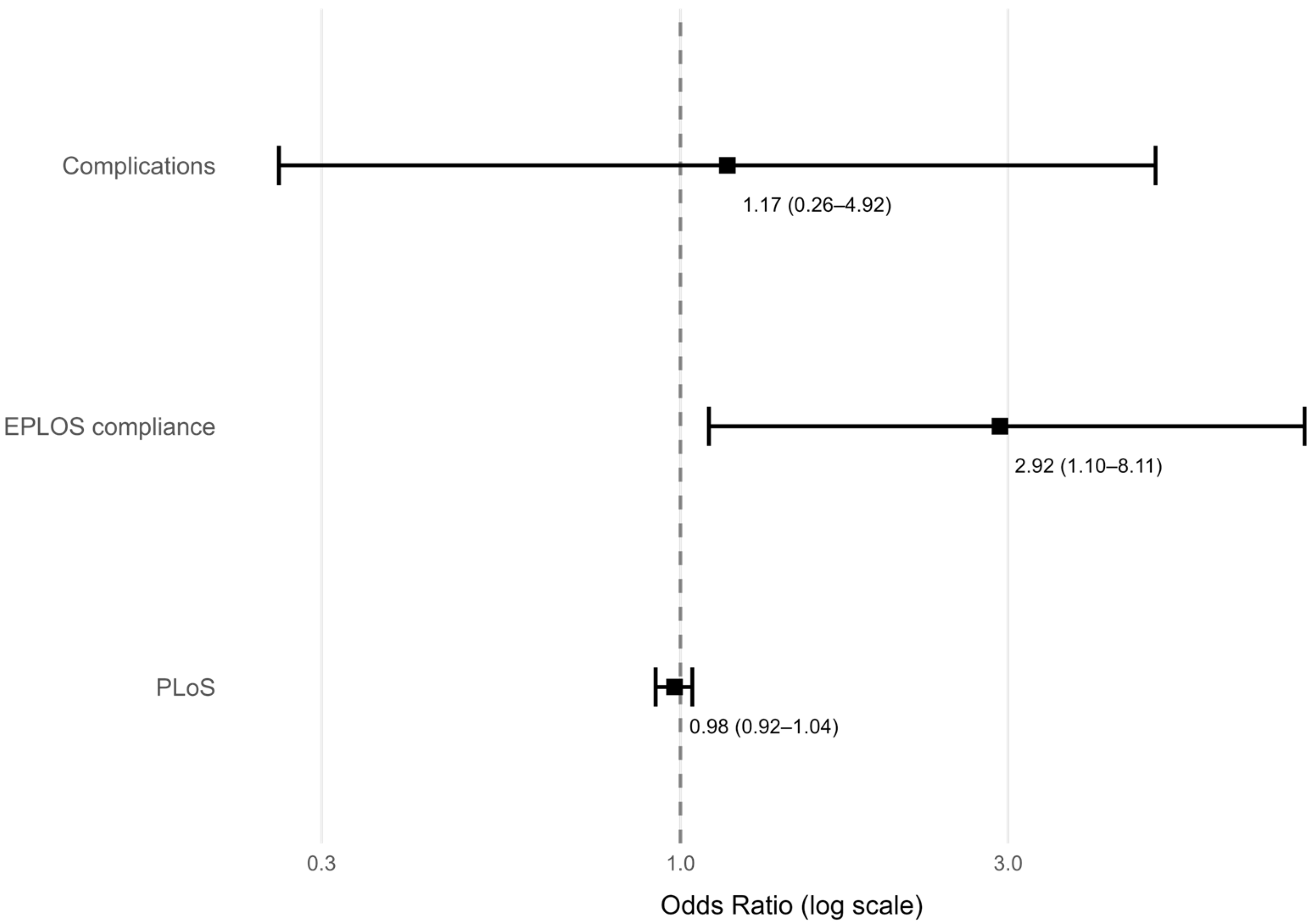
A forest plot was generated to visually summarise the differences in key clinical outcomes between adherent and non-adherent patients, enhancing the interpretability of the results (Figure 1).

2.6. Ethical Considerations

The study was approved by the Clinical Research Ethics Committees of both participating hospitals (approval number: PR426/21). The study was conducted in accordance with the STROBE guidelines for observational studies [13], and the corresponding checklist is provided in Appendix C. Data were anonymised prior to analysis, and the requirement for informed consent was waived due to the retrospective nature of the study.

3. Results

3.1. Patient Characteristics and Care Complexity

The final study cohort included 90 patients who met the predefined inclusion criteria. The median age was 69.8 years [62.0; 76.2], and 57.8% were male. Most patients (88.9%) underwent surgery with curative intent, and the majority had a laparoscopic approach (71.1%).
Care complexity was high, with a mean of 2.62 CCIFs per patient. The most prevalent domains were comorbidity/complications (96.7%) and developmental factors (31.1%), followed by psycho-emotional and mental–cognitive domains (Table 1).

3.2. ERAS Adherence

Overall ERAS adherence was 64%, reflecting variable implementation across the cohort. Adherence differed by perioperative phase, with higher compliance observed in the preoperative phase compared to intraoperative and postoperative phases (Table 2).

3.3. Association Between ERAS Adherence and Outcomes

Higher ERAS adherence was associated with shorter hospital length of stay in the primary analysis. Patients classified as adherent had a median stay of 4.0 days compared to 5.0 days in the non-adherent group (p = 0.033). Table 3 summarises the association between ERAS adherence and key clinical outcomes.
Patients with higher overall ERAS adherence demonstrated a significantly greater likelihood of meeting the expected length of stay (37.8% vs. 17.0%, p = 0.047).
When analysing adherence across perioperative phases, higher compliance was observed in the preoperative phase compared to intraoperative and postoperative phases (Table 2). However, phase-specific associations with length of stay were not formally analysed in this study.
No statistically significant differences were observed in postoperative complications between groups (p = 0.105).
A sensitivity analysis excluding postoperative ERAS adherence items showed attenuation of the associations between adherence and postoperative outcomes, with no statistically significant differences observed for postoperative length of stay or EPLOS compliance (Appendix F).
A forest plot summarising the association between ERAS adherence and key clinical outcomes is presented in Figure 1. The plot suggests a trend towards shorter length of stay and improved EPLOS compliance in the adherent group, although confidence intervals indicate uncertainty for some outcomes.

3.4. Care Complexity and Outcomes

Table 4 summarises the association between care complexity and ERAS adherence as well as compliance with the expected length of stay (EPLOS).
No statistically significant association was observed between overall care complexity (CCIFs) and adherence levels or EPLOS compliance. Patients frequently presented multiple complexity factors; however, these did not appear to significantly influence adherence or recovery indicators in this cohort.
Similarly, no statistically significant differences were observed in the mean number of Care Complexity Individual Factors between patients who met and those who did not meet the expected length of stay (2.70 [SD 1.06] vs. 2.62 [SD 1.04]; p = 0.210).
A detailed breakdown of Care Complexity Individual Factors is provided in Appendix D and Appendix E.

4. Discussion

This study evaluated the relationship between ERAS adherence, care complexity, and postoperative outcomes in patients undergoing oncological colorectal surgery in a real-world clinical setting. The findings indicate that higher ERAS adherence is associated with shorter hospital length of stay [3,4,5,14], supporting the relevance of implementation fidelity in perioperative care pathways. The forest plot representation suggests a consistent direction of association across key outcomes, although estimates should be interpreted cautiously due to the width of confidence intervals.
Although phase-specific associations were not formally analysed, differences in adherence across perioperative phases may have implications for recovery, as suggested in previous ERAS literature [15,16]. This interpretation is further supported by the sensitivity analysis excluding postoperative adherence items, which attenuated the observed associations with postoperative outcomes.
Despite the high burden of care complexity observed in the cohort, no significant association was found between Care Complexity Individual Factors and postoperative outcomes. These findings suggest that, within this context, adherence to structured perioperative care pathways may be more closely associated with recovery than patient complexity alone [6,12]. However, this interpretation should be considered exploratory, given the limited sample size.
The variability in ERAS adherence observed in this study reflects the challenges of implementing complex care protocols in routine clinical practice [8,9]. While both participating centres had adopted ERAS-based pathways, overall adherence remained below optimal levels, highlighting the gap between protocol adoption and effective implementation. These findings support the view of ERAS not only as a clinical protocol but also as a healthcare delivery model [7,9] requiring organisational alignment and sustained engagement.
From a clinical perspective, the results suggest that efforts to improve perioperative outcomes should prioritise strengthening adherence across all phases of care. Although the potential contribution of nursing-led interventions to improving adherence is recognised in the literature [17], the present study does not allow causal inference in this regard and should be interpreted accordingly.
This study has several limitations. Its retrospective design and relatively small sample size limit the ability to perform multivariable analyses and may reduce statistical power for subgroup comparisons. The absence of multivariable analysis limits the ability to account for potential confounding factors such as age, comorbidities, and postoperative complications. Therefore, the observed associations should be interpreted as exploratory and hypothesis-generating. Furthermore, the use of convenience sampling and the requirement for structured electronic nursing documentation may have introduced selection bias.
Finally, the absence of 30-day follow-up, readmissions, and mortality data restricts the assessment of broader postoperative outcomes. Although care complexity was measured using a structured framework, the level of detail required to fully explore its impact may exceed the analytical capacity of the available sample.

5. Conclusions

Higher adherence to ERAS protocols was associated with shorter hospital length of stay in oncological colorectal surgery within a real-world clinical setting. Adherence varied across perioperative phases, although phase-specific associations with outcomes were not formally analysed in this study.
Care complexity did not show a statistically significant association with postoperative outcomes in this cohort; however, this finding should be interpreted cautiously given the exploratory nature of the study, the limited sample size, and the absence of multivariable adjustment.
These findings suggest an association between implementation fidelity and postoperative recovery, although the relative contribution of care complexity cannot be definitively established. Further research in larger cohorts using adjusted analytical approaches is needed to better understand these relationships.

Author Contributions

Conceptualization, J.A.J.G., M.Á.H.-B. and M.E.J.-U.; methodology, M.Á.H.-B., J.A., B.M.-H. and O.P.-M.; formal analysis, B.M.-H. and O.P.-M.; investigation, J.A.J.G., M.M.C. and O.P.-M.; data curation, B.M.-H.; writing—original draft preparation, M.Á.H.-B. and J.A.J.G.; writing—review and editing, M.P.L., M.E.J.-U., J.A. and C.M.A.; supervision, C.M.A. and M.E.J.-U.; project administration, J.A.J.G.; funding acquisition, M.P.L. All authors have read and agreed to the published version of the manuscript.

Funding

This research was funded by the Departament de Recerca i Universitats de la Generalitat de Catalunya (AGAUR—2021SGR00929) and the Nursing Research Group (GRIN-IDIBELL). APC was funded by the Official College of Nurses of Barcelona (www.coib.cat) as part of the Nurse Research Projects Grants (PR-609/2023).

Institutional Review Board Statement

The study was conducted in accordance with the Declaration of Helsinki and approved by the Institutional Ethics Committee of both participating hospitals (protocol code PR426/21 and date of approval 3 January 2022).

Informed Consent Statement

Patient consent was waived due to this study was a retrospective analysis of anonymised data obtained from electronic health records.

Data Availability Statement

The data presented in this study are not publicly available due to ethical and privacy restrictions, as they contain sensitive information regarding individual participants and affiliated hospitals. Access to the data may be considered upon reasonable request and with appropriate ethical approval.

Acknowledgments

We thank the CERCA Programme/Generalitat de Catalunya for institutional support.

Conflicts of Interest

The authors declare no conflicts of interest. The funders had no role in the design of the study; in the collection, analyses, or interpretation of data; in the writing of the manuscript; or in the decision to publish the results.

Abbreviations

The following abbreviations are used in this manuscript:
CCIFsCare Complexity Individual Factors
EPLOSExpected postoperative length of stay
ERASEnhanced Recovery After Surgery
GRINNursing Research Group
ICUIntensive Care Unit
IDIBELLBellvitge Biomedical Research Institute
NURSEARCHNursing Research Group in Mental Health, Psychosocial and Complex Care
PLOSPostoperative length of stay
SDStandard deviation

Appendix A. ERAS Programme Indicators and Operational Definitions

LevelINDICATORIndicator DescriptionVariable CodeVariable Description Label
1. PreoperativeIP01Preoperative informationCOMP_INFOUnderstanding of the information provided
1. PreoperativeIP01Preoperative informationGUIA_INWas the information booklet provided to the patient?
1. PreoperativeIP01Preoperative informationAPACIHas the patient watched the video?
1. PreoperativeIP02Preoperative assessmentFUMADORSmoker
1. PreoperativeIP02Preoperative assessmentACFIDOLA_LDomestic/occupational physical activity
1. PreoperativeIP02Preoperative assessmentALCOHOLSNAlcohol consumption (yes/no)
1. PreoperativeIP02Preoperative assessmentCORREAnaemia correction
1. PreoperativeIP02Preoperative assessmentESC_MUSTMUST score (Malnutrition Universal Screening Tool)
1. PreoperativeIP02Preoperative assessmentVALIMCBMI assessment
1. PreoperativeIP03Mechanical bowel preparationPREPPreparation
1. PreoperativeIP04Preoperative fasting and carbohydrate loadingING_LIQUIFluid intake up to 2 h before surgery
1. PreoperativeIP04Preoperative fasting and carbohydrate loadingING_SOLISolid food intake up to 6 h before surgery
1. PreoperativeIP04Preoperative fasting and carbohydrate loadingPRE_CARCarbohydrate loading
1. PreoperativeIP04Preoperative fasting and carbohydrate loadingNU_POTUnits of Maltodextrine consumed
2. IntraoperativeIP05Thromboembolism prophylaxisPRO_HBPMEducation on LMWH prophylaxis
2. IntraoperativeIP05Thromboembolism prophylaxisMIT_COMCompression stockings/intermittent pneumatic compression
2. IntraoperativeIP06Antibiotic prophylaxisPRO_PREQPreoperative antibiotic prophylaxis
2. IntraoperativeIP07Surgical approachLAPAROLaparoscopy
2. IntraoperativeIP08Fluid managementBAL_LIQ_IQIntraoperative fluid balance
2. IntraoperativeIP08Fluid managementRE_SUERODiscontinuation of intravenous fluid therapy
2. IntraoperativeIP09Prevention of hypothermiaMESURESPhysical measures for hypothermia prevention
3. PostoperativeIP10DrainsNU_DRENumber of abdominal wall drains
3. PostoperativeIP10DrainsDRE_ABNumber of intra-abdominal drains
3. PostoperativeIP11Oral medicationANA_ORALOral analgesia
3. PostoperativeIP12Pain controlEVAVAS score (Visual Analogue Scale)
3. PostoperativeIP13Nutritional intakeSU_HIPERPROral high-protein supplements
3. PostoperativeIP13Nutritional intakePROGRE_DIEDiet progression
3. PostoperativeIP14Early mobilisationSED_6Mobilisation at 6 h postoperatively
3. PostoperativeIP14Early mobilisationSEDNot bedbound

Appendix B. Care Complexity Individual Factors (CCIFs) Domains and Variables

The Care Complexity Individual Factors (CCIFs) framework includes multiple domains reflecting patient-related complexity. Each domain comprises specific variables as detailed below.
DomainFactors
Mental–cognitiveAgitation; Mental status impairments; Impaired cognitive function; Perception of reality disorders
Psycho-emotionalAggressiveness; Fear/Anxiety; Impaired adaptation
SocioculturalLanguage barriers; Social exclusion; Belief conflict; Illiteracy; Lack of caregiver
DevelopmentalOlder age
Comorbidities/ComplicationsMajor chronic disease; Haemodynamic instability; Risk of haemorrhage; Communication disorders; Urinary or faecal incontinence; Vascular fragility; Postural limitation; Involuntary movements; Extreme weight; Dehydration; Oedema; Uncontrolled pain; Transmissible infection; Immunosuppression; Anatomical-functional disorders

Appendix C. STROBE Checklist for Observational Studies

This checklist follows the STROBE (Strengthening the Reporting of Observational Studies in Epidemiology) guidelines and indicates where each recommendation is addressed in the manuscript.
SectionItemRecommendationReported in Manuscript
Title and Abstract1Indicate the study design in the title or abstractTitle and Abstract
Provide an informative and balanced summaryAbstract
Introduction2Explain scientific background and rationaleIntroduction
3State specific objectivesEnd of Introduction
Methods4Present key elements of study designSection 2.1
5Describe setting, locations, and relevant datesSection 2.2
6Give eligibility criteria and sources of participantsSection 2.2
Describe selection methodsSection 2.2
7Clearly define all outcomes and variablesSection 2.3
8Describe data sources and measurement methodsSection 2.3 and Section 2.4
9Describe efforts to address biasSection 2.3.2 and Section 2.5
10Explain how study size was determinedSection 2.2 (retrospective inclusion)
11Explain handling of quantitative variablesSection 2.3.2 and Section 2.5
12Describe statistical methodsSection 2.5
Methods to examine subgroups and interactionsSection 2.5
Explain how missing data were addressedSection 2.4
Results13Report number of individuals at each stageSection 2.2/Results
Reasons for non-participationSection 2.2
Consider use of flow diagram(Optional―not included)
14Give characteristics of study participantsResults
Indicate missing data for each variableResults
15Report outcome dataResults
16Provide main results with estimates and precisionResults
Adjusted estimates (if applicable)Not applicable (no multivariable analysis)
17Report other analyses (subgroups, sensitivity)Results
Discussion18Summarise key resultsDiscussion
19Discuss limitationsDiscussion
20Provide cautious interpretationDiscussion
21Discuss generalisabilityDiscussion
Other Information22Give source of funding and role of fundersFunding

Appendix D. Numbers of CCIFs in All Perioperative Phases

Perioperative PhasePatients AdheredPatients Not Adheredp-Value
Overall Adherence2.86 (1.08)2.45 (0.99)0.070
Preoperative phase2.66 (1.03)2.30 (1.16)0.366
Intraoperative phase2.59 (1.02)2.67 (1.10)0.748
Postoperative phase2.83 (1.15)2.52 (0.98)0.202

Appendix E. Association Between CCIFs and Compliance with Expected Length of Stay (EPLOS)

CCIFsEPLOS
Yes (N = 23)No (N = 67)p-Value
N(%)N(%)
Number of factors―Mean (SD)2.70(1.06)2.62(1.04)0.210
Mental–cognitive1(4.35)2(2.99)1.000
Agitation0(0.00)0(0.00)
Mental status impairments1(4.35)2(2.99)1.000
Impaired cognitive function0(0.00)0(0.00)
Perception of reality disorders0(0.00)0(0.00)
Psycho-emotional4(17.4)7(10.4)0.462
Aggressiveness0(0.00)0(0.00)
Fear/Anxiety3(13.0)6(8.96)0.688
Impaired adaptation1(4.35)1(1.49)0.448
Sociocultural1(4.35)0(0.00)0.256
Language barriers1(4.35)0(0.00)0.256
Social exclusion0(0.00)0(0.00)
Belief conflict0(0.00)0(0.00)
Illiteracy0(0.00)0(0.00)
Lack of caregiver0(0.00)0(0.00)
Developmental6(26.1)22(32.8)0.732
Older age6(26.1)22(32.8)0.732
Comorbidities/Complications22(95.7)65(97.0)1.000
Major chronic disease14(60.9)42(62.7)1.000
Haemodynamic instability20(87.0)59(88.1)1.000
Risk of haemorrhage0(0.00)0(0.00)
Communication disorders0(0.00)0(0.00)
Urinary or faecal incontinence1(4.35)1(1.49)0.448
Vascular fragility0(0.00)1(1.49)1.000
Postural limitation0(0.00)1(1.49)1.000
Involuntary movements0(0.00)0(0.00)
Extreme weight2(8.70)4(5.97)0.643
Dehydration0(0.00)0(0.00)
Oedema0(0.00)3(4.48)0.567
Uncontrolled pain5(21.7)36(53.7)0.016
Transmissible infection1(4.35)1(1.49)0.448
Immunosuppression0(0.00)0(0.00)
Anatomical-functional disorders0(0.00)2(2.99)1.000
Abbreviations: CCIFs, Care Complexity Individual Factors; EPLOS, Expected Length of Stay; SD, Standard Deviation.

Appendix F. Sensitivity Analysis Excluding Postoperative ERAS Adherence Items

ALLNon-AdherentAdherentOR
(95% CI)
p-Value
N = 90N = 24N = 66
Postoperative Length of Stay (PLOS), median [Q1; Q3]5.00 [4.00; 8.00]5.00 [4.00; 8.00]5.00 [4.00; 7.00]0.99 [0.93; 1.05]0.484
EPLOS compliance (%)23 (25.6%)5 (20.8%)18 (27.3%)1.40 [0.47; 4.82]0.729
Complications, n (%)9 (10.0%)4 (16.7%)5 (7.58%)0.41 [0.10; 1.89]0.240
ERAS adherence was recalculated excluding postoperative adherence items to minimise potential circularity between recovery-related variables and postoperative outcomes. Values are presented as median (IQR) or number (%), as appropriate. Odds ratios (OR) with 95% confidence intervals are unadjusted and derived from bivariate analyses; they should be interpreted cautiously. EPLOS: Expected postoperative length of stay.

References

  1. Ljungqvist, O.; Scott, M.; Fearon, K.C. Enhanced recovery after surgery: A review. JAMA Surg. 2017, 152, 292–298. [Google Scholar] [CrossRef] [Scilit] [PubMed]
  2. Fearon, K.C.H.; Ljungqvist, O.; Von Meyenfeldt, M.; Revhaug, A.; Dejong, C.H.C.; Lassen, K.; Nygren, J.; Hausel, J.; Soop, M.; Andersen, J.; et al. Enhanced recovery after surgery: A consensus review of clinical care for patients undergoing colonic resection. Clin. Nutr. 2005, 24, 466–477. [Google Scholar] [CrossRef] [Scilit] [PubMed]
  3. ERAS Compliance Group. The impact of enhanced recovery protocol compliance on elective colorectal cancer resection: Results from an international registry. Ann. Surg. 2015, 261, 1153–1159. [Google Scholar] [CrossRef] [Scilit] [PubMed]
  4. Gustafsson, U.O.; Hausel, J.; Thorell, A.; Ljungqvist, O.; Soop, M.; Nygren, J.; ERAS Study Group. Adherence to the enhanced recovery after surgery protocol and outcomes after colorectal cancer surgery. Arch. Surg. 2011, 146, 571–577. [Google Scholar] [CrossRef] [Scilit] [PubMed]
  5. Berian, J.R.; Ban, K.A.; Liu, J.B.; Ko, C.Y.; Feldman, L.S.; Thacker, J.K. Adherence to enhanced recovery protocols in NSQIP and association with colectomy outcomes. Ann. Surg. 2019, 269, 486–493. [Google Scholar] [CrossRef] [Scilit] [PubMed]
  6. Gustafsson, U.O.; Oppelstrup, H.; Thorell, A.; Nygren, J.; Ljungqvist, O. Adherence to the ERAS Protocol Is Associated with 5-Year Survival after Colorectal Cancer Surgery: A Retrospective Cohort Study. World J. Surg. 2016, 40, 1741–1747. [Google Scholar] [CrossRef] [Scilit] [PubMed]
  7. Gustafsson, U.O.; Rockall, T.A.; Wexner, S.; How, K.Y.; Emile, S.; Marchuk, A.; Fawcett, W.J.; Sioson, M.; Riedel, B.; Chahal, R.; et al. Guidelines for Perioperative Care in Elective Colorectal Surgery: Enhanced Recovery After Surgery (ERAS) Society Recommendations 2025. Surgery 2025, 184, 109397. [Google Scholar] [CrossRef] [Scilit] [PubMed]
  8. Gillissen, F.; Hoff, C.; Maessen, J.M.; Winkens, B.; Teeuwen, J.H.; Von Meyenfeldt, M.F.; Dejong, C.H. Structured synchronous implementation of an enhanced recovery program in elective colonic surgery in 33 hospitals in The Netherlands. World J. Surg. 2013, 37, 1082–1093. [Google Scholar] [CrossRef] [Scilit] [PubMed]
  9. Nelson, G.; Wang, X.; Nelson, A.; Faris, P.; Lagendyk, L.; Wasylak, T.; Bathe, O.F.; Bigam, D.; Bruce, E.; Buie, W.D.; et al. Evaluation of the implementation of multiple enhanced recovery after surgery pathways across a provincial health care system in Alberta, Canada. JAMA Netw. Open 2021, 4, e2119769. [Google Scholar] [CrossRef] [Scilit] [PubMed]
  10. Song, J.H.; Kim, M. Clinical Outcomes and Future Directions of Enhanced Recovery after Surgery in Colorectal Surgery: A Narrative Review. Ewha Med. J. 2024, 47, e69. [Google Scholar] [CrossRef] [Scilit] [PubMed]
  11. Juvé-Udina, M.E.; Matud-Calvo, C.; Farrero-Muñoz, S.; Jiménez-Pérez, H.; Rodríguez-Gías, E.; Martínez-Muñoz, M.; Privat-Marcé, L.; Mauri-Herrero, C.; Sola-Miravete, H.; Soldevila-Casas, R.; et al. Intensidad de cuidados enfermeros: ¿Cargas de trabajo o complejidad individual? Metas Enferm. 2010, 13, 6–14. [Google Scholar]
  12. Adamuz, J.; Juvé-Udina, M.E.; González-Samartino, M.; Jiménez-Martínez, E.; Tapia-Pérez, M.; López-Jiménez, M.M.; Romero-García, M.; Delgado-Hito, P. Care complexity individual factors associated with adverse events and in-hospital mortality. PLoS ONE 2020, 15, e0236370. [Google Scholar] [CrossRef] [Scilit] [PubMed]
  13. von Elm, E.; Altman, D.G.; Egger, M.; Pocock, S.J.; Gøtzsche, P.C.; Vandenbroucke, J.P. The Strengthening the Reporting of Observational Studies in Epidemiology (STROBE) Statement: Guidelines for Reporting Observational Studies. PLoS Med. 2007, 4, e296. [Google Scholar] [CrossRef] [Scilit] [PubMed]
  14. Sauro, K.M.; Smith, C.; Ibadin, S.; Thomas, A.; Ganshorn, H.; Bakunda, L.; Bajgain, B.; Bisch, S.P.; Nelson, G. Enhanced Recovery after Surgery Guidelines and Hospital Length of Stay, Readmission, Complications, and Mortality: A Meta-Analysis of Randomized Clinical Trials. JAMA Netw. Open 2024, 7, e2417310. [Google Scholar] [CrossRef] [Scilit] [PubMed]
  15. Aarts, M.A.; Rotstein, O.D.; Pearsall, E.A.; Victor, J.C.; Okrainec, A.; McKenzie, M.; McCluskey, S.A.; Conn, L.G.; McLeod, R.S.; iERAS Group. Postoperative ERAS interventions have the greatest impact on optimal recovery: Experience with implementation of ERAS across multiple hospitals. Ann. Surg. 2018, 267, 992–997. [Google Scholar] [CrossRef] [Scilit] [PubMed]
  16. Urbina, A.; Juvé-Udina, M.E.; Romero-García, M.; Delgado-Hito, P.; González-Samartino, M.; Adamuz, J. Care complexity factors associated with revisits to an emergency department. Emergencias 2023, 35, 245–251. [Google Scholar] [CrossRef] [Scilit] [PubMed]
  17. Tong, Y.; Qin, X. Perioperative nursing interventions based on the enhanced recovery after surgery concept for patients with gynecological malignancies: A retrospective study. Medicine 2025, 104, e43290. [Google Scholar] [CrossRef] [Scilit] [PubMed]
Figure 1. Forest plot showing the association between ERAS adherence and clinical outcomes. Odds ratios (OR) with 95% confidence intervals are presented. Values <1 indicate lower odds of the outcome in the adherent group. Estimates are unadjusted and should be interpreted cautiously.
Healthcare 14 01519 g001
Table 1. Patient Characteristics and Care Complexity Profile.
All
N = 90
Gender
Female38 (42.2%)
Male52 (57.8%)
Age (median, [Q1; Q3])69.8 [62.0; 76.2]
Surgical approach (laparoscopic)64 (71.1%)
Surgical site, n (%)
Colon62 (68.9%)
Rectal28 (31.1%)
ICU admission21 (23.3%)
Complications9 (10.0%)
Postoperative Length of Stay (PLoS)5.00 [4.00; 8.00]
Expected PLoS23 (25.6%)
CCIFs, mean (SD)2.62 (1.04)
Domain
Mental–cognitive3 (3.33%)
Psycho-emotional11 (12.2%)
Sociocultural1 (1.11%)
Developmental28 (31.1%)
Comorbidities/Complications87 (96.7%)
Values are presented as median (interquartile range, IQR), mean (standard deviation, SD), or number (percentage), as appropriate. CCIFs: Care Complexity Individual Factors. ICU: Intensive Care Unit (postoperative recovery unit in the context of this study).
Table 2. Global and Phase-Specific ERAS Adherence.
All
Overall ERAS adherence, mean (SD)0.64 (0.22)
Preoperative adherence, mean (SD)0.86 (0.17)
Intraoperative adherence, mean (SD)0.63 (0.27)
Postoperative adherence, mean (SD)0.53 (0.31)
Values are expressed as mean (standard deviation, SD). ERAS adherence is reported as a proportion ranging from 0 to 1, corresponding to 0% to 100% compliance with protocol items. Phase-specific adherence refers to compliance within preoperative, intraoperative, and postoperative ERAS components.
Table 3. Association Between ERAS Adherence and Clinical Outcomes.
AllNon-AdherentAdherentOR
(95% CI)
p-Value
N = 90N = 53N = 37
Postoperative Length of Stay (PLOS), median [Q1; Q3]5.00 [4.00; 8.00]5.00 [5.00; 8.50]4.00 [3.00; 4.00]0.98 [0.92; 1.04]0.033
EPLOS compliance (%)23 (25.6%)9 (17.0%)14 (37.8%)2.92 [1.10; 8.11]0.047
Complications, n (%)9 (10.0%)5 (9.43%)4 (10.8%)1.17 [0.26; 4.92]0.105
Values are presented as median (IQR) or number (%), as appropriate. Odds ratios (OR) with 95% confidence intervals are unadjusted and derived from bivariate analyses; they should be interpreted cautiously. EPLOS: Expected postoperative length of stay.
Table 4. Association Between Care Complexity (CCIFs), ERAS Adherence, and Compliance with Expected Length of Stay (EPLOS).
Non-AdherentAdherentOR
(95% CI)
p-Value
N = 53N = 37
CCIFs, mean (SD)2.45 (0.99)2.86 (1.08)1.48 [0.97; 2.26]0.070
Domain
Mental–cognitive2 (3.77%)1 (2.70%)0.75 [0.02; 9.65]1.000
Psycho-emotional1 (1.89%)10 (27.0%)16.7 [2.91; 429]<0.001
Sociocultural1 (1.89%)0 (0.00%) 1.000
Developmental18 (34.0%)10 (27.0%)0.73 [0.28; 1.82]0.640
Comorbidities/Complications51 (96.2%)36 (97.3%)1.33 [0.10; 42.7]1.000
Non EPLOS ComplianceEPLOS ComplianceOR
(95% CI)
p-Value
N = 67N = 23
CCIFs, mean (SD)2.70 (1.06)2.39 (0.99)0.74 [0.46; 1.19]0.210
Domain
Mental–cognitive2 (2.99%)1 (4.35%)1.56 [0.05; 20.1]1.000
Psycho-emotional7 (10.4%)4 (17.4%)1.81 [0.42; 6.89]0.462
Sociocultural0 (0.00%)1 (4.35%)--0.256
Developmental22 (32.8%)6 (26.1%)0.73 [0.23; 2.07]0.732
Comorbidities/Complications65 (97.0%)22 (95.7%)0.64 [0.05; 20.8]1.000
Values are presented as mean (standard deviation, SD) or number (%), as appropriate. Odds ratios (OR) with 95% confidence intervals are unadjusted and derived from bivariate analyses; they should be interpreted cautiously. CCIFs: Care Complexity Individual Factors; EPLOS: Expected postoperative length of stay.
Disclaimer/Publisher’s Note: The statements, opinions and data contained in all publications are solely those of the individual author(s) and contributor(s) and not of MDPI and/or the editor(s). MDPI and/or the editor(s) disclaim responsibility for any injury to people or property resulting from any ideas, methods, instructions or products referred to in the content.