Healthcare Quality Systems: International Frameworks, Evaluation and Improvement Strategies



Abstract
1. Introduction
2. Materials and Methods
3. Conceptual Foundations of Quality in Healthcare
4. Major International Quality Systems and Frameworks

| Framework/System | Primary Level of Application | Main Orientation | Typical Strengths | Common Limitations or Caveats |
|---|---|---|---|---|
| WHO Quality, Patient Safety and UHC 1 Frameworks | National and health-system level | Policy architecture linking quality, safety, people-centered care and UHC | Supports national governance, stakeholder engagement, safety priorities and system-wide measurement | Requires political commitment, implementation capacity, financing and adaptation to local context |
| JCI Accreditation | Healthcare organization/hospital | External standards, survey and accreditation | Creates a common safety language and strengthens governance, infection prevention, medication safety and facility processes | Can become episodic, documentation-driven or survey-focused if not linked to daily learning |
| NCQA/HEDIS | Payer, ambulatory and population-health level | Standardized quality measurement, benchmarking and accountability | Scalable indicators for contracting, public accountability and population management | May underrepresent relational, experiential and contextual aspects of care; primarily US-oriented |
| EFQM Model | Organization/enterprise level | Organizational excellence, leadership, strategy, results | Integrates quality with management, transformation and long-term performance | Less clinically specific than healthcare-focused accreditation systems |
| ISO 9001 and ISO 7101 | Organization/quality management system | Process standardization, documentation, risk-based thinking and continuous improvement | Formalizes workflows, corrective action and healthcare-specific quality governance | Generic ISO 9001 is not clinical [11]; ISO 7101 diffusion and implementation evidence remain early [12] |
| AHRQ Quality Indicators | Hospital/system analytics | Administrative data-based quality and safety measurement | Feasible, standardized and useful for surveillance and benchmarking | Dependent on coding quality, may miss clinical nuance or patient experience |
| OECD HCQI/PaRIS | Cross-national health system comparison | Comparative performance measurement and patient-reported outcomes/experiences | Enables international benchmarking and inclusion of patient voice | Cross-country comparability and contextual interpretation remain challenging |
5. Methods for Assessing and Improving Quality in Healthcare
6. Determinants of Effective Implementation
7. What Does the Evidence Show About Effectiveness?
8. Persistent Challenges and Future Directions
9. Conclusions
Author Contributions
Funding
Institutional Review Board Statement
Informed Consent Statement
Data Availability Statement
Conflicts of Interest
References
- Donabedian, A. The quality of care: How can it be assessed? J. Am. Med. Assoc. 1988, 260, 1743–1748. [Google Scholar] [CrossRef] [PubMed]
- Institute of Medicine (US) Committee on Quality of Health Care in America. Crossing the Quality Chasm: A New Health System for the 21st Century; National Academies Press: Washington, DC, USA, 2001. [Google Scholar] [CrossRef]
- World Health Organization. Quality of Care. Available online: https://www.who.int/health-topics/quality-of-care (accessed on 6 March 2026).
- Kruk, M.E.; Gage, A.D.; Arsenault, C.; Jordan, K.; Leslie, H.H.; Roder-DeWan, S.; Adeyi, O.; Barker, P.; Daelmans, B.; Doubova, S.V.; et al. High-quality health systems in the Sustainable Development Goals era: Time for a revolution. Lancet Glob. Health 2018, 6, e1196–e1252. [Google Scholar] [CrossRef]
- World Health Organization. Handbook for National Quality Policy and Strategy: A Practical Approach for Developing Policy and Strategy to Improve Quality of Care; WHO: Geneva, Switzerland, 2018; Available online: https://iris.who.int/server/api/core/bitstreams/c21e214e-fa6d-4507-8b34-1ae943b1e9d4/content (accessed on 6 March 2026).
- World Health Organization. Global Patient Safety Action Plan 2021–2030: Towards Eliminating Avoidable Harm in Health Care; WHO: Geneva, Switzerland, 2021; Available online: https://iris.who.int/server/api/core/bitstreams/a28c34c0-089c-4f5d-a0b1-5d9c35a3cd67/content (accessed on 6 March 2026).
- World Health Organization. Global Patient Safety Report 2024; WHO: Geneva, Switzerland, 2024; Available online: https://iris.who.int/server/api/core/bitstreams/ae1caeae-bc04-4a71-a6b0-ab478f9a8c79/content (accessed on 6 March 2026).
- Joint Commission International. Joint Commission International Accreditation Standards for Hospitals, 8th ed.; Joint Commission International: Oakbrook Terrace, IL, USA, 2025. [Google Scholar]
- National Committee for Quality Assurance. HEDIS Measures and Technical Resources. Available online: https://www.ncqa.org/hedis/measures/ (accessed on 6 March 2026).
- EFQM. The EFQM Model. Available online: https://efqm.org/the-efqm-model/ (accessed on 6 March 2026).
- ISO 9001:2015; Quality Management Systems—Requirements. International Organization for Standardization: Geneva, Switzerland, 2015. Available online: https://www.iso.org/standard/62085.html (accessed on 6 March 2026).
- ISO 7101:2023; Healthcare Organization Management—Management Systems for Quality in Healthcare Organizations—Requirements. International Organization for Standardization: Geneva, Switzerland, 2023. Available online: https://www.iso.org/standard/81647.html (accessed on 6 March 2026).
- Agency for Healthcare Research and Quality. AHRQ Quality Indicators. Available online: https://qualityindicators.ahrq.gov/ (accessed on 6 March 2026).
- Organisation for Economic Co-Operation and Development. Health at a Glance 2025: OECD Indicators; OECD Publishing: Paris, France, 2025; Available online: https://www.oecd.org/content/dam/oecd/en/publications/reports/2025/11/health-at-a-glance-2025_a894f72e/8f9e3f98-en.pdf (accessed on 6 March 2026).
- Valderas, J.M.; Porter, I.; Martin-Delgado, J.; Rijken, M.; de Jong, J.; Groene, O.; Bloemeke-Cammin, J.; Sunol, R.; Williams, R.; Ballester, M.; et al. Development of the Patient-Reported Indicator Surveys (PaRIS) conceptual framework to monitor and improve the performance of primary care for people living with chronic conditions. BMJ Qual. Saf. 2025, 34, 529–536. [Google Scholar] [CrossRef] [PubMed]
- Schang, L.; Blotenberg, I.; Boywitt, D. What makes a good quality indicator set? A systematic review of criteria. Int. J. Qual. Health Care 2021, 33, mzab107. [Google Scholar] [CrossRef]
- Heenan, M.A.; Randall, G.E.; Evans, J.M. Selecting performance indicators and targets in health care: An international scoping review and standardized process framework. Risk Manag. Healthc. Policy 2022, 15, 747–764. [Google Scholar] [CrossRef]
- MacLean, C.H.; Kerr, E.A.; Qaseem, A. Time Out—Charting a Path for Improving Performance Measurement. N. Engl. J. Med. 2018, 378, 1757–1761. [Google Scholar] [CrossRef]
- Jacobs, D.B.; Schreiber, M.; Seshamani, M.; Tsai, D.; Fowler, E.; Fleisher, L.A. Aligning Quality Measures across CMS—The Universal Foundation. N. Engl. J. Med. 2023, 388, 776–779. [Google Scholar] [CrossRef]
- Flodgren, G.; Gonçalves-Bradley, D.C.; Pomey, M.-P. External inspection of compliance with standards for improved healthcare outcomes. Cochrane Database Syst. Rev. 2016, 12, CD008992. [Google Scholar] [CrossRef]
- Hussein, M.; Pavlova, M.; Ghalwash, M.; Groot, W. The impact of hospital accreditation on the quality of healthcare: A systematic literature review. BMC Health Serv. Res. 2021, 21, 1057. [Google Scholar] [CrossRef] [PubMed]
- Alhawajreh, M.J.; Paterson, A.S.; Jackson, W.J. Impact of hospital accreditation on quality improvement in healthcare: A systematic review. PLoS ONE 2023, 18, e0294180. [Google Scholar] [CrossRef]
- Hinchcliff, R.; Greenfield, D.; Moldovan, M.; Westbrook, J.I.; Pawsey, M.; Mumford, V.; Braithwaite, J. Narrative synthesis of health service accreditation literature. BMJ Qual. Saf. 2012, 21, 979–991. [Google Scholar] [CrossRef]
- Bull, C.; Teede, H.; Watson, D.; Callander, E.J. Selecting and implementing patient-reported outcome and experience measures to assess health system performance. JAMA Health Forum 2022, 3, e220326. [Google Scholar] [CrossRef]
- Lowry, V.; Tremblay-Vaillancourt, V.; Beaupré, P.; Poirier, M.-D.; Perron, M.-È.; Bernier, J.; Morin, A.; Cormier, C.; Haggerty, J.; Ahmed, S.; et al. How patient-reported outcomes and experience measures (PROMs and PREMs) are implemented in healthcare professional and patient organizations? An environmental scan. J. Patient Rep. Outcomes 2024, 8, 133. [Google Scholar] [CrossRef]
- Bonsel, J.M.; Itiola, A.J.; Huberts, A.S.; Bonsel, G.J.; Penton, H. The use of patient-reported outcome measures to improve patient-related outcomes: A systematic review. Health Qual. Life Outcomes 2024, 22, 101. [Google Scholar] [CrossRef] [PubMed]
- Fontaine, G.; Ramos, J.; Mooney, M.; Perron, M.-E.; Crump, L.; Lambert, S.D. Implementation strategies for embedding patient-reported outcome and experience measures (PROMs/PREMs) in routine care: Secondary analysis of an umbrella review. J. Patient Rep. Outcomes 2026, 10, 17. [Google Scholar] [CrossRef] [PubMed]
- Vibe, A.; Rasmussen, S.H.; Rasmussen, N.O.P.; Østergaard, D.; Dieckmann, P. The predictors of patient safety culture in hospital setting: A systematic review. J. Patient Saf. 2024, 20, 576–592. [Google Scholar] [CrossRef] [PubMed]
- Finn, M.; Walsh, A.; Rafter, N.; Mellon, L.; Chong, H.Y.; Naji, A.; O’Brien, N.; Williams, D.J.; McCarthy, S.E. Effect of interventions to improve safety culture on healthcare workers in hospital settings: A systematic review of the international literature. BMJ Open Qual. 2024, 13, e002506. [Google Scholar] [CrossRef]
- Althobaiti, F.M. The effects of leadership on patient safety culture in health care: A systematic review. BMC Nurs. 2026, 25, 125. [Google Scholar] [CrossRef]
- Alabdaly, A.; Hinchcliff, R.; Debono, D.; Hor, S.Y. Relationship between patient safety culture and patient experience in hospital settings: A scoping review. BMC Health Serv. Res. 2024, 24, 906. [Google Scholar] [CrossRef]
- Endalamaw, A.; Khatri, R.B.; Mengistu, T.S.; Erku, D.; Wolka, E.; Zewdie, A.; Assefa, Y. A scoping review of continuous quality improvement in healthcare system: Conceptualization, models and tools, barriers and facilitators, and impact. BMC Health Serv. Res. 2024, 24, 487. [Google Scholar] [CrossRef]
- Wang, J.; Lv, H.; Chen, M.; Liu, C.; Ren, W.; Jiang, H.; Zhang, L. A systematic review of Lean implementation in hospitals: Impact on efficiency, quality, cost, and satisfaction. Int. J. Health Policy Manag. 2025, 14, 8974. [Google Scholar] [CrossRef]
- Rathi, R.; Vakharia, A.; Shadab, M. Lean six sigma in the healthcare sector: A systematic literature review. Mater. Today Proc. 2022, 50, 773–781. [Google Scholar] [CrossRef]
- McDermott, O.; Antony, J.; Bhat, S.; Jayaraman, R.; Rosa, A.; Marolla, G.; Parida, R. Lean Six Sigma in healthcare: A systematic literature review on challenges, organisational readiness and critical success factors. Processes 2022, 10, 1945. [Google Scholar] [CrossRef]
- Agency for Healthcare Research and Quality. About Learning Health Systems, 2019. Available online: https://www.ahrq.gov/learning-health-systems/about.html (accessed on 21 May 2026).
- McDonald, P.L.; Foley, T.J.; Verheij, R.; Braithwaite, J.; Rubin, J.; Harwood, K.; Phillips, J.; Gilman, S.; van der Wees, P.J. Data to knowledge to improvement: Creating the learning health system. BMJ 2024, 384, e076175. [Google Scholar] [CrossRef]
- Kaplan, H.C.; Brady, P.W.; Dritz, M.C.; Hooper, D.K.; Linam, W.M.; Froehle, C.M.; Margolis, P. The influence of context on quality improvement success in health care: A systematic review of the literature. Milbank Q. 2010, 88, 500–559. [Google Scholar] [CrossRef]
- Ye, F.; Zhang, D.; Martino, S.; Elliott, M.; Paz, C.; Longo, E.; Tyler-Mills, S.; Ong, C.; Madera, D.; Ninh, K.; et al. Updating the Framework for the Agency for Healthcare Research and Quality’s National Healthcare Quality and Disparities Report; Technical Brief No. 50; Agency for Healthcare Research and Quality: Rockville, MD, USA, 2025. Available online: https://effectivehealthcare.ahrq.gov/sites/default/files/related_files/updating-framework-qdr-technical-brief-50.pdf (accessed on 6 March 2026).
- World Health Organization. Global Strategy on Digital Health 2020–2025; WHO: Geneva, Switzerland, 2021; Available online: https://www.who.int/publications/i/item/9789240020924 (accessed on 21 May 2026).
- Sheikh, A.; Anderson, M.; Albala, S.; Casadei, B.; Franklin, B.D.; Richards, M.; Taylor, D.; Tibble, H.; Mossialos, E. Health information technology and digital innovation for national learning health and care systems. Lancet Digit. Health 2021, 3, e383–e396. [Google Scholar] [CrossRef] [PubMed]
- Greenfield, D.; Braithwaite, J. Health sector accreditation research: A systematic review. Int. J. Qual. Health Care 2008, 20, 172–183. [Google Scholar] [CrossRef] [PubMed]
- Yousefinezhadi, T.; Mohamadi, E.; Safari Palangi, H.; Akbari Sari, A. The effect of ISO 9001 and the EFQM model on improving hospital performance: A systematic review. Iran. Red. Crescent Med. J. 2015, 17, e23010. [Google Scholar] [CrossRef]
- World Health Organization. Ethics and Governance of Artificial Intelligence for Health: WHO Guidance; WHO: Geneva, Switzerland, 2021; Available online: https://www.who.int/publications/i/item/9789240029200 (accessed on 21 May 2026).
- Villa-Gallón, J.E.; Valencia-Bernal, J.A.; Garcés-Gómez, Y.A. ISO standards in healthcare organizations: Research evolution and trends from a bibliometric analysis. Publications 2024, 12, 27. [Google Scholar] [CrossRef]
- Organisation for Economic Co-Operation and Development. Does Healthcare Deliver? Results from the Patient-Reported Indicator Surveys (PaRIS); OECD Publishing: Paris, France, 2025; Available online: https://www.oecd.org/content/dam/oecd/en/publications/reports/2025/02/does-healthcare-deliver_978507f1/c8af05a5-en.pdf (accessed on 6 March 2026).

| Method | Typical Data/Metrics | Best Use | Main Advantages | Key Limitations |
|---|---|---|---|---|
| Structure, process and outcome indicators | Staffing, compliance, mortality, readmissions, infections, experience, PROMs | Monitoring performance over time and across units | Quantifiable and comparable; supports accountability and improvement | Risk of tunnel vision, gaming, overmeasurement or inequitable improvement |
| Clinical audit and feedback | Chart review, adherence to protocols, care bundles | Improving reliability of defined practices | Actionable and clinically focused | Effect depends on data timeliness, credibility and local authority to change practice |
| Accreditation/certification/external inspection | Standards compliance, survey findings, corrective actions | Strengthening governance, standardization and safety systems | Creates organizational focus and external accountability | Causal link to patient outcomes is often difficult to demonstrate; may create documentation burden |
| Benchmarking and public reporting | Peer comparison dashboards, national reports, league tables | Identifying outliers and strategic priorities | Encourages transparency and comparative learning | Requires risk adjustment and analytic capability; may create reputational pressure without learning |
| PROMs and PREMs | Symptoms, functioning, communication, trust, coordination, experience | Patient-centered evaluation, shared decisions and pathway redesign | Captures domains invisible to administrative data | Requires validated tools, workflow integration, case-mix interpretation and action on feedback |
| Safety culture assessment | Survey-based measures of teamwork, openness, staffing, leadership | Diagnosing organizational conditions for safe care | Illuminates social and cultural barriers to improvement | Measures perceptions rather than safety events directly |
| CQI 1 methods (PDSA, Lean, Six Sigma, Lean Six Sigma) | Cycle times, defects, variation, delays, handoffs | Redesigning processes and reducing waste or error | Translates measurement into operational change | Fails when treated as a short-term toolkit rather than a management system |
| Digital quality infrastructure | EHR 2, registries, interoperability, automated extraction, real-time dashboards | Enabling timely measurement and feedback | Reduces manual reporting and supports learning | Requires data quality, privacy, cybersecurity, usability and digital inclusion |
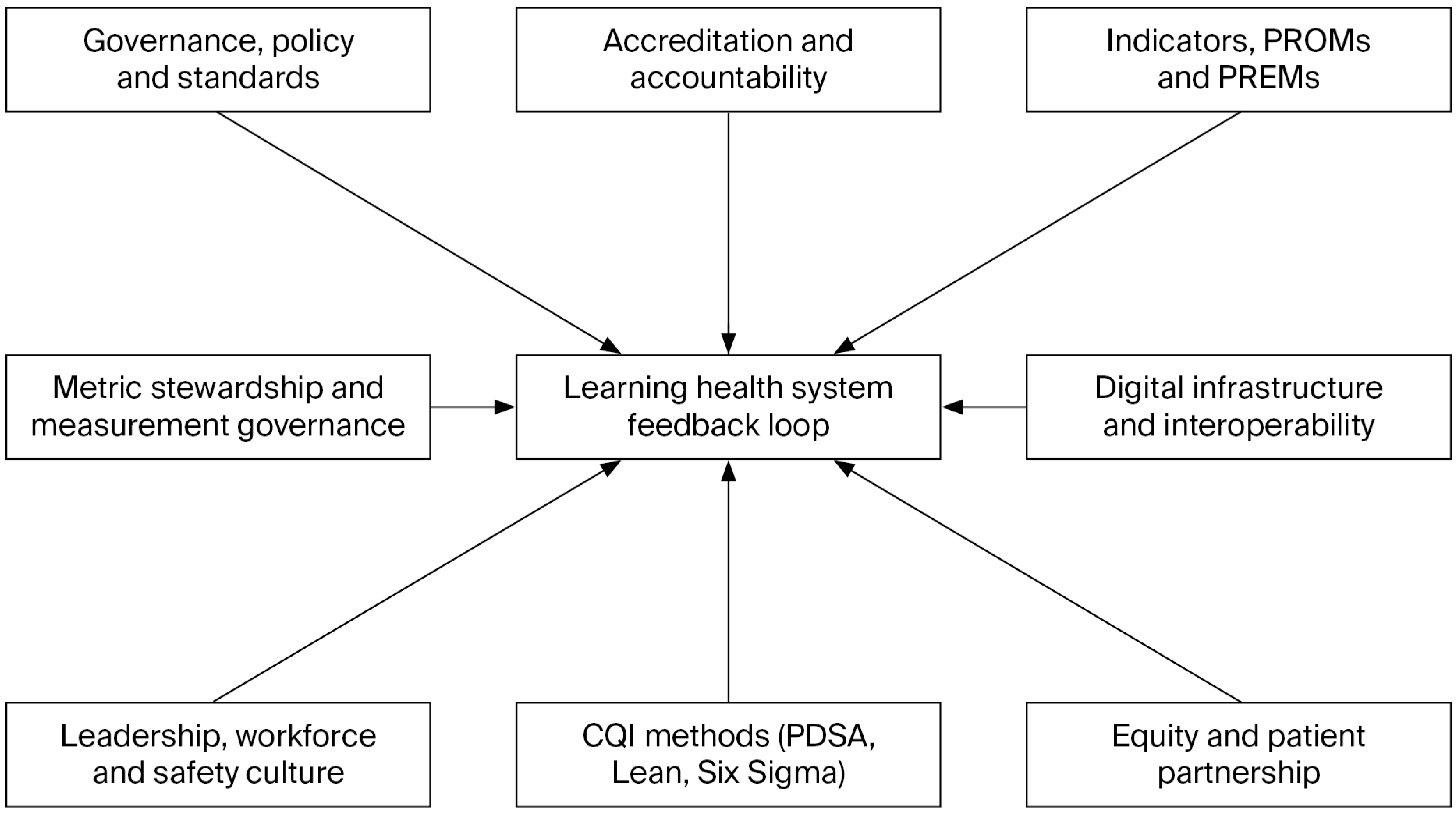
| Learning health system feedback loops | Routine data, evidence, patient input, implementation feedback | Connecting measurement to continuous learning | Integrates analytics, CQI, evidence and patient partnership | Requires leadership, governance, analytic capacity and sustained investment |
| Approach | Most Consistent Benefits Reported | What Remains Uncertain | Implementation Message |
|---|---|---|---|
| Accreditation/external standards | Better standardization, documentation, governance attention and some safety processes | Magnitude of effect on patient outcomes and cost-effectiveness | Use accreditation as a platform for learning, not as an end in itself |
| ISO/EFQM-based management systems | Improved process discipline, strategic alignment and selected performance indicators | Generalizability across settings, independent clinical effect | Most useful where organizations need stronger system-wide quality governance |
| Lean/CQI/Lean Six Sigma | Shorter waits, improved flow, less waste, stronger process reliability and some satisfaction gains | Durability of gains and risk of work intensification | Frontline ownership and local data are essential |
| PROM/PREM programmes | Better symptom monitoring, communication, shared decisions and patient-centered pathway improvement | Best large-scale implementation and benchmarking models | The closer the data are to care decisions, the greater the likely value |
| Safety culture interventions | Improved teamwork, communication, stress recognition and selected staff outcomes | Direct causal pathways to patient outcomes | Culture work should be paired with leadership development and process redesign |
| Learning health systems | Improved feedback loops, evidence uptake, data-informed redesign and spread of local learning | How to evaluate maturity, scalability and equity impact | Requires aligned governance, digital infrastructure, analytic capacity and improvement execution |
Disclaimer/Publisher’s Note: The statements, opinions and data contained in all publications are solely those of the individual author(s) and contributor(s) and not of MDPI and/or the editor(s). MDPI and/or the editor(s) disclaim responsibility for any injury to people or property resulting from any ideas, methods, instructions or products referred to in the content. |
© 2026 by the authors. Licensee MDPI, Basel, Switzerland. This article is an open access article distributed under the terms and conditions of the Creative Commons Attribution (CC BY) license.
Share and Cite
Ntais, C.; Talias, M.A. Healthcare Quality Systems: International Frameworks, Evaluation and Improvement Strategies. Healthcare 2026, 14, 1510. https://doi.org/10.3390/healthcare14111510
Ntais C, Talias MA. Healthcare Quality Systems: International Frameworks, Evaluation and Improvement Strategies. Healthcare. 2026; 14(11):1510. https://doi.org/10.3390/healthcare14111510
Chicago/Turabian StyleNtais, Christos, and Michael A. Talias. 2026. "Healthcare Quality Systems: International Frameworks, Evaluation and Improvement Strategies" Healthcare 14, no. 11: 1510. https://doi.org/10.3390/healthcare14111510
APA StyleNtais, C., & Talias, M. A. (2026). Healthcare Quality Systems: International Frameworks, Evaluation and Improvement Strategies. Healthcare, 14(11), 1510. https://doi.org/10.3390/healthcare14111510