2. Materials and Methods
2.1. Study Design and Setting
A cross-sectional study was conducted among schoolteachers in Jordan to assess knowledge, attitudes, and practices related to diabetes mellitus and the management of students with diabetes in school settings. The survey targeted teachers working in public and private schools across the northern, central, and southern regions of the country. Data were collected online between February and April 2026.
2.2. Participants and Sampling
Eligible participants were schoolteachers who were actively teaching during the study period and agreed to participate. Teachers who declined participation or submitted unusable questionnaires were excluded from the relevant analyses. Recruitment used a nonprobability convenience sampling approach, and the questionnaire was distributed electronically through school administrations, teacher communication channels, and professional networks. This strategy was intended to broaden coverage across major regions and school systems.
The minimum required sample size was estimated using the single-population proportion formula, assuming a 95% confidence level, a 5% margin of error, and an expected proportion of 50% in the absence of prior national estimates. This yielded a minimum target of 384 participants [
10]. A larger sample was sought to improve precision and reduce the impact of nonresponse.
2.3. Instrument Development
Data was collected using a structured, self-administered questionnaire developed after reviewing published instruments on teachers’ diabetes-related knowledge and school preparedness [
11,
12]. The final questionnaire was administered electronically through Google Forms.
Section 1 included 15 sociodemographic and professional items: age, sex, marital status, educational level, professional role, school type and sector, grade level taught, years of experience, region, availability of a school nurse, prior diabetes-related training, presence of students with diabetes in the classroom, respondents’ own diabetes status, family history of diabetes, and main sources of information.
Section 2 assessed diabetes-related knowledge using 14 statements focused primarily on T1DM.
Section 3 assessed attitudes toward students with diabetes using 10 Likert-type items.
Section 4 assessed school practices using 13 Likert-type items, divided into emergency readiness and routine school practices.
2.4. Scoring System
The knowledge score was calculated from the 14 knowledge items in the questionnaire, coded as 1 for a correct response and 0 for all other responses, yielding a possible score range of 0 to 14. The attitude score was calculated as the sum of 10 Likert-type items (range 10–50), emergency readiness as the sum of 7 items (range 7–35), and routine practices as the sum of 6 items (range 6–30). Higher scores indicated better knowledge, more favorable attitudes, greater emergency readiness, and more supportive routine practices. Negatively worded attitude items were reverse coded so that higher values consistently reflected more positive attitudes. Composite scores were prorated when at least 50% of items within the relevant scale had been completed, in line with the supplied analysis dataset.
2.5. Validity and Reliability
Content validity was assessed by specialists in endocrinology, who reviewed the questionnaire for clarity, relevance, and appropriateness. A pilot test was conducted with teachers who were not included in the final analysis, and minor wording revisions were made before full deployment. Internal consistency of the final scales ranged from acceptable to excellent. Ordinal Cronbach’s alpha was 0.878 for knowledge, 0.880 for attitudes, 0.924 for emergency readiness, and 0.841 for routine practices.
2.6. Statistical Analysis
All statistical analysis we conducted using R version 4.5.3. Descriptive statistics were used to summarize participants’ characteristics and study variables. Categorical variables were reported as frequencies and percentages, whereas continuous variables and composite scores were summarized using medians and interquartile ranges (IQRs). Percentages were calculated based on the number of available responses for each variable.
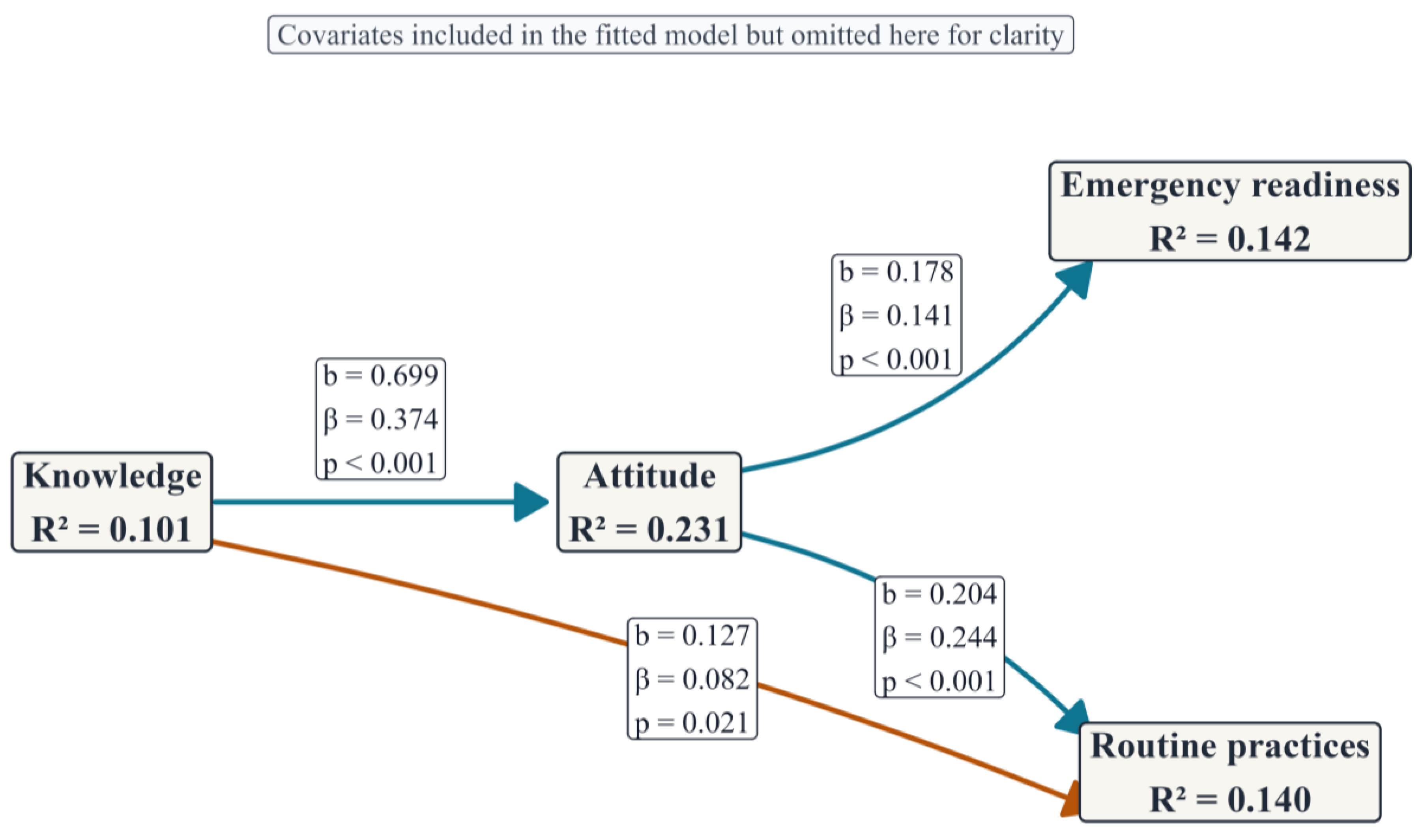
The path model was specified as a theory-informed extension of the knowledge-attitude-practice framework. In this framework, diabetes-related knowledge was treated as the most proximal informational domain because accurate understanding of type 1 diabetes is expected to shape teachers’ beliefs, perceived responsibility, and confidence in supporting affected students. Attitudes were then modeled as antecedents of emergency readiness and routine practices because these outcomes reflect teachers’ reported preparedness and school-support behaviours. Thus, the directional paths represent a prespecified conceptual ordering rather than evidence of temporal or causal effects. The hypothesized model, with the fitted core effects, is shown in
Figure 1.
The main multivariable analysis used path analysis in R with the lavaan package. Knowledge, attitudes, emergency readiness, and routine practices were treated as continuous observed variables. The structural model specified that knowledge was regressed on demographic and school-related covariates; attitudes were regressed on knowledge and the same covariates; emergency readiness was regressed on attitudes and covariates, with the direct path from knowledge to emergency readiness fixed to zero; and routine practices were regressed on both knowledge and attitudes, in addition to the covariates. The adjusted path model controlled for age, years of teaching experience, sex, marital status, educational level, professional title, school type, school sector, grade level taught, school nurse availability, prior diabetes-related training, presence of students with diabetes in the classroom, respondent diabetes status, and family history of diabetes.
Missing data were handled using full information maximum likelihood. Because FIML relies on the assumption that missingness is ignorable conditional on observed variables, the extent of missingness was summarized and the final model was refitted using complete cases as a sensitivity analysis. Robust standard errors for the main model were estimated using the MLR estimator, whereas indirect and total effects were quantified using nonparametric bootstrap confidence intervals under maximum likelihood. Multicollinearity was assessed using variance inflation factors, with a maximum VIF below 4, indicating no major collinearity concerns. Because age and years of experience reflect closely related aspects of professional seniority, sensitivity analyses were conducted using alternative model specifications that retained only age or only years of experience.
2.7. Ethical Considerations
The study was conducted in accordance with the Declaration of Helsinki. Ethical approval was obtained from the Institutional Review Board of Mutah University before data collection. Participation was voluntary, informed consent was obtained from all respondents, and the questionnaire was completed anonymously. No names or other direct personal identifiers were collected, and online self-administration was used to allow teachers to complete the questionnaire privately without direct interviewer or school-administrator presence [
13,
14,
15]. Data were stored securely and were accessible only to the research team.
4. Discussion
This study provides broader national evidence on schoolteachers’ diabetes-related knowledge, attitudes, emergency readiness, and routine school practices in Jordan. Overall, teachers showed generally positive attitudes toward supporting students with diabetes, and many demonstrated a reasonable level of basic knowledge, particularly regarding the chronic nature of type 1 diabetes, the importance of blood glucose monitoring, and common symptoms of hypoglycemia. However, these strengths were accompanied by substantial gaps in emergency preparedness and inconsistency in school-level support. The findings suggest that willingness to support students with diabetes is present, but that willingness is not yet matched by the confidence, training, and institutional systems needed for safe care during the school day. Therefore, the relatively high attitude scores, despite only 15.9% of teachers reporting prior diabetes-related training, should be interpreted as evidence of willingness and perceived professional responsibility rather than adequate preparedness. This interpretation is consistent with studies showing that favorable teacher attitudes can coexist with limited school preparedness, low perceived competence, or weaker practice indicators [
16,
17,
18]. In this sense, the low level of previous training does not contradict the attitude findings; rather, it suggests that diabetes training may be well received and could build on teachers’ existing willingness while improving practical knowledge, confidence, and emergency management skills [
9,
13,
19].
This distinction between willingness and preparedness was most apparent in the emergency readiness domain. Teachers in this study were broadly supportive of students with diabetes, strongly endorsed the need for training, and expressed support for school nurses and glucometers. However, confidence was notably lower for high-risk situations, particularly responding to an unconscious student or administering glucagon. This pattern is consistent with previous work showing that teachers are often sympathetic and willing to help but feel underprepared when practical or high-risk management tasks are involved. In Spain, San Laureano et al. [
16] found that teachers perceived their schools as inadequately prepared to manage diabetic emergencies and reported very limited specific training. Similarly, Wright et al. [
17] reported limited diabetes knowledge and low perceived self-competence among school personnel in Georgia public schools.
The present findings also align with recent studies from the Middle East. In Saudi Arabia, it was reported that schoolteachers generally held positive attitudes toward supporting students with diabetes, but practical knowledge and readiness were uneven [
11]. Likewise, Aljefree et al. [
18] found moderate knowledge, favorable attitudes, and poor practice scores among public-school teachers in Jeddah. That combination is similar to the pattern seen in the present study, where attitudes were comparatively positive but routine practices and emergency readiness were less robust. Overall, these studies suggest that positive intentions alone do not ensure effective school-based diabetes care.
The knowledge findings in the current study show a similar mix of strengths and gaps. Most respondents correctly recognized that type 1 diabetes is a chronic condition requiring ongoing management and understood the importance of blood glucose monitoring. However, many still incorrectly attributed type 1 diabetes to excessive sugar intake and lack of exercise, and only about half correctly recognized that insulin does not cause dependency. Comparable misconceptions have been reported elsewhere. Alshammari and Haridi [
20] in a study of public female elementary schools in northern Saudi Arabia, found that although teachers demonstrated a fair overall knowledge score, only 27.3% achieved a level considered good, and the authors concluded that teachers particularly needed stronger knowledge around recognizing and managing diabetic emergencies. Stefanowicz-Bielska et al. [
12] likewise concluded that teachers’ knowledge was insufficient to ensure a safe school experience for a child with type 1 diabetes.
These misconceptions may have practical consequences, as misunderstandings about type 1 diabetes could affect how teachers interpret students’ needs and how confident they feel in providing support. In this study, greater knowledge was associated with more favorable attitudes, which in turn were associated with better emergency readiness and routine practices. This pattern aligns with qualitative findings from Horvath et al. [
12] showed that teachers’ attitudes toward students with type 1 diabetes are closely tied to their knowledge, emotions, and beliefs about diabetes management, including misunderstandings about treatment. Together, these findings suggest that strengthening teachers’ understanding of type 1 diabetes may improve not only what they know, but also how prepared and confident they feel in supporting students at school.
The use of path analysis allowed this study to extend beyond descriptive findings and examine the interrelationships among knowledge, attitudes, emergency readiness, and routine practices. Greater knowledge was associated with more favorable attitudes, and more favorable attitudes were associated with both better emergency readiness and more supportive routine practices. In addition, knowledge had a significant total effect on routine practices, with part of that effect operating indirectly through attitudes. This suggests that knowledge may not influence school support only in a direct, technical sense. It may also help shape how teachers view their role, responsibility, and confidence in supporting students with diabetes. This interpretation is consistent with intervention studies showing that diabetes education can strengthen teachers’ factual knowledge alongside their self-efficacy and confidence in managing diabetes-related situations at school [
9,
13].
Training emerged as one of the most consistent correlates of better outcomes in this study. Teachers who had received prior diabetes-related training reported more favorable attitudes, greater emergency readiness, and better routine practices. This is highly consistent with the available evidence. In Jordan, Allefdawi et al. [
9] showed that a brief, structured educational intervention significantly improved teachers’ knowledge, attitudes, and self-efficacy for managing type 1 diabetes in school settings. In northern Saudi Arabia, Alshammari and Haridi [
20] found that prior training was a significant predictor of good teacher knowledge. These converging findings strengthen the case that training is not merely desirable but central to improving school preparedness. However, the modest variance explained for emergency readiness (R
2 = 0.142) and routine practices (R
2 = 0.140) indicates that teacher cognitions account for only part of these outcomes. Unmeasured organizational factors, such as written school health policies, nurse workload, availability of trained backup staff, administrative support, and access to diabetes supplies, are likely to play an important role alongside knowledge and attitudes.
The finding that school nurse availability was strongly associated with greater emergency readiness is also important. Although only a small proportion of respondents reported access to a school nurse, those who did had better readiness scores. This mirrors the conclusions of Stefanowicz-Bielska et al. [
12], who argued that the quality of care for children with type 1 diabetes in schools should be improved through stronger nurse support, ongoing teacher training, and detailed care plans adapted to school conditions. The current study therefore adds to a growing body of evidence suggesting that teacher goodwill cannot substitute for school health infrastructure.
The routine practice findings are similarly telling. Teachers generally endorsed allowing students to monitor blood glucose or eat snacks when needed, and communication with parents or school nurses was strongly supported. However, fewer respondents reported that their schools provided appropriate food options, adapted physical activity where necessary, or organized educational sessions about diabetes. This suggests that schools may be more comfortable accommodating isolated immediate needs than embedding diabetes support into everyday school routines. That pattern is again in line with prior studies showing that schools often lack formalized systems for managing diabetes despite general teacher willingness to help. Previous findings [
17,
21] point to this broader issue of incomplete institutional preparedness. At a system level, these findings indicate that teacher training should be accompanied by low-resource school protocols rather than depending only on the presence of a school nurse [
7,
8]. A feasible minimum package would include an individualized diabetes care plan for each student, a written hypoglycemia and emergency algorithm, identification of at least two trained staff members, accessible glucose sources and prescribed glucagon, arrangements for appropriate snacks or food choices, and clear procedures for glucose monitoring, physical activity, parent contact, and escalation to health services [
7,
8]. Developing these protocols with teachers, school leaders, parents, students, nurses or primary-care teams, and education and health authorities may improve feasibility and shared ownership [
7,
8].
Several covariate findings are also noteworthy, although they should be interpreted with caution. Teachers who reported having students with diabetes in their classroom had higher knowledge scores, which is in keeping with earlier work suggesting that direct exposure can improve familiarity and confidence. Alshammari and Haridi [
20] similarly found that having or having had a student with type 1 diabetes was associated with better knowledge. The association between family history or personal diabetes experience and more favorable attitudes or practices may reflect the influence of lived experience, which could increase empathy and practical understanding.
A few findings were less intuitive. Postgraduate education was associated with lower knowledge scores, and male sex was associated with higher emergency readiness. These results should be interpreted with care. The postgraduate education finding may reflect unmeasured differences in role, exposure, or subject specialization rather than any true disadvantage associated with higher education. The male sex finding is also not entirely consistent with prior literature. For example, Aljefree et al. [
18] found that female teachers were more knowledgeable in some areas, whereas male teachers were more willing to accommodate students with type 1 diabetes and attend support programs. This suggests that sex differences may be context-specific and should not be overinterpreted.
These findings have important implications for school-based diabetes support. While teachers generally expressed positive attitudes toward supporting students with diabetes, this was not accompanied by equally strong emergency readiness or consistently supportive routine practices. Only a minority had received prior diabetes-related training, few reported access to a school nurse, and confidence was notably weaker in relation to more serious situations such as unconsciousness and glucagon administration. These findings suggest that professional development should move beyond general awareness workshops and prioritize simulation-based first-aid training, including recognition of severe hypoglycemia, response to an unconscious student, supervised practice with glucagon devices, and rehearsal of school emergency protocols [
13]. Overall, this suggests that teacher willingness alone may not be enough to ensure safe and consistent support during the school day. Instead, the findings point to the importance of more structured preparation, including training that addresses both misconceptions about type 1 diabetes and practical emergency management, supported by clearer school protocols and stronger coordination with parents and school health personnel.
Strengths, Limitations, and Future Directions
A key strength of this study is its broader coverage across public and private schools and multiple regions of Jordan. The sample exceeded the minimum target, the scales showed acceptable to excellent internal consistency, and the analysis extended beyond description by examining how knowledge, attitudes, emergency readiness, and routine practices were interrelated. Another strength is that the study captured both emergency readiness and day-to-day school practices, offering a fuller account of school support than studies focused on knowledge alone. Nevertheless, generalizability to other low- and middle-income countries should be interpreted with caution because school health infrastructure, nurse availability, diabetes-care policies, teacher roles, family-school communication, and cultural expectations regarding chronic disease support may differ substantially across settings.
Furthermore, several limitations should also be noted. First, the cross-sectional design prevents causal interpretation. Although the path model is theoretically plausible and informative, the direction of the observed relationships cannot be established with certainty. Second, the study used convenience sampling and an online survey, which may have introduced selection bias. Teachers with a greater interest in health topics may have been more likely to participate. Therefore, the regional and public/private coverage should be interpreted as sample diversity rather than statistical representativeness. Third, all data were self-reported and may therefore have been influenced by recall bias or social desirability, particularly for items relating to supportive attitudes and school practices. Anonymous online completion was intended to reduce this risk by providing a more private response setting, but residual social desirability bias cannot be excluded [
13,
14,
15]. Fourth, no objective school audit or direct verification was conducted to validate reported emergency preparedness or routine school practices. Specifically, the study did not independently verify whether schools had glucometers, written diabetes protocols, trained staff, or other emergency supplies in place. In addition, the model did not include detailed organizational variables such as school health policy content, nurse workload, staff-to-student coverage, leadership support, or supply availability, which may explain additional variation in emergency readiness and routine practices. Fifth, the lower knowledge score observed among postgraduate participants should be interpreted cautiously. Although professional title was included in the adjusted model, the study did not collect detailed information on teaching subject, postgraduate specialization, administrative role complexity, or prior exposure to student health issues; residual confounding by these factors may partly explain the observed postgraduate education finding. Sixth, prior diabetes-related training was measured only as a yes/no variable; the survey did not capture training duration, recency, accreditation status, content, or whether hands-on emergency practice was included. Therefore, the present data cannot assess a dose–response relationship between training exposure and preparedness. Finally, although the instrument showed good reliability and content review, and underwent pilot testing, and internal consistency assessment, formal construct validation such as exploratory or confirmatory factor analysis was not conducted. The knowledge scale should therefore be interpreted as assessing diabetes-related school-care knowledge in the context of type 1 diabetes, rather than as a purely type 1 diabetes-specific biomedical construct, because some items intentionally covered broader management concepts that remain relevant to school support for children with type 1 diabetes. Future studies should further evaluate the factor structure and measurement properties of the instrument in independent samples.
Future research could extend the current findings by evaluating which types of training are most effective, sustainable, and scalable in school settings. Such studies should record the intensity, recency, accreditation status, and practical components of training so that dose–response effects can be examined and the evidence base for periodic continuing education can be strengthened. The recent Jordanian intervention study [
9] offers a useful starting point, but further work is needed in larger and more diverse school contexts. Mixed-methods studies could also explore how teachers, parents, students, and school leaders understand responsibility for diabetes care and where the main practical barriers lie. Observational and audit-based studies would be particularly useful for documenting existing support systems within schools, rather than relying entirely on staff reports.




 ,
,