The Impact of Augmented Reality-Based Aromatherapy Education on Symptoms in Older Adults with Early-Stage Dementia

 , , , and
Highlights
- Greater Reduction in BPSD and Caregiver Distress Compared with Routine Care: Participants receiving the 12-session AR-based aromatherapy education program showed significantly greater reductions in the frequency and severity of BPSD, as well as caregiver distress, than those receiving routine care.
- Improvements in Physical and Psychosocial Outcomes: Compared with routine care, the intervention was associated with significant improvements in pain, insomnia severity, subjective well-being, and life satisfaction.
- Potential of AR-Integrated Aromatherapy as a Non-Pharmacological Approach: The findings suggest that the AR-based aromatherapy education program may offer a promising non-pharmacological approach for supporting the care of older adults with early-stage dementia.
- Clinical Relevance of AR-Integrated Aromatherapy in Dementia Care: These findings suggest that AR-based aromatherapy education program may be clinically relevant as a technology-enhanced, non-pharmacological approach for reducing neuropsychiatric symptoms and improving well-being among older adults with early-stage dementia.
- Potential Relevance for Institutional Dementia Care: The intervention may have practical relevance for long-term care and related therapeutic settings, with the potential to reduce caregiver burden and support the delivery of dementia care.
Abstract
1. Introduction
2. Materials and Method
2.1. Study Design
2.2. Participants
2.3. Study Procedure
2.4. Intervention Program
2.5. Measures
2.5.1. Neuropsychiatric Inventory Questionnaire (NPI-Q)
2.5.2. Pain
2.5.3. Insomnia
2.5.4. Subjective Well-Being (WHO-5)
2.5.5. Life Satisfaction
2.6. Statistical Analysis
2.7. Ethical Considerations
3. Results
3.1. Participant Characteristics
3.2. Within-Group Comparison
3.3. Intervention Effects
4. Discussion
5. Conclusions
Supplementary Materials
Author Contributions
Funding
Institutional Review Board Statement
Informed Consent Statement
Data Availability Statement
Acknowledgments
Conflicts of Interest
References
- González, D.A.; Finley, J.-C.A.; Patel, S.E.S.; Soble, J.R. Practical assessment of neuropsychiatric symptoms: Updated reliability, validity, and cutoffs for the neuropsychiatric inventory questionnaire. Am. J. Geriatr. Psychiatry 2025, 33, 524–534. [Google Scholar] [CrossRef]
- Ministry of Health and Welfare. National Community-Based Dementia Epidemiological Survey. 2025. Available online: https://www.mohw.gov.tw/cp-16-78102-1.html (accessed on 22 March 2026).
- Konecny, J.; Lanza, G.; Buono, S.; Ferri, R.; Luca, A.; Martinek, R.; Musso, S.; Palmigiano, A.; Prauzkova, B.; Quercia, A.; et al. Immersive Technologies for Cognitive Rehabilitation in Dementia and Mild Cognitive Impairment: Systematic Review. J. Med. Internet Res. 2026, 28, e84349. [Google Scholar] [CrossRef]
- Zuschnegg, J.; Schoberer, D.; Häussl, A.; Herzog, S.A.; Russegger, S.; Ploder, K.; Fellner, M.; Hofmarcher-Holzhacker, M.M.; Roller-Wirnsberger, R.; Paletta, L.; et al. Effectiveness of computer-based interventions for community-dwelling people with cognitive decline: A systematic review with meta-analyses. BMC Geriatr. 2023, 23, 229. [Google Scholar] [CrossRef] [PubMed]
- Blackman, J.; Swirski, M.; Clynes, J.; Harding, S.; Leng, Y.; Coulthard, E. Pharmacological and non-pharmacological interventions to enhance sleep in mild cognitive impairment and mild Alzheimer’s disease: A systematic review. J. Sleep Res. 2021, 30, e13229. [Google Scholar] [CrossRef] [PubMed]
- Mascherona, I.; Ferretti, M.; Soldini, E.; Biggiogero, M.; Maggioli, C.; Fontana, P.E. Essential oil therapy for the short-term treatment of behavioral and psychological symptoms of dementia: A monocentric randomized pilot study. Aging Clin. Exp. Res. 2021, 33, 2251–2259. [Google Scholar] [CrossRef] [PubMed]
- Wang, P.-H.; Lin, H.-W.; Nguyen, T.T.T.; Hu, C.-J.; Huang, L.-K.; Tam, K.-W.; Kuan, Y.-C. Efficacy of Aromatherapy Against Behavioral and Psychological Disturbances in People With Dementia: A Meta-Analysis of Randomized Controlled Trials. J. Am. Med. Dir. Assoc. 2024, 25, 105199. [Google Scholar] [CrossRef]
- Thyrian, J.R.; Hertel, J.; Wucherer, D.; Eichler, T.; Michalowsky, B.; Dreier-Wolfgramm, A.; Zwingmann, I.; Kilimann, I.; Teipel, S.; Hoffmann, W. Effectiveness and Safety of Dementia Care Management in Primary Care: A Randomized Clinical Trial. JAMA Psychiatry 2017, 74, 996–1004. [Google Scholar] [CrossRef]
- Cohen, J. Statistical Power Analysis for the Behavioral Sciences, 2nd ed.; Routledge: New York, NY, USA, 1988. [Google Scholar] [CrossRef]
- Galvin, J.E.; Roe, C.M.; Powlishta, K.K.; Coats, M.A.; Muich, S.J.; Grant, E.; Miller, J.P.; Storandt, M.; Morris, J.C. The AD8: A brief informant interview to detect dementia. Neurology 2005, 65, 559–564. [Google Scholar] [CrossRef]
- Yang, C.-H.; Lin, Y.-T.; Hsieh, M.H.; Hwang, T.-J. A re-evaluation study and literature review on AD8 as a screening tool for dementia. PLoS ONE 2025, 20, e0321570. [Google Scholar] [CrossRef]
- Hopewell, S.; Chan, A.W.; Collins, G.S.; Hróbjartsson, A.; Moher, D.; Schulz, K.F.; Tunn, R.; Aggarwal, R.; Berkwits, M.; Berlin, J.A.; et al. CONSORT 2025 Statement: Updated guideline for reporting randomised trials. BMJ 2025, 388, e081123. [Google Scholar] [CrossRef]
- Abbey, J.; Piller, N.; De Bellis, A.; Esterman, A.; Parker, D.; Giles, L.; Lowcay, B. The Abbey Pain Scale: A 1-minute numerical indicator for people with end-stage dementia. Int. J. Palliat. Nurs. 2004, 10, 6–13. [Google Scholar] [CrossRef]
- Chiang, H.L.; Chen, H.C.; Bai, C.H.; Che, H.H.; Lee, M.B.; Lai, S.H.; Chou, P. A Validation Study of the Chinese Version of the Athens Insomnia Scale. Taiwan. J. Psychiatry 2009, 23, 43–52. [Google Scholar] [CrossRef]
- Musikanski, L.; Cloutier, S.; Bejarano, E.; Briggs, D.; Colbert, J.; Strasser, G.; Russell, S. Happiness index methodology. J. Sustain. Soc. Change 2017, 9, 2. [Google Scholar] [CrossRef]
- Pavot, W.; Diener, E. Review of the Satisfaction with Life Scale. In Assessing Well-Being: The Collected Works of Ed Diener; Springer: Dordrecht, The Netherlands, 2009; pp. 101–117. [Google Scholar] [CrossRef]
- Hayhurst, J. How Augmented Reality and Virtual Reality is Being Used to Support People Living with Dementia—Design Challenges and Future Directions. In Augmented Reality and Virtual Reality: Empowering Human, Place and Business; Jung, T., Dieck, M.C.T., Eds.; Springer International Publishing: Cham, Switzerland, 2018; pp. 295–305. [Google Scholar] [CrossRef]
- Kakoutopoulos, K.; Drakakis, E.; Papadopoulou, A.; Goumopoulos, C. Feasibility of Augmented Reality-Based Cognitive Training for Older Adults: The MarketMind AR Approach. Sensors 2025, 25, 2081. [Google Scholar] [CrossRef] [PubMed]
- Forrester, L.T.; Maayan, N.; Orrell, M.; Spector, A.E.; Buchan, L.D.; Soares-Weiser, K. Aromatherapy for dementia. Cochrane Database Syst. Rev. 2014. Issue 2. [Google Scholar] [CrossRef]
- Okuda, M.; Fujita, Y.; Takada-Takatori, Y.; Sugimoto, H.; Urakami, K. Aromatherapy improves cognitive dysfunction in senescence-accelerated mouse prone 8 by reducing the level of amyloid beta and tau phosphorylation. PLoS ONE 2020, 15, e0240378. [Google Scholar] [CrossRef]
- Ebihara, T.; Yamasaki, M.; Kozaki, K.; Ebihara, S. Medical aromatherapy in geriatric syndrome. Geriatr. Gerontol. Int. 2021, 21, 377–385. [Google Scholar] [CrossRef]
- Huang, Y.; Yuan, X. Smellscape as a healing factor in institutional gardens to enhance health and well-being for older people with dementia: A scoping review. J. Clin. Nurs. 2024, 33, 454–468. [Google Scholar] [CrossRef]
- Gillis, K.; van Diermen, L.; Lahaye, H.; De Witte, M.; De Wit, Y.; Roelant, E.; Lips, D.; Zhiri, A.; Hockley, J.; Van Bogaert, P. Effect of need-based care on behavioural and psychological symptoms in residents with dementia and formal caregivers’ distress in nursing homes: A three-arm cluster randomized controlled trial. Eur. Geriatr. Med. 2023, 14, 1083–1096. [Google Scholar] [CrossRef]
- Xiao, S.; Wang, Y.; Duan, S.; Li, B. Effects of aromatherapy on agitation and aggression in cognitive impairment: A meta-analysis. J. Clin. Nurs. 2025, 34, 4974–4988. [Google Scholar] [CrossRef]
- Kaymaz, T.T.; Ozdemir, L. Effects of aromatherapy on agitation and related caregiver burden in patients with moderate to severe dementia: A pilot study. Geriatr. Nurs. 2017, 38, 231–237. [Google Scholar] [CrossRef]
- Tampi, R.R.; Jeste, D.V. Dementia Is More Than Memory Loss: Neuropsychiatric Symptoms of Dementia and Their Nonpharmacological and Pharmacological Management. Am. J. Psychiatry 2022, 179, 528–543. [Google Scholar] [CrossRef]
- Meng, X.; Sun, J.; Du, Z.; Wang, W.; Sun, D.; Chen, Y.; Zhi, S.; Wang, S. Comparisons of nonpharmacological caregiver interventions for behavioural and psychological symptoms of dementia: A systematic review and network meta-analysis. Int. J. Nurs. Stud. 2025, 170, 105153. [Google Scholar] [CrossRef]
- Fan, C.-C.; Choy, C.-S.; Huang, C.-M.; Chih, P.-S.; Lee, C.-C.; Lin, F.-H.; Guo, J.-L. The effects of a combination of 3D virtual reality and hands-on horticultural activities on mastery, achievement motives, self-esteem, isolation and depression: A quasi-experimental study. BMC Geriatr. 2022, 22, 744. [Google Scholar] [CrossRef]



| Session | NPI-Q Symptom | Aromatherapy Activity | Learning Objectives |
|---|---|---|---|
| 1 | Delusion | Aroma necklace crafting |
|
| 2 | Hallucination | Aroma Massage oil blending |
|
| 3 | Agitation or aggression | Aroma lotion crafting |
|
| 4 | Depression or dysphoria | Eco-printing |
|
| 5 | Anxiety | Aroma ointment crafting |
|
| 6 | Elation or euphoria | Aroma Sachet crafting |
|
| 7 | Apathy or indifference | Creative floral art |
|
| 8 | Disinhibition | Herb picking/Tea bagging |
|
| 9 | Irritability or lability | Aroma nasal inhaler crafting |
|
| 10 | Motor disturbance | Aroma bath salt crafting |
|
| 11 | Nighttime behaviors | Lavender eye pillow making |
|
| 12 | Appetite and eating | Aroma diffuser spray crafting |
|
| Variables | Comparison Group (n = 80, 50%) | Experimental Group (n = 80, 50%) | χ2/t | p Value | ||
|---|---|---|---|---|---|---|
| Age (years) | 2.713 | 0.258 | ||||
| 65–74 | 19 | 23.8 | 16 | 20.0 | ||
| 75–84 | 37 | 46.3 | 30 | 37.5 | ||
| 85+ | 24 | 30.0 | 34 | 42.5 | ||
| Gender, n (%) | 5.942 | 0.015 | ||||
| Male | 25 | 31.3 | 12 | 15.0 | ||
| Female | 55 | 68.7 | 68 | 85.0 | ||
| Marital status, n (%) | 7.553 | 0.056 | ||||
| Unmarried | 3 | 3.8 | 1 | 1.3 | ||
| Married | 27 | 33.8 | 23 | 28.7 | ||
| Divorced or separated | 9 | 11.2 | 2 | 2.5 | ||
| Widowed | 41 | 51.2 | 54 | 67.5 | ||
| Educational level, n (%) | 1.863 | 0.761 | ||||
| Elementary school | 46 | 57.5 | 41 | 51.2 | ||
| Middle school | 16 | 20.0 | 19 | 23.8 | ||
| High school | 13 | 16.3 | 11 | 13.8 | ||
| University and above | 5 | 6.3 | 9 | 11.2 | ||
| Occupation, n (%) | 0.340 | 0.560 | ||||
| Yes | 2 | 2.5 | 1 | 1.2 | ||
| No | 78 | 97.5 | 79 | 98.8 | ||
| Self-rated health status, n (%) | 1.983 | 0.576 | ||||
| Very poor | 7 | 8.7 | 8 | 10.0 | ||
| Poor | 47 | 58.8 | 50 | 62.5 | ||
| Good | 22 | 27.5 | 21 | 26.3 | ||
| Very good | 4 | 5.0 | 1 | 1.3 | ||
| Sought medical consultation for dementia symptoms, n (%) | 0.400 | 0.527 | ||||
| Yes | 37 | 46.2 | 41 | 51.2 | ||
| No | 43 | 53.8 | 39 | 48.8 | ||
| Undergone a cognitive function assessment, n (%) | 0.101 | 0.751 | ||||
| Yes | 43 | 53.8 | 45 | 56.2 | ||
| No | 37 | 46.2 | 35 | 43.8 | ||
| Comparison Group | Experimental Group | |||||||||||
|---|---|---|---|---|---|---|---|---|---|---|---|---|
| T1 | T2 | T1 | T2 | |||||||||
| Variables | Mean | SD | Mean | SD | t | p | Mean | SD | Mean | SD | t | p |
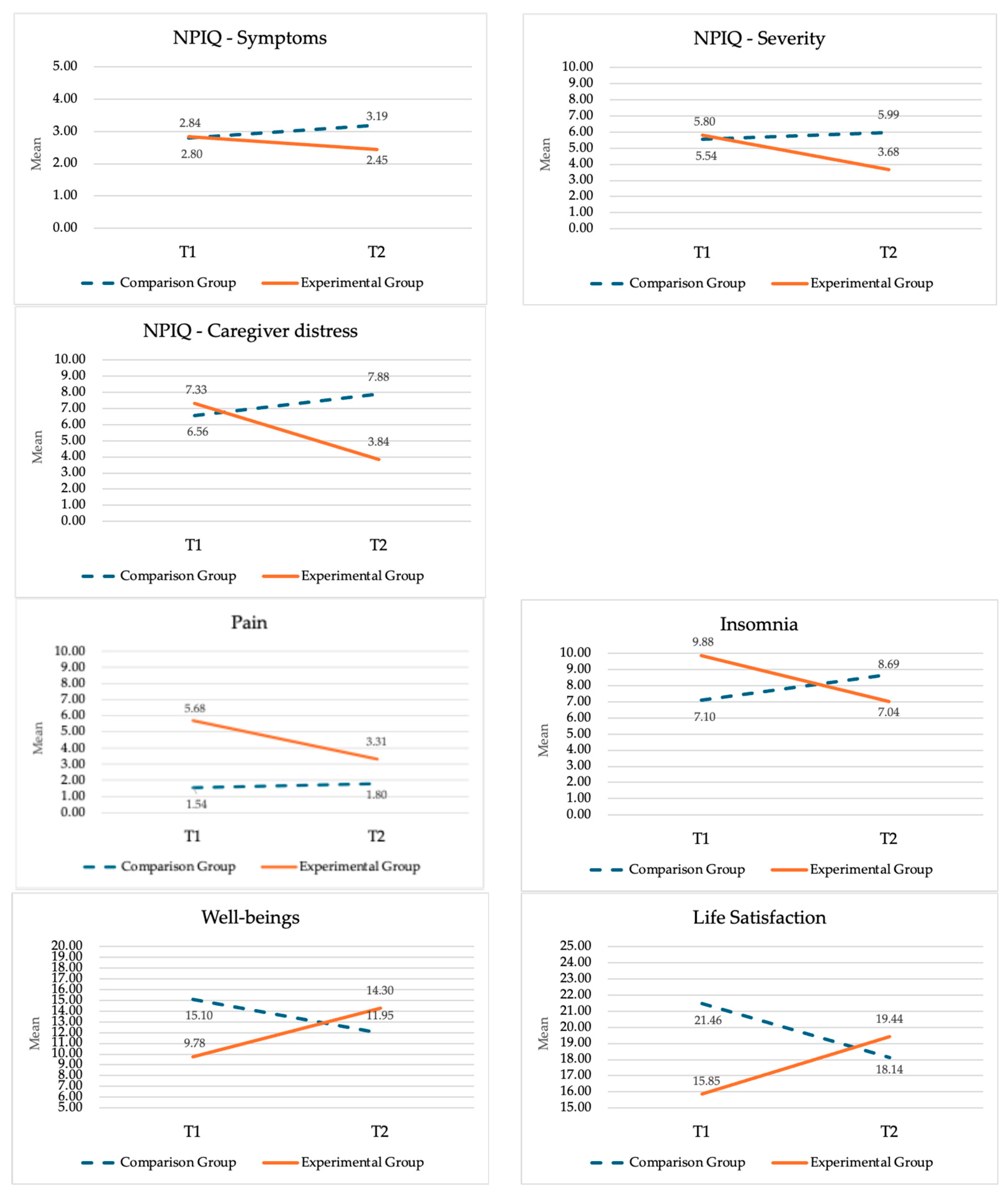
| NPIQ—Symptoms | 2.80 | 2.29 | 3.19 | 2.42 | 2.11 | 0.038 | 2.84 | 1.67 | 2.45 | 1.36 | 3.47 | <0.001 |
| NPIQ—Severity | 5.54 | 4.51 | 5.99 | 4.48 | −1.61 | 0.111 | 5.80 | 3.83 | 3.68 | 3.11 | 8.50 | <0.001 |
| NPIQ—Caregiver distress | 6.56 | 6.05 | 7.88 | 6.90 | 3.71 | <0.001 | 7.33 | 5.86 | 3.84 | 4.70 | 10.17 | <0.001 |
| Pain | 1.54 | 2.21 | 1.80 | 2.30 | −1.31 | 0.194 | 5.68 | 5.24 | 3.31 | 3.40 | 5.71 | <0.001 |
| Insomnia | 7.10 | 5.48 | 8.69 | 5.31 | 3.90 | <0.001 | 9.88 | 4.68 | 7.04 | 4.18 | 7.85 | <0.001 |
| Well-beings | 15.10 | 6.59 | 11.95 | 6.14 | 5.39 | <0.001 | 9.78 | 6.40 | 14.30 | 5.18 | 9.29 | <0.001 |
| Life Satisfaction | 21.46 | 8.02 | 18.14 | 7.68 | 5.20 | <0.001 | 15.85 | 6.35 | 19.44 | 5.21 | 7.74 | <0.001 |
| Comparison Group | Experimental Group | |
|---|---|---|
| Variables | d (95% CI) | d (95% CI) |
| NPIQ—Symptoms | 0.24 (0.01–0.46) * | 0.39 (0.16–0.61) *** |
| NPIQ—Severity | −0.18 (−0.40–0.04) | 0.95 (0.68–1.21) *** |
| NPIQ—Caregiver distress | 0.42 (0.19–0.64) *** | 1.14 (0.85–1.42) *** |
| Pain | −0.15 (−0.37–0.07) | 0.64 (0.40–0.88) *** |
| Insomnia | 0.44 (0.21–0.66) *** | 0.88 (0.62–1.13) *** |
| Well-beings | 0.60 (0.36–0.84) *** | 1.04 (0.76–1.31) *** |
| Life Satisfaction | 0.58 (0.34–0.82) *** | 0.87 (0.61–1.12) *** |
| Variable | Coefficient (β) | SE | p-Value |
|---|---|---|---|
| NPIQ—Symptoms (0–12 points) | |||
| Intercept | 2.445 | 0.1362 | <0.001 |
| Gender | 0.034 | 0.4557 | 0.941 |
| Time (T2) b | 0.388 | 0.1111 | <0.001 |
| Group (Experimental group) c | 0.732 | 0.3313 | 0.027 |
| Time (T2) Group (Experimental group) d | −0.775 | 0.2136 | <0.001 |
| NPIQ—Severity (0–36 points) | |||
| Intercept | 3.658 | 0.2873 | <0.001 |
| Gender | 0.113 | 0.9243 | 0.903 |
| Time (T2) b | 2.125 | 0.2484 | <0.001 |
| Group (Experimental group) c | 2.294 | 0.6908 | <0.001 |
| Time (T2) Group (Experimental group) d | −2.575 | 0.3726 | <0.001 |
| NPIQ—Caregiver distress (0–60 points) | |||
| Intercept | 3.854 | 0.4149 | <0.001 |
| Gender | −0.107 | 1.4195 | 0.940 |
| Time (T2) b | 3.488 | 0.3410 | <0.001 |
| Group (Experimental group) c | 4.055 | 1.0818 | <0.001 |
| Time (T2) Group (Experimental group) d | −4.800 | 0.4898 | <0.001 |
| Pain (0–18 points) | |||
| Intercept | 3.412 | 0.3772 | <0.001 |
| Gender | −0.662 | 0.5475 | 0.226 |
| Time (T2) b | 2.363 | 0.4113 | <0.001 |
| Group (Experimental group) c | −1.405 | 0.4853 | 0.004 |
| Time (T2) Group (Experimental group) d | −2.625 | 0.4569 | <0.001 |
| Insomnia (0–24 points) | |||
| Intercept | 7.187 | 0.4794 | <0.001 |
| Gender | −0.997 | 0.8798 | 0.257 |
| Time (T2) b | 2.838 | 0.3590 | <0.001 |
| Group (Experimental group) c | 1.812 | 0.7693 | 0.019 |
| Time (T2) Group (Experimental group) d | −4.425 | 0.5412 | <0.001 |
| Well-beings (0–25 points) | |||
| Intercept | 14.032 | 0.6002 | <0.001 |
| Gender | 1.786 | 1.0373 | 0.085 |
| Time (T2) b | −4.525 | 0.4841 | <0.001 |
| Group (Experimental group) c | −2.640 | 0.9220 | 0.004 |
| Time (T2) Group (Experimental group) d | 7.675 | 0.7564 | <0.001 |
| Life Satisfaction (5–35 points) | |||
| Intercept | 19.258 | 0.6154 | <.001 |
| Gender | 1.197 | 1.0815 | 0.269 |
| Time (T2) b | −3.587 | 0.4609 | <0.001 |
| Group (Experimental group) c | −1.494 | 1.0800 | 0.166 |
| Time (T2) Group (Experimental group) d | 6.913 | 0.7845 | <0.001 |
Disclaimer/Publisher’s Note: The statements, opinions and data contained in all publications are solely those of the individual author(s) and contributor(s) and not of MDPI and/or the editor(s). MDPI and/or the editor(s) disclaim responsibility for any injury to people or property resulting from any ideas, methods, instructions or products referred to in the content. |
© 2026 by the authors. Licensee MDPI, Basel, Switzerland. This article is an open access article distributed under the terms and conditions of the Creative Commons Attribution (CC BY) license.
Share and Cite
Cheng, V.Y.-W.; Tu, C.-L.; Chien, H.-C.; Hsu, H.-C.; Hong, S.-M.; Huang, C.-M.; Guo, J.-L. The Impact of Augmented Reality-Based Aromatherapy Education on Symptoms in Older Adults with Early-Stage Dementia. Healthcare 2026, 14, 1482. https://doi.org/10.3390/healthcare14111482
Cheng VY-W, Tu C-L, Chien H-C, Hsu H-C, Hong S-M, Huang C-M, Guo J-L. The Impact of Augmented Reality-Based Aromatherapy Education on Symptoms in Older Adults with Early-Stage Dementia. Healthcare. 2026; 14(11):1482. https://doi.org/10.3390/healthcare14111482
Chicago/Turabian StyleCheng, Vivian Ya-Wen, Chia-Ling Tu, Hsiu-Chun Chien, Hui-Chen Hsu, Shu-Mei Hong, Chiu-Mieh Huang, and Jong-Long Guo. 2026. "The Impact of Augmented Reality-Based Aromatherapy Education on Symptoms in Older Adults with Early-Stage Dementia" Healthcare 14, no. 11: 1482. https://doi.org/10.3390/healthcare14111482
APA StyleCheng, V. Y.-W., Tu, C.-L., Chien, H.-C., Hsu, H.-C., Hong, S.-M., Huang, C.-M., & Guo, J.-L. (2026). The Impact of Augmented Reality-Based Aromatherapy Education on Symptoms in Older Adults with Early-Stage Dementia. Healthcare, 14(11), 1482. https://doi.org/10.3390/healthcare14111482