Article

Edge-Hosted LLM-Assisted NICU Discharge Summary Generation: Field-Level Evaluation Using a Clinician-Defined Rubric


1
AcSIR at CSIR—Institute of Genomics and Integrative Biology (CSIR-IGIB), Council of Scientific & Industrial Research New Delhi, New Delhi 110001, India
2
QSec (EquipSecond) Medical LLC., Sun Prairie, WI 53590, USA
3
Department of Computer Science, University of Wisconsin, Whitewater, WI 53590, USA
4
Department of Neonatology, Sir Ganga Ram Hospital, New Delhi 110060, India
5
Department of Pediatrics, College of Medicine, Ewha Womans University, Seoul 07985, Republic of Korea
6
Division of Neonatology, University of California San Francisco, San Francisco, CA 94158, USA
7
Department of Pediatrics, University of Wisconsin School of Medicine and Public Health, Madison, WI 53792, USA
*
Author to whom correspondence should be addressed.
Healthcare 2026, 14(11), 1457; https://doi.org/10.3390/healthcare14111457
Submission received: 4 April 2026 / Revised: 15 May 2026 / Accepted: 19 May 2026 / Published: 25 May 2026

Abstract

Objective: To develop and evaluate an edge-hosted Large Language Model (LLM)-assisted system for automated Neonatal Intensive Care Unit (NICU) discharge summary generation using an evidence-grounded, field-level evaluation framework. Methods: This implementation and evaluation study was conducted in a Level III NICU in India. Longitudinal patient records were constructed from integrated bedside physiologic data (ARCHITECT) and a structured electronic medical record (EMR) platform Although an embedded audio–video module was present, it was not used in this study. Automated discharge summaries were generated by MORPHEUS, an edge-hosted orchestration pipeline running on NVIDIA Jetson AGX Orin hardware with JetPack 6.2. Local orchestration, preprocessing, and workflow execution were performed on the edge device, while language generation inference was performed using the OpenAI gpt-4o-mini API. Documentation quality was assessed with an LLM-based evaluator guided by a clinician-defined rubric comprising 72 fields organized across 14 section contexts and scored on five dimensions: clinical accuracy, completeness, actionability, coherence, and non-hallucination. Paired, field-level comparisons were performed against clinician-authored summaries. Of 549 NICU admissions screened between 1 October 2024 and 3 November 2025, 401 met the inclusion criteria for evaluation. Prompt refinement was performed iteratively using omission-derived feedback without model weight updates. Results: Across 401 evaluated admissions, MORPHEUS-generated summaries demonstrated higher rubric-based scores and lower omission burden than clinician-authored summaries within the structured evaluation framework used in this study, with mean scores of 0.93 versus 0.75 for accuracy, 0.91 versus 0.67 for completeness, 0.93 versus 0.72 for actionability, 0.94 versus 0.74 for coherence, and 0.95 versus 0.78 for non-hallucination, with the largest absolute advantage observed for completeness. Error taxonomy analysis demonstrated fewer omissions, unsupported assertions, and contradictions in AI-generated summaries than in clinician-authored summaries. Iterative prompt refinement was associated with directional improvement across quality dimensions and reduced omission burden, with omission rate per patient decreasing from 2.484 to 1.807 in the later iteration. Conclusions: An edge-hosted LLM-assisted pipeline can generate NICU discharge summaries that meet or exceed clinician-authored documentation quality under a reproducible, clinician-grounded evaluation framework. These findings support the feasibility of deploying edge-orchestrated generative AI systems for high-stakes neonatal clinical documentation using a clinician-grounded field-level evaluation framework.

1. Introduction

Neonatal Intensive Care Units (NICUs) require extensive clinical documentation, including admission assessments, daily progress notes, procedural reports, investigations, and discharge summaries. Although EMRs have improved data capture, NICU documentation remains labor-intensive and variable in structure, often containing redundant information and inconsistent formatting that can hinder interpretability and continuity of care [1,2,3,4]. Time spent on clinical documentation can reduce clinician availability for direct patient care. Incomplete discharge summaries may lead to missed follow-up of critical issues and potential patient harm [5,6,7]. These challenges are amplified in neonatal care, where physiologic status can change rapidly, preterm infants often require prolonged hospitalization, and discharge summaries must synthesize complex longitudinal information across organ systems and therapies [8,9].
Daily EMR documentation captures key aspects of the neonatal hospitalization, including comorbidities, vital signs, laboratory results, medications, procedures, and screening evaluations. These records serve multiple purposes within the healthcare system, including clinical communication, billing and reimbursement, medico-legal documentation, and quality improvement initiatives [10]. Over the course of a NICU stay, which may extend for weeks or months in preterm infants, this longitudinal documentation forms the basis for the discharge summary.
The NICU discharge summary synthesizes the clinical course of the infant and communicates essential information to multiple stakeholders [11]. It must accurately describe diagnoses and interventions for clinicians, provide clear follow-up plans for outpatient providers, and convey understandable information to parents responsible for ongoing care at home. Discharge documentation also supports the administrative and billing processes required to close the hospitalization episode. Balancing these clinical, communicative, and administrative functions makes NICU discharge summaries complex and time-intensive to generate.
Large language models (LLMs) have demonstrated the ability to synthesize clinical text into coherent summaries [12]. Broader work in LLMs extends this capability by integrating heterogeneous clinical inputs, including structured data, temporal physiologic trends, and clinical documentation, into prompt-guided summaries [13]. However, NICU documentation presents a distinct problem. Neonatal records are highly templated yet inconsistently completed, often contain repeated phrases across time, and may embed key clinical events within lengthy nursing notes, vital sign logs, and diagnostic reports [14]. These characteristics increase the risk of omission, temporal inconsistency, and unverifiable statements when summaries are generated without explicit grounding in the source medical record. Recent work in LLM-assisted clinical documentation spans both discharge summary generation and adjacent tasks, and these should be distinguished clearly. In discharge-focused work, retrospective hospital studies and shared-task systems have evaluated prompted, fine-tuned, or hybrid extractive–abstractive pipelines that generate full discharge notes or selected discharge sections from longitudinal EHR data, primarily in adult inpatient and ICU settings [15,16,17,18,19]. Related studies in pediatric and NICU settings have more often addressed adjacent tasks, such as pediatric discharge summary comparison, coding support, or plain-language simplification, rather than NICU-specific discharge summary generation itself [20,21]. Overall, prior work suggests promise for LLM-assisted discharge documentation, but it has been concentrated largely in adult settings and has not adequately addressed the need for longitudinally grounded, section-structured NICU discharge generation with clinically interpretable error analysis [15,16,17,20,21]. A comparative synthesis of prior studies, including task type, clinical setting, model design, approach, and the remaining gap motivating the present work, is provided in Table 1.
To address these gaps, NICU discharge generation requires more than a general-purpose summarization approach. Effective systems should be tailored to the structure and constraints of NICU documentation and designed to support safe use. This includes adherence to standardized section formats, preservation of the admission-to-discharge timeline, and inclusion of only information supported by the source EMR to reduce omissions, contradictions, and hallucinations [18]. Because NICU documentation is heterogeneous and frequently incomplete, performance improvements require clinically interpretable error signals rather than ad hoc prompt adjustments. Iterative, feedback-driven refinement at the prompt and section level can be used to systematically target high-impact failure modes, such as missing diagnoses, incomplete medication courses, feeding progression, or procedural timelines, while limiting inconsistencies across sections. Such a framework enables transparent and reproducible improvement in documentation quality without requiring model weight updates and can support future local deployment in real-world NICU environments.
In this study, we developed and evaluated MORPHEUS 1.0, an edge-hosted orchestration pipeline for automated NICU discharge summary generation using longitudinal EMR-derived clinical data. The present work makes several distinct contributions relative to prior LLM-assisted clinical documentation studies. First, we developed a NICU-specific staged discharge summary generation pipeline incorporating section-specific extraction, targeted contextual refinement, and deterministic template assembly designed for fragmented longitudinal neonatal records. Second, we implemented and evaluated a clinician-defined field-level rubric comprising 72 discrete clinical fields across five orthogonal quality dimensions to enable structured and auditable comparison between AI-generated and clinician-authored summaries. Third, we demonstrated the feasibility of Protected Health Information (PHI)-controlled edge-hosted orchestration on NVIDIA Jetson AGX Orin Developer Kit (NVIDIA Corporation, Santa Clara, CA, USA) within a real Level III NICU workflow while separating local orchestration from cloud-based language inference. Fourth, we evaluated iterative omission-driven prompt refinement without model fine-tuning as a mechanism for improving documentation completeness and reducing clinically relevant omission burden. Together, these contributions establish a reproducible framework for evaluating and deploying LLM-assisted neonatal clinical documentation systems in resource-constrained hospital environments.

2. Materials and Methods

2.1. Study Design and Setting

This implementation and evaluation study was conducted in a Level III NICU in India. Among 549 neonatal admissions identified between 1 October 2024 and 3 November 2025, we included only those with a NICU stay of at least 24 h and complete documentation of birth weight, vital signs, nutrition, medications, and discharge summaries. After excluding short stays (<24 h) and admissions with missing key data elements, 401 admissions were retained for the final evaluation cohort.

2.2. Clinical Informatics Infrastructure

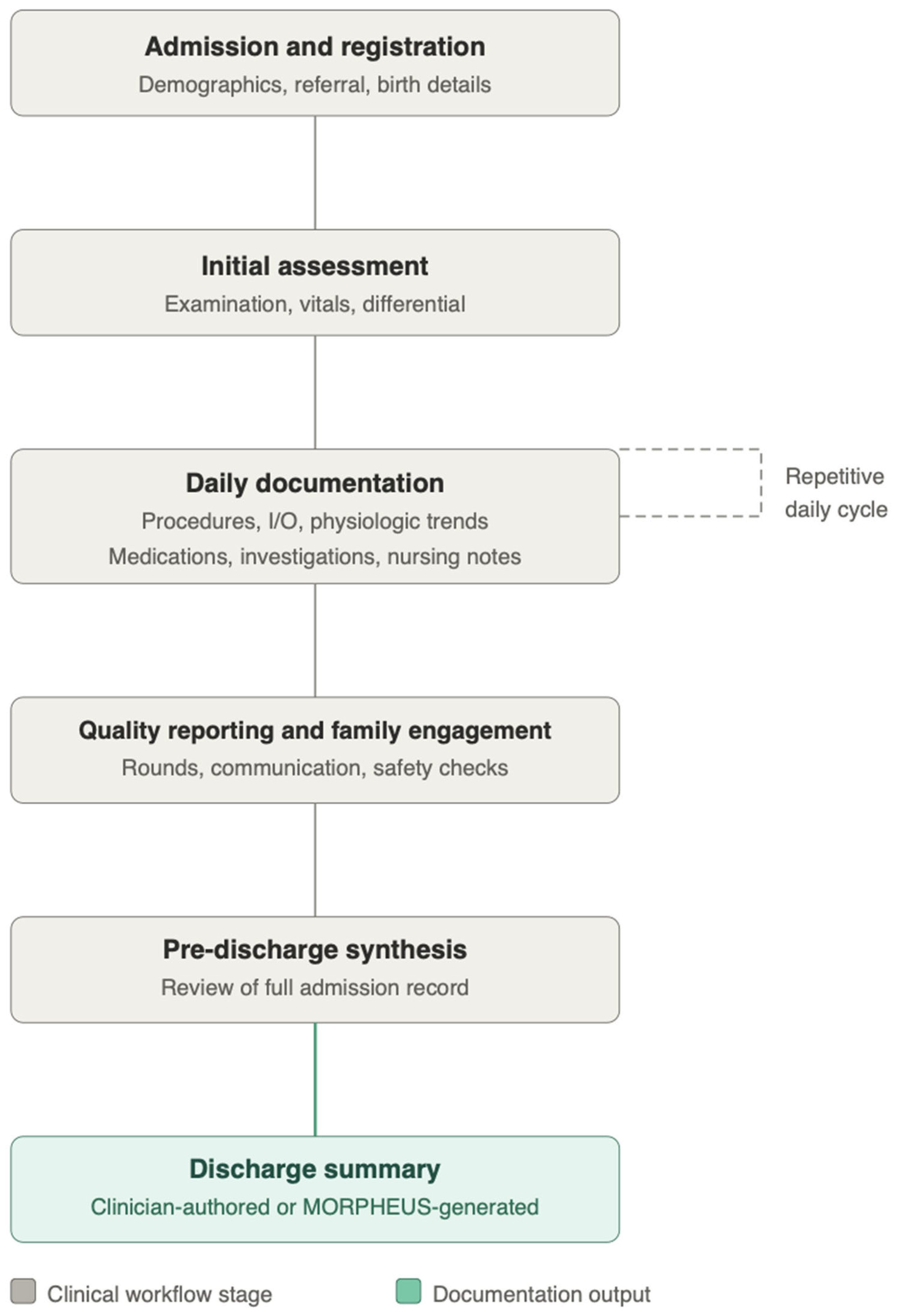
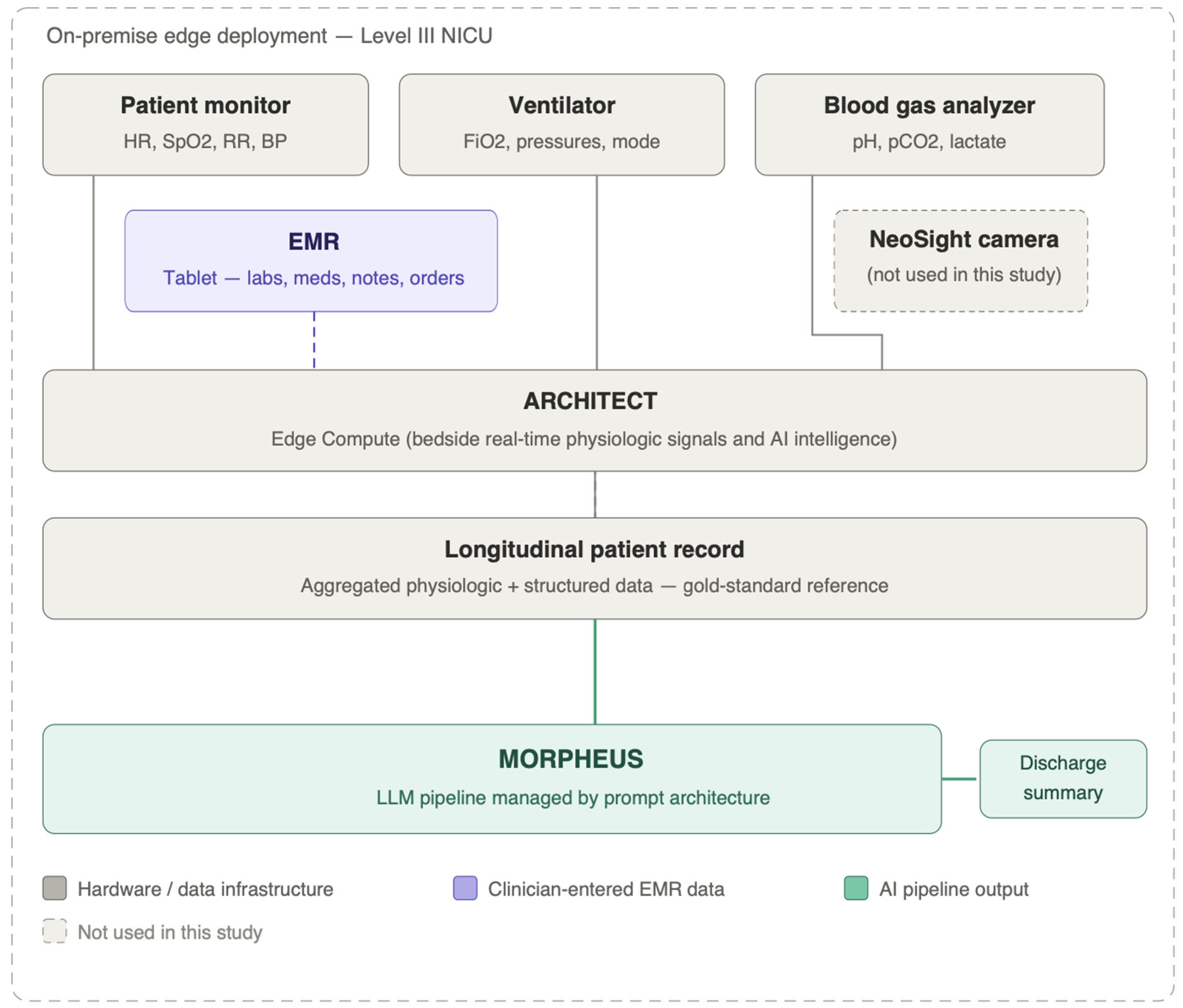
Clinical data were captured through two integrated platform components. ARCHITECT, a bedside data acquisition system, interfaced with bedside cameras and NICU medical devices (including patient monitors, ventilators, and blood gas analyzers) to stream real-time physiologic data (Figure 1). An embedded audio–video module (NEO) [22] was present but not used in this study. Structured clinical data were entered by physicians and nurses at the bedside through the EMR platform [23], a tablet-based web EMR that integrates laboratory results, medication and nutrition orders, procedural records, and longitudinal clinical assessments (Figure 2). Longitudinal patient records were constructed by aggregating ARCHITECT physiologic data and EMR structured entries across the full NICU admission. The complete longitudinal patient record (Figure 3), comprising physiologic streams, structured EMR entries, laboratory results, medication logs, nursing documentation, and daily progress notes, served as the reference standard for downstream evaluation [24,25]. For the present analysis, only textual and structured clinical data were used for discharge summary generation. Audio, video, and imaging streams available through the platform were not included in the generation pipeline.

2.3. Automated Discharge Summary Generation: MORPHEUS

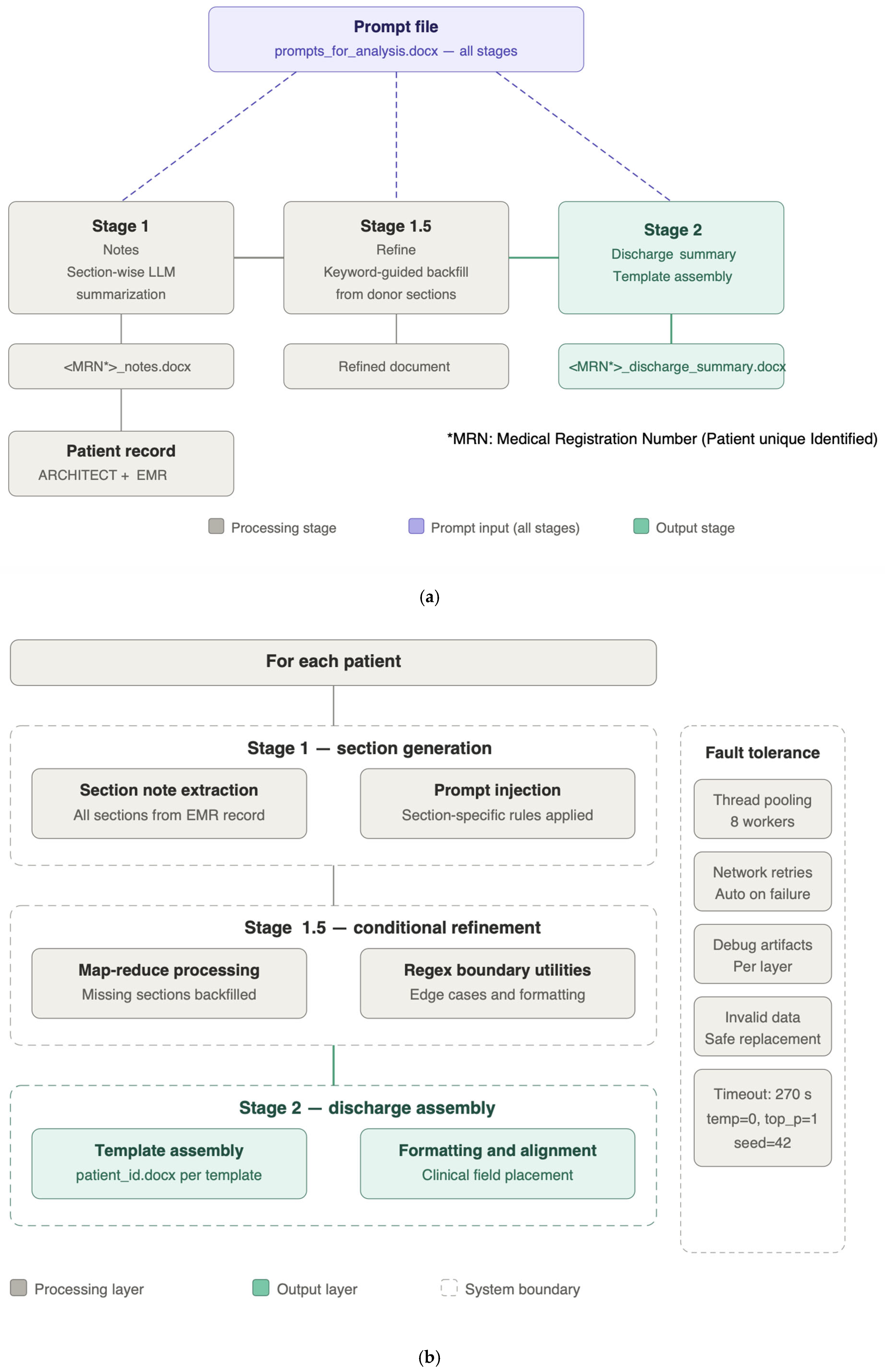
Clinician-authored discharge summaries were completed at the end of admission by the attending team using EMR data. Automated summaries were generated by MORPHEUS (source code provided). MORPHEUS was deployed on an ARCHITECT device built on the NVIDIA Jetson AGX Orin 64 GB Developer Kit [26] with a 1 TB NVMe SSD (Western Digital Corporation, San Jose, California, USA) [27] running JetPack 6.2 [28]. The system used OpenAI’s gpt-4o-mini model [29] with fixed decoding parameters (temperature = 0, top_p = 1, seed = 42, and timeout = 270 s). The edge-hosted ARCHITECT orchestrated a three-stage discharge summary pipeline over the longitudinal patient record (Figure 4a). The discharge summary pipeline was governed by clinician-defined prompts. To minimize variability introduced by changing local model behavior during pipeline development, the study used a fixed OpenAI model configuration for generation and evaluation.
In the current implementation, all patient-data ingestion, preprocessing, section extraction, orchestration logic, prompt assembly, retry handling, rubric processing, and workflow execution occurred locally within the hospital network on the Jetson AGX Orin device. Only the language generation inference step was executed through the OpenAI API. No raw database access or orchestration logic was performed outside the local deployment environment.
Stage 1—Section generation. The discharge summary was decomposed into predefined clinical sections spanning demographic information, antenatal and birth history, admission status, daily clinical course, organ-system complications, medications, procedures, investigations, final diagnosis, and discharge planning. Each section was generated independently by LLM [30,31] using structured, section-specific prompts. The prompts enforced (a) temporal normalization (dates expressed as day of life [DOL]), (b) exemplar outputs designed to discourage unsupported generation, and (c) restriction of output to information present in the source record. To limit token load, API latency, and inference cost for high-variance sections, source text was capped at 8000 characters using tail-only truncation, which preferentially retained the most recent clinical documentation. Demographics, feeding/nutrition, and medications were exempt from truncation because of their direct discharge relevance. Truncation primarily affected long-stay infants with highly detailed longitudinal records. Stage 1 used a fault-tolerant, 8-worker thread pool (Figure 4b), with each worker processing a distinct section in parallel.
Stage 1.5—Conditional refinement. Sections flagged as absent or sentinel in Stage 1 underwent targeted LLM-based backfill using a constrained donor bundle drawn from clinically related sections of the same admission. For example, a missing apnea section would draw supporting content from nursing notes, daily progress notes, and medication logs documenting caffeine use or apnea monitoring. Keyword-guided extraction recovered documented events (e.g., apnea episodes, sepsis workup, phototherapy) while prohibiting fabrication of numeric values, dates, device identifiers, or medication doses. Sections with existing content were preserved without modification.
Stage 2—Discharge summary assembly. Refined section outputs were merged into a standardized template as shown in Supplementary File S1. Key identifiers, anthropometry, dates, and vital sign ranges were inserted deterministically through rule-based logic; the LLM performed light narrative polishing under strict factual-preservation constraints. No new clinical inferences were introduced. When a section remained absent after Stage 1.5, Stage 2 propagated an explicit “Not documented during admission” placeholder.

2.4. Prompt Architecture

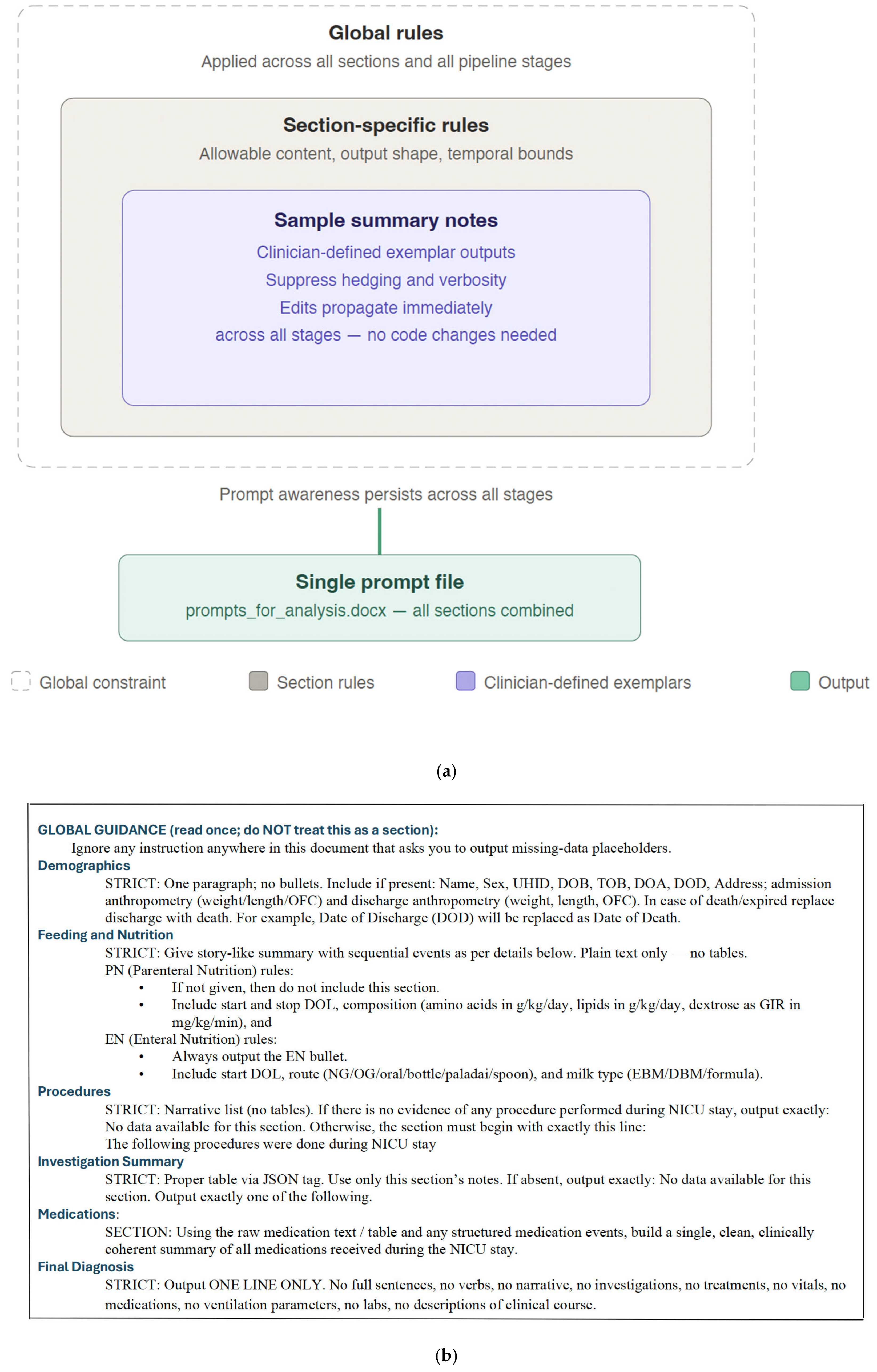
A unified prompt file governed all three stages of discharge summary generation (Figure 5a). It comprised global rules, section-specific constraints, and exemplar outputs designed to reduce hedging and verbosity. Section-specific prompts defined allowable content, output structure, temporal bounds, and evidence requirements (Figure 5b). This shared prompt architecture functioned as a section-level clinical contract intended to improve completeness, accuracy, coherence, actionability, and traceability while allowing clinician-directed prompt revision without changes to pipeline code.

2.5. Evaluation Framework

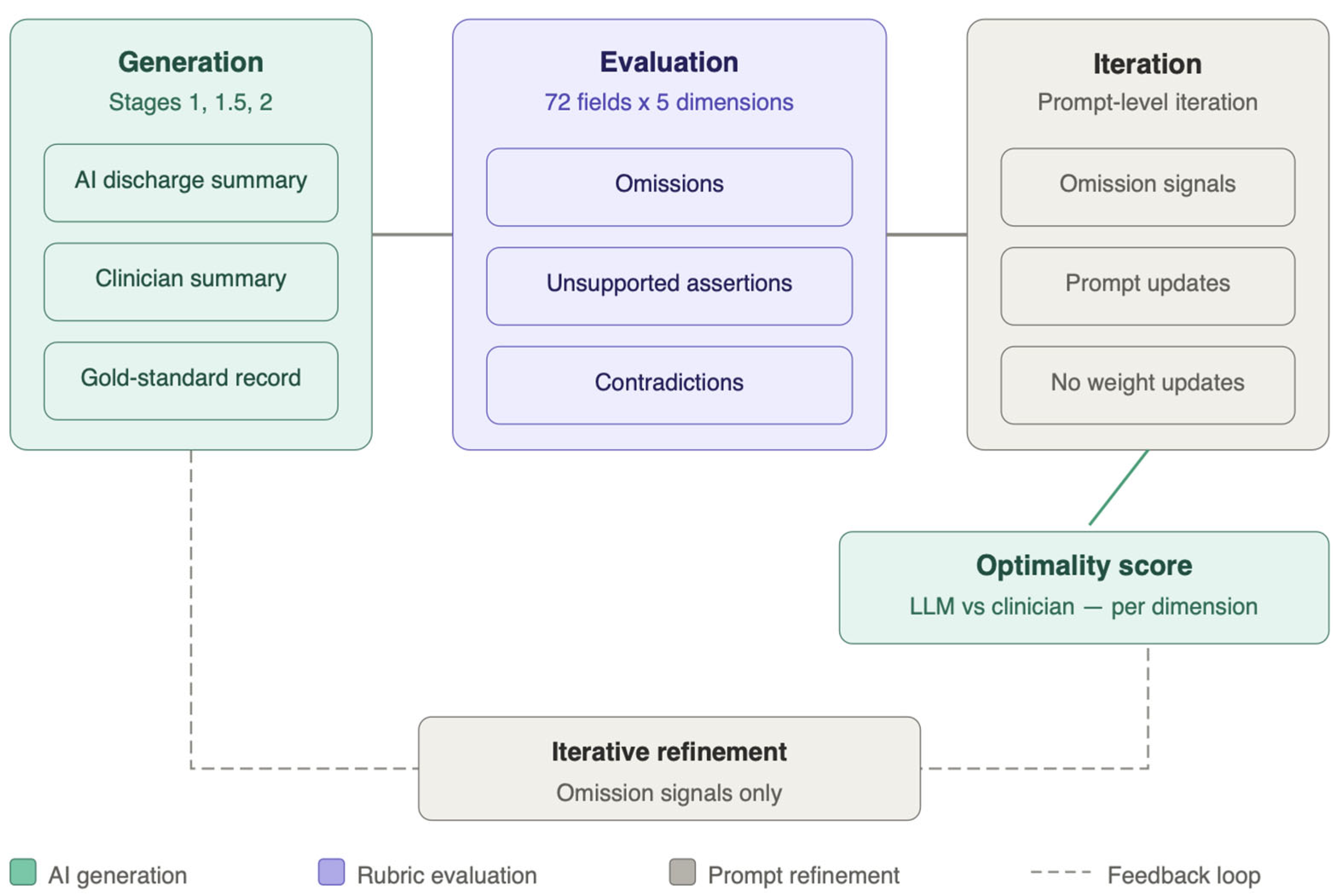
Rubric design—Documentation quality was assessed by a gpt-4o-mini-based evaluator guided by a clinician-defined rubric comprising 72 discrete clinical fields organized into 14 section contexts (Table 2). The rubric was developed for this study through clinical expert consensus and content-validity-informed item design, with fields mapped to standard NICU workflows and specified as measurable elements of a given section (e.g., feeding initiation, FiO2 range, antibiotic duration, sepsis workup status, bilirubin threshold) (Figure 6) [32].
Scoring dimensions—Each field was scored independently across five orthogonal dimensions: clinical accuracy, completeness, actionability and continuity of care, coherence and timeline validation, and non-hallucination (traceability) (Table 3). These dimensions were defined for the present study and informed by prior frameworks for clinical note quality, discharge communication quality, and factual consistency evaluation [33,34,35]. Each dimension used a three-level ordinal scale: 1.0 (fully satisfactory—content complete, specific, and directly traceable to the medical record), 0.5 (partially satisfactory—clinically plausible but limited by vagueness, incomplete quantification, or implied rather than explicit timelines), and 0.0 (unsatisfactory—content absent, incorrect, contradictory, or not supported by the patient record). This yielded 360 field-dimension evaluations per summary (72 fields × 5 dimensions).
Clinicians contributed to rubric design and validation only and did not participate in discharge summary generation. Evaluator prompts were finalized before comparative analyses and remained unchanged throughout scoring.

2.6. Blinded Comparative Evaluation

Clinician-authored and LLM-generated summaries were scored independently against the same reference record (i.e., the gold-standard patient record, comprising the full chart corpus of initial assessments, investigations, ventilator and respiratory support notes, nutrition records, medication logs, nursing documentation, and daily progress notes) by the LLM-based evaluator. Each summary was blinded to the other. Clinicians contributed only to rubric design and validation. The resulting parallel outputs (360 scored rows per summary type) were aligned field-by-field and dimension-by-dimension, producing 360 paired human–LLM comparison units per patient.

2.7. Error Taxonomy

For each field-dimension pair scoring below 1.0, failures were classified into three categories: omission (gold record contains evidence for the field, but the LLM or human discharge summary fails to document it), unsupported assertion (summary states a fact absent from the gold record), and contradiction (defined as a field-level discrepancy in which both the chart and the summary contained evidence for the same rubric item, but the two conflicted). This taxonomy was operationalized for the present study and informed by prior work on omissions, hallucinations, and factual inconsistency in clinical and general summarization [36,37].

2.8. Iterative Prompt Refinement

Prompt refinement was performed over 15 sequential iterations using omission-derived feedback, with deterministic generation ensured by fixed decoding settings (temperature = 0, top_p = 1, seed = 42) [38,39,40,41]. Iterations were continued until omission burden and section-level completeness demonstrated diminishing practical improvement during clinician-guided review, without modification of model weights. Temperature controls the randomness of token selection during generation, with lower values producing more deterministic outputs, whereas top_p (nucleus sampling) limits token selection to the smallest set of tokens whose cumulative probability reaches the specified threshold. The primary endpoint was paired AI-versus-human field-level performance across the five rubric dimensions. A secondary endpoint was the effect of iterative prompt refinement on omission burden and related safety metrics.

2.9. Pipeline-Stage Ablation Analysis

To evaluate the contribution of individual MORPHEUS pipeline components, we performed a pipeline-stage ablation analysis using saved intermediate pipeline artifacts and an additional generic single-stage baseline. Stage 0 represented a generic direct-generation baseline in which all available patient files were concatenated and provided to the LLM together with the discharge summary template, without section-specific prompts, global clinical rules, donor-based refinement, or deterministic template assembly. Stage 1 represented section-wise generation before refinement. Stage 1.5 represented targeted omission-aware refinement using donor sections to recover missing clinical content. Stage 2 represented the final MORPHEUS discharge summary generated through deterministic template assembly. All configurations were evaluated against the same clinician-authored summaries using the identical field-level rubric and structured error taxonomy employed in the primary analysis. Evaluation dimensions included clinical accuracy, completeness, coherence, actionability, non-hallucination, omission burden, unsupported assertions, and contradictions.

3. Results

3.1. Study Cohort

Of the 549 neonates admitted between October 2024 and November 2025, 401 met the inclusion criteria after excluding cases with missing birth weight, vital sign, nutrition, medication, or discharge data. The evaluated cohort had a mean (SD) gestational age of 35.3 (3.4) weeks and a mean (SD) birth weight of 2312.7 (795.8) g; NICU length of stay is reported as median (IQR) and decreased with increasing gestational age. Gestation-stratified baseline characteristics, including demographics, perinatal factors, and major morbidities, are summarized in Table 4.

3.2. Pipeline Performance

Stage 1. Mean generation time was 62.7 s per patient, corresponding to a throughput of approximately 30 patients per hour. The most time-intensive sections were vitals (mean 60.1 s) and medications (mean 30.3 s), reflecting their higher token volumes. Several high-volume domains, particularly vitals, nursing notes, investigation summaries, and respiratory distress summaries, exceeded the 8000-character input cap in long-stay infants. Vitals and nursing-note sections reached the truncation threshold at the median level, indicating truncation in at least 50% of admissions for these domains. These sections were therefore most susceptible to loss of early longitudinal context. Stage-wise timing and section-level input lengths are reported in Table 5.
Stage 1.5. The refinement stage identified 2799 missing section-instances across 401 patients and generated updated non-sentinel content for 1087 of these. The mean Stage 1.5 runtime was 169.5 s per patient. After refinement, the median number of missing sections decreased from 7 to 3 per patient. The most frequently missing sections before refinement were medications, CNS, shock, apnea, and infections; among these, apnea showed the highest backfill yield (61.7%), followed by infections (44.9%) and shock (41.7%), while medications remained unrecovered in the refinement stage. Refinement drew supporting content from sections such as antenatal details, birth details, admission notes, nursing notes, medications, and investigation summaries, while preserving section-level auditability through stored prompts, source bundles, and outputs. Total Stage 1.5 wall-clock runtime was 18.88 h. The most time-consuming section refinements were respiratory distress summary (mean 116.1 s per attempt), follow-up (76.2 s), advice on discharge (47.5 s), shock (44.1 s), and vitals (43.3 s).
Stage 2. Generation and assembly of 401 discharge summaries required 42.4 s in total. On average, each summary contained 12.0 non-empty clinical sections across 19 evaluated domains, along with 8.0 populated header fields and 4.0 anthropometry fields. Formatting compliance was high, with sequential numbering achieved in 80.5% of medication sections and 97.5% of procedure sections. Completeness was greatest in routinely documented domains, including antenatal details (98.8%), medications (97.0%), vitals (96.3%), feeding and nutrition (95.3%), and status at admission (93.8%). Moderate completeness was observed for respiratory distress summary (74.1%), ROP (57.6%), CNS (56.4%), and shock (55.4%). Lower completion in apnea (44.6%), infections (38.7%), death note (30.7%), and jaundice (20.4%) was consistent with selective clinical relevance rather than failure of summary generation.

3.3. Rubric-Based Evaluation

Across all rubric dimensions, MORPHEUS-generated summaries demonstrated higher rubric-based performance than clinician-authored summaries. Table 6 mean scores favored the LLM for clinical accuracy, completeness, actionability, coherence, and non-hallucination, with the largest absolute advantage observed for completeness. Field-level paired comparisons favored the LLM more often than the clinician summaries in every dimension, indicating consistently superior performance across scorable rubric items.
The rubric comprised 72 candidate field items per patient; however, these items represent a superset of potential neonatal discharge elements and were not expected to apply uniformly across all cases. Field-level comparisons were therefore restricted to scorable patient-field instances with sufficient gold-record evidence and valid paired scores for both summaries within a given dimension. For this reason, the effective denominator was substantially lower than the theoretical maximum of 28,872 fields per dimension across 401 patients. Many rubric items were condition-specific and therefore not applicable to every patient, and additional field instances were excluded when one or both summaries yielded non-scorable or null outputs. Consequently, only 2614–3142 paired field-level comparisons contributed to each dimension-level analysis.
Taxonomy error analysis demonstrated that MORPHEUS-generated summaries had substantially fewer errors than clinician-authored summaries across all three evaluated error classes (Table 7). Omissions were the dominant error type in both summary types but occurred far less frequently in LLM-generated summaries than in human-authored summaries (1010 vs. 2703), corresponding to a 62.63% relative reduction and a significantly lower rate per patient and per 100 fields. Similar reductions were observed for unsupported assertions (31 vs. 54; 42.59% reduction; p = 0.017) and contradictions (43 vs. 112; 61.61% reduction; p < 0.001). Together, these findings indicate that the LLM pipeline reduced both omission burden and factually inconsistent content relative to clinician-authored discharge summaries.
The highest residual error burden in both summary types was concentrated in a small number of sections, particularly Vitals, Medications, and Investigation Summary (Table 8). Among these, Vitals showed the largest absolute difference between summary types, with 148 total LLM errors compared with 1073 human errors, driven predominantly by omissions in clinician-authored summaries. Medications and Investigation Summary remained challenging for both approaches, although MORPHEUS still produced fewer total error counts than clinicians in each case. Procedures also showed a marked reduction in LLM errors relative to human summaries (25 vs. 359), suggesting that LLM provided the greatest benefit in sections requiring structured capture of procedural and bedside details.
Granular section-level analysis (Table 9) confirmed that MORPHEUS -generated summaries had significantly lower combined error burden than clinician-authored summaries in most sections. The largest improvement was observed in Vitals, where mean per-patient error burden decreased from 2.676 ± 2.229 in clinician-authored summaries to 0.369 ± 0.666 in AI-generated summaries (mean difference 2.307; 95% CI 2.094 to 2.520; p < 0.001), corresponding to an 86.21% relative improvement. Substantial and statistically significant gains were also seen in Procedures, Feeding and Nutrition, Respiratory Distress Summary, Apnea, and Initial Assessment. In contrast, Investigation Summary and ROP showed only modest numerical improvement, and these differences were not statistically significant, indicating that these sections remain comparatively difficult for both clinician-authored and MORPHEUS -generated discharge summaries.
Clinically meaningful discrepancies were concentrated in a small number of sections, particularly Vitals, Medications, Investigation Summary, Procedures, and Jaundice (Supplementary Table S1). The largest clinician-authored discrepancy burden was observed in Vitals, where missing blood pressure and perfusion details were common, followed by Medications and Investigation Summary, which were dominated by omitted structured drug details and laboratory values. In contrast, procedural discrepancies were often driven by contradictory status or outcome narration rather than simple omission. Jaundice-related discrepancies most commonly reflected missing bilirubin values and phototherapy details. Together, these examples illustrate that most residual errors were not stylistic, but reflected loss, distortion, or unsupported reporting of clinically actionable bedside information.
Table 10 summarizes the effect of iterative prompt refinement on performance and safety metrics using a fixed paired evaluation cohort. Compared with Iteration 1, the final iteration showed modest gains across all five quality dimensions, with Accuracy increased from 0.937 to 0.943, Completeness from 0.913 to 0.933, Coherence from 0.941 to 0.961, Actionability from 0.935 to 0.957, and Clinical safety from 0.952 to 0.974. At the safety level, the omission rate per patient decreased from 2.484 to 1.807, and unsupported assertions per patient decreased from 0.095 to 0.072, while contradictions remained essentially unchanged at 0.095. Among these changes, the reduction in omission burden was statistically significant (p = 0.028), whereas improvements in the quality dimensions and the other safety indicators did not reach statistical significance in this comparison. Overall, the results suggest that iterative prompt refinement was associated with directional improvement in summary quality and reduced omission burden, while other gains were smaller and should be interpreted as supportive trends rather than definitive improvements.
Table 11 shows the final paired AI-versus-human comparison across the five rubric dimensions. AI-generated summaries scored higher than clinician-authored summaries on all dimensions, with 95% confidence intervals excluding zero. The largest absolute advantage was observed for completeness, and effect sizes ranged from moderate to large.

3.4. Pipeline-Stage Ablation Analysis

Pipeline-stage ablation demonstrated progressive gains from generic prompting to structured MORPHEUS orchestration (Table 12). The generic single-stage baseline (Stage 0) achieved moderate rubric performance, indicating that frontier LLMs can generate clinically plausible NICU discharge summaries directly from heterogeneous patient records. However, the staged MORPHEUS pipeline consistently improved clinical accuracy, completeness, coherence, actionability, non-hallucination, and omission burden beyond generic prompting alone. Compared with Stage 0, Stage 1 section-wise generation improved evaluable clinical coverage and overall rubric performance, supporting the value of section-specific prompt engineering and structured extraction. Stage 1.5 achieved the strongest completeness (0.959), non-hallucination (0.988), and lowest omission burden (2.76 omissions/patient), consistent with its role as targeted omission-aware contextual refinement using donor sections. The final Stage 2 summaries preserved high coherence (0.966) and actionability (0.962) while transforming refined notes into a standardized clinically deployable discharge summary format. Although Stage 2 summaries were slightly more compressed than Stage 1.5 outputs, they maintained high factual fidelity and substantially lower omission burden compared with both clinician-authored summaries and generic single-stage prompting.

4. Discussion

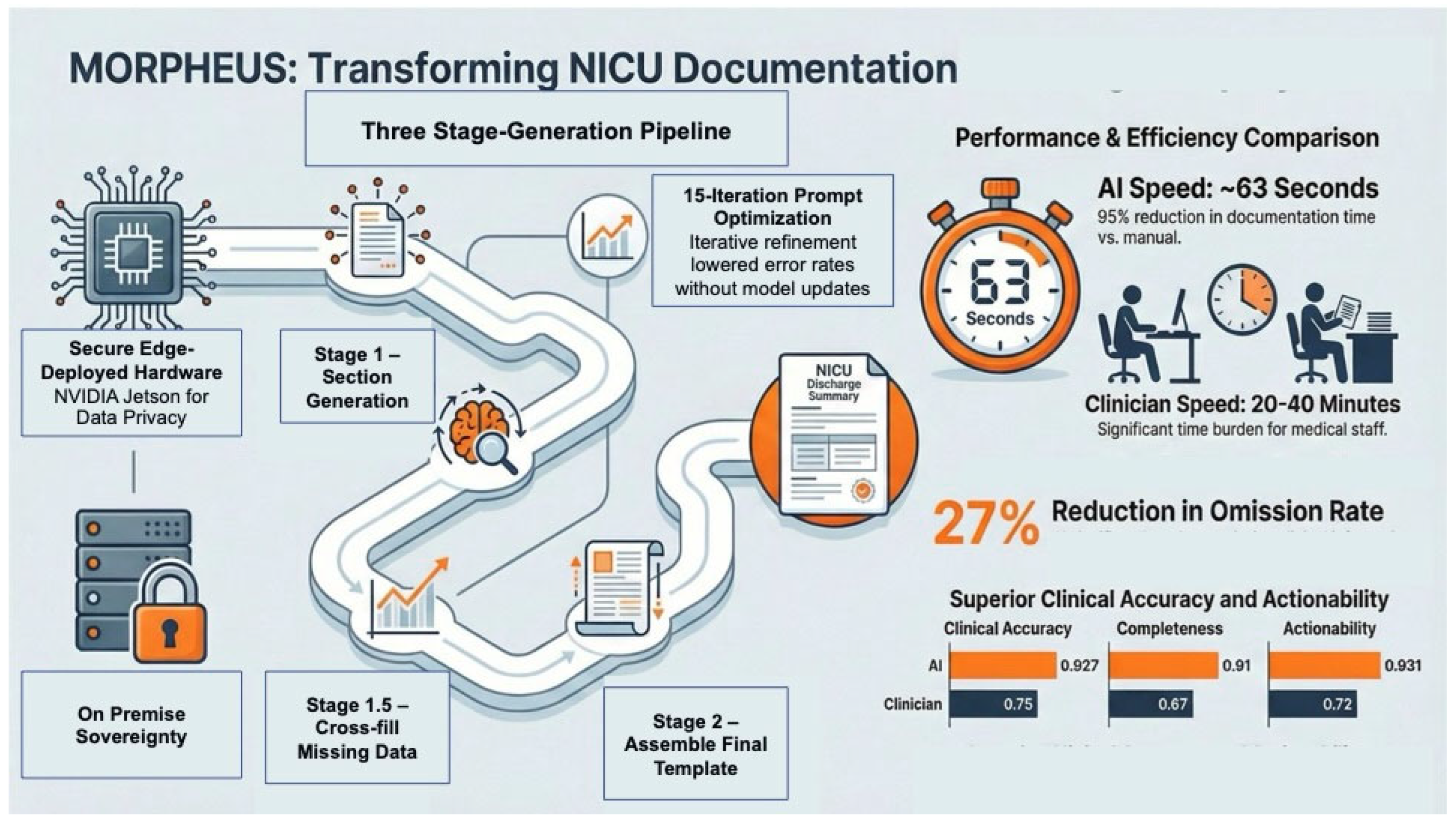
This study suggests that the MORPHEUS pipeline produced more complete and more chart-grounded discharge summaries than routine clinician-authored documentation within the rubric-based evaluation framework used in this study. MORPHEUS, an edge-hosted LLM-assisted pipeline, generated NICU discharge summaries that scored higher than clinician-authored documentation across all five evaluated rubric dimensions—accuracy, completeness, actionability, coherence, and non-hallucination—under a structured, evidence-grounded evaluation framework. These findings suggest that evidence-grounded, field-level evaluation of LLM-generated documentation is feasible in a resource-constrained NICU setting and may support safe, scalable deployment without model fine-tuning (Figure 7). Unlike prior discharge summary studies focused primarily on adult inpatient or ICU settings, the present work combines NICU-specific longitudinal orchestration, field-level clinician-grounded evaluation, iterative omission-targeted refinement, and edge-hosted workflow execution within a real neonatal clinical environment.
The performance advantage of MORPHEUS-generated summaries across most evaluation dimensions likely reflects the system’s structured orchestration framework, which enforces section isolation, temporal normalization, and evidence-grounded generation from clinically relevant note buckets. The pipeline decomposes longitudinal NICU records into section-specific evidence streams, iteratively refines missing content, and assembles outputs into a standardized NICU template. Clinician-authored summaries, by contrast, are generated under routine workflow constraints and are subject to variability driven by experience, fatigue, time pressure, and manual chart navigation across prolonged NICU admissions [42]. The largest observed improvement was completeness, suggesting that reduction in omission burden, rather than stylistic fluency alone, was the primary mechanism underlying performance improvement. These findings should be interpreted within the context of the rubric-based evaluation framework and routine clinical workflow conditions under which clinician-authored summaries were produced.
The lower non-hallucination score for AI-generated summaries (0.692 vs. 0.738) warrants careful interpretation. Rather than indicating fabrication of clinical facts, this gap likely reflects the LLM’s tendency to infer or extrapolate from sparse documentation in domains where the source record itself was incomplete, particularly CNS and ROP documentation [43]. This distinction between hallucination and plausible inference from incomplete source data is clinically important and supports the case for conservative rubric design, explicit evidence-traceability requirements, and clinician-supervised review in future systems [36].
The remaining residual errors therefore reflected not only model behavior, but also limitations in source-document completeness and section-specific extraction fidelity. The iterative prompt refinement loop, which drove omission rates down across 15 iterations without modifying model weights, offers an additional practically important insight. Structured error signals derived from field-level evaluation can improve summary quality without requiring costly fine-tuning or retrieval-augmented architectures, making the approach more feasible for resource-limited deployment environments. This prompt-level feedback mechanism is conceptually analogous to reinforcement learning from human feedback but operates entirely through clinician-interpretable error categories, thereby preserving transparency and auditability. The convergence behavior observed across iterations suggests that a stable minimum-error configuration can be achieved within a clinically feasible number of refinement cycles. In practice, refinement was stopped after 15 iterations because subsequent cycles produced only marginal qualitative improvement relative to the operational cost of repeated generation and clinician review.
The MORPHEUS pipeline generated complete discharge summaries at a mean of 62.7 s per patient (Stage 1). In the current implementation, orchestration, preprocessing, scoring, and workflow management were performed locally on edge hardware, while language generation inference was performed through the OpenAI API. Based on input from clinical staff at the participating NICU, manual discharge summary preparation typically requires approximately 10–40 min per patient, depending on case complexity and length of stay, even within the current EMR-based workflow. This observation is consistent with broader evidence that discharge documentation is time-intensive and that delayed completion of discharge summaries remains common in hospital practice [44]. The observed reduction in documentation time could translate into substantial recovery of clinician-hours annually in high-volume NICUs, with potential implications for clinician workload and burnout. The automated evaluation stage adds approximately 60–90 s per patient and runs asynchronously, functioning as a quality assurance mechanism rather than a workflow bottleneck. Accordingly, the term ‘edge-hosted’ in this study refers primarily to local orchestration, PHI-controlled workflow execution, and hospital-side data handling rather than fully local LLM inference.
Deployment on the NVIDIA Jetson AGX Orin reflects a deliberate design choice for settings where local orchestration, data control, and modest infrastructure requirements are important (Supplementary Table S2). In the current implementation, orchestration and workflow execution were performed on edge hardware, while runtime was still influenced substantially by network delay and waiting time associated with OpenAI API calls. The decision to use a fixed OpenAI model in this study reflected a pragmatic focus on prompt architecture and documentation quality before benchmarking fully local inference. Future migration to locally hosted quantized models may reduce latency and eliminate per-call API cost, but this will require direct benchmarking in the target hardware environment. In the current implementation, generation required approximately 18,000–25,000 tokens per patient, corresponding to an estimated cost of USD $0.03–$0.07 per discharge using cloud LLM APIs; including automated evaluation, the total per-patient cost was estimated at USD $0.08–$0.17.
The field-level rubric developed here (72 candidate clinical fields across section contexts, scored across five orthogonal dimensions) represents a contribution independent of the generation system. Existing approaches to LLM documentation evaluation rely predominantly on holistic or aggregate scoring, which can mask deficits in completeness or safety. The field-dimension matrix used here reduces this masking effect and produces actionable, section-specific error signals. The rubric is likely adaptable to other NICU documentation contexts and, with modification, to other high-acuity inpatient settings where discharge summary quality has direct implications for continuity of care [45].
Several limitations merit consideration. First, the 8000-character input truncation applied in Stage 1 preferentially retains the most recent source text, which may omit clinically significant early events in long admissions. This tradeoff favored computational feasibility and reduced API transaction cost but may have reduced recovery of clinically important early-admission events in prolonged NICU hospitalizations. This likely contributed to residual omission errors, particularly in vitals, medications, procedures, jaundice-related content, nursing notes, and investigation summaries. Second, Stage 1.5 applied LLM-based backfill to nearly all absent sections without distinguishing missing documentation from conditionally irrelevant sections. For domains such as ROP screening, CNS complications, and death notes, absence often reflects an appropriate clinical context. Future iterations should incorporate clinical relevance gating and confidence-aware review mechanisms before triggering refinement. Third, although orchestration and PHI-controlled workflow execution occurred locally on edge hardware, language generation inference in the current implementation depended on cloud-based API access. Future evaluation using fully local hospital-deployable LLMs will be important to assess latency, operational cost, and deployment feasibility in restricted-network environments. Fourth, this study was conducted at a single Level III NICU in India, and generalizability to other settings with different EMR platforms, documentation cultures, or patient populations requires prospective evaluation [46,47]. Because the MORPHEUS pipeline depends partly on institution-specific documentation structure, section organization, and longitudinal note patterns, prospective validation across heterogeneous NICU environments and EMR systems will be necessary before broader deployment claims can be made. Finally, clinician involvement was limited to rubric design and validation; the system has not yet been evaluated in a prospective workflow study with real-time clinician interaction, which remains an essential next step before clinical adoption.
Future work will extend the platform to incorporate bedside video and multimodal physiologic data captured through the NEO module, enabling automated procedure documentation, behavioral assessment, and workflow interpretation from direct observation. Future versions of the pipeline may also incorporate audience-specific summary generation, where discharge summaries are adapted according to the educational level, language preference, and domain understanding of the target reader. Parent-facing summaries using simplified and lay-language phrasing while remaining faithful to the clinical record represent a near-term extension with direct relevance to family-centered NICU care. Additional planned directions include deployment and benchmarking of fully local hospital-deployable LLMs on edge hardware, implementation of clinical relevance gating and confidence-aware review mechanisms, and expansion of the framework beyond discharge summaries into other NICU documentation workflows such as daily progress notes, nutrition summaries, respiratory-support documentation, procedure summaries, and longitudinal developmental follow-up reporting.

5. Conclusions

In this single-center NICU study, MORPHEUS-generated discharge summaries achieved higher structured rubric-based scores and lower omission burden than clinician-authored summaries across all five evaluated dimensions—accuracy, completeness, coherence, actionability, and non-hallucination. Iterative prompt refinement significantly reduced omission burden without model fine-tuning, while other gains across iterations were supportive but not independently significant. The field-level rubric provides an auditable framework for evaluating AI-generated clinical documentation and identifying specific residual failure modes. Prospective workflow validation and evaluation of locally hosted inference are the next steps toward responsible deployment in neonatal care.

Supplementary Materials

The following supporting information can be downloaded at: https://www.mdpi.com/article/10.3390/healthcare14111457/s1.

Author Contributions

Conceptualization, H.S., R.K. and S.S.; methodology, H.S., R.K. and S.S.; software, H.S. and R.K.; validation, H.S., R.K. and S.S.; formal analysis, H.S., R.K., S.S. and R.M.M.; resources, H.S., R.K. and S.S.; data curation, H.S., R.K. and S.S.; writing—original draft preparation, H.S., R.K. and R.M.M.; writing—review and editing, H.S., R.K., R.M.M., Y.S. and S.J.C.; visualization, H.S., R.K. and R.M.M.; supervision, H.S., R.K. and S.S.; project administration, H.S., R.K. and S.S.; funding acquisition, H.S. and R.K. All authors have read and agreed to the published version of the manuscript.

Funding

This research project is privately funded by EquipSecond QSec Medical USA.

Institutional Review Board Statement

The study was conducted in accordance with the Declaration of Helsinki and approved on 5 February 2025 by the Institutional Review Board (or Ethics Committee) of Sir Gangaram Hospital, Delhi, India (protocol code: IRB No.2025NC0089).

Informed Consent Statement

Informed consent was obtained from the families of the neonates prior to study enrolment.

Data Availability Statement

The raw data used in this study consists of protected neonatal patient health information (PHI), including longitudinal NICU clinical records and discharge documentation governed by hospital privacy policies, institutional approvals, and ethical restrictions. Due to patient confidentiality obligations and institutional data-sharing limitations, the raw clinical data cannot be publicly shared.

Acknowledgments

We acknowledge Shubham Gupta for developing the database queries in accordance with the study design requirements defined by the authors and clinical team. We also thank the nurses, residents, and clinical staff at the NICU study site for their support during data collection and clinical workflow integration. We are grateful to Sangdo Kim of QSec Korea for technical design feedback related to the Jetson device, and to Henry Lee and Abrar Majeedi for their review of the manuscript. We further acknowledge the contributions of the QSec EquipSecond team members and all others whose support helped make this study possible.

Conflicts of Interest

The authors declare no conflicts of interest. Authors H.S. and R.K. are co-founders of EquipSecond QSec Medical LLC./QSec, which provided the NVIDIA Jetson hardware used in this study. H.S. and R.K. were not employed or paid by EquipSecond QSec Medical LLC./QSec to conduct this research, and the company did not provide salary support, research funding, data analysis payments, or publication-related payments for this work. The study was conducted collaboratively with the clinical team to evaluate and improve NICU discharge summary documentation quality. To mitigate potential company sponsor influence, the clinical documentation rubric was clinician-defined, the same evaluation framework and error taxonomy were applied uniformly to clinician-authored and AI-generated summaries, and clinically meaningful discrepancies were reviewed with clinical authors. EquipSecond QSec Medical LLC./QSec did not control the clinical data, clinical interpretation, data analysis, decision to submit, or final manuscript conclusions. Authors S.S., S.J.C. and Y.S. declare no commercial or financial relationships that could be construed as a potential conflict of interest. Author R.M.M. is a consultant for GE Healthcare; this relationship is unrelated to the present manuscript.

Abbreviations

The following abbreviations are used in this manuscript:
AIArtificial Intelligence
ARCHITECTBedside data acquisition system name used in the study
BPBlood Pressure
CC BYCreative Commons Attribution
CIConfidence Interval
CNSCentral Nervous System
DOLDay of Life
EMRElectronic Medical Record
FiO2Fraction of Inspired Oxygen
ICUIntensive Care Unit
HRHeart Rate
I/OIntake and Output
IoTInternet of Things
IQRInterquartile Range
LLMLarge Language Model
MORPHEUSAutomated discharge summary generation pipeline name used in the study
MRNMedical Registration Number
NEOEmbedded audio–video module name used in the platform
NICUNeonatal Intensive Care Unit
NVMeNon-Volatile Memory Express
pCO2Partial Pressure of Carbon Dioxide
pHPotential of Hydrogen
ROPRetinopathy of Prematurity
RRRespiratory Rate
SDStandard Deviation
SpO2Peripheral Capillary Oxygen Saturation
SSDSolid-State Drive
TBTerabyte

References

  1. Baumann, L.A.; Baker, J.; Elshaug, A.G. The impact of electronic health record systems on clinical documentation times: A systematic review. Health Policy 2018, 122, 827–836. [Google Scholar] [CrossRef]
  2. Genes, N.; Sills, J.; Heaton, H.A.; Shy, B.D.; Scofi, J. Addressing note bloat: Solutions for effective clinical documentation. JACEP Open. 2025, 6, 100031. [Google Scholar] [CrossRef]
  3. Rule, A.; Bedrick, S.; Chiang, M.F.; Hribar, M.R. Length and redundancy of outpatient progress notes across a decade at an academic medical center. JAMA Netw. Open 2021, 4, e2115334. [Google Scholar] [CrossRef]
  4. Gaffney, A.; Woolhandler, S.; Cai, C.; Bor, D.; Himmelstein, J.; McCormick, D.; Himmelstein, D.U. Medical documentation burden among US office-based physicians in 2019: A national study. JAMA Intern Med. 2022, 182, 564–566. [Google Scholar] [CrossRef]
  5. Hauschildt, K.E.; Hechtman, R.K.; Prescott, H.C.; Iwashyna, T.J. Crit Care Explorummaries are insufficient following ICU stays: A qualitative study. Crit. Care Explor. 2022, 4, e0715. [Google Scholar] [CrossRef] [PubMed]
  6. Caruso, L.B.; Thwin, S.S.; Brandeis, G.H. Following up on clinical recommendations in transitions from hospital to nursing home. J. Aging Res. 2014, 2014, 873043. [Google Scholar] [CrossRef] [PubMed]
  7. Were, M.C.; Li, X.; Kesterson, J.; Cadwallader, J.; Asirwa, C.; Khan, B.A.; Rosenman, M.B. Adequacy of hospital discharge summaries in documenting tests with pending results and outpatient follow-up providers. J. Gen. Intern. Med. 2009, 24, 1002–1006. [Google Scholar] [CrossRef] [PubMed]
  8. Ng, I.K.S.; Tung, D.; Seet, T.; Yow, K.S.; Chan, K.L.E.; Teo, D.B.; Chua, C.E. How to write a good discharge summary: A primer for junior physicians. Postgrad. Med. J. 2025, 101, 764–772. [Google Scholar] [CrossRef]
  9. Feblowitz, J.C.; Wright, A.; Singh, H.; Samal, L.; Sittig, D.F. Summarization of clinical information: A conceptual model. J. BioMed Inform. 2011, 44, 688–699. [Google Scholar] [CrossRef]
  10. Murad, M.H.; Vaa Stelling, B.E.; West, C.P.; Hasan, B.; Simha, S.; Saadi, S.; Firwana, M.; Viola, K.E.; Prokop, L.J.; Nayfeh, T.; et al. Measuring documentation burden in healthcare. J. Gen. Intern. Med. 2024, 39, 2837–2848. [Google Scholar] [CrossRef]
  11. Lenert, L.A.; Sakaguchi, F.H.; Weir, C.R. Rethinking the discharge summary: A focus on handoff communication. Acad. Med. 2014, 89, 393–398. [Google Scholar] [CrossRef]
  12. Hu, D.; Zhang, S.; Liu, Q.; Zhu, X.; Liu, B. Large language models in summarizing radiology report impressions for lung cancer in Chinese: Evaluation study. J. Med. Internet Res. 2025, 27, e65547. [Google Scholar] [CrossRef]
  13. Woo, B.F.Y.; Cato, K.; Cho, H.; You, S.B.; Song, J. The use of large language models in clinical documentation: A scoping review. Int. J. Nurs. Stud. 2026, 176, 105322. [Google Scholar] [CrossRef] [PubMed]
  14. Butt, F.; Varghese, N.; Elhadidi, A.; Abdulrahman, S.; Ben Ayad, A. Standardized neonatal ICU progress note template and feedback system: A clinical documentation improvement initiative. Cureus 2024, 16, e69971. [Google Scholar] [CrossRef] [PubMed]
  15. Williams, C.Y.K.; Subramanian, C.R.; Ali, S.S.; Apolinario, M.; Askin, E.; Barish, P.; Cheng, M.; Deardorff, W.J.; Donthi, N.; Ganeshan, S.; et al. Physician- and large language model-generated hospital discharge summaries: A blinded comparative quality and safety study. JAMA Intern. Med. 2025, 185, 818–825. [Google Scholar] [CrossRef] [PubMed]
  16. Lyu, M.; Peng, C.; Paredes, D.; Chen, Z.; Chen, A.; Bian, J.; Wu, Y. UF-HOBI at “Discharge Me!”: A Hybrid Solution for Discharge Summary Generation through Prompt-Based Tuning of GatorTronGPT Models. In Proceedings of the 23rd Workshop on Biomedical Natural Language Processing, Bangkok, Thailand, 16 August 2024. [Google Scholar]
  17. Klang, E.; Gill, J.; Sharma, A.; Leibner, E.; Sabounchi, M.; Freeman, R.; Kohli-Seth, R.; Kovatch, P.; Charney, A.W.; Stump, L.; et al. Summarize-then-Prompt: A novel prompt engineering strategy for generating high-quality discharge summaries. Appl. Clin. Inform. 2025, 16, 1325–1331. [Google Scholar] [CrossRef]
  18. Mudumbai, S.C.; Chung, P.; Chen, J.Q.; Litake, O.; Regala, S.; Madhok, J.; Krause, M.; Pearl, R.G.; Boateng Evans, A.; Rodney, G. Evaluating large language model performance in generating clinically relevant intensive care unit discharge summaries. A&A Pract. 2025, 19, e02057. [Google Scholar] [CrossRef]
  19. Hains, L.; Kleinig, O.; Murugappa, A.; Gluck, S.; Marks, J.; Gilbert, T.; Bacchi, S. Large language model discharge summary preparation using real-world electronic medical record data shows promise. Intern. Med. J. 2025, 55, 1188–1192. [Google Scholar] [CrossRef]
  20. Mehri, T.; Nadalini, T.; Hoekman, A.H.; van der Laan, T.P.; Kagialari, K.; Wagner, R.K.; Doornberg, J.N.; Schoonbeek, R.C.; Bootsma-Robroeks, C.M.; Aalderink, M.; et al. Assessing the quality of AI-generated and physician-written discharge summaries: Evaluation of an EHR-integrated tool in a Dutch academic hospital. EBioMedicine 2026, 127, 106247. [Google Scholar] [CrossRef]
  21. Rust, P.; Frings, J.; Meister, S.; Fehring, L. Evaluation of a large language model to simplify discharge summaries and provide cardiological lifestyle recommendations. Commun. Med. 2025, 5, 208. [Google Scholar] [CrossRef]
  22. Singh, H.; Kaur, R.; Gangadharan, A.; Pandey, A.K.; Manur, A.; Sun, Y.; Saluja, S.; Gupta, S.; Palma, J.P.; Kumar, P. Neo-bedside monitoring device for integrated neonatal intensive care unit (iNICU). IEEE Access 2019, 7, 7803–7813. [Google Scholar] [CrossRef]
  23. Singh, H.; Yadav, G.; Mallaiah, R.; Joshi, P.; Joshi, V.; Kaur, R.; Bansal, S.; Brahmachari, S. iNICU—Integrated neonatal care unit: Capturing neonatal journey in an intelligent data way. J. Med. Syst. 2017, 41, 132. [Google Scholar] [CrossRef]
  24. Sun, Y.; Kaur, R.; Gupta, S.; Paul, R.; Das, R.; Cho, S.J.; Anand, S.; Boutilier, J.J.; Saria, S.; Palma, J.; et al. Development and validation of high definition phenotype-based mortality prediction in critical care units. JAMIA Open 2021, 4, ooab004. [Google Scholar] [CrossRef]
  25. Singh, H.; Cho, S.J.; Gupta, S.; Kaur, R.; Sunidhi, S.; Saluja, S.; Pandey, A.K.; Bennett, M.V.; Lee, H.C.; Das, R.; et al. Designing a bed-side system for predicting length of stay in a neonatal intensive care unit. Sci. Rep. 2021, 11, 3342. [Google Scholar] [CrossRef] [PubMed]
  26. NVIDIA. Jetson AGX Orin Specifications. Available online: https://www.nvidia.com/en-us/autonomous-machines/embedded-systems/jetson-orin/ (accessed on 15 May 2026).
  27. SanDisk. WD_BLACK SN850X NVMe SSD Product Specifications. Available online: https://www.sandisk.com/products/ssd/internal-ssd/wd-black-sn850x-nvme-ssd?sku=WDS100T2X0E (accessed on 15 May 2026).
  28. NVIDIA. JetPack 6.2 Release Notes and SDK Documentation. NVIDIA Developer. Available online: https://developer.nvidia.com/embedded/jetpack-sdk-62 (accessed on 15 May 2026).
  29. OpenAI. GPT-4o Mini: Advancing Cost-Efficient Intelligence. 2024. Available online: https://openai.com/index/gpt-4o-mini-advancing-cost-efficient-intelligence/ (accessed on 15 May 2026).
  30. Van Veen, D.; Van Uden, C.; Blankemeier, L.; Delbrouck, J.-B.; Aali, A.; Bluethgen, C.; Pareek, A.; Polacin, M.; Reis, E.P.; Seehofnerová, A.; et al. Clinical text summarization: Adapting large language models can outperform human experts. Res. Sq. 2023. [Google Scholar] [CrossRef]
  31. Brown, T.B.; Mann, B.; Ryder, N.; Subbiah, M.; Kaplan, J.; Dhariwal, P.; Neelakantan, A.; Shyam, P.; Sastry, G.; Askell, A.; et al. Language models are few-shot learners. Adv. Neural Inf. Process Syst. 2020, 33, 1877–1901. [Google Scholar]
  32. Boateng, G.O.; Neilands, T.B.; Frongillo, E.A.; Melgar-Quiñonez, H.R.; Young, S.L. Best practices for developing and validating scales for health, social, and behavioral research: A primer. Front. Public Health 2018, 6, 149. [Google Scholar] [CrossRef]
  33. Burke, H.B.; Sessums, L.L.; Hoang, A.; Becher, D.; Fontelo, P.; Liu, F.; Stephens, M.; Pangaro, L.N.; O’Malley, P.; Baxi, N.S.; et al. QNOTE: An instrument for measuring the quality of EHR clinical notes. J. Am. Med. Inform. Assoc. 2014, 21, 910–916. [Google Scholar] [CrossRef]
  34. Kripalani, S. Care Transitions. PSNet, Agency for Healthcare Research and Quality. Available online: https://psnet.ahrq.gov/perspective/care-transitions (accessed on 15 May 2026).
  35. Luo, Z.; Xie, Q.; Ananiadou, S. Factual consistency evaluation of summarization in the era of large language models. Expert Syst. Appl. 2024, 254, 124456. [Google Scholar] [CrossRef]
  36. Asgari, E.; Montaña-Brown, N.; Dubois, M.; Khalil, S.; Balloch, J.; Au Yeung, J.; Pimenta, D. A framework to assess clinical safety and hallucination rates of LLMs for medical text summarisation. npj Digit. Med. 2025, 8, 274. [Google Scholar] [CrossRef]
  37. Ji, Z.; Lee, N.; Frieske, R.; Yu, T.; Su, D.; Xu, Y.; Ishii, E.; Bang, Y.; Chen, D.; Dai, W.; et al. Survey of hallucination in natural language generation. ACM Comput. Surv. 2024, 57, 248. [Google Scholar] [CrossRef]
  38. Tang, L.; Goyal, T.; Fabbri, A.R.; Laban, P.; Xu, J.; Yavuz, S.; Kryściński, W.; Rousseau, J.F.; Durrett, G. Understanding Factual Errors in Summarization: Errors, Summarizers, Datasets, Error Detectors. In Proceedings of the 61st Annual Meeting of the Association for Computational Linguistics, Toronto, ON, Canada, 9–14 July 2023; pp. 11626–11644. Available online: https://aclanthology.org/2023.acl-long.650.pdf (accessed on 15 May 2026).
  39. Madaan, A.; Tandon, N.; Gupta, P.; Hallinan, S.; Gao, L.; Wiegreffe, S.; Alon, U.; Dziri, N.; Prabhumoye, S.; Yang, Y.; et al. SELF-REFINE: Iterative refinement with self-feedback. arXiv 2023, arXiv:2303.17651. [Google Scholar] [CrossRef]
  40. Ramnath, K.; Zhou, K.; Guan, S.; Mishra, S.S.; Qi, X.; Shen, Z.; Wang, S.; Woo, S.; Jeoung, S.; Wang, Y.; et al. A systematic survey of automatic prompt optimization techniques. In Proceedings of the 2025 Conference on Empirical Methods in Natural Language Processing, Suzhou, China, 4–9 November 2025; Association for Computational Linguistics: Stroudsburg, PA, USA, 2025; pp. 33078–33110. Available online: https://aclanthology.org/2025.emnlp-main.1681.pdf (accessed on 15 May 2026).
  41. Zhu, Z.; Zhou, H.; Feng, Z.; Li, T.; Deryl, C.J.J.; Onn, M.L.; Ng, G.W.; Mao, K. Rethinking prompt optimizers: From prompt merits to optimization. arXiv 2025, arXiv:2505.09930. [Google Scholar] [CrossRef]
  42. Freedman, S.; Golberstein, E.; Huang, T.-Y.; Satin, D.; Smith, L.B. Docs with their eyes on the clock? The effect of time pressures on primary care productivity. J. Health Econ. 2021, 77, 102442. [Google Scholar] [CrossRef]
  43. Van Veen, D.; Van Uden, C.; Blankemeier, L.; Delbrouck, J.-B.; Aali, A.; Bluethgen, C.; Pareek, A.; Polacin, M.; Reis, E.P.; Seehofnerová, A.; et al. Adapted large language models can outperform medical experts in clinical text summarization. Nat. Med. 2024, 30, 1134–1142. [Google Scholar] [CrossRef]
  44. Kleinig, O.; Hains, L.; Murugappa, A.; Gluck, S.; Marks, J.; Gilbert, T.; Bacchi, S. Time for a rethink? Discharge summary completion is often delayed and associated with increased readmission. Intern. Med. J. 2025, 55, 1575–1577. [Google Scholar] [CrossRef]
  45. Kripalani, S.; Jackson, A.T.; Schnipper, J.L.; Coleman, E.A. Promoting effective transitions of care at hospital discharge: A review of key issues for hospitalists. J. Hosp. Med. 2007, 2, 314–323. [Google Scholar] [CrossRef] [PubMed]
  46. Patel, S.Y.; Palma, J.P.; Hoffman, J.M.; Lehmann, C.U. Neonatal informatics: Past, present and future. J. Perinatol. 2024, 44, 773–776. [Google Scholar] [CrossRef] [PubMed]
  47. Ellsworth, M.A.; Lang, T.R.; Pickering, B.W.; Herasevich, V. Clinical data needs in the neonatal intensive care unit electronic medical record. BMC Med. Inform. Decis. Mak. 2014, 14, 92. [Google Scholar] [CrossRef] [PubMed]
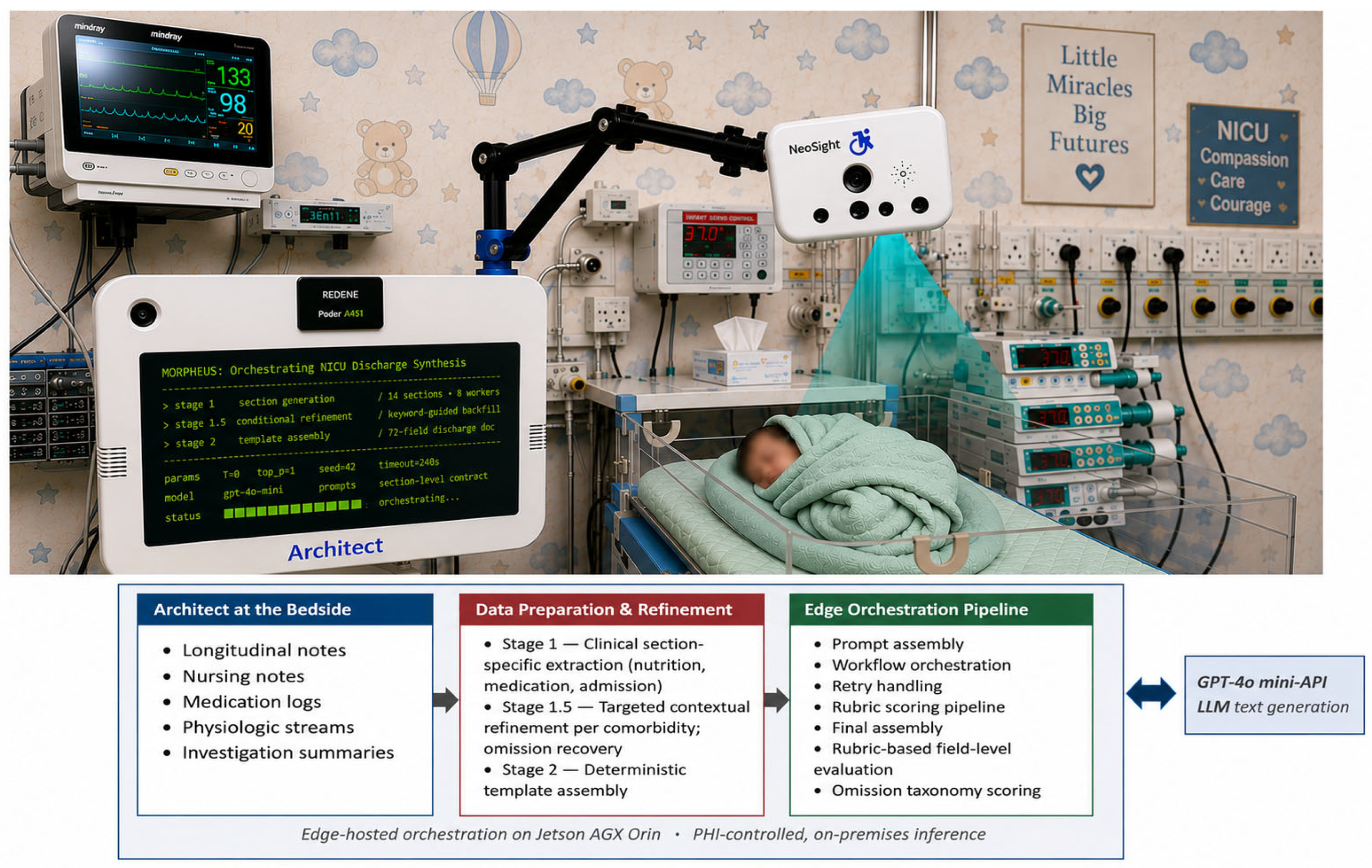
Figure 1. MORPHEUS edge-hosted NICU documentation architecture illustrating bedside longitudinal clinical data ingestion, PHI-controlled Jetson-based orchestration, staged discharge summary generation workflow, rubric-based evaluation, and cloud-based LLM text generation. Longitudinal NICU documentation distributed across nursing notes, vitals, medications, and investigations is processed through section-specific extraction, targeted contextual refinement, and deterministic template assembly to reduce omission burden and improve evidence-grounded discharge summary generation.
Healthcare 14 01457 g001
Figure 2. Clinical documentation workflow in NICU: Six sequential stages from admission through discharge. Daily documentation (Stage 3) operates as a repetitive cycle. The discharge summary represents the terminal output, generated either by a clinician or by MORPHEUS.
Healthcare 14 01457 g002
Figure 3. Data from Architect and Note Templates power the MLLM Engine to automatically generate summaries.
Healthcare 14 01457 g003
Figure 4. (a): Three-stage LLM-based summary generation. (b): Architecture of the multi-stage LLM clinical assistant.
Healthcare 14 01457 g004
Figure 5. (a): Prompt architecture for the MORPHEUS LLM system: Three nested layers govern model behavior: global rules (outer dashed boundary) apply to all sections; section-specific rules (middle) define allowable content, output shape, temporal bounds, and evidence requirements; clinician-defined sample notes (innermost) suppress hedging and verbosity. All layers are encoded in a single prompt file; clinician edits propagate immediately across the pipeline without code modification. (b): Brief snapshot of the prompt showing various sections. Each prompt aims to improve five dimensions of accuracy, completeness, coherence, non-hallucination, and actionability.
Healthcare 14 01457 g005
Figure 6. Rubric-based evaluation architecture with iterative feedback loop for continuous learning.
Healthcare 14 01457 g006
Figure 7. MORPHEUS, an Edge-deployed AI data flow.
Healthcare 14 01457 g007
Table 1. Comparative synthesis of prior LLM-assisted discharge documentation studies and related clinical documentation tasks.
StudyPrimary TaskSetting Model/
Pipeline
Study ApproachMain Findings and Relevance to Present Study
Woo et al., 2025/2026
[13]
Adjacent task: scoping reviewCross-settingReview of 41 studiesMapped LLM applications in clinical documentation; many studies focused on note generation, discharge summaries, and encounter documentation; common issues included hallucinations, complex-case performance, privacy, and clinician trustProvided broader contextual support for LLM-assisted clinical documentation research by summarizing reported benefits in efficiency, readability, and standardization across multiple healthcare settings. The review also highlighted persistent concerns regarding hallucinations, factual reliability, clinician trust, privacy, and degraded performance in clinically complex cases, reinforcing the importance of grounded evaluation and safety-focused summarization workflows.
Butt et al., 2024 [14]Adjacent task: NICU documentation standardizationNICUStandardized progress-note template and feedback systemImproved NICU documentation structure/compliance through template redesign and feedbackReinforced that neonatal documentation is structurally unique and benefits from standardized organization and feedback-driven workflows. However, the work focused on template compliance and documentation consistency rather than automated synthesis of prolonged neonatal hospital courses across heterogeneous EMR sources.
Williams et al., 2025 [15]Discharge summary generationAdult general inpatient; UCSF hospital discharge summariesLLM-generated discharge narratives compared with physician-authored narrativesBlinded comparative quality and safety study of 100 discharge summaries; LLM and physician summaries were rated comparably overall, with LLM outputs more concise/coherent but less comprehensiveDemonstrated feasibility of blinded clinician evaluation of LLM-generated discharge summaries in real clinical workflows, with strengths in coherence and conciseness. However, residual gaps in comprehensiveness emphasized the challenge of preserving clinically important details during automated summarization.
Lyu et al. (UF-HOBI), 2024 [16]Discharge summary generationShared-task benchmark, not NICU-specificTwo-stage hybrid pipeline: NER extraction + prompt-tuned
GatorTronGPT
Generated two discharge sections (“Brief Hospital Course” and “Discharge Instructions”); ranked 5th with overall score 0.284Relevant for demonstrating hybrid structured-generation approaches and handling dispersed records. However, the study evaluated selected discharge components rather than complete discharge synthesis and did not assess clinician-grounded safety, longitudinal neonatal complexity, or field-level documentation completeness.
Klang et al., 2025 [17]Discharge summary generationAdult inpatient discharge summariesPrompt-engineering strategy: Summarize-then-PromptEvaluated whether summarizing individual notes before final prompting improves discharge summary generationSupports the importance of prompt architecture and iterative summarization strategies for long clinical records. However, the work did not address the role of prompt orchestration and staged synthesis approaches for handling temporally distributed documentation.
Mehri et al., 2026 [20]Automated discharge summary generation and evaluationDutch academic hospital; multi-specialty inpatient settingEHR-integrated GPT-4o discharge summary generation pipelineCompared physician-written and AI-generated discharge summaries across multiple specialties using blinded clinician evaluationDemonstrated that EHR-integrated LLM-generated discharge summaries can achieve quality comparable to physician-written summaries in real-world workflows, although completeness gaps and need for specialty-specific refinement remained. Supports the importance of clinically grounded evaluation frameworks and structured prompting approaches.
Rust et al., 2025 [21]Adjacent task: simplification/patient-facing adaptationAdult cardiology discharge summariesGPT-4o, full-text vs. segment-wise promptingSimplified existing discharge summaries and generated lifestyle recommendations; improved readability and was rated largely correct/complete/harmless by expertsDemonstrates value of section-wise prompting and discharge-document adaptation workflows. Supports the importance of modular prompting strategies for transforming complex clinical narratives into targeted outputs for different audiences.
Mudumbai et al., 2025 [18]ICU discharge summary generation/evaluationICU settingLLM evaluation for clinically relevant ICU discharge summariesEvaluated LLM performance on ICU discharge summary generation, emphasizing the challenge of summarizing complex ICU coursesParticularly relevant because ICU workflows are closer to NICU complexity than general inpatient settings. However, adult ICU workflows differ substantially from neonatal care, and available reports did not establish NICU-specific templates, longitudinal neonatal constraints, or clinician-grounded field-level evaluation.
Hains et al., 2025 [19]Discharge summary preparation/generationReal-world EMR data; adult hospital settingLLM-based discharge summary preparation from EMR dataDemonstrated promise using real-world EMR-derived records for discharge summary preparationOperationally relevant because it used authentic EMR-derived discharge workflows. However, published evaluation details on section-level safety, omission analysis, and longitudinal complexity remained limited.
Table 2. Fields for neonatal discharge summary evaluation rubric.
Initial Assessment
Presenting problem and relevant antenatal/perinatal context,
Delivery details and APGAR scores if available,
Immediate postnatal events,
Admission anthropometry (weight, length, OFC),
Initial vitals (HR, RR, SpO2, BP, CRT),
Early systemic examination findings and initial differential impression.
Feeding and NutritionMedicationsInfectionsCNS
Feeding initiation
Feeding mode
PN/EN timeline
Advancement pattern
Max tolerated feed
Growth Velocity (g/kg/day)
Drug name
Route
Dose correctness
Duration
Suspected/confirmed
Sepsis workup
Antibiotics timeline
Culture result
Duration of therapy
Source of suspected infection (maternal, device, community, hospital)
Tone and reflex exam
Seizure documentation
Neuroimaging
Neurological impression
Tone evolution direction (improving/stable/worsening)
VitalsRespiratory Distress SummaryJaundiceApnea
HR range
RR range
SpO2
BP
Temperature
CRT
Onset timing
Respiratory mode(s) used
FiO2 range
Escalation/weaning timeline
Surfactant use
Respiratory severity scale (Silverman/Downes)
Onset timing
Phototherapy type
Phototherapy timeline
Bilirubin values
Threshold interpretation
Exchange transfusion status
Onset timing
Frequency/severity
Intervention documented
Resolution timing
Trigger identifier (central/obstructive/secondary cause)
ShockROPProceduresInvestigations
Hypoperfusion signs
Shock intervention
Resolution timing
Type (hypovolemic/septic/
cardiogenic)
Screening timing
Zone
Stage
Plus disease
Intervention and follow-up
PMA (Post-Menstrual Age) at screening
Procedure type
Indication
Date/timeline
Outcome/status
Hematology
Metabolic
Microbiology
Imaging
Abnormal values
Highlighted background colors are used to visually group related neonatal discharge summary domains and rubric sections for easier interpretation and organization of evaluation fields.
Table 3. Scoring Framework for 5 dimensions.
Clinical AccuracyCompleteness/Missing Data
Detection
Actionability and Continuity of Care
1.0 = Factually correct, clinically plausible, matches chart, values.
0.5 = Minor vagueness, non-specific phrasing, rounding or omission of units, but clinically acceptable.
0 = Factually incorrect, physiologically impossible, contradicts chart/evidence, or misinterprets findings.
1.0 = All required sub-elements documented with meaningful detail and measurable values when applicable.
0.5 = ≥50% elements present OR partially descriptive without quantification.
0.0 = Largely missing placeholders, generic descriptors, or value-less text.
1.0 = Provides a clear next step, monitoring instruction, follow-up requirement, threshold or escalation trigger.
0.5 = Gives some guidance but lacks specificity, interval, or responsible provider/location.
0.0 = Descriptive without implied clinical decision or continuity relevance.
Coherence and Timeline ValidationNon-Hallucination Scoring
1.0 = Chronicle flows logically, dates/DOL consistent across the entire summary, no reverse-time events, and resolution follows intervention.
0.5 = Timeline implied but not explicit OR mild ambiguity without contradiction.
0.0 = Contradictory sequences, impossible chronology, or circular logic.
1.0 = Fully traceable to primary record, timestamp, nursing/doctor notes, orders, reports, or validated clinical logic.
0.5 = Ambiguous origin OR seems inferred rather than documented, but possibly true.
0.0 = Invented, guessed, reverse-engineered, or clearly absent from the chart.
Highlighted background colors are used to visually distinguish and group related scoring dimensions in the evaluation rubric.
Table 4. Gestation-wise Baseline Characteristics (N = 401).
CharacteristicsGestational Age Groups, Weeks
23–25
(n = 3)
26–28
(n = 12)
29–31
(n = 40)
32–34
(n = 65)
≥35
(n = 281)
Gestation *23.9 (0.0)26.2 (0.9)29.9 (0.8)32.9 (0.9)37.2 (1.6)
Birth weight (grams) *630.0 (26.5)820.4 (126.8)1138.7(306.8)1749.0 (426.2)2691.9 (555.7)
Gender (Male)2 (66.7%)9 (75.0%)30 (75.0%)41 (63.1%)175 (62.3%)
Conception type (IVF)2 (66.7%)1 (8.3%)5 (12.5%)15 (23%)21 (7.4%)
Length of Stay (LOS) #17.7 (15.5)59.5 (63.5)35.3 (50.75)14.2 (15)7.7 (9)
Antenatal Steroids0 (0.0%)8 (66.7%)27 (67.5%)38(58.4%)36(12.8%)
Mode of delivery (LSCS)2 (66.7%)7 (58.3%)32 (80.0%)55 (84.6%)214(76.5%)
Outborn2 (66.7%)2 (16.7%)17 (42.5%)17 (26.15%)82 (29.18%)
Baby type (Multiple)2(66.7)2(16.7%)7 (17.5%)16 (24.6%)26 (9.25%)
APGAR #—One minute 6.0(0.0)5.2 (1.5)5.8 (1.0)7.4 (1.0)7.7 (2.0)
APGAR #—Five minutes7.0(0.0)7.2 (1.75)7.8 (2.0)8.8 (2.0)9.0 (1.0)
Birth head circumference21.5(1.1)23.9 (1.1)27.5 (2.5)29.9 (2.9)33.1 (2.1)
Jaundice needing phototherapyNA2 (16.7%)1 (2.5%)11 (16.9%)104 (37.3%)
Sepsis3 (100.0%)4 (30.8%)11 (30.6%)17 (27.4%)50 (17.9%)
Respiratory Distress Syndrome3 (100.0%)11 (84.6%)35 (97.2%)52 (83.9%)154 (55.2%)
Data expressed as n (%) unless specified * Mean (Standard Deviation), # median (IQR), LOS: Length of Stay, IVF: In Vitro Fertilization, LSCS: Lower segment Caesarean section, APGAR: Appearance, Pulse, Grimace, Activity, and Respiration.
Table 5. Stage-wise results.
Stage 1Stage 1.5
Time per patient (seconds)62.73169.5
LLM Calls
(per patient/total in stage)
12/49507/2642
SectionsPatient with these sectionsMean time (seconds)Mean number of charactersNumber of sections
refined
Average time per section
(seconds)
Mean number of characters
Vitals4012.6122,1171943.3171,570
Medications4017.0616,6882514.3675,196
Nursing notes401NA43,1610NANA
Feeding and Nutrition4015.0211,6510NANA
Procedures2775.613670221.179,721
Initial Assessment (birth, antenatal, status at admission)4001.57/
2.44/
5.79
12730NANA
Demographics40110.075430NANA
Investigation summary37218.63220,17126014
Respiratory distress summary1001.7821,994121116.2157,757
Assessments
(CNS, shock, apnea, infection, jaundice, ROP)
0, 34, 6, 78, 190, 00, 3.5, 1.5, 3.6, 1.21, 052,858, 53,060, 52,873, 52,858, 54,791, 0106, 148, 203, 144, 28, 1739.88, 44.07, 34.55, 12.31, 24.25, 30.7990,892,
86,952,
81,050,
101,697,
70,291
Table 6. Results with respect to data dimensions in each iteration.
DimensionTotal Fields Compared ^HumanLLMReward/Penalty/Neutral
Clinical Accuracy31420.750.95842/141/2159
Completeness31290.670.921157/177/1795
Actionability26140.720.94801/122/1691
Coherence26160.740.95721/105/1790
Non-hallucination26190.770.96610/79/1930
* (per patient 72 fields for each dimension * 401 patients theoretical maximum = 28,872 field slots per dimension). ^ field-level paired comparisons that were scorable for that dimension.
Table 7. Error Taxonomy comparison between LLM and human-generated discharge summaries.
Error TypeLLM TotalHuman TotalLLM Rate/
Patient
Human Rate
/Patient
LLM Rate
/100 Fields
Human Rate
/100 Fields
Relative Reduction (%)p-Value
Omission101027032.5196.743.4989.36262.63<0.001
Unsupported assertion31540.0770.1350.1070.18742.590.017
Contradiction431120.1070.2790.1490.38861.61<0.001
Bold formatting highlights statistically significant p-values (p < 0.05) and corresponding section-level findings for ease of interpretation.
Table 8. Top five sections contributing the highest combined error burden in MORPHEUS-generated and clinician-authored discharge summaries.
OmissionUnsupportedContradictionTotal Errors
SectionLLM Human LLM HumanLLM Human LLM Human
Vitals11910323926321481073
Medications4094893191034422542
Investigation Summary332350912110342372
Procedures203423421325359
Jaundice32107222236111
Table 9. Section-level performance comparison between final AI-generated and clinician-authored summaries.
SectionAI
Mean ± SD
Clinician Mean ± SDMean
Difference
95% CIp-ValueRelative
Improvement (%)
Apnea0.007 ± 0.0860.057 ± 0.3070.050.019 to 0.0800.00286.96
CNS0.045 ± 0.2300.145 ± 0.3590.10.061 to 0.138<0.00168.97
Feeding And Nutrition0.007 ± 0.0860.157 ± 0.5030.150.101 to 0.198<0.00195.24
Infections0.032 ± 0.1910.065 ± 0.2930.0320.002 to 0.0630.03650.0
Initial Assessment0.022 ± 0.1790.162 ± 0.4600.140.092 to 0.187<0.00186.15
Investigation Summary0.853 ± 1.1030.928 ± 1.1930.075−0.059 to 0.2080.4178.06
Jaundice0.090 ± 0.2860.277 ± 0.5340.1870.130 to 0.244<0.00167.57
Medications1.052 ± 1.3381.352 ± 1.3410.2990.147 to 0.452<0.00122.14
Procedures0.062 ± 0.3300.895 ± 1.4030.8330.697 to 0.969<0.00193.04
ROP0.082 ± 0.2750.100 ± 0.3080.017−0.017 to 0.0520.31717.5
Respiratory Distress Summary0.017 ± 0.1310.192 ± 0.5300.1750.125 to 0.224<0.00190.91
Shock0.062 ± 0.2420.150 ± 0.3780.0870.046 to 0.129<0.00158.33
Vitals0.369 ± 0.6662.676 ± 2.2292.3072.094 to 2.520<0.00186.21
Bold formatting highlights statistically significant p-values (p < 0.05) and corresponding section-level findings for ease of interpretation.
Table 10. Impact of iterative prompt refinement on performance and safety metrics (temperature = 0, top_p = 1, seed = 42, time out = 270 s, number of iterations = 15).
MetricIteration 1Iteration 15Absolute Change% Changep-Value
Accuracy0.9370.9430.0060.60.124
Completeness0.9130.9330.0202.00.262
Coherence0.9410.9610.0202.00.520
Actionability0.9350.9570.0222.20.892
Non-hallucination 0.9520.9740.0222.20.670
Omission rate/patient2.4841.807−0.677−270.028
Unsupported assertions/patient0.0950.072−0.023−240.317
Contradictions/patient0.0950.095000.8842
Table 11. Final AI-versus-clinician comparison at the dimension level.
DimensionLLM Mean (SD)Human Mean (SD)Mean
Difference
95% CIp-ValueCohen’s d
Accuracy0.927 (0.106)0.748 (0.231)0.1780.154–0.201<0.010.742
Completeness0.911 (0.124)0.671 (0.230)0.240.202–0.251<0.010.90
Coherence0.935 (0.110)0.741 (0.264)0.190.163–0.217<0.010.7
Actionability0.931 (0.134)0.724 (0.265)0.2020.174–0.229<0.010.734
Non-hallucination0.951 (0.137)0.784 (0.259)0.1610.135–0.188<0.010.61
Bold formatting highlights statistically significant effect sizes (Cohen’s d) and corresponding dimension-level findings for ease of interpretation.
Table 12. Pipeline-Stage Ablation Analysis of the MORPHEUS NICU Discharge Summary Generation Framework Across Progressive Prompting and Refinement Configurations.
MetricHuman
Summaries
Stage 0:
Generic
Single-Stage Prompt
Stage 1:
Section-Wise
Generation
Stage 1.5: Targeted RefinementStage 2:
Final
MORPHEUS Summary
Accuracy0.7480.8580.9530.9610.956
Completeness0.6710.7940.9350.9590.939
Coherence0.7410.8420.9650.9610.966
Actionability0.7240.8400.9620.9590.962
Non-hallucination0.7840.8750.9700.9880.974
Omissions/patient 7.645.123.002.763.16
Unsupported/patient 0.160.000.120.000.08
Contradictions/patient0.360.160.360.080.08
Bold formatting indicates the final Stage 2 MORPHEUS discharge-summary configuration evaluated in the primary manuscript analysis.
Disclaimer/Publisher’s Note: The statements, opinions and data contained in all publications are solely those of the individual author(s) and contributor(s) and not of MDPI and/or the editor(s). MDPI and/or the editor(s) disclaim responsibility for any injury to people or property resulting from any ideas, methods, instructions or products referred to in the content.