1. Introduction
In recent years, rapid advances in the internet and other digital technologies have substantially changed how people access health-related information. Social media platforms have become major channels for sharing, distributing, and retrieving health information, allowing users to seek advice, exchange experiences, and communicate directly with health professionals [
1,
2,
3]. In this context, platforms such as Instagram, Facebook, YouTube, and X (formerly Twitter) are increasingly used not only for health communication and patient education, but also for the public presentation and promotion of healthcare services [
2,
3,
4]. As a result, social media now plays an important role in shaping how health information is encountered, interpreted, and used in everyday decision-making.
Dentistry is particularly visible on visually oriented social media platforms, especially Instagram, because treatment outcomes can often be directly observed and easily presented through images and videos [
5]. Dentists and clinics use social media to showcase treatment outcomes, provide patient information, and increase professional visibility [
3,
6]. At the same time, a considerable proportion of publicly available dental content is not subject to scientific review and may include promotional messages that are ethically, legally, and professionally debatable [
5]. Although social media can facilitate communication between dental professionals and patients, it can also disseminate inaccurate, incomplete, or commercially biased information [
5]. For this reason, the quality and reliability of oral health information shared on social media are of increasing concern.
Oral health literacy broadly encompasses the capacity to obtain, process, and understand basic oral health information needed to make appropriate health decisions, a concept rooted in broader health literacy frameworks [
7]. In digital environments, this capacity may be challenged by the rapid circulation of inaccurate, incomplete, or commercially driven messages that reach large audiences without adequate scientific scrutiny [
4,
5]. This challenge is especially relevant in esthetic dentistry, where strong visual appeal, high public interest, and the potential for self-directed practices may amplify the influence of misleading or incomplete information before professional consultation [
8]. With the widespread use of social media, public awareness of and interest in esthetic dental procedures have been reported to increase markedly, as documented in Gulf-region populations [
9,
10]; whether equivalent trends characterize the Turkish population specifically warrants further investigation. In Turkey, 90.9% of individuals aged 16–74 used the internet in 2025, and Instagram was among the most widely used social media platforms, with a 65.4% usage rate among internet users. These figures indicate high digital penetration in Turkey and suggest that a substantial proportion of the population may encounter health-related content on these platforms, including when researching dental treatment options [
11]. In particular, demand for esthetic procedures such as the “Hollywood smile,” laminate veneers, and tooth whitening has been observed alongside social media trends and posts shared by highly followed independent users [
9]. This growing reliance on social media for treatment-related information underscores the importance of evaluating the quality and reliability of the content encountered by the public in digital environments.
Tooth whitening is one of the most conservative and commonly performed procedures in esthetic dentistry, used to reduce tooth discoloration and improve dental appearance [
12]. Interest in tooth whitening has increased substantially alongside rising esthetic expectations and the widespread promotion of the ideal smile on social media [
13]. Although tooth whitening procedures and product sales are subject to regulatory restrictions in Turkey, the relatively easy access to over-the-counter (OTC) products may encourage individuals to pursue whitening practices outside professional supervision [
12,
14]. In this context, economic considerations may further amplify the tendency toward self-directed whitening; professional in-office procedures represent a considerable financial outlay relative to OTC and DIY alternatives, potentially making lower-cost self-administered options more attractive to a price-sensitive segment of the Turkish population, irrespective of the associated safety limitations. At the same time, the growing popularity of whitening has led to an intense flow of content on social media generated not only by dentists, but also by commercial companies and independent users, much of which may be marketing-oriented, scientifically limited, or insufficiently verified [
12,
13]. Previous studies have shown that individuals frequently obtain oral and dental health information from social media sources, although a substantial proportion of this information may be incomplete or inaccurate [
15,
16]. In this respect, whitening-related content may represent an important source of misinformation, with the potential to influence treatment preferences and health-related decision-making in undesirable ways [
8]. Such misinformation in social media environments makes it more difficult for patients to access accurate oral health information and creates new challenges for dental professionals in patient counseling and management. Therefore, evaluating the scientific reliability, informational value, and communication quality of tooth whitening content shared on social media is clearly important [
15,
16]. Although previous studies have assessed the quality of dental content on social media, most have focused on English-language material and international populations, with only a limited number addressing Turkish-language content specifically [
12,
13,
17]. Recent cross-sectional analyses have extended this line of inquiry to non-English-language contexts; for instance, Li et al. (2026) evaluated the quality and reliability of periodontitis-related videos on Chinese social media platforms (TikTok and Xiaohongshu) using the Modified DISCERN tool and engagement metrics, and found that dental professionals produced higher-quality content than non-medical uploaders, with persistent gaps in overall reliability across both platforms [
18]. Nonetheless, such studies have addressed distinct clinical topics, video-based content formats, and sociocultural and regulatory contexts that differ substantially from those of Turkey. By contrast, studies specifically examining Turkish-language content and posts directed toward the Turkish population remain limited [
17], and to the authors’ knowledge, no prior study has investigated the quality or audience engagement of tooth-whitening-specific content on Instagram within a Turkish-language context, based on a search of PubMed, Scopus, and Web of Science conducted prior to data collection. Since social media content may vary substantially across linguistic, cultural, and regulatory contexts, evaluating posts shared under Turkish-language hashtags is important for assessing the quality of oral health information available to this population.
Beyond individual-level quality concerns, the present findings raise questions about the institutional scaffolding within which digital dental health content circulates. Although professional authorship is consistently associated with higher content reliability, professional origin alone does not guarantee that content meets established standards for evidence-based health communication. The observation that 72.0% of sampled posts were marketing-oriented, including a substantial proportion from dentist/clinic accounts, illustrates that a licensed professional source is a necessary but not sufficient condition for content quality. The World Health Organization has increasingly emphasized the role of healthcare institutions in curating and endorsing digital health content as a complement to individual practitioner communication [
19]. In the absence of such institutional quality standards, professionally authored content remains structurally vulnerable to commercial bias, a concern directly relevant to the regulatory context described in Section Legal and Ethical Considerations. Furthermore, misinformation regarding DIY whitening techniques should not be characterized merely as an information gap: it constitutes a patient safety concern with concrete clinical implications, including enamel erosion, mucosal irritation, and use of hydrogen peroxide concentrations exceeding regulatory thresholds [
8].
The paradigm of health communication is undergoing a significant shift from a traditional top-down information-delivery model to a digital era of supervision. In this new landscape, health literacy is no longer defined solely by an individual’s ability to find and understand information, but rather by the quality of the digital ecosystem and the presence of institutional content curation. As the volume of user-generated content on social media escalates, the role of professional dental organizations as “digital gatekeepers” becomes critical to ensure that e-health literacy is supported by evidence-based, verified resources [
20]. Whether tooth whitening content on a high-penetration platform such as Instagram meets this standard remains empirically unexamined in the Turkish-language context.
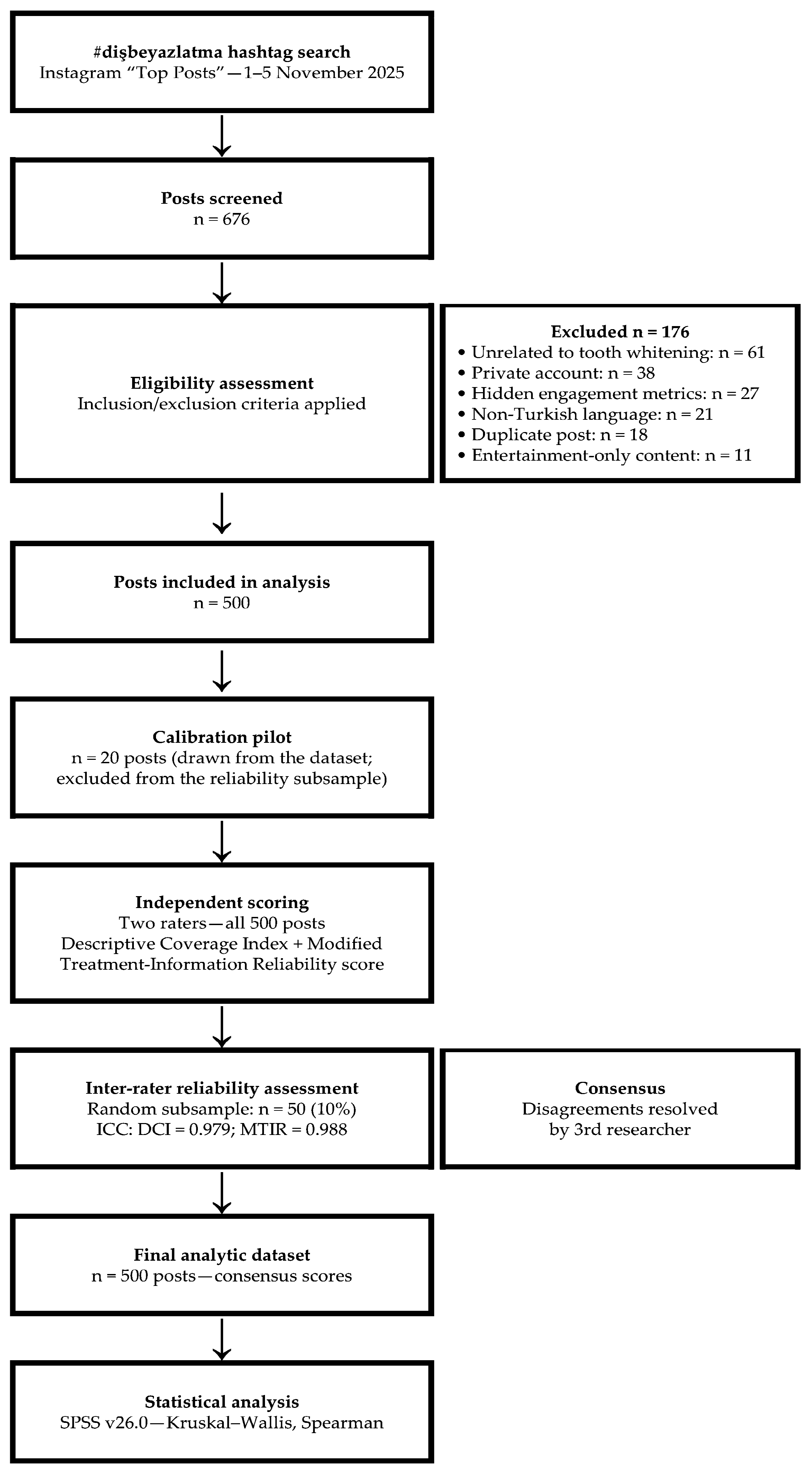
Accordingly, the present study aimed to compare the scope and reliability of information in popular Turkish Instagram posts about tooth whitening by poster source. It also examined whether post format, posting purpose, and whitening approach were associated with these measures, and whether higher-quality information was related to normalized audience engagement. Two research questions were addressed: (1) whether posts from dentists or clinics demonstrated greater information reliability than posts from independent users or brand accounts (primary aim); and (2) as a secondary, exploratory question, whether information quality was associated with normalized audience engagement within this algorithmically curated sample, an association that should be interpreted with caution given that engagement also served as an implicit inclusion criterion for Top Posts.
4. Discussion
The internet and social media have transformed health communication from a traditional one-way model into a dynamic ecosystem in which patients can access information instantly and shape their treatment-related decisions accordingly [
1,
2]. In esthetic dentistry, where visual outcomes play a particularly prominent role, patients show a strong tendency to review independent users’ experiences, dentists’ portfolios, and before-and-after images related to topics such as the “Hollywood smile” and tooth whitening, before presenting for clinical care [
6]. Within this high-volume information environment, hashtags serve as key tools for categorizing content and enhancing its visibility to target audiences [
1,
6]. In this context, the hashtag #dişbeyazlatma was selected for analysis because it was among the Turkish-language hashtags with the highest number of relevant posts. It should be acknowledged, however, that the Top Posts section reflects Instagram’s engagement-based curation rather than a neutral sample of all available content; accordingly, engagement-related findings in this study are conditional on this pre-selection, as detailed in
Section 3.8. This tendency to prioritize high-engagement content, potentially at the expense of scientific rigor, has been documented in other healthcare social media contexts, including oncology and vaccine communication [
24,
25].
The findings of the present study indicate that popular Turkish Instagram content on tooth whitening is heterogeneous in terms of informational scope and reliability. Although the informational scope did not differ significantly by poster source, dentist/clinic accounts demonstrated higher Modified Treatment-Information Reliability scores than independent users and brand accounts, suggesting that professional authorship may be associated with more reliable digital oral health communication. The moderate-to-strong positive correlation between Descriptive Coverage Index and Modified Treatment-Information Reliability score (r = 0.629) further suggests that posts covering a broader range of whitening-related topics may also be more likely to present information in a more balanced and trustworthy manner. Nevertheless, these two instruments assess related but distinct dimensions of information quality, and their differing patterns across source categories support their use as complementary rather than redundant measures.
The most important interpretive constraint on source-level comparisons in this dataset is the near-complete collinearity between poster source and whitening approach (Cramér’s V = 0.701), a central structural finding rather than a mere nuisance covariate. Because dentist/clinic accounts primarily focused on in-office whitening, which was associated with substantially higher quality scores, and independent users predominantly focused on DIY methods, which were associated with lower scores, the source-level difference in Modified Treatment-Information Reliability score is substantially confounded by content domain. To address this directly, two supplementary analyses were conducted. The ordinal logistic regression model satisfied the proportional odds assumption (Test of Parallel Lines:
p = 0.150). However, the Deviance goodness-of-fit statistic indicated marginal model misfit (
p = 0.043), likely reflecting sparse cells arising from the strong association between poster source and whitening approach. This misfit implies that the point estimates of the odds ratios, including OR = 3.54 for dentist/clinic accounts, should be treated as approximate rather than precise, and the regression findings should be interpreted accordingly as directional rather than quantitatively definitive. With this caveat noted, the model confirmed that the dentist/clinic accounts were significantly more likely to achieve a higher Modified Treatment-Information Reliability score category than the brand/commercial accounts after controlling for whitening approach (OR = 3.54, 95% CI: 1.33–9.42,
p = 0.011; Nagelkerke R
2 = 0.276). Approach-stratified Kruskal–Wallis analyses further demonstrated that significant source-related differences in Modified Treatment-Information Reliability score were present within the OTC stratum (
p = 0.028; dentist/clinic > brand, adj.
p = 0.022). Within the DIY stratum (
n = 38), the Mann–Whitney U test yielded a statistically significant result (exact
p = 0.003); however, the dentist/clinic cell comprised only five posts, which is insufficient to support substantive interpretation. This result should therefore be regarded as consistent in direction with the overall source effect, but not as independent corroborating evidence. Taken together, while content domain substantially shapes quality scores, these analyses suggest that account type may contribute to information reliability beyond content domain, though this inference should be treated as directional given the sparse cells and marginal model fit noted above. This pattern is consistent with the findings reported by Li et al. (2026), who evaluated periodontitis-related short videos on TikTok and Xiaohongshu using the Modified Treatment-Information Reliability tool, and similarly found that dental professionals produced higher-quality content than non-medical uploaders with marked source-related differences in reliability scores [
18]. This convergence supports the hypothesis that professional authorship contributes to information reliability across dental social media contexts, a pattern consistent with recent analyses of orthodontic content [
31] and with earlier systematic evidence that health content quality varies substantially by source type [
2]. Nevertheless, replication across additional platforms, clinical topics, and linguistic contexts is needed before broad generalization is warranted. These findings also underscore the importance of controlling for content domain when interpreting source-level comparisons, given the strong confounding between poster source and whitening approach observed in the present study [
12,
13].
A different pattern emerged for audience engagement on Instagram. Independent-user posts generated higher raw counts of likes and comments than posts shared by dentist/clinic or brand accounts; however, these differences were no longer evident after normalization for follower count, suggesting that the apparent engagement advantage largely reflects account size rather than greater per-follower interaction. Normalized engagement differed across Modified Treatment-Information Reliability quality categories (Kruskal–Wallis test significant); however, the underlying association was weak (Spearman r = 0.141; r2 ≈ 0.02). Given the pronounced right skew of Engagement Rate and the small number of high-quality posts (n = 43), this pattern is parsimoniously interpreted as evidence that higher information reliability was not associated with reduced engagement, rather than as evidence of a meaningful positive effect.
Post format and posting purpose provided further context for these findings. The Reel posts achieved higher scores on both content scope and information reliability than the photo posts; the carousel posts achieved higher reliability scores than the photo posts (adj.
p = 0.006) and, notably, demonstrated a higher average rank than the Reel posts on this measure (291.38 vs. 271.53), though this difference did not reach statistical significance (adj.
p = 1.000); the difference in content scope between the carousel and photo posts did not reach statistical significance after Bonferroni correction (adj.
p = 0.073). These patterns are consistent with the greater content capacity of dynamic and multi-panel formats. This advantage may be particularly pronounced in dentistry, where clinically adequate communication frequently requires sequential presentation of procedural steps, safety precautions, contraindications, and expected outcomes, information that a single static image is structurally unable to accommodate. Reels afford temporal ordering of content, enabling creators to walk viewers through a whitening procedure step-by-step in a manner that maps naturally onto the logic of clinical explanation; carousel formats offer a comparable advantage through spatially ordered multi-panel disclosure. The higher reliability scores of these formats may therefore reflect not merely greater available space, but also a structural alignment between their affordances and the communicative demands of evidence-based dental health information. Regarding posting purpose, the experience-based posts attracted substantially greater raw engagement counts than the educational or marketing posts, a pattern consistent with the broader literature on audience responsiveness to personal narrative in digital health communication [
2]. This observation must, however, be interpreted with caution given that the experience-based category comprised only 10 posts; the substantial raw engagement counts recorded for this group likely reflect a small number of high-reach outlier accounts rather than a systematic pattern generalizable to this content type. Nonetheless, these raw engagement differences did not persist after normalization for audience size (Engagement Rate:
p = 0.750), suggesting that the apparent engagement advantage of experience-based posts primarily reflects account reach rather than superior interaction efficiency.
The engagement data add a strategically important dimension to this interpretation. The Reel posts demonstrated significantly higher normalized Engagement Rates than the photo posts (adj.
p < 0.001), whereas the carousel posts did not differ significantly from either format. This pattern suggests that Reels distinctively combine informational capacity with audience reach in this sample, an alignment that carousel posts, despite their comparable reliability advantage over photos, did not replicate in terms of normalized engagement [
6]. Carousel formats, while structurally capable of layered disclosure, do not appear to confer the same engagement advantage within this high-visibility sampling frame, which may reflect platform-level algorithmic prioritization of video content over static multi-panel posts. Whether this engagement pattern reflects genuine viewer preference for video-based dental content or algorithmic amplification of the Reels format cannot be determined from the present data and warrants direct investigation. In this regard, Li et al. (2026) reported that TikTok demonstrated significantly higher user engagement than Xiaohongshu for periodontitis-related videos, and that higher-quality content was not penalized in terms of audience interaction [
18]; a convergent pattern was observed in the present study, in which the platform’s engagement-based curation did not appear to actively penalize evidence-informed content. As noted in
Section 3.8, however, this observation is conditioned on the Top Posts sampling frame and cannot support causal inference; platform differences also preclude direct comparison with the Li et al. findings [
18].
The observed reliability advantage of Reels and carousel posts, and the content scope advantage specific to Reels, should, however, be interpreted with an important caveat: poster source and post format were significantly associated (Cramér’s V = 0.292;
Table 5), with the dentist/clinic accounts more frequently utilizing these formats. Consequently, the apparent format effect on information quality may partly reflect the higher reliability of professionally authored content rather than an independent contribution of format per se. Disentangling these contributions, whether it is the format that enables higher quality, the professional author who chooses the format, or both, was beyond the scope of the present study and represents a priority for future research employing designs capable of isolating format effects independently of source type.
Whether repeated exposure to highly visible social media content shapes patients’ prior expectations and treatment preferences before professional consultation was not assessed in this study; this question warrants direct investigation in future research, as it has direct implications for pre-consultation communication in esthetic dentistry [
6,
15]. These findings suggest that dental professionals may benefit from awareness of the whitening-related content their patients are likely to have encountered through highly visible social media posts [
12,
18]. Because of the cross-sectional observational design, the associations identified in this study should be interpreted as descriptive rather than causal.
Legal and Ethical Considerations
The regulatory and ethical dimensions of social media dental advertising warrant explicit consideration in interpreting the present findings. In Turkey, medical and dental advertising is subject to restrictions under the Law on the Practice of Medicine and Medical Arts (Law No. 1219) and the professional ethical guidelines issued by the Turkish Medical Association, which limit promotional health communications by licensed practitioners. Additionally, tooth whitening products are regulated under the Turkish Cosmetic Regulation (Kozmetik Yönetmeliği, Annex III/12), which is harmonized with EU Directive 2011/84/EU and restricts the sale of products containing more than 0.1% hydrogen peroxide to dental practitioners [
32,
33]. The observation that 72.0% of sampled posts were classified as marketing-oriented raises the question of whether a substantial proportion of this content may operate at or beyond the boundaries of these regulatory frameworks, particularly where clinically licensed accounts engage in direct promotional communication. The present study was not designed to adjudicate regulatory compliance and did not apply legal criteria to post classification; accordingly, no inference regarding individual legal liability is made or implied. Nevertheless, the scale of marketing-oriented content in the highest-visibility stratum of a major dental health hashtag is a finding that may be of relevance to Turkish professional regulatory bodies and to researchers investigating the intersection of digital health communication and advertising law.
The present findings also speak to a broader transition in health communication: from a traditional one-way dissemination model toward what has been described as a “supervised digital health” ecosystem, in which authoritative institutions actively curate and endorse online content [
19,
20]. In the absence of such institutional scaffolding, the burden of evaluating dental information falls disproportionately on the patient, a burden that public e-health literacy interventions are specifically designed to address. E-health literacy, defined as the ability to seek, find, and critically appraise health information from electronic sources [
34], has been shown to improve when official health bodies actively engage in content curation and digital health education [
35]. Strengthening these institutional mechanisms represents a priority direction for dental public health communication, particularly in high-penetration social media environments such as Turkey’s [
11].
Future studies should consider incorporating regulatory compliance assessment as a distinct analytical dimension, particularly in jurisdictions with explicit statutory frameworks governing health-related commercial communication on social media. More broadly, the present findings support the argument that professional authorship, while associated with higher reliability, is insufficient in the absence of institutional quality oversight: content produced by licensed professionals that is predominantly marketing-oriented may still fall short of the evidence-based communication standards recommended by WHO for digital health environments [
19]. Strengthening public e-health literacy, defined as the ability to seek, find, and critically evaluate health information from digital sources [
34,
36], represents a complementary strategy, particularly for patients who lack the professional background to independently evaluate DIY whitening claims. The development and adoption of institutional endorsement mechanisms, such as professional society certification of social media dental health content, represents a priority direction for the field [
19,
37].
This study has several limitations. First, the analysis was restricted to Top Posts, which are shaped by Instagram’s platform-specific visibility algorithms and may not reflect the full range of whitening-related content. In addition, because engagement served both as a determinant of Top Posts inclusion and as an outcome under analysis, a degree of selection-on-outcome circularity should be acknowledged when interpreting the engagement-related findings. Second, the sampling frame was based on a single Turkish-language hashtag. It is also possible that #dişbeyazlatma overrepresents professionally generated content relative to other whitening-related hashtags, potentially biasing source-level comparisons toward higher reliability scores for dentist/clinic accounts. Third, the poster source was classified based on publicly visible account characteristics and could not be independently verified in all cases. Fourth, although the scoring framework was adapted from previously used instruments, the Descriptive Coverage Index was applied in its original binary format (1 point per criterion present; maximum 8 points). In addition, the exclusion of
Section 1 from the original Modified DISCERN instrument also represents a deliberate structural adaptation. Neither instrument has been formally validated in Turkish-language short-form social media contexts. More broadly, the DCI, which is used here as a descriptive information-coverage index, lacks published evidence of external validation in any context: no study to date has established its construct validity, criterion validity, or measurement equivalence across samples. The Modified Treatment-Information Reliability score benefits from a stronger validation lineage through its derivation from the original Modified DISCERN instrument [
26]; however, the structural adaptations applied here, binary scoring and the exclusion of
Section 1, have not been independently evaluated. These absences represent a field-level limitation rather than a study-specific shortcoming, underscoring the need for systematic psychometric evaluation of content-analytic instruments used in dental social media research. In particular, future studies should develop and validate a content-analytic instrument specifically calibrated to the communicative and clinical demands of cosmetic dentistry social media content, including criterion validity assessment against expert consensus ratings and cross-platform measurement equivalence testing. Fifth, audience engagement should not be interpreted as a direct indicator of educational value or behavioral impact; higher visibility may reflect attention capture rather than knowledge acquisition [
2]. Sixth, the present study did not assess whether the sampled content complied with Turkish regulatory restrictions on tooth whitening products and procedures. Seventh, the independent user category encompasses considerable internal heterogeneity, including DIY content creators, OTC product reviewers, and experience-based testimonial accounts, each with markedly different risk profiles and motivations. Grouping these accounts under a single category may therefore obscure meaningful within-group variation and should be considered when interpreting source-level comparisons. Of particular relevance, the present classification system did not distinguish between genuinely independent users and influencers who may have undisclosed commercial relationships with product brands. Where an account is nominally classified as “independent”, yet the predominant posting purpose is marketing-oriented, the reliability of the content may be structurally compromised in ways that the source classification alone does not capture. Future studies should incorporate disclosure status and commercial affiliation as explicit classification variables to address this ambiguity. Eighth, the supplementary ordinal logistic regression model showed marginal misfit on the Deviance goodness-of-fit statistic (
p = 0.043), with the proportional odds assumption formally met (Test of Parallel Lines: χ
2(6) = 9.449,
p = 0.150); as discussed in
Section 4, this misfit is attributable to sparse cells arising from the strong source–approach collinearity, and the OR estimates should be treated as directional rather than quantitatively precise. Future studies should employ oversampling of underrepresented source–content combinations to provide more precise point estimates. However, approach-stratified analyses were constrained by severely unequal group sizes across the multiple methods and by unspecified strata, which precluded meaningful comparisons within those categories. Finally, as data collection was completed within a five-day window in November 2025, the findings reflect a temporally fixed snapshot of a highly dynamic content environment [
12,
13].
5. Conclusions
Popular Turkish Instagram posts on tooth whitening showed substantial variability in both content scope and information reliability. Dentist/clinic accounts demonstrated higher reliability scores than independent users and brand accounts, yet commanded substantially lower raw audience reach; among the independent users, DIY-focused content, which was associated among the lower content scope scores across approach categories (median DCI = 3.50) and with information reliability scores among the lowest across all approach categories (median Modified Treatment-Information Reliability = 2.00, shared with OTC and unspecified/other groups), was the predominant whitening approach (45.8%). However, the content scope did not differ significantly by source. The source-level reliability difference should be interpreted in the context of strong confounding by the whitening approach. Post format and whitening approach were each significantly associated with content scope and information reliability; in-office-focused posts scored higher on both measures, Reels scored higher than photos on both measures, and carousel posts scored higher than photos on reliability but not on content scope. These associations should be interpreted with caution, however, as post format and whitening approach were both strongly associated with poster source, and no multivariate analysis was conducted to isolate their independent contributions. While independent users generated higher raw engagement metrics, these differences were no longer evident after normalization for audience size. Within this sampling frame, higher information reliability was not associated with reduced normalized audience engagement; this observation is hypothesis-generating and should not be interpreted as establishing a causal or platform-generalizable relationship, given the circularity inherent to the Top Posts sampling design (
Section 3.8). Given the observational design and hashtag-based sampling frame, generalization beyond the conditions of this study is not warranted. Nonetheless, the descriptive patterns identified here may provide preliminary evidence to inform how dental professionals and public health communicators approach content development on social media platforms targeting Turkish-speaking audiences.
Future research should examine whether the source-level and format-related patterns identified here replicate across additional dental topics, platforms, and language contexts, and whether longitudinal or experimental designs can establish directional relationships between content quality and audience engagement that cannot be inferred from cross-sectional sampling. In particular, multivariable modeling approaches and stratified sampling designs with more balanced group sizes across poster source, post format, and whitening approach would better disentangle the independent contributions of each factor to information quality and engagement, addressing the near-complete collinearity constraint identified in the present study. Prospective studies examining how exposure to social media content of varying quality influences patient knowledge, treatment expectations, and clinical decision-making would further advance the evidence base for digital oral health communication.