Effect of a Clear Communication Training on Medical Residents’ Use of Jargon in Written Messages to Patients

Highlights
- Medical residents use jargon in personalized written communication with patients.
- Residents’ use of unexplained jargon in written messages to patients decreased during 3 months of follow-up after a brief training on health literacy and clear communication.
- Participation in a skill-building workshop that includes rewriting messages to improve understandability for patients may contribute to the development of plain language habits regarding unexplained jargon use among resident physicians.
- To our knowledge, this is the first study to quantify physicians’ use of jargon in written communication with patients, and the first to show a reduction in such jargon associated with training.
Abstract
1. Introduction
1.1. Jargon
1.2. Readability
1.3. Curriculum
2. Materials and Methods
2.1. Design
2.2. Data Collection
2.3. Defining and Operationalizing Jargon
2.4. Coding Medical Jargon
2.5. Undefined Jargon
2.6. Jargon Counting
2.7. Grade-Level Readability
2.8. Statistical Analysis
3. Results
4. Discussion
5. Conclusions
Author Contributions
Funding
Institutional Review Board Statement
Informed Consent Statement
Data Availability Statement
Acknowledgments
Conflicts of Interest
References
- Coleman, C.; Hudson, S.; Pederson, B. Prioritized Health Literacy and Clear Communication Practices for Health Care Professionals. Health Lit. Res. Pract. 2017, 1, e91–e99. [Google Scholar] [CrossRef] [PubMed] [PubMed Central]
- Coleman, C.A.; Hudson, S.; Maine, L.L. Health literacy practices and educational competencies for health professionals: A consensus study. J. Health Commun. 2013, 18, 82–102. [Google Scholar] [CrossRef] [PubMed] [PubMed Central]
- Richwine, C. Individuals’ Access and Use of Patient Portals and Smartphone Health Apps, 2024. In ASTP Health IT Data Brief [Internet]; Office of the Assistant Secretary for Technology Policy: Washington, DC, USA, 2025. [Google Scholar] [PubMed]
- Castro, C.M.; Wilson, C.; Wang, F.; Schillinger, D. Babel babble: Physicians’ use of unclarified medical jargon with patients. Am. J. Health Behav. 2007, 31, S85–S95. [Google Scholar] [CrossRef] [PubMed]
- Charpentier, V.; Gotlieb, R.; Praska, C.E.; Hendrickson, M.; Pitt, M.B.; Marmet, J. Say What? Quantifying and Classifying Jargon Use During Inpatient Rounds. Hosp. Pediatr. 2021, 11, 406–410. [Google Scholar] [CrossRef] [PubMed]
- Deuster, L.; Christopher, S.; Donovan, J.; Farrell, M. A method to quantify residents’ jargon use during counseling of standardized patients about cancer screening. J. Gen. Intern. Med. 2008, 23, 1947–1952. [Google Scholar] [CrossRef] [PubMed] [PubMed Central]
- Green, J.A.; Gonzaga, A.M.; Cohen, E.D.; Spagnoletti, C.L. Addressing health literacy through clear health communication: A training program for internal medicine residents. Patient Educ. Couns. 2014, 95, 76–82. [Google Scholar] [CrossRef] [PubMed]
- Howard, T.; Jacobson, K.L.; Kripalani, S. Doctor talk: Physicians’ use of clear verbal communication. J. Health Commun. 2013, 18, 991–1001. [Google Scholar] [CrossRef] [PubMed]
- Koch-Weser, S.; Dejong, W.; Rudd, R.E. Medical word use in clinical encounters. Health Expect. 2009, 12, 371–382. [Google Scholar] [CrossRef] [PubMed] [PubMed Central]
- Links, A.R.; Callon, W.; Wasserman, C.; Walsh, J.; Beach, M.C.; Boss, E.F. Surgeon use of medical jargon with parents in the outpatient setting. Patient Educ. Couns. 2019, 102, 1111–1118. [Google Scholar] [CrossRef] [PubMed] [PubMed Central]
- Miller, A.N.; Bharathan, A.; Duvuuri, V.N.S.; Navas, V.; Luceno, L.; Zraick, R.; Atmakuri, S.; Schmidt-Owens, M.; Deichen, M.; Ayers, T.; et al. Use of seven types of medical jargon by male and female primary care providers at a university health center. Patient Educ. Couns. 2022, 105, 1261–1267. [Google Scholar] [CrossRef] [PubMed]
- Rainey, R.; Theiss, L.; Lopez, E.; Wood, T.; Wood, L.; Marques, I.; Cannon, J.A.; Kennedy, G.D.; Morris, M.S.; Hollis, R.; et al. Characterizing the impact of verbal communication and health literacy in the patient-surgeon encounter. Am. J. Surg. 2022, 224, 943–948. [Google Scholar] [CrossRef] [PubMed]
- Wood, M.; Gupta, A. Identifying and classifying medical jargon through analysis of recorded standardized patient encounters. Patient Educ. Couns. 2021, 104, 2122–2125. [Google Scholar] [CrossRef] [PubMed]
- Karnieli-Miller, O.; Adler, A.; Merdler, L.; Rosenfeld, L.; Eidelman, S. Written notification of test results: Meanings, comprehension and implication on patients’ health behavior. Patient Educ. Couns. 2009, 76, 341–347. [Google Scholar] [CrossRef] [PubMed]
- Barker, K.L.; Reid, M.; Minns Lowe, C.J. What does the language we use about arthritis mean to people who have osteoarthritis? A qualitative study. Disabil. Rehabil. 2014, 36, 367–372. [Google Scholar] [CrossRef] [PubMed]
- Cosic, F.; Kimmel, L.; Edwards, E. Patient Comprehension of Common Orthopedic Terminology. Health Lit. Res. Pract. 2019, 3, e187–e193. [Google Scholar] [CrossRef] [PubMed] [PubMed Central]
- Dua, R.; Vassiliou, L.; Fan, K. Common maxillofacial terminology: Do our patients understand what we say? Surgeon 2015, 13, 1–4. [Google Scholar] [CrossRef] [PubMed]
- Gotlieb, R.; Praska, C.; Hendrickson, M.A.; Marmet, J.; Charpentier, V.; Hause, E.; Allen, K.A.; Lunos, S.; Pitt, M.B. Accuracy in Patient Understanding of Common Medical Phrases. JAMA Netw. Open 2022, 5, e2242972. [Google Scholar] [CrossRef] [PubMed] [PubMed Central]
- Hayes, E.; Dua, R.; Yeung, E.; Fan, K. Patient understanding of commonly used oral medicine terminology. Br. Dent. J. 2018, 223, 842–845. [Google Scholar] [CrossRef] [PubMed]
- O’Connell, R.L.; Hartridge-Lambert, S.K.; Din, N.; St John, E.R.; Hitchins, C.; Johnson, T. Patients’ understanding of medical terminology used in the breast clinic. Breast 2013, 22, 836–838. [Google Scholar] [CrossRef] [PubMed]
- Pieterse, A.H.; Jager, N.A.; Smets, E.M.; Henselmans, I. Lay understanding of common medical terminology in oncology. Psychooncology 2013, 22, 1186–1191. [Google Scholar] [CrossRef] [PubMed]
- Rau, N.M.; Basir, M.A.; Flynn, K.E. Parental understanding of crucial medical jargon used in prenatal prematurity counseling. BMC Med. Inform. Decis. Mak. 2020, 20, 169. [Google Scholar] [CrossRef] [PubMed] [PubMed Central]
- Kutner, M.; Greenberg, E.; Jin, Y.; Paulsen, C. The Health Literacy of America’s Adults: Results from the 2003 National Assessment of Adult Literacy; National Center for Education Statistics, United States Department of Education: Washington, DC, USA, 2006.
- Santana, S.; Brach, C.M.; Harris, L.; Ochiai, E.; Blakey, C.B.; Bevington, F.M.; Kleinman, D.D.; Pronk, N.P. Updating Health Literacy for Healthy People 2030: Defining Its Importance for a New Decade in Public Health. J. Public Health Manag. Pract. 2021, 27, S258–S264. [Google Scholar] [CrossRef] [PubMed] [PubMed Central]
- Forsey, J.; Ng, S.; Rowland, P.; Freeman, R.; Li, C.; Woods, N.N. The Basic Science of Patient-Physician Communication: A Critical Scoping Review. Acad. Med. 2021, 96, S109–S118. [Google Scholar] [CrossRef] [PubMed]
- Wernick, M.; Hale, P.; Anticich, N.; Busch, S.; Merriman, L.; King, B.; Pegg, T. A randomised crossover trial of minimising medical terminology in secondary care correspondence in patients with chronic health conditions: Impact on understanding and patient reported outcomes. Intern. Med. J. 2016, 46, 596–601. [Google Scholar] [CrossRef] [PubMed]
- Hitchcock, E.; Sanders, S. An Intervention to Teach Physicians to Use Plain Language for After Visit Summaries. J. Grad. Med. Educ. 2016, 8, 450–451. [Google Scholar] [CrossRef] [PubMed] [PubMed Central][Green Version]
- Wang, L.W.; Miller, M.J.; Schmitt, M.R.; Wen, F.K. Assessing readability formula differences with written health information materials: Application, results, and recommendations. Res. Soc. Adm. Pharm. 2013, 9, 503–516. [Google Scholar] [CrossRef] [PubMed]
- Berkman, N.D.; Dewalt, D.A.; Pignone, M.P.; Sheridan, S.L.; Lohr, K.N.; Lux, L.; Sutton, S.F.; Swinson, T.; Bonito, A.J. Literacy and health outcomes. Evid. Rep. Technol. Assess. 2004, 19, 1–8. [Google Scholar] [PubMed] [PubMed Central]
- Coleman, C.A.; Nguyen, N.T.; Garvin, R.; Sou, C.; Carney, P.A. Health Literacy Teaching in U.S. Family Medicine Residency Programs: A National Survey. J. Health Commun. 2016, 21, 51–57. [Google Scholar] [CrossRef] [PubMed]
- Meyers, N.; Friedman, S.; Morrison, A.; Costich, M.; Gupta, A.; Moore, B.; Abrams, M.A.; Wood, M.; Solano, J. Health Literacy Curricula in Pediatric Residency Programs: A National Survey. Health Lit. Res. Pract. 2025, 9, e3–e7. [Google Scholar] [CrossRef] [PubMed] [PubMed Central]
- Coleman, C.; Peterson-Perry, S.; Sachdeva, B.; Kobus, A.; Garvin, R. Long-term Effects of a Health Literacy Curriculum for Family Medicine Residents. PRiMER Peer-Rev. Rep. Med. Educ. Res. 2017, 1, 22. [Google Scholar] [CrossRef] [PubMed] [PubMed Central]
- Coleman, C. Teaching health care professionals about health literacy: A review of the literature. Nurs. Outlook 2011, 59, 70–78. [Google Scholar] [CrossRef] [PubMed]
- Pitt, M.B.; Hendrickson, M.A. Eradicating Jargon-Oblivion-A Proposed Classification System of Medical Jargon. J. Gen. Intern. Med. 2019, 35, 1861–1864. [Google Scholar] [CrossRef] [PubMed] [PubMed Central]
- Taylor, A.M.; Diggle, P.; Wessels, Q. What do the public know about anatomy? Anatomy education to the public and the implications. Anat. Sci. Educ. 2018, 11, 117–123. [Google Scholar] [CrossRef] [PubMed]
- Lenahan, J.L.; McCarthy, D.M.; Davis, T.C.; Curtis, L.M.; Serper, M.; Wolf, M.S. A drug by any other name: Patients’ ability to identify medication regimens and its association with adherence and health outcomes. J. Health Commun. 2013, 18, 31–39. [Google Scholar] [CrossRef] [PubMed] [PubMed Central]
- Berman, J.R.; Aizer, J.; Bass, A.R.; Blanco, I.; Davidson, A.; Dwyer, E.; Fields, T.R.; Huang, W.-T.; Kang, J.S.; Kerr, L.D.; et al. Fellow use of medical jargon correlates inversely with patient and observer perceptions of professionalism: Results of a rheumatology OSCE (ROSCE) using challenging patient scenarios. Clin. Rheumatol. 2016, 35, 2093–2099. [Google Scholar] [CrossRef] [PubMed]
- Hill-Briggs, F.; Schumann, K.P.; Dike, O. Five-step methodology for evaluation and adaptation of print patient health information to meet the <5th grade readability criterion. Med. Care 2012, 50, 294–301. [Google Scholar] [CrossRef] [PubMed] [PubMed Central]
- Yakushi, J.; Wintner, M.; Yau, N.; Borgo, L.; Solorzano, E. Utilization of Secure Messaging to Primary Care Departments. Perm. J. 2020, 24, 19–177. [Google Scholar] [CrossRef] [PubMed] [PubMed Central]
- Coleman, C.; Birk, S.; Stowers, K.; Mullowney, C.; Chisholm-Burns, M. The hidden curriculum undermines teaching about health literacy and clear communication, promoting inequities in care. Soc. Sci. Med. 2025, 386, 118545. [Google Scholar] [CrossRef] [PubMed]
- Coleman, C.; Salcido-Torres, F.; Cantone, R.E. “What Questions Do You Have?” Teaching Medical Students to Use an Open-Ended Phrase for Eliciting Patients’ Questions. Health Lit. Res. Pract. 2022, 6, e12–e16. [Google Scholar] [CrossRef] [PubMed] [PubMed Central]


| Session Title | Learning Objectives | Description | |
|---|---|---|---|
| Part 1 (June 2023) | Intro to Health Literacy and Clear Communication |
| 2 h interactive didactic |
| Part 2 (July 2023) | Spoken Communication Best Practices Workshop |
| 2 h skill-building workshop includes didactics, plus role-play practice discussing test results using plain language, and using teach-back |
| Part 3 (Feb 2024) | Numeracy: Writing Easy-To-Adhere-To Prescriptions * |
| 40 min interactive, didactic, and small team prescription-writing activity * |
| Part 4 (Feb 2024) | Written Communication Best Practices Workshop |
| 80 min skill-building workshop includes didactic review of best practices, plus rewriting test result notes for improved readability, understandability, and actionability * |
| Jargon Category | Description | Examples † | Notes and Exceptions |
|---|---|---|---|
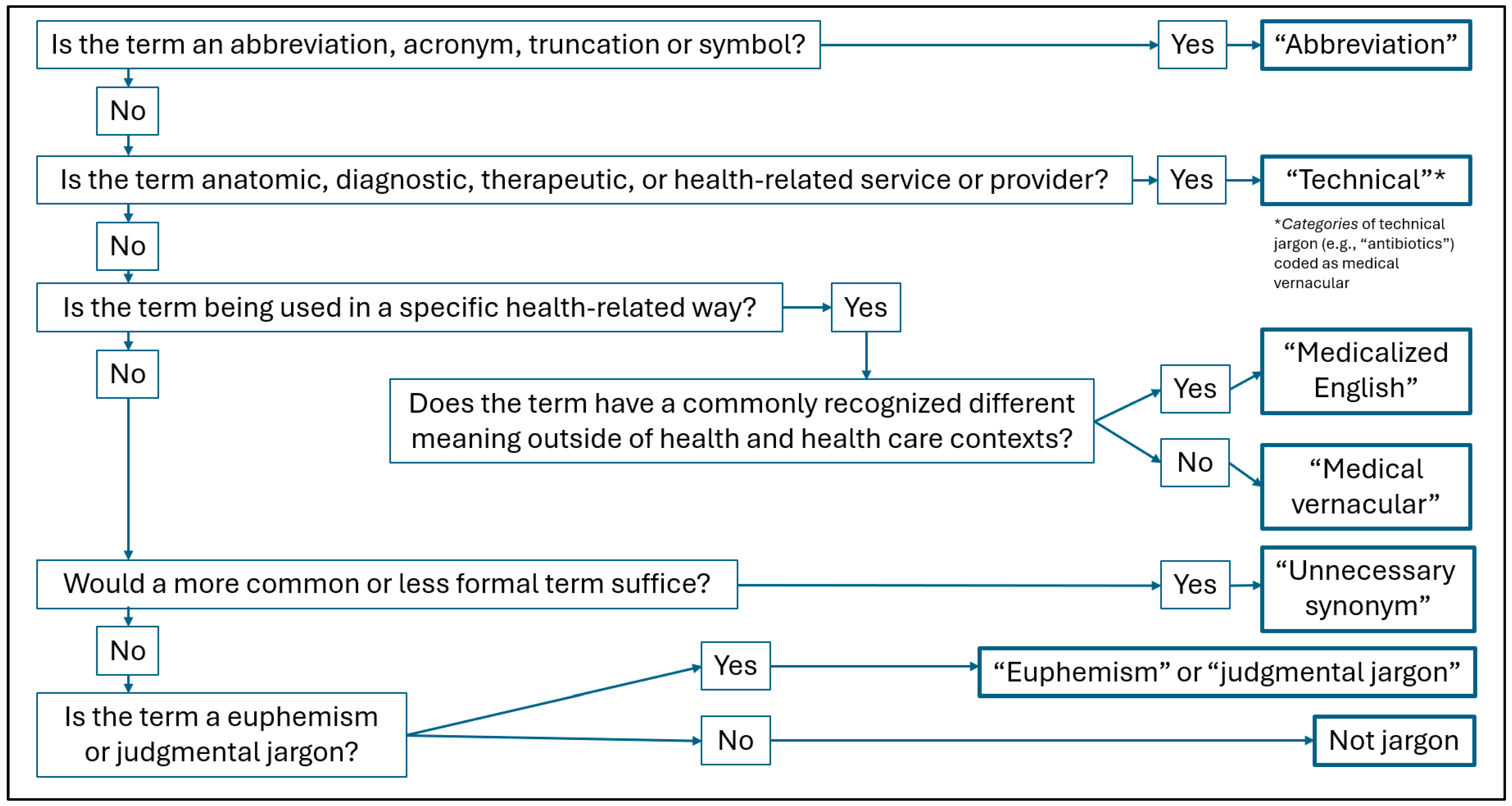
| Technical terms (classic jargon) | Anatomy, disease names, drug names, job titles, microbes, symptom names, tests and procedures, therapies | Bilirubin Colonoscopy Creatinine Gastroenterology Levothyroxine Lung Palpitations Plantar fascia Phlebotomy (lab) Triglycerides | Easily recognizable external anatomy (e.g., eyes, head, hips) was not coded as jargon; internal anatomy (e.g., heart, liver, lungs) was coded as jargon because internal anatomy is poorly understood (Taylor et al., 2018) [35] |
| Abbreviations, acronyms, truncations, or shorthand symbols | Acronyms for technical and non-technical terms, abbreviations and shorthand, symbols | < CBC COPD CT scan GI Lab mg Ortho Script (prescription) Snafu | Time (i.e., AM/PM), states (e.g., OR [Oregon]), directions (e.g., SW), and weblinks were not coded as jargon; “lab” and “exam” were coded as truncations but could also be medical vernacular |
| Medical vernacular | Categories of technical terms, descriptions of symptoms, syndromes, health-related phenomena, and neologisms | Antibiotics Blood pressure Chronic Diagnostics eConsult Electrolytes Follow-up [noun] Imaging Mental health Over-the-counters Procedure Provider Referral Side effects | “Schedule,” “appointment,” and “visit” were not coded as jargon due to widespread use in other contexts; “blood pressure” and “pill” were coded as jargon despite being preferred plain language alternatives to “hypertension” and “tablet,” for example |
| Medicalized English | Words with different meanings inside and outside of health-related contexts | Covered Drawn Indicated Negative Positive Stable Stool Study | |
| Unnecessary synonyms | Less common terms used when a more familiar one would suffice | Cumbersome Dissipate Expediency | Not included in analysis |
| Euphemisms and idioms | Vague phrasing or colloquialisms that attempt to soften language but may reduce clarity | Not a good candidate for surgery Slipping through the cracks | Not included in analysis |
| Judgmental jargon | Phrases that appear derogatory or suggest bias | [None observed] | Not included in analysis |
| Pre-Training | Post-Training | Total | p | |
|---|---|---|---|---|
| Number of resident authors | 9 | 9 | 9 | - |
| Total number of messages (all residents) | 210 | 211 | 421 | - |
| Mean (SD) number of messages per resident | 23.3 (18.4) | 23.4 (15.6) | 23.4 (16.6) | 0.989 |
| Total word count, all messages | 18,192 | 18,562 | 36,754 | - |
| Mean (SD) words per message | 86.6 (81.3) | 88.0 (75.5) | 87.3 (78.4) | 0.860 |
| Number of messages with ≥100 words | 51 | 57 | 108 | - |
| Mean (SD) grade-level readability of messages with ≥100 words * | 9.1 (2.9) [95% CI 8.7–9.5] | 9.1 (2.6) [95% CI 8.7–9.5] | 9.1 (2.7) [95% CI 8.8–9.4] | 0.896 |
| Subtype | Item | Pre-Training (n = 210) | Post-Training (n = 211) | p | Adjusted p † |
|---|---|---|---|---|---|
| Technical | Number of technical terms (all residents) | 481 | 483 | - | - |
| Number of unique * technical terms (all residents) | 414 | 418 | - | - | |
| Number (%) of unique * undefined technical terms | 399/414 (96.4%) | 386/418 (92.3%) | 0.01 | 0.07 | |
| Mean (SD) number of unique * undefined technical terms per message | 399/210 = 1.9 (2.4) | 386/211 = 1.8 (2.1) | 0.75 | 0.81 | |
| Mean (SD) unique * undefined technical jargon rate per 100 words | 2.2 (2.0) [95% CI 1.9–2.5] | 2.1 (1.8) [95% CI 1.9–2.3] | 0.29 | 0.51 | |
| Acronyms/abbreviations | Number of abbreviated terms (all residents) | 324 | 256 | - | - |
| Number of unique * abbreviated terms (all residents) | 270 | 220 | - | - | |
| Number (%) of unique * undefined abbreviated terms | 260/270 (96.3%) | 211/220 (95.9%) | 0.82 | 0.82 | |
| Mean (SD) number of unique * undefined abbreviation terms per message | 260/210 = 1.2 (1.7) | 211/211 = 1.0 (1.7) | 0.15 | 0.35 | |
| Mean (SD) unique * undefined abbreviated jargon rate per 100 words | 1.4 (1.8) [95% CI 1.2–1.6] | 1.1 (1.8) [95% CI 0.9–1.3] | 0.07 | 0.33 | |
| Medical vernacular | Number of vernacular terms (all residents) | 579 | 541 | - | - |
| Number of unique * vernacular terms (all residents) | 515 | 469 | - | - | |
| Number (%) of unique * undefined vernacular terms | 512/515 (99.4%) | 465/469 (99.2%) | 0.61 | 0.71 | |
| Mean (SD) number of undefined unique* vernacular terms per message | 512/210 = 2.4 (2.4) | 465/211 = 2.2 (1.9) | 0.27 | 0.51 | |
| Mean (SD) unique * undefined vernacular jargon rate per 100 words | 2.8 (2.2) [95% CI 2.5–3.1] | 2.5 (2.2) [95% CI 2.2–2.8] | 0.36 | 0.56 | |
| Medicalized English | Number of medicalized English terms (all residents) | 151 | 131 | - | - |
| Number of unique * medicalized English terms (all residents) | 131 | 118 | - | - | |
| Number (%) of unique * undefined medicalized English terms | 131/131 (100.0%) | 116/118 (98.3%) | 0.14 | 0.35 | |
| Mean (SD) number of unique * undefined medicalized English terms per message | 131/210 = 0.6 (1.2) | 116/211 = 0.5 (0.9) | 0.46 | 0.64 | |
| Mean (SD) unique * undefined medicalized English rate per 100 words | 0.7 (1.3) [95% CI 0.5–0.9] | 0.6 (1.1) [95% CI 0.4–0.8] | 0.60 | 0.71 | |
| All forms of jargon | Number of jargon terms—all types (all residents) | 1535 | 1411 | - | - |
| Number of unique * jargon terms—all types (all residents) | 1330 | 1225 | - | - | |
| Number (%) of unique * undefined jargon terms—all types | 1302/1330 (97.9%) | 1178/1225 (96.2%) | 0.01 | 0.07 | |
| Mean (SD) number of unique * undefined jargon terms per message— all types | 1302/210 = 6.2 (2.12) | 1178/211 = 5.6 (1.80) | 0.12 | 0.35 | |
| Mean (SD) unique * undefined jargon rate per 100 words—all jargon types | 7.2 (2.0) [95% CI 6.9–7.5] | 6.3 (2.0) [95% CI 6.0–6.6] | 0.05 | n/a ‡ |
Disclaimer/Publisher’s Note: The statements, opinions and data contained in all publications are solely those of the individual author(s) and contributor(s) and not of MDPI and/or the editor(s). MDPI and/or the editor(s) disclaim responsibility for any injury to people or property resulting from any ideas, methods, instructions or products referred to in the content. |
© 2026 by the authors. Licensee MDPI, Basel, Switzerland. This article is an open access article distributed under the terms and conditions of the Creative Commons Attribution (CC BY) license.
Share and Cite
Coleman, C.; Lin, C. Effect of a Clear Communication Training on Medical Residents’ Use of Jargon in Written Messages to Patients. Healthcare 2026, 14, 1374. https://doi.org/10.3390/healthcare14101374
Coleman C, Lin C. Effect of a Clear Communication Training on Medical Residents’ Use of Jargon in Written Messages to Patients. Healthcare. 2026; 14(10):1374. https://doi.org/10.3390/healthcare14101374
Chicago/Turabian StyleColeman, Cliff, and Chelsea Lin. 2026. "Effect of a Clear Communication Training on Medical Residents’ Use of Jargon in Written Messages to Patients" Healthcare 14, no. 10: 1374. https://doi.org/10.3390/healthcare14101374
APA StyleColeman, C., & Lin, C. (2026). Effect of a Clear Communication Training on Medical Residents’ Use of Jargon in Written Messages to Patients. Healthcare, 14(10), 1374. https://doi.org/10.3390/healthcare14101374