1. Introduction
Primary health care (PHC) systems play a central role in promoting population health, preventing disease, and addressing inequalities in access to health services. As the first point of contact between communities and health systems, PHC requires planning processes that are responsive to the actual needs of the populations served. Health needs assessment (HNA) is widely recognized as a key tool for aligning health policy, service planning, and resource allocation with population needs [
1,
2]. By identifying gaps between existing services and population needs, HNA can support the development of more responsive and equitable health systems, reflecting persistent gaps between population needs and actual service delivery [
3,
4].
However, traditional approaches to health needs assessment have largely relied on epidemiological indicators, administrative data, and service utilization patterns. While these sources provide valuable information about population health status, they often fail to capture the subjective, social, and contextual dimensions of health needs experienced by individuals and communities, including needs that remain unexpressed or insufficiently recognized within health systems [
5,
6,
7,
8]. Similar limitations have also been highlighted in applied public health contexts (i.e., real-world public health practice settings, including primary care delivery, community health planning, and resource allocation processes), where needs assessment processes remain fragmented and insufficiently integrated into planning and decision-making [
9,
10].
Health-related needs are not limited to clinically defined conditions but also encompass perceived, expressed, and unmet needs shaped by social context and individual experience, which may not be adequately captured through service utilization or epidemiological indicators [
2,
9]. This is further supported by recent evidence demonstrating the persistence of unmet health needs even within systems with established service provision, including well-resourced healthcare systems [
10]. In this study, we adopt a multidimensional concept of health-care need that builds on classic definitions of health needs assessment and the Andersen Behavioral Model of Health Services Use. Health-care needs are understood as needs that can benefit from health-care actions (prevention, diagnosis, treatment, rehabilitation and support), rather than only as clinically defined conditions, and include unmet needs that remain insufficiently recognized within health systems. Within Andersen’s model, need is treated as both perceived need—how people view and experience their own health status, symptoms and everyday functioning—and evaluated need, referring to more professional or objective assessments of health status and need for care [
11,
12,
13,
14,
15]. Building on these perspectives and on recent work in community health-needs assessment, we distinguish three interrelated dimensions of health-care needs in primary care settings: (a) subjective health-care needs, referring to individuals’ perceived current and future health problems, functional limitations and unmet needs for care; (b) social health-care needs, arising from social and economic conditions, roles and support networks that shape both health and the capacity to seek and use care; and (c) contextual health-care needs, related to characteristics of local services and broader environments that create or amplify gaps between population needs and available PHC provision.
These three dimensions guided item generation and are reflected in the factorial structure of the Primary Care Needs Assessment (PCNA) questionnaire, which comprises factors capturing perceived and unmet clinical and functional needs (subjective dimension), social and economic strain and support deficits (social dimension), and barriers related to the organization, accessibility and responsiveness of local primary-care services (contextual dimension) [
1,
7,
9,
16,
17,
18,
19,
20,
21].
This broader conceptualization underscores the need for approaches that move beyond predominantly biomedical and static assessments toward more integrative and context-sensitive models of needs assessment. In this direction, the integration of quantitative and qualitative data, as well as the inclusion of community perspectives alongside those of health professionals, has been increasingly recognized as essential for addressing the complexity of health needs in PHC settings [
22,
23,
24,
25].
Participatory approaches, particularly those grounded in community-based participatory research (CBPR), emphasize the active involvement of stakeholders in identifying priorities and shaping health interventions. Engaging community members and frontline professionals in the development of assessment tools can enhance their relevance, acceptability, and practical applicability [
25,
26,
27], while recent applications suggest their potential contribution to capturing context-specific and community-defined health needs [
20,
24].
However, such approaches are often applied as context-specific tools for project design and are iteratively refined based on stakeholder feedback, without being systematically translated into standardized, psychometrically validated instruments [
16,
19].
A complex interplay of individual, social, and structural factors shapes health needs and health service utilization. The Andersen Behavioral Model of Health Services Use provides a widely recognized framework for understanding this complexity, distinguishing between predisposing, enabling, and need-related factors at both individual and contextual levels [
11,
12,
13,
14,
15]. Within this framework, health needs are understood not solely as clinical conditions but as outcomes of dynamic interactions between perceived needs, access to services, and broader social determinants.
Several quantitative instruments have been developed to assess health needs or related constructs, including generic health status measures such as the Nottingham Health Profile (NHP) [
28,
29], PHC assessment tools [
30,
31], and condition-specific needs questionnaires [
17,
19]. More recently, quantitative approaches to measuring unmet healthcare needs have been implemented in population-based surveys and toolkits, using standardized questions and indicators to capture both expressed and unexpressed needs across different conditions and settings [
10,
18].
While these approaches provide valuable population-level insights, they often rely on predefined indicators (e.g., consultation rates, referral patterns, screening uptake) and may therefore fail to capture the contextual, subjective, and community-defined dimensions of health needs, particularly in PHC settings characterized by complex and evolving needs (e.g., workforce constraints, patient–provider relational dynamics, varying levels of community trust) [
2,
8,
18].
However, many existing quantitative tools are either condition-specific, primarily focused on service performance, or embedded in large-scale survey frameworks, which may limit their applicability as flexible, community-oriented instruments for assessing perceived, unmet, and contextual health needs in PHC settings [
1,
18,
21].
In addition, many existing instruments are based on predefined and predominantly biomedical categories of need, which may constrain their ability to capture the dynamic and context-dependent nature of health needs [
5,
8]. Widely used PHC assessment tools, such as the Primary Care Assessment Tool (PCAT) [
30,
31] and the Patient-Centred Primary Care Measure (PCPCM) [
32,
33], have contributed significantly to the evaluation of PHC performance; however, they primarily focus on service attributes and care experiences (i.e., individual encounters with health services, such as satisfaction and communication quality) rather than on the assessment of community-perceived and context-dependent health needs (i.e., broader social, environmental, and systemic factors that shape access to and utilization of care beyond the clinical encounter) [
34]. Moreover, existing instruments vary considerably in their scope and psychometric robustness, with only a limited number comprehensively capturing core primary care attributes while demonstrating adequate validity and reliability [
35,
36]. Recent studies highlight the need for more integrative and context-sensitive approaches to needs assessment in PHC [
20,
36,
37,
38].
Taken together, these limitations highlight a gap in the availability of validated, community-oriented instruments for assessing health needs in PHC settings [
1,
21]. Although the Andersen Behavioral Model has been widely applied in health services research [
13,
14,
15], its multidimensional structure is not always fully operationalized in existing assessment tools, particularly in ways that reflect the interplay of individual, social, and contextual determinants of health needs.
To address these gaps, the present study introduces the Primary Care Needs Assessment (PCNA), a multidimensional instrument designed to assess perceived, unmet, and contextual health needs within community populations in PHC settings. The instrument was developed through a mixed-methods approach integrating perspectives from PHC professionals and community members into the instrument development process.
The aim of the present study was to develop and validate a context-sensitive PCNA questionnaire and to examine its factorial structure and reliability using exploratory and confirmatory factor analysis. By integrating community perspectives, defined as the lived experiences, priorities, and self-identified needs of community members and local stakeholders, into the development and validation of a needs assessment instrument, the study endeavours to provide a structured tool for assessing population healthcare needs and to support evidence-informed planning and decision-making in PHC systems.
2. Materials and Methods
2.1. Generating the PCNA Questionnaire
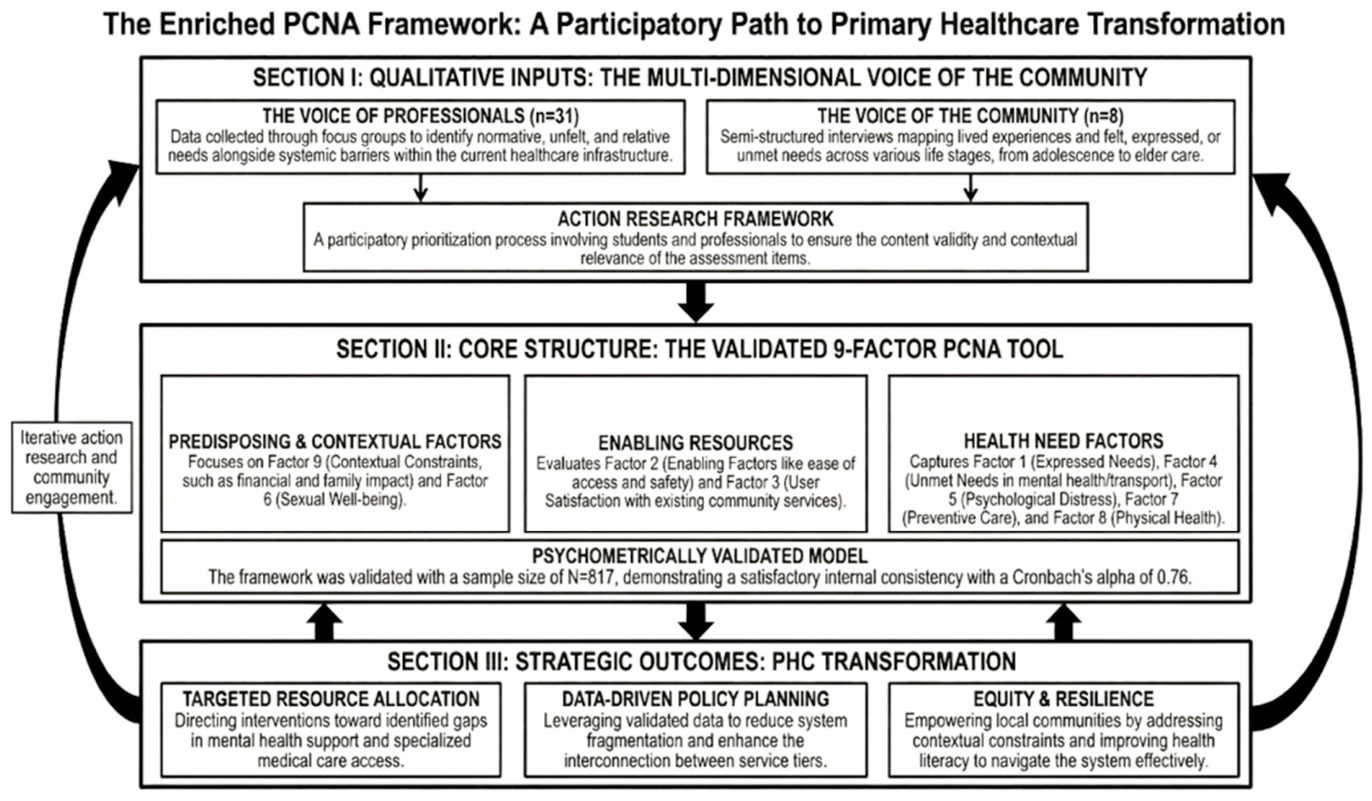
The PCNA questionnaire was developed using a sequential mixed-methods design, integrating qualitative exploration into item generation alongside subsequent quantitative validation. The development process comprised three stages: (a) qualitative exploration of community healthcare needs through focus groups and interviews, (b) generation of questionnaire items informed by thematic analysis and alignment with Andersen’s Behavioral Model, and (c) psychometric evaluation of the resulting instrument. Mixed-methods approaches are widely recommended in instrument development, as they enable the integration of stakeholder-derived insights with statistical validation of measurement constructs [
32,
33]. The research architecture and the sequential steps of the study are visually summarized in
Figure 1. Stages (a) and (b) drew on the same qualitative dataset but represent sequential analytical steps: stage (a) involved the open exploration and identification of community healthcare needs, while stage (b) involved the systematic translation of identified themes into candidate questionnaire items, guided by the dimensions of Andersen’s Behavioral Model [
17,
18].
2.1.1. Qualitative Data Collection
The qualitative phase was conducted in Thessaloniki, Northern Greece, between May 2021 and June 2022, and comprised two complementary components: focus group discussions with PHC professionals and semi-structured interviews with community members.
Focus groups with PHC professionals: Three focus group discussions were conducted with a total of 31 PHC professionals, selected through purposive, theory-informed sampling. Eligibility criteria included current employment in PHC services or active involvement in clinical training related to PHC; individuals with no formal association to PHC were excluded.
Participants were recruited through professional health networks, postgraduate university programs in PHC, and direct contact with local PHC units.
The three groups were composed as follows: FG1 included fourteen postgraduate students from a multidisciplinary PHC program, whose inclusion captured early-career perspectives; FG2 involved eleven general medicine residents undergoing clinical training in PHC; and FG3 comprised six experienced professionals from an interdisciplinary team at a local PHC unit (TOMY) in Thessaloniki, including general practitioners, community nurses, a health visitor, and a social worker.
The first focus group was conducted online via Zoom due to COVID-19 restrictions, while the second and third were held in person—at a university facility and a local PHC unit, respectively. All sessions lasted 90–120 min, were facilitated by two experienced moderators (one from psychology and one from adult education), and were audio-recorded and video-recorded with participants’ written informed consent.
Discussions followed a semi-structured guide developed specifically for the study, covering perceived and unmet healthcare needs, healthcare-seeking behavior, service gaps, participatory planning, and PHC’s impact on community well-being. The guide was informed by international literature on needs assessment and aligned with the core dimensions of Andersen’s Behavioral Model (predisposing, enabling, and need-related factors). In line with the study’s exploratory design, insights from the first two groups informed iterative refinements to the discussion guide used in FG3.
Semi-structured interviews with community members: To incorporate the perspectives of potential service users, eight semi-structured interviews were conducted with adult community members representing different life stages (ages 15–67), including adolescents, young adults, a pregnant woman, middle-aged adults, and older adults.
These participants were not limited to current health service users but were selected purposively to capture variation in age, gender, and life-stage-specific healthcare needs.
The interviews were conducted by the first author at the participants’ homes, were audio-recorded, and were transcribed verbatim.
Interview guides were developed based on themes emerging from the preceding focus group analysis, enabling the exploration of expressed and perceived unmet needs, factors influencing access to care, and healthcare experiences from the community perspective.
The distinction between professional and community perspectives reflects a deliberate methodological choice: while PHC professionals offered insights into population needs as observed through service delivery (normative and comparative needs), community members articulated their own experiences, priorities, and self-identified needs (felt and expressed needs). Although both groups are part of the same PHC ecosystem, they provide complementary viewpoints that together inform a more comprehensive understanding of healthcare needs.
2.1.2. Qualitative Data Analysis
All focus group sessions and individual interviews were transcribed verbatim. Transcription of focus group recordings was performed by the first author and reviewed for accuracy by a second researcher.
Focus group data were analyzed using Interpretative Phenomenological Analysis (IPA), following the eight-step framework proposed by Palmer et al. (2010) for focus group data [
39]. This approach focused on identifying “objects of concern”—explicit needs, frustrations, and values expressed by participants—and analyzing participants’ roles, interactions, and use of language. Deductive coding aligned with the three core dimensions of Andersen’s Behavioral Model (predisposing, enabling, and need factors) was used alongside inductive codes emerging from the data. Emergent themes were revisited in light of group dynamics and refined through repeated engagement with the full transcripts.
Interview data were analyzed using thematic analysis, following the six-phase framework of Braun and Clarke (2006) [
34]. Initial coding was performed by the first author, with subsequent review and discussion with a second researcher to reach consensus on the thematic structure.
The combined analysis yielded core thematic domains, including perceptions of health needs beyond clinical diagnoses, barriers to accessing care, the role of community context, trust and communication with providers, unexpressed and stigmatized needs, service fragmentation, and preventive care gaps. These domains—encompassing physical, psychological, social, and access-related dimensions—were subsequently mapped onto the predisposing, enabling, and need-related dimensions of Andersen’s Behavioral Model and translated into an initial pool of 65 candidate questionnaire items.
2.1.3. Item Development and Origins
The majority of questionnaire items were originally developed through the qualitative phase of this study, directly derived from the themes identified in the focus groups and interviews. A subset of items was informed by domains covered in established instruments, including the Primary Care Assessment Tool (PCAT) [
23], the Nottingham Health Profile (NHP) [
22], ensuring alignment with recognized dimensions of healthcare needs assessment while maintaining the participatory orientation of the PCNA.
The preliminary version of the PCNA was reviewed by an expert panel comprising three PHC researchers and two practicing clinicians, who assessed items for clarity, relevance, and comprehensiveness. Cognitive interviews (n = 20) using a think-aloud protocol were subsequently conducted to identify ambiguous or problematic items. Refinements included rewording unclear items, adjusting response option labels for consistency, and reordering items to improve logical flow.
Following these steps, community engagement activities were conducted to further ensure contextual relevance and community acceptability. Six group sessions with community stakeholders—including a subset of original qualitative participants and additional community members—were held at community venues and focused on ranking and prioritizing item domains. Complementary individual sessions focused specifically on item clarity and wording. Participants included general practitioners, community nurses, and community members; terminology was standardized to “general practitioners” throughout, consistent with Greek PHC nomenclature.
The instrument was subsequently advanced to quantitative evaluation to examine its factorial structure and psychometric properties.
2.2. Participants and Procedure
A total of 1030 questionnaires were distributed through a combination of in-person and online data collection across community and PHC settings in the Thessaloniki metropolitan area and surrounding rural areas of Northern Greece. Of these, 817 were fully completed and included in the analysis (response rate: 79.3%). In-person data collection involved trained research assistants administering paper questionnaires face-to-face at recruitment sites; online completion was offered as an alternative for participants who preferred it. No incentives were provided for participation.
Community settings included public venues such as community centers, municipal offices, and public events, where non-service-users were also reached. PHC settings referred to primary care units where participants were recruited during or after visits. This distinction ensured that the sample captured both active service users and community members whose healthcare needs may remain unexpressed within formal healthcare encounters.
This community-embedded, multi-site recruitment strategy is consistent with international recommendations for participatory health needs assessment. The WHO has emphasized that effective PHC systems require the active engagement of communities in identifying health priorities and co-designing responses [
30,
35]. A strictly clinical or service-based recruitment approach would have limited the sample to active service users, thereby excluding individuals whose healthcare needs remain unmet or unexpressed—precisely the populations that participatory needs assessment aims to reach [
13,
36].
Recruitment was conducted in collaboration with municipal health departments, local community centers, patient associations, and rural PHC units. Diversity in the sample was promoted through targeted recruitment across age groups, gender, education levels, urban and rural residence, and chronic disease status. Descriptive statistics for the sample are reported in
Table 1.
The pilot testing, cognitive interviews (
n = 20), and community engagement activities that informed the refinement of the questionnaire prior to main data collection are described in
Section 2.1.3.
2.3. PCNA Questionnaire
The PCNA is a multidimensional, self-administered questionnaire designed to assess perceived healthcare needs in PHC populations. The questionnaire captures a range of domains, including individual perceptions of health, access to services, psychosocial factors, and interaction with the health system, informed by Andersen’s Behavioral Model of Health Services Use. Accordingly, the questionnaire incorporates dimensions related to predisposing characteristics, enabling resources, and perceived needs, allowing for a comprehensive assessment of factors influencing health service utilization.
The PCNA questionnaire uses 5-point Likert-type response scales with domain-appropriate anchors (e.g., 1 = Very poor to 5 = Very good for health evaluations; 1 = Not at all to 5 = Very much for service utilization items). The initial questionnaire comprised 65 items covering sociodemographic characteristics, health status perceptions, service utilization, satisfaction, unmet needs, and psychosocial and contextual factors. Following pilot testing, participatory refinement, and iterative factor analysis (see
Section 2.4), the instrument was reduced to 33 items through EFA (10-factor solution) and subsequently refined to 29 items through CFA (9-factor solution). The item reduction pathway is documented in
Supplementary Table S3.
Participants in the quantitative phase completed the PCNA questionnaire (29 items plus a sociodemographic section) as a self-administered paper questionnaire or equivalent online form. No additional tasks beyond questionnaire completion were required.
The factorial structure and construct validity of the questionnaire were examined through exploratory factor analysis (EFA) and confirmatory factor analysis (CFA), while internal consistency was assessed using Cronbach’s alpha coefficients.
2.4. Statistical Analysis
Statistical analysis was conducted to examine the factorial structure, construct validity, and internal consistency of the PCNA questionnaire. Statistical significance was set at p < 0.05 for all analyses.
For psychometric validation, the total sample was randomly split into two independent subsamples for cross-validation purposes. The first subsample (
n = 520) was used for exploratory factor analysis (EFA) to identify the underlying factor structure, and the second subsample (
n = 297) for confirmatory factor analysis (CFA) to test the proposed measurement model. This random allocation approach ensured that the two subsamples were drawn from the same population under comparable data collection conditions, and their sociodemographic comparability was examined (
Table 1).
EFA was performed on the first subsample using principal axis factoring, which does not assume multivariate normality. Oblique rotation (Promax) was applied, given the expected correlations among latent factors. The adequacy of the data for factor analysis was assessed using the Kaiser–Meyer–Olkin (KMO) measure of sampling adequacy and Bartlett’s test of sphericity. Factor retention was based on eigenvalues greater than 1.0, a widely used criterion in factor analytic research [
40,
41,
42], inspection of the scree plot (
Figure S1), and interpretability of the factor solution. An iterative item-reduction procedure was employed across eight successive steps: at each step, items with factor loadings below 0.40 or with cross-loadings ≥ 0.40 on more than one factor were removed, consistent with commonly applied thresholds in scale development [
33], and the analysis was repeated on the remaining items until a stable and interpretable solution was obtained.
CFA was subsequently conducted on the second independent subsample to evaluate the fit of the proposed measurement model. Model fit was assessed using multiple indices, including the chi-square-to-degrees-of-freedom ratio (χ2/df), the Comparative Fit Index (CFI), the Tucker–Lewis Index (TLI), the Root Mean Square Error of Approximation (RMSEA), and the Standardized Root Mean Square Residual (SRMR). Acceptable model fit was determined based on commonly recommended thresholds (CFI and TLI ≥ 0.90, RMSEA ≤ 0.08, SRMR ≤ 0.08).
Internal consistency of the questionnaire and its subscales was assessed using Cronbach’s alpha coefficients.
All analyses were performed using IBM SPSS Statistics version 21.0 and AMOS version 18.0.
2.5. Ethics Approval and Consent to Participate
The study was conducted in accordance with established ethical standards for social research and complied with the principles of the American Psychological Association (APA) Code of Ethics. The study was approved by the Bioethics and Ethics Committee of the School of Medicine, Aristotle University of Thessaloniki (Approval No. 5.170/18.12.2019).
Written informed consent was obtained from all qualitative study participants (focus groups and individual interviews) prior to participation. For minor participants, written parental/guardian consent was obtained in all cases. For the quantitative component, participants completing paper questionnaires signed a Participant Information Sheet and Consent Form prior to questionnaire completion. For online participants, informed consent was obtained electronically: participants reviewed the study information sheet and indicated their consent by proceeding with questionnaire completion. No personally identifiable information was collected in either mode of administration.
Audio and video recordings from focus groups and audio recordings from individual interviews were collected solely for transcription and analysis purposes and were securely stored in accordance with data protection regulations.
4. Discussion
The present study developed and validated the PCNA questionnaire using a mixed-methods approach integrating qualitative exploration into a sequential design comprising exploratory and confirmatory factor analysis. The findings support the factorial validity and internal consistency of the questionnaire, while demonstrating its capacity to capture the multidimensional and context-dependent nature of healthcare needs in PHC settings. These findings should be interpreted considering the limitations of existing health needs assessment approaches, which have been characterized by a predominant focus on biomedical indicators and limited integration of contextual and community-derived perspectives into assessment frameworks [
2,
6,
8,
43].
The factorial structure identified through EFA and confirmed through CFA reflects a multidimensional conceptualization of healthcare needs, encompassing not only individual health status and service utilization, but also psychological, social, and contextual dimensions. This is consistent with established models of health service utilization, particularly the Andersen Behavioral Model, which emphasizes the interaction between predisposing, enabling, and need-related factors [
11,
12,
13,
14,
15].
Alignment of the PCNA Factor Structure with Andersen’s Behavioral Model: To further clarify the theoretical underpinnings of the PCNA factor structure, the nine validated factors can be explicitly mapped onto the three core dimensions of Andersen’s Behavioral Model of Health Services Use (
Table 6). This mapping demonstrates that the instrument’s empirical structure aligns with its theoretical foundations, while also extending the model’s operationalization to include dimensions that are often underrepresented in existing PHC assessment tools.
As shown in
Table 6, all three Andersen dimensions are represented in the final CFA model, with the nine PCNA factors distributing across them, though with a grader concentration in the need domain (five factors). This distribution reflects the instrument’s primary orientation toward capturing perceived and unmet healthcare needs, consistent with its design as a community-oriented needs assessment tool rather than a service performance measure. The predisposing dimension is represented by a single factor (Preventive Care Needs), capturing health beliefs and awareness that shape individuals’ propensity to engage with preventive services. Three factors map onto the enabling dimension: Enabling Factors (structural access), User Satisfaction (perceived system adequacy), and Contextual Constraints (family and financial determinants). These collectively operationalize the resources and circumstances that facilitate or hinder healthcare utilization.
Within the need dimension, the PCNA differentiates between physical health status (F8), psychological distress (F5), sexual well-being (F6), expressed needs translated into service utilization (F1), and unmet needs representing gaps between felt needs and available services (F4). This granular decomposition of the need construct is a distinctive feature of the PCNA: whereas many existing instruments treat “need” as a unitary construct, the PCNA reflects the qualitative finding that healthcare needs are multidimensional, life-stage-dependent, and often unexpressed (see
Section 3.1).
This factor–theory alignment also provides a framework for interpreting the reduction from 10 (EFA) to 9 (CFA) factors. Factor 10 (Rest-related Concerns), which demonstrated marginal internal consistency (α = 0.62) and conceptual overlap with adjacent factors, was removed during CFA model refinement. This reduction is consistent with standard EFA-to-CFA refinement processes in scale development [
44], where factors with borderline reliability and ambiguous theoretical positioning are consolidated. The removal of Factor 10 did not diminish the instrument’s theoretical coverage of Andersen’s three dimensions; rather, it improved model parsimony while retaining comprehensive domain representation. This refinement reflects both statistical optimization and clearer delineation of construct boundaries within primary health care needs.
Importantly, the integration of qualitative findings ensures that healthcare needs are operationalized not only as statistically derived constructs but also as lived and contextually embedded experiences, thereby strengthening the ecological validity of the instrument. In this study, needs emerged not as static or purely clinical conditions, but as dynamic constructs shaped by everyday life, social context, health literacy, and access to services, consistent with prior research highlighting the limitations of traditional needs assessment approaches based on predefined and predominantly biomedical categories of need [
4,
5,
8].
Building on this, the PCNA addresses key limitations of existing needs assessment tools by incorporating both individual and contextual dimensions of healthcare needs, as well as perspectives derived from both community members and PHC professionals. Compared to established instruments such as the Primary Care Assessment Tool (PCAT) [
30], the Patient-Centred Primary Care Measure (PCPCM) [
32], the Quality and Outcomes Framework (QOF) [
45], and the Primary Health Care Performance Initiative (PHCPI) [
46], the PCNA places greater emphasis on perceived and unmet needs, as well as on subjective and contextual dimensions of health, rather than focusing primarily on service performance, clinical indicators, or patient satisfaction. While the PCPCM has advanced the assessment of relational and person-centered aspects of care, it remains primarily focused on care experiences rather than the broader spectrum of community-perceived and context-dependent healthcare needs [
31,
33].
Several quantitative instruments are condition-specific or embedded within large-scale survey frameworks, which may limit their flexibility for community-oriented assessments [
18]. At the same time, the CFA results indicate model fit indices comparable to those reported for the PCAT and PCPCM [
30,
32], supporting the psychometric robustness of the PCNA. However, consistent with Andersen’s behavioral framework and recent methodological perspectives, measurement constructs and their associations may vary across populations and contexts, reinforcing the need for ongoing validation [
15,
31].
The factorial structure of the PCNA, encompassing domains such as expressed needs, unmet needs, psychological distress, preventive care, and contextual constraints, aligns with previous multidimensional approaches [
47]. Notably, the prominence of unmet needs related to mental health, access to specialized care, and structural barriers observed in this study is consistent with recent quantitative evidence highlighting the role of enabling and contextual factors in shaping access to care in PHC systems [
10].
A key contribution of this study lies in the participatory and action-oriented approach adopted during instrument development. The integration of community engagement activities, stakeholder involvement, and iterative feedback processes into the development procedure enhanced the ecological and content validity of the questionnaire, ensuring that the resulting items reflect real-world experiences and priorities. This participatory mixed-methods approach responds to calls in the literature for more inclusive and context-sensitive models of health needs assessment [
22,
26,
43], and aligns with participatory health approaches that position communities as active contributors to knowledge production rather than passive recipients of care [
25]. In this context, stakeholder engagement functioned not only as a mechanism for contextualization but also as an iterative refinement process incorporating elements of pre-testing procedures described in the scale development literature, whereby items are progressively clarified, revised, and aligned with participants’ lived experience [
19,
48]. This approach is further supported by recent community-based health needs assessment research, which emphasizes the iterative development of tools through stakeholder feedback and their role in identifying priority health issues grounded in local context [
16].
The findings also have implications for PHC practice and policy. The results underscore the need to strengthen system responsiveness and coordination, particularly in addressing gaps in mental health care, access to specialized services, and structural constraints such as transportation. This interpretation is supported by cross-national evidence demonstrating that unmet healthcare needs are closely associated with structural and enabling factors, including income level, healthcare resource availability, and geographical accessibility [
3], as well as by research highlighting the role of access barriers in shaping health service utilization within PHC systems [
12]. The findings further resonate with evidence from the Greek context, which underscores the need for more systematic, coordinated, and participatory approaches to health needs assessment [
21].
Moreover, the findings support the view that needs assessment should not be treated as a one-time measurement process, but as an ongoing, collaborative practice embedded within PHC systems [
23].
Several aspects of the psychometric findings warrant further discussion. The Physical Health subscale demonstrated a lower internal consistency (α = 0.62) compared to other factors, which may reflect the heterogeneity of the three items comprising this factor (dietary habits, general health, physical activity), each tapping a distinct behavioral domain. This interpretation is further supported by the comparatively lower CFA loading observed for the physical activity item, suggesting that while physical activity is conceptually integral to physical health status, it may function as a more distal indicator compared to dietary habits and self-rated health. While values above 0.60 are considered acceptable in early-stage instrument development [
48], future revisions may benefit from expanding or refining this subscale. Beyond the Physical Health subscale, two additional factors warrant comment regarding their structure. While two-item factors may be considered a structural limitation, both the Sexual Well-being and Contextual Constraints factors demonstrated high internal loadings and strong theoretical grounding within Andersen’s framework. Their retention was guided by conceptual relevance rather than purely statistical criteria, consistent with recommendations for early-stage instrument development where theoretical coherence is prioritized alongside empirical fit [
44]. Future studies with larger and more diverse samples should examine the stability and potential expansion of these factors. Overall, the PCNA contributes a multidimensional and participatory framework for assessing healthcare needs in primary care, bridging the gap between theoretical models and real-world experiences. By integrating subjective, contextual, and system-level dimensions, the instrument provides a foundation for more responsive, equitable, and community-oriented primary health care planning.
4.1. Limitations
A number of limitations should be considered when interpreting the findings of this study. First, the non-probabilistic, community-based recruitment strategy limits the generalizability of the results, although it was consistent with the participatory orientation of the study and aimed to enhance ecological validity. The diversity of recruitment settings and the combination of in-person and online data collection partially mitigate this limitation. Future studies should validate the instrument in more diverse populations and across different healthcare system contexts.
Second, the predominantly healthy sample may have limited the identification of healthcare needs associated with chronic conditions, suggesting the need for further validation in clinical populations. Third, the cross-sectional design precludes assessment of temporal stability. Fourth, the use of self-reported data may introduce response biases, including social desirability and recall bias [
49]. Finally, although the sample was randomly split for EFA and CFA, temporal confounding cannot be entirely excluded.
The present study represents an initial phase of psychometric validation, primarily focused on factorial structure and internal consistency. Face and content validity were supported through expert review and cognitive interviews (
n = 20), alongside qualitative-to-quantitative item development grounded in Andersen’s Behavioral Model. Construct validity was examined through EFA and CFA, demonstrating acceptable model fit (
Table 6), and internal consistency was within acceptable ranges (overall α = 0.76). However, additional psychometric properties, including convergent and discriminant validity, criterion validity, and test–retest reliability, were not assessed and should be addressed in future research. Specifically, future studies should examine composite reliability and average variance extracted for convergent validity and assess temporal stability through test–retest designs.
This staged validation approach is consistent with recommended scale development practices, where establishing a stable factor structure precedes more advanced psychometric testing [
19,
44,
48]. The life-stage-specific modules developed during the qualitative phase also warrant further targeted validation.
4.2. Strengths
The study presents several notable strengths. The development of the PCNA questionnaire was grounded in a sequential mixed-methods design integrating qualitative and quantitative approaches, allowing for both conceptual depth and empirical validation. The qualitative phase drew on two complementary data sources—focus groups with 31 PHC professionals and semi-structured interviews with eight community members across different life stages (ages 15–67)—ensuring that item development reflected both normative and felt healthcare needs. The systematic mapping of qualitative themes to final questionnaire items (
Supplementary Table S2) and the documented item reduction pathway (
Supplementary Table S3) provide a transparent audit trail from community voices to validated instrument.
The use of independent subsamples for exploratory and confirmatory factor analysis enhanced the robustness of psychometric evaluation. The explicit alignment of the 9-factor structure with Andersen’s Behavioral Model (
Table 6) demonstrates theoretical coherence alongside empirical fit.
In addition, the participatory and community-informed approach adopted during instrument development strengthened the content and ecological validity of the questionnaire by aligning measurement with lived experience and stakeholder priorities. Notably, participants were not limited to health service users but included community members recruited from diverse social settings, enabling the assessment of healthcare needs beyond the boundaries of formal service utilization. This approach is aligned with the WHO Astana Declaration’s emphasis on empowering communities to identify and prioritize their own health needs [
50].
The PCNA’s capacity to capture unexpressed and context-dependent needs—as evidenced by the qualitative findings (
Section 3.1) and confirmed through its factorial structure—addresses a recognized gap in existing PHC assessment tools, which have predominantly focused on service performance and clinical indicators rather than community-perceived healthcare needs.
5. Conclusions
The present study aimed to develop and validate the PCNA questionnaire, a multidimensional and context-sensitive instrument for assessing perceived, unmet, and context-dependent healthcare needs in community populations within PHC settings. The findings demonstrate that the PCNA exhibits a stable factorial structure and satisfactory internal consistency, supporting its use as a reliable tool for assessing population healthcare needs.
By integrating quantitative validation with community-informed qualitative insights into a unified instrument development framework, the PCNA extends existing approaches to needs assessment beyond predominantly biomedical and service-centered models toward a more comprehensive understanding of healthcare needs. The instrument captures not only individual health status and service utilization, but also psychosocial and contextual dimensions, reflecting the complex interplay between individuals, health systems, and broader social determinants.
The participatory and action-oriented approach adopted in its development enhances the ecological validity and practical relevance of the questionnaire, supporting its use in evidence-informed planning, resource allocation, and service design within PHC systems.
In clinical practice, the PCNA can support PHC teams in systematically identifying unmet healthcare needs that extend beyond the clinical encounter—including unexpressed psychological distress, barriers to preventive care, and contextual constraints related to family roles and financial circumstances. Its application may inform targeted service planning, facilitate community participation in priority-setting, and contribute to more equitable resource allocation. The instrument may also serve as a monitoring tool for evaluating the impact of PHC reforms on population-perceived needs, and for identifying emerging healthcare needs across different life stages and community contexts.
Overall, the PCNA offers a structured and adaptable framework for assessing healthcare needs at the community level, shifting needs assessment from a measurement exercise to a participatory process embedded in PHC systems. Its application in practice may facilitate the alignment of services with community-identified needs and contribute to more responsive, equitable, and person-centred primary health care.




 ,
,