Predicting Serious Adverse Events, Medication Abuse, Misuse, and Risk of Dependence for Medications with High Dependence Potential: Role of Patient-Reported Factors and Machine Learning Approach

 ,
,  ,
,
Abstract
1. Introduction
2. Materials and Methods
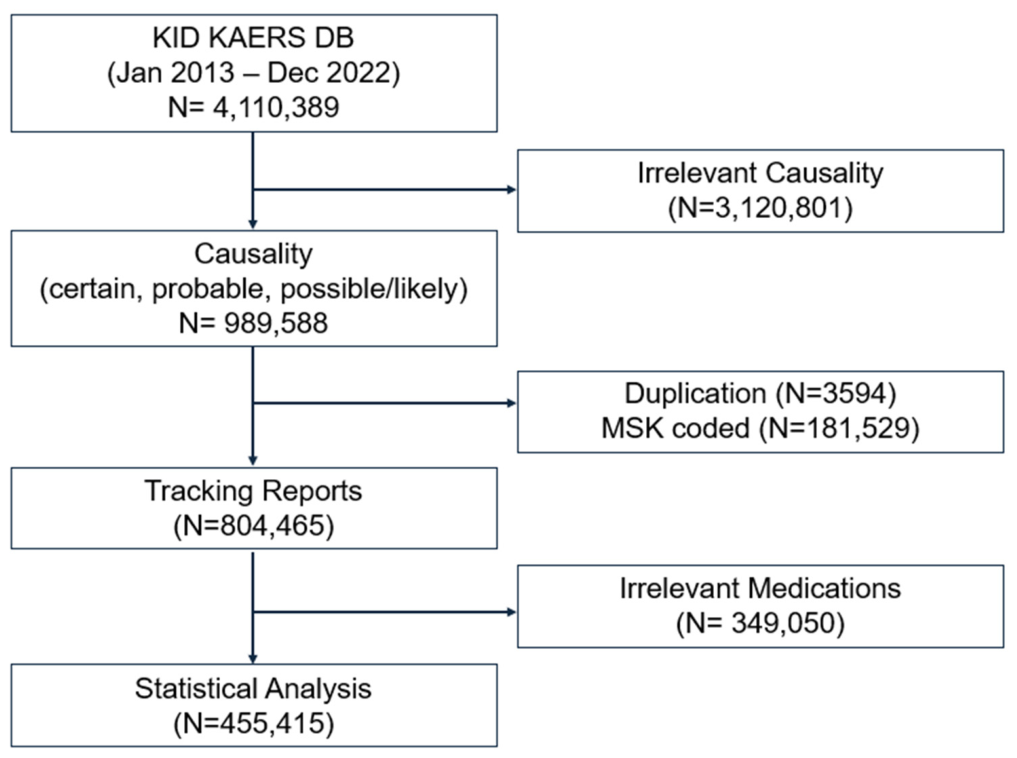
2.1. Database, Definition, and Data Acquisition
2.2. Statistical Analysis
2.3. Development and Validation of ML Models for Detecting Serious Abuse, Misuse, and Dependence Cases
3. Results
3.1. Baseline Characteristics
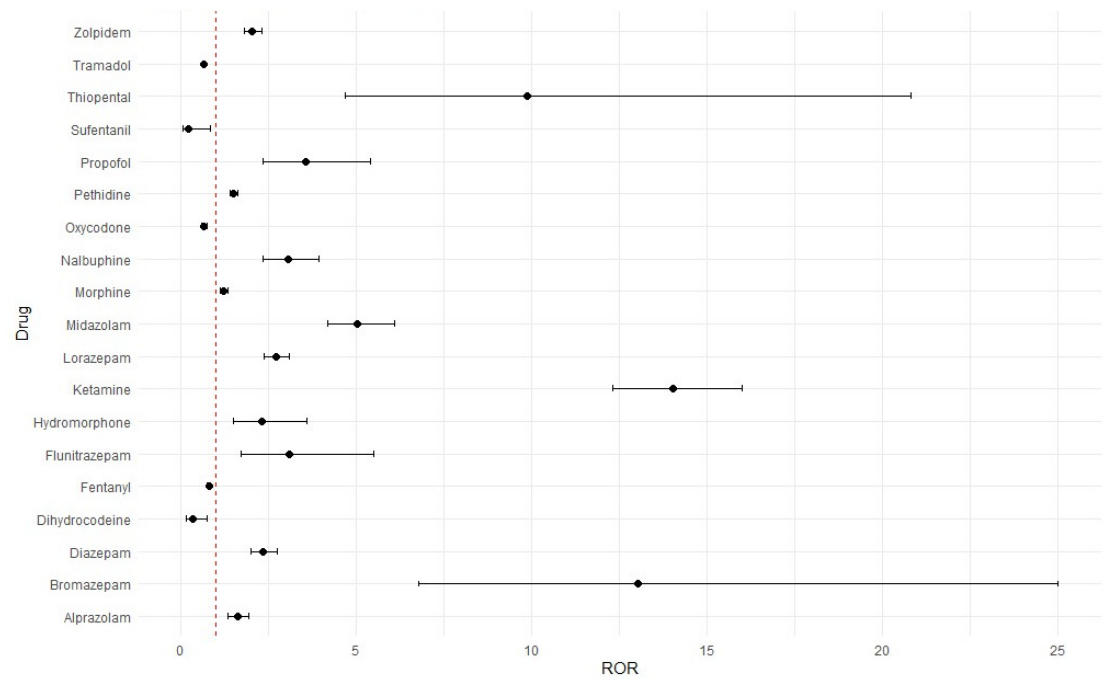
3.2. ADE Types and Risk of Reporting SAEs
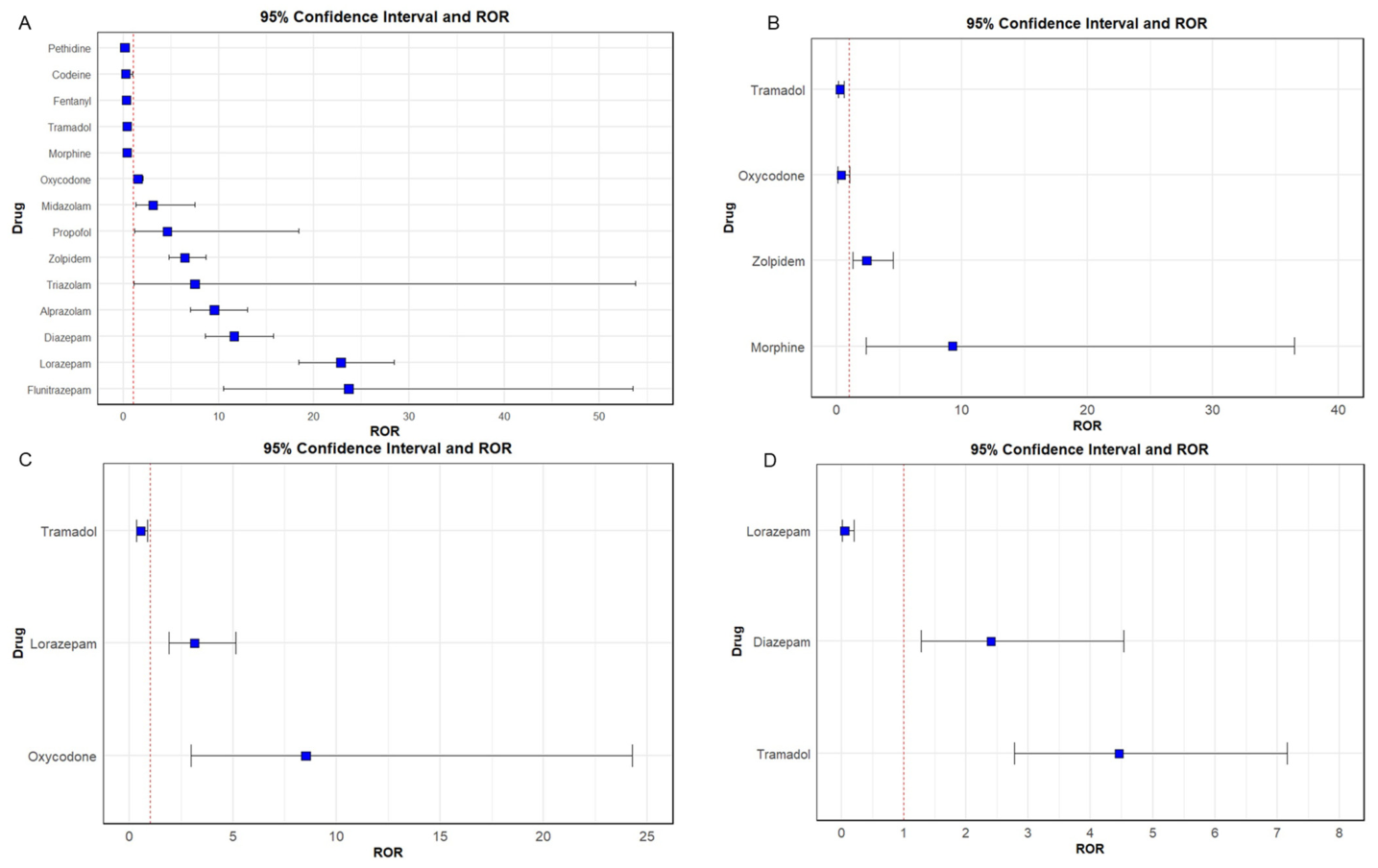
3.3. ADEs Related to Medication Abuse, Misuse, and Dependence
3.4. Predictors Associated with SAEs and Medication Abuse, Misuse, and Dependence
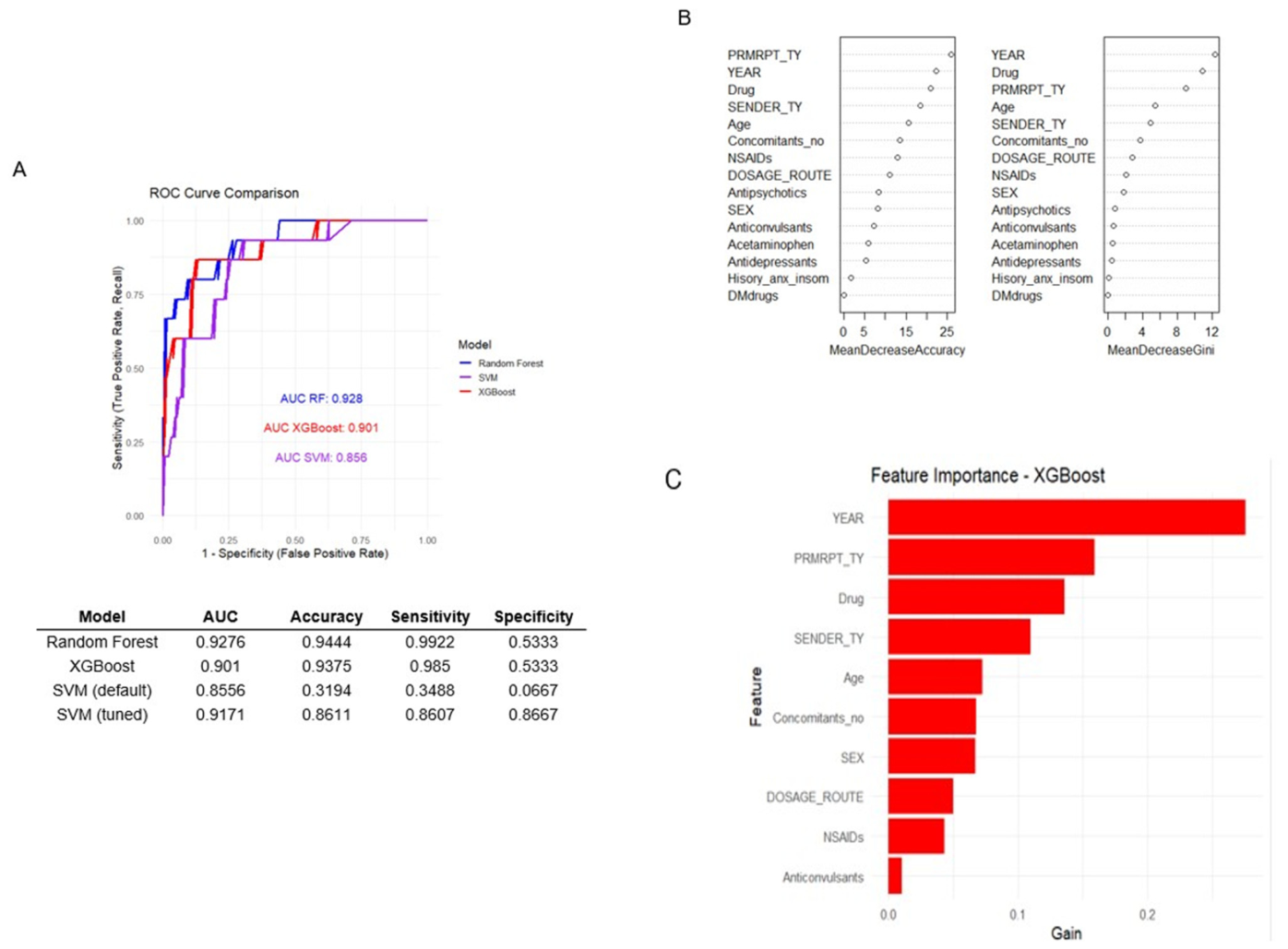
3.5. ML Models for Predicting Serious Medication Abuse, Misuse, and Dependence Cases
4. Discussion
5. Conclusions
Supplementary Materials
Author Contributions
Funding
Institutional Review Board Statement
Informed Consent Statement
Data Availability Statement
Conflicts of Interest
Abbreviations
| ADE | Adverse Drug Events |
| CI | Confidence Interval |
| DUD | Drug Use Disorder |
| FDA | Food and Drug Administration |
| OR | Odds Ratio |
| RF | Random Forest |
| ROR | Reporting Odds Ratio |
| SVM | Support Vector Machine |
| SUD | Substance Use Disorder |
| XGBoost | eXtreme Gradient Boosting |
References
- Volkow, N.D.; Blanco, C. Substance use disorders: A comprehensive update of classification, epidemiology, neurobiology, clinical aspects, treatment and prevention. World Psychiatry 2023, 22, 203–229. [Google Scholar] [CrossRef]
- Hasin, D.S.; O’Brien, C.P.; Auriacombe, M.; Borges, G.; Bucholz, K.; Budney, A.; Compton, W.M.; Crowley, T.; Ling, W.; Petry, N.M.; et al. DSM-5 criteria for substance use disorders: Recommendations and rationale. Am. J. Psychiatry 2013, 170, 834–851. [Google Scholar] [CrossRef] [PubMed]
- Kim, S.; Lee, H.; Woo, S.; Lee, H.; Park, J.; Kim, T.; Fond, G.; Boyer, L.; Rahmati, M.; Smith, L.; et al. Global, regional, and national trends in drug use disorder mortality rates across 73 countries from 1990 to 2021, with projections up to 2040: A global time-series analysis and modelling study. eClinicalMedicine 2025, 79, 102985. [Google Scholar] [CrossRef] [PubMed]
- Vowles, K.E.; McEntee, M.L.; Julnes, P.S.; Frohe, T.; Ney, J.P.; van der Goes, D.N. Rates of opioid misuse, abuse, and addiction in chronic pain: A systematic review and data synthesis. Pain 2015, 156, 569–576. [Google Scholar] [CrossRef] [PubMed]
- Couto, J.E.; Romney, M.C.; Leider, H.L.; Sharma, S.; Goldfarb, N.I. High rates of inappropriate drug use in the chronic pain population. Popul. Health Manag. 2009, 12, 185–190. [Google Scholar] [CrossRef]
- Volkow, N.D.; McLellan, A.T. Opioid abuse in chronic pain-Misconceptions and mitigation strategies. N. Engl. J. Med. 2016, 374, 1253–1263. [Google Scholar] [CrossRef] [PubMed]
- Neuman, M.D.; Bateman, B.T.; Wunsch, H. Inappropriate opioid prescription after surgery. Lancet 2019, 393, 1547–1557. [Google Scholar] [CrossRef]
- Pek, E.A.; Remfry, A.; Pendrith, C.; Fan-Lun, C.; Bhatia, R.S.; Soong, C. High prevalence of inappropriate benzodiazepine and sedative hypnotic prescriptions among hospitalized older adults. J. Hosp. Med. 2017, 12, 310–316. [Google Scholar] [CrossRef]
- Beckerleg, W.; Hudgins, J. Substance use-related emergency department visits and resource utilization. West. J. Emerg. Med. 2022, 23, 166–173. [Google Scholar] [CrossRef]
- Koob, G.F.; Volkow, N.D. Neurobiology of addiction: A neurocircuitry analysis. Lancet Psychiatry 2016, 3, 760–773. [Google Scholar] [CrossRef]
- Marsden, J.; White, M.; Annand, F.; Burkinshaw, P.; Carville, S.; Eastwood, B.; Kelleher, M.; Knight, J.; O’Connor, R.; Tran, A.; et al. Medicines associated with dependence or withdrawal: A mixed-methods public health review and national database study in England. Lancet Psychiatry 2019, 6, 935–950. [Google Scholar] [CrossRef]
- Gustafsson, M.; Silva, V.; Valeiro, C.; Joaquim, J.; van Hunsel, F.; Matos, C. Misuse, abuse and medication errors’ adverse events associated with opioids—A systematic review. Pharmaceuticals 2024, 17, 1009. [Google Scholar] [CrossRef]
- Harpaz, R.; DuMouchel, W.; LePendu, P.; Bauer-Mehren, A.; Ryan, P.; Shah, N.H. Performance of pharmacovigilance signal-detection algorithms for the FDA adverse event reporting system. Clin. Pharmacol. Ther. 2013, 93, 539–546. [Google Scholar] [CrossRef]
- Pilipiec, P.; Liwicki, M.; Bota, A. Using machine learning for pharmacovigilance: A systematic review. Pharmaceutics 2022, 14, 266. [Google Scholar] [CrossRef] [PubMed]
- von Elm, E.; Altman, D.G.; Egger, M.; Pocock, S.J.; Gøtzsche, P.C.; Vandenbroucke, J.P. The Strengthening the reporting of observational studies in epidemiology (STROBE) statement: Guidelines for reporting observational studies. Ann. Intern. Med. 2007, 147, 573–577. [Google Scholar] [CrossRef] [PubMed]
- Shin, J.Y.; Jung, S.Y.; Ahn, S.H.; Lee, S.H.; Kim, S.J.; Seong, J.M.; Chung, S.Y.; Park, B.J. New initiatives for pharmacovigilance in South Korea: Introducing the Korea Institute of Drug Safety and Risk Management (KIDS). Pharmacoepidemiol. Drug Saf. 2014, 23, 1115–1122. [Google Scholar] [CrossRef]
- Kim, S.Y.; Cho, N.W.; Yoo, M.S.; Han, S.Y.; Oh, J.W. Narcotics information management system in South Korea: System development and innovation. BMC Health Serv. Res. 2023, 23, 73. [Google Scholar] [CrossRef] [PubMed]
- Choi, Y.J.; Kim, M.H.; Chung, E.K.; Lee, J.K.; Yoon, J.; Yug, J.S.; Jang, D.K. Prevalence and seriousness of analgesic-induced adverse events in Korea: A 10-year nationwide surveillance. J. Patient Saf. 2020, 16, e215–e224. [Google Scholar] [CrossRef]
- The Uppsala Monitoring Centre. The Use of the WHO-UMC System for Standarised Case Causality Assessment. Available online: https://www.who.int/docs/default-source/medicines/pharmacovigilance/whocausality-assessment.pdf (accessed on 25 October 2025).
- International Conference on Harmonisation of Technical Requirements for Registration of Pharmaceuticals for Human Use. ICH Harmonised Tripartite Guideline: Post-Approval Safety Data Management: Definitions and Standards for Expedited Reporting E2D2003. Available online: https://database.ich.org/sites/default/files/E2D_Guideline.pdf (accessed on 25 October 2025).
- Choi, Y.J.; Choi, C.Y.; Kim, C.U.; Shin, S. A nationwide pharmacovigilance investigation on trends and seriousness of adverse events induced by anti-obesity medication. J. Glob. Health 2023, 13, 04095. [Google Scholar] [CrossRef]
- Choi, Y.J.; Yang, S.W.; Kwack, W.G.; Lee, J.K.; Lee, T.H.; Jang, J.Y.; Chung, E.K. Comparative safety profiles of sedatives commonly used in clinical practice: A 10-year nationwide pharmacovigilance study in Korea. Pharmaceuticals 2021, 14, 783. [Google Scholar] [CrossRef]
- Tesselaar, D.R.M.; Schellekens, A.F.A.; Homberg, J.R.; Booij, J.; Guerrin, C. Psychiatric comorbidity in substance use disorders, a systematic review of neuro-imaging findings. Neurosci. Biobehav. Rev. 2025, 177, 106325. [Google Scholar] [CrossRef]
- Webster, L. Opioid Risk Tool. 2005. Available online: https://nida.nih.gov/sites/default/files/opioidrisktool.pdf (accessed on 15 March 2026).[Green Version]
- Volkow, N.D.; Blanco, C. The changing opioid crisis: Development, challenges and opportunities. Mol. Psychiatry 2020, 26, 218–233. [Google Scholar] [CrossRef] [PubMed]
- Robinson, J.; Sareen, J.; Cox, B.J. Role of self-medication in the development of comorbid anxiety and substance use disorders: A longitudinal investigation. Arch. Gen. Psychiatry 2011, 68, 800–807. [Google Scholar] [CrossRef] [PubMed]
- Lipari, R.N.; Williams, M.; Van Hron, S.L. Why do adults misuse prescription drugs? In The CBHSQ Report. Rockville (MD); Substance Abuse and Mental Health Services Administration (US): Rockville, MD, USA, 2017. Available online: https://www.ncbi.nlm.nih.gov/books/NBK458284/ (accessed on 3 May 2026).
- Ruoff, G.E.; Rosenthal, N.; Jordan, D.; Karim, R.; Kamin, M. Tramadol/Acetaminophen combination tablets for the treatment of chronic lower back pain: A multicenter, randomized, double-blind, placebo-controlled outpatient study. Clin. Ther. 2003, 25, 1123–1141. [Google Scholar] [CrossRef] [PubMed]
- Yoon, S.-H.; Kim, J.; Yoon, S.; Lee, H.-J. Current status of opioid prescription in South Korea using narcotics information management system. Korean J. Pain 2024, 37, 41–50. [Google Scholar] [CrossRef]
- Kim, K.; Lee, H.; Shin, J.Y. Explosive increase in tramadol use in Korea 2003–2013: Analysis of patient trends based on the Korea national health insurance database. J. Psychoact. Drugs 2020, 52, 153–161. [Google Scholar] [CrossRef]
- Kim, Y.; Choo, E.; Shin, S.; Choi, Y.J. Comparative risk of psychiatric comorbidities associated with codeine and tramadol in patients with hip osteoarthritis: A nationwide population-based cohort study. J. Glob. Health 2026, 16, 0421. [Google Scholar] [CrossRef]
- Toki, T.; Ono, S. Spontaneous reporting on adverse events by consumers in the United States: An analysis of the Food and Drug Administration adverse event reporting system database. Drugs Real. World Outcomes 2018, 5, 117–128. [Google Scholar] [CrossRef]
- McNeely, J.; Adam, A. Substance Use Screening and Risk Assessment in Adults. National Library of Medicine. 1 October 2020. Available online: https://www.ncbi.nlm.nih.gov/books/NBK565474/ (accessed on 3 March 2026).
- Perry, C.; Liberto, J.; Milliken, C.; Burden, J.; Hagedorn, H.; Atkinson, T.; McKay, J.R.; Mooney, L.; Sall, J.; Sasson, C.; et al. The management of substance use disorders: Synopsis of the 2021 U.S. Department of veterans affairs and U.S. Department of defense clinical practice guideline. Ann. Intern. Med. 2022, 175, 720–731. [Google Scholar] [CrossRef]
- Alzahrani, M.S.; Alotaibi, H.A.; Alhumayani, S.M.; Aljuaid, H.F.; Alghamdi, R.S.; Althobaiti, Y.S. Assessment of general population understanding and awareness of drug addiction before and after a health educational campaign in Taif City, Saudi Arabia. Healthcare 2024, 12, 1877. [Google Scholar] [CrossRef]
- Mercieca-Bebber, R.; King, M.T.; Calvert, M.J.; Stockler, M.R.; Friedlander, M. The importance of patient-reported outcomes in clinical trials and strategies for future optimization. Patient Relat. Outcome Meas. 2018, 9, 353–367. [Google Scholar] [CrossRef]
- Kim, M.; Park, S.K.; Kim, W.M.; Kim, E.; Kim, H.; Park, J.-M.; Choi, S.-S.; Choi, E.J. Updated guidelines for prescribing opioids to treat patients with chronic non-cancer pain in Korea: Developed by committee on hospice and palliative care of the Korean Pain Society. Korean J. Pain 2024, 37, 119–131. [Google Scholar] [CrossRef]
- Zur, M.; Tsur, A.M.; Friedensohn, L.; Matok, I. Trends in medication use among young adults and the COVID-19 pandemic effect. Pharmacoepidemiol. Drug Saf. 2025, 34, e70273. [Google Scholar] [CrossRef]



| Characteristics | No. of Cases (% Relative Frequency) |
|---|---|
| Sex a | |
| Men | 147,254 (32.33%) |
| Women | 303,344 (66.61%) |
| Age b Median (IQR) | 57 (23) |
| <20 | 16,685 (3.66%) |
| 20~39 | 78,333 (17.20%) |
| 40~59 | 159,359 (34.99%) |
| 60~79 | 168,070 (36.90%) |
| ≥80 | 26,657 (5.85%) |
| Causality | |
| Certain | 7680 (1.69%) |
| Probable/Likely | 153,350 (33.67%) |
| Possible | 294,385 (64.64%) |
| Seriousness | |
| Non-serious ADEs | 447,986 (98.37%) |
| Serious ADEs | 7429 (1.63%) |
| No. of Concomitantly Used Medications | |
| 1 | 299,401 (65.74%) |
| 2 | 87,087 (19.12%) |
| 3 | 26,672 (5.86%) |
| 4 | 14,442 (3.17%) |
| ≥5 | 27,813 (6.11%) |
| Etiologic Drug Classes | |
| Opioids | 427,005 (93.76%) |
| Anxiolytics | 14,620 (3.21%) |
| Sedative & Hypnotics | 9846 (2.16%) |
| Anesthetics | 3944 (0.87%) |
| Medications | |
| Tramadol | 192,802 (42.34%) |
| Fentanyl | 125,852 (27.63%) |
| Pethidine | 45,235 (9.93%) |
| Oxycodone | 27,367 (6.01%) |
| Morphine | 24,557 (5.39%) |
| Codeine | 8246 (1.81%) |
| Zolpidem | 7916 (1.74%) |
| Lorazepam | 5580 (1.23%) |
| Alprazolam | 4783 (1.05%) |
| Diazepam | 4135 (0.91%) |
| Ketamine | 1538 (0.34%) |
| Midazolam | 1536 (0.34%) |
| Nalbuphine | 1278 (0.28%) |
| Remifentanil | 1273 (0.28%) |
| Dihydrocodeine | 1098 (0.24%) |
| Sufentanil | 579 (0.13%) |
| Hydromorphone | 570 (0.13%) |
| Propofol | 415 (0.09%) |
| Flunitrazepam | 248 (0.05%) |
| Triazolam | 127 (0.03%) |
| Alfentanil | 82 (0.02%) |
| Bromazepam | 62 (0.01%) |
| Thiopental | 57 (0.01%) |
| Clotiazepam | 32 (0.01%) |
| Clobazam | 26 (0.00%) |
| Zopiclone | 19 (0.00%) |
| Chlordiazepoxide | 2 (0.00%) |
| System Organ Class | p-Value | ROR (95%CI) | PRR (95% CI) | IC (IC025–0975) |
|---|---|---|---|---|
| Body as a whole-general disorders | <0.001 | 3.26 (3.02–3.52) | 3.15 (2.93–3.39) | 1.55 (1.44–1.66) |
| Cardiovascular disorders, general | <0.001 | 30.36 (28.58–32.25) | 22.19 (21.17–23.26) | 4.09 (4.00–4.17) |
| Central & peripheral nervous system disorders | <0.001 | 0.86 (0.81–0.91) | 0.86 (0.81–0.91) | −0.18 (−0.26, −0.09) |
| Gastro-intestinal system disorders | <0.001 | 0.07 (0.07–0.08) | 0.08 (0.07–0.08) | −2.63 (−2.74, −2.52) |
| Hearing and vestibular disorders | 0.043 | 2.32 (1.03–5.25) | 2.27 (1.04–4.98) | 1.05 (−0.08–2.18) |
| Heart rate and rhythm disorders | <0.001 | 6.04 (5.30–6.88) | 5.59 (4.97–6.30) | 2.43 (2.24–2.62) |
| Liver and biliary system disorders | <0.001 | 4.08 (3.44–4.85) | 3.89 (3.31–4.57) | 1.93 (1.68–2.17) |
| Metabolic and nutritional disorders | 0.097 | 1.39 (0.94–2.05) | 1.38 (0.95–2.02) | 0.45 (−0.1–1.01) |
| Musculo-skeletal system disorders | <0.001 | 2.21 (1.51–3.25) | 2.17 (1.50–3.15) | 1.09 (0.54–1.64) |
| Platelet, bleeding & clotting disorders | <0.001 | 5.81 (3.03–11.11) | 5.38 (2.98–9.74) | 2.15 (1.24–3.07) |
| Psychiatric disorders | 0.289 | 1.05 (0.96–1.16) | 1.05 (0.96–1.16) | 0.07 (−0.07–0.21) |
| Resistance mechanism disorders | <0.001 | 8.04 (2.93–22.84) | 7.22 (2.87–18.12) | 2.09 (0.68–3.51) |
| Respiratory system disorders | <0.001 | 17.03 (15.93–18.20) | 13.95 (13.2–14.75) | 3.55 (3.46–3.64) |
| Secondary terms-events | 0.028 | 2.50 (1.10–5.65) | 2.44 (1.11–5.34) | 1.13 (0, 2.26) |
| Skin and appendages disorders | 0.558 | 1.03 (0.94–1.12) | 1.03 (0.94–1.12) | 0.035 (−0.09–0.16) |
| Urinary system disorders | 0.307 | 1.11 (0.91–1.35) | 1.11 (0.91–1.34) | 0.14 (−0.14–0.43) |
| Vascular (extracardiac) disorders | <0.001 | 3.70 (2.49–5.50) | 3.54 (2.44–5.15) | 1.75 (1.19–2.32) |
| Vision disorders | <0.001 | 2.78 (1.90–4.06) | 2.70 (1.88–3.89) | 1.39 (0.84–1.93) |
| White cell and RES * disorders | 0.047 | 1.76 (1.01–3.04) | 1.73 (1.01–2.96) | 0.75 (−0.03–1.53) |
| Medication | ROR (95% CI) | PRR (95% CI) | IC (IC025–IC975) |
|---|---|---|---|
| Abuse | |||
| Morphine | 9.26 (2.35–36.48) | 4.39 (2.61–7.36) | 1.67 (0.29–3.05) |
| Zolpidem | 2.41 (1.29–4.52) | 2.85 (1.64–4.93) | 0.94 (0.12–1.77) |
| Oxycodone | 0.37 (0.13–1.05) | 0.45 (0.17–1.21) | −0.89 (−2.32–0.54) |
| Tramadol | 0.29 (0.14–0.61) | 0.30 (0.15–0.61) | −1.05 (−2.05, −0.05) |
| Dependence | |||
| Oxycodone | 8.52 (2.99–24.27) | 1.49 (1.29–1.73) | 0.46 (−0.13–1.05) |
| Lorazepam | 3.15 (1.93–5.15) | 1.32 (1.10–1.57) | 0.21 (−0.14–0.57) |
| Tramadol | 0.56 (0.36–0.87) | 0.56 (0.44–0.70) | −0.55 (−1.00, −0.10) |
| Misuse | |||
| Tramadol | 4.46 (2.78–7.16) | 3.52 (2.23–5.56) | 0.79 (0.28, 1.30) |
| Diazepam | 2.40 (1.28–4.54) | 1.63 (1.06–2.51) | 0.53 (−0.26, 1.32) |
| Lorazepam | 0.05 (0.01–0.20) | 0.04 (0.01–0.17) | −3.52 (−5.33, −1.70) |
| Predictors | Overall Classes | Opioids | Anxiolytics | Anesthetics | Sedatives & Hypnotics |
|---|---|---|---|---|---|
| Sex | |||||
| Men | 1 (reference) | ||||
| Women | 0.65 (0.62–0.68) | 0.62 (0.58–0.65) | N/A | 0.67 (0.51–0.87) | N/A |
| Age | |||||
| <20 | 1 (reference) | ||||
| 20–39 | 0.48 (0.43–0.53) | 0.77 (0.66–0.89) | 0.65 (0.44–0.96) | 0.08 (0.04–0.16) | 0.18 (0.11–0.29) |
| 40–59 | 0.55 (0.50–0.61) | 0.94 (0.82–1.07) | 0.42 (0.29–0.60) | 0.18 (0.12–0.28) | 0.16 (0.11–0.24) |
| 60–79 | 0.64 (0.58–0.71) | 1.09 (0.95–1.24) | 0.41 (0.29–0.59) | 0.23 (0.15–0.35) | 0.23(0.16–0.33) |
| ≥80 | 0.77 (0.68–0.87) | 1.28 (1.09–1.51) | 0.78 (0.51–1.20) | 0.06 (0.01–0.44) | 0.28 (0.18–0.44) |
| No. Concomitantly Used Medications | |||||
| 1 | 1 (reference) | ||||
| 2 | 1.12 (1.04–1.21) | 1.01 (0.93–1.10) | 1.79 (1.42–2.26) | 0.88 (0.64–1.19) | 2.21 (1.67–2.91) |
| 3 | 1.71 (1.54–1.89) | 1.83 (1.65–2.04) | 0.88 (0.65–1.19) | 1.50 (0.91–2.47) | 1.55 (1.03–2.33) |
| 4 | 1.49 (1.29–1.72) | 1.60 (1.37–1.87) | 0.90 (0.64–1.26) | 1.90 (0.90–4.00) | 1.01 (0.57–1.76) |
| ≥5 | 1.00 (0.86–1.15) | 1.41 (1.23–1.62) | 0.25 (0.17–0.36) | N/A | 0.29 (0.16–0.50) |
| Types of Concomitantly Used Medications | |||||
| NSAIDs | 0.83 (0.75–0.92) | N/A | 0.08 (0.02–0.34) | 2.20 (1.12–4.30) | |
| Acetaminophen | 0.62 (0.57–0.68) | 0.58 (0.53–0.63) | N/A | N/A | N/A |
| Anticonvulsants | 1.45 (1.23–1.69) | 2.94 (2.22–3.89) | N/A | N/A | |
| Antidepressants | 0.44 (0.34–0.57) | 0.32 (0.14–0.71) | 0.52 (0.38–0.73) | N/A | N/A |
| Antipsychotics | 1.46 (1.14–1.86) | N/A | N/A | 2.92 (1.72–4.96) | |
| Medication Classes | |||||
| Opioids | 1 (reference) | N/A | |||
| Anxiolytics | 2.32 (2.09–2.56) | ||||
| Anesthetics | 4.24 (3.73–4.82) | ||||
| Sedatives & Hypnotics | 2.37 (2.13–2.64) | ||||
| Predictors | Overall Classes | Opioids | Anxiolytics | Anesthetics | Sedatives & Hypnotics |
|---|---|---|---|---|---|
| Sex | |||||
| Men | 1 (reference) | ||||
| Women | N/A | 0.66 (0.48–0.92) | N/A | N/A | N/A |
| Age | |||||
| <20 | N/A | ||||
| 20–39 | |||||
| 40–59 | |||||
| 60–79 | |||||
| ≥80 | |||||
| No. Concomitantly Used Medications | |||||
| 1 | 1 (reference) | ||||
| 2 | 0.39 (0.26–0.58) | 0.44 (0.18–1.05) | 0.26 (0.13–0.52) | N/A | N/A |
| 3 | 0.25 (0.16–0.42) | 0.26 (0.09–0.71) | 0.26 (0.13–0.53) | ||
| 4 | 0.14 (0.07–0.25) | 0.19 (0.07–0.57) | 0.05 (0.01–0.22) | ||
| ≥5 | 0.17 (0.10–0.29) | 0.12 (0.04–0.33) | 0.33 (0.19–0.59) | ||
| Types of Concomitantly Used Medications | |||||
| NSAIDs | N/A | N/A | N/A | N/A | 5.59 (2.08–15.06) |
| Acetaminophen | 3.60 (2.40–5.39) | 4.42 (1.86–10.48) | N/A | N/A | 0.10 (0.01–0.82) |
| Antidepressants | 1.75 (1.17–2.61) | N/A | N/A | N/A | N/A |
| Antipsychotics | 4.97 (3.21–7.71) | 7.06 (0.89–56.07) | 4.04 (2.43–6.72) | N/A | 2.53 (1.06–6.05) |
| Anticonvulsants | 3.42 (2.42–4.81) | 3.48 (2.01–6.00) | 2.91 (1.75–4.83) | N/A | N/A |
| Reporting Personnel | |||||
| Doctors | 1 (reference) | ||||
| Pharmacists | 1.18 (0.88–1.57) | 3.64 (1.99–6.67) | 0.65 (0.42–1.02) | N/A | 0.37 (0.16–0.87) |
| Other Healthcare Professional | 0.11 (0.08–0.16) | 0.17 (0.09–0.33) | 0.18 (0.10–0.32) | 0.12 (0.05–0.30) | |
| General Public | 4.59 (3.04–6.94) | 8.35 (4.01–17.36) | 3.17 (1.51–6.67) | 5.89 (2.44–14.21) | |
| Medication Classes | |||||
| Opioids | 1 (reference) | N/A | |||
| Anxiolytics | 14.87 (11.04–20.03) | ||||
| Anesthetics | 1.41 (0.20–10.16) | ||||
| Sedatives & Hypnotics | 7.81 (5.36–11.38) | ||||
Disclaimer/Publisher’s Note: The statements, opinions and data contained in all publications are solely those of the individual author(s) and contributor(s) and not of MDPI and/or the editor(s). MDPI and/or the editor(s) disclaim responsibility for any injury to people or property resulting from any ideas, methods, instructions or products referred to in the content. |
© 2026 by the authors. Licensee MDPI, Basel, Switzerland. This article is an open access article distributed under the terms and conditions of the Creative Commons Attribution (CC BY) license.
Share and Cite
Kim, Y.; Sohn, Y.J.; Yoo, J.Y.; Kim, M.; Kim, S.; Choi, Y.J. Predicting Serious Adverse Events, Medication Abuse, Misuse, and Risk of Dependence for Medications with High Dependence Potential: Role of Patient-Reported Factors and Machine Learning Approach. Healthcare 2026, 14, 1265. https://doi.org/10.3390/healthcare14101265
Kim Y, Sohn YJ, Yoo JY, Kim M, Kim S, Choi YJ. Predicting Serious Adverse Events, Medication Abuse, Misuse, and Risk of Dependence for Medications with High Dependence Potential: Role of Patient-Reported Factors and Machine Learning Approach. Healthcare. 2026; 14(10):1265. https://doi.org/10.3390/healthcare14101265
Chicago/Turabian StyleKim, Yujin, Yu Jin Sohn, Jin Young Yoo, Minsung Kim, Semi Kim, and Yeo Jin Choi. 2026. "Predicting Serious Adverse Events, Medication Abuse, Misuse, and Risk of Dependence for Medications with High Dependence Potential: Role of Patient-Reported Factors and Machine Learning Approach" Healthcare 14, no. 10: 1265. https://doi.org/10.3390/healthcare14101265
APA StyleKim, Y., Sohn, Y. J., Yoo, J. Y., Kim, M., Kim, S., & Choi, Y. J. (2026). Predicting Serious Adverse Events, Medication Abuse, Misuse, and Risk of Dependence for Medications with High Dependence Potential: Role of Patient-Reported Factors and Machine Learning Approach. Healthcare, 14(10), 1265. https://doi.org/10.3390/healthcare14101265