Review

Advancing a Hybrid Decision-Making Model in Anesthesiology: Applications of Artificial Intelligence in the Perioperative Setting


by
Gilberto Duarte-Medrano
1,
Natalia Nuño-Lámbarri
2,3,
Daniele Salvatore Paternò
4,
Luigi La Via
5,*,
Simona Tutino
4,
Guillermo Dominguez-Cherit
1 and
Massimiliano Sorbello
4,6
1
Anesthesiology Department of Hospital Medica Sur, Mexico City 11510, Mexico
2
Translational Research Unit, Medica Sur Clinic & Foundation, Mexico City 11510, Mexico
3
Department of Surgery, Faculty of Medicine, The National Autonomous University of Mexico (UNAM), Mexico City 14050, Mexico
4
Department of Anesthesia and Intensive Care, Hospital “Giovanni Paolo II”, ASP Ragusa, 97100 Ragusa, Italy
5
Department of General Surgery and Medical Surgical Specialties, University of Catania, 95123 Catania, Italy
6
Faculty of Medicine and Surgery, University of Enna “Kore”, 94100 Enna, Italy
*
Author to whom correspondence should be addressed.
Healthcare 2026, 14(1), 97; https://doi.org/10.3390/healthcare14010097

Submission received: 26 October 2025 / Revised: 17 December 2025 / Accepted: 30 December 2025 / Published: 31 December 2025
(This article belongs to the Special Issue Smart and Digital Health)

Abstract

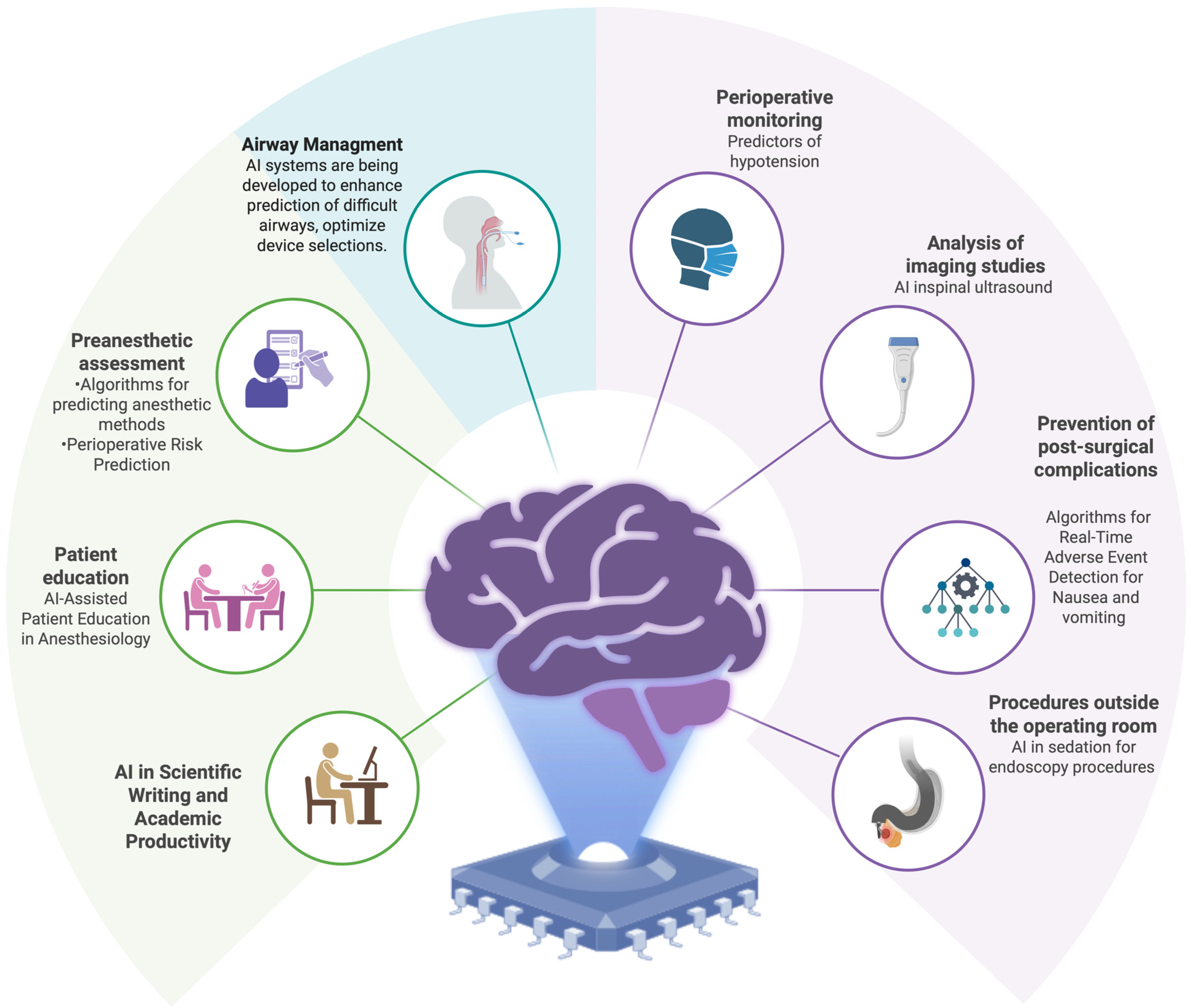
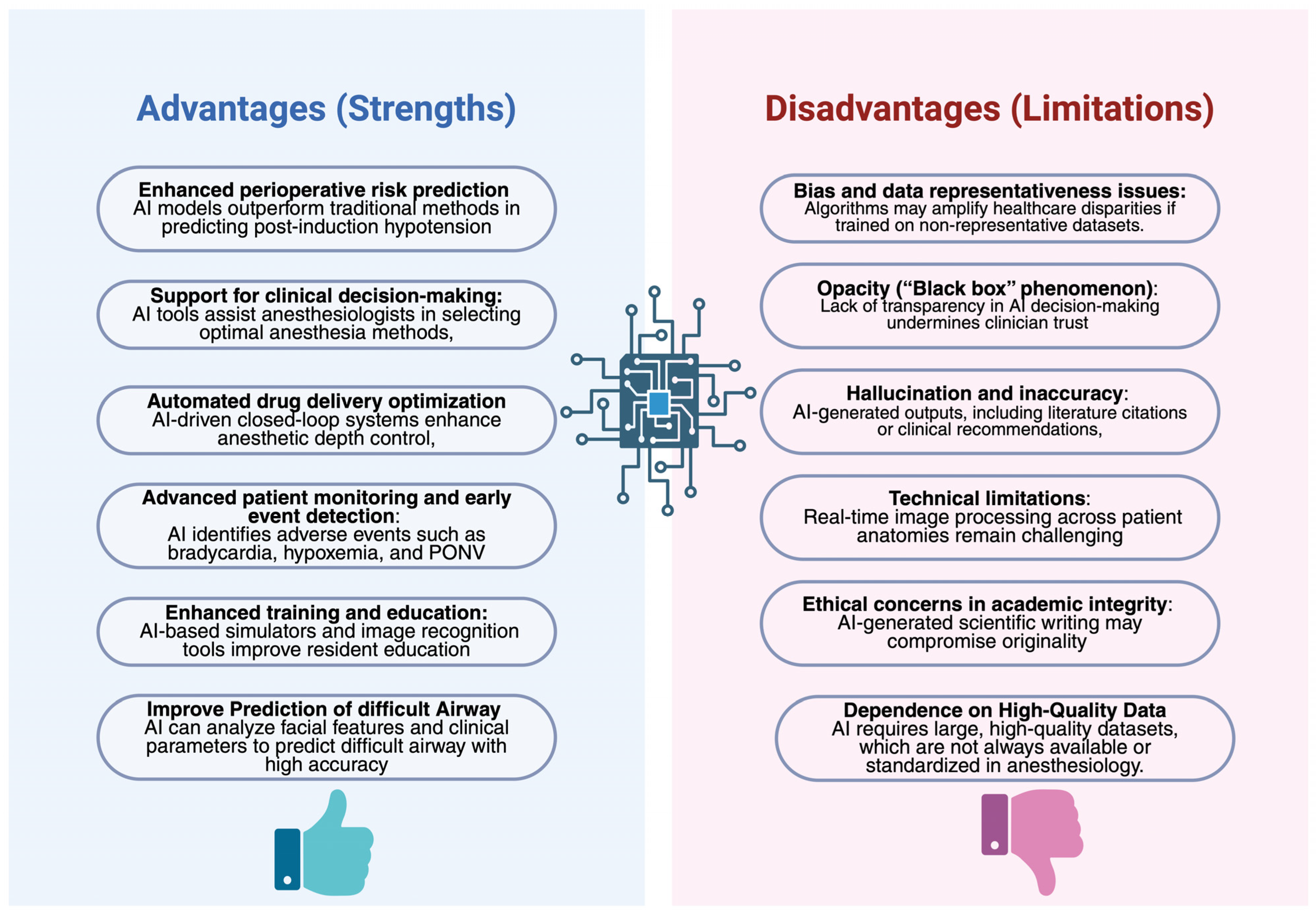
Artificial intelligence (AI) is rapidly transforming anesthesiology practice across perioperative settings. This review explores the evolution and implementation of hybrid decision-making models that integrate AI capabilities with human clinical expertise. From historical foundations to current applications, we examine how machine learning algorithms, deep learning networks, and big data analytics are enhancing anesthetic care. Key applications include perioperative risk prediction, AI-assisted patient education, automated analysis of clinical records, airway management support, predictive hemodynamic monitoring, closed-loop anesthetic delivery systems, and pain management optimization. In procedural contexts, AI demonstrates promising utility in regional anesthesia through anatomical structure identification and needle navigation, monitoring anesthetic depth via EEG analysis, and improving quality control in endoscopic sedation. Educational applications include intelligent simulators for procedural training and academic productivity tools. Despite significant advances, implementation challenges persist, including algorithmic bias, data security concerns, clinical validation requirements, and ethical considerations regarding AI-generated content. The optimal integration model emphasizes a complementary approach where AI augments rather than replaces clinical judgment—combining computational efficiency with the irreplaceable contextual understanding and ethical reasoning of the anesthesiologist. This hybrid paradigm reinforces the anesthesiologist’s leadership role in perioperative care while enhancing safety, precision, and efficiency through technological innovation. As AI integration advances, continued emphasis on algorithmic transparency, rigorous clinical validation, and human oversight remains essential to ensure that these technologies enhance rather than compromise patient-centered anesthetic care.
Keywords: artificial intelligence; machine learning; anesthesiology; perioperative care; clinical decision support artificial intelligence; machine learning; anesthesiology; perioperative care; clinical decision support