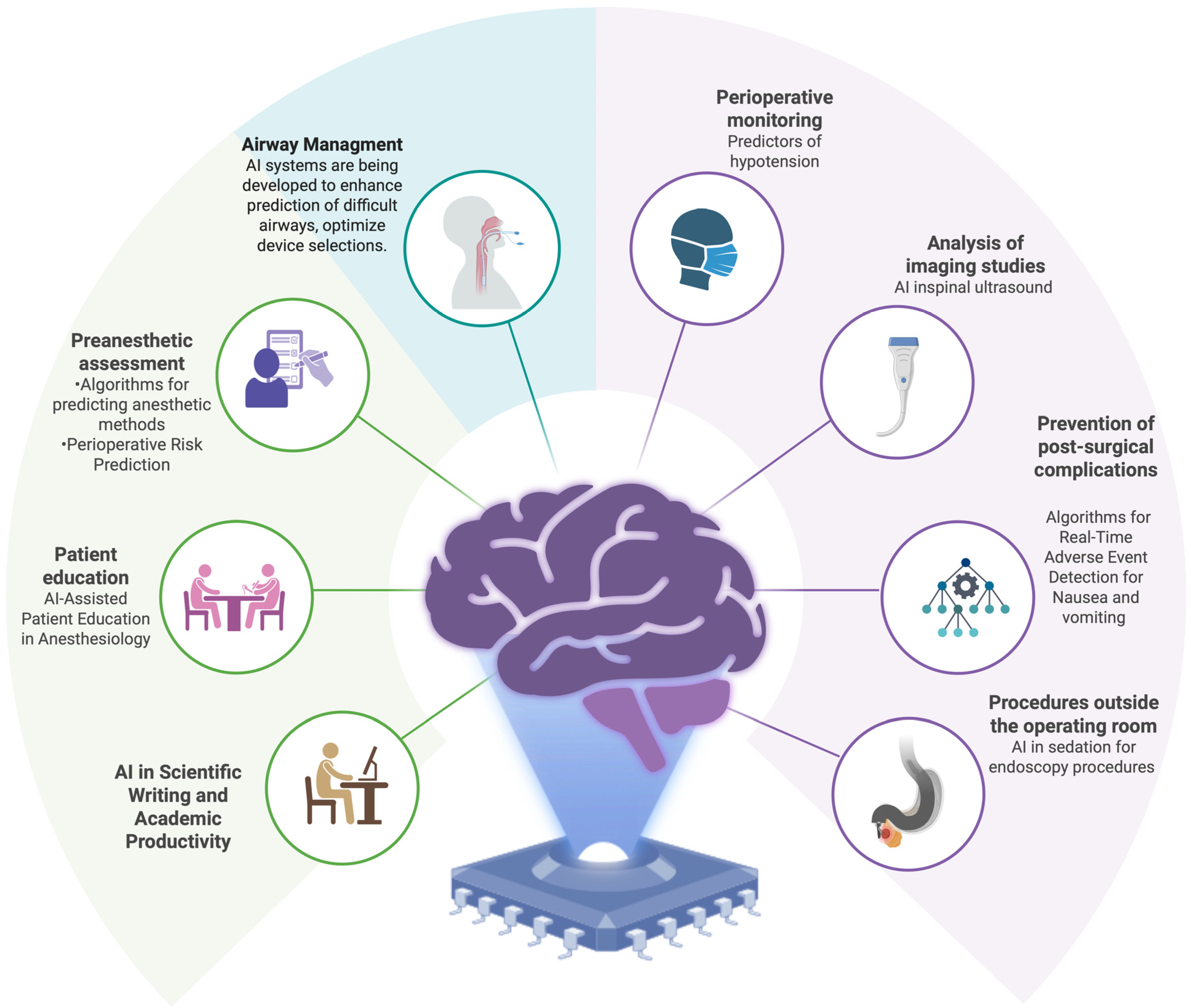
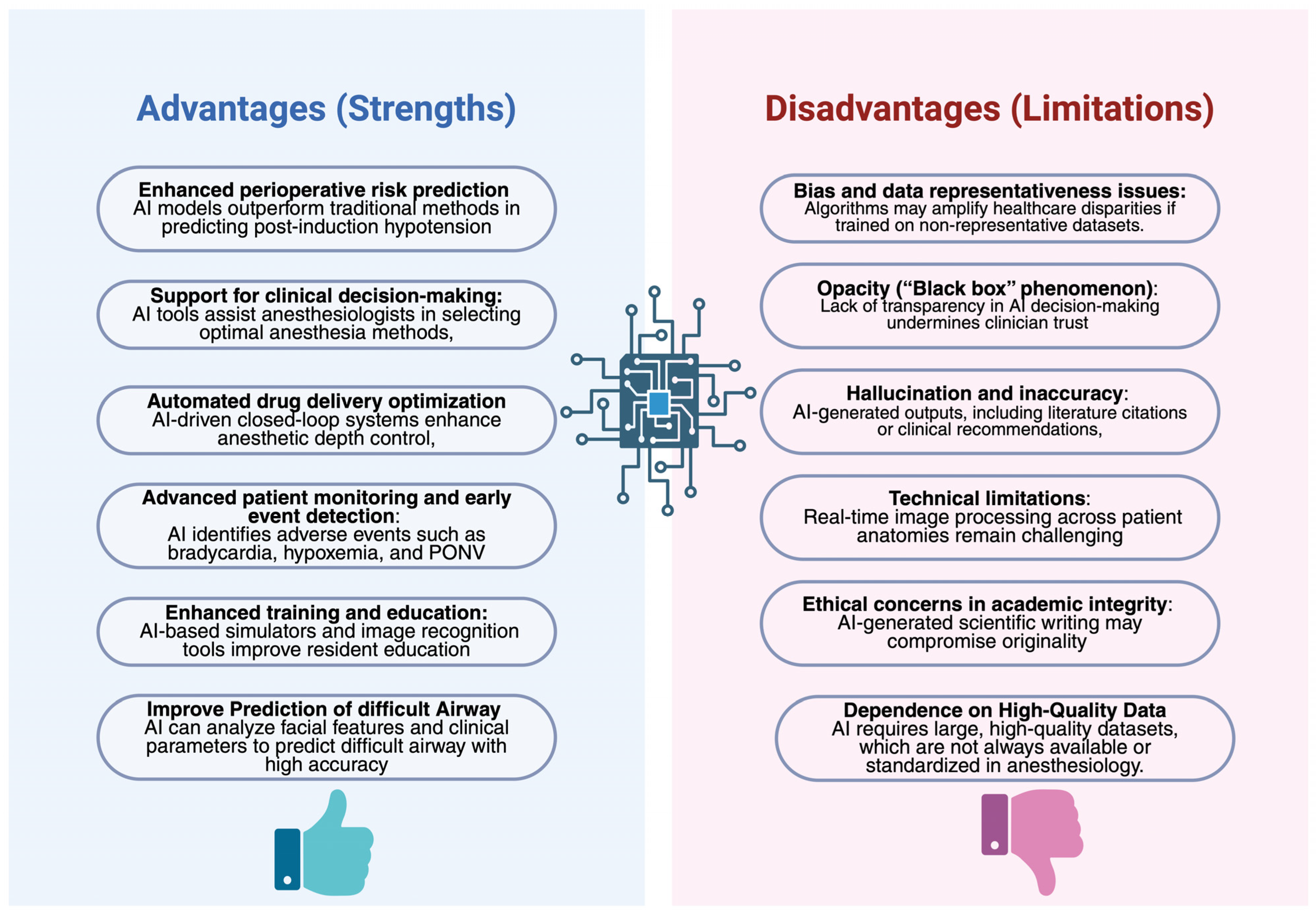
Advancing a Hybrid Decision-Making Model in Anesthesiology: Applications of Artificial Intelligence in the Perioperative Setting

Abstract
1. Introduction
2. Materials and Methods
3. Clinical Applications of Artificial Intelligence in Anesthesiology
3.1. Perioperative Risk Prediction: ASA Classification and Postoperative Complications
3.2. AI-Assisted Patient Education in Anesthesiology
3.3. Automated Analysis of Clinical Records and Medical Imaging
3.4. Artificial Intelligence in Airway Management
3.5. Predictive Models of Hemodynamic Instability
3.6. Closed-Loop Systems for Drug Administration (TIVA/TCI)
3.7. Algorithms for Real-Time Adverse Event Detection
4. Pain Management and Analgesia
4.1. Prediction of Chronic Postoperative Pain
4.2. Facial and Emotional Recognition for Pain Assessment in Non-Communicative Patients
5. Regional Anesthesia and Ultrasonography
5.1. Computer Vision Assistance for Anatomical Structure Identification
5.2. Needle Navigation and Automated Positioning
6. AI in Monitoring the Depth of Anesthesia
7. AI in Sedation for Endoscopy Procedures
8. Artificial Intelligence in Anesthesiology Research and Education
Intelligent Simulators for Anesthesiology Training
9. AI in Scientific Writing and Academic Productivity
10. Challenges, Limitations, and Ethical Considerations
11. Conclusions
Author Contributions
Funding
Institutional Review Board Statement
Informed Consent Statement
Data Availability Statement
Conflicts of Interest
Abbreviations
| AI | Artificial Intelligence |
| ML | Machine Learning |
| DL | Deep Learning |
| CNN(s) | Convolutional Neural Network(s) |
| EEG | Electroencephalogram |
| TIVA | Total Intravenous Anesthesia |
| TCI | Target-Controlled Infusion |
| ASA | American Society of Anesthesiologists |
| POCUS | Point-of-Care Ultrasound |
| HPI | Hypotension Prediction Index |
| AUROC | Area Under the Receiver Operating Characteristic |
| LASSO | Least Absolute Shrinkage and Selection Operator |
| ANN | Artificial Neural Network |
| SEF95 | Spectral Edge Frequency 95% |
| ROC | Receiver Operating Characteristic |
| AUC | Area Under the Curve |
| DoA | Depth of Anesthesia |
| SampEn | Sample Entropy |
| VR | Virtual Reality |
| ALS | Advanced Life Support |
| ACLS | Advanced Cardiac Life Support |
| RHS | Reference Hallucination Score |
| GPT-4 | Generative Pre-trained Transformer 4 |
| DOI | Digital Object Identifier |
| ICU | Intensive Care Unit |
References
- Hirani, R.; Noruzi, K.; Khuram, H.; Hussaini, A.S.; Aifuwa, E.I.; Ely, K.E.; Lewis, J.M.; Gabr, A.E.; Smiley, A.; Tiwari, R.K.; et al. Artificial Intelligence and Healthcare: A Journey through History, Present Innovations, and Future Possibilities. Life 2024, 14, 557. [Google Scholar] [CrossRef]
- Bellini, V.; Carnà, E.R.; Russo, M.; Di Vincenzo, F.; Berghenti, M.; Baciarello, M.; Bignami, E. Artificial intelligence and anesthesia: A narrative review. Ann. Transl. Med. 2022, 10, 528. [Google Scholar] [CrossRef] [PubMed]
- Enslin, S.; Kaul, V. Past, Present, and Future: A History Lesson in Artificial Intelligence. Gastrointest. Endosc. Clin. N. Am. 2025, 35, 265–278. [Google Scholar] [CrossRef] [PubMed]
- Grzybowski, A.; Pawlikowska-Lagod, K.; Lambert, W.C. A History of Artificial Intelligence. Clin. Dermatol. 2024, 42, 221–229. [Google Scholar] [CrossRef] [PubMed]
- Bajwa, J.; Munir, U.; Nori, A.; Williams, B. Artificial intelligence in healthcare: Transforming the practice of medicine. Futur. Healthc. J. 2021, 8, e188–e194. [Google Scholar] [CrossRef]
- Mudgal, S.K.; Agarwal, R.; Chaturvedi, J.; Gaur, R.; Ranjan, N. Real-world application, challenges and implication of artificial intelligence in healthcare: An essay. Pan Afr. Med. J. 2022, 43, 3. [Google Scholar]
- Singhal, M.; Gupta, L.; Hirani, K. A Comprehensive Analysis and Review of Artificial Intelligence in Anaesthesia. Cureus 2023, 15, e45038. [Google Scholar] [CrossRef]
- Chen, M.; Zhang, D. Machine learning-based prediction of post-induction hypotension: Identifying risk factors and enhancing anesthesia management. BMC Med. Inform. Decis. Mak. 2025, 25, 96. [Google Scholar] [CrossRef]
- Çelik, E.; Turgut, M.A.; Aydoğan, M.; Kılınç, M.; Toktaş, İ.; Akelma, H. Comparison of AI applications and anesthesiologist’s anesthesia method choices. BMC Anesthesiol. 2025, 25, 2. [Google Scholar] [CrossRef]
- Yahagi, M.; Hiruta, R.; Miyauchi, C.; Tanaka, S.; Taguchi, A.; Yaguchi, Y. Comparison of Conventional Anesthesia Nurse Education and an Artificial Intelligence Chatbot (ChatGPT) Intervention on Preoperative Anxiety: A Randomized Controlled Trial. J. Perianesth. Nurs. 2024, 39, 767–771. [Google Scholar] [CrossRef]
- Shimada, K.; Inokuchi, R.; Ohigashi, T.; Iwagami, M.; Tanaka, M.; Gosho, M.; Tamiya, N. Artificial intelligence-assisted interventions for perioperative anesthetic management: A systematic review and meta-analysis. BMC Anesthesiol. 2024, 24, 306. [Google Scholar] [CrossRef] [PubMed]
- Kong, A.; Liu, N.; Tan, H.; Sia, A.; Sng, B. Artificial intelligence in obstetric anaesthesiology—The future of patient care? Int. J. Obstet. Anesth. 2025, 61, 104288. [Google Scholar] [CrossRef] [PubMed]
- La Via, L.; Maniaci, A.; Gage, D.; Cuttone, G.; Misseri, G.; Lentini, M.; Paternò, D.S.; Pappalardo, F.; Sorbello, M. Exploring the potential of artificial intelligence in airway management. Trends Anaesth. Crit. Care 2024, 59, 101512. [Google Scholar] [CrossRef]
- Hayasaka, T.; Kawano, K.; Kurihara, K.; Suzuki, H.; Nakane, M.; Kawamae, K. Creation of an artificial intelligence model for intubation difficulty classification by deep learning (convolutional neural network) using face images: An observational study. J. Intensive Care 2021, 9, 38. [Google Scholar] [CrossRef]
- Balavenkatasubramanian, J.; Kumar, S.; Sanjayan, R.D. Artificial intelligence in regional anaesthesia. Indian J. Anaesth. 2024, 68, 100–104. [Google Scholar] [CrossRef]
- Cai, N.; Wang, G.; Xu, L.; Zhou, Y.; Chong, H.; Zhao, Y.; Wang, J.; Yan, W.; Zhang, B.; Liu, N. Examining the impact perceptual learning artificial-intelligence-based on the incidence of paresthesia when performing the ultrasound-guided popliteal sciatic block: Simulation-based randomized study. BMC Anesthesiol. 2022, 22, 392. [Google Scholar] [CrossRef]
- Wijnberge, M.; Geerts, B.F.; Hol, L.; Lemmers, N.; Mulder, M.P.; Berge, P.; Schenk, J.; Terwindt, L.E.; Hollmann, M.W.; Vlaar, A.P.; et al. Effect of a Machine Learning-Derived Early Warning System for Intraoperative Hypotension vs. Standard Care on Depth and Duration of Intraoperative Hypotension During Elective Noncardiac Surgery: The HYPE Randomized Clinical Trial. JAMA 2020, 323, 1052–1060. [Google Scholar] [CrossRef]
- Wang, L.; Weng, Y.; Yu, W. Anesthesia depth prediction from drug infusion history using hybrid AI. BMC Med. Inform. Decis. Mak. 2025, 25, 158. [Google Scholar] [CrossRef]
- Glebov, M.; Lazebnik, T.; Katsin, M.; Orkin, B.; Berkenstadt, H.; Bunimovich-Mendrazitsky, S. Predicting postoperative nausea and vomiting using machine learning: A model development and validation study. BMC Anesthesiol. 2025, 25, 135. [Google Scholar] [CrossRef]
- Chan, J.J.I.; Ma, J.; Leng, Y.; Tan, K.K.; Tan, C.W.; Sultana, R.; Sia, A.T.H.; Sng, B.L. Machine learning approach to needle insertion site identification for spinal anesthesia in obese patients. BMC Anesthesiol. 2021, 21, 246. [Google Scholar] [CrossRef]
- Ruiz, A.; Kraus, M.; Arendt, K.; Schroeder, D.; Sharpe, E. Artificial intelligence-created personal statements compared with applicant-written personal statements: A survey of obstetric anesthesia fellowship program directors in the United States. Int. J. Obstet. Anesth. 2025, 61, 104293. [Google Scholar] [CrossRef] [PubMed]
- Gu, Y.; Liang, Z.; Hagihira, S. Use of Multiple EEG Features and Artificial Neural Network to Monitor the Depth of Anesthesia. Sensors 2019, 19, 2499. [Google Scholar] [CrossRef] [PubMed]
- Jiang, G.J.A.; Fan, S.-Z.; Abbod, M.F.; Huang, H.-H.; Lan, J.-Y.; Tsai, F.-F.; Chang, H.-C.; Yang, Y.-W.; Chuang, F.-L.; Chiu, Y.-F.; et al. Sample entropy analysis of EEG signals via artificial neural networks to model patients’ consciousness level based on anesthesiologists experience. Biomed. Res. Int. 2015, 2015, 343478. [Google Scholar] [CrossRef] [PubMed]
- Xu, C.; Zhu, Y.; Wu, L.; Yu, H.; Liu, J.; Zhou, F.; Xiong, Q.; Wang, S.; Cui, S.; Huang, X.; et al. Evaluating the effect of an artificial intelligence system on the anesthesia quality control during gastrointestinal endoscopy with sedation: A randomized controlled trial. BMC Anesthesiol. 2022, 22, 313. [Google Scholar] [CrossRef]
- Kitapcioglu, D.; Aksoy, M.E.; Ozkan, A.E.; Usseli, T.; Colak, D.C.; Torun, T. Enhancing Immersion in Virtual Reality-Based Advanced Life Support Training: Randomized Controlled Trial. JMIR Serious Games 2025, 13, e68272. [Google Scholar] [CrossRef]
- Katz, D.; Shah, R.; Kim, E.; Park, C.; Shah, A.; Levine, A.; Burnett, G. Utilization of a Voice-Based Virtual Reality Advanced Cardiac Life Support Team Leader Refresher: Prospective Observational Study. J. Med. Internet Res. 2020, 22, e17425. [Google Scholar] [CrossRef]
- Wei, C.-H.; Allot, A.; Lai, P.-T.; Leaman, R.; Tian, S.; Luo, L.; Jin, Q.; Wang, Z.; Chen, Q.; Lu, Z. PubTator 3.0: An AI-powered literature resource for unlocking biomedical knowledge. Nucleic Acids Res. 2024, 52, W540–W546. [Google Scholar] [CrossRef]
- Aljamaan, F.; Temsah, M.-H.; Altamimi, I.; Al-Eyadhy, A.; Jamal, A.; Alhasan, K.; A Mesallam, T.; Farahat, M.; Malki, K.H. Reference Hallucination Score for Medical Artificial Intelligence Chatbots: Development and Usability Study. JMIR Med. Inform. 2024, 12, e54345. [Google Scholar] [CrossRef]
- Granjeiro, J.M.; Cury, A.A.D.B.; Cury, J.A.; Bueno, M.; Sousa-Neto, M.D.; Estrela, C. The Future of Scientific Writing: AI Tools, Benefits, and Ethical Implications. Braz. Dent. J. 2025, 36, e256471. [Google Scholar] [CrossRef]
- Angel, M.C.; Rinehart, J.B.; Cannesson, M.P.; Baldi, P. Clinical Knowledge and Reasoning Abilities of AI Large Language Models in Anesthesiology: A Comparative Study on the American Board of Anesthesiology Examination. Anesth. Analg. 2024, 139, 349–356. [Google Scholar] [CrossRef]
- BaHammam, A.S. Balancing Innovation and Integrity: The Role of AI in Research and Scientific Writing. Nat. Sci. Sleep 2023, 15, 1153–1156. [Google Scholar] [CrossRef]
- Chirichela, I.A.; Mariani, A.W.; Pego-Fernandes, P.M. Artificial intelligence in scientific writing. Sao Paulo Med. J. 2024, 142, e20241425. [Google Scholar] [CrossRef]
- Khalifa, M.; Albadawy, M. Using artificial intelligence in academic writing and research: An essential productivity tool. Comput. Methods Programs Biomed. Update 2024, 5, 100145. [Google Scholar] [CrossRef]
- Song, B.; Zhou, M.; Zhu, J. Necessity and Importance of Developing AI in Anesthesia from the Perspective of Clinical Safety and Information Security. Med. Sci. Monit. 2023, 29, e938835. [Google Scholar] [CrossRef]
- Paiste, H.J.; Godwin, R.C.; Smith, A.D.; Berkowitz, D.E.; Melvin, R.L. Strengths-weaknesses-opportunities-threats analysis of artificial intelligence in anesthesiology and perioperative medicine. Front. Digit. Health 2024, 6, 1316931. [Google Scholar] [CrossRef]


| Author (Year) | AI Application | Study Design | Sample Size | Key Results | Limitations/Generalizability |
|---|---|---|---|---|---|
| Chen et al. (2025) [8] | Post-induction hypotension prediction | Retrospective analysis | 5406 | AUROC = 0.74 (logistic regression) | Superior to complex models; needs external validation |
| Çelik et al. (2025) [9] | AI-guided anesthetic choice | Observational comparison | Not stated | AI-human concordance up to 85.7% | Model variability; lacks real-time clinical testing |
| Yahagi et al. (2024) [10] | Chatbot-assisted patient education | Randomized controlled trial (RCT) | Not stated | Significant anxiety reduction over time (p = 0.015) | Content reliability not guaranteed; time-sensitive effects |
| Shimada et al. (2024) [11] | HPI monitoring for intraoperative hypotension | Meta-analysis of small RCTs | Varies | Trend toward lower hypotension burden | Limited by small trials; moderate heterogeneity |
| Wijnberge et al. (2020) [17] | ML-based early warning system (HPI) | Randomized controlled trial | 60 | ↓ TWA hypotension (0.10 vs. 0.44 mmHg, p = 0.001) | Single-center; requires broader validation |
| Xu et al. (2022) [24] | AI-assisted sedation monitoring (ENDOANGEL) | Randomized controlled trial | 154 | ↓ emergence/recovery time; ↑ satisfaction (p < 0.01) | Generalizability beyond GI endoscopy unconfirmed |
| Application Domain | AI Techniques Used | Validation Type | Performance Metrics | Clinical Barriers |
|---|---|---|---|---|
| Clinical Records | NLP, text mining | Implementation studies | Improved documentation and extraction accuracy | Low adoption rate, data heterogeneity |
| Medical Imaging & Ultrasound | CNNs, deep learning, computer vision | Prospective cohorts | Landmark ID success up to 79.1% (Chan et al. [20]) | Variability in anatomy; image quality issues |
| Airway Management | ML classifiers, facial image analysis | Accuracy-based validations | >85% prediction accuracy for difficult airway | Black-box limitations; operator trust |
| Hemodynamic Monitoring | ML, early warning systems (HPI) | RCTs, meta-analyses | ↓ TWA hypotension, ↑ prediction accuracy | Alert fatigue; limited to specific procedures |
| TIVA/TCI Automation | Hybrid neural networks (LSTM, Transformer) | Model performance (MSE) | MSE = 0.0062 (Wang et al. [18]) | Need for real-time pharmacodynamic integration |
| Patient Education | LLM-based chatbots (e.g., ChatGPT) | Randomized controlled trial | Improved engagement, anxiety modulation (p = 0.015) | Reference hallucination; inconsistent output |
| Procedural Sedation | Deep learning (ENDOANGEL) | Randomized controlled trial | ↓ adverse events, ↓ recovery time | Validation limited to endoscopy |
| Education & Simulation | AI-guided simulators, voice recognition | Simulation-based RCTs | ↑ procedural safety; ↓ paresthesia in block placement | Voice recognition errors; cost of simulation |
| Analgesia & Pain Prediction | Penalized regression, ensemble learning | Model development and internal validation | >80% accuracy for PONV prediction | Sparse data on chronic pain; external validation needed |
| Depth of Anesthesia Monitoring | ANN + EEG entropy/Spectral analysis | Comparison with BIS and expert assessment | AUC up to 0.95; better correlation than BIS | Noise sensitivity; lack of standardization |
Disclaimer/Publisher’s Note: The statements, opinions and data contained in all publications are solely those of the individual author(s) and contributor(s) and not of MDPI and/or the editor(s). MDPI and/or the editor(s) disclaim responsibility for any injury to people or property resulting from any ideas, methods, instructions or products referred to in the content. |
© 2025 by the authors. Licensee MDPI, Basel, Switzerland. This article is an open access article distributed under the terms and conditions of the Creative Commons Attribution (CC BY) license.
Share and Cite
Duarte-Medrano, G.; Nuño-Lámbarri, N.; Paternò, D.S.; La Via, L.; Tutino, S.; Dominguez-Cherit, G.; Sorbello, M. Advancing a Hybrid Decision-Making Model in Anesthesiology: Applications of Artificial Intelligence in the Perioperative Setting. Healthcare 2026, 14, 97. https://doi.org/10.3390/healthcare14010097
Duarte-Medrano G, Nuño-Lámbarri N, Paternò DS, La Via L, Tutino S, Dominguez-Cherit G, Sorbello M. Advancing a Hybrid Decision-Making Model in Anesthesiology: Applications of Artificial Intelligence in the Perioperative Setting. Healthcare. 2026; 14(1):97. https://doi.org/10.3390/healthcare14010097
Chicago/Turabian StyleDuarte-Medrano, Gilberto, Natalia Nuño-Lámbarri, Daniele Salvatore Paternò, Luigi La Via, Simona Tutino, Guillermo Dominguez-Cherit, and Massimiliano Sorbello. 2026. "Advancing a Hybrid Decision-Making Model in Anesthesiology: Applications of Artificial Intelligence in the Perioperative Setting" Healthcare 14, no. 1: 97. https://doi.org/10.3390/healthcare14010097
APA StyleDuarte-Medrano, G., Nuño-Lámbarri, N., Paternò, D. S., La Via, L., Tutino, S., Dominguez-Cherit, G., & Sorbello, M. (2026). Advancing a Hybrid Decision-Making Model in Anesthesiology: Applications of Artificial Intelligence in the Perioperative Setting. Healthcare, 14(1), 97. https://doi.org/10.3390/healthcare14010097