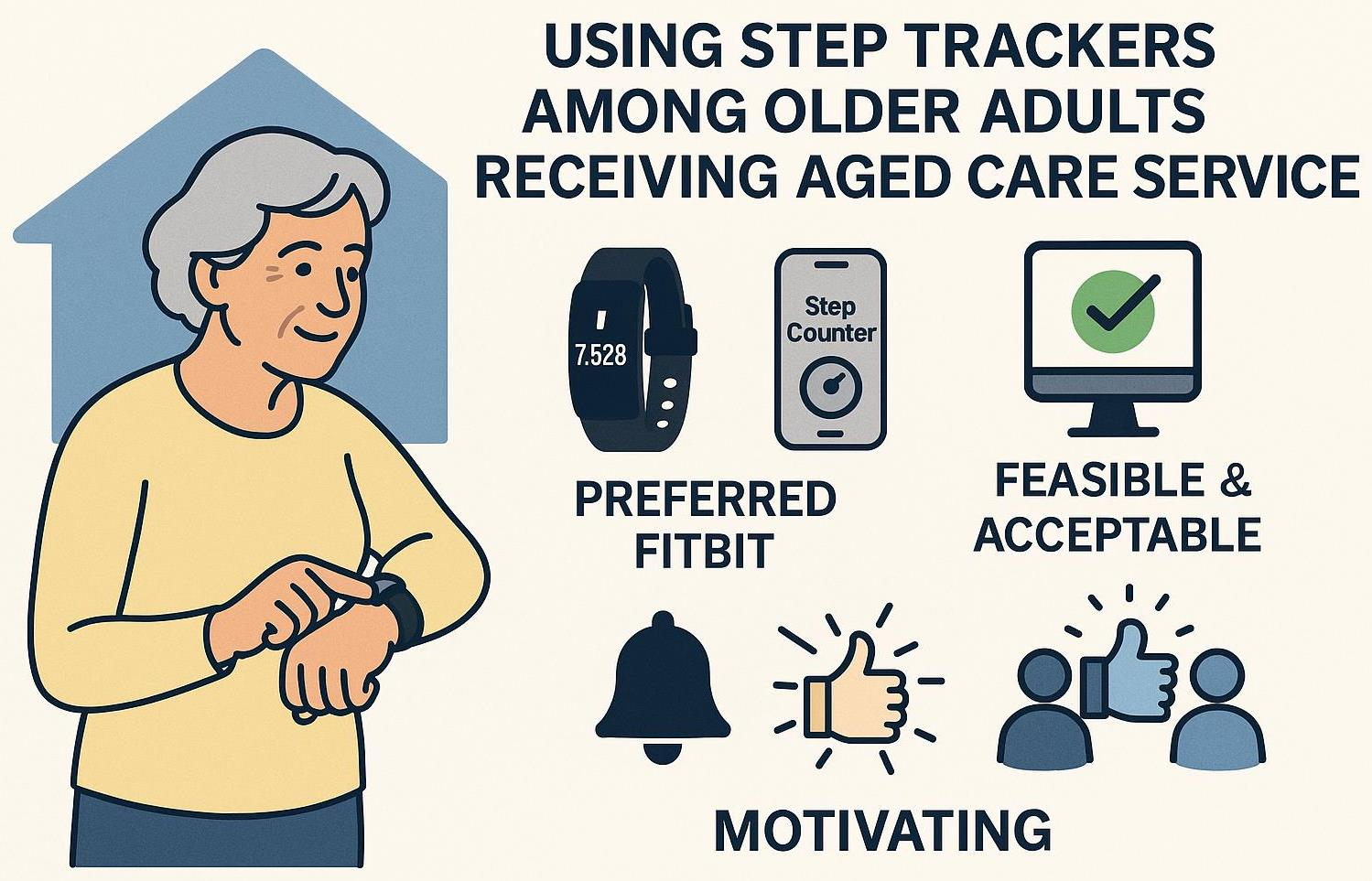
Using Step Trackers Among Older People Receiving Aged Care Services Is Feasible and Acceptable: A Mixed-Methods Study

 ,
, 
Highlights
- Step tracking was feasible and acceptable for older adults receiving aged care, with strong engagement and a clear preference for Fitbit devices over phone or website interfaces.
- Wrist-worn trackers increased physical activity awareness and motivation, supported by reminders, rewards, and social sharing.
- Digital activity monitoring for older people is likely to benefit from simple, user-friendly designs that provide quick and accessible feedback.
- Wearable trackers may offer a practical, scalable way to enhance motivation, support restorative care, and strengthen social connectedness in aged care settings.
Abstract
1. Introduction
2. Method
2.1. Eligibility Criteria
2.2. Recruitment and Consent
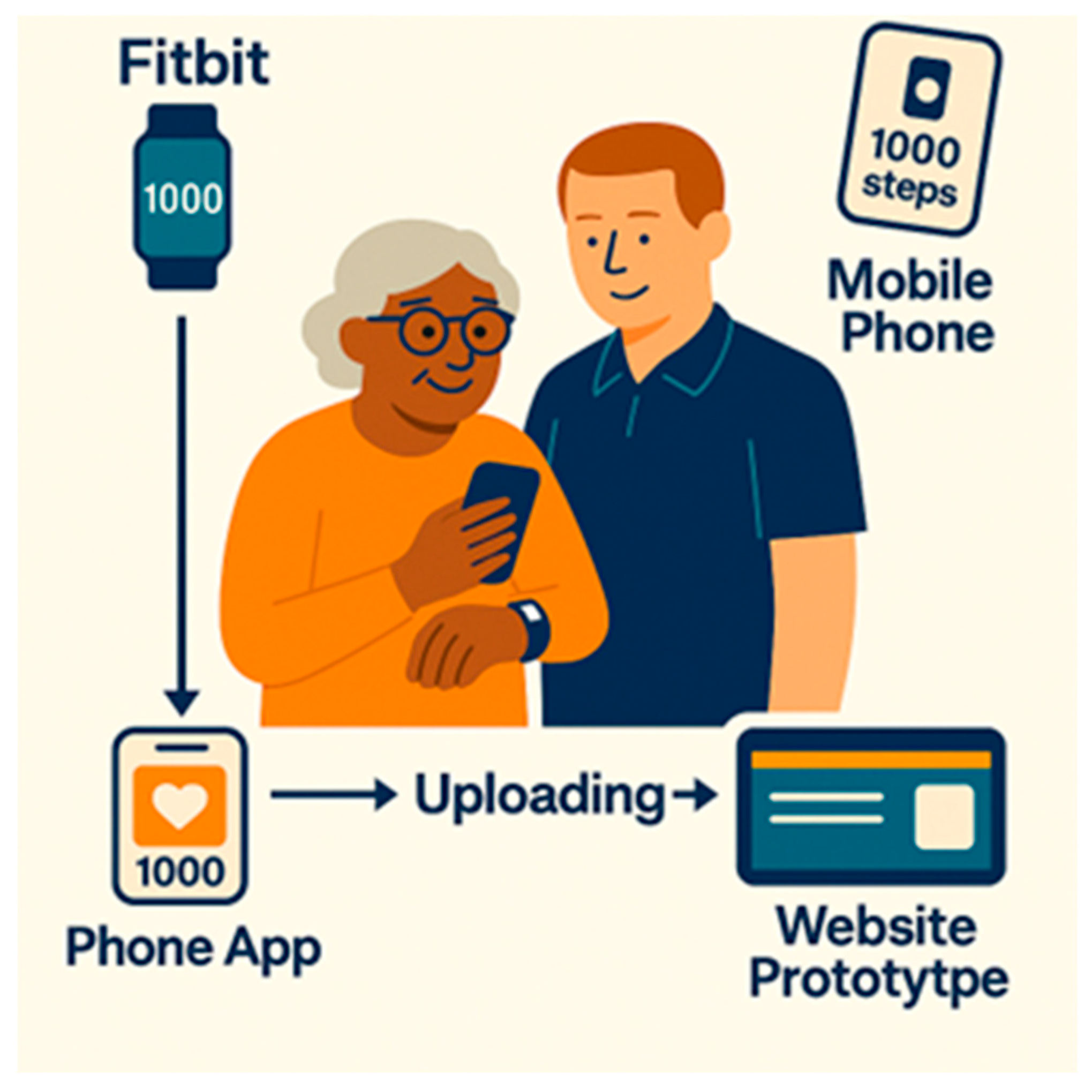
2.3. Step Tracking Intervention
2.4. Data Collection
2.5. Analysis
3. Results
Content Analysis of Open-Ended Survey Responses
- “Doing something positive”: Finding purpose in step tracking
- 2.
- “A little push helps”: Gamification and personal challenge
- 3.
- “Sharing steps, sharing stories”: Building social connection
- 4.
- “Not always easy, but worth it”: Barriers and support
- 5.
- “Fitbit are easier to use”: Device preferences and usability
4. Discussion
5. Conclusions
Supplementary Materials
Author Contributions
Funding
Institutional Review Board Statement
Informed Consent Statement
Data Availability Statement
Acknowledgments
Conflicts of Interest
Appendix A. Testing Devices for Tracking Step Counts: Survey Questions
| Thank you again for participating in this part of the TOP-UP study. We’re going to discuss your experiences using a Fitbit and mobile phone to track your steps over the last four weeks. These questions will focus on how you used both these devices and how you felt about using them. | ||||
| 1. Let’s start with a really broad question: What was it like to use a Fitbit and mobile phone to track your steps? | ||||
| 2. Was it hard to remember to put the Fitbit on each day or to carry your phone when you were moving around? [if they mention forgetting it sometimes, follow up re how often] | ||||
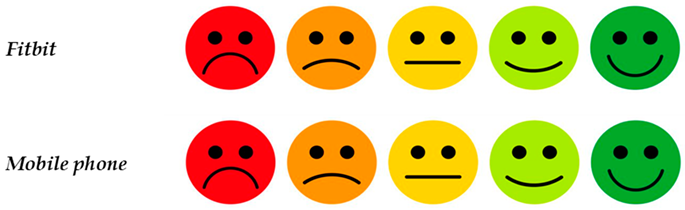
| 3. We’d like to know which of the devices you liked best for tracking your steps: the Fitbit or your mobile phone? [Talk about their experience first then ask the participants how they would rate each device on this scale]: | ||||
 | ||||
| [If one is preferred] Why was that device preferable? | ||||
| 4. Were there any difficulties or concerns about tracking your steps? If you could change one thing about the Fitbit or about using your phone to track steps, what would it be? | ||||
| 5. What was it like to see the amount of steps you’d done on the iPad? How did it feel? | ||||
| 6. Could we improve the way information about your steps was shown on the website? | ||||
| 7. Do you think that tracking your steps affected the amount of walking or other exercise you did? | ||||
| I have a few more questions. I’ll read out each statement, and I’d like you to tell me how much you agree or disagree with it. The first one is... 1: | ||||
| 8. It was easy to use the Fitbit to track my daily step count | ||||
| Strongly disagree | Somewhat disagree | Neither agree nor disagree | Somewhat Agree | Strongly Agree |
| 1 | 2 | 3 | 4 | 5 |
| 9. I liked using the Fitbit to track my steps | ||||
| Strongly disagree | Somewhat disagree | Neither agree nor disagree | Somewhat Agree | Strongly Agree |
| 1 | 2 | 3 | 4 | 5 |
| 10. It was easy to use the mobile phone to track my daily step count | ||||
| Strongly disagree | Somewhat disagree | Neither agree nor disagree | Somewhat Agree | Strongly Agree |
| 1 | 2 | 3 | 4 | 5 |
| 11. I liked using my mobile phone to track my steps | ||||
| Strongly disagree | Somewhat disagree | Neither agree nor disagree | Somewhat Agree | Strongly Agree |
| 1 | 2 | 3 | 4 | 5 |
| 12. I liked being able to see my step count | ||||
| Strongly disagree | Somewhat disagree | Neither agree nor disagree | Somewhat Agree | Strongly Agree |
| 1 | 2 | 3 | 4 | 5 |
| 13. Tracking my steps made me more aware of being physically active | ||||
| Strongly disagree | Somewhat disagree | Neither agree nor disagree | Somewhat Agree | Strongly Agree |
| 1 | 2 | 3 | 4 | 5 |
| 14. Tracking my steps motivated me to walk or exercise more | ||||
| Strongly disagree | Somewhat disagree | Neither agree nor disagree | Somewhat Agree | Strongly Agree |
| 1 | 2 | 3 | 4 | 5 |
| 15. I will continue to track my steps after this study ends | ||||
| Strongly disagree | Somewhat disagree | Neither agree nor disagree | Somewhat Agree | Strongly Agree |
| 1 | 2 | 3 | 4 | 5 |
| 16. Finally, is there anything else you can tell us that might help us improve how we engage people in the TOP-UP program? | ||||
| Thank you so much for sharing your views and experiences. It’s really helpful for us to have your input. | ||||
| 1 Explain/negotiate the response options as they answer each question to ensure it’s the best fit for them. Only one whole number can be selected (e.g., 3.5 or 3 to 4 are not acceptable). | ||||
References
- Cunningham, C.; O’ Sullivan, R.; Caserotti, P.; Tully, M.A. Consequences of physical inactivity in older adults: A systematic review of reviews and meta-analyses. Scand. J. Med. Sci. Sports 2020, 30, 816–827. [Google Scholar] [CrossRef]
- Kwok, W.S.; Khalatbari-Soltani, S.; Dolja-Gore, X.; Byles, J.; Oliveira, J.S.; Sherrington, C. Physical Activity and Falls From Midlife: Patterns and Bidirectional Associations. Am. J. Prev. Med. 2025, 68, 914–922. [Google Scholar] [CrossRef] [PubMed]
- Cameron, I.; Fairhall, N.; Langron, C.; Lockwood, K.; Monaghan, N.; Aggar, C.; Sherrington, C.; Lord, S.R.; Kurrle, S.E. A multifactorial interdisciplinary intervention reduces frailty in older people: Randomized trial. BMC Med. 2013, 11, 65. [Google Scholar] [CrossRef] [PubMed]
- Kwok, W.S.; Khalatbari-Soltani, S.; Dolja-Gore, X.; Byles, J.; Oliveira, J.S.; Pinheiro, M.B.; Tiedemann, A.; Sherrington, C. Falls and patterns of physical activity participation over 18 years in the Australian Longitudinal Study on Women’s Health. Br. J. Sports Med. 2024, 58, 919–929. [Google Scholar] [CrossRef] [PubMed]
- Mc Ardle, R.; Sverdrup, K.; Del Din, S.; Lord, S.; Kerse, N.; Rochester, L.; Taylor, L. Quantifying physical activity in aged residential care facilities: A structured review. Ageing Res. Rev. 2021, 67, 101298. [Google Scholar] [CrossRef]
- St Fleur, R.G.; St George, S.M.; Leite, R.; Kobayashi, M.; Agosto, Y.; Jake-Schoffman, D.E. Use of Fitbit Devices in Physical Activity Intervention Studies Across the Life Course: Narrative Review. JMIR mHealth uHealth 2021, 9, e23411. [Google Scholar] [CrossRef]
- Laranjo, L.; Ding, D.; Heleno, B.; Kocaballi, B.; Quiroz, J.C.; Tong, H.L.; Chahwan, B.; Neves, A.L.; Gabarron, E.; Dao, K.P.; et al. Do smartphone applications and activity trackers increase physical activity in adults? Systematic review, meta-analysis and metaregression. Br. J. Sports Med. 2021, 55, 422–432. [Google Scholar] [CrossRef]
- Ferguson, T.; Olds, T.; Curtis, R.; Blake, H.; Crozier, A.J.; Dankiw, K.; Dumuid, D.; Kasai, D.; O’Connor, E.; Virgara, R.; et al. Effectiveness of wearable activity trackers to increase physical activity and improve health: A systematic review of systematic reviews and meta-analyses. Lancet Digit. Health 2022, 4, e615–e626. [Google Scholar] [CrossRef]
- Bertolazzi, A.; Quaglia, V.; Bongelli, R. Barriers and facilitators to health technology adoption by older adults with chronic diseases: An integrative systematic review. BMC Public Health 2024, 24, 506–517. [Google Scholar] [CrossRef]
- Naslund, J.A.; Aschbrenner, K.A.; Bartels, S.J. Wearable devices and smartphones for activity tracking among people with serious mental illness. Ment. Health Phys. Act. 2016, 10, 10–17. [Google Scholar] [CrossRef]
- Dawson, R.; Pinheiro, M.; Oliveira, J.; Haynes, A.; Naganathan, V.; Taylor, M.E.; Bowes, N.; Nelson, K.; Rayner, J.; Sherrington, C. The Telephysiotherapy for Older People (TOP-UP) program for improving mobility in people receiving aged care: A hybrid type 1 effectiveness–implementation randomised controlled trial. Med. J. Aust. 2025, 223, 205–213. [Google Scholar] [CrossRef] [PubMed]
- Dawson, R.; Gilchrist, H.; Pinheiro, M.; Nelson, K.; Bowes, N.; Sherrington, C.; Haynes, A. Experiences of Older Adults, Physiotherapists, and Aged Care Staff in the TOP UP Telephysiotherapy Program: Interview Study of the TOP UP Interventions. JMIR Aging 2024, 7, e53010. [Google Scholar] [CrossRef]
- Ferrucci, L.; Del Lungo, I.; Guralnik, J.M.; Bandinelli, S.; Benvenuti, E.; Salani, B.; Lamponi, M.; Ubezio, C.; Benvenuti, F.; Baroni, A. Is the Telephone Interview for Cognitive Status a valid alternative in persons who cannot be evaluated by the Mini Mental State Examination? Aging Clin. Exp. Res. 1998, 10, 332–338. [Google Scholar] [CrossRef]
- Hennink, M.; Kaiser, B.N. Sample sizes for saturation in qualitative research: A systematic review of empirical tests. Soc. Sci. Med. 2022, 292, 114523. [Google Scholar] [CrossRef]
- Broom, A. Conceptualizing Qualitative Data. Qual. Health Res. 2021, 31, 1767–1770. [Google Scholar] [CrossRef]
- Smith, B.; McGannon, K.R. Developing rigor in qualitative research: Problems and opportunities within sport and exercise psychology. Int. Rev. Sport Exerc. 2018, 11, 101–121. [Google Scholar] [CrossRef]
- Auerswald, T.; Meyer, J.; von Holdt, K.; Voelcker-Rehage, C. Application of Activity Trackers among Nursing Home Residents-A Pilot and Feasibility Study on Physical Activity Behavior, Usage Behavior, Acceptance, Usability and Motivational Impact. Int. J. Environ. Res. Public Health 2020, 17, 6683. [Google Scholar] [CrossRef] [PubMed]
- Consolvo, S.; Roessler, P.; Shelton, B.E. (Eds.) The CareNet Display: Lessons Learned from an in Home Evaluation of an Ambient Display; Springer: Berlin/Heidelberg, Germany, 2004. [Google Scholar]
- White, B.K.; Martin, A.; White, J. Gamification and older adults: Opportunities for gamification to support health promotion initiatives for older adults in the context of COVID-19. Lancet Reg. Health West. Pac. 2023, 35, 100528. [Google Scholar] [CrossRef]
- Ahn, J.; Falk, E.B.; Kang, Y. Relationships between physical activity and loneliness: A systematic review of intervention studies. Curr. Res. Behav. Sci. 2024, 6, 100141. [Google Scholar] [CrossRef]
- Riadi, I.B.; Kervin, L.B.A.; Dhillon, S.M.A.; Teo, K.M.A.; Churchill, R.M.A.; Card, K.G.P.; Sixsmith, A.; Moreno, S.; Fortuna, K.L.; Torous, J.; et al. Digital interventions for depression and anxiety in older adults: A systematic review of randomised controlled trials. Lancet Healthy Longev. 2022, 3, e558–e571. [Google Scholar] [CrossRef]
- Drabble, S.J.; O’Cathain, A.; Thomas, K.J.; Rudolph, A.; Hewison, J. Describing qualitative research undertaken with randomised controlled trials in grant proposals: A documentary analysis. BMC Med. Res. Methodol. 2014, 14, 24. [Google Scholar] [CrossRef] [PubMed]
- Hamilton, A.B.; Finley, E.P. Qualitative methods in implementation research: An introduction. Psychiatry Res. 2019, 280, 112516. [Google Scholar] [CrossRef] [PubMed]

| Survey Question | Median | IQR (Q1–Q3) | Range |
|---|---|---|---|
| 5 | 5–5 | 3–5 * |
| 5 | 5–5 | 3–5 * |
| 3 | 2–4 | 1–5 |
| 3 | 2–4 | 1–4 |
| 5 | 5–5 | 3–5 |
| 5 | 4–5 | 3–5 |
| 5 | 5–5 | 3–5 * |
Disclaimer/Publisher’s Note: The statements, opinions and data contained in all publications are solely those of the individual author(s) and contributor(s) and not of MDPI and/or the editor(s). MDPI and/or the editor(s) disclaim responsibility for any injury to people or property resulting from any ideas, methods, instructions or products referred to in the content. |
© 2025 by the authors. Licensee MDPI, Basel, Switzerland. This article is an open access article distributed under the terms and conditions of the Creative Commons Attribution (CC BY) license.
Share and Cite
Dawson, R.; Kay, J.; Cameron, L.; Bucalon, B.; Sherrington, C.; Haynes, A. Using Step Trackers Among Older People Receiving Aged Care Services Is Feasible and Acceptable: A Mixed-Methods Study. Healthcare 2026, 14, 86. https://doi.org/10.3390/healthcare14010086
Dawson R, Kay J, Cameron L, Bucalon B, Sherrington C, Haynes A. Using Step Trackers Among Older People Receiving Aged Care Services Is Feasible and Acceptable: A Mixed-Methods Study. Healthcare. 2026; 14(1):86. https://doi.org/10.3390/healthcare14010086
Chicago/Turabian StyleDawson, Rik, Judy Kay, Lauren Cameron, Bernard Bucalon, Catherine Sherrington, and Abby Haynes. 2026. "Using Step Trackers Among Older People Receiving Aged Care Services Is Feasible and Acceptable: A Mixed-Methods Study" Healthcare 14, no. 1: 86. https://doi.org/10.3390/healthcare14010086
APA StyleDawson, R., Kay, J., Cameron, L., Bucalon, B., Sherrington, C., & Haynes, A. (2026). Using Step Trackers Among Older People Receiving Aged Care Services Is Feasible and Acceptable: A Mixed-Methods Study. Healthcare, 14(1), 86. https://doi.org/10.3390/healthcare14010086