Perspective

Indigenous Epistemological Frameworks and Evidence-Informed Approaches to Consciousness and Body Representations in Osteopathic Care: A Call for Academic Engagement


by
Rafael Zegarra-Parodi
1,*,
Thioro Loum
2,
Giandomenico D’Alessandro
3,4,
Francesca Baroni
1,
René Zweedijk
5,
Stéphan Schillinger
6,
Josie Conte
7,8,
Lewis Mehl-Madrona
9 and
Christian Lunghi
1
1
BMS Formation, 75116 Paris, France
2
Institut d’Ethnologie, Université de Neuchâtel, 2000 Neuchâtel, Switzerland
3
Clinical-Based Human Research Department, Foundation Centre for Osteopathic Medicine Collaboration, 65121 Pescara, Italy
4
Research Department, A.T. Still Academy Italia, 70124 Bari, Italy
5
Panta Rhei, 5121 ML Rijen, The Netherlands
6
Curieux Hasard, 67100 Strasbourg, France
7
University of New England College of Osteopathic Medicine, Biddeford, ME 04005, USA
8
Maine-Dartmouth Family Medicine Residency, Augusta, ME 04330, USA
9
Coyote Institute, Orono, ME 04473, USA
*
Author to whom correspondence should be addressed.
Healthcare 2025, 13(6), 586; https://doi.org/10.3390/healthcare13060586

Submission received: 12 December 2024 / Revised: 20 January 2025 / Accepted: 5 March 2025 / Published: 7 March 2025

Abstract

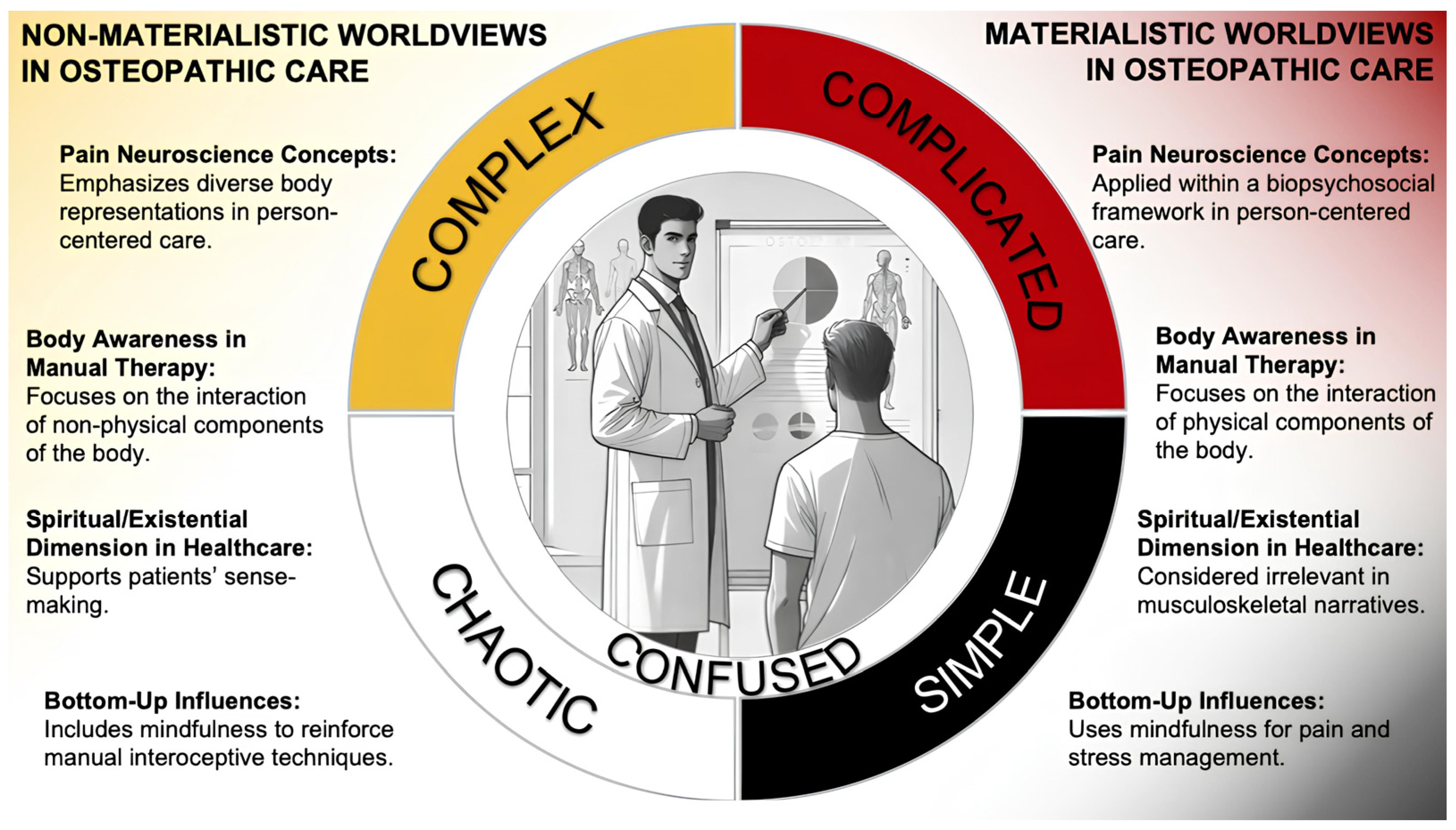
Background/Objectives: Indigenous perspectives, which emphasize non-materialistic dimensions of healing, such as the interconnectedness of the body, mind, and spirit, align with one foundational principle of osteopathic care. Integrating these perspectives into person-centered care may enhance therapeutic effectiveness by accommodating diverse understandings of health and well-being. This perspective paper explores how various epistemological frameworks, including Indigenous non-materialistic approaches, can inform manual therapy techniques and therapeutic alliances to advance person-centered care. Methods: We synthesized the best available evidence with expert insights and interdisciplinary viewpoints to address the gaps in the scientific literature. Our approach integrates conceptual analysis and emerging research to provide a comprehensive discussion for a broad professional audience. Results: We focused on detailing the existing sociocultural and experiential frameworks available to describe patients’ bodily perceptions rather than abstract intellectual constructs. Our findings were divided into two sections. The first examines the incorporation of diverse body representations that extend beyond purely biomechanical interpretations, emphasizing the role of non-materialistic components in therapeutic processes. The second explores recent neuroscientific research on self and consciousness, demonstrating how these insights intersect with Indigenous perspectives to enrich the theoretical and practical applications of osteopathic principles in different clinical contexts. Conclusions: Epistemological flexibility has the potential to refine clinical frameworks and ensure that they reflect the full scope of osteopathic practices beyond musculoskeletal care. By integrating diverse sociocultural perspectives without reinforcing stereotypes or rigid cultural constructs, this approach clarifies the diversity of body representations in osteopathic practices, addresses gaps in academic discourse, and promotes the integration of multiple worldviews as a foundation for truly person-centered care.
Keywords: body representation; cultural competence; consciousness; evidence-based medicine; Indigenous narratives; manual therapy; osteopathy; person-centered care; traditional healing body representation; cultural competence; consciousness; evidence-based medicine; Indigenous narratives; manual therapy; osteopathy; person-centered care; traditional healing
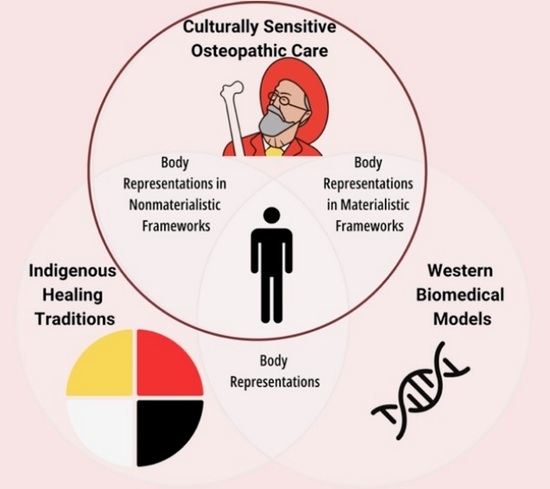
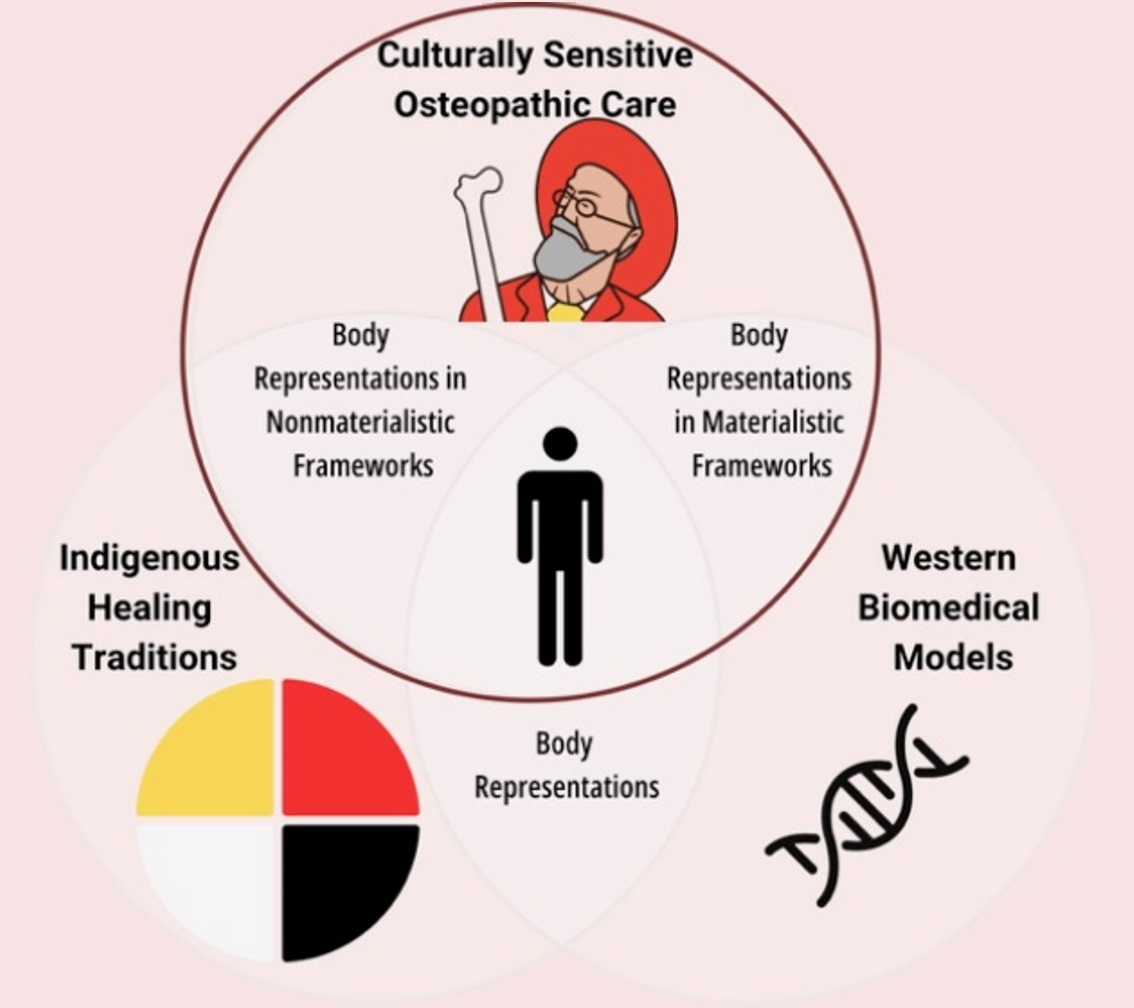
Graphical Abstract