Article

Movement-Based Mindfulness vs. Attention Control for Modifying Physiological Risk in Chronic Stroke: Evidence from a Feasibility Trial


1
School of Clinical Sciences at Monash Health, Monash University, Clayton, VIC 3168, Australia
2
Centre of Research Excellence in Stroke Rehabilitation, Heidelberg, VIC 3084, Australia
3
Centre of Research Excellence in Aphasia Recovery and Rehabilitation, Melbourne, VIC 3086, Australia
4
Heart and Stroke Research Program, Hunter Medical Research Institute, New Lambton Heights, NSW 2305, Australia
5
College of Health, Medicine and Wellbeing, The University of Newcastle, Newcastle, NSW 2308, Australia
6
Centre for Rehab Innovations, University of Newcastle, Callaghan, NSW 2308, Australia
7
Australian e-Health Research Centre, Commonwealth Scientific and Industrial Research Organization, Brisbane, QLD 4006, Australia
8
College of Nursing and Health Sciences, Flinders University, Adelaide, SA 5000, Australia
9
Innovation IMPlementation and Clinical Translation in Health (IIMPACT), Allied Health and Human Performance, University of South Australia, Adelaide, SA 5000, Australia
10
Stroke and Critical Care theme, the Florey Institute of Neuroscience and Mental Health, University of Melbourne, Heidelberg, VIC 3084, Australia
11
School of Translational Medicine, Monash University, Melbourne, VIC 3168, Australia
12
Survivor of Stroke, Inspirational and Motivational Speaker, Cotham, VIC 3101, Australia
13
School of Allied Health, Human Service and Sport, LaTrobe University, Melbourne, VIC 3086, Australia
14
School of Psychological Sciences, Monash University, Clayton, VIC 3800, Australia
*
Author to whom correspondence should be addressed.
Healthcare 2025, 13(22), 2940; https://doi.org/10.3390/healthcare13222940

Submission received: 17 September 2025 / Revised: 31 October 2025 / Accepted: 10 November 2025 / Published: 17 November 2025

Abstract

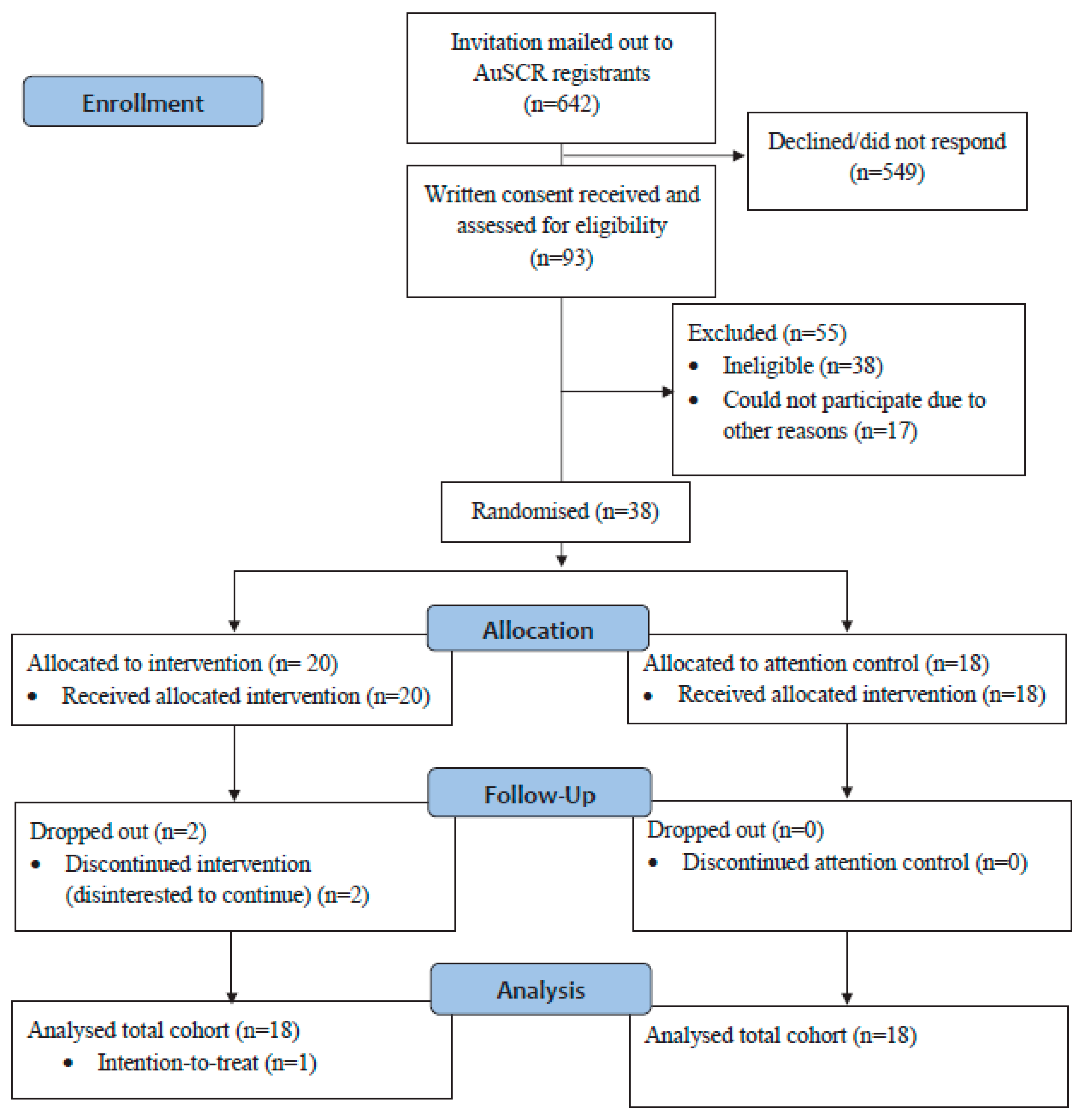
Background: Managing physiological risk factors (blood pressure, lipids, stress, blood glucose) post-stroke is essential yet challenging. In this sub-study of a feasibility randomized controlled trial, we examined changes in these parameters following a stroke-tailored mindfulness-based intervention (MBI) compared with an attention control. Methods: Participants 3–18 months post-stroke were recruited from the Australian Stroke Clinical Registry (May 2021–July 2023) and randomized 1:1 to a 12-week MBI (weekly yoga + ≥3 home meditation sessions) or attention control (education and peer support). All attended weekly 60-min classes. Outcomes included blood pressure and stress (perceived stress scale, hair cortisol). A sub-group (n = 17) also had HbA1c and lipid profile assessed. Descriptive statistics, within-group effect sizes (Cohen’s d), and generalized linear modeling were used. Results: A total of 38 participants were randomized with 36 participants completing the trial (mean age 69 years; 72% male), and the MBI group showed greater within-group improvements in blood pressure, with clinically meaningful reductions in systolic (5 mmHg; d = 0.35) and diastolic (4 mmHg; d = 0.41) values, compared to smaller effects in the control group. Exploratory trends suggested favorable change in lipid profiles (HDL and LDL) in the MBI group, while triglycerides improved in the control group. No changes were observed for HbA1c. Stress markers, including hair cortisol, showed positive trends in the MBI group (d = 0.52). No significant between-group differences were detected. Conclusions: This sub-study of a well-designed, rigorous feasibility trial provides preliminary findings of clinically meaningful differences in blood pressure and lipid profiles in the MBI group. The findings support the potential of MBIs in managing post-stroke cardiovascular risk factors and warrant larger trials to confirm these preliminary effects.
Keywords: mindfulness; stroke; feasibility trial; biomarkers; risk factors; blood pressure mindfulness; stroke; feasibility trial; biomarkers; risk factors; blood pressure