Article

A Study on the Acceptance of Smart Cane Technology Among Chinese Older Adults

School of Art & Design, Guangdong University of Technology, Guangzhou 510090, China
*
Author to whom correspondence should be addressed.
Healthcare 2025, 13(22), 2934; https://doi.org/10.3390/healthcare13222934

Submission received: 23 September 2025 / Revised: 2 November 2025 / Accepted: 13 November 2025 / Published: 16 November 2025
(This article belongs to the Special Issue Emerging Technologies for Person-Centred Healthcare)

Abstract

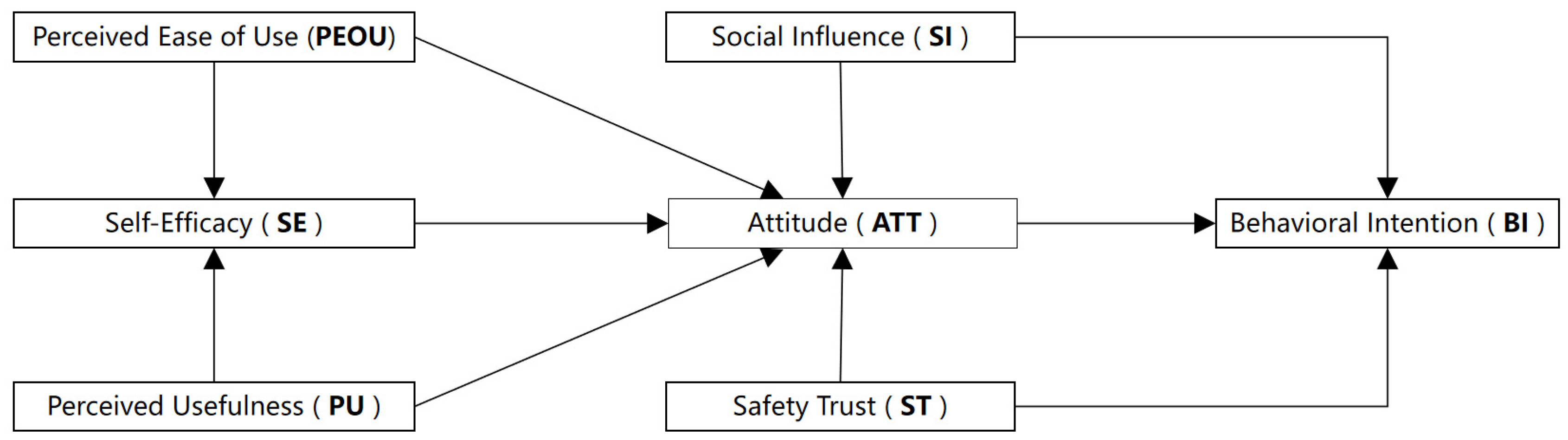
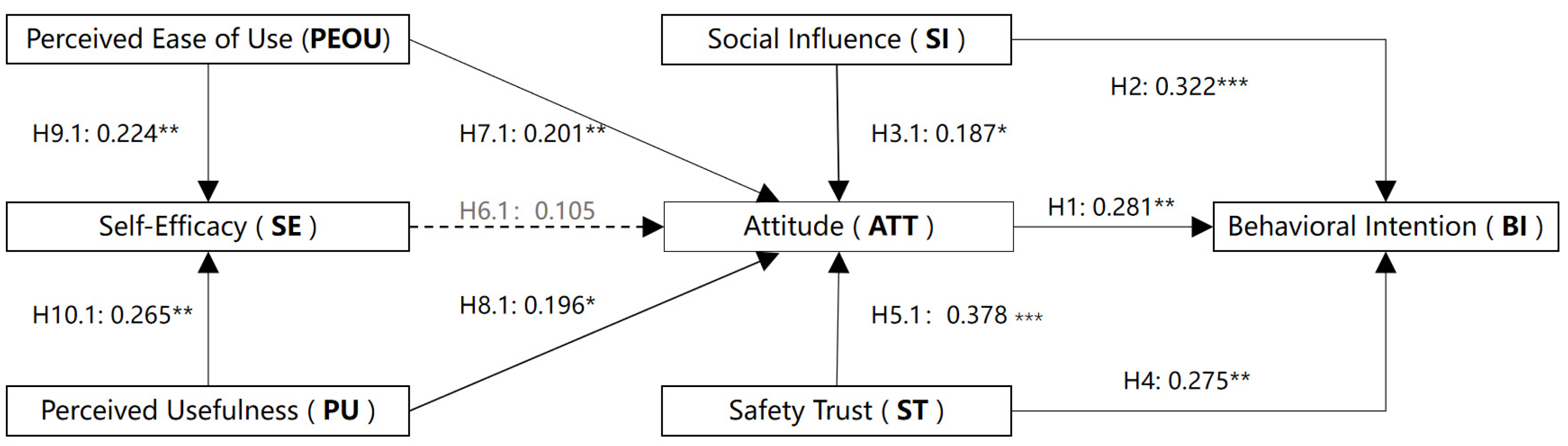
Background: Although smart products improve older adults’ quality of life, their acceptance and usage of smart assistive devices remain relatively low, and the influencing factors remain unclear. Methods: This study takes canes, which are commonly used by older adults, as the research object. To explore older adults’ acceptance of smart canes and the influencing factors, we constructed an integrated framework based on the extended Technology Acceptance Model (TAM), which incorporates multiple variables: Perceived Usefulness (PU), Perceived Ease of Use (PEOU), Attitude (ATT), Social Influence (SI), Safety Trust (ST), Self-Efficacy (SE), and Behavioral Intention (BI). A questionnaire survey was conducted to collect 232 valid responses, and structural equation modeling (SEM) was employed for data analysis. Results: The results indicate that factors including PU, PEOU, and SI have significant impacts on older adults’ ATT towards using smart canes, their SE, and BI. Among these factors, ATT and SE play a mediating role between PU, PEOU, SI, and BI in using smart canes. Conclusions: The practical implications of the current results are discussed with the aim of providing empirical evidence for the development and application of smart assistive devices for older adults.
Keywords: smart canes; technology acceptance; older adults; extended TAM; mediating effect smart canes; technology acceptance; older adults; extended TAM; mediating effect