Article

Bridging Leadership Competency Gaps and Staff Nurses’ Turnover Intention: Dual-Rater Study in Saudi Tertiary Hospitals


by
Hanan A. Alkorashy
1,* and
Dhuha A. Alsahli
2,*
1
Nursing Administration and Education Department, College of Nursing, King Saud University, Riyadh 11421, Saudi Arabia
2
Nursing Services Department, Johns Hopkins Aramco Healthcare, Dhahran 31311, Saudi Arabia
*
Authors to whom correspondence should be addressed.
Healthcare 2025, 13(19), 2506; https://doi.org/10.3390/healthcare13192506

Submission received: 27 August 2025 / Revised: 11 September 2025 / Accepted: 13 September 2025 / Published: 2 October 2025

Abstract

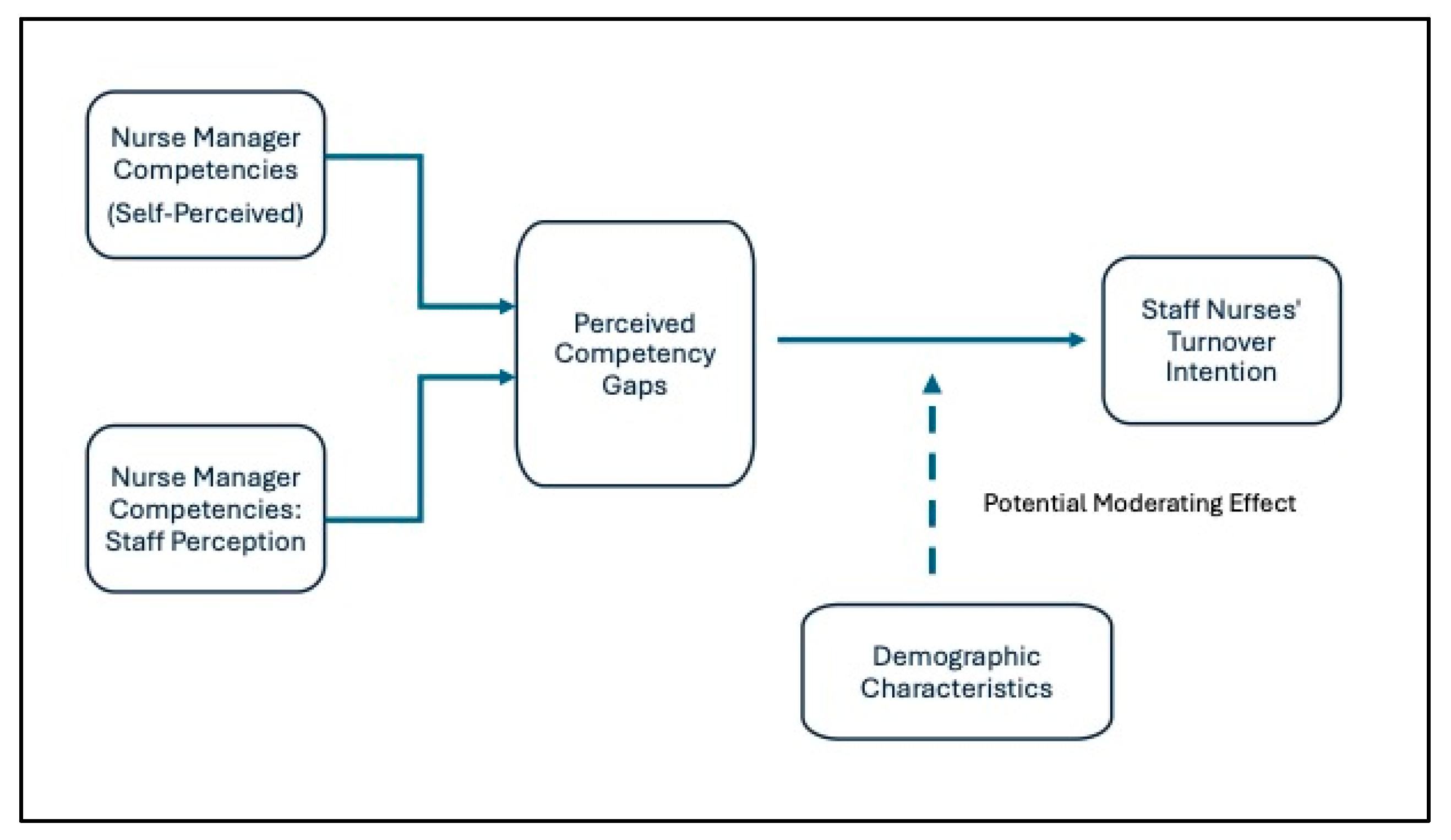
Background: Nurse-manager competencies shape workforce stability, yet role-based perception gaps between managers and staff may influence staff nurses’ turnover cognitions. Objectives: To (1) compare nurse managers’ self-ratings with staff nurses’ ratings of the same managers on the Nurse Manager Competency Inventory (NMCI); (2) compare both groups’ perceptions of staff nurses’ turnover intention (EMTIS); (3) examine domain-specific links between perceived competencies and perceived turnover intention; and (4) explore demographic influences (age, education, experience) on these perceptions. Methods: Cross-sectional dual-rater study with 225 staff nurses and 171 nurse managers in two tertiary hospitals in Saudi Arabia. Data were collected from August to November 2024. Managers completed NMCI self-ratings, and staff nurses rated their managers on the same NMCI domains; both groups rated staff nurses’ turnover intention using EMTIS. Between-group differences were tested with one-way ANOVA (two-tailed α = 0.05), and associations were examined with Pearson’s r (95% CIs). Findings: Managers consistently rated themselves higher than staff rated them across all nine NMCI domains; the largest descriptive gaps were in Promoting Staff Retention, Recruit Staff, Perform Supervisory Responsibilities, and Facilitate Staff Development (e.g., overall NMCI: managers M = 3.67, SD = 0.61 vs. staff M = 3.04, SD = 0.74; F = 0.114, p = 0.73)with comparatively smaller divergence for Ensure Patient Safety and Quality. Managers and staff did not differ significantly on EMTIS (overall EMTIS: managers M = 3.16, SD = 1.28 vs. staff M = 3.00, SD = 1.15; F = 21.32, p = 0.173). Specific competency domains—retention, supervision, staff development, safety/quality leadership, and quality improvement—showed small inverse correlations with EMTIS facets (typical r ≈ −0.11 to −0.19; p < 0.05), whereas the global NMCI–overall EMTIS correlation was non-significant (r = −0.077, p = 0.124). Effect sizes were modest and should be interpreted cautiously. Conclusions: Actionable signals reside at the domain (micro-competency) level rather than in global leadership composites. Targeted, continuous, unit-embedded development in human- and development-focused competencies—tracked with dual-lens (manager–staff) measurement and linked to retention KPIs—may help nudge turnover cognitions downward. Key limitations include the cross-sectional, perception-based design and two-site setting. Findings nonetheless align with international workforce challenges and may be transferable to similar hospital contexts.
Keywords: professional competence; leadership; nurse administrators; nursing staff; hospital; personnel turnover; quality improvement; cross-sectional studies; Saudi Arabia professional competence; leadership; nurse administrators; nursing staff; hospital; personnel turnover; quality improvement; cross-sectional studies; Saudi Arabia