Article

Parent–Child Mismatch in Educational Expectations and Depressive Symptoms among Chinese Adolescents


School of Social Sciences, Harbin Institute of Technology, Harbin 150001, China
*
Authors to whom correspondence should be addressed.
Healthcare 2024, 12(17), 1792; https://doi.org/10.3390/healthcare12171792

Submission received: 6 August 2024 / Revised: 1 September 2024 / Accepted: 5 September 2024 / Published: 7 September 2024

Abstract

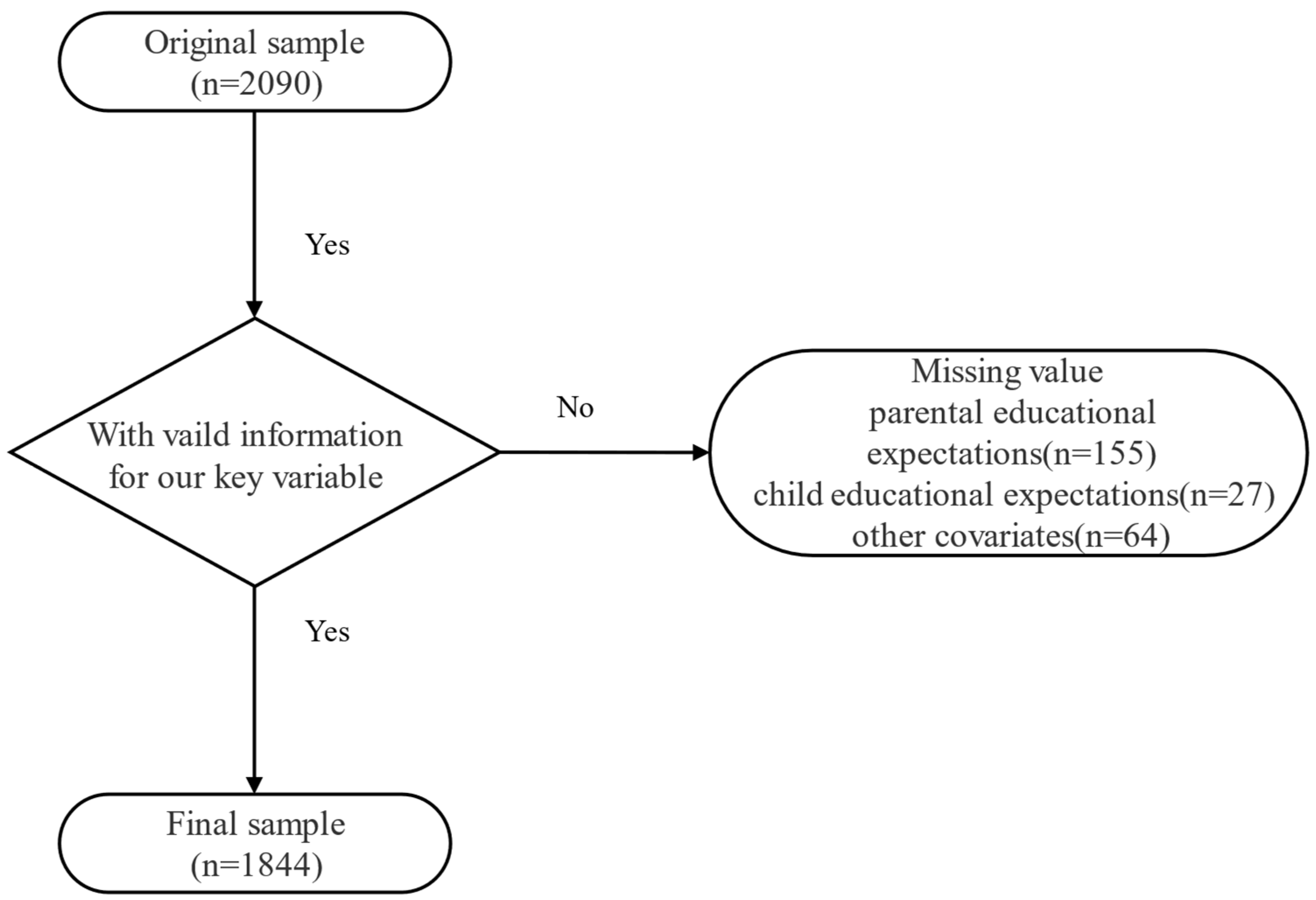
Background: The roles of both parents’ and children’s educational expectations in shaping adolescent depressive symptoms have increasingly been discussed, yet in a separate manner. To date, few studies have associated parent–child mismatch in educational expectations with depressive symptoms, and less is known about the variation in the association across gender (male vs. female), educational level (primary vs. secondary), and region status (urban vs. rural) in the Chinese educational setting. Methods: Respondents were from a nationally representative sample of adolescent students in China (sample size: 1844; age range: 10–15 years). Parent–child mismatch in educational expectations included three categories: (1) “match”, (2) “mismatch—parent higher”, and (3) “mismatch—parent lower”. Regression analysis with inverse propensity-score weighting was employed to estimate the effect of parent–child mismatch as to educational expectations on depressive symptoms, and stratified analysis was used to examine the variation of the effect by gender, educational level, and region. Results: Compared with the “match” group, the “mismatch—parent higher” group had significantly higher levels of depressive symptoms. Furthermore, the pattern remained consistent between boys and girls, but differed significantly by adolescents’ educational level and region status. Specifically, the pattern was more pronounced in the primary school and urban subsamples. Conclusions: Findings in this study indicated that educators and policymakers can develop tailored strategies to alleviate depressive symptoms among the “mismatch—parent higher” group, and especially for those children from primary schools and urban areas.
Keywords: depressive symptoms; parent–child mismatch in educational expectations; Chinese adolescents depressive symptoms; parent–child mismatch in educational expectations; Chinese adolescents