Article

Path to Suicidality in Korean Adolescents: Mediating Role of Self-Esteem, Somatic Symptoms, and Self-Harm Amid Depressive Symptoms

by
Jiyeon Kim
1 and
Myongsun Cho
2,*
1
College of Nursing, Ewha Womans University, Seoul 03760, Republic of Korea
2
Department of Nursing, Gangneung-Wonju National University, Wonju 26403, Republic of Korea
*
Author to whom correspondence should be addressed.
Healthcare 2024, 12(16), 1662; https://doi.org/10.3390/healthcare12161662

Submission received: 2 June 2024 / Revised: 31 July 2024 / Accepted: 2 August 2024 / Published: 20 August 2024

Abstract

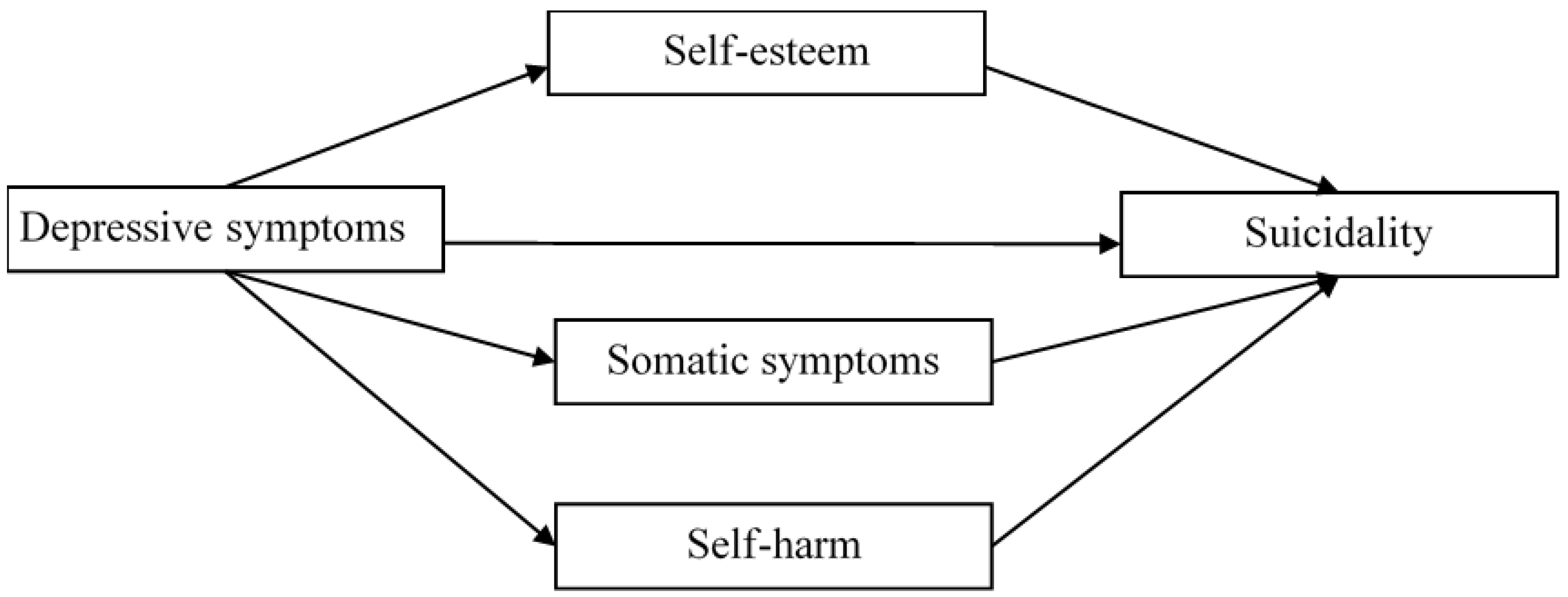
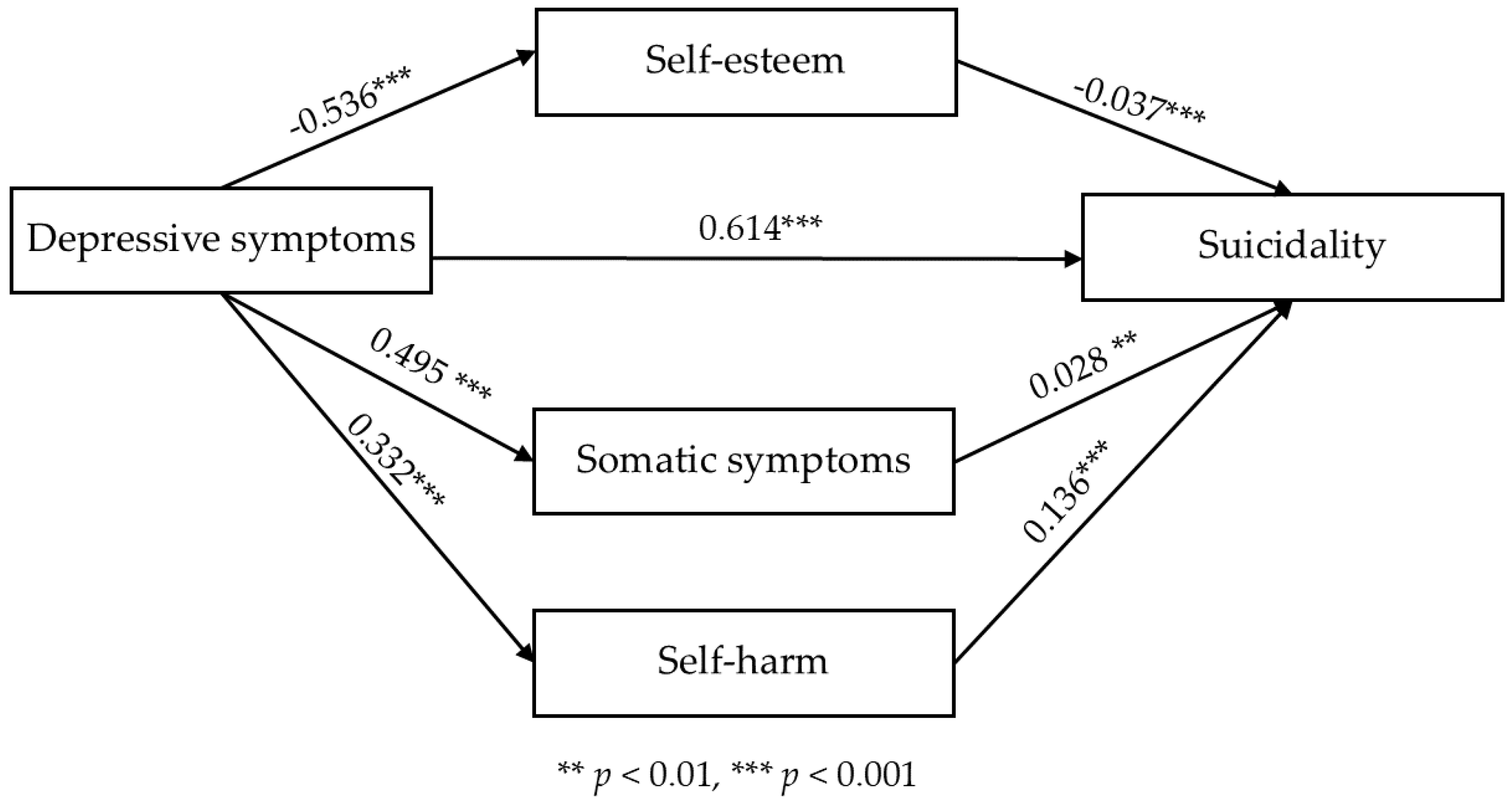
This study explored the relationship between depressive symptoms and suicidality among community-dwelling adolescents aged 10–18 years, examining whether self-esteem, somatic symptoms, and self-harm mediate this relationship. Utilizing a pre-existing dataset from a nationwide adolescent mental health survey conducted in Korea in 2021, data were collected using several standardized self-administered instruments: the Korean version of Rosenberg’s self-esteem scale, Korean Children’s Somatization Inventory, Korean version of the Self-Harm Inventory, Mental Health Screening for Depressive Disorders, and Mental Health Screening for Suicide Risk. A path model was constructed and validated, followed by path analysis to assess the effects. Data from 6689 adolescents, including 5937 students and 752 out-of-school adolescents, revealed that 18.7% were in the suicidality group, 11.8% experienced depressive symptoms, 57.9% exhibited somatic symptoms, and 27.4% engaged in self-harm. Depressive symptoms had a positive direct effect on suicidality (β = 0.166, p < 0.001, 95% confidence interval = 0.159–0.172). Bootstrapping tests showed a statistically significant indirect effect of self-esteem, somatic symptoms, and self-harm on the relationship between depressive symptoms and suicidality (β = 0.021, 95% confidence interval = 0.013–0.029). Our findings suggest that self-esteem, somatic symptoms, and self-harm mediate the relationship between depressive symptoms and suicidality, and comprehensive mental health management strategies addressing these factors are recommended.
Keywords: adolescent health; suicidality; self-harm; somatization; depression; self-esteem adolescent health; suicidality; self-harm; somatization; depression; self-esteem