


Population-Level Impacts of Alcohol Use on Mental and Physical Health Outcomes
 ,
,  , , and
Abstract
1. Introduction
2. Materials and Methods
2.1. Data Source
2.2. Data Collection and Sampling Method
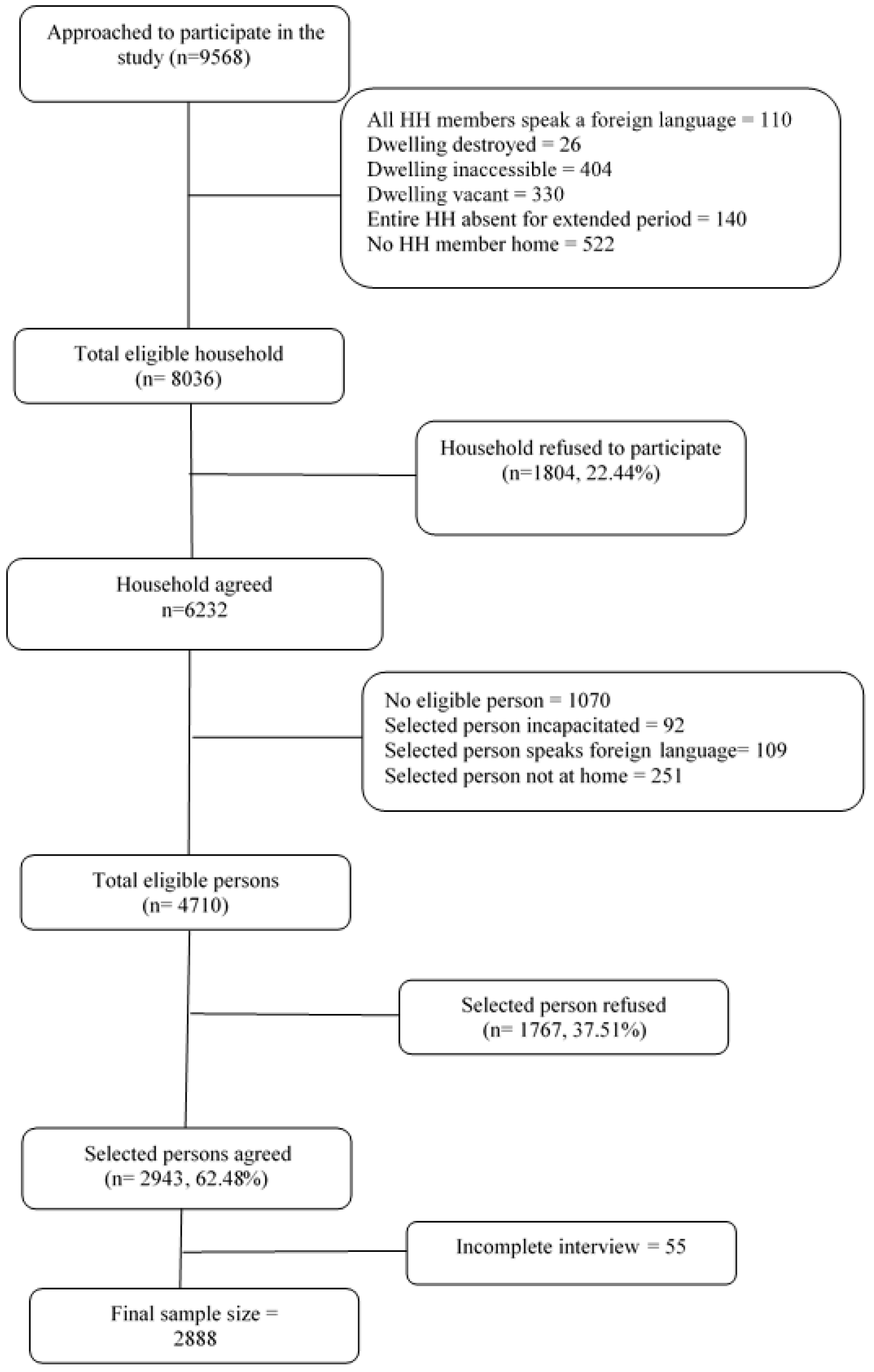
2.3. Study Sample
2.4. Measures
2.4.1. Sociodemographic Characteristics
2.4.2. Alcohol Use, Drinking Patterns, and Alcohol-Related Problems
2.4.3. Outcome of Interest: Health Status
2.5. Analytic Procedures
3. Results
3.1. Prevalence of Alcohol Drinking Measures for the Whole Sample
3.2. Gender Differences in Alcohol Drinking Measures
3.3. Alcohol Drinking Measures by Sociodemographic Characteristics
3.4. Health Consequences of Alcohol Behaviours
4. Discussion
4.1. Prevalence of Alcohol Use and Alcohol Drinking Patterns
4.2. Gender Differences
4.3. Age Differences
4.4. Socioeconomic Differences
4.5. Ethnicity
4.6. Association between EDI and Later Alcohol Drinking Patterns
4.7. Health Consequences of Alcohol Behaviours
4.8. Limitations
4.9. Strengths
4.10. Implications
5. Conclusions
Supplementary Materials
Author Contributions
Funding
Institutional Review Board Statement
Informed Consent Statement
Data Availability Statement
Acknowledgments
Conflicts of Interest
References
- Marten, R.; Amul, G.G.H.; Casswell, S. Alcohol: Global health’s blind spot. Lancet Glob. Health 2020, 8, e329–e330. [Google Scholar] [CrossRef] [Scilit] [PubMed]
- World Health Organization. Global Status Report on Alcohol and Health and Treatment of Substance Use Disorders 2024; World Health Organization: Geneva, Switzerland, 2024; Available online: https://iris.who.int/bitstream/handle/10665/377960/9789240096745-eng.pdf?sequence=1 (accessed on 22 July 2024).
- Skog, O. The collectivity of drinking cultures: A theory of the distribution of alcohol consumption. Br. J. Addict. 1985, 80, 83–99. [Google Scholar] [CrossRef] [Scilit] [PubMed]
- Ministerial Committee on Drug Policy. National Drug Policy 2007–2012; Ministry of Health: Wellington, New Zealand, 2007. Available online: https://www.health.govt.nz/publication/national-drug-policy-2007-2012 (accessed on 26 October 2021).
- World Health Organization. Global Status Report on Alcohol and Health; World Health Organization: Geneva, Switzerland, 2014; Available online: https://www.who.int/publications/i/item/global-status-report-on-alcohol-and-health-2014 (accessed on 8 November 2021).
- Corrao, G.; Bagnardi, V.; Zambon, A.; La Vecchia, C. A meta-analysis of alcohol consumption and the risk of 15 diseases. Prev. Med. 2004, 38, 613–619. [Google Scholar] [CrossRef] [Scilit] [PubMed]
- Macdonald, S.; Greer, A.; Brubacher, J.; Cherpitel, C.; Stockwell, T.; Zeisser, C. Alcohol consumption and injury. In Alcohol: Science, Policy and Public Health; Boyle, P., Boffetta, P., Lowenfels, A.B., Burns, H., Brawley, O., Zatonski, W., Eds.; Oxford Scholarship Online: Oxford, UK, 2013. [Google Scholar] [CrossRef] [Scilit]
- Sartor, C.E.; Lynskey, M.T.; Heath, A.C.; Jacob, T.; True, W. The role of childhood risk factors in initiation of alcohol use and progression to alcohol dependence. Addiction 2007, 102, 216–225. [Google Scholar] [CrossRef] [Scilit] [PubMed]
- Guerri, C.; Pascual, M. Impact of neuroimmune activation induced by alcohol or drug abuse on adolescent brain development. Int. J. Dev. Neurosci. 2019, 77, 89–98. [Google Scholar] [CrossRef] [Scilit] [PubMed]
- Maldonado-Devincci, A.M.; Badanich, K.A.; Kirstein, C.L. Alcohol during adolescence selectively alters immediate and long-term behavior and neurochemistry. Alcohol 2010, 44, 57–66. [Google Scholar] [CrossRef] [Scilit]
- Keyes, C.L.M. Promoting and protecting mental health as flourishing. Am. Psychol. 2007, 62, 95–108. [Google Scholar] [CrossRef] [Scilit] [PubMed]
- Keyes, C.L.M. The mental health continuum: From languishing to flourishing in life. J. Health Soc. Behav. 2002, 43, 207–222. [Google Scholar] [CrossRef] [Scilit]
- Nielson. Alcohol Use in New Zealand Survey (AUiNZ) 2019/20 Questionnaire; Health Promotion Agency: Wellington, New Zealand, 2021; Available online: https://www.hpa.org.nz/research-library/research-publications/alcohol-use-in-new-zealand-survey-auinz-2019-20-questionnaire (accessed on 2 November 2021).
- Ministry of Health. Annual Data Explorer 2018/19: New Zealand Health Survey [Data File]; Ministry of Health: Wellington, New Zealand, 2019; Available online: https://minhealthnz.shinyapps.io/nz-health-survey-2018-19-annual-data-explorer/ (accessed on 2 November 2021).
- Ministry of Health. Annual Data Explorer 2020/21: New Zealand Health Survey [Data File]; Ministry of Health: Wellington, New Zealand, 2021; Available online: https://minhealthnz.shinyapps.io/nz-health-survey-2020-21-annual-data-explorer/ (accessed on 2 November 2021).
- Fanslow, J.; Gulliver, P.; Hashemi, L.; Malihi, Z.; McIntosh, T. Methods for the 2019 New Zealand family violence study—A study on the association between violence exposure, health and well-being. Kōtuitui N. Z. J. Soc. Sci. Online 2021, 16, 196–209. [Google Scholar] [CrossRef] [Scilit]
- Statistics New Zealand. Statistical Standard for Meshblock; Statistics New Zealand: Wellington, New Zealand, 2016. [Google Scholar]
- Fanslow, J.; Hashemi, L.; Gulliver, P.; McIntosh, T. Adverse Childhood Experiences in New Zealand and Subsequent Victimization in Adulthood: Findings from a Population-Based Study; Elsevier: Amsterdam, The Netherlands, 2021. [Google Scholar]
- Statistics New Zealand. Household Income and Housing-Cost Statistics: Year Ended June 2020; Statistics New Zealand: Wellington, New Zealand, 2021. Available online: https://www.stats.govt.nz/information-releases/household-income-and-housing-cost-statistics-year-ended-june-2020 (accessed on 28 October 2021).
- Exeter, D.J.; Zhao, J.; Crengle, S.; Lee, A.; Browne, M. The New Zealand Indices of Multiple Deprivation (IMD): A new suite of indicators for social and health research in Aotearoa, New Zealand. PLoS ONE 2017, 12, e0181260. [Google Scholar] [CrossRef] [Scilit]
- StataCorp. Stata Statistical Software: Release 14 [Computer Software]; StataCorp LP: College Station, TX, USA, 2015. [Google Scholar]
- National Institute on Alcohol Abuse and Alcoholism. Alcohol Use in the United States. 2021. Available online: https://www.niaaa.nih.gov/publications/brochures-and-fact-sheets/alcohol-facts-and-statistics (accessed on 11 November 2021).
- Australian Institute of Health and Welfare. Alcohol, Tobacco & Other Drugs in Australia. 2021. Available online: https://www.aihw.gov.au/reports/alcohol/alcohol-tobacco-other-drugs-australia/contents/drug-types/alcohol (accessed on 3 November 2021).
- NHS Digital. Health Survey for England, 2018: Adults’ Health Related Behaviours Report (Version 2). 2019. Available online: https://files.digital.nhs.uk/A3/2F03E4/HSE18-Adult-Health-Related-Behaviours-rep-v2.pdf (accessed on 3 November 2021).
- Antai, D.; Lopez, G.B.; Antai, J.; Anthony, D.S. Alcohol drinking patterns and differences in alcohol-related harm: A population-based study of the United States. BioMed Res. Int. 2014, 2014, 853410. [Google Scholar] [CrossRef] [Scilit] [PubMed]
- French, D.J.; Sargent-Cox, K.A.; Kim, S.; Anstey, K.J. Gender differences in alcohol consumption among middle-aged and older adults in Australia, the United States and Korea. Aust. N. Z. J. Public Health 2014, 38, 332–339. [Google Scholar] [CrossRef] [Scilit]
- Ceylan-Isik, A.F.; McBride, S.M.; Ren, J. Sex difference in alcoholism: Who is at a greater risk for development of alcoholic complication? Life Sci. 2010, 87, 133–138. [Google Scholar] [CrossRef] [Scilit] [PubMed]
- Begg, D.; Brookland, R.; Connor, J. Associations of repeated high alcohol use with unsafe driving behaviors, traffic offenses, and traffic crashes among young drivers: Findings from the New Zealand Drivers Study. Traffic Inj. Prev. 2017, 18, 111–117. [Google Scholar] [CrossRef] [Scilit]
- White, A.M.; Orosz, A.; Powell, P.A.; Koob, G.F. Alcohol and aging—An area of increasing concern. Alcohol 2023, 107, 19–27. [Google Scholar] [CrossRef] [Scilit] [PubMed]
- Lewer, D.; Meier, P.; Beard, E.; Boniface, S.; Kaner, E. Unravelling the alcohol harm paradox: A population-based study of social gradients across very heavy drinking thresholds. BMC Public Health 2016, 16, 599. [Google Scholar] [CrossRef] [Scilit] [PubMed]
- Brown, P.; Guy, M.; Broad, J. Individual socio-economic status, community socio-economic status and stroke in New Zealand: A case control study. Soc. Sci. Med. 2015, 61, 1174–1188. [Google Scholar] [CrossRef] [Scilit] [PubMed]
- Casswell, S.; You, R.Q.; Huckle, T. Alcohol’s harm to others: Reduced wellbeing and health status for those with heavy drinkers in their lives. Addiction 2011, 106, 1087–1094. [Google Scholar] [CrossRef] [Scilit]
- Winter, T.; Riordan, B.C.; Surace, A.; Scarf, D. Association between experience of racial discrimination and hazardous alcohol use among Māori in Aotearoa New Zealand. Addiction 2019, 114, 2241–2246. [Google Scholar] [CrossRef] [Scilit]
- Ebbett, E.; Clarke, D. Maori Identification, Alcohol Behaviour and Mental Health: A Review. Int. J. Ment. Health Addict. 2010, 8, 214–231. [Google Scholar] [CrossRef] [Scilit]
- Kapuaahiwalani-Fitzsimmons, M. Critical Success Factors in Kaupapa Māori AOD Residential Treatment: Māori Youth Perspectives. Master’s Thesis, University of Otago, Otago, New Zealand, 2015. Available online: http://hdl.handle.net/10523/5596 (accessed on 23 July 2024).
- Enstad, F.; Evans-Whipp, T.; Kjeldsen, A.; Toumbourou, J.W.; von Soest, T. Predicting hazardous drinking in late adolescence/young adulthood from early and excessive adolescent drinking—A longitudinal cross-national study of Norwegian and Australian adolescents. BMC Public Health 2019, 19, 790. [Google Scholar] [CrossRef] [Scilit] [PubMed]
- Pautassi, R.M.; Bravo, A.J.; Acquas, E.; Pilatti, A. Editorial: Is early onset of alcohol use associated with later alcohol use? Front. Behav. Neurosci. 2020, 14, 133. [Google Scholar] [CrossRef] [Scilit] [PubMed]
- Paraje, G.R.; Guindon, G.E.; Chaloupka, F.J. Prices, alcohol use initiation and heavy episodic drinking among Chilean youth. Addiction 2021, 116, 485–494. [Google Scholar] [CrossRef] [Scilit] [PubMed]
- Carlfjord, S.; Johansson, K. Association between frequency of heavy episodic drinking and self-reported consequences: A cross-sectional study in a Swedish population. Alcohol Alcohol. 2012, 47, 719–724. [Google Scholar] [CrossRef] [Scilit]
- Kerr, W.C.; Stockwell, T. Understanding standard drinks and drinking guidelines. Drug Alcohol Rev. 2012, 31, 20–205. [Google Scholar] [CrossRef] [Scilit]
- Bernardin, F.; Maheut-Bosser, A.; Paille, F. Cognitive impairments in alcohol-dependent subjects. Front. Psychiatry 2014, 5, 78. [Google Scholar] [CrossRef] [Scilit]
- Rehm, J. The Risks Associated with Alcohol Use and Alcoholism. Alcohol Res. Health 2011, 34, 135–143. [Google Scholar]
- Puddephatt, J.; Irizar, P.; Jones, A.; Gage, S.H.; Goodwin, L. Associations of common mental disorder with alcohol use in the adult general population: A systematic review and meta-analysis. Addiction 2022, 117, 1543–1572. [Google Scholar] [CrossRef] [Scilit]
- Glantz, M.D.; Bharat, C.; Degenhardt, L.; Sampson, N.A.; Scott, K.M.; Lim, C.C.W.; Al-Hamzawi, A.; Alonso, J.; Andrade, L.H.; Cardoso, G.; et al. The epidemiology of alcohol use disorders cross-nationally: Findings from the World Mental Health Surveys. Addict. Behav. 2020, 102, 106128. [Google Scholar] [CrossRef] [Scilit]
- Connor, J.; Broad, J.; Rehm, J.; Vander Hoorn, S.; Jackson, R. The burden of death, disease, and disability due to alcohol in New Zealand. N. Z. Med. J. 2005, 118, U1412. [Google Scholar]
- Stockwell, T.; Zhao, J.; Sherk, A.; Rehm, J.; Shield, K.; Naimi, T. Underestimation of alcohol consumption in cohort studies and implications for alcohol’s contribution to the global burden of disease. Addiction 2018, 113, 2245–2249. [Google Scholar] [CrossRef] [Scilit] [PubMed]
- Crombie, I.K.; Cunningham, K.B.; Irvine, L.; Williams, B.; Sniehotta, F.F.; Norrie, J.; Melson, A.; Jones, C.; Briggs, A.; Rice, P.M.; et al. Modifying Alcohol Consumption to Reduce Obesity (MACRO): Development and feasibility trial of a complex community-based intervention for men. Health Technol. Assess. 2017, 21, 1–150. [Google Scholar] [CrossRef] [Scilit]
- Gilligan, C.; Anderson, K.G.; Ladd, B.O.; Yong, Y.M.; David, M. Inaccuracies in survey reporting of alcohol consumption. BMC Public Health 2019, 19, 1639. [Google Scholar] [CrossRef] [Scilit] [PubMed]
- Flor, L.S.; Gakidou, E. The burden of alcohol use: Better data and strong policies towards a sustainable development. Lancet Public Health 2020, 5, e10–e11. [Google Scholar] [CrossRef] [Scilit] [PubMed]
- Gianfrancesco, M.A.; Tamang, S.; Yazdany, J.; Schmajuk, G. Potential Biases in Machine Learning Algorithms Using Electronic Health Record Data. JAMA Intern. Med. 2018, 178, 1544–1547. [Google Scholar] [CrossRef] [Scilit]
- Babor, T.F.; Caetano, R.; Casswell, S.; Edwards, G.; Giesbrecht, N.; Graham, K.; Grube, J.W.; Hill, L.; Holder, H.; Homel, R.; et al. Alcohol: No Ordinary Commodity—Research and Public Policy, 2nd ed.; Oxford University Press Inc.: Oxford, UK, 2010. [Google Scholar]
- Darrah, T.; Waa, A.; Jones, A.; Mizdrak, A. Māori perspectives on alcohol: A narrative review. Int. J. Crit. Indig. Stud. 2021, 14, 51–64. [Google Scholar] [CrossRef] [Scilit]
- Kypri, K.; Maclennan, B.; Connor, J. Alcohol Harms over a Period of Alcohol Policy Reform: Surveys of New Zealand College Residents in 2004 and 2014. Int. J. Environ. Res. Public Health 2020, 17, 836. [Google Scholar] [CrossRef] [Scilit]
- Kypros, K.; McCambridge, J.; Vater, T.; Bowe, S.J.; Saunders, J.B.; Cunningham, J.A.; Horton, N.J. Web-based alcohol intervention for Māori university students: Double-blind, multi-site randomized controlled trial. Addiction 2013, 108, 331–338. [Google Scholar] [CrossRef] [Scilit]
- Connor, J.; Kypri, K.; Bell, M.L.; Cousins, K. Alcohol outlet density, levels of drinking and alcohol-related harm in New Zealand: A national study. J. Epidemiol. Community Health 2011, 65, 841–846. [Google Scholar] [CrossRef] [Scilit] [PubMed]
- Purcell-Khodr, G.; Webster, E.; Harrison, K.; Dawson, A.; Lee, K.S.K.; Conigrave, K. The Importance of Culture in Alcohol Care. Int. Indig. Policy J. 2022, 13, 1–29. [Google Scholar] [CrossRef] [Scilit]

| Total N (%) | Male N (%) | Female N (%) | |
|---|---|---|---|
| 2887 | 1423 50.2 (45.5–54.8) | 1464 49.8 (45.2–54.4) | |
| Age groups * | |||
| 16–24 | 228 (12.8) | 129 (14.7) | 98 (10.8) |
| 25–34 | 355 (13.5) | 165 (13.6) | 190 (13.3) |
| 35–44 | 507 (16.0) | 268 (16.5) | 239 (15.5) |
| 45–54 | 548 (19.7) | 270 (18.8) | 278 (20.7) |
| 55–64 | 508 (16.3) | 252 (16.6) | 256 (16.0) |
| ≥65 | 738 (21.7) | 337 (19.8) | 401 (23.6) |
| Ethnicity * | |||
| European | 1984 (63.0) | 963 (61.8) | 1021 (64.2) |
| Māori | 318 (12) | 129 (9.3) | 188 (14.5) |
| Pasifika | 159 (7.9) | 88 (8.1) | 71 (7.7) |
| Asian | 378 (15.7) | 218 (19.1) | 160 (12.2) |
| MELAA | 45 (1.5) | 23 (1.6) | 22 (1.3) |
| Having independent source of income * | |||
| No | 492 (20.8) | 173 (16.6) | 319 (24.9) |
| Yes | 2393 (79.2) | 1248 (83.4) | 1144 (75.0) |
| Individual income * | |||
| <NZD 50K | 1504 (57.0) | 573 (45.7) | 930 (68.8) |
| ≥NZD 50K | 1230 (43.0) | 801 (54.3) | 429 (31.2) |
| Deprivation level * | |||
| Low | 789 (25.8) | 365 (24.4) | 424 (27.2) |
| Moderate | 1243 (41.8) | 648 (44.3) | 595 (39.3) |
| High | 852 (32.4) | 410 (31.3) | 442 (33.5) |
| Food security * | |||
| Secure | 2352 (81.1) | 1183 (83.1) | 1169 (79.2) |
| Insecure | 519 (18.9) | 230 (16.9) | 289 (20.8) |
| Total Mean (SD) | Male Mean (SD) | Female Mean (SD) | t-Test (p-Value) | |
|---|---|---|---|---|
| Age at regular drinking onset | 20.43 (7.95) | 19.46 (6.43) | 21.46 (9.17) | t-test (1927.3) = 5.93 (<0.001) |
| Total n (W%) | Male W% (CI) | Female W% (CI) | p-value for Chi-square | |
| Early drinking initiation | 1283 (44.6) | 48.5 (45.2–51.7) | 40.7 (37.7–43.8) | 0.0006 |
| Frequency of drinking | <0.001 | |||
| Never | 438 (17.0) | 14.4 (12.0–17.1) | 19.7 (16.5–23.4) | |
| Less than once a month | 426 (16.0) | 13.4 (11.5–15.5) | 18.7 (16.4–21.3) | |
| 1–3 times a month | 410 (15.6) | 16.0 (13.8–18.5) | 15.1 (13.1–17.4) | |
| Once or twice a week | 798 (26.0) | 28.2 (25.6–30.9) | 23.7 (21.4–26.3) | |
| Every day or nearly every day (or frequent drinking) | 622 (18.9) | 22.1 (19.8–24.6) | 15.8 (13.6–18.2) | |
| In the past not now | 184 (6.4) | 6.0 (4.6–7.7) | 6.9 (5.5–8.5) | |
| Quantity b (Drink per occasion) | <0.001 | |||
| 0 drinks | 143 (6.9) | 4.7 (3.4–6.4) | 9.3 (7.4–11.6) | |
| 1 drink | 675 (29.1) | 23.8 (21.0–26.8) | 34.9 (31.7–38.3) | |
| 2 drinks | 735 (30.9) | 31.1 (28.1–34.4) | 30.7 (27.8–33.6) | |
| 3 drinks | 284 (12.3) | 14.5 (12.3–17.0) | 10.0 (8.3–12.1) | |
| 4 drinks | 157 (7.1) | 8.7 (7.0–10.7) | 5.4 (4.1–7.1) | |
| 5 or more drinks | 262 (13.7) | 17.2 (14.7–20.0) | 9.7 (7.5–12.3) | |
| Heavy episodic drinking | 536 (19.5) | 20.6 (18.2–23.2) | 18.4 (16.0–21.0) | 0.2 |
| Experiencing alcohol-related problems | 111 (3.6) | 4.4 (3.3–5.7) | 2.9 (2.2–4.0) | 0.054 |
| Substance abuse disorder (SAD) | 34 (1.1) | 0.7 (0.4–1.4) | 1.5 (0.9–2.5) | 0.07 |
| Early Drinking Initiation W% (CI) | Frequent Drinking W% (CI) | HED W% (CI) | Experiencing Alcohol-Related Problems W% (CI) | SAD W% (CI) | |
|---|---|---|---|---|---|
| Age group | |||||
| 16–24 | 51.8 (44.7–58.9) | 5.0 (2.6–9.6) | 31.1 (24.7–38.3) | 5.2 (3.0–8.9) | 1.5 (0.4–5.0) |
| 25–34 | 44.9 (39.2–50.9) | 5.1 (3.2–8.1) | 22.2 (17.6–27.8) | 2.9 (1.6–5.2) | 0.6 (0.2–1.9) |
| 35–44 | 47.7 (42.5–53.0) | 16.3 (13.2–20.0) | 18.1 (14.7–22.0) | 4.9 (3.2–7.3) | 1.4 (0.5–3.6) |
| 45–54 | 48.9 (43.6–54.3) | 20.8 (17.1–25.1) | 22.1 (18.4–26.3) | 6.0 (4.3–8.4) | 1.3 (0.6–2.8) |
| 55–64 | 48.8 (44.3–53.3) | 24.1 (20.3–28.3) | 18.4 (14.9–22.5) | 3.2 (1.9–5.3) | 1.4 (0.7–2.7) |
| ≥65 | 30.9 (27.5–34.6) | 32.0 (28.5–35.7) | 10.3 (8.2–13.0) | 0.5 (0.2–1.3) | 0.6 (0.3–1.5) |
| χ2 (p) | <0.0001 | < 0.0001 | <0.0001 | <0.0001 | 0.7 |
| Ethnicity | |||||
| European | 51.0 (48.5–53.5) | 26.3 (24.2–28.6) | 18.3 (16.4–20.4) | 3.8 (2.9–4.9) | 1.0 (0.6–1.6) |
| Māori | 55.7 (49.1–62.0) | 10.0 (6.6–14.9) | 32.5 (26.8–38.7) | 4.9 (3.0–7.7) | 3.0 (1.4–6.4) |
| Pacifica | 28.7 (20.8–38.1) | 4.9 (2.5–9.4) | 33.9 (25.0–44.1) | 7.3 (4.1–12.9) | 1.4 (0.3–6.4) |
| Asian | 20.7 (16.8–25.3) | 3.7 (2.3–6.1) | 8.2 (5.3–12.3) | 0.5 (0.1–1.6) | NO |
| MELAA | 24.5 (13.4–40.5) | 5.8 (1.9–16.1) | 9.6 (3.4–24.2) | 1.9 (0.3–12.4) | NO |
| χ2 (p) | <0.0001 | <0.0001 | <0.0001 | 0.0003 | 0.02 |
| Having independent source of income | |||||
| Yes | 45.7 (43.3–48.1) | 22.4 (20.5–24.4) | 19.4 (17.5–21.3) | 4.0 (3.2–4.9) | 0.9 (0.6–1.4) |
| No | 40.8 (35.8–45.9) | 5.6 (3.9–8.1) | 20.2 (16.1–24.9) | 2.4 (1.4–4.0) | 1.9 (0.9–4.0) |
| χ2 (p) | 0.08 | <0.0001 | 0.7 | 0.06 | 0.1 |
| Individual income | |||||
| ≥NZD 50K | 51.3 (47.9–54.8) | 24.0 (21.5–26.9) | 19.8 (17.3–22.5) | 4.0 (3.0–5.4) | 0.4 (0.2–0.9) |
| <NZD 50K | 40.8 (38.0–43.7) | 15.6 (13.6–17.7) | 19.4 (17.0–22.0) | 3.5 (2.6–4.7) | 1.7 (1.1–2.7) |
| χ2 (p) | <0.0001 | <0.0001 | 0.8 | 0.5 | 0.0004 |
| Deprivation level | |||||
| Low | 48.6 (44.7–52.5) | 25.9 (22.8–29.2) | 17.2 (14.3–20.5) | 3.4 (2.3–5.0) | 0.5 (0.2–1.3) |
| Moderate | 46.5 (43.2–49.7) | 20.9 (18.3–23.7) | 18.7 (16.3–21.2) | 3.8 (2.7–5.2) | 0.9 (0.4–1.7) |
| High | 39.2 (35.0–43.6) | 10.8 (8.7–13.4) | 22.5 (19.0–26.4) | 3.7 (2.6–5.2) | 1.9 (1.1–3.3) |
| χ2 (p) | 0.003 | <0.0001 | 0.06 | 0.9 | 0.03 |
| Food security | |||||
| Secure | 45.2 (42.8–47.7) | 21.3 (19.4–23.2) | 18.2 (16.3–20.2) | 3.2 (2.5–4.1) | 0.7 (0.4–1.3) |
| Insecure | 42.3 (37.5–47.3) | 8.5 (6.2–11.4) | 25.0 (20.9–29.6) | 5.2 (3.5–7.5) | 2.9 (1.8–4.7) |
| χ2 (p) | 0.3 | <0.00001 | 0.003 | 0.04 | <0.0001 |
| Participant Age Group (Years) | Mean Age of Drinking Initiation (Years) |
|---|---|
| 16–24 | 16.84 |
| 25–34 | 18.11 |
| 35–44 | 19.56 |
| 45–54 | 19.86 |
| 55–64 | 20.62 |
| 65+ | 23.43 |
| Adverse Health Outcomes | Positive Health Outcomes | |||||||||
|---|---|---|---|---|---|---|---|---|---|---|
| Chronic Health Condition | Poor Mental Health | Disability | Good General Health | Positive Mental Health | ||||||
| OR | AOR | OR | AOR | OR | AOR | OR | AOR | OR | AOR | |
| Early drinking initiation (ref. = no) | 0.85 (0.71–1.01) | 0.93 (0.77–1.13) | 1.05 (0.87–1.26) | 0.91 (0.74–1.13) | 0.98 (0.79–1.21) | 1.00 (0.80–1.27) | 0.97 (0.79–1.2) | 0.89 (0.71–1.13) | 0.96 (0.79–1.17) | 0.95 (0.77–1.18) |
| Frequent drinking (ref. = no) | 1.44 (1.18–1.75) | 0.96 (0.76–1.22) | 1.22 (0.99–1.50) | 1.22 (0.97–1.55) | 0.99 (0.75–1.31) | 0.85 (0.63–1.15) | 1.41 (1.08–1.84) | 1.19 (0.89–1.59) | 1.18 (0.94–1.49) | 0.94 (0.73–1.21) |
| HED (ref. = no) | 0.90 (0.73–1.11) | 1.02 (0.80–1.31) | 1.26 (1.00–1.58) | 1.27 (0.99–1.64) | 1.05 (0.81–1.37) | 1.13 (0.84–1.52) | 0.60 (0.47–0.77) | 0.61 (0.47–0.81) | 0.68 (0.55–0.85) | 0.67 (0.53–0.84) |
| Experiencing alcohol-related problems | 0.91 (0.60–1.38) | 1.17 (0.75–1.81) | 1.98 (1.31–3.00) | 2.21 (1.42–3.46) | 1.42 (0.88–2.27) | 1.79 (1.06–3.00) | 0.65 (0.41–1.02) | 0.69 (0.43–1.01) | 0.34 (0.22–0.52) | 0.28 (0.18–0.42) |
| SAD | 2.29 (1.04–5.02) | 2.12 (0.89–5.08) | NO | NO | 5.2 (2.28–11.67) | 3.5 (1.42–8.62) | 0.23 (0.10–0.52) | 0.34 (0.15–0.80) | 0.17 (0.07–0.38) | 0.17 (0.8–0.39) |
| Frequent Drinking | HED | Experiencing Alcohol-Related Problems | SAD | |
|---|---|---|---|---|
| Early drinking initiation | ||||
| OR | 1.36 (1.11–1.66) | 3.77 (2.99–4.76) | 3.45 (2.17–5.49) | 0.74 (0.30–1.81) |
| AOR | 1.14 (0.92–1.42) | 3.24 (2.50–4.19) | 2.49 (1.51–4.12) | 0.63 (0.26–1.50) |
Disclaimer/Publisher’s Note: The statements, opinions and data contained in all publications are solely those of the individual author(s) and contributor(s) and not of MDPI and/or the editor(s). MDPI and/or the editor(s) disclaim responsibility for any injury to people or property resulting from any ideas, methods, instructions or products referred to in the content. |
© 2024 by the authors. Licensee MDPI, Basel, Switzerland. This article is an open access article distributed under the terms and conditions of the Creative Commons Attribution (CC BY) license (https://creativecommons.org/licenses/by/4.0/).
Share and Cite
Fanslow, J.L.; Hashemi, L.; Gulliver, P.J.; McIntosh, T.K.D.; Newcombe, D.A.L. Population-Level Impacts of Alcohol Use on Mental and Physical Health Outcomes. Healthcare 2024, 12, 1592. https://doi.org/10.3390/healthcare12161592
Fanslow JL, Hashemi L, Gulliver PJ, McIntosh TKD, Newcombe DAL. Population-Level Impacts of Alcohol Use on Mental and Physical Health Outcomes. Healthcare. 2024; 12(16):1592. https://doi.org/10.3390/healthcare12161592
Chicago/Turabian StyleFanslow, Janet L., Ladan Hashemi, Pauline J. Gulliver, Tracey K. D. McIntosh, and David A. L. Newcombe. 2024. "Population-Level Impacts of Alcohol Use on Mental and Physical Health Outcomes" Healthcare 12, no. 16: 1592. https://doi.org/10.3390/healthcare12161592
APA StyleFanslow, J. L., Hashemi, L., Gulliver, P. J., McIntosh, T. K. D., & Newcombe, D. A. L. (2024). Population-Level Impacts of Alcohol Use on Mental and Physical Health Outcomes. Healthcare, 12(16), 1592. https://doi.org/10.3390/healthcare12161592

