Article

Sentiments about Mental Health on Twitter—Before and during the COVID-19 Pandemic

1
National Institute of Informatics, Tokyo 101-8430, Japan
2
Institute of Clinical Epidemiology and Biometry (ICE-B), University of Würzburg, 97074 Würzburg, Germany
*
Author to whom correspondence should be addressed.
Healthcare 2023, 11(21), 2893; https://doi.org/10.3390/healthcare11212893

Submission received: 12 September 2023 / Revised: 23 October 2023 / Accepted: 1 November 2023 / Published: 3 November 2023

Abstract

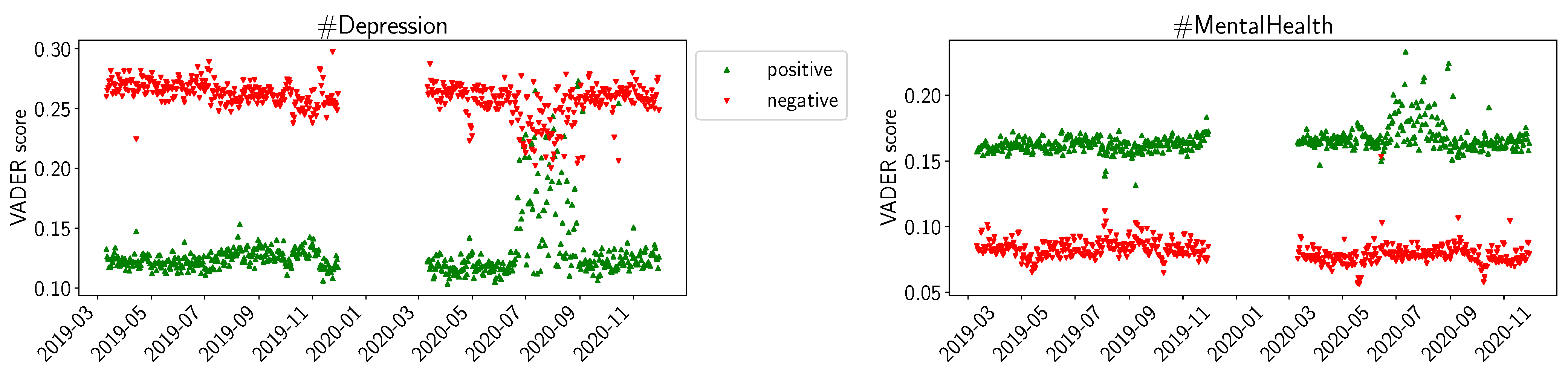
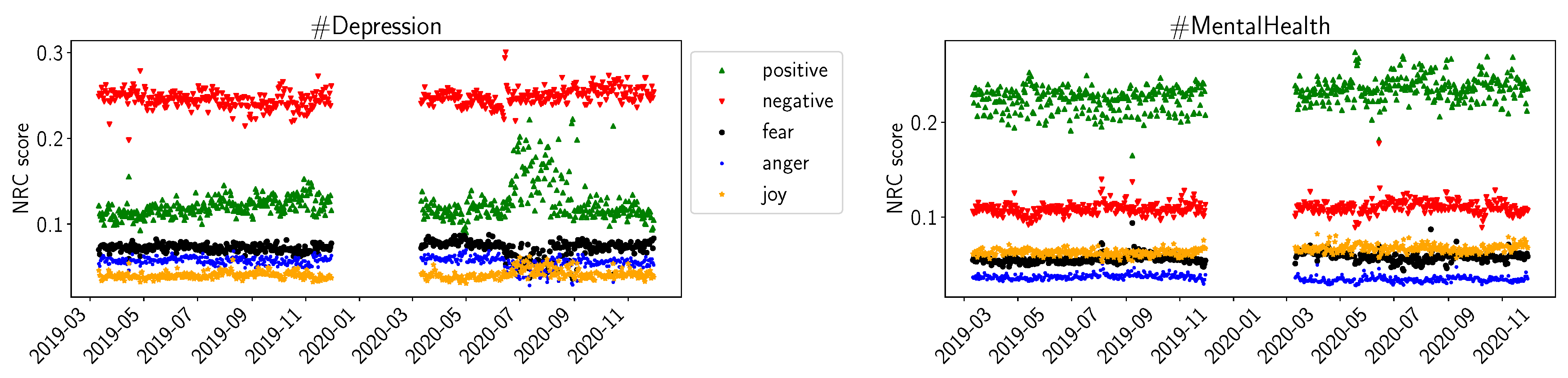
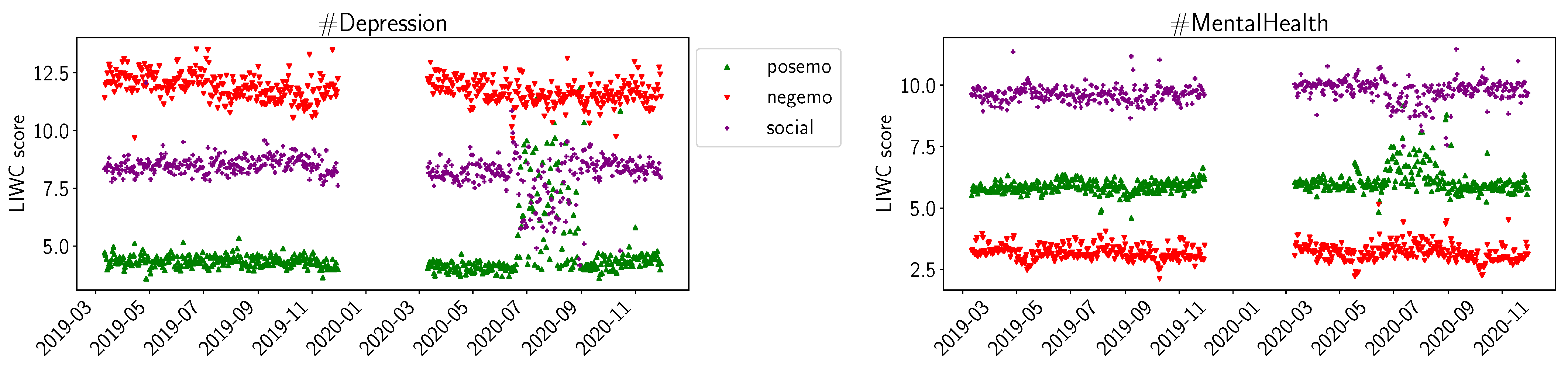
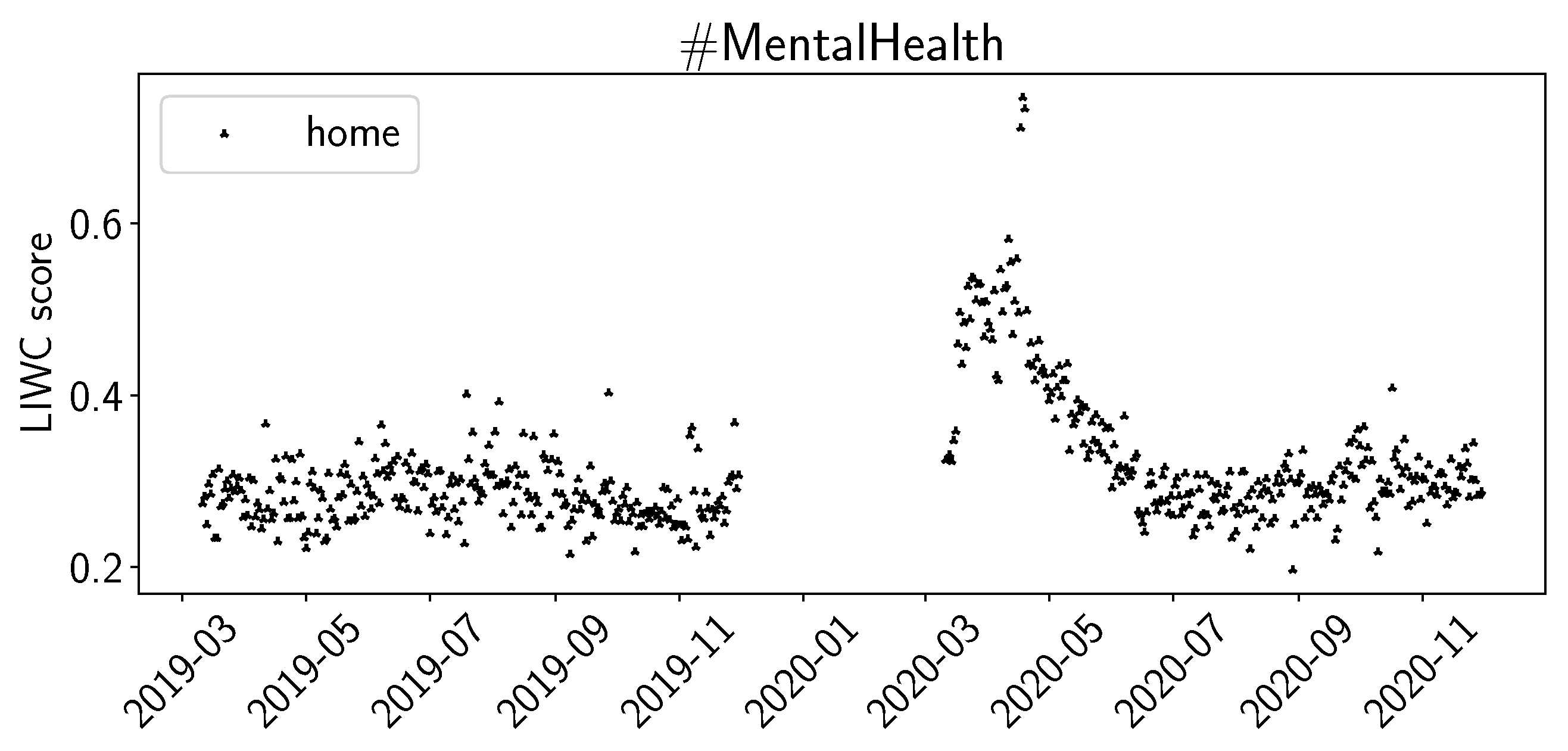
During the COVID-19 pandemic, the novel coronavirus had an impact not only on public health but also on the mental health of the population. Public sentiment on mental health and depression is often captured only in small, survey-based studies, while work based on Twitter data often only looks at the period during the pandemic and does not make comparisons with the pre-pandemic situation. We collected tweets that included the hashtags #MentalHealth and #Depression from before and during the pandemic (8.5 months each). We used LDA (Latent Dirichlet Allocation) for topic modeling and LIWC, VADER, and NRC for sentiment analysis. We used three machine-learning classifiers to seek evidence regarding an automatically detectable change in tweets before vs. during the pandemic: (1) based on TF-IDF values, (2) based on the values from the sentiment libraries, (3) based on tweet content (deep-learning BERT classifier). Topic modeling revealed that Twitter users who explicitly used the hashtags #Depression and especially #MentalHealth did so to raise awareness. We observed an overall positive sentiment, and in tough times such as during the COVID-19 pandemic, tweets with #MentalHealth were often associated with gratitude. Among the three classification approaches, the BERT classifier showed the best performance, with an accuracy of 81% for #MentalHealth and 79% for #Depression. Although the data may have come from users familiar with mental health, these findings can help gauge public sentiment on the topic. The combination of (1) sentiment analysis, (2) topic modeling, and (3) tweet classification with machine learning proved useful in gaining comprehensive insight into public sentiment and could be applied to other data sources and topics.
Keywords: COVID-19; coronavirus; public health; sentiment analysis; topic modeling; machine learning COVID-19; coronavirus; public health; sentiment analysis; topic modeling; machine learning