Article

Multimodal Identification Based on Fingerprint and Face Images via a Hetero-Associative Memory Method

1
College of Intelligent Technology and Engineering, Chongqing University of Science and Technology, Chongqing 401331, China
2
College of Electrical Engineering, Chongqing University of Science and Technology, Chongqing 401331, China
*
Author to whom correspondence should be addressed.
Mathematics 2021, 9(22), 2976; https://doi.org/10.3390/math9222976
Submission received: 28 October 2021 / Revised: 15 November 2021 / Accepted: 16 November 2021 / Published: 22 November 2021
(This article belongs to the Special Issue Modeling and Analysis of Complex Networks)

Abstract

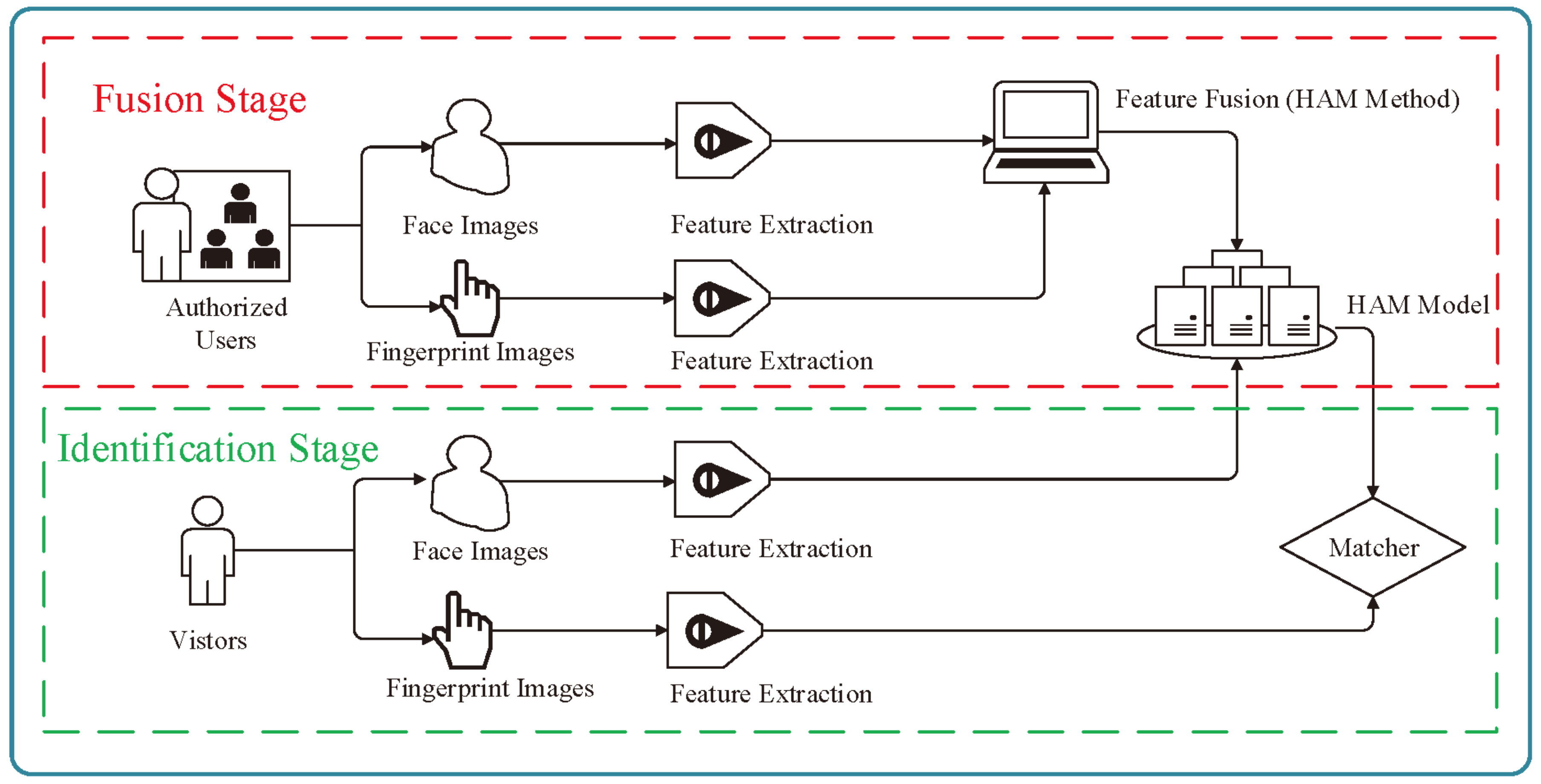
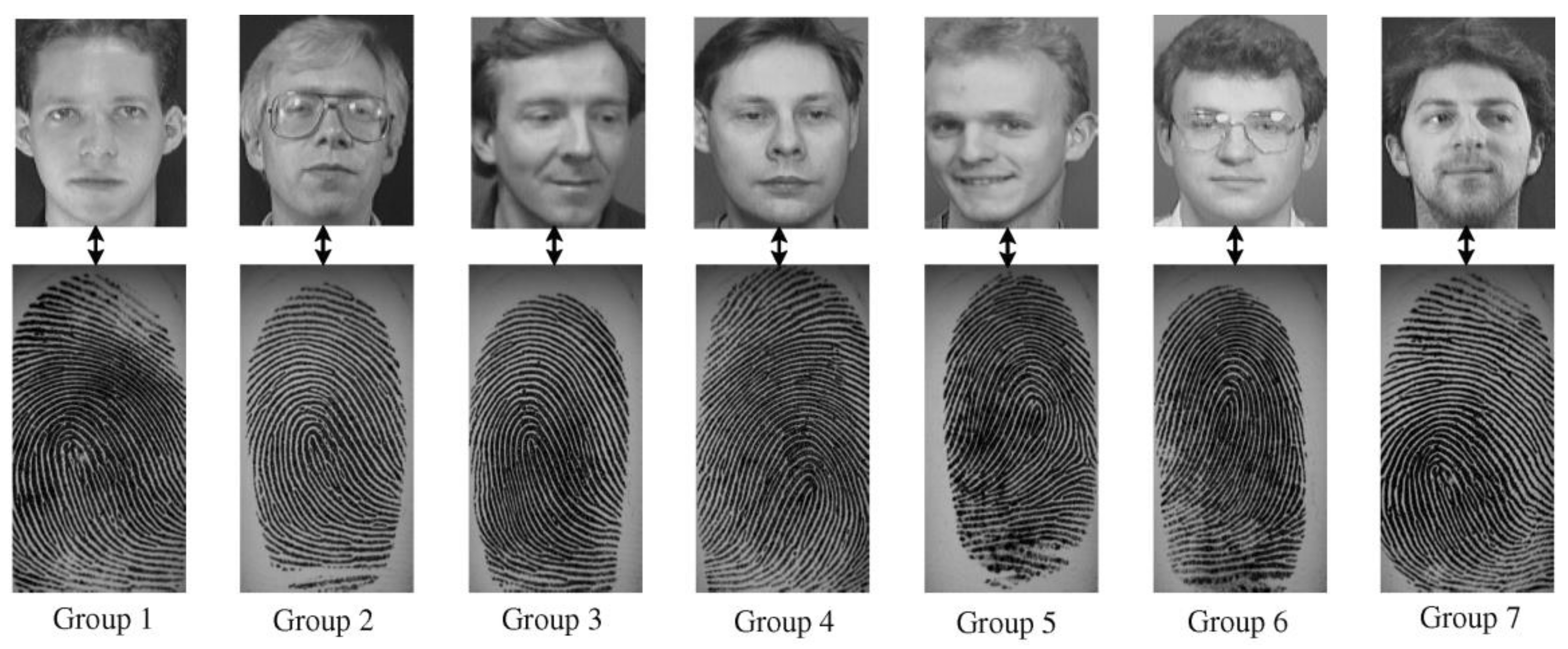
Multimodal identification, which exploits biometric information from more than one biometric modality, is more secure and reliable than unimodal identification. Face recognition and fingerprint recognition have received a lot of attention in recent years for their unique advantages. However, how to integrate these two modalities and develop an effective multimodal identification system are still challenging problems. Hetero-associative memory (HAM) models store some patterns that can be reliably retrieved from other patterns in a robust way. Therefore, in this paper, face and fingerprint biometric features are integrated by the use of a hetero-associative memory method for multimodal identification. The proposed multimodal identification system can integrate face and fingerprint biometric features at feature level when the system converges to the state of asymptotic stability. In experiment 1, the predicted fingerprint by inputting an authorized user’s face is compared with the real fingerprint, and the matching rate of each group is higher than the given threshold. In experiment 2 and experiment 3, the predicted fingerprint by inputting the face of an unauthorized user and the stealing authorized user’s face is compared with its real fingerprint input, respectively, and the matching rate of each group is lower than the given threshold. The experimental results prove the feasibility of the proposed multimodal identification system.
Keywords: stability; multimodal identification; fingerprint recognition; face recognition stability; multimodal identification; fingerprint recognition; face recognition