Abstract
We present new Monte Carlo algorithms for extracting mutual capacitances for a system of conductors embedded in inhomogeneous isotropic dielectrics. We represent capacitances as functionals of the solution of the external Dirichlet problem for the Laplace equation. Unbiased and low-biased estimators for the capacitances are constructed on the trajectories of the Random Walk on Spheres or the Random Walk on Hemispheres. The calculation results show that the accuracy of these new algorithms does not exceed the statistical error of estimators, which is easily determined in the course of calculations. The algorithms are based on mean value formulas for harmonic functions in different domains and do not involve a transition to a difference problem. Hence, they do not need a lot of storage space.
1. Introduction
The problems of finding potentials and mutual capacitances for complex three-dimensional objects have become widespread with the development of high-frequency electrical engineering. In the case of one or two conductors, they can still be solved analytically, but solving problems for systems of a large number of conductors of complex shape causes significant difficulties. The more the operation frequency is, the more impact on the system of parasitic capacitance and induction. This is true for radio frequency communication devices, as well as very large-scale integration circuits and multilayer printed-circuit boards [1,2].
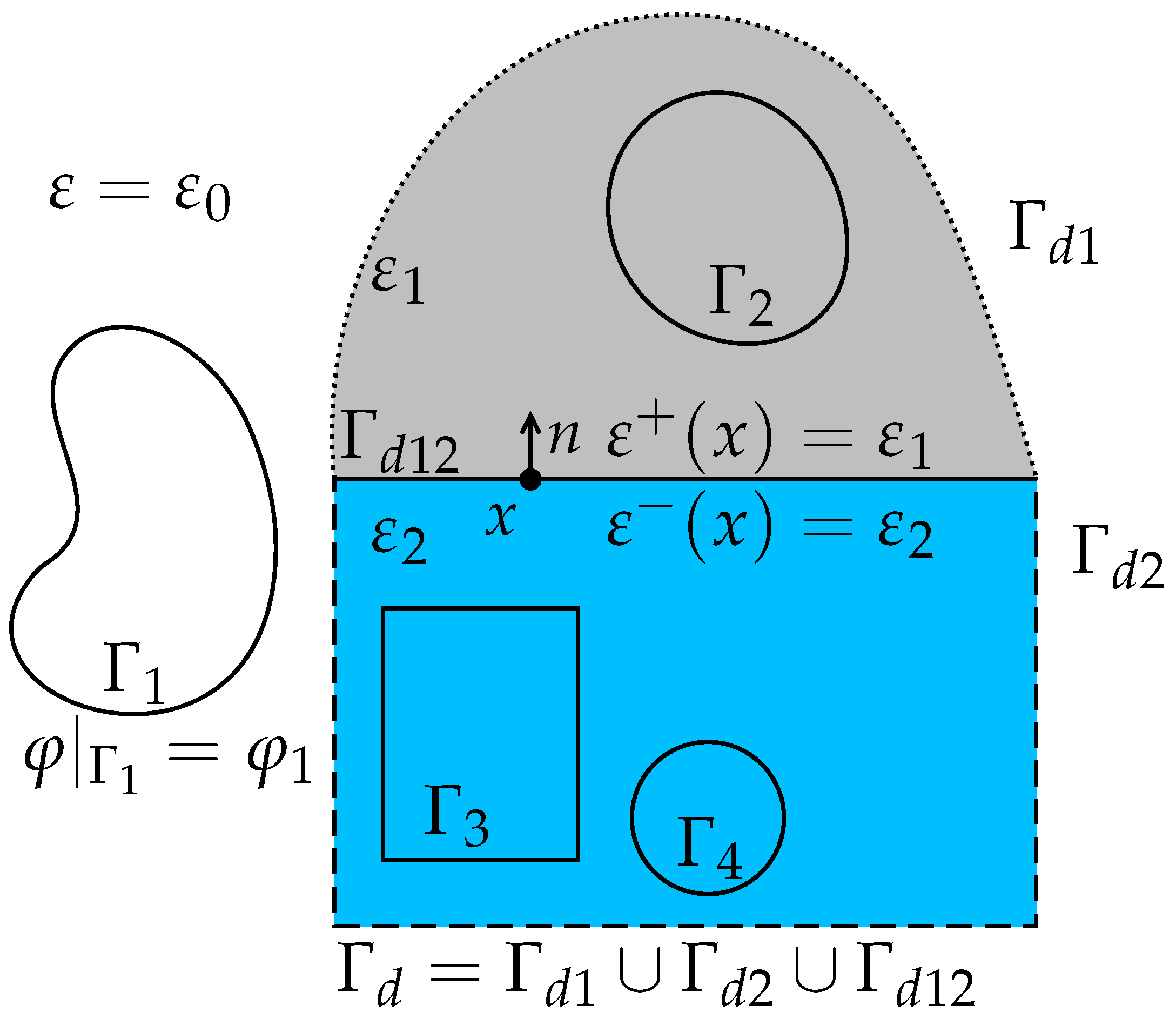
In inhomogeneous media with permittivity the electrostatic potential satisfies the boundary value problem:
Here denotes the conductor surfaces, is the union of the dielectric interfaces, n is the external normal to is Euclidean length of x, and are the values of the potential on different sides dielectric interfaces, and are the permittivity constants on different sides dielectric interfaces, are values of the potential on the is the differential element of area, and is the charge on (Figure 1).
Figure 1.
Domain for the boundary value problem.
Charges linearly depend on potentials [3]: Here, is mutual electrostatic capacitance for the conductors i and j, it is known that . Hence, is equal to the charge when all potential , if and
The analytical solution is only available for simple geometries [3], and could not be used for real-life tasks. Another way is to use pattern-matching algorithms, but there is dependency on available patterns and the quality of geometry approximation with patterns [2,4].
The methods used most for computing capacitances in complicated three-dimensional geometries are the boundary-element technique (for example, [5,6,7]) and Monte Carlo methods (for example, [8,9,10,11]).
The boundary element method is used to solve the system of integral equations of potential theory for the charge density on the surfaces of conductors. The charge on the conductor is then calculated by integrating the density. The main drawbacks of these methods are the necessity of approximation of the conductor’s surface, high random access memory requirements, and additional computational error when equations are solved using the iterative technique.
The Monte Carlo method is used to solve the Dirichlet boundary value problem (1). Capacitance is calculated using the Gaussian formula through the normal derivative of the potential. Monte Carlo algorithms for a boundary value problem are based on the representation of its solution in the form of the mathematical expectation of some random variable, which in mathematical statistics is called an unbiased estimator. A common drawback for Monte Carlo methods isthe necessity of a large number of simulations, but usually they are highly parallelizable and have low random access memory requirements.
There are various formulas for the average value for the potential, which determine both the estimate itself and the type of Random Walk along the trajectories of which it is calculated.
One of the first works on using Monte Carlo method for real-life capacitance extraction is [8]. This article describes Random Walk on Cubes methods for rectilinear conductors in a homogeneous medium. The proposed algorithm uses the mean value theorem for the potential at the center of a cube. To simplify the procedure for modeling a Random Walk, the problem was discretized. The development of the method of Random Walk on Cubes in various directions (multiple dielectrics, non-Manhattan polygonal shapes, optimizations) can be found, for example, in [12,13,14]. Besides the statistical error of Monte Carlo approximations, Walk on Cubes have additional bias because of the approximation of Green’s function for cubes using the Fourier series.
In [15], Random Walk on Boundary was described for calculating conductor’s capacitance in free space, in [9] Random Walk on Spheres and Walk on Boundary were used for estimating electrostatic properties of molecules, including cases for different (constant) permittivities. These methods were extended in [16] for analysis on multidielectric integrated circuits of arbitrary geometry from a scanning electron microscopy image. Besides the statistical error of Monte Carlo approximations, there is additional bias, because of various discretizations, that could not be estimated along with the calculations.
In this article we discuss algorithms of the Monte Carlo method that do not require discretization of the boundary value problem. Consequently, there is no approximation error in them. Due to this, it is possible to estimate the error of the approximate solution of the problem during the calculations. Furthermore, Random Walks in unbounded regions may not reach the boundary of the conductors in a finite time with a positive probability. Forced completion of the trajectory leads to a bias in the estimate of the potential, which authors usually do not take into account. Our proposed algorithms are free from this drawback.
In our previous work [10,11], we developed algorithms for mutual capacitance calculation in homogeneous media on trajectories of a Walk on Spheres and in inhomogeneous media on trajectories of a Walk on Hemispheres, when dielectric interfaces are polyhedral. We summarize the main results of these works here.
In this paper, we also consider a new version of the Walk on Hemispheres and its application to the calculation of electrostatic capacitances for systems with various dielectric interfaces, including non-Manhattan geometries.
Using the examples of conductor systems for which the capacitances are calculated analytically [3], it is shown that the accuracy of the Monte Carlo approximation is within the statistical error. In more complex examples, the simulation results are compared with the results of calculating these capacitances using the programs FastCap2 and FFTCap [6,17,18].
The paper is organized as follows. Section 2 introduces a description of the problem. Section 3 describes different kinds of unbiased estimators for the capacitance. It begins with a description of previously proposed algorithms in Section 3.1 and Section 3.2, followed by the description of a new version of the Walk on Hemispheres in Section 3.3, and finishes with a description of the generic algorithm for capacitance extraction with these methods in Section 3.4. Section 4 contains the numerical results for capacitance extraction, where we compare the results of the proposed algorithms with analytical solutions or other programs. Section 5 concludes the paper.
2. Integral Representation for the Capacitance
Using Gauss’s theorem we have
where is the surface containing the i-th conductor inside and separating it from others conductors and interfaces.
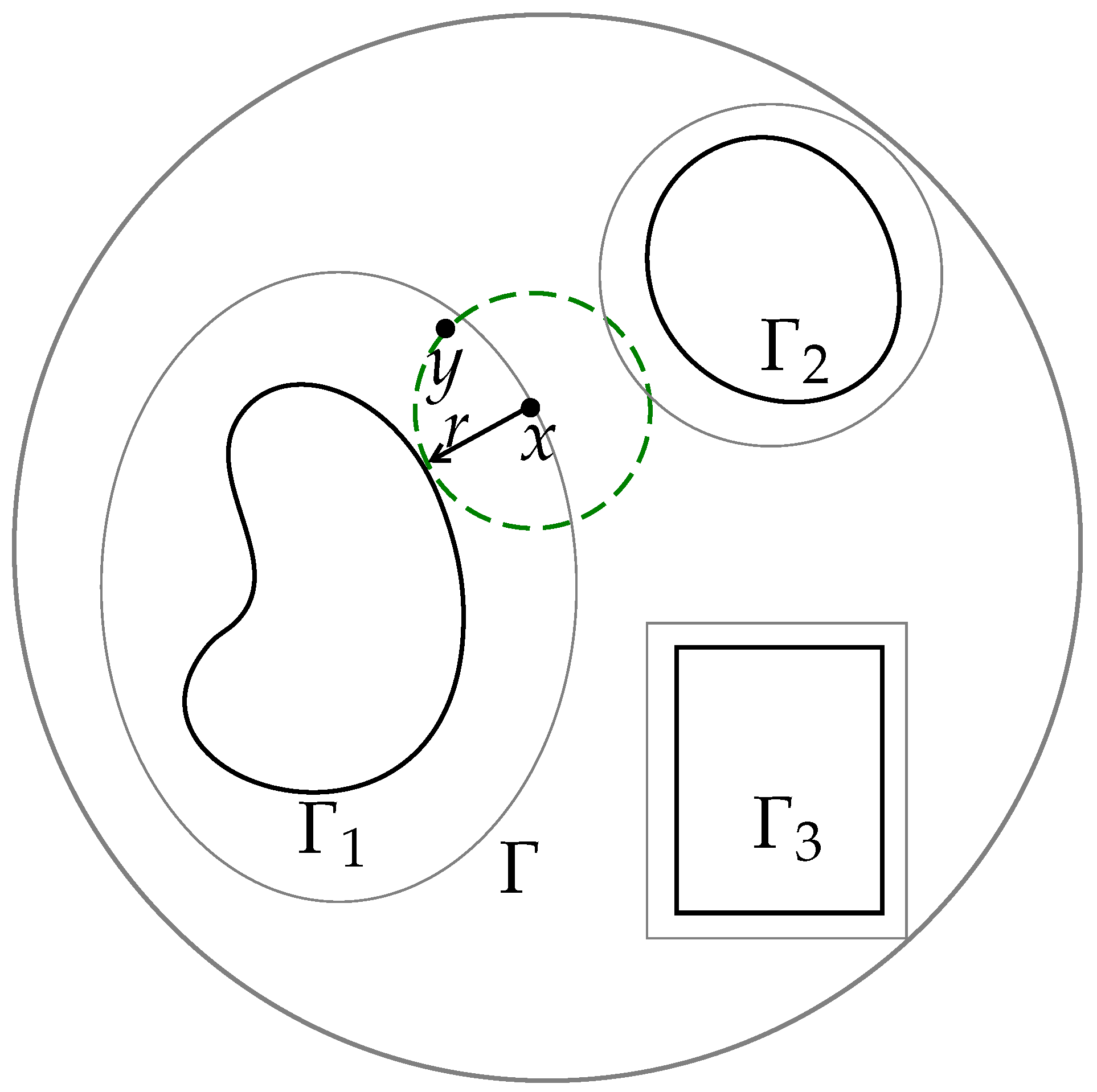
Using the Poisson formula, we obtain the following representation for the normal derivative of the potential on the shell :
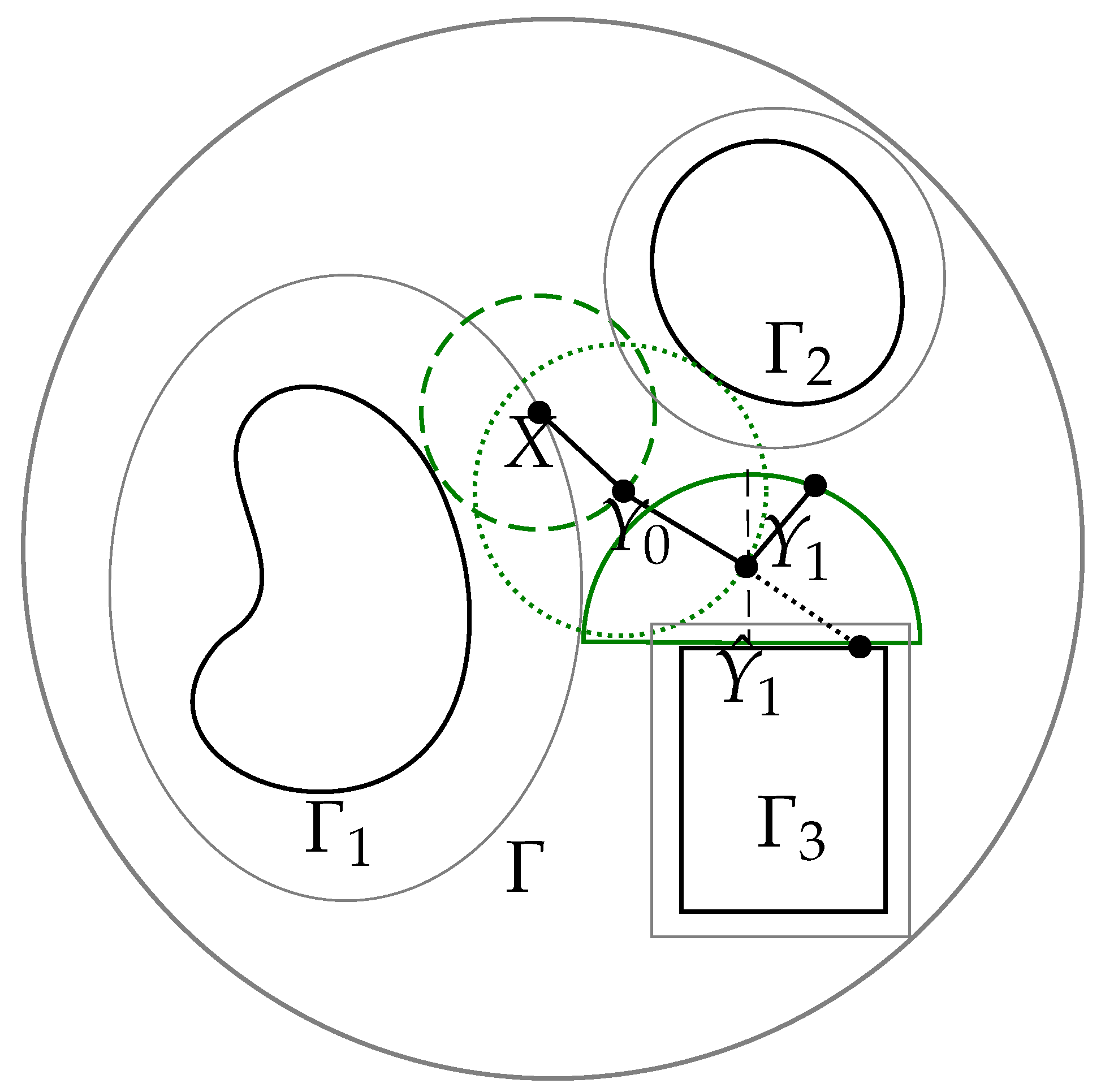
where x is a point on the shell around the i-th conductor, r is distance from point x to the nearest conductor or interface, is sphere of radius r centered at point x, y is a point on (Figure 2).
Figure 2.
First steps of Random Walk on Spheres for estimation of . Here are conductor’s surfaces, is a shell around first conductor.
Finally, replacing the normal derivative by its integral representation in the ball, which lies entirely in the region with the dielectric constant , we obtain an integral representation of the mutual capacitance of the i-th and j-th conductors:
where is a surface area .
3. Unbiased Estimators for the Capacitance
Using Formula (4) we have unbiased estimator for capacitance
Here, a random point X is uniformly distributed on and is an isotropic vector (random unit vector). It remains to estimate the potential at the point This can be done using the mean value formula
where and D is the set of interior points of all conductors. The unbiased estimators for are constructed on trajectories of Random Walk , , in space Q. The kernel must be stochastic or sub-stochastic. It determines the distribution of the next point of the Random Walk over the current point.
Let
If at time k the “weight” , then the current value of the estimator is multiplied by the “weight”: The Random Walk stops at time , when it reaches the -boundary of the conductors, that is, when the distance from point to the boundary of the conductors becomes less than the Hence, it must satisfy the condition We define estimator if , and zero, otherwise. If the boundary is smooth enough, then for some constant In practice, the estimator is simulated in a reasonable time, only if Having received a sufficient number of realizations of the estimator and calculating their arithmetic mean, we obtain an approximate value of the capacitance
We will now describe some of the types of Random Walks used to calculate the capacitances of conductors.
3.1. Random Walk on Spheres for the External Dirichlet Problem
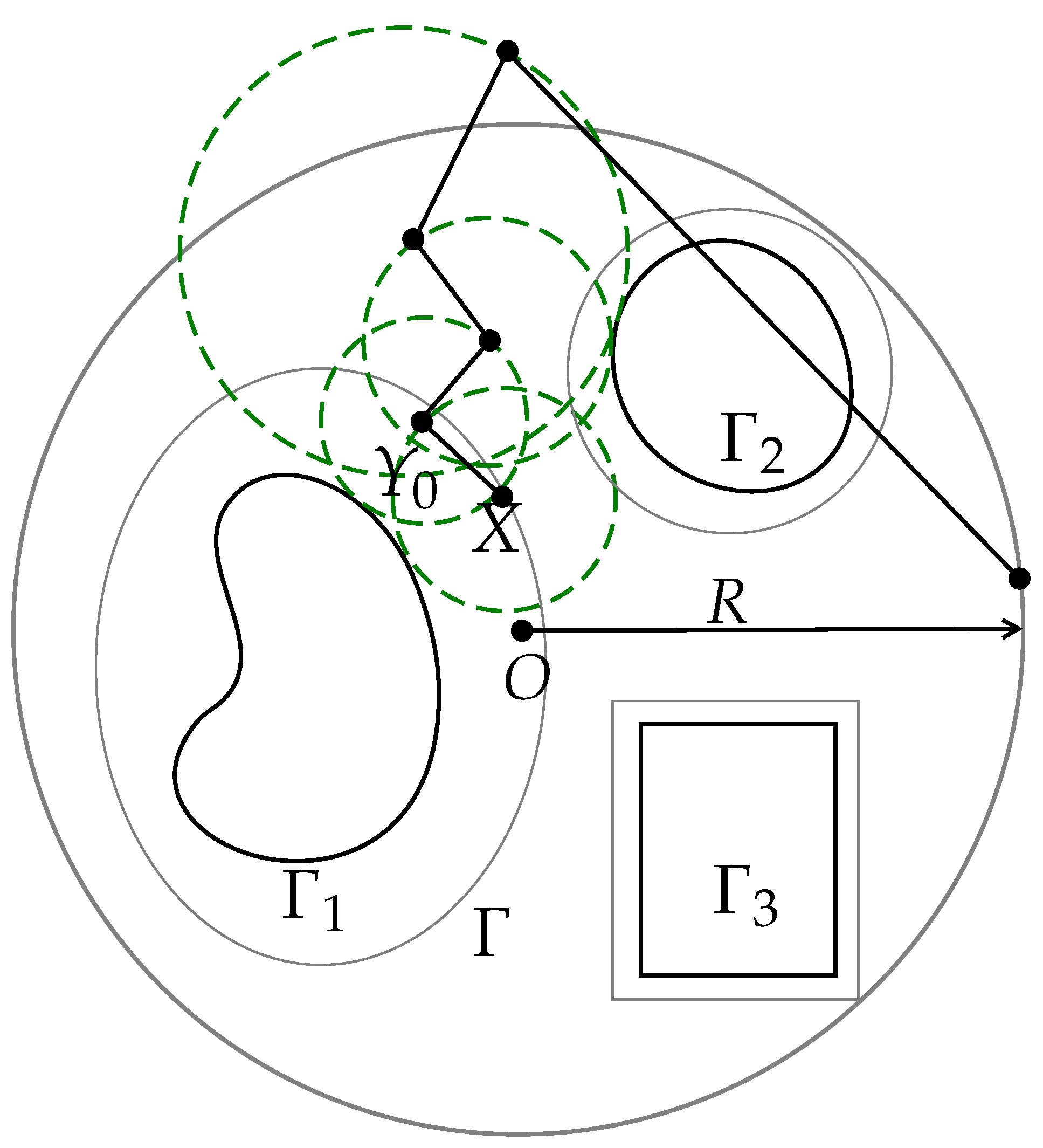
Random Walk on Spheres (WoS) is used to solve the external Dirichlet problem for the Laplace equation [19], and allows for the calculation of the capacitances of conductors in a homogeneous medium [10]. Let all the conductors lie inside a sphere of radius R centered at the origin. Let be a continuous function such that for some constant
By the mean value theorem for harmonic functions, we obtain for Let be a sequence of independent isotropic vectors. Then we get a Random Walk
To restrict the region of the Random Walk, we use the Poisson formula for :
Namely, if , then “weight” and is distributed on the sphere with density
(Figure 3).
Figure 3.
Random Walk on Spheres. Return on external sphere .
It is proved [19] that the Random Walk on Spheres reaches the -neighborhood of the boundary of the conductors in a finite time. The formulas for simulating the Random Walk are also given.
3.2. Random Walk on Hemispheres
The Random Walk on Hemispheres (WoH) algorithm was proposed in [20] for solving various boundary value problems for the Laplace and Poisson equations. It allows for the calculation of capacitances when dielectric interfaces are polyhedral [11]. In cases when surfaces of the conductors are also polyhedral, the algorithm gives unbiased statistical estimators of the capacitances. We will now briefly describe this algorithm.
Let all the conductors and dielectric interfaces lie inside a sphere of radius R centered at the origin. If , then and has a distribution density (8). “Weight”
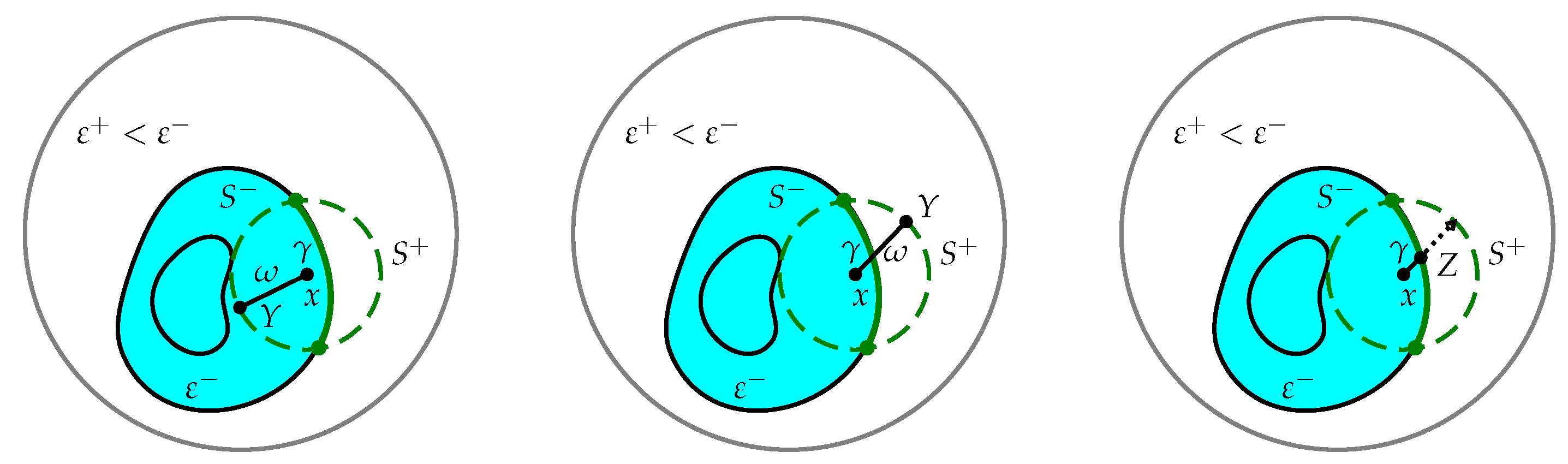
Now, let , where is a component of the dielectric interface. Next, we choose the maximum such, that and part of the lying in sphere is plane. The sphere is divided into two parts and lying in media with permittivity constants and , respectively. The point is uniformly distributed in or in with probability and respectively (Figure 4).
Figure 4.
Random Walk on Hemispheres. Exit from interface.
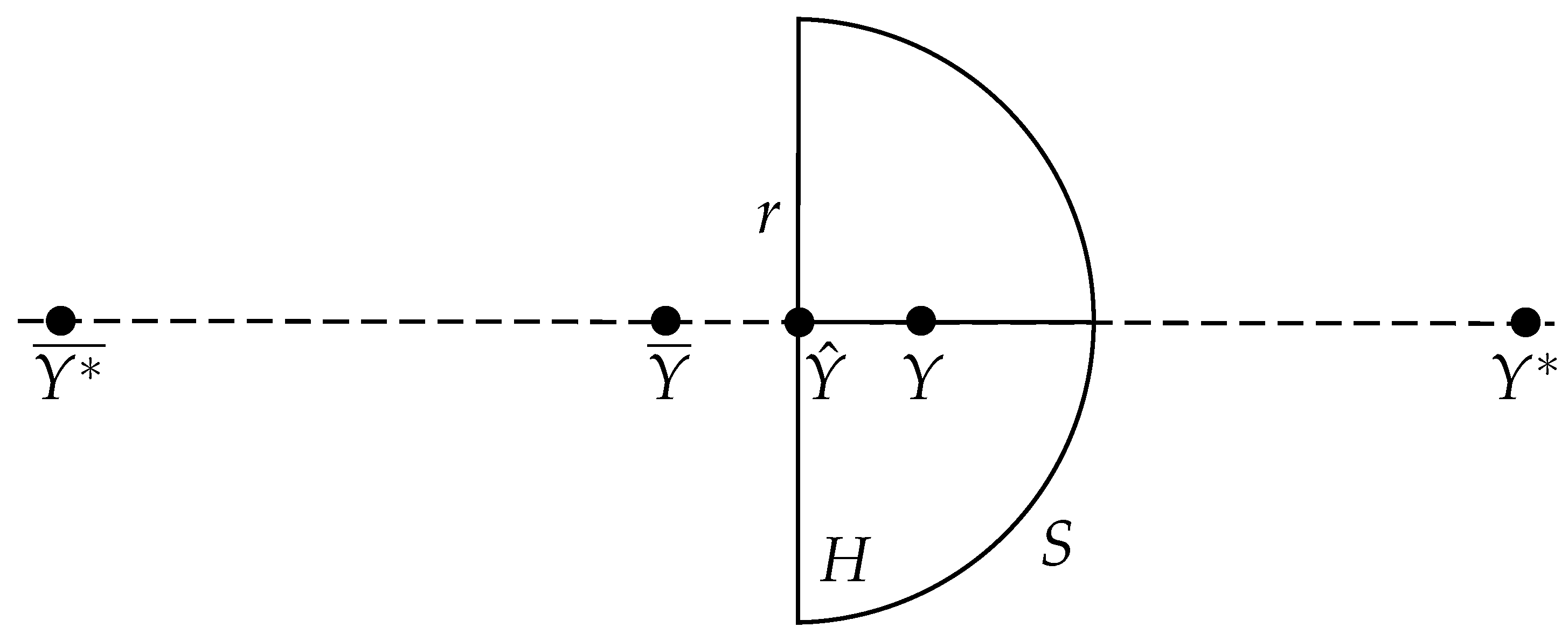
If and , then is distributed on a sphere or hemisphere. The center of the hemisphere must be in a plane containing a face of the conductor surface or interface and is the orthogonal projection of onto this plane.
Hemisphere radius , where is a fixed constant. The hemisphere must be contained in a medium with a dielectric constant . The distribution density of the point on the hemisphere is the normal derivative of the Green’s function for the half of the ball
Here H is the plane part, and S is the spherical part of the hemisphere. The point is symmetric to relative to plane H. The point lies outside of the sphere S and it is inverse to the point () (Figure 5).
Figure 5.
Random Walk on Hemispheres. Symmetrical points on hemisphere.
If it is impossible to construct such a hemisphere, then is distributed uniformly on a sphere of radius , centered at .
Von Neumann’s Acceptance-Rejection Method can be used to simulate density (9). To do this, we write the density in the form
where is the angle between the vector and the external normal to the surface of the hemisphere at the point y.
The first factor in this formula is the distribution density of the point Z on the surface of the hemisphere and the vector is isotropic one. The second factor does not exceed the constant , where
To select the next point of the random walk, we simulate an isotropic vector and a random variable with uniform distribution on . Then we define the point Z, in which the ray emerging from the in the direction crosses the hemisphere. If , then . Otherwise, it is necessary to repeat the simulation until the inequality is true (Figure 6).
Figure 6.
Random Walk on Hemispheres. Jump on hemisphere.
3.3. Random Walk on Hemispheres for a Convex Dielectric Interfaces (RWHC)
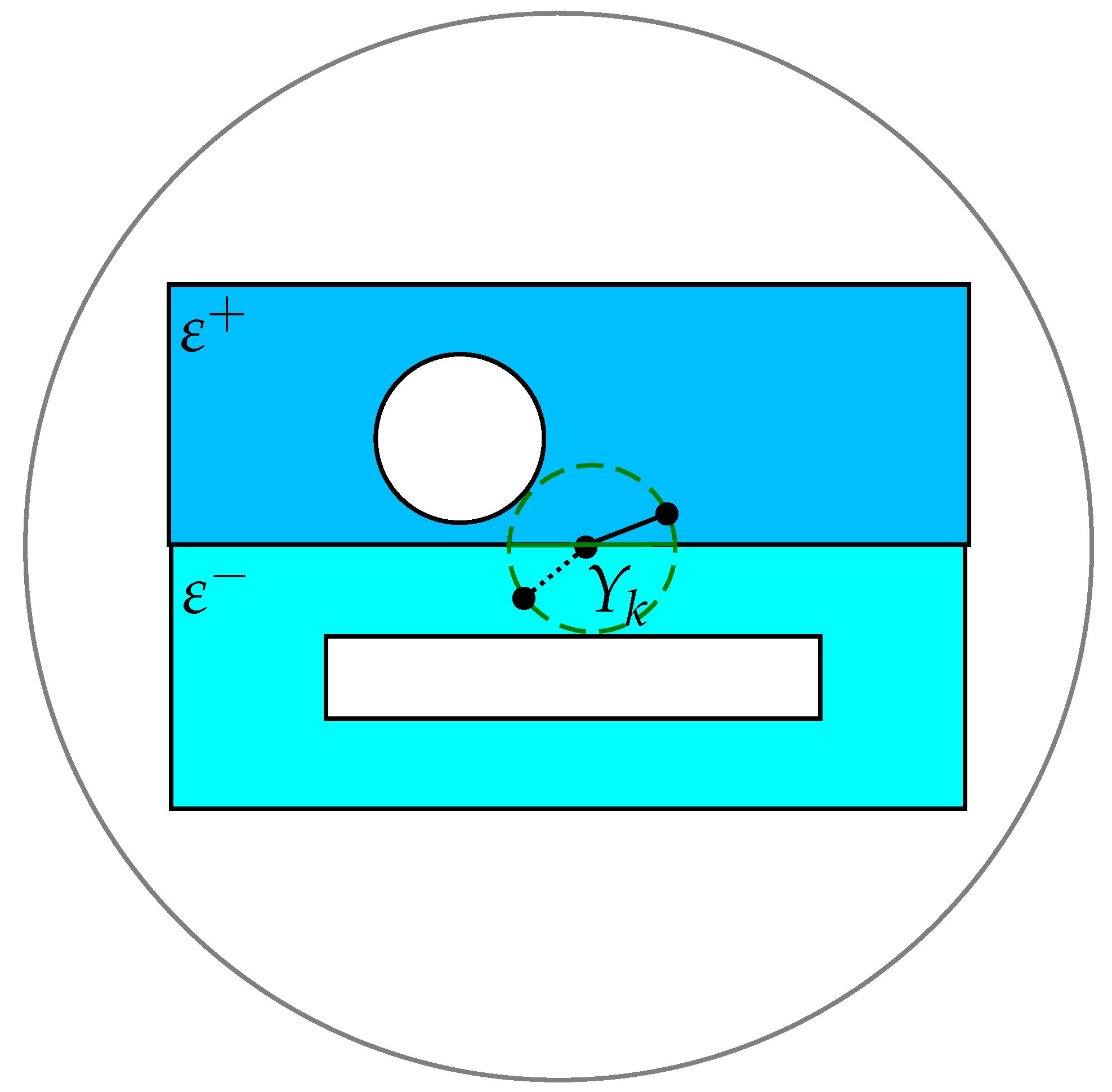
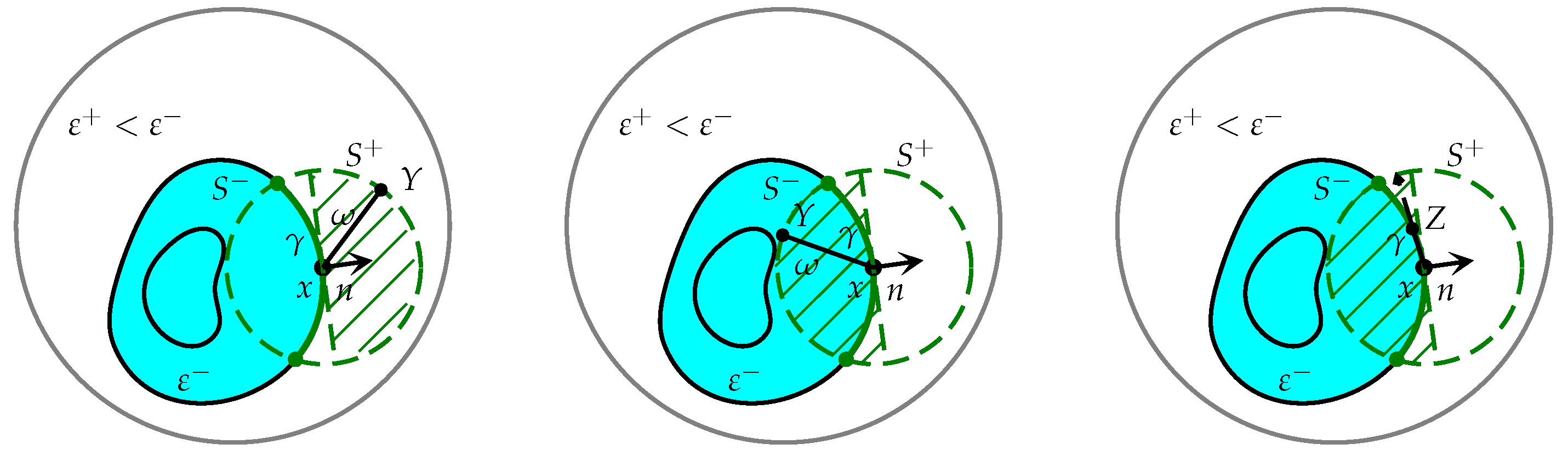
Let be a connected convex part of some dielectric interface lying inside a sphere of radius centered at point For all we choose the direction of the normal vector so, that the surface lies in the half-space . Surface divides the sphere into two parts and lying in media with permittivity constants and , respectively, and for all
The potential is a harmonic function for the part of the ball bounded by surfaces and part of the ball bounded by surfaces also. Using the second Green’s formula for a harmonic function in a bounded domain, we obtain the following Theorem.
Theorem 1.
Let and let be the angle between vectors Then the potential satisfies the mean value formulas:
If the Formula (11) defines the stochastic kernel. To simulate the transition from the surface , we chose with the probability a random direction that satisfies the condition and define With probability we simulate a random direction satisfying the condition We calculate If , we change Y to a point , which is visible from x in the direction (Figure 7).
Figure 7.
RWHC. Jump from convex part of interface.
If the Formula (12) defines the stochastic kernel also. To simulate the transition from we simulate a random direction and calculate If , than with probability we change Y to a point , which is visible from x in the direction (Figure 8).
Figure 8.
RWHC. Jump from dielectric with higher permittivity.
If the Formula (13) defines the stochastic kernel, if any ray outgoing from point x intersects at no more than one point. The modeling procedure is similar to the algorithm for the Formula (12).
Thus, Formulas (11)–(13) make it possible to simulate transitions from a region with a higher dielectric constant to a region with a lower dielectric constant. To pass from point x through the interface , it is sufficient to take such that Reverse transitions can be provided using, for example, formulas for solving external and internal Dirichlet problems for standard domains. The exit from the “bad” point x can be done by Random Walk on Spheres or Hemispheres in the set As always, from distant points of the external medium there is a transition to the sphere
3.4. Algorithm for Mutual Capacitance Calculation
On this basis we could describe algorithm for capacitance estimation as follows:
- For each conductor i select shell , that separate it from other conductors and dielectric interfaces.
- Select radius R for, centered at the origin, “outer” sphere, that contains all conductors and shells.
- If at some step n process exit outside of sphere , next point is selected at sphere and “weight” updated, as described in Section 3.1.
- Otherwise, if at some step n, located at flat surface of k-th conductor or at -neighborhood of non-flat surface of k-th conductor, estimation included into accumulator and number of trajectories, that used this conductor for evaluation is incremented by 1. (Because , we could use the same accumulator and counter for both of them.) Values in other accumulators are not changed, but the number of trajectories for j-th conductor is also incremented by 1 with the exception of nested conductors: if j-th conductor is inside i-th, its number of trajectories is not changed.
- If the number of evaluated trajectories is not sufficient, return to step 3.
- The approximation for capacitance is calculated as value stored in the corresponded accumulator divided by the stored number of trajectories for this accumulator. If the system contains nested conductors, the self-capacitance of external conductor m is updated as (here sum is taken by numbers of conductors that are located inside m-th).
4. Results
4.1. Mutual Capacitance of Two Spheres in Free Space
Mutual capacitance for two spheres could be calculated analytically [3]. When spheres are not nested:
where and are radii, d—distance between sphere centers. For nested spheres ():
In Table 1 results of mutual capacitance estimation for two non-nested spheres using Walk on Spheres are presented. Here and below is error estimation, calculated as triple square root of ratio of sample variance to number of trajectories, Time is “wall time” of calculation, and Memory is a peak memory usage. Calculations were performed on one personal computer (PC) with central processing unit (CPU) “AMD Ryzen 7 2700 Eight-Core Processor 3.20 GHz”. Monte Carlo simulations were performed in parallel by eight worker processes on one PC using the Message Passing Interface, and memory usage is at its peak for one worker process. FastCap2 and FFTCap are 32-bit single-threaded applications, so no parallel execution were used for them. It should also be noted that we have not used additional optimizations, so the calculation time could be improved for the Monte Carlo case, for example, by using a different pseudo random number generator or using optimizations in distance calculations.
| 1st sphere radius: | 5; |
| 1st sphere center: | (1, 2, 3); |
| 1st sphere shell radius: | 8; |
| 2nd sphere radius: | 3; |
| 2nd sphere center: | (10, 13, 12); |
| 2nd sphere shell radius: | 8; |
| “External” sphere radius: | 31.155; |
| : . |
Table 1.
Mutual capacitance estimation for two non-nested spheres, .
Usually, the bias order is the same as the order of , so, in this and following examples, error of methods is equal to statistical error. We will say that results of the estimation are matched, when the modulus of difference between the Monte Carlo estimation and the reference solution are not more than the statistical error (). As we can see in the Table 1, the analytical solution and our estimation are matched, so the algorithm is working correctly.
In Table 2, results of mutual capacitance estimation for two nested spheres using Walk on Spheres (WoS) are presented. There is no formula for in the case of two nested spheres in [3], so we do not show the estimation results for this value.
| 1st sphere radius: | 3; |
| 1st sphere center: | (10, 13, 12); |
| 1st sphere shell radius: | 5; |
| 2nd sphere radius: | 31; |
| 2nd sphere center: | (1, 2, 3); |
| 2nd sphere shell radius: | 35; |
| “External” sphere radius: | 42.616; |
| : . |
Table 2.
Mutual capacitance estimation for two nested spheres, .
Estimation results in Table 2 are within statistical error, so analytical solution and our estimation are matched.
4.2. Capacitance of “Coated” Sphere
In Table 3 and Table 4, results of capacitance estimation for the conductive sphere of radius a encased in concentric spherical dielectric of radius b with relative permittivity using RWHC are presented. In this example, the external sphere radius is equal to the dielectric shell radius. Analytical solutions for this case is [3]. Also here we compare results with FastCap2 (FC2) [18] (correspondent sphere discretization was made using spheregen tool from [21] with refine depth 5).
Table 3.
Capacitance estimation for coated sphere, .
Table 4.
Capacitance estimation for coated sphere. Time and memory usage.
Comparing values in columns 2, 4, 5 of Table 3 we conclude that the analytical solution and RWHC estimation are matched in all cases. However, comparing columns 2 and 3, we can see that the estimation error for FC2 grows up with (as it is stated in [7]). So we can state, that RWHC working correctly with high permittivities too, but more number of simulation may be needed to get estimation with desired statistical error.
Table 4 shows that RWHC is used more often than boundary-element technique-based methods, such as FC2, but use much less memory.
4.3. Mutual Capacitance of Two Spheres in Spherical Dielectric
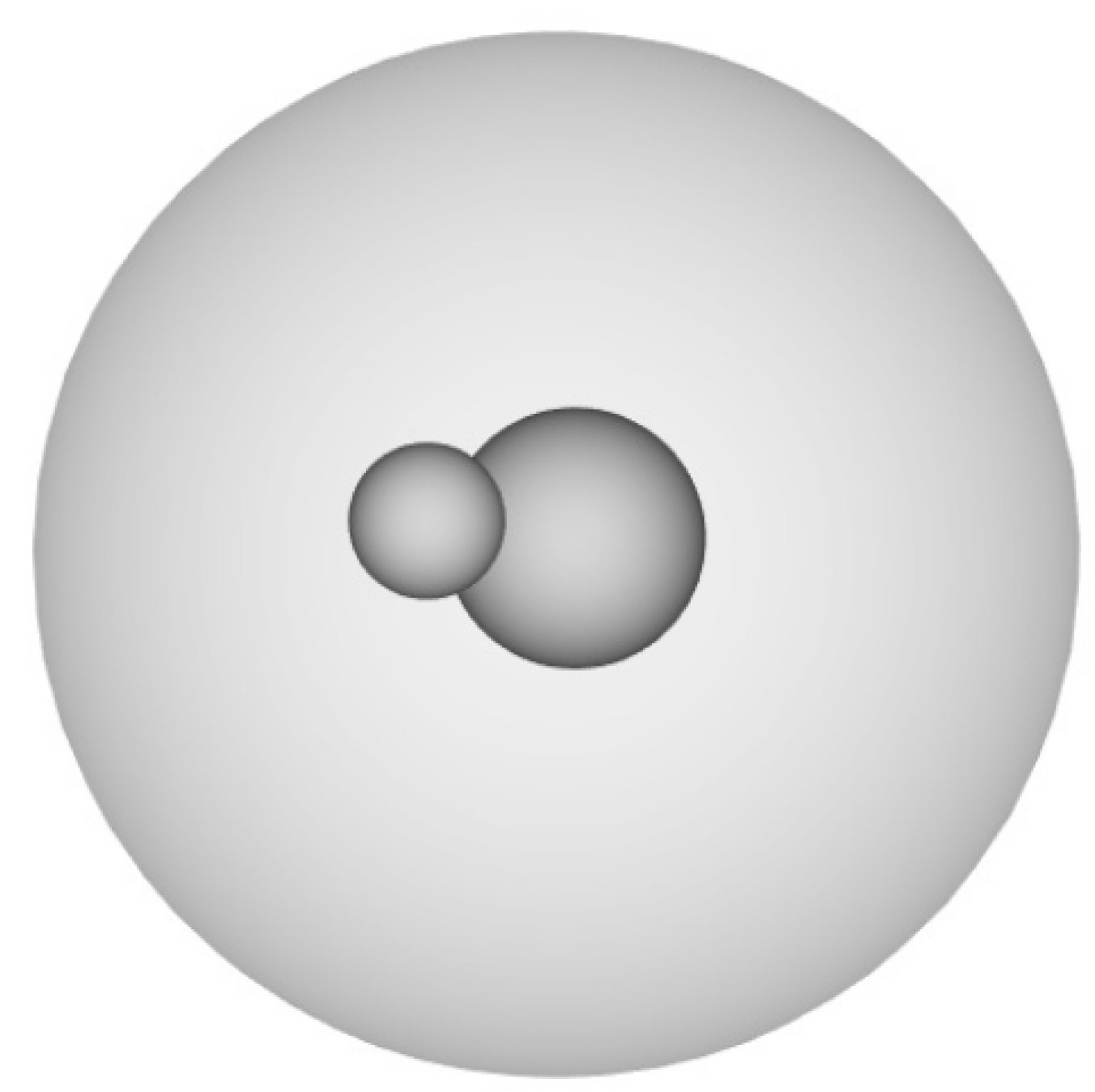
In the Table 5 and Table 6 results of mutual capacitance estimation using FC2 (correspondent sphere discretization was made using spheregen tool from [21] with refined depth 5) and RWHC for two conductive spheres in spherical dielectric (Figure 9) are presented. In this case external sphere radius is set to the dielectric shell radius.
| 1st sphere radius: | 5; |
| 1st sphere center: | (1, 2, 3); |
| 1st sphere shell radius: | 6; |
| 2nd sphere radius: | 3; |
| 2nd sphere center: | (10, 3, 11); |
| 2nd sphere shell radius: | 4; |
| Dielectric ball radius: | 20; |
| : . |
Table 5.
Mutual capacitance estimation for two spheres in dielectric shell, .
Table 6.
Mutual capacitance estimation for two spheres in dielectric shell. Time and memory usage.
Figure 9.
Two spheres in dielectrical shell.
In this case we have no analytical solutions for reference, so we compare our results with FC2. But we also have no error estimation for FC2 result, so we could not guarantee that the difference will be within statistical margin of error. Comparing results in columns 2 and 3 of Table 5 we could say that the estimations are matched, but it is not true for columns 2 and 4. In previous cases we ascertained that RWHC is matched with the analytical solution. Also, in this case, we can see that results in columns 3 and 4 are matched. So we can state that in this case the estimation error with FC2 is more than with RWHC on trajectories.
In Table 6 we can see that RWHC is better both in time and memory. This is due to the fact that for FC2 spheres should be approximated with a large number of panels. Also, we can see that with the refinement depth we used, we have almost reached the memory limit for the original 32-bit fastcap application, so we cannot compare to these results with better discretization.
4.4. Mutual Capacitance of Two Spheres in Spherical Dielectrics
In Table 7 and Table 8, results of mutual capacitance estimation using FC2 (correspondent sphere discretization was made using the spheregen tool from [21] with refined depth 5) and RWHC for two conductive spheres, each in its own spherical dielectric, (Figure 10) are presented.
| 1st sphere radius: | 5; |
| 1st sphere center: | (1, 2, 3); |
| 1st dielectric radius: | 9; |
| 1st dielectric center: | (2, 3, 4); |
| Relative permittivity of 1st dielectric: | 2; |
| 2nd sphere radius: | 3; |
| 2nd sphere center: | (10, −3, 20); |
| 2nd dielectric radius: | 6; |
| 2nd dielectric center: | (10, −4, 20); |
| Relative permittivity of 2nd dielectric: | 5; |
| External sphere radius: | 30; |
| : . |
Table 7.
Mutual capacitance estimation for two spheres in dielectric shells, .
Table 8.
Mutual capacitance estimation for two spheres in dielectric shells. Time and memory usage.
Figure 10.
Two spheres in dielectrical shells.
There are no reference analytical solutions in this case either. Using the results from Table 7, we have reached the same conclusion as in the previous case.
4.5. Mutual Capacitance of Parallel “Pins”
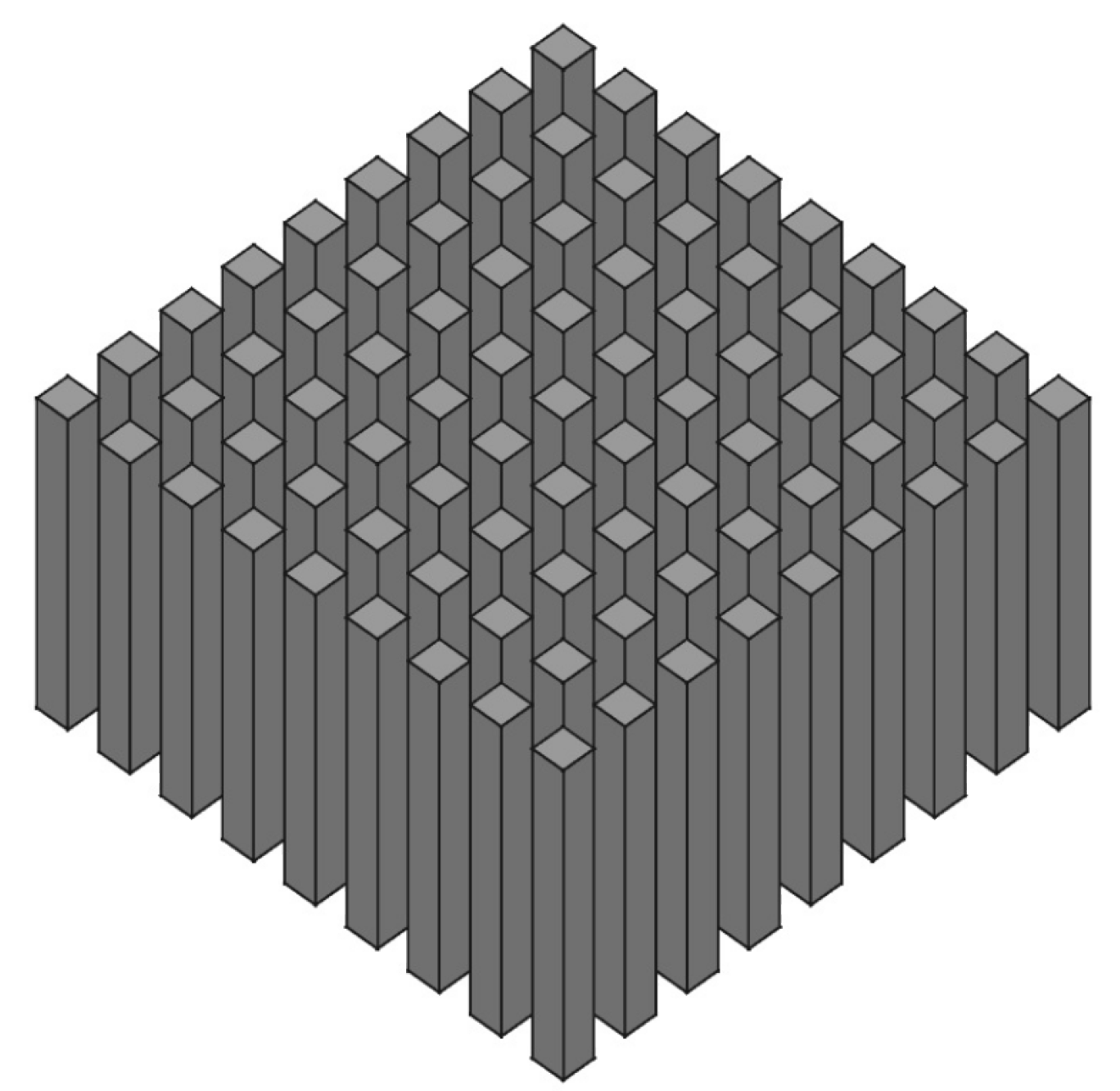
In Table 9 and Table 10, the results of the mutual capacitance estimation using FFTCap [17,18] (correspondent discretization was made using cubegen tool from [18] with 5 panels per side) and Walk on Hemispheres for 81 conductive “pins” placed in uniform lattice points (Figure 11) are presented. The full capacitance matrix has dimensions of , so we show only a few values in the table.
| Pin size: | ; |
| Cell size: | ; |
| Shell offset: | ; |
| : | ; |
| “External” sphere radius: | ; |
| : | . |
Table 9.
Mutual capacitance of conductive pins, .
Table 10.
Mutual capacitance of conductive pins. Time and memory usage.
Figure 11.
conductive pins.
In this case objects have flat faces, so this task is “good” for FFTCap and we can take this solution as reference. The results from Table 9 shows that the estimations are matched. Also, we could see that, besides matching statistical error, the results for WoH estimation when , have a larger statistical error than in other cases (about 6%). This is due to the fact that these conductors are located in opposite corners of the lattice, so only a small number of trajectories started near the first conductor will end on 81st. In this case, to get an estimation with the desired statistical error, more simulations may be required. For example, with trajectories we get the value of and statistical error of (less than 2%).
Also we could estimate difference with FFTCap results by norm: let A—FFTCap result matrix, B—WoH result matrix for trajectories from each conductor, then , where is Frobenius norm of matrix A.
4.6. Mutual Capacitance of Rectangular Parallelepipeds in Dielectric Shells
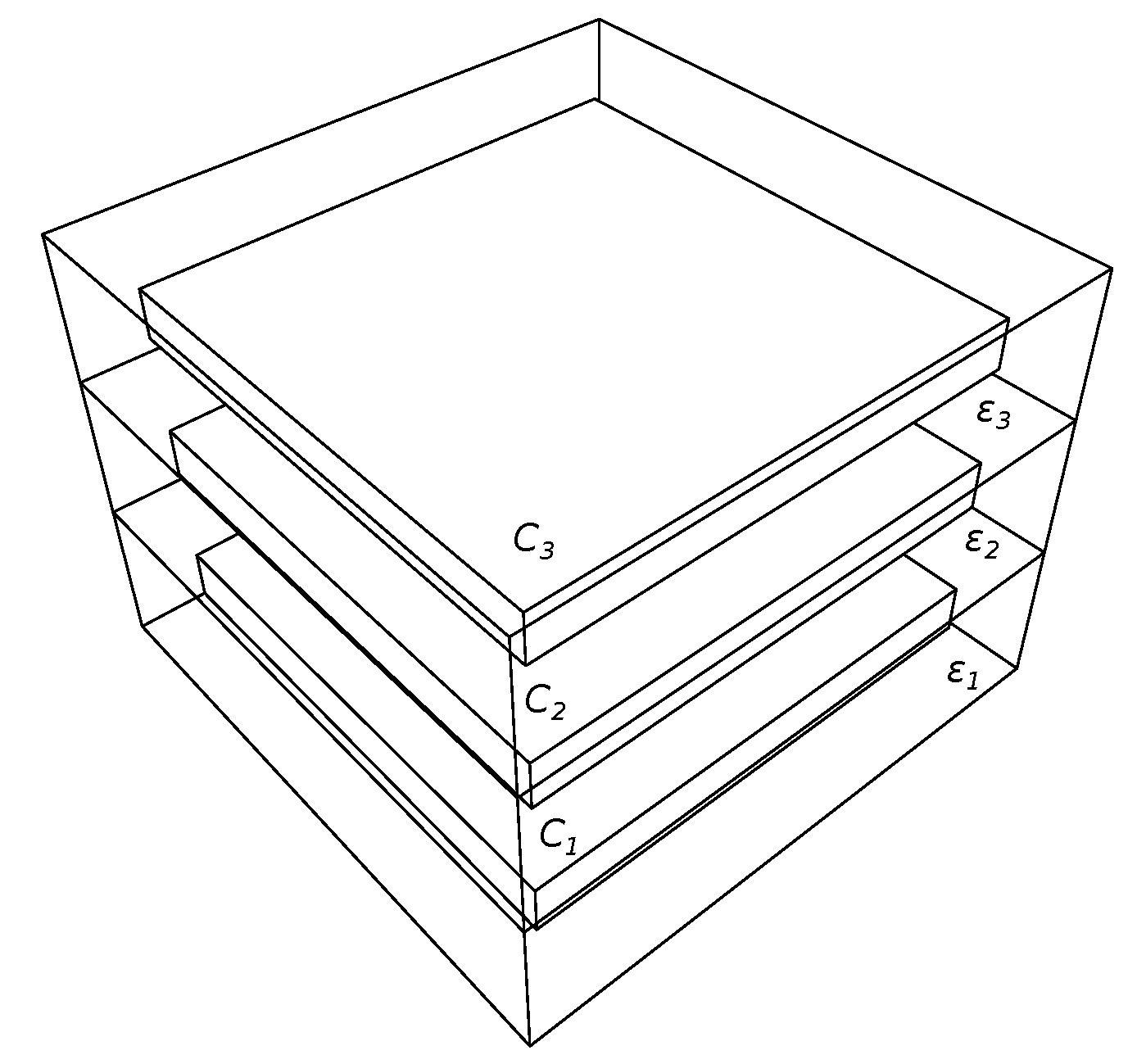
In Table 11 and Table 12, the results of mutual capacitance estimation using FC2 (correspondent sphere discretization was made using the spheregen tool from [21] with 10 and 15 panels per side) and Walk on Hemispheres for three conductive rectangular parallelepipeds in parallelepipedic dielectrics (Figure 12) are presented.
| Conductor size: | ; |
| Dielectric size: | ; |
| origin: | ; |
| origin: | ; |
| : | 2; |
| origin: | ; |
| origin: | ; |
| : | 4; |
| origin: | ; |
| origin: | ; |
| : | 3; |
| Shell offset: | ; |
| : | ; |
| “External” sphere radius: | ; |
| : | . |
Table 11.
Mutual capacitance of rectangular parallelepipeds in dielectric shells, .
Table 12.
Mutual capacitance of rectangular parallelepipeds in dielectric shells. Time and memory usage.
Figure 12.
Rectangular parallelepipeds in dielectric shells.
As before, we can compare the RWHC results with the FC2 estimation. In Table 11, the results are not matched between FC2 and RWHC with trajectories when , . Because WoH results are matched for and trajectories and FC2 results with 15 panels per side are closer to our estimation than results with 10 panels per side, we could assume that this discrepancy is related to an FC2 estimation error, as in example Section 4.3.
4.7. Mutual Capacitance of “Woven Bus”
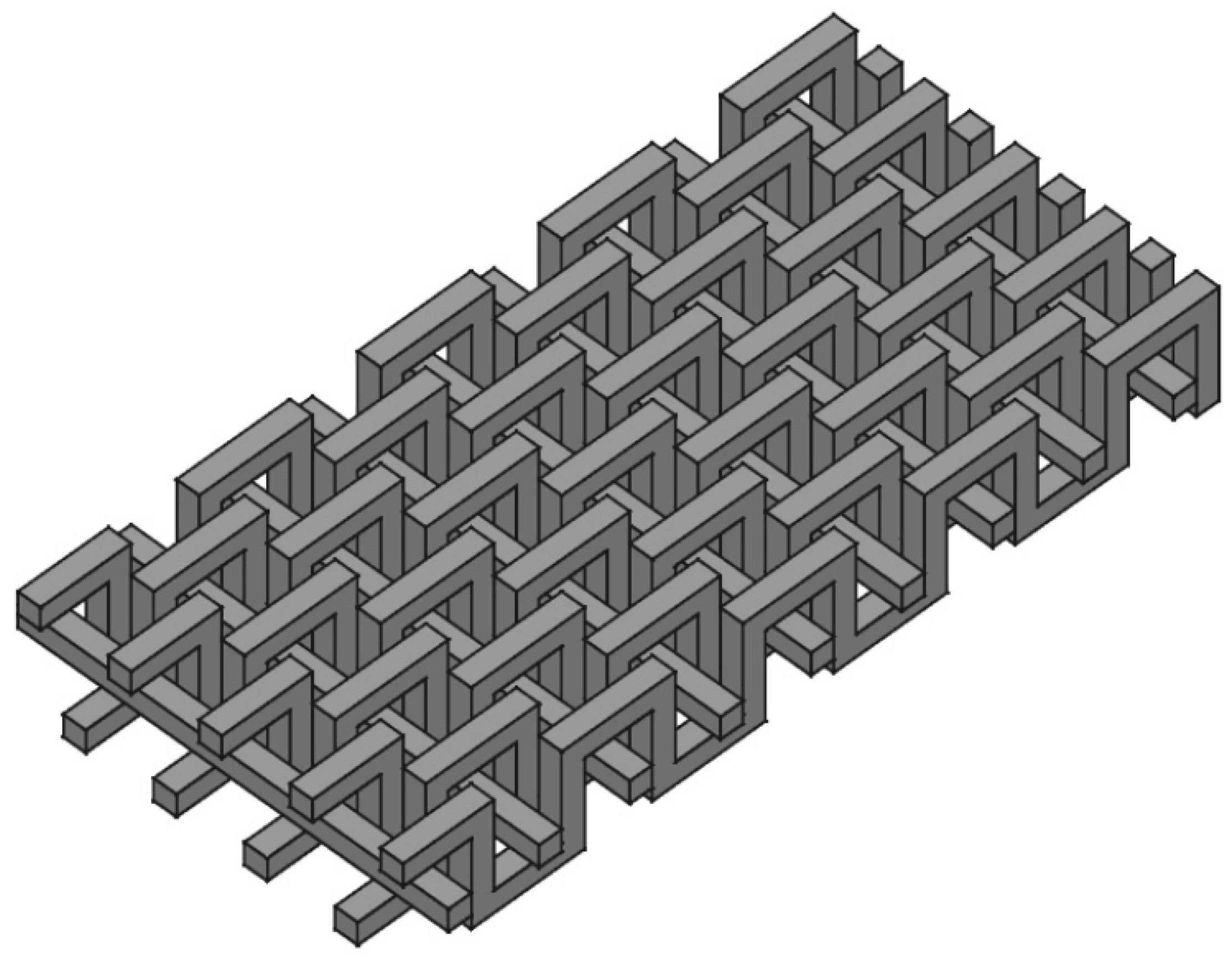
In Table 13 and Table 14, the results of mutual capacitance estimation using FFTCap [18] (correspondent discretization was made using wovengen tool from [21] with 10 panels per side) and Walk on Hemispheres for woven bus [7] (Figure 13) are presented.
| Width: | 1; |
| Segment length: | 8; |
| Distance between wovens: | 1; |
| Shell offset: | ; |
| : | ; |
| : | . |
Table 13.
Mutual capacitance of “woven bus”, .
Table 14.
Mutual capacitance of “woven bus”. Time and memory usage.
Figure 13.
woven bus.
The results in Table 13 match. The difference with FFTCap results also could be evaluated by norm: let A—FFTCap result matrix, B—WoH result matrix for trajectories from each conductor, then .
5. Conclusions
We developed some new numerical algorithms for extracting capacitances. These algorithms do not use the approximation of the Laplace operator by its difference counterpart. Their computational error is determined by the sum of the statistical error and the value of the estimator bias. The statistical error is determined in the course of calculations. The systematic error of the estimator is equal to the error when we approximate the potential at points lying near the boundary of the conductor by values at the boundary. This error is controlled by the parameter .
The Random Walk on Spheres algorithm is universal in the case of a homogeneous dielectric. It works for conductors with any geometry.
The Random Walk on Hemispheres is applied when dielectric interfaces are polyhedral. In cases when surfaces of the conductors are also polyhedral, the algorithm gives unbiased statistical estimators of the capacitances. The accuracy of this algorithm is equal to the statistical error of the estimators, which is easily determined in the course of calculations.
The Modified Random Walk on Hemispheres algorithm works for convex dielectric interfaces.
Computational experiments show that the algorithms are effective. For systems where capacitances are calculated analytically [3], it is shown that the accuracy of the Monte Carlo approximation is within the statistical error (see Table 1, Table 2 and Table 3). In more complex examples, to prove that the Monte Carlo estimation results are correct, we have matched them with the results of the calculation of the capacitances using the non-Monte Carlo methods implemented in the FastCap2 and FFTCap programs [18] (see Table 5, Table 7, Table 9, Table 11 and Table 13). The algorithm also works correctly in cases when the ratio of the permittivities is 100 or more (see Table 3).
Monte Carlo simulation times for different cases were presented with numerical results, but these are not final and could be improved upon, even with the same configuration of PC, by using another implementation of the pseudo random number generator, for example, or using a function for calculating distance that is optimized for a particular task. For example, by using another implementation of pseudo random number generator, or using function for calculating distance, that is optimized for particular task.

Author Contributions
Investigation, A.K., A.S. All authors contributed equally to this work. All authors have read and agreed to the published version of the manuscript.
Funding
The research was funded by Russian Science Foundation grant 19-11-00020.
Institutional Review Board Statement
Not applicable.
Informed Consent Statement
Not applicable.
Data Availability Statement
Data sharing is not applicable to this article.
Conflicts of Interest
The authors declare no conflict of interest.
References
- Kamon, M.; McCormick, S.; Shepard, K. Interconnect parasitic extraction in the digital IC design methodology. In Proceedings of the 1999 IEEE/ACM International Conference on Computer-Aided Design. Digest of Technical Papers (Cat. No.99CH37051), San Jose, CA, USA, 7–11 November 1999; pp. 223–230. [Google Scholar] [CrossRef]
- Bezrukov, A.; Rusakov, A.; Tkachev, D.; Khapaev, M. Methods of the parasitic extraction of interconnect in the integral circuits. In Problems of Perspective Microelectronic Systems Development; Stempkovsky, A., Ed.; Institute for Design Problems in Microelectronics of Russian Academy of Sciences (IPPM RAS): Moscow, Russia, 2005; pp. 45–50. (In Russian) [Google Scholar]
- Smythe, W. Static and Dynamic Electricity, 2nd ed.; McGraw-Hill: New York, NY, USA; Toronto, ON, Canada; London, UK, 1950. [Google Scholar]
- Yu, W.; Song, M.; Yang, M. Advancements and Challenges on Parasitic Extraction for Advanced Process Technologies. In Proceedings of the 2021 26th Asia and South Pacific Design Automation Conference (ASP-DAC), Tokyo, Japan, 18–21 January 2021; pp. 841–846. [Google Scholar]
- Nabors, K.; Kim, S.; White, J. Fast capacitance extraction of general three-dimensional structures. IEEE Trans. Microw. Theory Tech. 1992, 40, 1496–1506. [Google Scholar] [CrossRef]
- Nabors, K.; White, J. Multipole-accelerated capacitance extraction algorithms for 3-D structures with multiple dielectrics. IEEE Trans. Circuits Syst. Fundam. Theory Appl. 1992, 39, 946–954. [Google Scholar] [CrossRef]
- Tausch, J.; White, J. Capacitance extraction of 3-D conductor systems in dielectric media with high-permittivity ratios. IEEE Trans. Microw. Theory Tech. 1999, 47, 18–26. [Google Scholar] [CrossRef]
- Iverson, R.B.; Le Coz, Y.L. A floating random-walk algorithm for extracting electrical capacitance. Math. Comput. Simul. 2001, 55, 59–66. [Google Scholar] [CrossRef]
- Simonov, N.A.; Mascagni, M. Random walk algorithms for estimating electrostatic properties of large molecules. In The International Conference on Computational Mathematics; Mikhailov, G.A., Il’in, V.P., Laevsky, Y.M., Eds.; ICM&MG Publisher: Novosibirsk, Russia, 2004; pp. 352–358. [Google Scholar]
- Kuznetsov, A.N.; Sipin, A.S. Universal Monte-Carlo algorithm for extracting electrical capacitancies. Mat. Model. 2009, 21, 41–52. (In Russian) [Google Scholar]
- Kuznetsov, A.N. Calculation of mutual capacitances for system of conductors in dielectric media using “walk on hemispheres”. Mat. Model. 2015, 27, 86–95. (In Russian) [Google Scholar]
- Yu, W.; Zhuang, H.; Zhang, C.; Hu, G.; Liu, Z. RWCap: A Floating Random Walk Solver for 3-D Capacitance Extraction of Very-Large-Scale Integration Interconnects. IEEE Trans.-Comput.-Aided Des. Integr. Circuits Syst. 2013, 32, 353–366. [Google Scholar] [CrossRef]
- Xu, Z.; Zhang, C.; Yu, W. Floating Random Walk-Based Capacitance Extraction for General Non-Manhattan Conductor Structures. IEEE Trans.-Comput.-Aided Des. Integr. Circuits Syst. 2017, 36, 120–133. [Google Scholar] [CrossRef]
- Yang, M.; Yu, W. Floating Random Walk Capacitance Solver Tackling Conformal Dielectric With On-the-Fly Sampling on Eight-Octant Transition Cubes. IEEE Trans.-Comput.-Aided Des. Integr. Circuits Syst. 2020, 39, 4935–4943. [Google Scholar] [CrossRef]
- Mascagni, M.; Simonov, N.A. Random walk on the boundary methods for computing reaction rate and capacitance. In The International Conference on Computational Mathematics; Mikhailov, G., Il’in, V., Laevsky, Y., Eds.; ICM&MG Publisher: Novosibirsk, Russia, 2002; pp. 238–242. [Google Scholar]
- Bernal, F.; Acebrón, J.A.; Anjam, I. A Stochastic Algorithm Based on Fast Marching for Automatic Capacitance Extraction in Non-Manhattan Geometries. SIAM J. Imaging Sci. 2014, 7, 2657–2674. [Google Scholar] [CrossRef][Green Version]
- Phillips, J.R.; White, J.K. A precorrected-FFT method for electrostatic analysis of complicated 3-D structures. IEEE Trans.-Comput.-Aided Des. Integr. Circuits Syst. 1997, 16, 1059–1072. [Google Scholar] [CrossRef]
- Computer Codes Produced and Supported by the RLE Computational Prototyping Group. Available online: https://www.rle.mit.edu/cpg/research_codes.htm (accessed on 3 January 2011).
- Ermakov, S.M.; Nekrutkin, V.V.; Sipin, A.S. Random Processes for Classical Equations of Mathematical Physics; Kluwer Academic Publishers: Dordrecht, The Netherlands; Boston, MA, USA; London, UK, 1989. [Google Scholar] [CrossRef]
- Ermakov, S.M.; Sipin, A.S. The “walk in hemispheres” process and its applications to solving boundary value problems. Vestn. St. Petersburg Univ. Math. 2009, 42, 155–163. [Google Scholar] [CrossRef]
- Fast Field Solvers FastCap2. Available online: https://www.fastfieldsolvers.com/fastcap2.htm (accessed on 26 July 2021).
Publisher’s Note: MDPI stays neutral with regard to jurisdictional claims in published maps and institutional affiliations. |
© 2021 by the authors. Licensee MDPI, Basel, Switzerland. This article is an open access article distributed under the terms and conditions of the Creative Commons Attribution (CC BY) license (https://creativecommons.org/licenses/by/4.0/).