The Comprehensive Identification of Roof Risk in a Fully Mechanized Working Face Using the Cloud Model




Abstract
1. Introduction
2. Risk Evaluation Index System of Roof Accidents
3. Determining Each Risk Index Weight of Roof Accidents
3.1. Establishment of Judgment Matrices Groups and Calculation of Index Weight
| A | B1 | B2 | B3 | B4 |
| B1 | 1 | 1/3 | 2 | 1/2 |
| B2 | 3 | 1 | 4 | 2 |
| B3 | 1/2 | 1/4 | 1 | 1/4 |
| B4 | 2 | 1/2 | 4 | 1 |
| B1 | C1 | C2 | C3 | C4 |
| C1 | 1 | 1/4 | 1/5 | 1/2 |
| C2 | 4 | 1 | 1/2 | 3 |
| C3 | 5 | 2 | 1 | 4 |
| C4 | 2 | 1/3 | 1/4 | 1 |
| B2 | C5 | C6 | C7 | C8 | C9 | C10 |
| C5 | 1 | 1/2 | 3 | 1/6 | 1/4 | 1/5 |
| C6 | 2 | 1 | 3 | 1/5 | 1/3 | 1/4 |
| C7 | 1/3 | 1/3 | 1 | 1/7 | 1/5 | 1/6 |
| C8 | 6 | 5 | 7 | 1 | 3 | 2 |
| C9 | 4 | 3 | 5 | 1/3 | 1 | 1/3 |
| C10 | 5 | 4 | 6 | 1/2 | 3 | 1 |
| B3 | C11 | C12 | C13 | C14 |
| C11 | 1 | 4 | 1/2 | 2 |
| C12 | 1/4 | 1 | 1/5 | 1/3 |
| C13 | 2 | 5 | 1 | 4 |
| C14 | 1/2 | 3 | 1/4 | 1 |
| B4 | C15 | C16 | C17 |
| C15 | 1 | 3 | 2 |
| C16 | 1/3 | 1 | 1/3 |
| C17 | 1/2 | 3 | 1 |
3.2. Calculation of Total Weight of Each Risk Index
4. Standard Cloud Model of Roof Risk Assessment
4.1. Cloud Model
4.2. Establishment of Comprehensive Standard Cloud Model
4.3. Identification Criteria of Roof Risk Grade
5. Risk Identification of Roof Accidents—Case Study
5.1. Engineering Background
5.2. Calculating the Digital Features of Each Roof Risk Index
5.3. Generating Comprehensive Risk Evaluation Cloud Images
6. Conclusions
- (1)
- A comprehensive risk assessment model of roof accidents, including 4 indexes in the criterion level and a total of 17 causing factors, was constructed in a quantitative identification roof risk grade. Additionally, the main causing factors of roof accidents were roof separation distances, weighting intensity and rib spalling followed by the stress concentration of coal body, initial support force and geological conditions through the values of index weight determined by using the analytic hierarchy process.
- (2)
- Based on the comprehensive risk assessment cloud images, the overall risk grade in 42,115 intelligent fully mechanized working faces was regarded as Grade II (general risk). Additionally, the support conditions, personnel working status and coal body status had limited effect on the occurrence of roof accidents, while there was a large risk (Grade III) for roof conditions in the potential occurrence of roof accidents.
- (3)
- Compared with the AHP evaluation results, we showed that the risk assessment cloud model proposed in this study could identify the risk grade of each index and output comprehensive results by considering various aspects, such as cloud digital features, risk assessment cloud images and standard cloud images. It was effective in solving the problems of the ambiguity and difficulty of quantitative identification of traditional risk assessment methods, and it is worth promoting.
Author Contributions
Funding
Institutional Review Board Statement
Informed Consent Statement
Data Availability Statement
Conflicts of Interest
References
- Cheng, J.; Wan, Z.; Ji, Y.; Zhang, R.R. Shield-Roof Interaction in Longwall Panels: Insights from Field Data and Their Application to Ground Control. Adv. Civ. Eng. 2018, 2018, 3031714. [Google Scholar] [CrossRef]
- Kong, D.; Xiong, Y.; Cheng, Z.; Wang, N.; Wu, G.; Liu, Y. Stability analysis of coal face based on coal face-support-roof system in steeply inclined coal seam. Geomech. Eng. 2021, 25, 233–243. [Google Scholar]
- Liu, Y.; Wang, X. Accident Analysis and Prevention Measure of Dynamic Load Mine Pressure of the 31201 Fully Mechanized Working Face of Shigetai Coal Mine. In Proceedings of the 2015 International Conference on Energy, Materials and Manufacturing Engineering (EMME 2015), Kuala Lumpur, Malaysia, 15–16 October 2015; Volume 25, p. 03001. [Google Scholar] [CrossRef]
- Cheng, Z.; Li, L.; Zhang, Y. Laboratory investigation of the mechanical properties of coal-rock combined body. Bull. Eng. Geol. Environ. 2020, 79, 1947–1958. [Google Scholar] [CrossRef]
- Cheng, Z.; Yang, S.; Li, L.; Zhang, L. Support working resistance determined on top-coal caving face based on coal-rock combined body. Geomech. Eng. 2019, 19, 255–268. [Google Scholar] [CrossRef]
- Lv, H.; Tang, Y.; Zhang, L.; Cheng, Z.; Zhang, Y. Analysis for mechanical characteristics and failure models of coal specimens with non-penetrating single crack. Geomech. Eng. 2019, 17, 355–365. [Google Scholar] [CrossRef]
- Cheng, Z.; Pan, W.; Li, X.; Sun, W. Numerical simulation on strata behaviours of TCCWF influenced by coal-rock combined body. Geomech. Eng. 2019, 19, 269–282. [Google Scholar] [CrossRef]
- Yasidu, U.M.; Fujii, Y.; Kodama, J.; Fukuda, D.; Maneya, G.J.; Dandadzi, J.; Dassanayake, A.B.N.; Zhang, R.R. Influences of Water Vapor on Roof Fall Accidents in Selected Underground Coal Mines in Malawi. Adv. Civ. Eng. 2019, 2019, 5350686. [Google Scholar] [CrossRef]
- Xiong, Y.; Kong, D.; Wu, G.; Li, Q. Study on the Support Capacity Determination and Movement Law of Overlying Strata in a Thin-Bedrock Large-Cutting-Height Longwall Panel. Geotech. Geol. Eng. 2021, 39, 2347–2358. [Google Scholar] [CrossRef]
- Lou, J.; Gao, F.; Yang, J.; Ren, Y.; Li, J.; Wang, X.; Yang, L. Characteristics of evolution of mining-induced stress field in the longwall panel: Insights from physical modeling. Int. J. Coal Sci. Technol. 2021, 24. [Google Scholar] [CrossRef]
- Kong, D.; Cheng, Z.; Zheng, S. Study on the failure mechanism and stability control measures in a large-cutting-height coal mining face with a deep-buried seam. Bull. Eng. Geol. Environ. 2019, 78, 6143–6157. [Google Scholar] [CrossRef]
- Lv, H.; Cheng, Z.; Liu, F. Study on the mechanism of a new fully mechanical mining method for extremely thick coal seam. Int. J. Rock Mech. Min. Sci. 2021, 142, 104788. [Google Scholar] [CrossRef]
- Kong, D.; Pu, S.; Cheng, Z.; Wu, G.; Liu, Y. Coordinated Deformation Mechanism of the Top Coal and Filling Body of Gob-Side Entry Retaining in a Fully Mechanized Caving Face. Int. J. Geomech. 2021, 21, 04021030. [Google Scholar] [CrossRef]
- Hassani, M.; Behnam, B.; Maknoon, R. A risk-based framework for design of concrete structures against earthquake. Comput. Concr. 2020, 25, 167–179. [Google Scholar] [CrossRef]
- Li, W.; Ye, Y.; Wang, Q.; Wang, X.; Hu, N. Fuzzy risk prediction of roof fall and rib spalling: Based on FFTA–DFCE and risk matrix methods. Environ. Sci. Pollut. Res. 2020, 27, 8535–8547. [Google Scholar] [CrossRef]
- Cai, W.; Dou, L.; Zhang, M.; Cao, W.; Shi, J.; Feng, L. A fuzzy comprehensive evaluation methodology for rock burst forecasting using microseismic monitoring. Tunn. Undergr. Space Technol. 2018, 80, 232–245. [Google Scholar] [CrossRef]
- Pramanik, R.; Baidya, D.K.; Dhang, N. Implementation of fuzzy reliability analysis for elastic settlement of strip footing on sand considering spatial variability. Int. J. Geomech. 2019, 19, 04019126. [Google Scholar] [CrossRef]
- Zhao, S.; Zhang, D.; Huang, H. Deep learning–based image instance segmentation for moisture marks of shield tunnel lining. Tunn. Undergr. Space Technol. 2020, 95, 103156. [Google Scholar] [CrossRef]
- Mottahedi, A.; Ataei, M. Fuzzy fault tree analysis for coal burst occurrence probability in underground coal mining. Tunn. Undergr. Space Technol. 2019, 83, 165–174. [Google Scholar] [CrossRef]
- Duzgun, H.S.B.; Einstein, H.H. Assessment and management of roof fall risks in underground coal mines. Saf. Sci. 2004, 42, 23–41. [Google Scholar] [CrossRef]
- Jiang, W.; Qu, F.; Zhang, L. Quantitative Identification and Analysis on Hazard Sources of Roof Fall Accident in Coal Mine. Procedia Eng. 2012, 45, 83–88. [Google Scholar] [CrossRef]
- Ala, C.K.; Tripathy, D.P. Qualitative Assessment of Strata Control in an Indian Underground Coal Mine. J. Inst. Eng. 2016, 97, 99–104. [Google Scholar] [CrossRef]
- Tripathy, D.P.; Ala, C.K. Risk Assessment in Underground Coalmines Using Fuzzy Logic in the Presence of Uncertainty. J. Inst. Eng. 2018, 99, 157–163. [Google Scholar] [CrossRef]
- Tripathy, D.P.; Ala, C.K. Identification of safety hazards in Indian underground coal mines. J. Sustain. Min. 2018, 17, 175–183. [Google Scholar] [CrossRef]
- Xie, J.; Xu, J.; Zhu, W. Gray algebraic curve model-based roof separation prediction method for the warning of roof fall accidents. Arab. J. Geosci. 2016, 9, 514. [Google Scholar] [CrossRef]
- Martin, B.; Bruce, H.; Rudrajit, M. Coal mine roof rating (CMRR), rock mass rating (RMR) and strata control: Carborough Downs Mine, Bowen Basin, Australia. Int. J. Min. Sci. Technol. 2020, 30, 225–234. [Google Scholar] [CrossRef]
- Bai, C.; Xue, Y.; Qiu, D.; Yang, W.; Su, M.; Ma, X. Real-Time Updated Risk Assessment Model for the Large Deformation of the Soft Rock Tunnel. Int. J. Geomech. 2021, 21, 04020234. [Google Scholar] [CrossRef]
- Tong, R.; Zhang, Y.; Yang, Y.; Jia, Q.; Ma, X.; Shao, G. Evaluating Targeted Intervention on Coal Miners’ Unsafe Behavior. Int. J. Environ. Res. Public Health 2019, 16, 422. [Google Scholar] [CrossRef]
- Yu, K.; Cao, Q.; Xie, C.; Qu, N.; Zhou, L. Analysis of intervention strategies for coal miners’ unsafe behaviors based on analytic network process and system dynamics. Saf. Sci. 2019, 118, 145–157. [Google Scholar] [CrossRef]
- Sajjad, A.; Gholamreza, S.; Hossein, J. Risk analysis of roof fall and prediction of damaged regions at retreat longwall coal mining face. Rudarsko-Geološko-Naftni Zbornik 2020, 35, 85–95. [Google Scholar] [CrossRef]
- Li, D.; Fan, D.; Dong, C. Ecological Environment Evaluation of Coal Mining Area Based on Cloud Model. Adv. Mater. Res. 2012, 1566, 1372–1376. [Google Scholar] [CrossRef]
- Liang, X.; Liang, W.; Zhang, L.; Guo, X. Risk assessment for long-distance gas pipelines in coal mine gobs based on structure entropy weight method and multi-step backward cloud transformation algorithm based on sampling with replacement. J. Clean. Prod. 2019, 227, 218–228. [Google Scholar] [CrossRef]
- Yan, F.; Li, Z.; Dong, L.; Huang, R.; Cao, R. Cloud model-clustering analysis based evaluation for ventilation system of underground metal mine in alpine region. J. Cent. South Univ. 2021, 28, 796–815. [Google Scholar] [CrossRef]
- Liu, Z.; Shao, J.; Xu, W.; Xu, F. Comprehensive Stability Evaluation of Rock Slope Using the Cloud Model-Based Approach. Rock Mech. Rock Eng. 2014, 47, 2239–2252. [Google Scholar] [CrossRef]
- Gu, X.; Wu, S.; Ji, X.; Zhu, Y.; Oliveto, G. The Risk Assessment of Debris Flow Hazards in Banshanmen Gully Based on the Entropy Weight-Normal Cloud Method. Adv. Civ. Eng. 2021, 2021, 8841310. [Google Scholar] [CrossRef]
- Elkin, K.E.; Vasenin, I.M. Mathematical modeling of sedimentation of a rarefied cloud of particles. Russ. Phys. J. 1999, 42, 333–336. [Google Scholar] [CrossRef]
- Li, T.; Yang, X. Reliability analysis of tunnel face in broken soft rocks using improved response surface method. Int. J. Geomech. 2018, 18, 04018021. [Google Scholar] [CrossRef]
- Tan, F.; Wang, J.; Jiao, Y.; Ma, B.; He, L. Suitability evaluation of underground space based on finite interval cloud model and genetic algorithm combination weighting. Tunn. Undergr. Space Technol. 2021, 108, 103743. [Google Scholar] [CrossRef]
- Wang, J.; Liu, J.; Wei, Q.; Wang, P. Risk Assessment Based on Combined Weighting-Cloud Model of Tunnel Construction. Teh. Vjesn. 2021, 28, 203–210. [Google Scholar] [CrossRef]
- Xu, Q.; Xu, K.; Li, L.; Yao, X. Safety assessment of petrochemical enterprise using the cloud model, PHA–LOPA and the bow-tie model. R. Soc. Open Sci. 2018, 5, 180212. [Google Scholar] [CrossRef]
- Ju, F.; Huang, P.; Guo, S.; Xiao, M.; Lan, L. A roof model and its application in solid backfilling mining. Int. J. Min. Sci. Technol. 2017, 27, 139–143. [Google Scholar] [CrossRef]
- Wu, Z.; Qiu, S.; Li, Y. Numerical Simulation of Inclined Multi-Seam Mining Subsidence of Considered the Impact by Faults. Adv. Mater. Res. 2011, 1270, 2135–2140. [Google Scholar] [CrossRef]
- Tong, R.; Zhai, C.; Jia, Q.; Wu, C.; Liu, Y.; Xue, S. An Interactive Model among Potential Human Risk Factors: 331 Cases of Coal Mine Roof Accidents in China. Int. J. Environ. Res. Public Health 2018, 15, 1144. [Google Scholar] [CrossRef] [PubMed]
- Gao, P. Research on Unsafe Acts and Control Method of Coal Mine Roof Accidents in China. Ph.D. Thesis, China University of Mining & Technology, Beijing, China, 26 June 2016. [Google Scholar]
- Firdaus, A.; Dina, E.; Asep, K.; Raju, W.; Supratman, Z. Decision Support System in Detrmination of Project Tender Winner Using the Analytical Hierarchy Process (AHP) Method. J. Phys. Conf. Ser. 2021, 1779, 012006. [Google Scholar] [CrossRef]
- Xie, H.; Ma, J.; Fu, X.; Tian, Y. Regional Credit Environment Evaluation Based on Analytic Hierarchy Process (AHP) Method and Fuzzy Comprehensive Evaluation (FCE). J. Phys. Conf. Ser. 2021, 1813, 012060. [Google Scholar] [CrossRef]
- Zaelani, A.A.; Hidayatul, H.M.; Bisma, I.; Sri, W.; Heneng, P.S.; Perdana, W.A.; Ari, W. Analysis of Decision Support System with Analytical Hierarchy Process Method. J. Phys. Conf. Ser. 2021, 1783, 012017. [Google Scholar] [CrossRef]
- Praveenkumar, S.; Sankarasubramanian, G.; Sindhu, S. Selecting optimized mix proportion of bagasse ash blended high performance concrete using analytical hierarchy process (AHP). Comput. Concr. 2019, 23, 459–470. [Google Scholar] [CrossRef]
- Saaty, T. A scaling method for priorities in hierarchical structures. J. Math. Psychol. 1977, 15, 234–281. [Google Scholar] [CrossRef]
- Ishizaka, A.; Labib, A. Analytic Hierarchy Process and Expert Choice: Benefits and limitations. OR Insight 2009, 22, 201–220. [Google Scholar] [CrossRef]
- Li, D.; Liu, C.; Gan, W. A new cognitive model: Cloud model. Int. J. Intell. Syst. 2009, 24, 357–375. [Google Scholar] [CrossRef]
- Wu, S.; Wang, M.; Zou, Y. Bidirectional cognitive computing method supported by cloud technology. Cogn. Syst. Res. 2018, 52, 615–621. [Google Scholar] [CrossRef]



| Date | Coal Mine | Death Toll | Reason Description |
|---|---|---|---|
| 26 October 2019 | 13,619 mining working faces, Shiping No. 1 coal mine, Sichuan Province | 6 | Due to the influence of the geological structure, stress superposition and other factors, the hydraulic support was compressed during fault crossing. Thus, the broken rock above the supports flowed into the working faces from the front of the top beam under the action of water. |
| 4 May 2020 | 301 working faces, Luoshanjing coal mine, Guangxi Province | 2 | The coal seam at the open-off cut of the working faces was soft, and the support strength of the wooden frame was insufficient, which led to the collapse of the coal seam and roof. |
| 12 June 2020 | 84,202 working faces, Wuguantun coal mine, Shanxi Province | 1 | In the area of the supports 57#–58# close to the coal face, operators did not obey the relevant operator regulations, and, over time, the move supports resulted in the roof control distance exceeding the requirements of the operating regulations and further roof collapse. |
| 23 June 2020 | 1221 air-return roadway, Ping’an coal mine, Hebei Province | 1 | Operators did not implement a temporary support, and the lumber was removed by hand causing coal and rock to cave. |
| 19 August 2020 | 91,803 working faces, Xingyun coal mine, Yunnan Province | 1 | The roof collapsed due to the influence of geological structures (e.g., faults, a broken roof and stress concentration), and operators failed to reinforce the supports in time. |
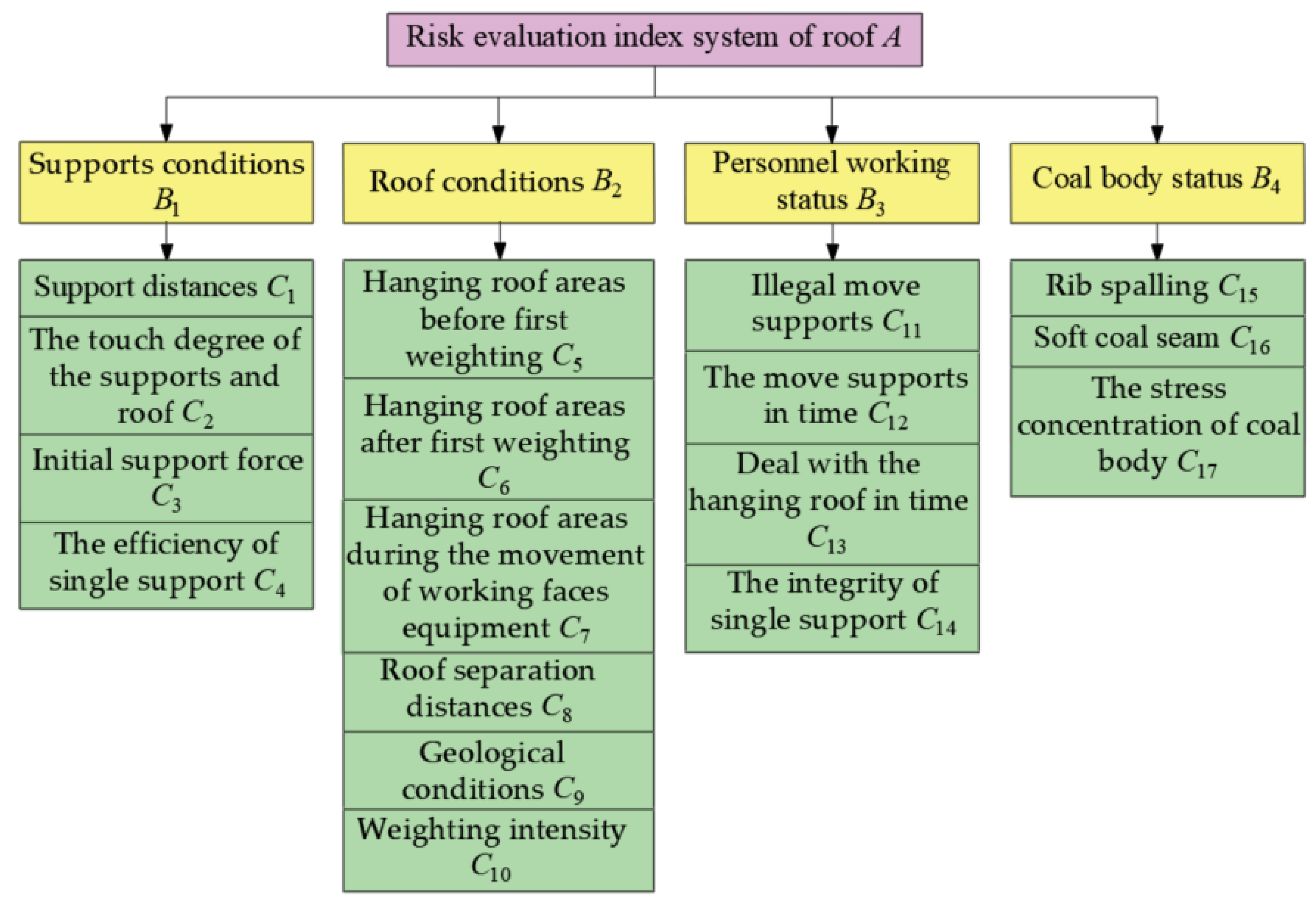
| Causing Factors | Risk Characterization |
|---|---|
| Support distances | If the hydraulic supports were overhauled, the support distances were too large, and the gangue slipped from the supports |
| The touch degree of the supports and roof | If roof and hydraulic supports were not tightly connected, the roof easily collapsed |
| Initial support force | If the initial support force was not up to the standard, the roof easily collapsed |
| The efficiency of single support | If the pillar of hydraulic supports was not intact and could not be effectively utilized, it easily caused roof collapse and hurt people |
| Hanging roof areas before first weighting | If the hanging areas of the main roof were too large before the first weighting, the roof collapsed suddenly, and it caused the occurrence of risk accidents |
| Hanging roof areas after first weighting | If the roof did not collapse in time after the first weighting, the main roof could not collapse in time along with the large hanging areas, causing the roof to collapse suddenly |
| Hanging roof areas during the movement of working faces equipment | During the movement of working faces equipment, the hanging roof areas were too large, causing the roof collapse easily |
| Roof separation distances | The large of roof separation distances caused the roof collapse |
| Geological conditions | If the coal mining processes needed to pass through the special geological structures, the roof was easily broken and collapsed to cause the occurrence of roof accidents |
| Weighting intensity | If the weighting intensity of overlying strata was high, the roof was easily broken and collapsed |
| Illegally moving supports | If someone illegally moved the supports, people were easily hurt |
| Moving supports in time | If the supports were not moved in time to reach the minimum control roof distances after coal cutting, it easily caused the gangue to slip and the roof to collapse |
| Dealing with the hanging roof in time | If the hanging roof areas between the side of the working faces and the side of the goaf exceeded the regulations, and the relevant measures were not taken in time, the roof easily collapsed |
| The integrity of single support | If the conditions of the pillars and the upper roof were not checked before the pillars were moved, the pillar caps could fall off, and the high-pressure liquids of hydraulic supports were ejected to cause the occurrence of roof collapse and people being hurt |
| Rib spalling | Rib spalling caused the roof to collapse easily in the side of the working faces |
| Soft coal seam | The soft coal seam caused the easy failure of coal body along with the roof collapse |
| The stress concentration of coal body | The stress concentration in the coal body was prone to causing the failure of the coal face and coal pillars and the roof collapse |
| Risk Evaluation Indexes | Evaluation Grade | |||
|---|---|---|---|---|
| I | II | III | IV | |
| Support distances (mm) | <200 | 200~400 | 400~600 | >600 |
| The touch degree of the supports and roof (%) | 85~100 | 70~85 | 55~70 | <55 |
| Initial support force (%) | 85~100 | 70~85 | 55~70 | <55 |
| The efficiency of single support (%) | 85~100 | 70~85 | 55~70 | <55 |
| Hanging roof areas before first weighting (m2) | <10 | 10~20 | 20~30 | >30 |
| Hanging roof areas after first weighting (m2) | <5 | 5~10 | 10~15 | >15 |
| Hanging roof areas during the movement of working faces equipment (m2) | <10 | 10~20 | 20~30 | >30 |
| Roof separation distances (cm) | <20 | 20~40 | 40~60 | >60 |
| Geological conditions (Quantity) | 0~5 | 5~10 | 10~15 | >15 |
| Weighting intensity (0~100 level) | <25 | 25~50 | 50~75 | >75 |
| Illegally moving supports (0~100 level) | <25 | 25~50 | 50~75 | >75 |
| Moving supports in time (0~100 level) | >75 | 50~75 | 25~50 | <25 |
| Dealing with the hanging roof in time (0~100 level) | >85 | 55~85 | 25~55 | <25 |
| The integrity of single support (0~100 level) | >80 | 50~80 | 20~50 | <20 |
| Rib spalling (%) | <15 | 15~30 | 30~45 | >45 |
| Soft coal seam (0~100 level) | <25 | 25~50 | 50~75 | >75 |
| The stress concentration of coal body (0~100 level) | <20 | 20~45 | 45~70 | >70 |
| Importance Grade | Assignment |
|---|---|
| Equally important | 1 |
| Slightly important | 3 |
| Obviously important | 5 |
| Strongly important | 7 |
| Extremely important | 9 |
| Criterion Level | Eigenvalue of Judgment Matrix | Eigenvector of Judgment Matrix | Vector of Index Weight | Consistency Index (CI) | Consistency Ratio (CR) | Consistency Test |
|---|---|---|---|---|---|---|
| Support conditions (B1) | 4.0484 | (0.077798, 0.30557, 0.49184, 0.12479) | 0.0778, 0.3056, 0.4918, 0.1248 | 0.017911 | 0.017911 | Pass |
| Roof conditions (B2) | 6.282 | (0.057375, 0.079261, 0.034083, 0.38458, 0.16279, 0.28191) | 0.0574, 0.0792, 0.0341, 0.3846, 0.1628, 0.2819 | 0.056404 | 0.045487 | Pass |
| Personnel working status (B3) | 4.0728 | (0.2753, 0.071639, 0.49783, 0.15524) | 0.2753, 0.0716, 0.4978, 0.1553 | 0.024281 | 0.026979 | Pass |
| Coal body status (B4) | 3.0536 | (0.52784, 0.13965, 0.33252) | 0.5278, 0.1397, 0.3325 | 0.026811 | 0.046225 | Pass |
| Cj | B1 | B2 | B3 | B4 | ωA(Cj) |
|---|---|---|---|---|---|
| 0.1564 | 0.4621 | 0.0877 | 0.2938 | ||
| C1 | 0.0778 | 0 | 0 | 0 | 0.0122 |
| C2 | 0.3056 | 0 | 0 | 0 | 0.0478 |
| C3 | 0.4918 | 0 | 0 | 0 | 0.0769 |
| C4 | 0.1248 | 0 | 0 | 0 | 0.0195 |
| C5 | 0 | 0.0574 | 0 | 0 | 0.0265 |
| C6 | 0 | 0.0792 | 0 | 0 | 0.0366 |
| C7 | 0 | 0.0341 | 0 | 0 | 0.0158 |
| C8 | 0 | 0.3846 | 0 | 0 | 0.1777 |
| C9 | 0 | 0.1628 | 0 | 0 | 0.0752 |
| C10 | 0 | 0.2819 | 0 | 0 | 0.1303 |
| C11 | 0 | 0 | 0.2753 | 0 | 0.0241 |
| C12 | 0 | 0 | 0.0716 | 0 | 0.0063 |
| C13 | 0 | 0 | 0.4978 | 0 | 0.0437 |
| C14 | 0 | 0 | 0.1553 | 0 | 0.0136 |
| C15 | 0 | 0 | 0 | 0.5278 | 0.1551 |
| C16 | 0 | 0 | 0 | 0.1397 | 0.0411 |
| C17 | 0 | 0 | 0 | 0.3325 | 0.0977 |
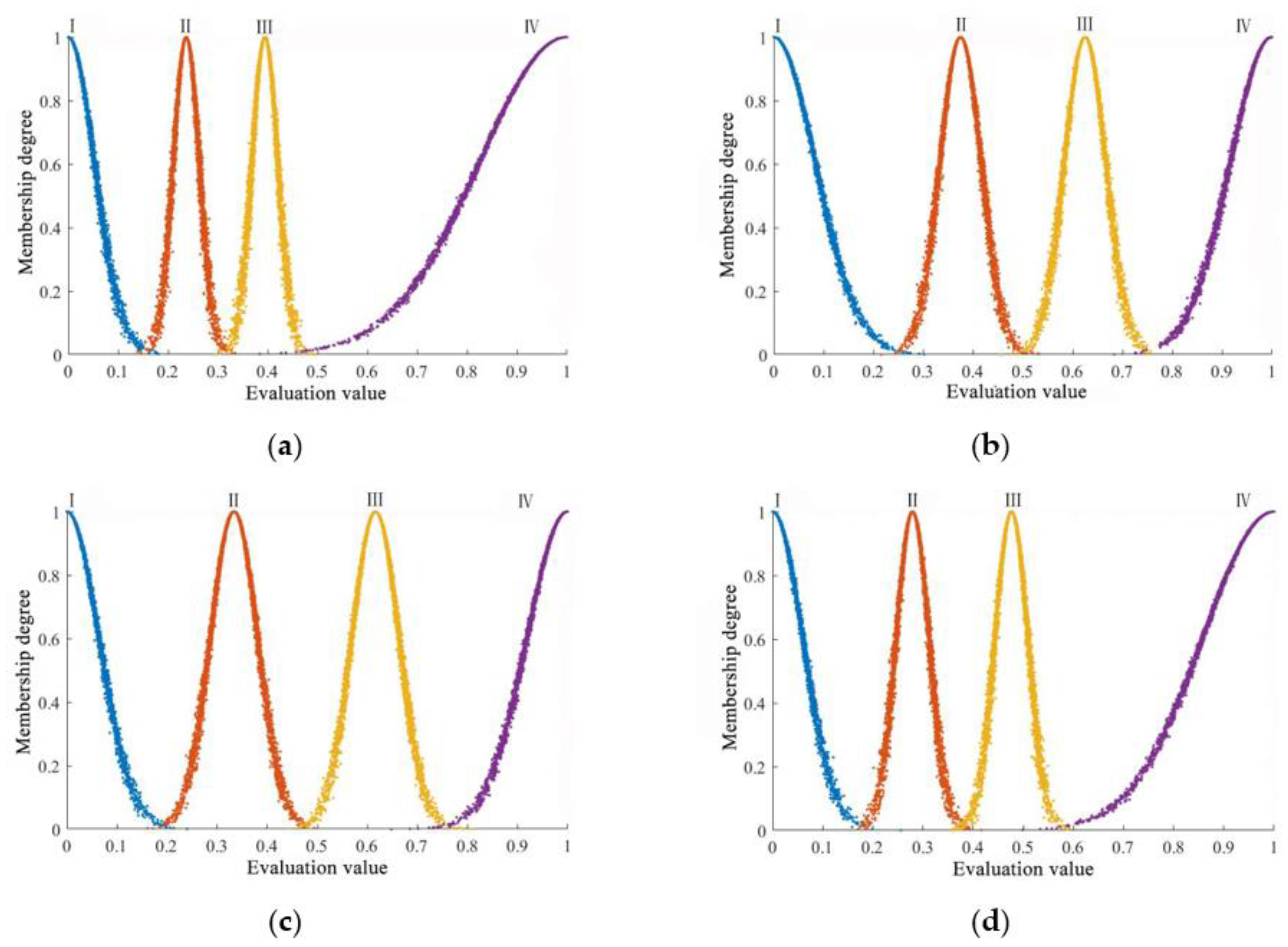
| Indexes of Criterion Level | Risk Evaluation Grade | |||
|---|---|---|---|---|
| I | II | III | IV | |
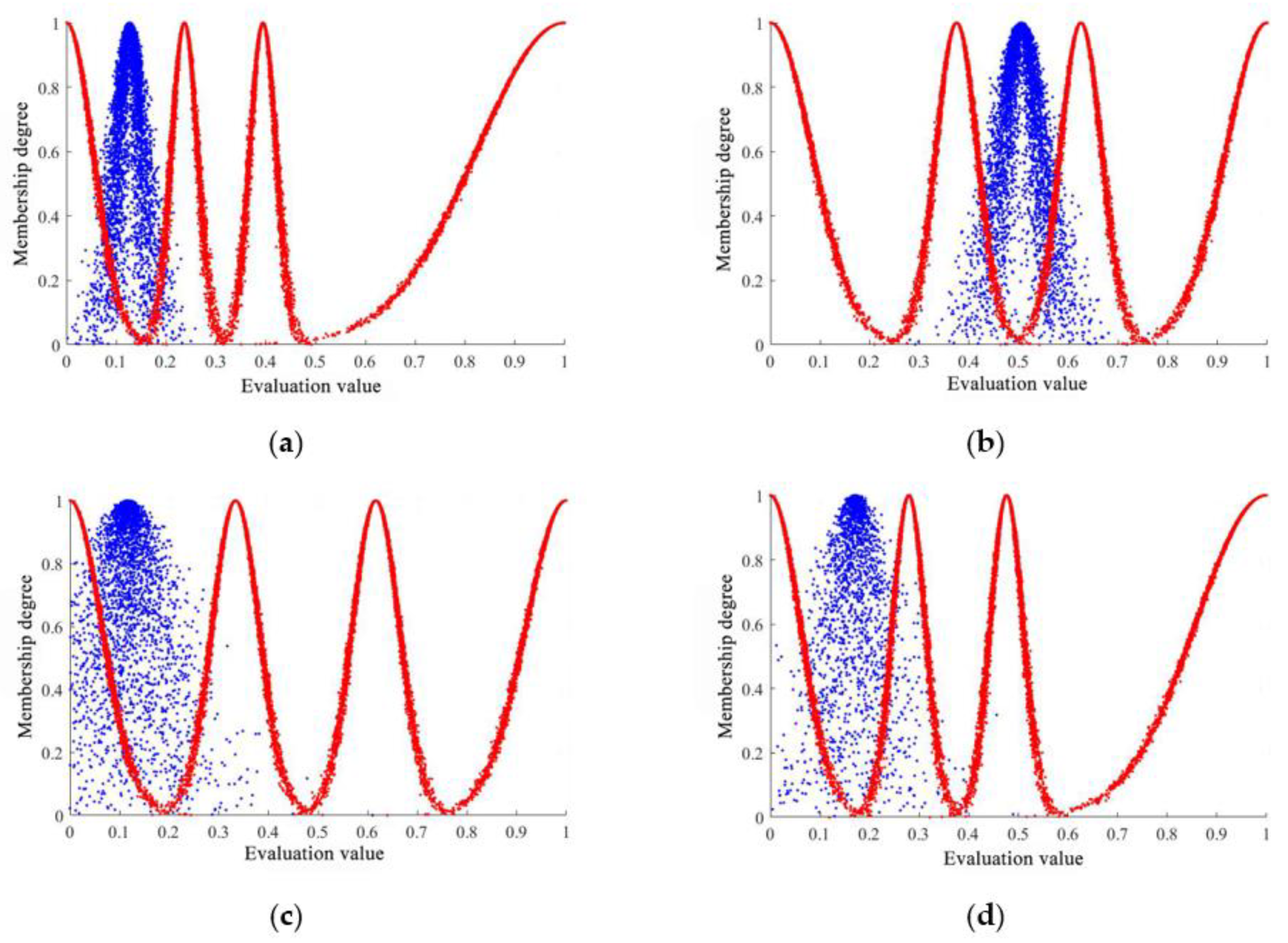
| B1 | (0, 0.0526, 0.05) | (0.2367, 0.0263, 0.05) | (0.3944, 0.0263, 0.05) | (1, 0.1755, 0.05) |
| B2 | (0, 0.0833, 0.05) | (0.375, 0.0417, 0.05) | (0.625, 0.0417, 0.05) | (1, 0.0833, 0.05) |
| B3 | (0, 0.0641, 0.05) | (0.3338, 0.0471, 0.05) | (0.6164, 0.0471, 0.05) | (1, 0.0807, 0.05) |
| B4 | (0, 0.0602, 0.05) | (0.2792, 0.0329, 0.05) | (0.4764, 0.0329, 0.05) | (1, 0.1416, 0.05) |
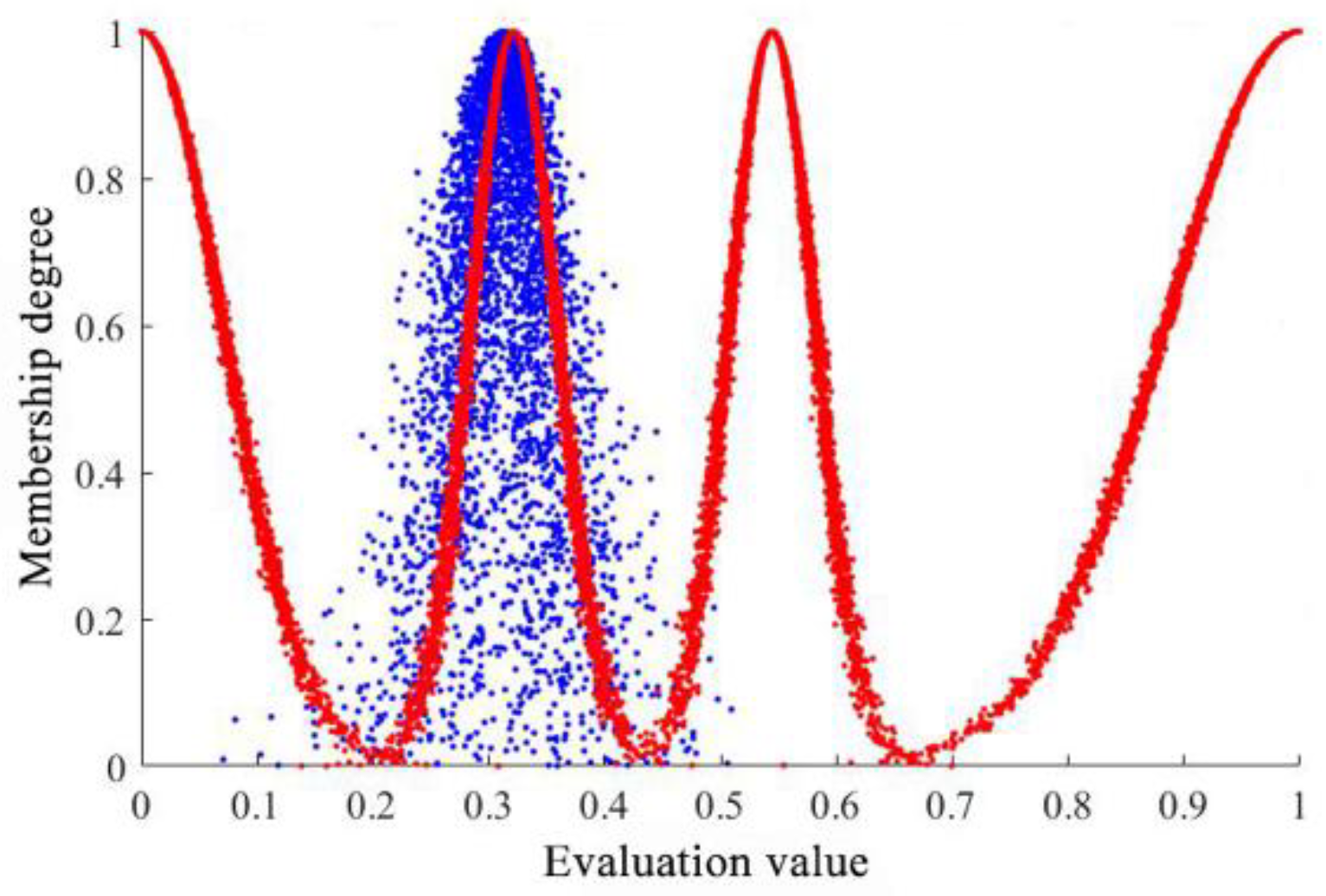
| Evaluation Grade | Digital Features |
|---|---|
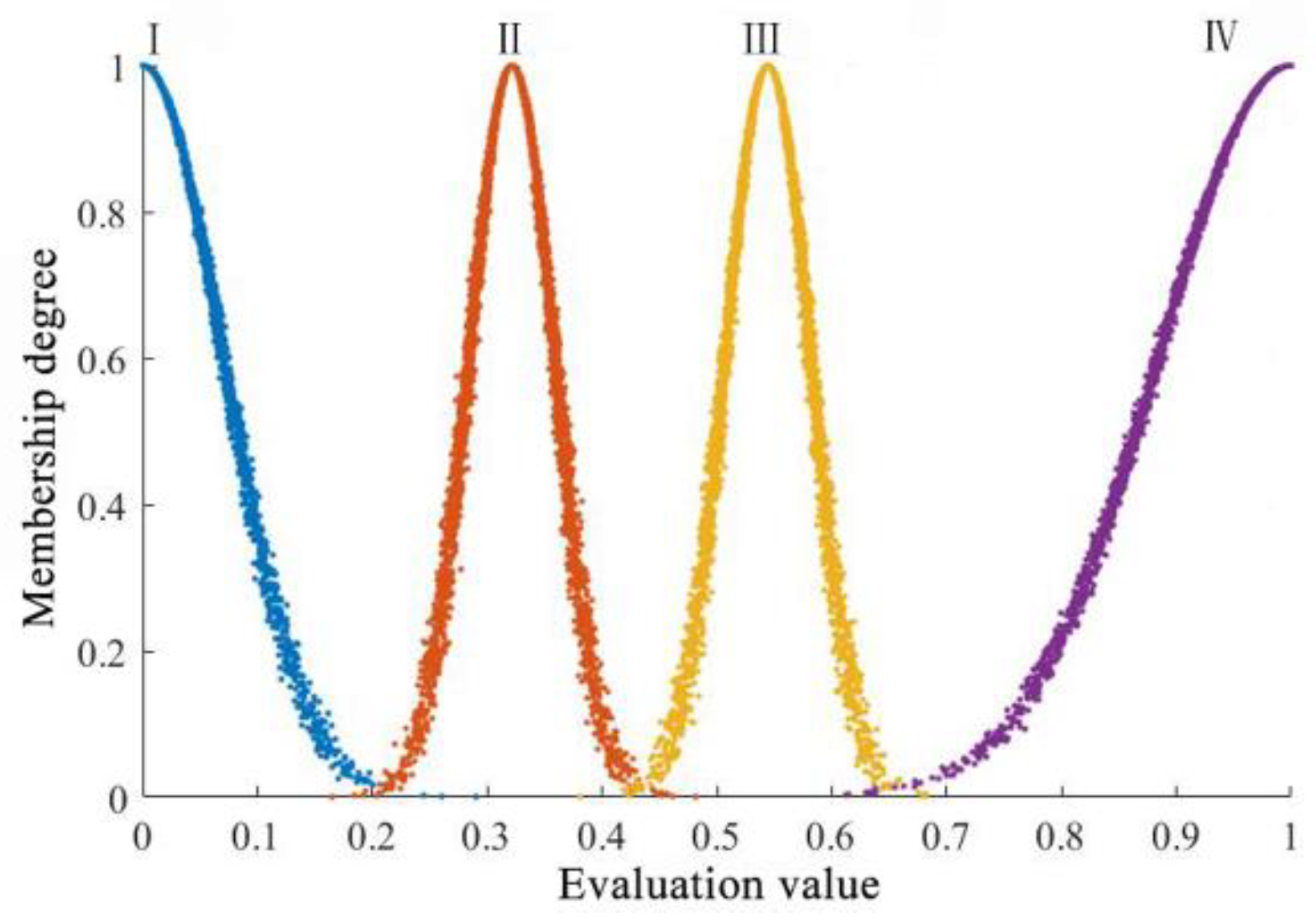
| I | (0, 0.07, 0.05) |
| II | (0.3216, 0.0372, 0.05) |
| III | (0.5445, 0.0372, 0.05) |
| IV | (1, 0.1147, 0.05) |
| Risk Evaluation Indexes | The 42,115 Fully Mechanized Working Faces | |
|---|---|---|
| Maximum Value | Minimum Value | |
| C1 | 100 | 5 |
| C2 | 95 | 80 |
| C3 | 95 | 80 |
| C4 | 90 | 75 |
| C5 | 40 | 30 |
| C6 | 18 | 10 |
| C7 | 25 | 15 |
| C8 | 25 | 10 |
| C9 | 15 | 8 |
| C10 | 80 | 65 |
| C11 | 15 | 5 |
| C12 | 95 | 80 |
| C13 | 95 | 85 |
| C14 | 85 | 75 |
| C15 | 15 | 5 |
| C16 | 10 | 5 |
| C17 | 40 | 25 |
| Risk Evaluation Indexes | Dimensionless Process | Ex | En | He | |
|---|---|---|---|---|---|
| Maximum Value | Minimum Value | ||||
| C1 | 0.125 | 0.00625 | 0.0656 | 0.0198 | 0.05 |
| C2 | 0.2 | 0.05 | 0.125 | 0.025 | 0.1 |
| C3 | 0.2 | 0.05 | 0.125 | 0.025 | 0.1 |
| C4 | 0.25 | 0.1 | 0.175 | 0.025 | 0.2 |
| C5 | 1 | 0.75 | 0.875 | 0.0416 | 0.1 |
| C6 | 0.9 | 0.5 | 0.7 | 0.0667 | 0.1 |
| C7 | 0.625 | 0.375 | 0.5 | 0.0417 | 0.1 |
| C8 | 0.3125 | 0.125 | 0.219 | 0.0312 | 0.05 |
| C9 | 0.75 | 0.4 | 0.575 | 0.0583 | 0.05 |
| C10 | 0.8 | 0.65 | 0.725 | 0.025 | 0.3 |
| C11 | 0.15 | 0.05 | 0.1 | 0.0167 | 0.32 |
| C12 | 0.2 | 0.05 | 0.125 | 0.025 | 0.2 |
| C13 | 0.15 | 0.05 | 0.1 | 0.0167 | 0.2 |
| C14 | 0.25 | 0.15 | 0.2 | 0.0167 | 0.2 |
| C15 | 0.15 | 0.05 | 0.1 | 0.0167 | 0.15 |
| C16 | 0.1 | 0.05 | 0.075 | 0.0083 | 0.3 |
| C17 | 0.4 | 0.25 | 0.325 | 0.025 | 0.25 |
| First-Level Indexes | Ex | En | He |
|---|---|---|---|
| B1 | 0.1266 | 0.0246 | 0.1086 |
| B2 | 0.5049 | 0.0376 | 0.1290 |
| B3 | 0.1173 | 0.0173 | 0.2330 |
| B4 | 0.1713 | 0.0183 | 0.2042 |
| Comprehensive Evaluation Indexes | The Range of Evaluation Cloud | Evaluation Grade | |||
|---|---|---|---|---|---|
| I | II | III | IV | ||
| B1 | (0.0528, 0.2004) | 0.6876 | 0.2789 | 0 | 0 |
| B2 | (0.3921, 0.6177) | 0 | 0.4539 | 0.4943 | 0 |
| B3 | (0.0654, 0.1693) | 0.7011 | 0 | 0 | 0 |
| B4 | (0.1164, 0.2262) | 0.44 | 0.2971 | 0 | 0 |
| All indexes | (0.2294, 0.398) | 0 | 0.8606 | 0 | 0 |
Publisher’s Note: MDPI stays neutral with regard to jurisdictional claims in published maps and institutional affiliations. |
© 2021 by the authors. Licensee MDPI, Basel, Switzerland. This article is an open access article distributed under the terms and conditions of the Creative Commons Attribution (CC BY) license (https://creativecommons.org/licenses/by/4.0/).
Share and Cite
Xiong, Y.; Kong, D.; Cheng, Z.; Wu, G.; Zhang, Q. The Comprehensive Identification of Roof Risk in a Fully Mechanized Working Face Using the Cloud Model. Mathematics 2021, 9, 2072. https://doi.org/10.3390/math9172072
Xiong Y, Kong D, Cheng Z, Wu G, Zhang Q. The Comprehensive Identification of Roof Risk in a Fully Mechanized Working Face Using the Cloud Model. Mathematics. 2021; 9(17):2072. https://doi.org/10.3390/math9172072
Chicago/Turabian StyleXiong, Yu, Dezhong Kong, Zhanbo Cheng, Guiyi Wu, and Qi Zhang. 2021. "The Comprehensive Identification of Roof Risk in a Fully Mechanized Working Face Using the Cloud Model" Mathematics 9, no. 17: 2072. https://doi.org/10.3390/math9172072
APA StyleXiong, Y., Kong, D., Cheng, Z., Wu, G., & Zhang, Q. (2021). The Comprehensive Identification of Roof Risk in a Fully Mechanized Working Face Using the Cloud Model. Mathematics, 9(17), 2072. https://doi.org/10.3390/math9172072