1. Introduction
Let
be a Lebesgue measurable open subset of
denotes the functions satisfying
The Fourier transform
for
is defined by
Let
,
denotes the Sobolev space such that
<
The inner product given by
and the norm is given by
We use
to denote the closure of
in
In this paper let
We are interested in the following elliptic variable coefficient equation with the homogeneous boundary conditions:
where
is a given function in
is a constant.
For
, define a bilinear form
,
Hence, there exists a unique
such that
thanks to Lax-Milgram theorem.
To solve the variational problem
, we use finite-dimensional subspaces
to approximate
Suppose
such that
satisfies the following equation
or equivalently,
where
In 1992, Chui and Wang [
1] studied semi-orthogonal wavelets generated from cardinal spline. Dahmen, Kunoth and Urban [
2] gave biorthogonal spline wavelets in 1999. In 2006, Jia and Liu [
3] constructed wavelet bases on the interval
and applied them to the Sturm-Liouville Equation with the Dirichlet boundary condition. In 2011, Jia and Zhao [
4] applied the wavelets bases on the unit square to the biharmonic equation and extended the method to general elliptic equation of fourth-order. However, to our knowledge, there is no numerical schemes based on wavelet bases to be derived.
This paper is organized as follows. In
Section 2, we construct splines on the interval
with homogeneous boundary condition and then investigate their approximation properties. The sufficient condition for norm equivalence is provided in
Section 3. In
Section 4, we describe the wavelet method and show that the condition number of the wavelet stiffness matrix is not only relatively small but also uniformly bounded. Finally, some numerical examples are given in
Section 5 so as to demonstrate that our wavelet bases are very useful and efficient.
2. Splines and Approximation Property
In this section, we construct splines which satisfy the homogeneous boundary conditions on the interval and then investigate their some properties.
Let
and
a countable index set. Suppose that
is the sequence such that
for all
. The B-spline of order
d is given by
where
denotes the
dth order divided difference at the points
, and
,
.
From now on, suppose that
,
,
is given by
Many useful properties of B-spline can be established. For example, there exist complex numbers such that . i.e., a polynomial p whose degree is at most 2 can be represented as a B-spline series.
Moreover, the above properties, we also have the following Lemma.
Lemma 1 ([
5]).
Let ,
be given by (5), then one has- (i)
, ;
- (ii)
, , ;
- (iii)
, , ;
- (iv)
, , .
From the properties
of Lemma 1, we can see that B-splines defined by (5) are divided into two kinds:
are symmetric boundary functions. The others are interior functions and can be obtained by shifting function
. So we only need to discuss
and
especially, where
Lemma 2. If, is given by (5), then
- (i)
, ;
- (ii)
, ;
- (iii)
, where , .
Proof. It is easy to check are established.
Let
, one obtains
by the Fourier transform of
.
Hence, for
, one obtains
i.e.,
. An analogous argument shows that
,
. □
Lemma 3. Ifthen one has
- (i)
;
- (ii)
There exists a constant which is independent of j such that
- (iii)
For with ;
- (iv)
For with ;
- (v)
Let then where - (vi)
is the Riesz sequence in the space , and the Riesz bounds are independent of j.
Proof. The conclusions (i)–(v) can be obtainen easily.
It is necessary to show that there exist
,
which are independent of
j such that
In fact,
where
is
Gramian matrix. i.e.,
Thanks to the properties of the
Rayleigh quotient [
6], one has
where
and
denote the minimal and maximal eigenvalue (in absolute value) of the matrix
respectively.
To estimate the eigenvalues of
, one uses Gerschgorin’s theorem [
7] to obtain that
where
denotes the
spectrum of the matrix
Therefore
Hence, one obtains
i.e.,
is a Riesz sequence in
, and the Riesz bounds are independent of the level
j. □
Theorem 1. Let, then one obtains
- (i)
is a closed subspace of Sobolev space , ;
- (ii)
;
- (iii)
;
- (iv)
, wheredenotes the space of all polynomials p of degree at most 2 on Ω.
For , since are local linear independence, one can find a continuous function where such that Obviously, there exists a positive constant M which is independent of j, such that.
Use the notationthen,
Define a family of projector,
then we have the following theorem.
Theorem 2. For anyone obtainswhere . Here and throughout, the notation indicates that with a positive constant c which is independent of A and B. If and , we call A and B are equivalent, denoted by . Proof. Let
, then
. Since
using the triangle inequality, one obtains
By the Cauchy-Schwartz inequality,
,
and
, one obtains that
From the Whitney type estimate [
8], one obtains
Since only a fixed number of
overlap, one has
□
Now, we are in a position to construct the wavelet functions. Let
Then we have the following properties.
Theorem 3. For any, one has
- (i)
, where ;
- (ii)
, ;
- (iii)
- (iv)
, where
For all
, let
be the linear projection from
onto
given as follows: for
,
is the unique element in
determined by the interpolation condition [
4]
then
, and
. Define
then
. Moreover,
is a Riesz basis of
and its Riesz bounds are independent of
j. Since
, one obtains
Suppose that
then from Lemma 3
and Theorem 3
, one obtains
is a unity matrix. Since the determinant of is equal to 0.5, one obtains is a basis of the space .
3. Characterization Theorem
In this section, we use wavelet bases to characterize Sobolev space , where .
Let
. For
we use
to denote the line segment
The modulus of continuity of
f is given by
The
mth modulus of smoothness of
f is given by
Let
,
, the Besov space
is the collection of the functions
satisfying
where
m is the least integer greater than
. The norm for
is defined by
If
, the space
is the same as the Sobolev space
, and the semi-norm
and
are equivalent [
9].
In the following theorem, we give a characterization of the space via the B-spline wavelets constructed before.
Theorem 4. For any,
there exists two constants such that Proof. According to paper [
10], for any
, one has
Let , then one obtains is convergent in .
- (i)
First, we show that the left part in (9) is established. Since
, one obtains
Please note that
is a Bessel sequence in space
[
11]. Therefore,
Since
is a Riesz bases of
and the Riesz bounds are independent of
j, one obtains
- (ii)
Next we show that the right part of inequality (9) is established. For any
, according to Poincare inequality, one has
From the definition of Besov space, one obtains
□
4. Wavelet Preconditioning
In this section, we show that our wavelet bases constructed in the previous section are very useful and efficient.
Recall that
is the base of
, then the above Equation (
10) is equivalent to the systems
where
,
However, the following example shows that the condition number of the stiffness matrix is almost ). Hence, the system is very difficult to solve without preconditioning.
Example 1. In Equation (1), let the coefficient function For , the condition numbers of the matrix are shown in Table 1. It is clearly seen that the condition numbers increase exponentially with respect to the level j. In
Table 2, the factors between two successive levels are indicated. The numbers show that the growth is by a factor of 4. Moreover, the increase rate is independent on the particular choice of
c.
To overcome the above difficulty, we use the wavelets preconditioning method. In fact, as we know, the collection of functions
is also a basis of
, so we suppose that
where the vector
is the solution of the following equation
where the matrix
.
In fact, we use the PCG (Preconditioned Conjugate Gradient) algorithm (please see, e.g., [
12] pp. 94–95) to solve the system (13), that is
where the preconditioner is a diagonal matrix
Therefore, the system (13) is equivalent to the following equation
where
.
To show the condition number of the matrix is uniformly bounded, we give the following example.
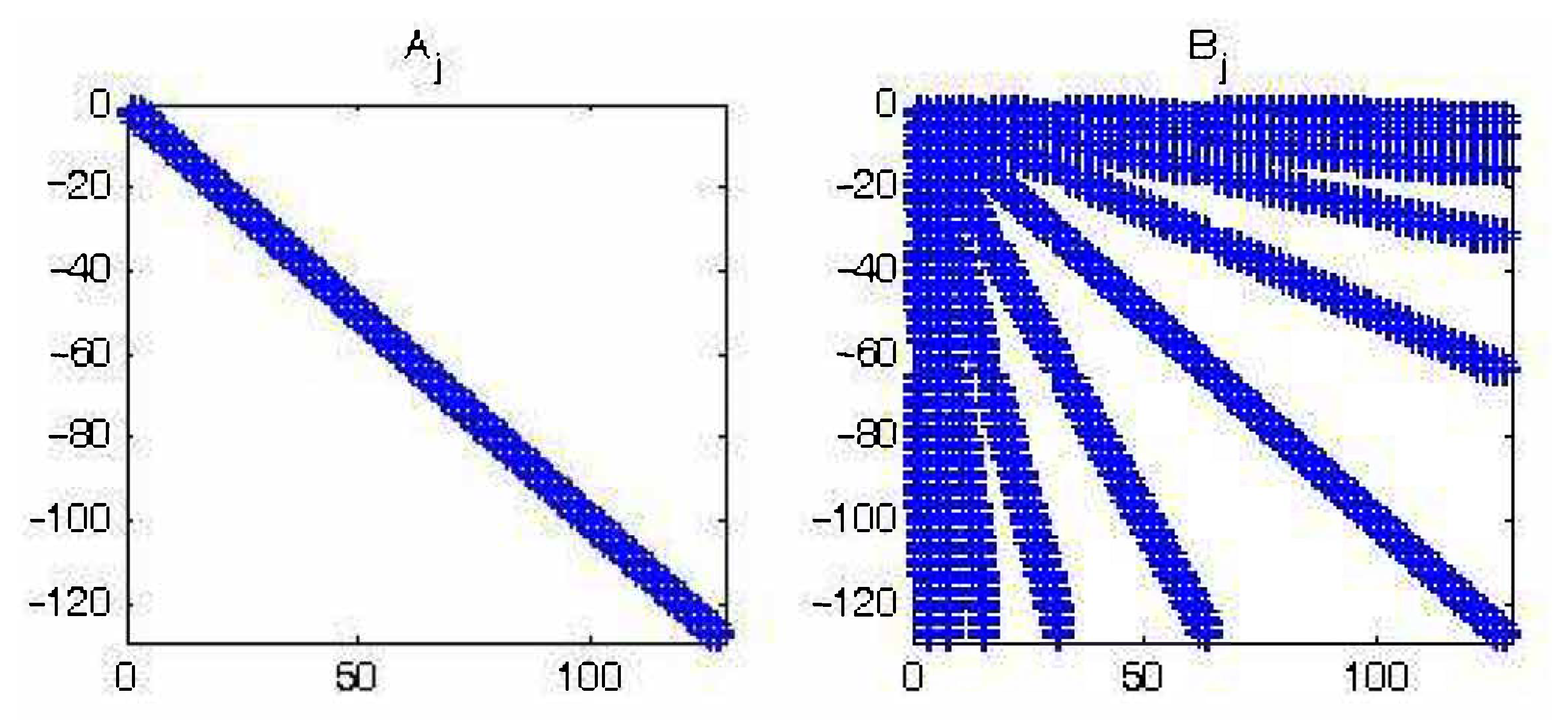
Example 2. In Equation (1), let the coefficient function For , the condition numbers of the matrix are shown in Table 3. Comparing with the values in Table 1, it is clearly seen that the condition numbers of the matrix are uniformly bounded with respect to the level j. Therefore, using as a basis for yields an asymptotically preconditioned system (15). However,
Figure 1 shows that the matrix
is not sparse. The so-called finger structure is visible. Now we are facing the following situation:
- ◊
the stiffness matrix with respect to the single-scale basis is sparse but ill conditioned;
- ◊
the wavelet stiffness matrix is asymptotically optimal preconditioned, but not sparse.
Till now, both methods cannot be used immediately. However,
where the matrix
and
given by (8) (14) respectively are both sparse. Therefore, we know that the matrix Hence
,
can be expressed as the product of some sparse matrices. that is Equation (
15) can be written as
In fact, the above Equation (
16) combines both positive effects.
5. Numerical Examples
In this Section, we focus on some numerical tests.
Supposed that
u is the exact solution of Equation
,
is the Galerkin approximation solution given by (12), then according to paper [
6] and Theorem 2, one has
The following examples show that combining with the preconditional Galerkin method, our wavelet bases constructed before are very useful and efficient.
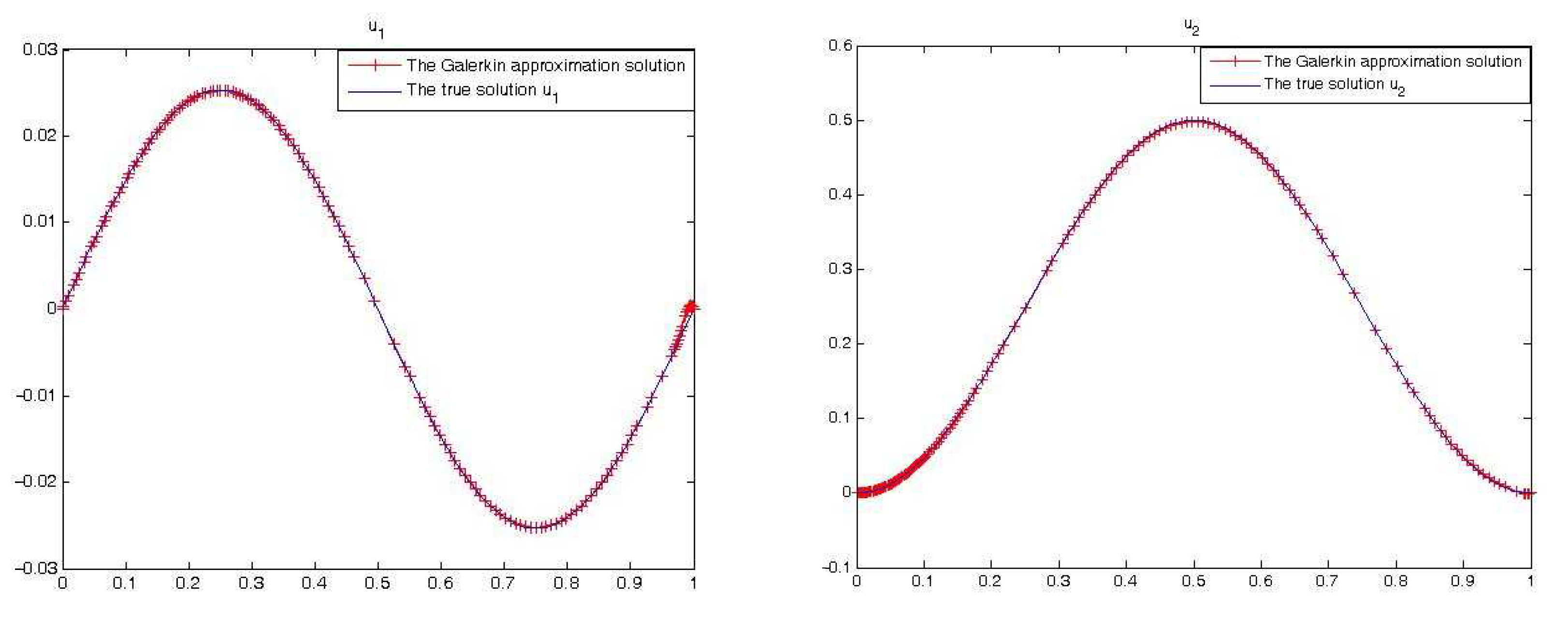
Example 3. In Equation (1), let Then the exact solution is given by Example 4. In Equation (1), let Then the exact solution is given by The exact solutions for the above two examples and their numerical solutions with
are showed respectively in
Figure 2. The error estimates in
norm and convergence factor between successive level are given in
Table 4 which demonstrates that the growth factor is almost by 4 which is the same as in (17).
Author Contributions
Conceptualization, J.W. and W.S.; methodology, J.W. and L.H.; validation, L.H.; formal analysis, J.W.; writing—original draft preparation, J.W.; writing—review and editing, W.S. and L.H.; supervision, J.W.; funding acquisition, L.H.; project administration, J.W. All authors have read and agreed to the published version of the manuscript.
Funding
This work is supported by the Premium Funding Project for Academic Human Resources Development in Beijing Union University (No. BPHR2018CZ10).
Institutional Review Board Statement
Not applicable.
Informed Consent Statement
Not applicable.
Data Availability Statement
Not applicable.
Acknowledgments
The authors would like to thank the referees for their very helpful comments.
Conflicts of Interest
The authors declare no conflict of interest.
References
- Chui, C.K.; Wang, J.Z. On compactly supported spline wavelets and a duality principle. Trans. Am. Math. Soc. 1992, 330, 903–916. [Google Scholar] [CrossRef]
- Dahmen, W.; Kunoth, A.; Urban, K. Biorthogonal spline wavelets on the interval–stability and moment conditions. Appl. Comput. Harmon. Anal. 1999, 6, 132–196. [Google Scholar] [CrossRef]
- Jia, R.Q.; Liu, S.T. Wavelet bases of Hermite cubic aline on the interval. Adv. Comput. Math. 2006, 25, 23–39. [Google Scholar] [CrossRef]
- Jia, R.Q.; Zhao, W. Riesz bases of wavelets and applications to numerical solutions of elliptic equations. Math. Comput. 2011, 80, 1525–1556. [Google Scholar] [CrossRef]
- Boor, C.D. A Practical Guide to Splines, Revised Ed.; World Book Press: Cleveland, NY, USA, 2008. [Google Scholar]
- Urban, K. Wavelet Methods for Elliptic Partial Differential Equations; Oxford University Press: Oxford, UK, 2009. [Google Scholar]
- Wang, G.L.; Shi, R.C. Matrix Theory; National Defense Industry Press: Beijing, China, 1988. (In Chinese) [Google Scholar]
- Cohen, A. Numerical Analysis of Wavelet Methods; North-Holland Publishing Company: Amsterdam, The Netherlands, 2003. [Google Scholar]
- Stein, E.M. Singular Integrals and Differentiability Properties of Functions; Princeton University Press: Princeton, NJ, USA, 1970. [Google Scholar]
- Jia, R.Q. Approximation with scaled shift-invariant spaces by means of quasi-projection operators. J. Approx. Theory 2004, 131, 30–46. [Google Scholar] [CrossRef]
- Jia, R.Q. Bessel sequences in Sobolev Spaces. Appl. Comput. Harmon. Anal. 2006, 20, 298–311. [Google Scholar] [CrossRef][Green Version]
- Leveque, R.J. Finite Difference Methods for Ordinary and Partial Differential Equations; SIAM: Philadelphia, PA, USA, 2007. [Google Scholar]
| Publisher’s Note: MDPI stays neutral with regard to jurisdictional claims in published maps and institutional affiliations. |
© 2021 by the authors. Licensee MDPI, Basel, Switzerland. This article is an open access article distributed under the terms and conditions of the Creative Commons Attribution (CC BY) license (https://creativecommons.org/licenses/by/4.0/).