1. Introduction
Why some firms engage in international trade while the others focus only on the domestic market, and the impacts of trade liberalization (or more broadly, globalization) when firms differ, have long been some of the main concerns of trade economists. Addressing these issues, recent firm heterogeneity literature in international trade has discovered many systematic links between the characteristics of firms and their degree of internationalization. In particular, it is now widely documented that exporting firms are more productive than non-exporters and/or that more productive firms self-select into export markets (see, e.g., [
1,
2]).
Consequently, on the theoretical side such selection effects of trade have largely been modeled and examined by incorporating exogenously given firm-level productivity differences [
3]. Another branch of modeling firm heterogeneity has been to assume exogenously given worker-level ability differences and consider firms’ endogenous technological choice together with employment decisions (see, e.g., [
4,
5,
6]). Some other papers model a continuum of tasks instead of a continuum of heterogeneous worker skills (see, e.g., [
7,
8]). All these approaches have also been generalized by assuming log-supermodularity between continuum of worker skills and continuum of tasks [
9].
Though many important new insights have been gained at the aggregate level, all these approaches are, however, limited in studying intra-firm managerial mechanisms and the resulting strategic direction and performance of firms. It has been extensively discussed in the management literature that the human capital investment of workers within firms has a considerable influence for the overall performance of firms. For the human capital formation of firms, many researchers highlighted the importance of organizational behavior and human decision processes within firms. Additionally, the international entrepreneurship (IE) literature in international business and management has extensively studied the key role of entrepreneurial (and/or managerial) vision in the performance of international firms (see, e.g., [
10,
11,
12,
13,
14,
15]).
While the economic literature has largely neglected these issues, some exceptions are found. By formally modeling CEO’s leadership style and/or vision, Rotemberg and Sloner [
16,
17] show that managerial preferences have an important effect on firm performance through encouraging incentives. Van den Steen [
18,
19] focuses on the sorting effect induced by managerial beliefs and shows that a firm attracts employees having similar beliefs to that of its manager and the shared beliefs have very pervasive performance effects for the firm. Additionally, some papers study how managerial characteristics can be determinants of firm boundaries [
20] or investigate how competition fosters commitment of firms by interacting with leadership styles [
21]. Though the important implications of organizational behavior and human capital investment on firm strategy and performance have been widely documented in the management literature during the last decades and some pioneering papers dealt with these implications in economics context, much less attention has been devoted to studying such implications in the international trade and/or globalization context.
In this paper, we make a first attempt in the literature (to our best knowledge) to bridge the gap. We develop a general-equilibrium trade model in which heterogeneous employees make an investment decision in acquiring advanced managerial skills and choose their optimal effort level based on their comparative advantage. Firms are free to enter the market and choose whether or not to enter the export market according to their status-quo technologies. The key element of the model is the interaction between workers’ strategy-specific abilities and the strategy-specific technologies within firms. We consider two market strategies: localization vs. internationalization. Given the externalities between the workers’ strategy-specific ability and the strategy-specific technologies used, as well as the existence of learning costs to obtain each strategy-specific managerial skill, workers endogenously sort into firms and tasks (production vs. management).
Given this setup, we investigate the impacts of globalization. We first investigate the effects of trade liberalization due to a fall in marginal trade cost. As will be shown later, trade liberalization increases the optimal effort level of exporting-firm managerial workers while decreases that of domestic-firm managerial workers; also, more production workers decide to invest in obtaining managerial skills and become managers in exporting firms. The expansion of high-tech exporting firms and the compression of low-tech domestic firms increase the overall productivity of the economy, and increase the aggregate welfare, which implies a sustainable economic development and growth. We also show that the effects of globalization-induced technological progress lead to very similar implications.
On the other hand, it is widely documented in the business and management literature that an individual worker follows a specific career path to be a specialist in a specific field. That is, being an international market specialist or being a national market specialist requires substantially different job training, and workers choose their career path based on their own beliefs and/or preferences (which can also be a part of individual’s intrinsic ability). An individual worker’s belief and goal setting then materialize as strategy-specific productivity. In this paper, we also consider such two-dimensional ability. This is one important departure from conventional models in international trade literature with heterogeneous workers and firms, where workers’ ability has only been uni-dimensional so that more able (talented) workers sort automatically into exporting firms while less able (less talented) workers sort into national firms (see, e.g., [
22,
23,
24,
25,
26]). Uni-dimensional ability frameworks inevitably lead to unrealistic results that all the workers in exporting firms are always paid higher wages than ones in national firms: there is one cutoff ability level and even the highest talented in national firms are paid less than the least talented in exporting firms. This is obviously very restrictive and simplistic assumption to study modern income inequality when looked at from the real business and management perspectives. Related to globalization and international entrepreneurship (IE) literature, a new type of highly international small and medium-sized enterprises (SMEs)—born global firms–have largely been emphasized in business academia. Though economic academia has been highlighting that on average exporting firms are larger and pay higher wages (see, e.g., [
27,
28,
29] and references therein), born global firms have been regarded as very quickly emerging and influential since the 1980s in the real business world. See, e.g., Kuivalainen et al. [
30] for a review of the literature on born global firms and the role of international entrepreneurial orientation.
Related to the literature of organizational behavior, we also extend the model by incorporating the externalities between workers’ organizational belief and CEO’s managerial vision, and study more explicitly the role of organizational behavior and human decision processes within firms in the firm performance. Since workers decide according to their own beliefs, workers with high beliefs on internationalization self-select to work as managers in exporting firms, while those with high beliefs on localization self-select to work as managers in domestic firms. The middling workers having relatively indifferent beliefs on both strategies self-select to work as production workers without making any investment to obtain managerial skills. Within firms, workers decide to invest and make efforts based on their own organizational belief, and workers having similar organization belief to the CEO’s managerial vision have higher productivity due to the positive externality. In this case, globalization increases the most the productivity and income of the worker who has the same belief as that of CEO in exporting firms, and also increases the aggregate welfare of the economy. By explicitly modeling the optimal effort level decision of individual workers within firms, the model therefore highlights a new source of productivity effects, which could not be captured by previous models in the firm heterogeneity literature where the productivity effect comes mainly from the self-selection (reassignment) of firms (or workers) with exogenously given productivity (or ability) differences.
The rest of the paper is organized as follows. In
Section 2, we present the basic setup of the model where heterogeneous workers make an investment decision in acquiring advanced managerial skills and choose their optimal effort level based on their comparative advantage. In
Section 3, we study the effects of globalization, and
Section 4 supplements our theoretical discussions by exploring numerically a parameterized version of the model. In
Section 5, we extend the model to incorporate the externalities between workers’ organizational belief and CEO’s managerial vision within firms and study the effects of globalization in this case.
Section 6 concludes with some concluding remarks.
2. The Model
We consider two symmetric countries. Each country is populated by a unit mass continuum of workers (households), indexed by . The distribution is given by with density on support . For simplicity of analysis, we assume a uniform distribution. More general distributions could of course be adopted, but that would only complicate the exposition with no additional insights gained. All workers are endowed with one unit of raw input . Each worker either provides or can make investments to gain managerial skills, . Here, can also be viewed as time of workers, which can be used either to work as production worker or to invest to obtain managerial skills. There are two types of managerial skills to be obtained for two types of strategies, : localization (domestic) strategy-specific or internationalization (exporting) strategy-specific .
2.1. Production and Heterogeneous Firms
There is a continuum of firms, each producing a differentiated variety
using natural resources
, and aggregates of labor inputs
. For the sake of simplicity, we assume a Leontief technology for the aggregates of labor inputs. Production of any variety requires combining two labor inputs:
units of
and
units of
, or equivalently,
efficiency units of production workers and
efficiency units of non-production managerial workers. These two labor inputs can also be viewed as blue-collar tasks and white-collar tasks that are not substitutable in general. Introducing some substitutability between the two inputs is straightforward, but that would only complicate the analysis with no additional insights gained: all the following results of the paper would be valid insofar as
and
are complementary rather than substitutes. Furthermore, we assume that each firm has access to a fixed amount of natural resources (
) to produce each variety in the following form:
where
. For simplicity and without loss of generality, we normalize
to one, and focus on the human capital investment of workers at a given amount of natural resources.
Firms are free to enter the market and choose whether or not to engage in international trade. Adopting either strategy incurs strategy-specific fixed costs
,
, measured in terms of firms’ foregone output. Exporting requires higher fixed set-up costs than serving only domestic market; we assume that
. Firms are atomistic profit-maximizers and produce goods under monopolistic competition, so that firms charge a constant mark-up over marginal production costs. From the Leontief technology (1), prices are given by:
where
and
,
, are unit production costs of each input (or task-specific efficiency wage rates), and
is the elasticity of substitution between varieties.
2.2. Technologies and Heterogeneous Workers
One key element of the model is that workers are heterogeneous in their individual ability for each strategy. Workers may have their own preferences and/or subjective beliefs about the likelihood of each strategy dominance in the market, which leads to different career path for skill development. We align workers according to their individual strategy-specific ability. A worker indexed with has an -strategy-specific ability level of , while has a -strategy-specific ability level of ; a worker with has the same ability in both strategies and is thus indifferent to both strategies. Note that here we are considering strategy-specific abilities, and not any general managerial skills, that require strategy-specific education and/or training; at a given time constraint, the more workers dedicate their time to obtain one strategy-specific ability, the less they can do for the other ability. Though any more general functional forms can of course be adopted, this mirror-characteristic linear ability schedule is adopted for simplicity. As will be shown later, modeling this two-dimensional ability differentiation allows for the study of the within-firm human capital investment decisions. Additionally, differently from the conventional models in the firm heterogeneity literature in international trade, it is shown that some workers in the domestic firms may have higher wages than some workers in the exporting firms; however, on average exporting firms may pay higher wages as we observe in reality.
There is now ample evidence that exporting firms use more productive technologies than domestic competitors (see, e.g., [
31,
32,
33] and references therein). There are two strategy-specific technologies
,
; we assume
. Workers then choose firm-types and tasks based on their comparative advantage. The output of a
-worker with an ability level
depends on his/her own effort level
for both strategies and the technology used:
where
is a function of
and
, a productivity factor that converts individual effort into respective output of
or
. Various interpretations might be applicable to the
-workers. One natural interpretation would be middle managers who carry out the strategic directives of CEO at the operational level and supervise the production of
-workers. In this paper we refer to them as managerial workers or simply managers in contrast to production workers. We assume positive externalities between the worker’s individual strategy-specific ability and the strategy-specific technology used. Specifically, we assume that:
Equation (4) shows that and monotonically increase in and , as well as in and , respectively. Learning managerial skills requires each strategy-specific individual investment , , measured in terms of individual’s forgone output. Similarly, we assume that , implying that being an expert for international markets is more costly.
Workers derive utility from net income, and disutility from exerting effort. The utility function is given by:
where
is the respective measured-in-efficiency-units wage rate for
, and
is a parameter that governs disutility from exerting effort. A utility-maximizing worker
determines his/her optimal level of effort for a given wage rate. From Equations (3)–(5), optimal effort level of a worker
is given by:
Given this individual optimal level of effort and from Equations (3) and (4), the output of a worker
is then given by:
Note from above that and increase in the respective wage rate and the strategy-specific technology, while decrease in .
2.3. Self-Selection of Workers
Assuming in what follows that both firm types,
(domestic) and
(exporting), exist in equilibrium, workers will sort based on their respective ability
. Let
,
and
be equilibrium thresholds with
. Then, from Equations (3) and (4), workers with low
,
, would self-select to develop and provide
-specific managerial inputs (
), whereas workers with high
,
, would self-select to develop and provide
-specific managerial inputs (
). The middling workers,
, are relatively indifferent to both strategies, and thus provide their inherently endowed raw inputs
without making any investment to obtain managerial skills. Assuming further that workers having relatively similar abilities work together, workers with
, provide
in domestic firms, while workers with
provide
in exporting firms. Given that all the workers with
offer homogeneous
, this distinction has no effect on the main results of the paper, but it serves for the boundary between the two firm-types, as well as corresponds to the widely documented corporate culture literature in the management (see, e.g., [
34] and references therein). The middling workers offering homogeneous
get paid the same
in both firm types.
From Equation (7), competitive wage of a worker
net of any learning costs
is therefore given by:
where we choose
as our numeraire:
.
In a perfectly competitive labor market, no-arbitrage conditions for the threshold workers lead to:
which implicitly pin down
and
as a function of
and
, respectively, and vice versa. Investigating Equations (9) and (10) leads immediately to the following lemma.
Lemma 1. A rise(fall) in increases(decreases) the threshold , while a rise(fall) indecreases(increases) the threshold :and .
Intuitively, higher managerial wages attract more workers to invest and develop managerial skills rather than simply offering their inherently endowed . More formally, totally differentiating Equation (9), we get . Similarly, totally differentiating Equation (10), we get .
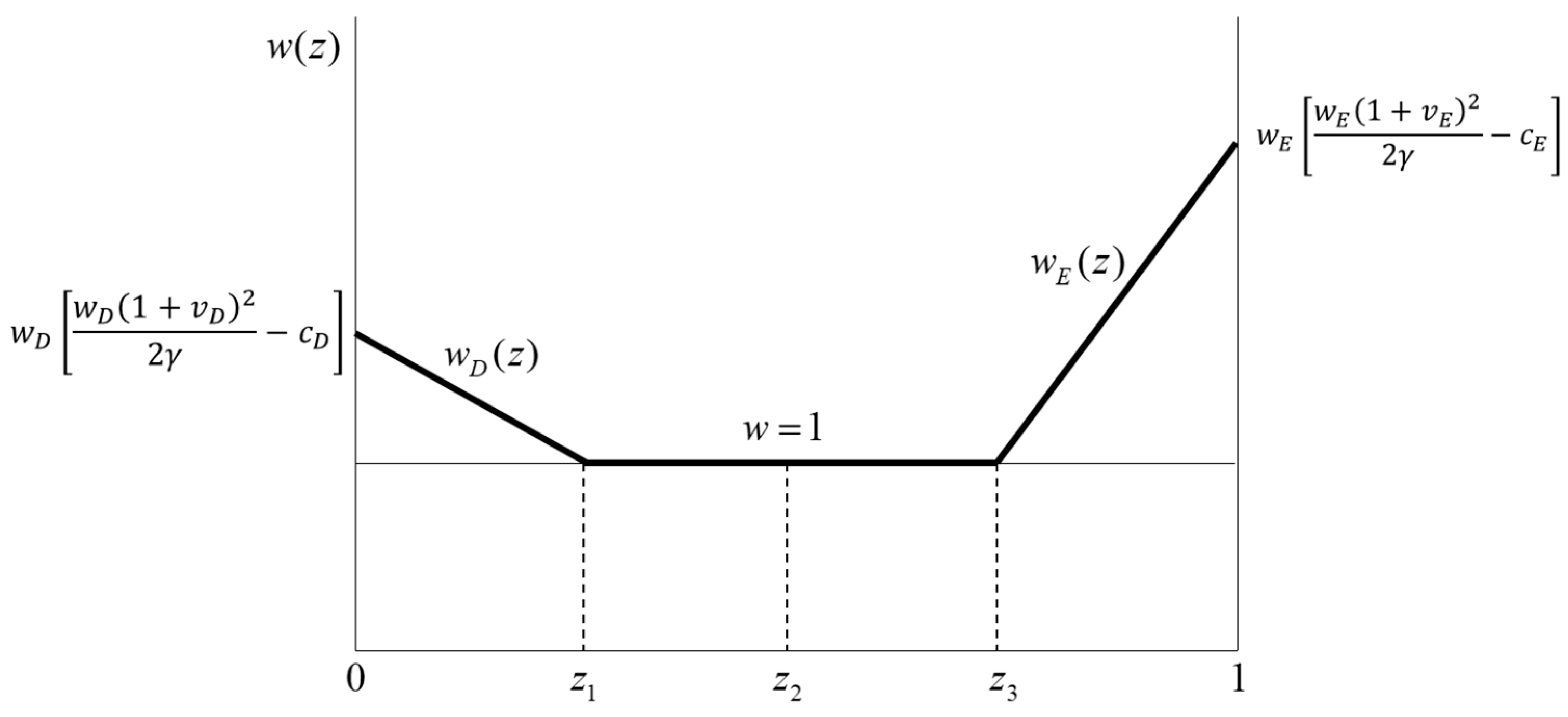
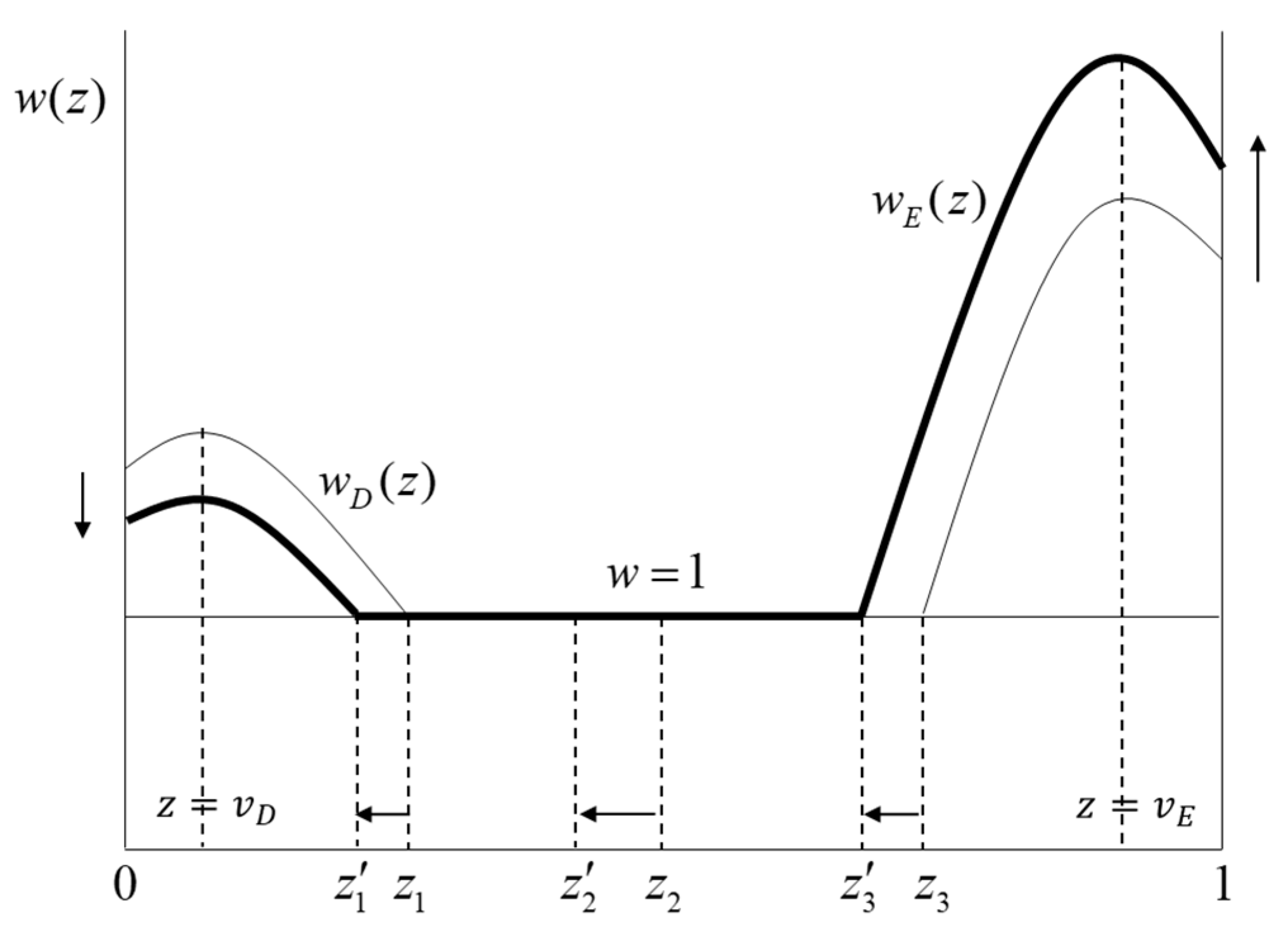
Following
Figure 1 illustrates the equilibrium individual wage distribution for different ability levels: the linear representation in
Figure 1 is adopted for illustrative purpose only.
As
Figure 1 shows, workers with high
(high
-ability) get paid the most when they work for exporting firms as managerial workers, while workers with low
(high
-ability) get paid the most when they work for domestic firms as managerial workers. The middling workers having relatively indifferent abilities get the highest wage when they work as production workers without making any investment to be a manager. Finally, the outer bold curve in
Figure 1 represents the equilibrium individual wage distribution resulting from self-selection of workers based on their individual abilities. Workers with ability
are employed by domestic firms, while workers with ability
are employed by exporting firms.
2.4. Demand
Households have Dixit–Stiglitz preferences over a continuum of differentiated varieties:
where
represents the mass of available varieties, and
is the elasticity of substitution between varieties. Consumer’s optimization yields demand schedule for each variety:
associated with an aggregate price index:
We assume that exporting goods is associated with iceberg trade costs
per unit. The domestic demands for domestically produced and imported goods are then given, respectively, by:
where
denotes foreign exporters price. In what follows, we use an asterisk to denote foreign variables.
The aggregate consumption price index (13) can be written as:
where
,
and
denote the number of domestic, exporting and foreign exporting firms, respectively, and
and
from the symmetry.
2.5. Equilibrium
From previously defined
,
and
, the total supply of
,
, is given by:
which also can be written simply as
and
from our uniform distribution assumption. The total supply of
,
, is given, respectively, by:
From the technology (1) and Equations (16) and (17), it follows then that:
Free entry ensures zero profits for both firm types, so that mark-up revenues exactly cover the fixed costs (forgone outputs):
where
and
. Now consider the revenue ratio between domestic firms and exporters. From Equations (2), (14) and (20), we have:
Here, from the assumption that domestic firms serve only a domestic market (or equivalently, domestic firms exist in equilibrium), it can be easily derived that
, implying that
(see
Appendix A). Given the presence of both the fixed exporting cost and the iceberg trade cost, entering the export market requires offering their products at cheaper prices than their local competitors to be profitable. Additionally, from our characterization of fixed costs as foregone output and from the technology (1), we have the following equilibrium condition:
Finally, aggregate income follows from factor supplies and prices:
To sum up, in this model the equilibrium is characterized by five key variables—, , , and —which are determined by five Equations (9), (10), (18), (19) and (21). In the following sections, we therefore focus on how these variables are affected by parameter changes.
3. Globalization
In this section we study the effects of trade liberalization and globalization-induced technological progress.
3.1. Trade Liberalization
We investigate first the impacts of trade liberalization. For this, we begin by studying possible relations between the thresholds (, and ) and , . It can be done by investigating Equations (18) and (19). Consider now a rise in . From Lemma 1 (), this increases RHS of Equation (18) unambiguously, which in turn induces a rise in due to a rise in demand for in domestic firms. This rise in decreases LHS of Equation (19) for a given . Then, from Lemma 1 () again, it is straightforward to check that a rise in is the only possibility to recover the equilibrium condition (19). A fall in induces inverse effects from the same reasoning. The following lemma establishes.
Lemma 2. ,andmove in the same direction. And if,andincrease,rises and falls, while if ,anddecrease, falls and rises.
We now consider trade liberalization. Trade liberalization can occur either from a fall in or from a fall in fixed costs to exporting , both of which induce very similar qualitative effects from Equation (21). One difference lies on the individual firm size adjustments. In this type of monopolistic competition models, changing the marginal costs to exporting () indirectly affects the relative individual firm size from the market competition, while changing firms’ fixed costs directly influences the individual firm size. Let us consider a fall in . This increases RHS of Equation (21) unambiguously, which in turn induces a rise in to recover the equilibrium. Then, from Equation (21) and Lemma 2, following proposition establishes immediately.
Propositon 1. A fall in induces a fall in and a rise in , and ,anddecrease.
From Proposition 1 and Equations (6) and (7), following corollaries follow then immediately.
Corollary 1. A fall in increases the optimal effort level of exporting-firm managerial workers, while decreases that of domestic-firm managerial workers. Consequently, exporting firms’ overall productivity increases, while that of domestic firms decreases.
Corollary 2. A fall in increases between-firm relative managerial incomes in favor of exporting firms; decreases within-firm income inequality in domestic firms, while increases it in exporting firms: ,, and .
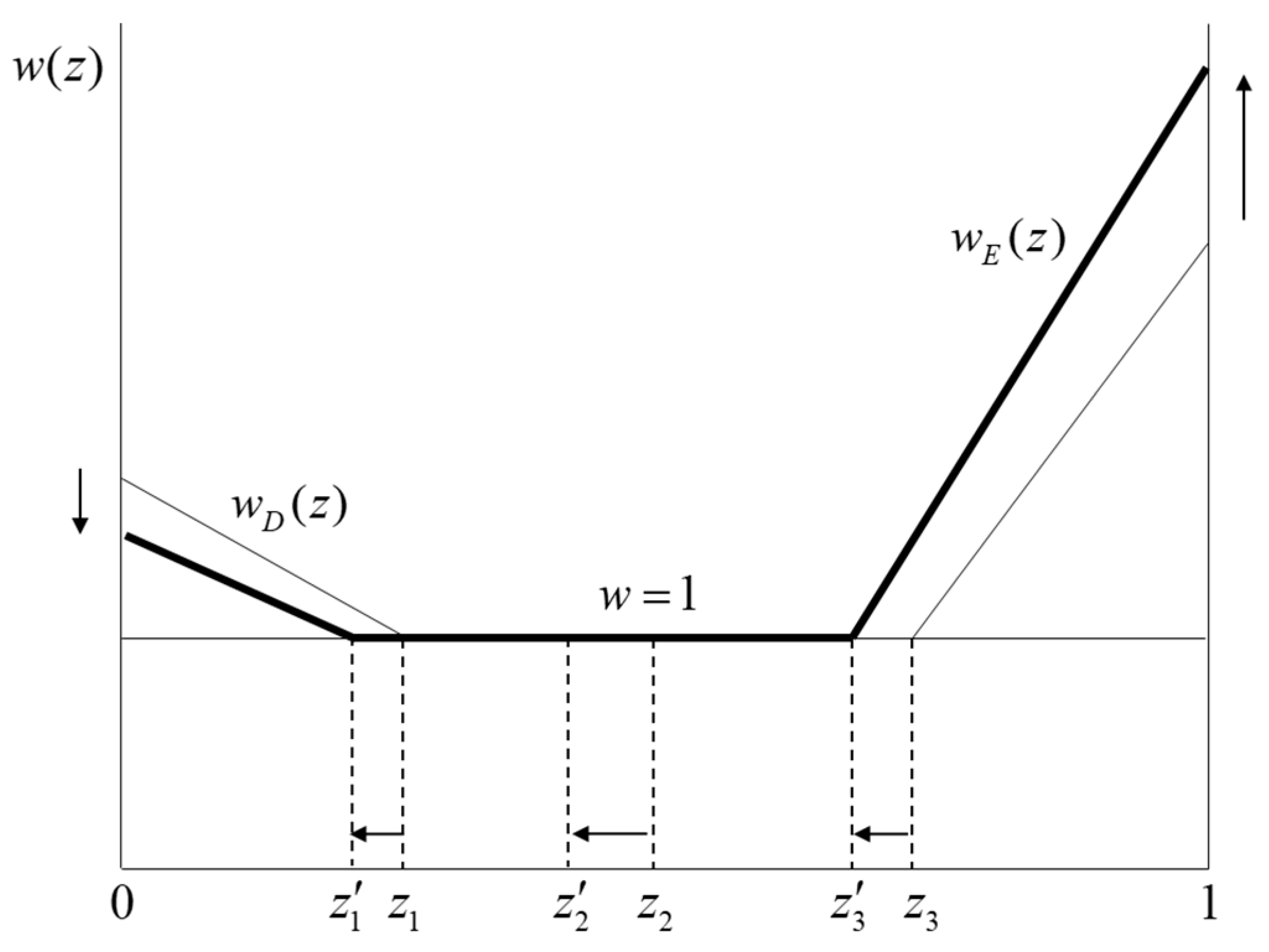
Following
Figure 2 illustrates the induced changes in the equilibrium wage distribution.
The rise in attracts more workers, , to invest in obtaining managerial skills and to become managers in exporting firms, while the fall in induces some managers with relatively low -ability, , to disinvest and turn to production workers in domestic firms. The expansion (compression) of exporting (domestic) firms leads to more (less) employment of production workers in exporting(domestic) firms, so that some production workers previously employed in domestic firms, , are now employed by exporting firms.
The impact of a fall in
on the market concentration can be investigated as follows. From Equations (2), (17), (20) and (22), we have:
From Proposition 1, following corollary follows immediately.
Corollary 3. A fall in reduces the number of domestic firms (), while increases that of exporting firms ().
3.2. Technological Progress
It is widely documented that globalization acts also like a technological progress through international knowledge spillovers. Here, we investigate the impacts of an increase in . Note that the analysis is not as simple as before since changes in directly affect the productivity factor in Equation (4) from the externality between workers’ ability and the strategy-specific technology, so that now Lemmas 1 and 2 do not hold a priori. The impacts can be investigated in the following steps instead.
First, consider relatively short-run within-exporting-firm impacts. (i) For given employment level and measured-in-efficiency-units wage rate (given and ), the first-order direct impact of a rise in is to increase expected remunerations for managerial workers, which induces a fall in . (ii) Then, to recover the within-firm factor clearing condition (19), starts to decrease and is shifted back, but finally is situated somewhere below the initial . These changes will then induce between-firm repercussions. From Equation (21), a fall in induces a fall in , which in turn induces a fall in from Equation (9). The final equilibrium requires overall factors’ market clearing conditions (18) and (19). A rise in together with the induced leftward shift of requires more employment of production workers within exporting firms. On the other hand, a fall in together with leftward shift of clearly implies less employment of production workers within domestic firms. Finally, from Equations (18) and (19) should shift left to ensure the overall factors’ market clearing. The effects are summarized in the following proposition.
Propositon 2. A rise in induces falls in and , and leftward shifts of ,and .
From the positive relationships among the optimal effort level (6), output level (7), and wage schedule of workers (8), following corollaries follow immediately.
Corollary 4. A rise inincreases the optimal effort and output levels of exporting-firm managerial workers, while decreases those of domestic-firm managerial workers.
Corollary 5. A rise inincreases between-firm relative managerial incomes in favor of exporting firms; decreases within-firm income inequality in domestic firms, while increases it in exporting firms.
Note that the effects on the measured-in-efficiency-units wages are not the same as the case of trade liberalization. A rise in acts like a technological shock that positively affects the associated workers’ productivity. Though a rise in decreases the associated measured-in-efficiency-units wage rate , the final income of managerial workers increases due to the positive productivity effect. A technological progress attracts more workers to invest in obtaining related managerial skills and to become managers within firms, while the opposite occurs within competitors. Additionally, from the above induced changes and from Equation (24), following corollary follows.
Corollary 6. A rise in increases the number of exporting firms, while reduces the number of domestic firms.
4. A Numerical Simulation
In this section, we illustrate our theoretical discussions with numerical simulations. The chosen (and/or calibrated) parameter values and initial benchmark equilibrium values for endogenous variables are reported in the
Appendix B. The base model parameter values are configured so that initially two firm-types have identical employment size:
, as well as the assumptions made on parameters in the text are satisfied. Initial variable values are normalized to one. Given the initial equilibrium,
Appendix C reports the effects of a fall in
and a rise in
, respectively, which confirms our previous theoretical analyses; for a robustness check, simulation results for alternative values of
are reported.
The concept of sustainable development and growth has been developing over the past decades. Here, we are particularly interested in the aggregate welfare changes. Sustainable development and growth of nations can be defined as sustainable human welfare over time since an economy can be seen as developing in a sustainable way as long as the average individual is not becoming worse off [
35,
36]. Is this regard, the measure of wealth can also be expanded to include a broadly defined capital that affects the welfare of individuals. As we have shown, globalization (defined as a fall in
and/or a rise in
) induces an overall human capital accumulation, with more workers investing to obtain high-tech managerial skills.
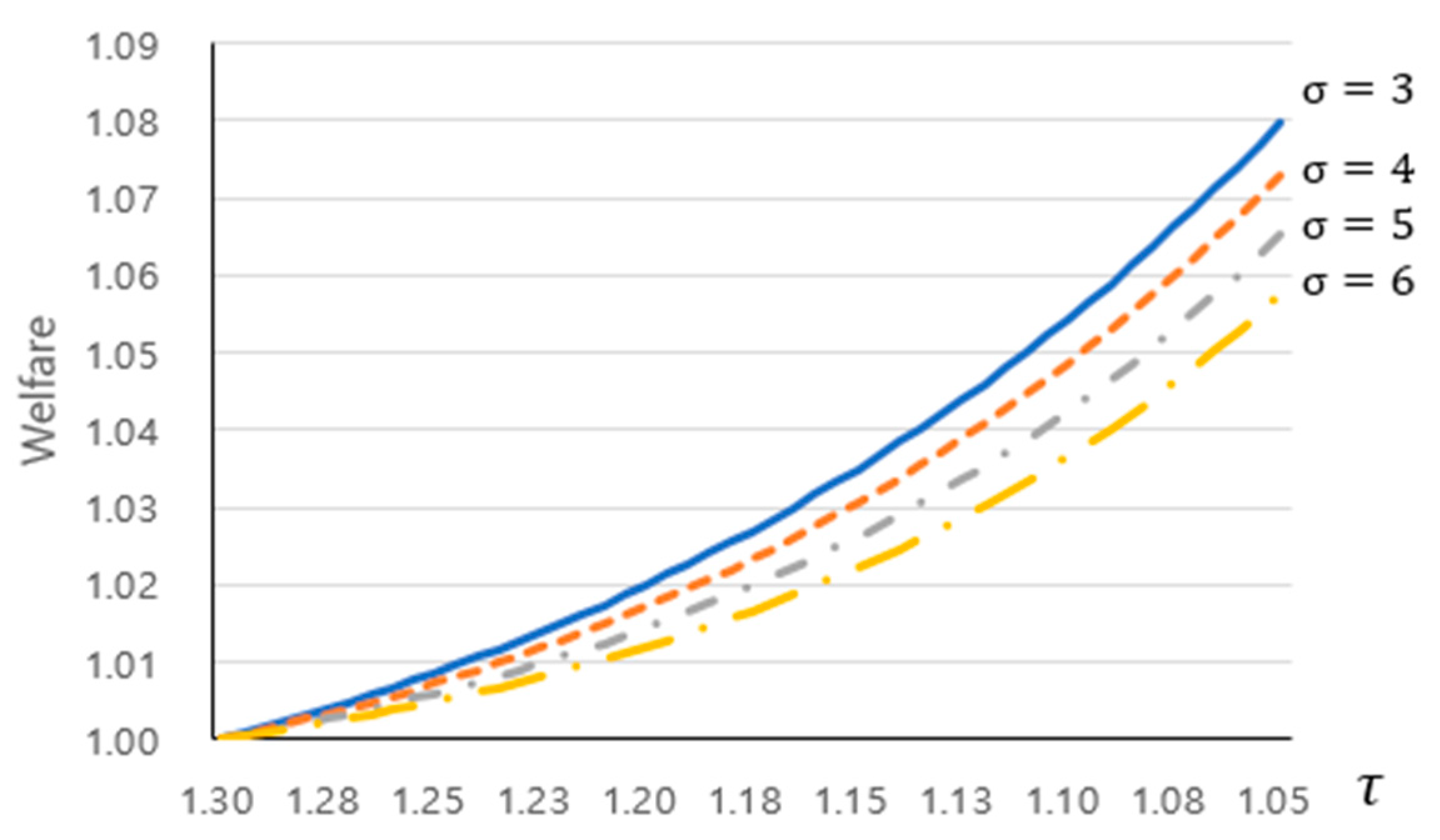
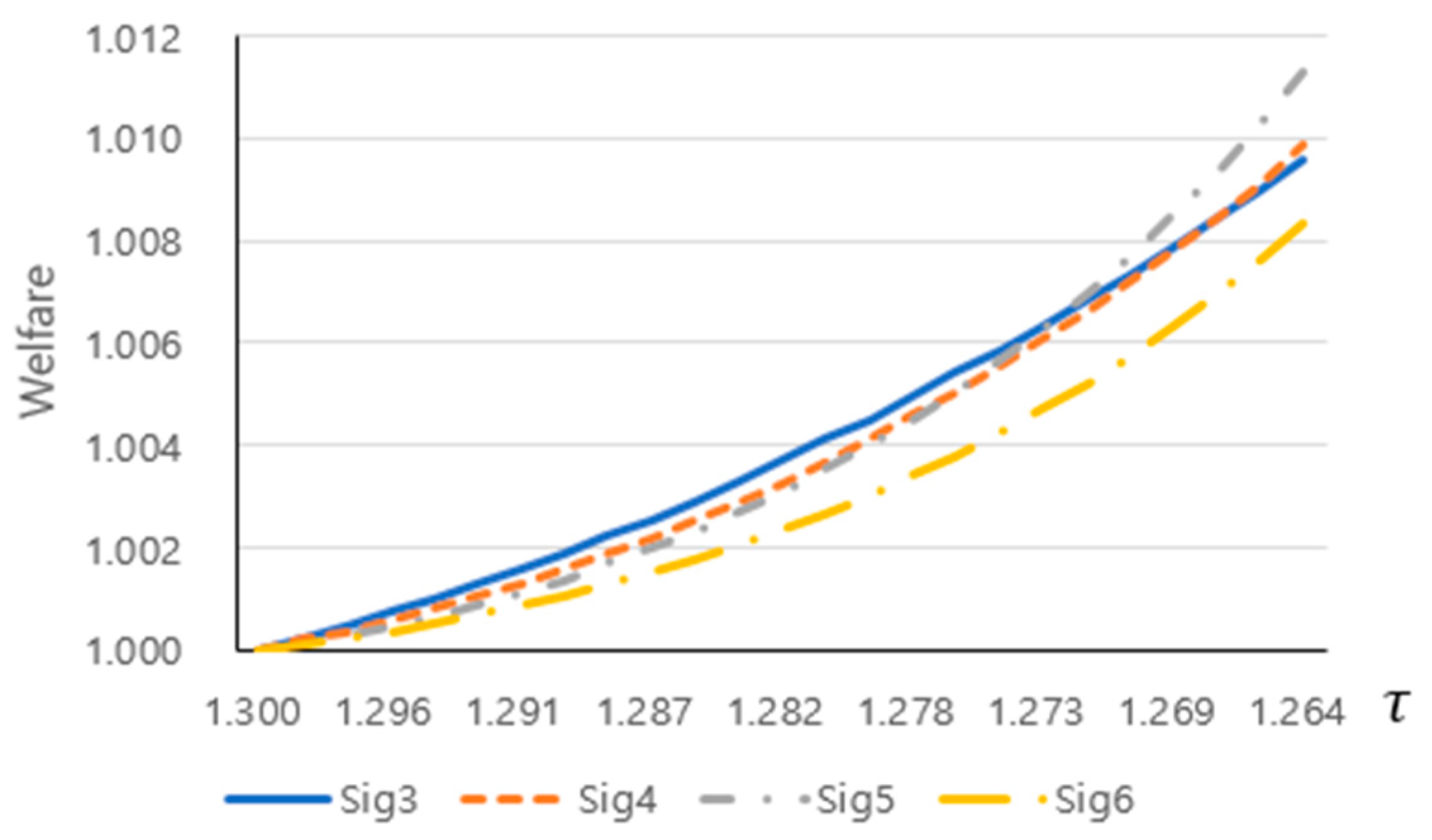
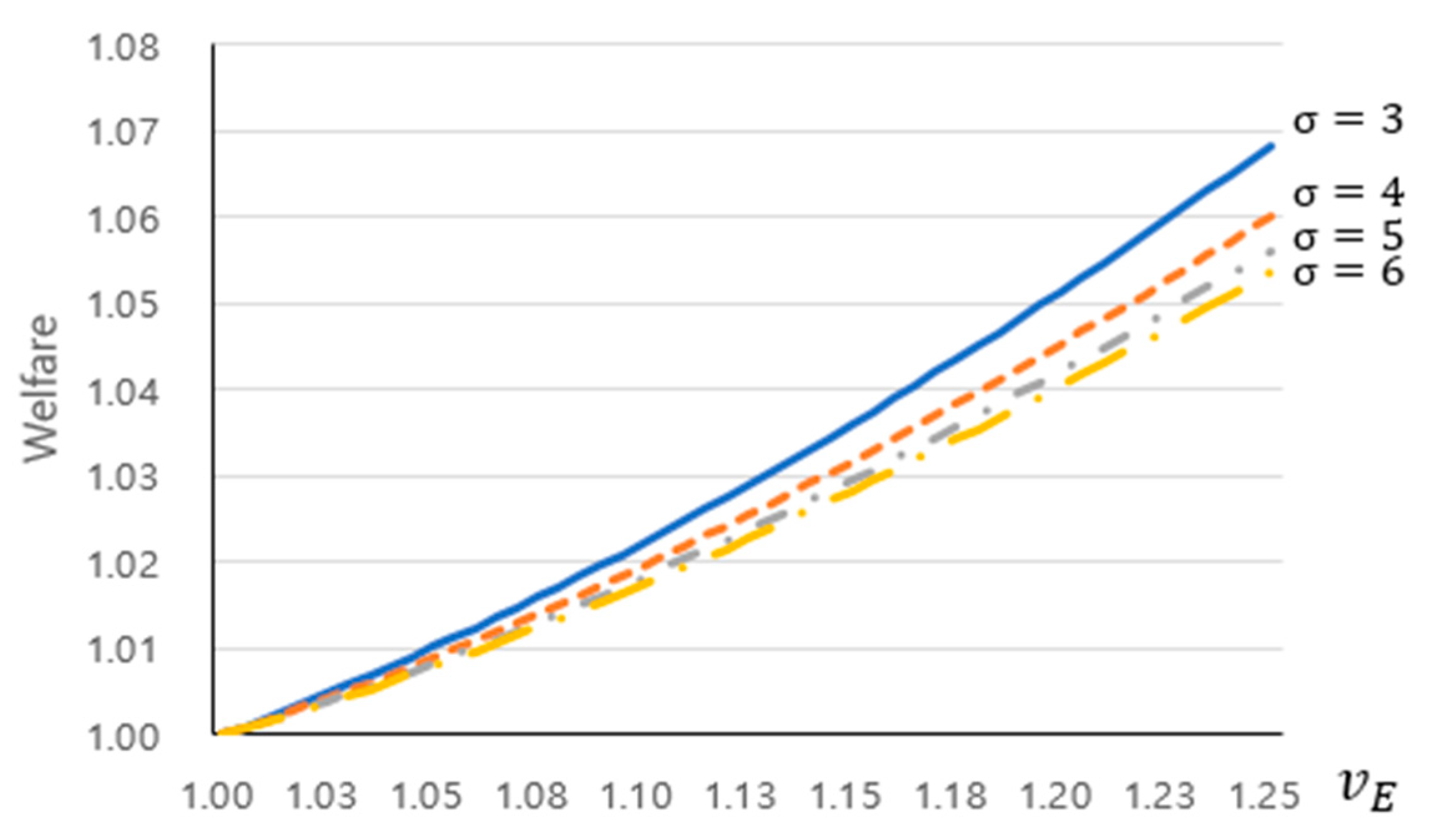
Following
Figure 3 and
Figure 4 show how such an accumulation of human capital leads to an improvement of the aggregate welfare, measured as the aggregate real income
. Since the total welfare effects may be sensitive to the value of the elasticity of substitution
in this type of monopolistic competition models, the results are reported for alternative values of
.
Figure 3 and
Figure 4 highlight the positive relationship between globalization and sustainable development/growth through globalization-induced human capital accumulation.
Differently from previous models in the firm heterogeneity literature assuming exogenously given productivity and/or ability differences between firms and workers, this paper highlighted the intra-firm human capital investment mechanism where individual workers decide their own effort (and/or investment) levels. We can investigate the welfare implications of such mechanism by comparing current model with fixed individual investment case. Specifically, we fix in Equation (3) and compute again the aggregate real income .
As is usual in this type of monopolistic competition model, the aggregate real income (consumption) changes cannot be shown analytically since the number of varieties and prices change simultaneously from Equation (15). On the other hand, the new modeling approach of this paper allows us to investigate the importance of the within-firm human capital investment and accumulation processes. We can compare directly two versions of the model with and without the above-mentioned intra-firm mechanisms.
The two versions of the model (endogenous
vs. fixed
) have exactly the same initial parameter and variable values. Following
Table 1 and
Table 2 show the new gains from trade based on endogenous human capital accumulation within firms. For each
, globalization-induced human capital accumulation leads to significantly higher welfare levels whether we define globalization as a fall in
or a rise in
.
5. Organizational Belief and Managerial Vision
Before concluding, in this section we discuss possible implications of workers’ organizational belief and CEO’s managerial vision within firms. Our analyses so far have been based on exogenously given workers’ initial ability levels and did not explain what determines such ability differences. One widely accepted explanation in the business and management literature would be the externality between workers’ organizational beliefs and the CEO’s managerial vision (see, e.g., [
37] and references therein). Workers decide to invest and make efforts based on their own organizational belief and the CEO’s managerial vision. Suppose now that all workers have their own subjective belief about the likelihood of each strategy dominance in the market: a worker
believes with probability
that the dominant overall market (and/or organization he/she works for) strategy would be
, while believes with probability
that
would be dominant. Due to be the positive externalities, workers having similar organizational beliefs to the CEO’s managerial vison have higher ability levels in the organization. Previous base model can easily be extended to incorporate explicitly such externalities. We now assume that:
where
is the individual organizational belief and
and
are CEO’s managerial vision for localization and internationalization, respectively, with
. Why CEOs have a different vision is out of the scope of this paper, but it is widely documented that firm policies and/or strategies systematically depend on the identity of the CEO [
38]. Following the previous definition, high
implies high belief (preference) for
-strategy, while low
implies high belief (preference) for
-strategy. However, note that here
is not necessarily higher than the highest
, as well as that
is not necessarily lower than the lowest
. Thus, in Equation (25)
and
are parameters representing the maximum productivity of a worker who has the same belief as that of CEO in domestic and exporting firms, respectively. We assume that
given the higher learning cost to obtain export market managerial skills:
. Replacing these in Equation (5), optimal effort level of a worker
is now given by:
and the output of a worker
is given by:
Note from above that, unlike the previous model
and
now increase in the similarity between
and
,
. From above, the modified wage schedules are given by:
Previous no-arbitrage conditions (9) and (10), and supply Equation (17) are modified accordingly to:
and
from which factor clearing conditions (18) and (19) are also modified accordingly to:
As before, the equilibrium is characterized by five key variables—
,
,
,
and
—, which are determined accordingly in this case by five Equations (21), (29), (30), (32) and (33). Note, however, from Equations (29) and (30) that in this case the initial
and
relative to workers’ overall beliefs matter. If initially
and
, we have
and
. Though much less plausible, however, if initially
and
, we would have
and
. More formally, totally differentiating Equation (29), we get
, which is negative (positive) if
(
). Similarly, totally differentiating Equation (30), we get
, which is negative (positive) if
(
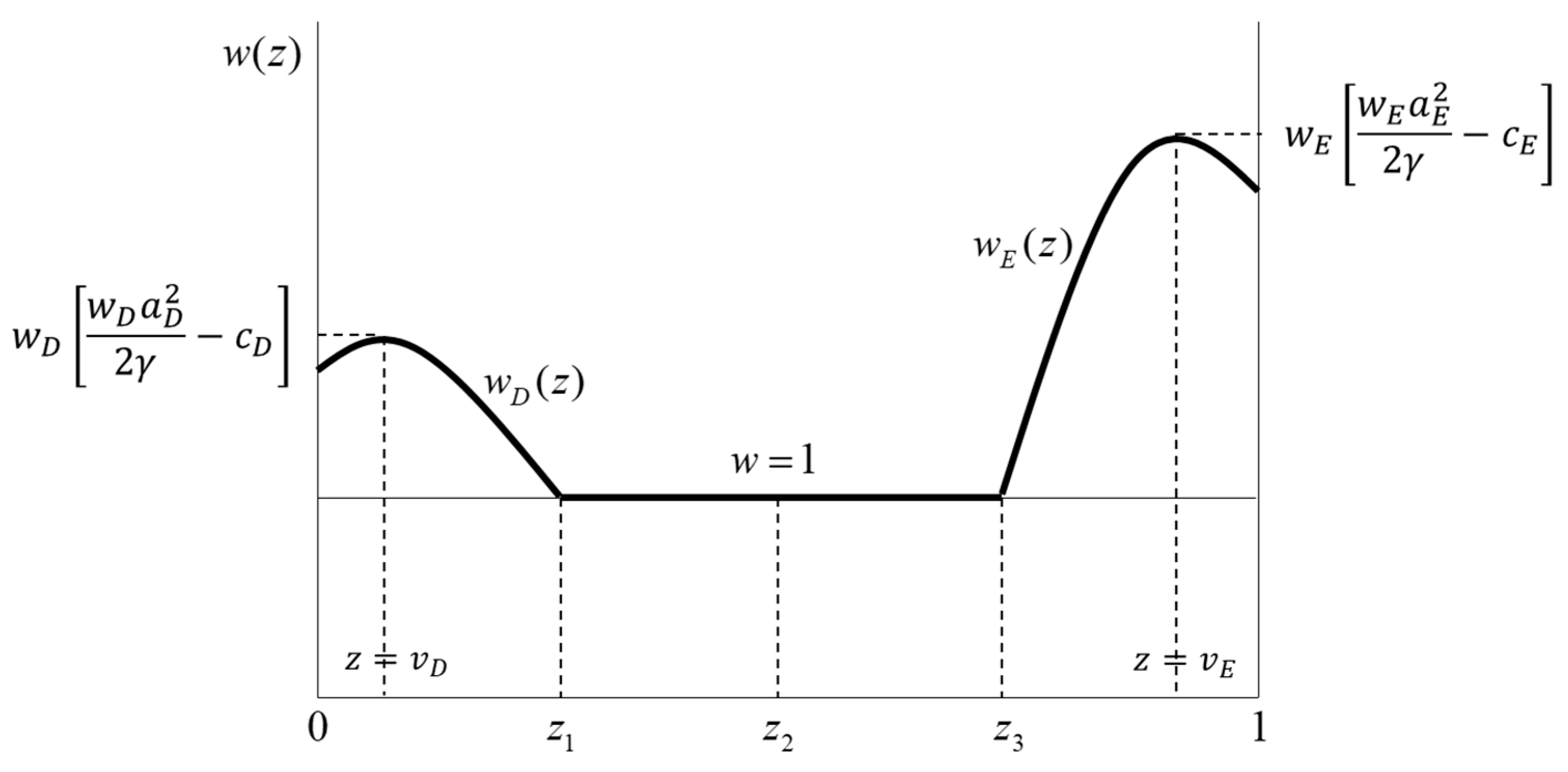
). Following
Figure 5 illustrates the modified equilibrium wage distribution for the former case. Here, we do not explicitly model the earnings of CEOs for expositional simplicity purpose. However, it is straightforward to adapt the formulation: one convenient and widely used modeling approach is to assume that the firms’ operating profits (the fixed costs in this model) go to the CEOs (see, e.g., [
39] and references therein).
Thus, in this case it is the worker with the same belief as CEO’s managerial vision who earns the highest income in each firm-type. Additionally, the presence of fixed learning costs to obtain managerial skills requires higher remunerations justifying such investments. Note that the sufficient condition for all managerial workers to get higher income than production workers is that initially
and
are stronger than the median belief of managerial workers in each firm-type, i.e.,
and
: this condition rules out also the case where the wage distribution cuts the horizontal line again on the extreme left and on the extreme right in
Figure 5. From the definition of visionary CEO, we focus on what follows on such cases.
It follows then immediately that Lemma 2 applies in this case too from the same reasoning as before. It can also be checked easily that globalization (a fall in
) induces the same effects as before. A fall in
induces a fall in
and a rise in
, and
,
and
shift leftward. Following
Figure 6 illustrates the effects of a fall in
in this case.
Note, however, that in this case within-firm income implications are different from before. It is now the worker with whose income increases the most following a fall in , while it is the worker with in domestic firms whose income decreases the most. It may be due to the presence of fixed learning cost , . A rise in due to a fall in increases also the learning cost in nominal term. Additionally, this comes as a relatively less burden to the workers having similar beliefs as that of CEO since initially the proportion of learning cost in their total income is relatively small. Similarly, a fall in due to a fall in decreases also the learning cost in nominal term in domestic firms; this beneficial effect is relatively small to the workers having similar beliefs as that of CEO since initially the proportion of learning cost in their total income is relatively small. Consequently, the overall negative impact from a fall in affects the most negatively the worker with .
Following
Figure 7 shows the welfare effects of globalization for alternative values of
under positive externality between workers’ organizational belief and CEO’s managerial vision. In this case too, the globalization-induced human capital accumulation leads to significant welfare improvements.
6. Conclusions
It has been widely documented in the management literature that the organizational behavior and human decision processes within firms have important implications for the firm’s behavior and performance. Though recent firm heterogeneity literature in international trade has made substantial advances in highlighting many systematic links between the characteristics of firms and their degree of internationalization, as well as bringing many important trade policy implications at the aggregate level, much less attention has been paid to the within-firm managerial mechanisms and the resulting strategic direction and performance of firms.
This paper made a first attempt to bridge the gap by developing a general-equilibrium trade model in which heterogeneous employees make an investment decision in acquiring advanced managerial skills and choose their optimal effort level based on their own comparative advantage. By explicitly modeling the optimal effort level decision of individual workers, as well as the individual investment decision to obtain advanced managerial skills, we highlighted how globalization may induce human capital accumulation within firms and contribute to achieve sustainable economic growth at a given amount of natural resources. We also highlighted that workers’ organizational belief and CEO’s managerial vision may be an important element for the human capital formation within firms and for the performance of firms in a global economy.
Though it was not the focus of this paper, the model highlights implicitly the importance of the labor market flexibility in a broad sense. We have assumed a perfectly competitive labor market, but the adjustments of the thresholds (, and ) would largely be dependent on the working of the local market. Economies having low institutional quality will experience rigid adjustments of the thresholds, which will inevitably lead to human–technology misallocation and/or unemployment. Thus, overall institutional-quality improvement of the local market might be as important as any other technological innovations to increase aggregate productivity.
At least in this model’s context, it should be clear that the intra-firm managerial mechanisms and the resulting strategic direction and performance of firms determine the size and direction of the aggregate effects of any policy changes. As the model shows, among others, the interaction between workers’ organizational belief and CEO’s managerial vision might be as important factor as tariff reduction movements to enhance international trade. Needless to say, the model abstracts from other important issues of the real world such as various labor market imperfections and the model’s theoretical predictions need to be tested in various ways. I believe that this paper’s attempt opens up new avenues for various promising extensions and for future research.
Various practical issues related to the operational research would be of great interest. Currently, we have assumed the same (exogenously given) strategy-specific individual investment cost () paid by each worker. Though the main qualitative insights of the model would not be affected, considering heterogeneous individual costs as well as the different sources of the investment might lead to different quantitative results through various internal incentive mechanisms. Additionally, the current developed model may be incorporated into large-scale computable general equilibrium (CGE) models to examine various policy implications. I leave them for future research.