Abstract
We consider a control system defined by a linear time-varying differential equation of n-th order with uncertain bounded coefficients. The problem of exponential stabilization of the system with an arbitrary given decay rate by linear static state or output feedback with constant gain coefficients is studied. We prove that every system is exponentially stabilizable with any pregiven decay rate by linear time-invariant static state feedback. The proof is based on the Levin’s theorem on sufficient conditions for absolute non-oscillatory stability of solutions to a linear differential equation. We obtain sufficient conditions of exponential stabilization with any pregiven decay rate for a linear differential equation with uncertain bounded coefficients by linear time-invariant static output feedback. Illustrative examples are considered.
Keywords:
linear differential equation; exponential stability; linear output feedback; stabilization; uncertain system MSC:
34D20; 93C05; 93D15; 93D23
1. Introduction
Consider a control system defined by an ordinary differential equation with time-varying coefficients of n-th order
where is the state variable, is the control input, . We suppose that the functions are measurable but exact values of these functions at time moments t are unknown, we know only that the functions are bounded on and lower and upper bounds ( and ) are known:
Functions can be arbitrary, in particular, they can vary fast or slowly. Denote . We consider a problem of feedback stabilization for system (1). One needs to construct a function , , such that, for system (1) closed-loop by , the zero solution is exponentially stable and has a given decay rate. The stated problem essentially relates to the problems of robust stabilization.
Let us assume that are time-invariant (and hence, are known), i.e., . In that case, the stabilization problem is trivial. In fact, we construct
where , , are chosen such that the polynomial
is stable (i.e., for all roots , , of (4)). Then system (1) closed-loop by the control
has the form
and the zero (and hence, every) solution of (6) is exponentially stable.
Now, assume that are time-varying. Then we can not construct the control by using (3) because are unknown. Let the feedback control law have the form (5), where are constant. The closed-loop system has the form
We study the following problem: construct constants such that all solutions of (7) are exponentially stable with a given decay of rate. This problem is non-trivial due to the following reasons. For studying this problem, we need use some sufficient conditions for exponential stability of linear time-varying systems. The problem of obtaining some sufficient conditions for (asymptotic, exponential) stability of linear time-varying systems
is one of the important and difficult problems in the theory of differential equations and control theory [1]. In contrast to systems with constant coefficients (), the condition , , fulfilled for the eigenvalues of the matrix of the system (8) is neither a sufficient nor a necessary condition for the asymptotic stability of the system (8) (see, e.g., [2], ([3], § 9)). Some sufficient conditions for asymptotic and exponential stability of linear time-varying systems (8) and linear time-varying differential equations
were obtained in [1,2,3,4,5,6,7,8,9,10,11]. The following theorem take place.
Theorem 1.
Suppose the functions are measurable and bounded on and the following inequalities hold:
Let the polynomial
have only real roots. Then all solutions of (9) are exponentially tends to 0 as .
Theorem 1 was proved by A.Yu. Levin in [6]. Note that these roots (of the polynomials (11) and (12)) are negative necessarily due to positivity of , . Next, it follows from the proof of Theorem 1 [6] that every solution of (9) along with its derivatives up to -th order has the form as , where is the largest of the roots of polynomials (11), (12).
Here is the companion matrix for the polynomial with the coefficients , , .
A large number of papers are devoted to the problems of robust asymptotic stability and stabilization for linear systems. We note here the famous works [12,13,14,15,16,17,18] and recent works [19,20,21,22]. The problems of stabilization of uncertain linear systems using linear matrix inequalities were studied in [23,24,25,26,27,28,29,30,31,32,33].
Uncertain systems (13), (14) were studied in [34,35,36,37] and in other works of A.H. Gelig and I.E. Zuber. In particular, it follows from results of [34] that system (13) is exponentially stabilizable by feedback control (14). This result is supplemented and developed in this paper. The difference between this result and the results obtained in the work is as follows. Firstly, we achieve exponential stabilization of (7) not only with some decay rate as it follows from [34] but with an arbitrary pregiven decay rate. Secondly, in contrast to [34], which uses the Second Lyapunov Method (Method of Lyapunov Function), we apply, in some sense, the First Lyapunov Method (which uses the roots of characteristic polynomial) and non-oscillation theory. Thirdly, we extend these stabilization results to systems with static output feedback control.
In this work, using Theorem 1, we prove results on exponential stabilization with any pregiven decay rate by linear stationary static state or output feedback for a control system defined by a linear time-varying differential equation of the n-th order with uncertain coefficients.
2. Preliminary Results
Theorem 2.
For any for any there exist polynomials
such that the following properties hold:
, ;
the roots , , of and the roots , , of are real (and hence, negative);
the following inequalities hold:
Proof.
At first, suppose that the theorem is proved for any . Let us construct, for , the polynomials (15), (16) providing properties , , , and denote them by , . Now, let . Then, let us set , . Hence, conditions , are satisfied. Since , condition holds as well. Thus, without loss of generality, one can assume that .
Let us give the proof by induction on n. The statements that we have to prove are different for odd and even numbers n: for even n, we need to ensure inequalities (17), in addition to and , and for odd n, we need to ensure inequalities (18). Therefore, the induction base as well as the induction hypothesis and the induction step should depend on whether the number n is even or odd. That is why we should check the induction base for and .
Let . For any , we set , . Then the polynomials and have the roots and respectively. Obviously, conditions , , and inequalities (18) are satisfied.
Let . For any , we set
Then
By (19), (20), condition and inequality (17) are satisfied. By (21) and the inequality , condition is satisfied. The induction base is proved.
Let us put forward the induction hypothesis. Suppose that the assertion of the theorem is true for . Then, let us prove that the assertion of the theorem is true for . We will carry out the induction step for even and odd k separately.
By the induction hypothesis, there exist polynomials
such that
Let us prove that there exist polynomials
such that
We assume that , . Set
for the case if , and
for the case if . Then , , . Consider lines
They intersect at the point with the coordinates , . Consider the set . The set is a cone, with a vertex at the point , located in the first quadrant of the -plane and bounded by half-lines (36) where . The ray is contained in . Consider the inequality system
The solution of system (37) is the set . The set is non-empty. In particular, the point lying on the ray m with is contained in . Calculating , we obtain that
Set
Then condition (31) is satisfied. Next, since , it follows that
Next, since is a solution of (37), we have
Thus, it follows from inequalities (41), (42), equalities (38) and induction hypothesis (26), (27) that inequalities (32) are satisfied if , and inequalities (33) are satisfied if .
Let us prove inequalities (30). From the definition (40) of the polynomials , and equalities (38), (25) we obtain that
Substituting (22), (23) and (28), (29) into (43) and opening the brackets, we obtain equalities
for the case if , and equalities
for the case if . The inequalities , , are satisfied due to inequalities (24) and the inequalities , . The inequalities
are equivalent to the inequality system
for the case if , and are equivalent to the inequality system
for the case if . System (45) is equivalent to the inequality system
System (46) is equivalent to the inequality system
For the case if , the following inequalities hold:
3. Time-Invariant Stabilization by Static State Feedback
Definition 1.
We say that system (1) is exponentially stabilizable with the decay rate by linear stationary static state feedback (5) if there exist constants such that every solution of the closed-loop system (7) is exponentially stable with the decay rate θ, i.e., along with its derivatives up to -th order has the form as .
Theorem 3.
Proof.
Let an arbitrary be given. Denote , , where , are from (2). We have , . We set . Then
Set . Then . Let us construct the polynomials (15), (16) according to Theorem 2 so that properties , , are satisfied. Then the roots and () of the polynomials and are real and the following inequalities hold:
Let us construct the polynomials , by formulas (11), (12) where , , . Then and have the roots and () respectively. These roots are real and by virtue of (51) the following inequalities hold:
Example 1.
Let . Consider a control system (1):
Suppose that satisfy conditions , , . Suppose, for simplicity, that , (one can achieve this by replacing time . Let be an arbitrary number. One needs to construct the controller in (53) where
with constant numbers , such that the closed-loop system
is exponentially stable with the decay rate θ. Without loss of generality, we suppose that . For constructing (54) we use the proof of Theorem 3. We have . Set . Then . Let us construct the polynomials (15), (16) according to Theorem 2: , . Then , , , . Due to , condition holds. Next, the equalities , hold. The gain coefficients constructed by Theorem 3 have the form
Here
All solutions of (57) are exponentially stable with the decay rate θ. Let us check it.
The substitution , reduces Equation (57) to the system
Let us show that system (58) is exponentially stable with the decay rate θ. The substitution
reduce system (58) to the system
Let us show that system (60) is Lyapunov stable. Set . Then in the sense of quadratic forms. Next, we have
Here and throughout, T is the transposition. Let us find the principal minors of (61). We obtain
We have
Hence . Thus, (61) is negative-semidefinite. Therefore, system (60) is stable. Hence, all solutions of (60) are bounded as . Then, by (59), , , as required.
As an example of numerical simulation, consider system (53) with , :
We have , , , . The free system (i.e., system (62) with ) has a general solution
and, obviously, is unstable. Let us set , . The gain coefficients (56) have the form
The closed-loop system (57) take the form
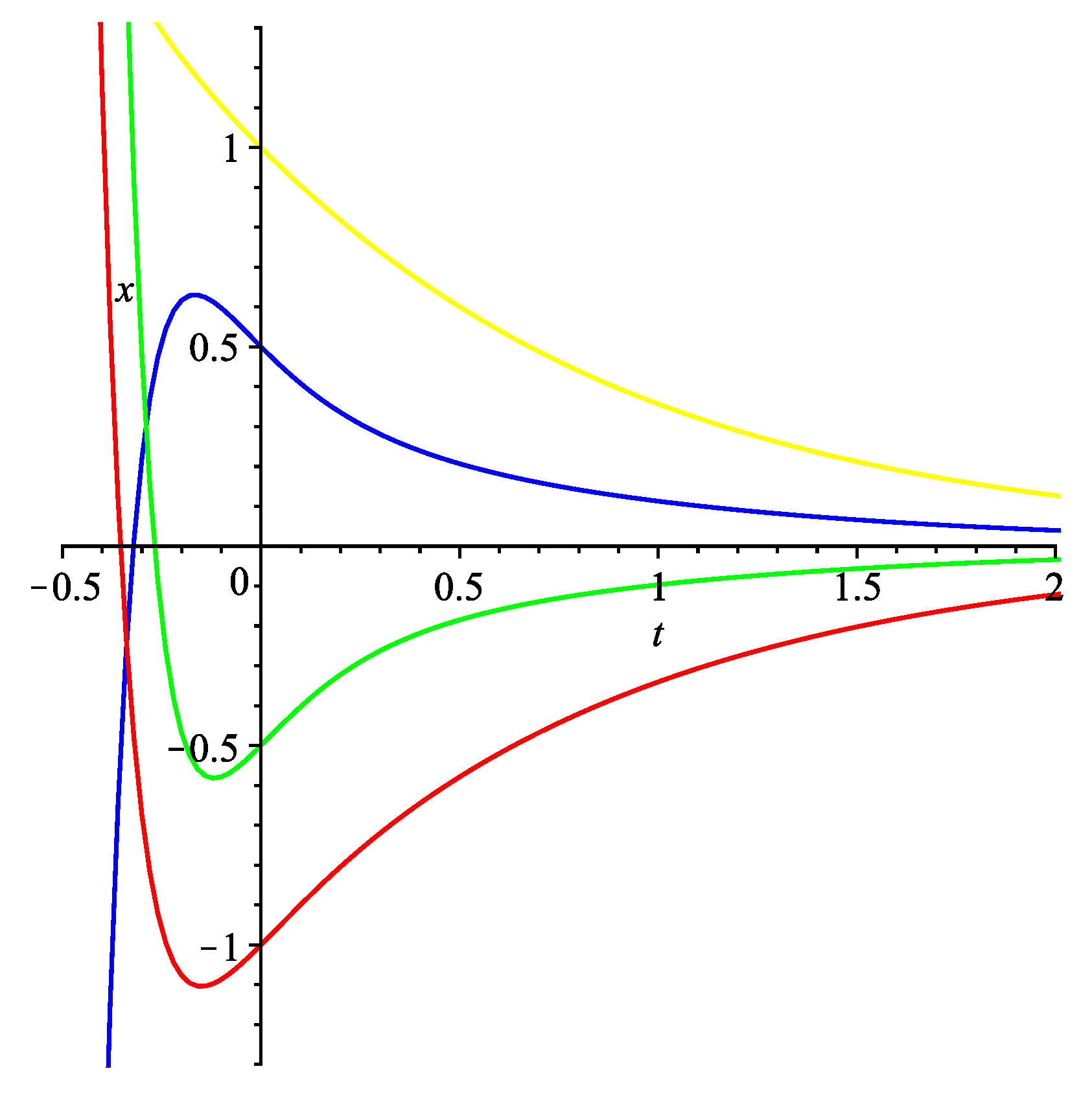
System (63) is exponentially stable with the decay rate . Some graphs of the solutions to system (63) are shown in Figure 1.
Figure 1.
Graphs of the solutions to (63).
4. Time-Invariant Stabilization by Static Output Feedback
Consider a linear control system defined by a linear differential equation of n-th order with time-varying uncertain coefficients satisfying (2); the input is a stationary linear combination of m variables and their derivatives of order ; the output is a k-dimensional vector of stationary linear combinations of the state x and its derivatives of order :
is an input vector; is an output vector. Let the control in (64), (65) have the form of linear static output feedback
We suppose that the gain matrix U is time-invariant. The closed-loop system has the form
where the coefficients of (67) depends on , , , U. On the basis of system (64), (65), we construct the -matrix , , , and the -matrix , , , where for and for . Denote by J the matrix whose entries of the first superdiagonal are equal to unity and whose remaining entries are zero; we set . By denote the trace of a matrix Q.
Definition 2.
Theorem 4.
The proof of Theorem 4 is identical to the proof of Theorem 1 [38].
Let us introduce the mapping that unwraps an -matrix row-by-row into the column vector . For any -matrices X, Y, the obvious equality holds:
Let us construct the -matrices
and the -matrix
Denote , . Equalities (68) represent a linear system of n equations with respect to the coefficients of the matrix U. Taking into account (69), one can rewrite system (68) in the form
Suppose that matrices (70) are linearly independent. Then . Hence, the system of linear equations (71) is solvable for any vector . In particular, system (71) has the solution .
By Theorem 3, for any pregiven there exists a constant vector such that system (67) with is exponentially stable with the decay rate . Resolving system (71) for that r with respect to and constructing U by the formula , we find the gain matrix of feedback (66) exponentially stabilizing system (64), (65) with the decay rate . Thus, the following theorem is proved.
Theorem 5.
Example 2.
Let . Consider a control system
System (72), (73) has the form (64), (65) where , . Suppose that is an arbitrary measurable function satisfying the condition . Let be an arbitrary number. One needs to construct feedback control (66), where , with constant , , providing exponential stability of the closed-loop system with the decay rate θ. Without loss of generality, we suppose that . By Theorem 4, the closed-loop system has the form
where have the form (68), and
At first, let us construct a constant vector , providing exponential stability of (74). For constructing r we use the proof of Theorem 3. We have , , , . Then , , , . Set . Using the proof of Theorem 2, we construct the polynomials (15), (16) such that properties , , are satisfied:
Then , , , , , . Conditions , , hold. Coefficients , , have the form
All solutions of (76) are exponentially stable with the decay rate θ. Let us check it.
The substitution , , reduces Equation (76) to the system
Let us show that the system (77) is exponentially stable with the decay rate θ. The substitution
reduce the system (77) to the system
Let us show that system (79) is Lyapunov stable. Set . Let us find the successive principal minors , , of S. We have , , . Then in the sense of quadratic forms. Next, we have
Let us find the principal minors of (80). We obtain
Hence, (80) is negative-semidefinite. Thus, the system (79) is stable. Hence, all solutions of (79) are bounded as . Then, by (78), , , as required.
Next, let us construct matrices (70) and P. We obtain . Obviously, and matrices (70) are linearly independent. Resolving system (71) where has the form (75), we obtain
Thus, the gain matrix has the form
We obtain that feedback (66) with the matrix (81) exponentially stabilizes the system (72), (73) with the decay rate θ.
We have . The function is ω-periodic with the period . The free system
is equivalent to the system of differential equations
System (83) is ω-periodic. Since system (83) is piecewise constant, the monodromy matrix for system (83) can be found explicitly. Calculating approximately eigenvalues , , and of , we obtain , . Hence, . Thus, system (83) (and hence, Equation (82)) is unstable. Let us set , . The gain matrix (81) has the form
The closed-loop system (76) take the form
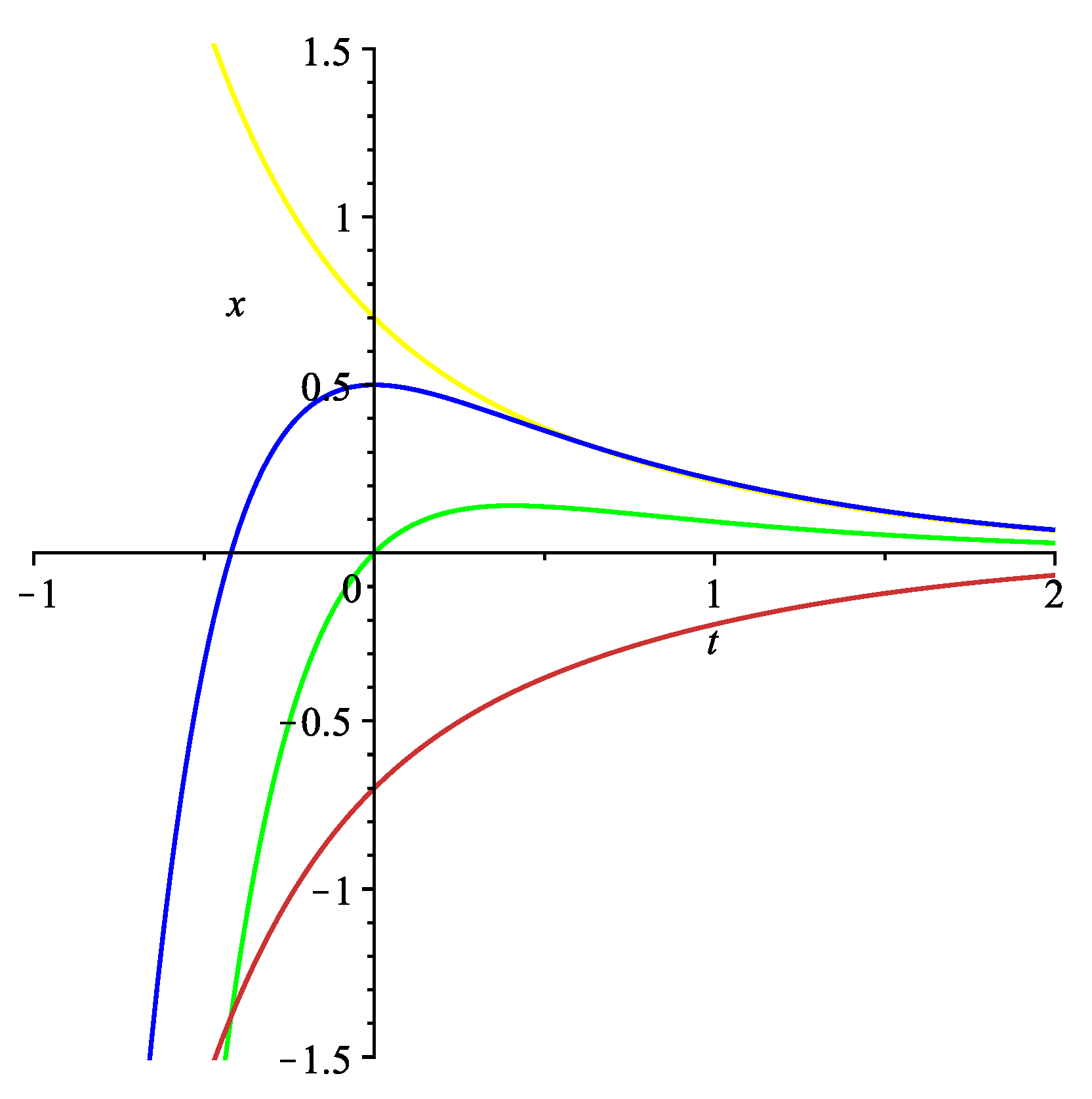
System (84) is exponentially stable with the decay rate . Some graphs of the solutions to system (84) are shown in Figure 2.
Figure 2.
Graphs of the solutions to (84).
5. Conclusions
We examined the problem of exponential stabilization with any pregiven decay rate for a linear time-varying differential equations with uncertain bounded coefficients by means of stationary linear static feedback. We have received sufficient conditions for the solvability of this problem by state and output feedback. For this purpose, the first Lyapunov method and the Levin theorem on non-oscillatory absolute stability were used. We plan to extend these results to systems of differential equation including systems with delays. A further development of these results may be their extension to systems (64), (65), (66), when and (or) depend on t. So far this question remains open.
Author Contributions
All authors contributed equally to this manuscript. All authors have read and agreed to the published version of the manuscript.
Funding
This research was funded by the Ministry of Science and Higher Education of the Russian Federation in the framework of state assignment No. 075-00232-20-01, project 0827-2020-0010 “Development of the theory and methods of control and stabilization of dynamical systems” and by the Russian Foundation for Basic Research (project 20–01–00293).
Acknowledgments
The research was performed using computing resources of the collective use center of IMM UB RAS “Supercomputer center of IMM UB RAS”.
Conflicts of Interest
The authors declare no conflict of interest.
References
- Aeyels, D.; Peuteman, J. Uniform asymptotic stability of linear time-varying systems. In Open Problems in Mathematical Systems and Control Theory; Blondel, V., Sontag, E.D., Vidyasagar, M., Willems, J.C., Eds.; Springer: London, UK, 1999; pp. 1–5. [Google Scholar] [CrossRef]
- Ilchmann, A.; Owens, D.H.; Prätzel-Wolters, D. Sufficient conditions for stability of linear time-varying systems. Syst. Control Lett. 1987, 9, 157–163. [Google Scholar] [CrossRef][Green Version]
- Bylov, B.F.; Vinograd, R.E.; Grobman, D.M.; Nemytskii, V.V. Theory of Lyapunov Exponents; Nauka: Moscow, Russia, 1966. [Google Scholar]
- Demidovich, B.P. Lectures on the Mathematical Stability Theory; Nauka: Moscow, Russia, 1967. [Google Scholar]
- Zhu, J.J. A necessary and sufficient stability criterion for linear time-varying systems. In Proceedings of the 28th Southeastern Symposium on System Theory, Baton Rouge, Louisiana, USA, 31 March–2 April 1996; pp. 115–119. [Google Scholar] [CrossRef]
- Levin, A.Y. Absolute nonoscillatory stability and related questions. St. Petersburg Math. J. 1993, 4, 149–161. [Google Scholar]
- Ragusa, M.A. Necessary and sufficient condition for a VMO function. Appl. Math. Comput. 2012, 218, 11952–11958. [Google Scholar] [CrossRef]
- Zhou, B. On asymptotic stability of linear time-varying systems. Automatica 2016, 68, 266–276. [Google Scholar] [CrossRef]
- Wan, J.-M. Explicit solution and stability of linear time-varying differential state space systems. Int. J. Control Autom. Syst. 2017, 15, 1553–1560. [Google Scholar] [CrossRef]
- Vrabel, R. A note on uniform exponential stability of linear periodic time-varying systems. IEEE Trans. Autom. Control 2020, 65, 1647–1651. [Google Scholar] [CrossRef]
- Zhou, B.; Tian, Y.; Lam, J. On construction of Lyapunov functions for scalar linear time-varying systems. Syst. Control Lett. 2020, 135, 104591. [Google Scholar] [CrossRef]
- Kharitonov, V.L. The asymptotic stability of the equilibrium state of a family of systems of linear differential equations. Differ. Uravn. 1978, 14, 2086–2088. [Google Scholar]
- Petersen, I.R. A stabilization algorithm for a class of uncertain linear systems. Syst. Control Lett. 1987, 8, 351–357. [Google Scholar] [CrossRef]
- Zhou, K.; Khargonekar, P.P. Robust stabilization of linear systems with norm-bounded time-varying uncertainty. Syst. Control Lett. 1988, 10, 17–20. [Google Scholar] [CrossRef]
- Khargonekar, P.P.; Petersen, I.R.; Zhou, K. Robust stabilization of uncertain linear systems: Quadratic stabilizability and H∞ control theory. IEEE Trans. Autom. Control 1990, 35, 356–361. [Google Scholar] [CrossRef]
- Xie, L.; de Souza, C.E. Robust H∞ control for linear systems with norm-bounded time-varying uncertainty. IEEE Trans. Autom. Control 1992, 37, 1188–1191. [Google Scholar] [CrossRef]
- Zhabko, A.P.; Kharitonov, V.L. Necessary and sufficient conditions for the stability of a linear family of polynomials. Autom. Remote Control 1994, 55, 1496–1503. [Google Scholar]
- Kharitonov, V.L. Robust stability analysis of time delay systems: A survey. Annu. Rev. Control 1999, 23, 185–196. [Google Scholar] [CrossRef]
- Sadabadi, M.S.; Peaucelle, D. From static output feedback to structured robust static output feedback: A survey. Annu. Rev. Control 2016, 42, 11–26. [Google Scholar] [CrossRef]
- Blanchini, F.; Colaneri, P. Uncertain systems: Time-varying versus time-invariant uncertainties. In Uncertainty in Complex Networked Systems. Systems and Control: Foundations and Applications; Başar, T., Ed.; Birkhäuser: Cham, Switzerland, 2018. [Google Scholar] [CrossRef]
- Carniato, L.A.; Carniato, A.A.; Teixeira, M.C.M.; Cardim, R.; Mainardi Junior, E.I.; Assunção, E. Output control of continuous-time uncertain switched linear systems via switched static output feedback. Int. J. Control 2018, 93, 1127–1146. [Google Scholar] [CrossRef]
- Gu, D.-K.; Liu, G.-P.; Duan, G.-R. Robust stability of uncertain second-order linear time-varying systems. J. Frankl. Instit. 2019, 356, 9881–9906. [Google Scholar] [CrossRef]
- Barmish, B.R. Necessary and sufficient conditions for quadratic stabilizability of an uncertain system. J. Optim. Theory Appl. 1985, 46, 399–408. [Google Scholar] [CrossRef]
- Xie, L.; Shishkin, S.; Fu, M. Piecewise Lyapunov functions for robust stability of linear time-varying systems. Syst. Control Lett. 1997, 31, 165–171. [Google Scholar] [CrossRef]
- Ramos, D.C.W.; Peres, P.L.D. An LMI approach to compute robust stability domains for uncertain linear systems. In Proceedings of the 2001 American Control Conference, Arlington, VA, USA, 25–27 June 2001. [Google Scholar] [CrossRef]
- Montagner, V.F.; Peres, P.L.D. A new LMI condition for the robust stability of linear time varying systems. In Proceedings of the 42nd IEEE Conference on Decision and Control, Maui, HI, USA, 9–12 December 2003. [Google Scholar] [CrossRef]
- Bliman, P.A. A convex approach to robust stability for linear systems with uncertain scalar parameters. SIAM J. Control Optim. 2004, 42, 2016–2042. [Google Scholar] [CrossRef]
- Geromel, J.C.; Colaneri, P. Robust stability of time varying polytopic systems. Syst. Control Lett. 2006, 55, 81–85. [Google Scholar] [CrossRef]
- Chesi, G.; Garulli, A.; Tesi, A.; Vicino, A. Robust stability of time-varying polytopic systems via parameter-dependent homogeneous Lyapunov functions. Automatica 2007, 43, 309–316. [Google Scholar] [CrossRef]
- Hu, T.; Blanchini, F. Non-conservative matrix inequality conditions for stability/stabilizability of linear differential inclusions. Automatica 2010, 46, 190–196. [Google Scholar] [CrossRef]
- Chesi, G. Sufficient and necessary LMI conditions for robust stability of rationally time-varying uncertain systems. IEEE Trans. Autom. Control 2013, 58, 1546–1551. [Google Scholar] [CrossRef]
- Gritli, H.; Belghith, S. New LMI conditions for static output feedback control of continuous-time linear systems with parametric uncertainties. In Proceedings of the 2018 European Control Conference (ECC), Limassol, Cyprus, 12–15 June 2018. [Google Scholar] [CrossRef]
- Gritli, H.; Belghith, S.; Zemouche, A. LMI-based design of robust static output feedback controller for uncertain linear continuous systems. In Proceedings of the 2019 International Conference on Advanced Systems and Emergent Technologies (IC_ASET), Hammamet, Tunisia, 19–22 March 2019. [Google Scholar] [CrossRef]
- Gelig, A.H.; Zuber, I.E. Invariant stabilization of classes of uncertain systems with delays. Autom. Remote Control 2011, 72, 1941–1950. [Google Scholar] [CrossRef]
- Zakharenkov, M.; Zuber, I.; Gelig, A. Stabilization of new classes of uncertain systems. IFAC-PapersOnLine 2015, 48, 1024–1027. [Google Scholar] [CrossRef]
- Gelig, A.H.; Zuber, I.E.; Zakharenkov, M.S. New classes of stabilizable uncertain systems. Autom. Remote Control 2016, 77, 1768–1780. [Google Scholar] [CrossRef]
- Gelig, A.K.; Zuber, I.E. Multidimensional output stabilization of a certain class of uncertain systems. Autom. Remote Control 2018, 79, 1545–1557. [Google Scholar] [CrossRef]
- Zaitsev, V.A. Modal control of a linear differential equation with incomplete feedback. Differ. Equ. 2003, 39, 145–148. [Google Scholar] [CrossRef]
© 2020 by the authors. Licensee MDPI, Basel, Switzerland. This article is an open access article distributed under the terms and conditions of the Creative Commons Attribution (CC BY) license (http://creativecommons.org/licenses/by/4.0/).