1. Introduction
In
, the concept of closed
k-surface was introduced in [
1,
2,
3] and its digital topological characterizations were also studied in many papers including [
4,
5,
6,
7,
8,
9,
10]. Many explorations of various properties of closed
k-surfaces have been proceeded from the viewpoints of digital topology, digital geometry, and fixed point theory [
1,
2,
4,
5,
6,
9,
10,
11,
12,
13,
14,
15,
16]. Despite the studies of the earlier works [
5,
6,
7,
17,
18], given (digital) closed
k-surfaces, we need to further study both the digital
k-contractibility of
n-times iterated connected sums of closed
k-surfaces and the non-almost fixed point property of them. Besides, we need to find a condition determining if a digital image
in
has the
AFPP. This approach facilitates the studies of digital geometry and fixed point theory.
So far, there were several kinds of approaches to establish a digital
k-surface [
3,
5,
6,
7,
9]. In the present paper we will often use the symbol “
” to define a new term, and given a digital image
is assumed to be
k-connected and its cardinality
. Since the digital surface theory is related to computer science, the present paper mainly deals with digital
k-surfaces
X in
. Hence, we need to consider a binary digital image structure
in
, denoted by
, where the
-adjacency is concerned with the set
. To be precise, in the case of the study of a closed
k-surface
, we should assume
X in the binary digital picture
P. For instance,
Let us now study a (digital) closed k-surface X with one of the above frames P of (1).
Given two closed
k-surfaces
and
in
, the concept of digital connected sum of them was firstly introduced in [
5,
7] by using several types of simple closed
k-curves in
(see
Section 4). Hereafter, we denote by
a (simple) closed
k-surface in
(for the details, see Definition 5). Indeed, when studying various properties of closed
k-surfaces, some digital
k-homotopic features of
such as the
k-contractibility are very important in digital surface theory.
For convenience, let
(resp.
) be the minimal simple closed 6-surface (resp. the minimal simple closed 18-surface) [
6]. The present paper deals with the following queries.
(Q1) We may ask if it is possible to propose the simple closed 6-surface in the picture instead of .
Hereafter, the operator “
” means the digital connected sum (see
Section 4 for the details).
(Q2) How many types of exist ?
Let . Then we have the following queries:
(Q3) How can we formulate ?
Given an , we may raise the following query.
(Q4) How many types of exist ?
Let . Then we have the following questions:
(Q5) How can we formulate ?
(Q6) How about the almost fixed point property (AFPP for short) of ?
(Q7) How about the AFPP of ?
(Q8) What are some properties relating to the AFPP of a closed k-surface in .
The rest of the paper is organized as follows:
Section 2 refers to some notions involving a digital
k-surface and a connected sum of two digital
k-surfaces.
Section 3 stresses some utilities of the minimal simple closed surfaces
,
,
, and
from the viewpoints of digital curve and digital surface theory.
Section 4 shows several types of
n-times iterated connected sums of the minimal simple closed 6-surfaces, e.g.,
.
Section 5 proves that there are only two types of connected sums
up to 18-isomorphism. Besides, in the case of
, we prove that only one type of
exists up to 18-isomorphism.
Section 6 intensively explores the 18-contractibility of an
n-times iterated connected sum of simple closed 18-surfaces
.
Section 7 proves that both
and
do not have the almost fixed point property,
,
. Thus, these approaches play important roles in digital topology, digital geometry, fixed point theory, and so on.
Section 8 concludes the paper with some remarks.
2. Basic Notions Involving Digital k-Surfaces and Connected Sums of Closed k-Surfaces
Let us now recall some terminology from digital curve and digital surface theories. Let and represent the sets of natural numbers and integers, respectively.
We call a set
with a
k-adjacency a digital image, denoted by
[
4,
5,
7,
9,
10]. In particular, in digital surface theory, we are absolutely required to consider a closed
k-surface
with a
k-adjacency in a binary digital picture
[
19,
20], where
and the
-adjacency is concerned with the set
. In order to study
in
, we need the
k-adjacency relations of
which are generalizations of the commonly used
k-adjacency of
,
, and
k-adjacency of
,
. As a generalization of this approach into those of
, a paper [
17] firstly established the digital
k-connectivity of
, as follows: We say that distinct points
are
k-(or
-)adjacent if they satisfy the following property [
17] (for the details, see also [
21,
22]).
For a natural number
t,
, we say that distinct points
These
-adjacency relations of
are determined according to the number
[
17] (see also [
21,
22]). Using the statement of (2), the
k-adjacency relations of
are obtained [
17] (see also [
21,
22]), as follows
A digital image
in
can indeed be considered to be a set
with one of the
k-adjacency relations of (3). Using the
k-adjacency relations of
of (3), we say that a digital
k-neighborhood of
p in
is the set [
20]
Furthermore, we often use the notation [
19]
For
with
, the set
with 2-adjacency is called a digital interval [
19]. Let us now recall some terminology and notions [
17,
19] which are used in this paper.
It is natural to say that a digital image is k-disconnected if there are nonempty sets such that , and further, there are no points and such that and are k-adjacent.
We say that a digital image is k-connected (or k-path connected) if it is not k-disconnected. Owing to this approach, we see that a singleton subset of is obviously k-connected.
Given a
k-connected digital image
whose cardinality is greater than 1, the so-called
k-path with
elements in
is assumed to be a finite sequence
such that
and
are
k-adjacent if
[
19]. Eventually, in the case that a digital image
is
k-connected, for any distinct points such as
in
, we see that there is a
k-path
such that
and
.
For a digital image
, the
k-component of
is defined to be the maximal
k-connected subset of
containing the point
x [
19].
We say that a simple
k-path means a finite set
such that
and
are
k-adjacent if and only if
[
19]. In the case of
and
, we denote the length of the simple
k-path with
.
A simple closed
k-curve (or simple
k-cycle) with
l elements in
, denoted by
[
17,
19],
,
is the set of even natural numbers, means the finite set
such that
and
are
k-adjacent if and only if
.
For a digital image
, a digital
k-neighborhood of
with radius
is defined in
X as the following subset [
17] of
X
where
is the length of a shortest simple
k-path from
to
x and
. For instance, for
, we obtain [
17]
For a digital image
, since
X is a subset of
, if it is assumed as a subspace of the typical
n-dimensional Euclidean topological space, it can naturally be a discrete topological subspace. However, as mentioned above, since a digital image
with the digital
k-connectivity (see (3)) is a kind of a digital graph in
, the paper [
17] already established another metric for
. Eventually, the sets of (4) and (5) can be represented by using this metric on
X derived from
. The important thing is that this metric is different from the typical Euclidean metric. Indeed, a paper [
17] firstly established the metric using the “length of a shortest simple
k-path from
to
x” for two points
in
. Owing to the length of a shortest
k-path in (4), we prove that a
k-connected digital image
can be considered to be a metric space, as follows:
Let us consider the map
on a
k-connected (or
k-path connected) digital image
defined by
such that
Owing to (6), we can see that
if
and further, we obviously see that the function
satisfies the metric axioms. Thus, we can represent the set
of (4) in the following way
Consequently, we can represent the set of (5), as follows:
Rosenfeld [
23] defined the notion of digital continuity of a map
by saying that
f maps every
-connected subset of
into a
-connected subset of
.
Motivated by this approach, using the set of (5) or (8), we can represent the digital continuity of a map between digital images by using a digital
k-neighborhood (see Proposition 1 below). Due to this approach, we have strong advantages of calculating digital fundamental groups of digital images
in terms of the unique digital lifting theorem [
17], the digital homotopy lifting theorem [
24], a radius 2-
-isomorphism and its applications [
24], the study of multiplicative properties for a digital fundamental group [
25,
26], a Cartesian product of the covering spaces [
26], and so on, as follows:
Proposition 1. [17,18] Let and be digital images in and , respectively. A function is (digitally) -continuous if and only if for every . In Proposition 1, in the case
and
, the map
f is called a ‘
k-continuous’ map. Since an
n-dimensional digital image
is considered to be a set
X in
with one of the
k-adjacency relations of (3) (or a digital
k-graph [
27]), regarding a classification of
n-dimensional digital images, we prefer the term a
-isomorphism (or
k-isomorphism) as in [
27] (see also [
18]) to a
-homeomorphism (or
k-homeomorphism) as in [
28].
Definition 1. [27] (see also a -homeomorphism in [28]) Consider two digital images and in and , respectively. Then a map is called a -isomorphism if h is a -continuous bijection and further, is -continuous. Then we use the notation . Besides, in the case , we use the notation . The following notion of interior is often used in establishing a digital connected sum of digital closed k-surfaces.
Definition 2. [5] Let be a closed k-curve in . A point x of , the complement of in , is said to be interior to if it belongs to the bounded -connected component of . The following digital images
,
, and
in
[
5,
6,
17] have essentially been used in establishing a connected sum and studying the digital fundamental group of a digital connected sum of closed
k-surfaces. Thus we now recall them.
[
6], where
is a digital image 8-isomorphic to the digital image,
.
[
6], where
is a digital image 4-isomorphic to the digital image,
.
[
6], where
is a digital image 8-isomorphic to the digital image,
.
Based on the pointed digital homotopy in [
29] (see also [
28]), the following notion of
k-homotopy relative to a subset
is often used in studying
k-homotopic properties of digital images
in
. For a digital image
and
, we often call
a digital image pair.
Definition 3. [17,24,28] Let and be a digital image pair and a digital image in and , respectively. Let be -continuous functions. Suppose there exist and a function such that for all and ;
for all , the induced function given by
for all is -continuous;
for all , the induced function given by for all is -continuous.
Then we say that H is a -homotopy between f and g [28]. Furthermore, for all , assume that the induced map on A is a constant which follows the prescribed function from A to Y [17] (see also [5]). To be precise, for all and for all .
Then we call H a -homotopy relative to A between f and g, and we say that f and g are -homotopic relative to A in Y, in symbols [17]. In Definition 3, if a
k-continuous map
is
k-homotopic to a certain constant map
, then we say that
f is (pointed)
k-null homotopic in
[
28]. In Definition 3, if
, then we say that
F is a pointed
-homotopy at
[
28]. When
f and
g are pointed
-homotopic in
Y, we use the notation
. In the case
and
,
f and
g are said to be pointed
k-homotopic in
Y and we use the notation
and
which denotes the
k-homotopy class of
g. If, for some
,
is
k-homotopic to the constant map in the space
X relative to
, then we say that
is
pointed k-contractible [
28]. Indeed, motivated by this approach, the notion of strong
k-deformation retract was developed in [
30].
Based on this
k-homotopy, the notion of digital homotopy equivalence was firstly introduced in [
31] (see also [
32]), as follows:
Definition 4. [31] (see also [32]) For two digital images and in , if there are k-continuous maps and such that the composite is k-homotopic to and the composite is k-homotopic to , then the map is called a k-homotopy equivalence and is denoted by . Besides, we say that is k-homotopy equivalent to . In the case that the identity map is k-homotopy equivalent to a certain constant map , we say that is k-contractible. In Definition 4, in the case , we say that is the same k-homotopy type as . In view of Definitions 3 and 4, we obviously see that the pointed k-contractibility implies the k-contractibility, the converse does not hold. Let be k-contractible. Then it is obvious that any k-loop in is k-null homotopic in .
The digital
k-fundamental group is induced from the pointed
k-homotopy [
28]. For a given digital image
, by using several notions such as digital
k-homotopy class [
29], Khalimsky operation of two
k-homotopy classes [
29], trivial extension [
28], the paper [
28] defined the digital
k-fundamental group, denoted by
. Indeed, in digital topology there are several kinds of digital fundamental groups [
33]. In addition, we have the following: If
X is pointed
k-contractible, then
is a trivial group [
28]. Hereafter, we shall assume that each digital image
is
k-connected.
Using the unique digital lifting theorem [
17] and the homotopy lifting theorem [
24] in digital covering theory [
4,
17,
18,
25,
26], for a non-
k-contractible space
, we obtain the following:
Theorem 1. [17] For a non-k-contractible , is an infinite cyclic group. Namely, for an
, it turns out that
is an infinite cyclic group. Regarding Theorem 1, we see that
has the trivial group,
[
24,
28] and further,
also has the trivial group because
is 4-contractible (see a certain idea from Example 1 below).
The following are proven in [
5,
7,
17,
18,
28].
In particular, both the non-8-contractibility of
and the non-4-contractibility of
play important roles in formulating a connected sum of two closed
k-surfaces (see
Section 4 for the details).
Whereas itself is not 6-contractible (see Theorem 1), identity map is 6-null homotopic in , where . To be precise, we obtain the following:
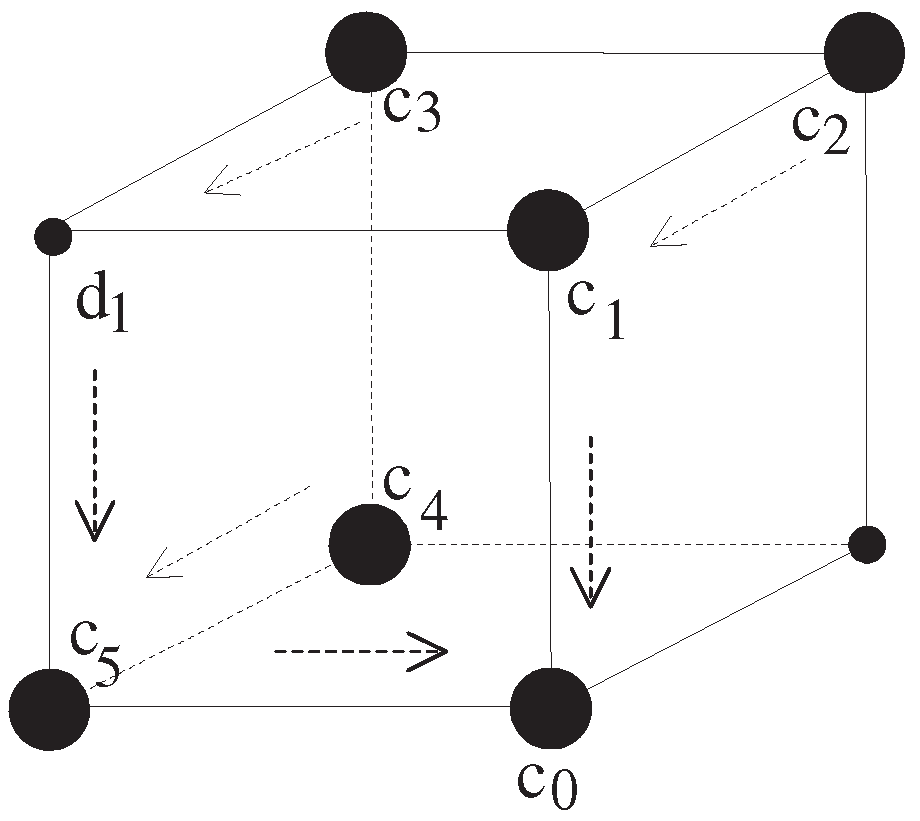
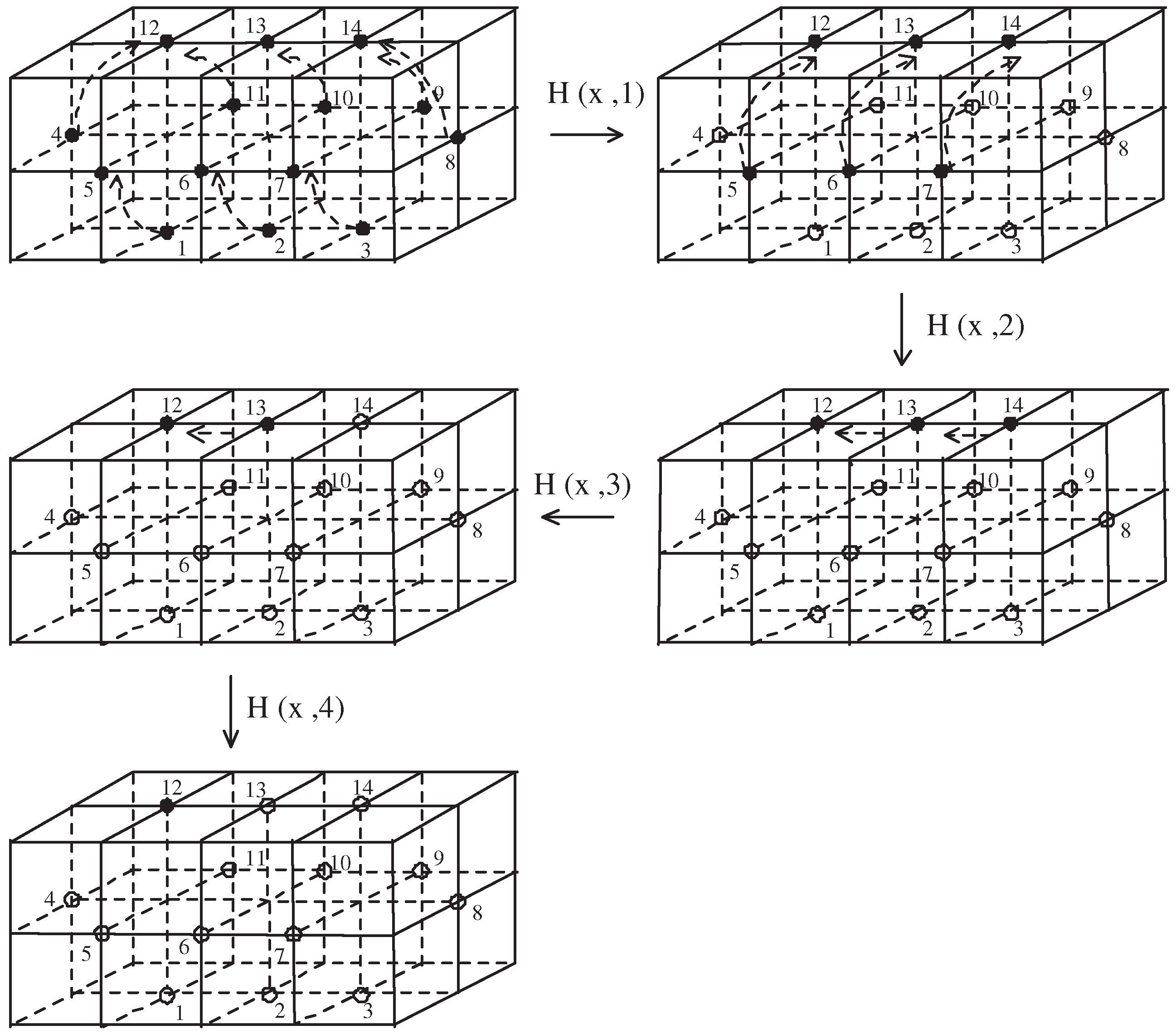
Example 1. Let us consider embedded in (see Figure 1), where . It is obvious that itself is not 6-contractible (see Theorem 1) because its 6-fundamental group is an infinite cyclic group [17]. However, identity map is clearly 6-null homotopic in (see Figure 1). To be specific, consider the map such that for Then we see that the map H is a 6-homotopy making 6-null homotopic in .
In view of Example 1, we observe that
is not 6-contractible in itself because its digital 6-fundamental group is an infinite cyclic group (see Theorem 1, for the details, see [
4,
17]).
Remark 1. The digital image is 6-contractible (see [34]). Hereafter, we denote the
n-dimensional digital cube (or digital
n-cube) with
Based on the 6-contractibility of
(see [
34]), using a similar method as the proof of it (see Remark 2 of [
8]), it is obvious that
is pointed
k-contractible for any
k-adjacency of
, where the
k-adjacency is that of (3) according to the dimension “
”.
Let us now examine if a k-isomorphism preserves a k-homotopy between two k-continuous maps.
Theorem 2. A k-isomorphism preserves a k-homotopy.
Proof. Given two spaces
,
in
, consider two
k-continuous functions
, relating to a
k-homotopy
, i.e.,
. Besides, further assume two
k-isomorphisms
and
, where
and
are considered in
. Then, it is clear that the two composites
are also
k-continuous maps from
to
. Based on the given
k-homotopy and the two
k-isomorphisms
and
, we now define the new map
Then, we obtain the following:
- (1)
for all , and ;
- (2)
for all , the induced function defined by for all is k-continuous;
- (3)
for all , the induced function defined by for all is k-continuous.
Thus we have a conclusion that G is a k-homotopy between and . □
Corollary 1. A k-isomorphism preserves the k-contractibility.
Proof. In Theorem 2, consider a k-contractible space such that for some point . Then, after replacing f (resp.g) by (resp. the constant map ), we prove the assertion. □
Corollary 2. A k-isomorphism preserves the pointed k-contractibility.
Proof. In Theorem 2 and Corollary 1, consider a pointed k-contractible space such that is k-homotopic to the constant map in the space relative to . After replacing f (resp.g) with (resp. the constant map ), we complete the proof. □
Using a method similar to the proof of Theorem 2, we obtain the following:
Corollary 3. A -isomorphism preserves a -homotopy equivalence.
3. Utilities of the Minimal Simple Closed 6-, 18- and 26-Surfaces; , ,
This section stresses some utilities of the minimal simple closed 6-, 18-, 26-surfaces, e.g.,
,
,
[
6] from the viewpoints of digital surface and digital homotopy theory. Indeed, these models for simple closed
k-surfaces play important roles in digital homotopy theory, digital surface theory, and fixed point theory. Furthermore, these have been used in formulating connected sums of some simple closed
k-surfaces,
[
5,
6,
7]. Besides, these were essentially used in proceeding with geometric realizations of digital
k-surfaces [
7,
8].
In order to study closed
k-surfaces in
, let us recall some terminology from digital surface theory, as follows: A point
is called a
k-corner if
x is
k-adjacent to two and only two points
y,
such that
y and
z are
k-adjacent to each other [
2]. The
k-corner
x is called
simple if
y,
z are not
k-corners and if
x is the only point
k-adjacent to both
y,
z.
is called a
generalized simple closedk-curve if what is obtained by removing all simple
k-corners of
X is a simple closed
k-curve [
2,
9]. For a
k-connected digital image
in
, we recall [
1,
2,
6]
In general, for a
k-connected digital image
in
, we can state [
7]
Hereafter, for a
k-surface in
[
5,
6], we call the set
of (9) the
minimal -adjacency neighborhood of
x in
X.
We say that two subsets,
and
of
, are
k-adjacent if
and there are points
and
such that
a and
b are
k-adjacent [
19]. In particular, in the case that
B is a singleton, say
, we say that
A is
k-adjacent to
x.
Papers [
5,
6,
7] introduced the notion of a closed
k-surface in
and various properties of it. However, in the present paper, we will stress the study of closed
k-surfaces in
with the following approach in [
3,
9,
10].
Definition 5. [3,10] Let be a digital image in , and . Then, X is called a closed k-surface if it satisfies the following. - (1)
In the case , for each point ,
- (a)
has exactly one k-component k-adjacent to x;
- (b)
has exactly two -components which are -adjacent to x; we denote by and these two components; and
- (c)
for any point (or in ), and .
Furthermore, if a closed k-surface X does not have a simple k-point, then X is called simple.
- (2)
In the case ,
- (a)
X is k-connected,
- (b)
for each point , is a generalized simple closed k-curve.
Furthermore, if the image is a simple closed k-curve, then the closed k-surface X is called simple.
Hereafter, we denote by
a
minimal simple closed k-surface in
(see
Figure 2). Furthermore, we recall the following closed
k-surfaces,
[
5]:
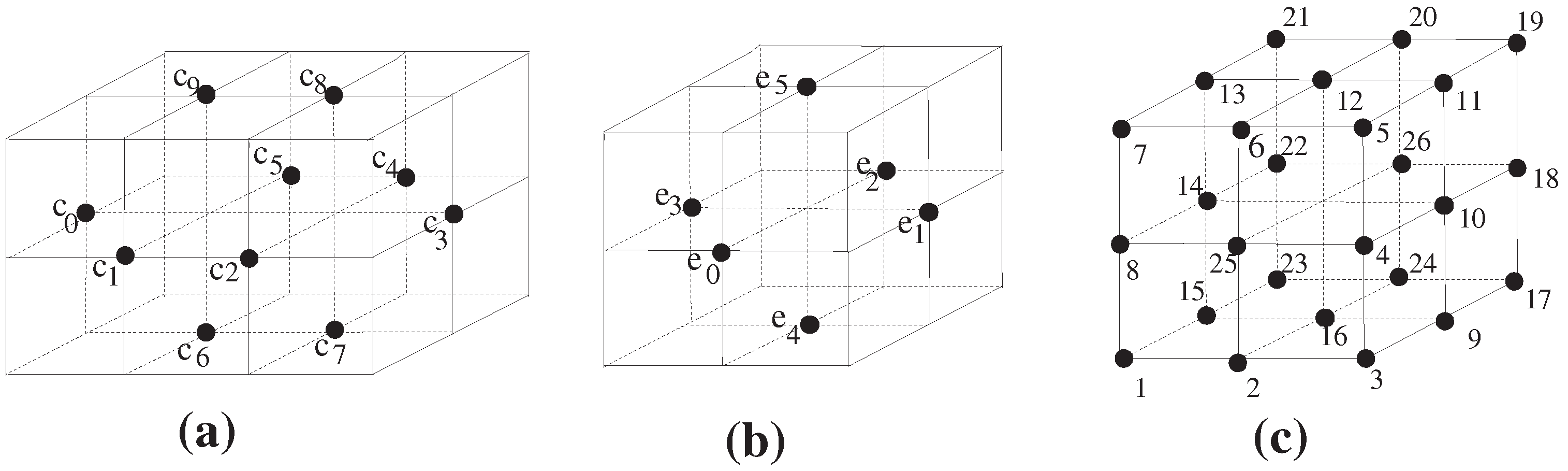
Remark 2. (1), where . Then, is the minimal simple closed 6-surface which is not 6-contractible (see Figure 2c). Namely, we obtain the digital picture according to (1). (2) , where d is the typical Euclidean distance in . Thus we obtain the digital picture according to (1).
Papers [
5,
6] indeed stated that
is 18-contractible and it is the minimal simple closed 18-surface. Besides, a paper [
5] proved the simply 18-connectedness of
and
. In addition, we see that
is simply 6-connected [
6,
8].
Let us further recall two simple closed k-surface, , as follows:
[
5,
6]. Thus we obtain the digital picture
according to (1).
which is 26-contractible [
5,
6] and is the minimal simple closed 26-surface (see
Figure 2b). Finally, we obtain the binary digital picture
according to (1). Besides, we recall the following:
Remark 3. [8] is pointed 18-contractible. Proposition 2. If given a digital image is not k-connected, then it is not k-contractible.
Proof. Owing to the second property of Definition 3, the assertion is proved. □
(Correction) In the Figure 4c of [
35], the given
K-topological space
should be referred to as “non-
K-retractible” instead of “
-retractible”.
4. Several Types of Models for
From now on we denote a (simple) closed
k-surface in
with
,
, which will be used in this paper. In particular, we will mainly consider an
,
in the picture as referred to in (1), i.e.,
Definition 6. [5] In , let (resp. ) be a closed -(resp. a closed -)surface, where . Consider and take , where or , or , and further, or , or , respectively.
Let be a -isomorphism. Remove and from and , respectively.
Identify and by using the -isomorphism f. Then, the quotient space is obtained by for and is denoted by , where , , and the map is the inclusion map.
Owing to Definition 6,
is obtained in
. Besides, the digital topological type of
absolutely depends on the choice of the subset
[
7]. Furthermore, the
k-adjacency of
is required as follows:
Remark 4. [5] In the quotient space , the subsets and in are assumed to be disjoint and there are no points and such that x and are k-adjacent, where . Then, the digital image is called a (digital) connected sum of and . As mentioned in Remark 4, the requirement involving the
k-adjacency of
in
plays an important role in studying connected sums of closed
-surfaces,
. Indeed, it turns out that [
8]
is also a closed
k-surface in the picture
, where
and
are closed
k-surfaces in the pictures
and
, respectively.
This section explores several methods of formulating the digital connected sums , and an n-times iterated connected sum of and that of .
At the moment, let us recall the previously-mentioned queries in
Section 1:
(Q1) After replacing in Definition 5(1) with , we may ask if it is possible to propose the simple closed 6-surface in the picture instead of .
This query is a reminder of the importance of the -adjacency of of a simple closed k-surface in the picture .
(Q2) Given the , how many models for exist ?
Let . Then we also have the following question:
(Q3) How can we formulate ?
To address these queries, we now study some properties of and . First of all, let us represent the question (Q1), as follows:
Unlike the three cases of (1), we may ask if there are other binary relations for , .
Remark 5. Regarding the question (Q1), we have a negative answer.
Proof. Consider the point indicated by the number “
” in
Figure 2c. Since the set
does not satisfy the properties of Definition 5(b) and (c), we cannot consider the picture
for the simple closed 6-surface
.
Similarly, using a method similar to the above approach, we cannot take the picture for . □
To address the above question (Q2), we have the following:
Lemma 1. Given an , the only one type of exists up to 6-isomorphism.
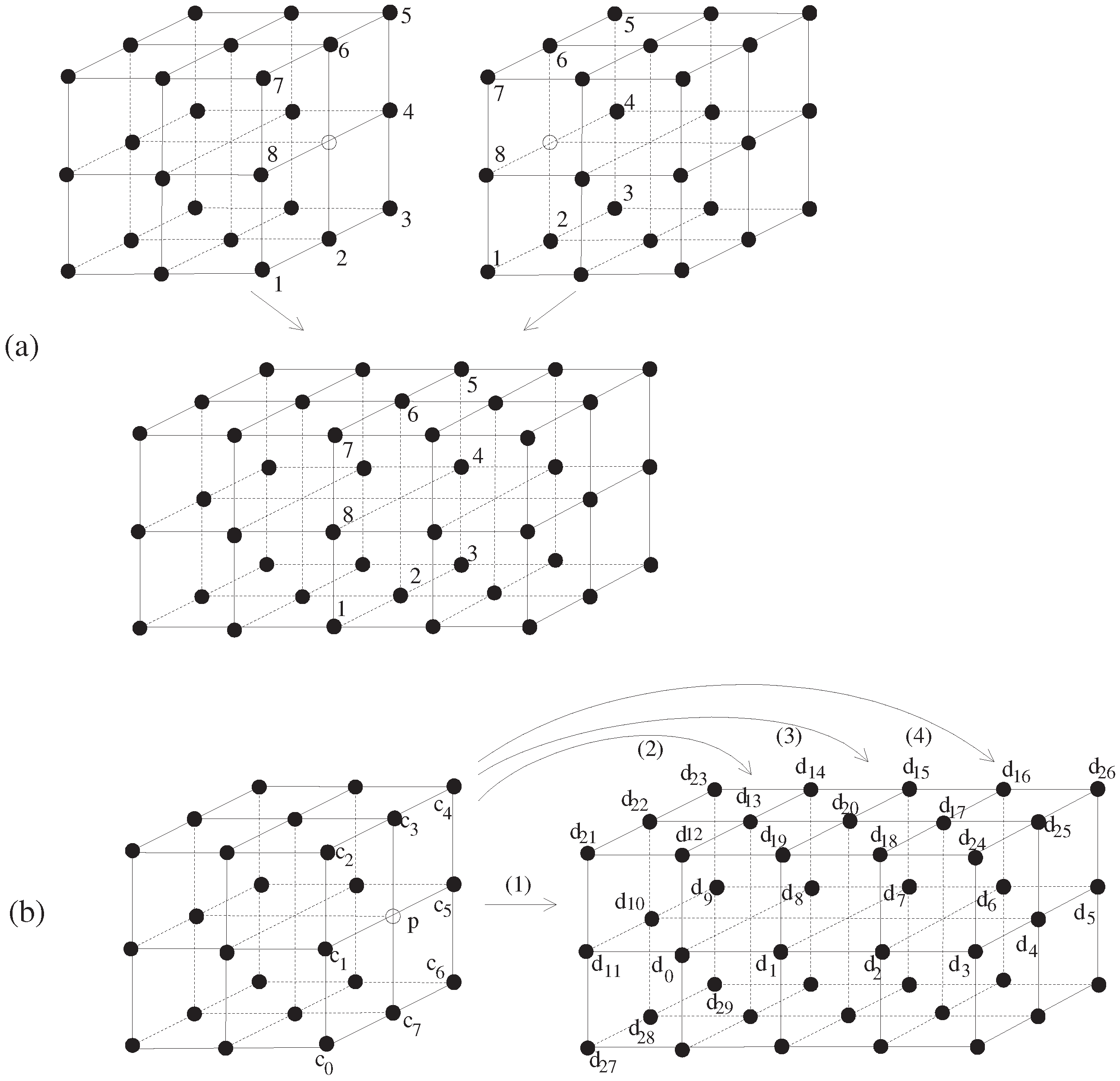
Proof. In order to formulate
, we should follow Definition 6 and Remark 4. In this situation, it is obvious that we obtain six cases of
(see one of the cases in
Figure 3a) which are 6-isomorphic to each other. Regarding the establishment of a connected sum
, suppose some possibility of taking one of the points indicated by the numbers “
” or “
” in
Figure 3a except the above-mentioned six points of
, e.g., the point
p of
Figure 3b. Then we have a contradiction to Remark 4. Hence we have the only one type of
as suggested in
Figure 3a up to 6-isomorphism. □
Regarding the question (Q3), we obtain the following:
Theorem 3. In the case of , many types of models for exist.
Proof. Let us formulate
. As shown in
Figure 3b, take a certain subset of
which is
-isomorphic to the set
, e.g., the set
in
(
Figure 3b). Depending on the choice of the corresponding part in
(see
Figure 3b), e.g., (1), (2), (3), and (4) in
Figure 3b, we have different types of shapes for
. To be precise, if we follow Case (1) in
Figure 3b, after deleting the two points
p and
in
Figure 3b, we obtain
by identifying the two sets
and
(see the method of Definition 6).
If we follow Case (2) in
Figure 3b, after deleting the two points
p and
in
Figure 3b, we obtain
by identifying the two sets
and
(see the method of Definition 6).
Using a method similar to these two approaches, after following Cases (3) and (4), we can also obtain . Then we observe some different shapes between the established via (2) and those formulated via (1) or (3). As a generalization of , we obviously obtain several types of models for . □
Motivated by Theorem 1 of [
8], we obtain the following:
Remark 6. [7] Given a closed 6-surface in the picture , we obtain that is a simple closed 6-surface in the picture . 6. Digital 18-Contractibility of and Simply k-Connectedness of ,
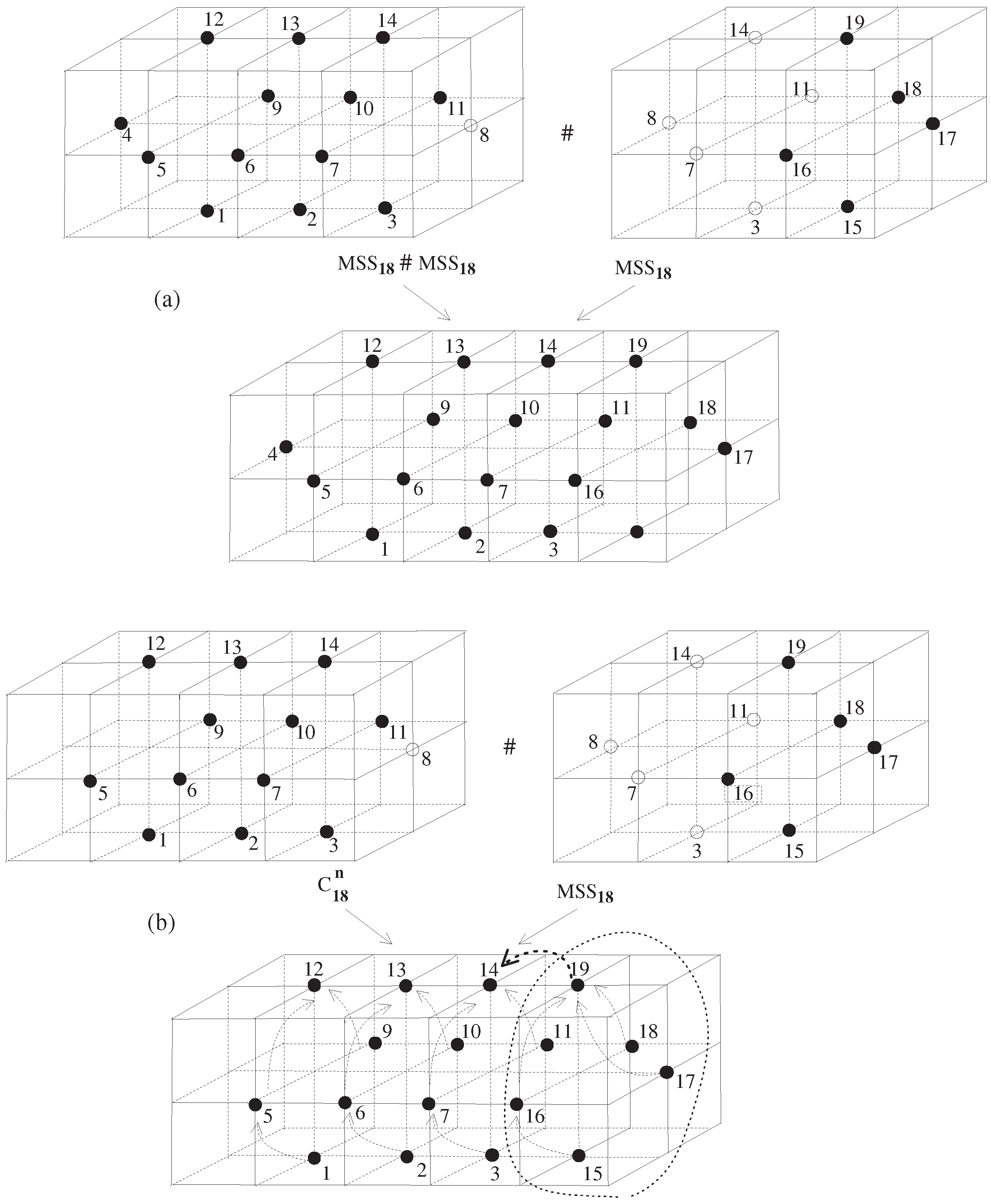
This section explores the digital 18-contractibility of and the simply k-connectedness of , . Hereafter, we consider the process and assume the case . As stated in the proof of Theorem 4, we obtain the following:
Lemma 2. In case , uniquely exists up to 18-isomorphism.
Definition 7. [17] For a k-connected digital image , if trivial, then we say that is simply k-connected. Lemma 3. [4,5,6,8] Each of , , , and is trivial. Proof. First of all, we see that the 6-fundamental group of
is a trivial group [
8]. Next, we see that each of
and
is 18-contractible and further,
is 26-contractible, the proof is completed. □
Proposition 3. A simple closed 6-surface is simply 6-connected.
Proof. It is obvious that is 6-connected. Using a trivial extension of a 6-loop on , we see that any 6-loop on is 6-null homotopic in so that is trivial, which completes the proof. □
Indeed, in [
5] we stated the simple closed
k-surface structure of a connected sum of two simple closed
k-surfaces (see Theorem 5.4 of [
5]).
Corollary 5. [8] Given two simple closed k-surfaces and in , is a simple closed k-surface in . Theorem 5. The n-times of connected sums of , , is simply 6-connected.
Proof. For convenience, for , using a method similar to the proof of the triviality of , since any 6-loop on is proved to be 6-null homotopic in by using a trivial extension, we obtain that is trivial. Besides, since is 6-connected, the proof is completed. □
Since is not 6-contractible, we obtain the following:
Remark 9. The connected sum is not 6-contractible.
Let us now prove the 18-contractibility of , as follows:
Theorem 6. The n-times of connected sums of , , is 18-contractible.
Before proving the assertion, as mentioned in (Case 1) of Theorem 4, at the moment we may only deal with the case
because
is 18-contractible (see the 18-homotopy of (9) of [
8] and Figure 2b of [
8]).
Proof. Let us prove the assertion using the mathematical induction.
(Step 1) A paper [
8] proved that
is 18-contractible (Remark 3 or the 18-homotopy of (9) proposed at the just above of Remark 2 of [
8]).
(Step 2) For any , assume that is 18-contractible.
Let us now prove that
is 18-contractible. Owing to the 18-contractibility of
, for some
, we may assume an 18-homotopy
supporting
for a certain point
.As usual, let
At the moment we should assume that the point
is not deleted in the process of (14). Then we now establish a map
such that the restriction of
of (15) to the set
is equal to the 18-homotopy
H of (13) on
B, where this
is that of (14). Besides, we may assume
and the singleton
is that of (13). We now need only consider the remaining part
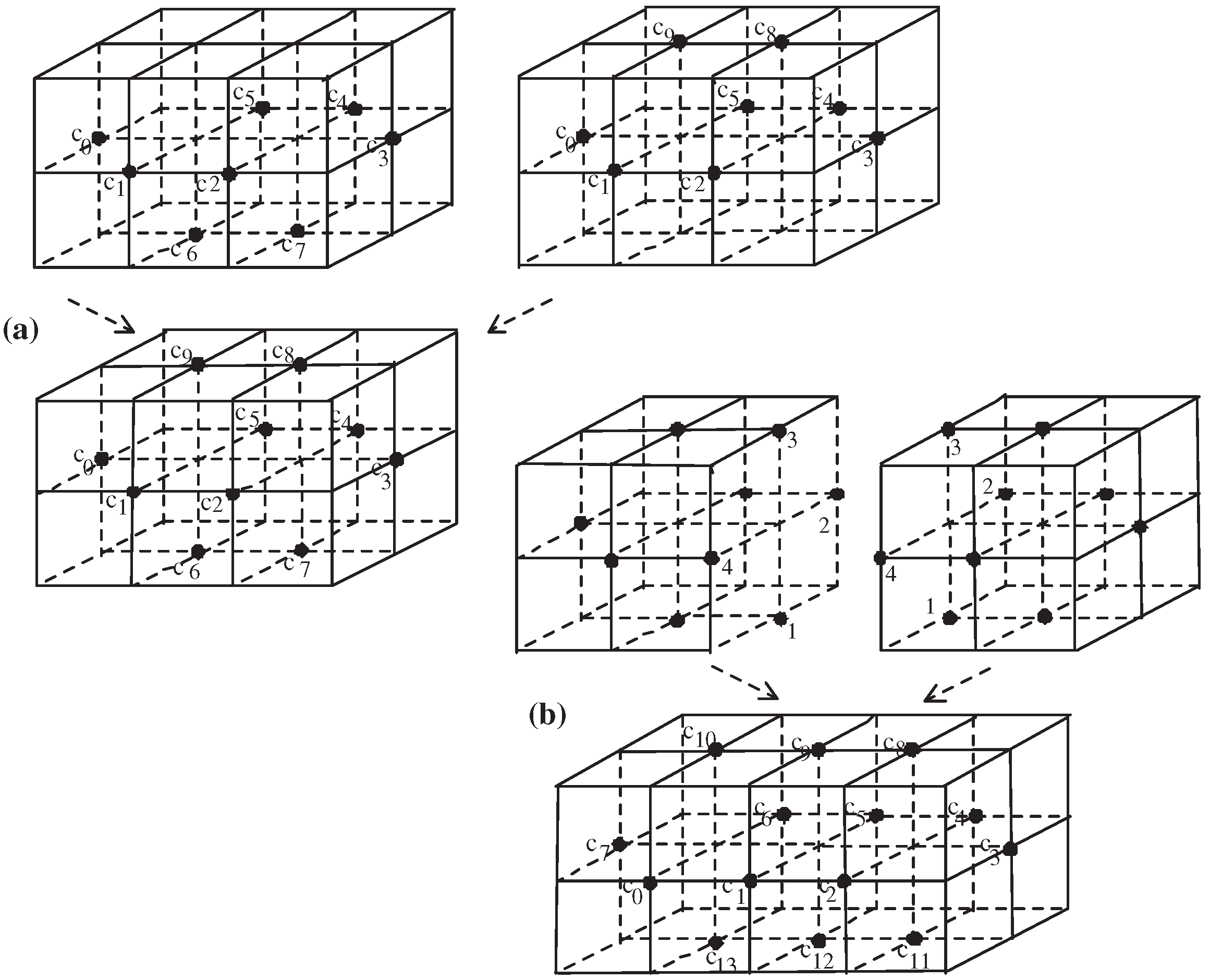
(see the right part of the dotted arrow of
Figure 5b). Using a method of the 18-contractibility of
combined with the given 18-homotopy
H of (13) (see
Figure 5b), we finally have an 18-homotopy
on
as in (15) supporting
for a the point
(see the right part of
Figure 5b shown by using the bold dotted arrow or the dotted ones). □
To explain the process of the proof of Theorem 6.7, motivated by the 18-contractibility of
(see Lemma 1 and Figure 2 of [
8]), we now consider the following:
Corollary 6. is 18-contractible.
Proof. Let us consider the map (see
Figure 6)
defined by
Then the map of
is an 18-homotopy making
18-contractible, i.e.,
. □
Corollary 7. The n-times of connected sum of , denoted by , is 26-contractible.
Proof. Since there is only one type of , is equal to which is 26-contractible, the proof is completed. □
7. Non-almost Fixed Point Property of
This section investigates if each of and has the AFPP. In order to address the problems proposed with (Q6)–(Q8), let us now recall the category of digital topological spaces and further, the fixed point property and the almost fixed point property from the viewpoint of digital topology.
We denote by
the category consisting of two data: The set of digital images
as
and the set of
-continuous maps between every pair of digital images
and
in
as
[
18].
We say that a digital image
in
has the fixed point property (for short FPP) [
23] if for every
k-continuous map
there is a point
such that
.
Due to the study of the non-FPP of a digital picture (or digital image) in [
23] (see Theorem 4.1 of [
23]), it is clear that only the digital image (or a digital picture)
with
has the FPP because a singleton set obviously has the FPP in DTC. Thus we need to recall the following (see Theorem 4.1 of [
23] and Remark 4.3 of [
34]):
Remark 10. [23,34] Only a digital image with has the FPP. This property is obviously a certain implication of Theorems 3.3 and 4.1 of [
23]. For the convenience of readers, we now confirm the assertion more precisely.
Proof. To wit the assertion, when establishing the notion of
AFPP in [
23] (see the bottom of the page 179 of [
23]), we obviously find that Rosenfeld [
23] stated two theorems such as Theorems 3.3 and 4.1 of [
23] relating to the above assertion. More precisely, as mentioned in the above part (see the part just below Section 4 of [
23]), a paper [
23] finally mentioned the AFPP of an
n-dimensional digital picture
or a general picture
in
. For instance, for the case of
, Rosenfeld [
23] proved the AFPP of it (see Theorem 3.3 of [
23]). To be precise, for any 2-continuous self-map
f of
, it turns out that
has the AFPP instead of the FPP. Then, Theorem 3.3 implies that not every 2-continuous self-map
f of
support the FPP of it. However, the assertion supports the
AFPP of
instead of the
FPP. Obviously, take a point
and
. Then consider any point
and further, according to Theorem 3.3 of [
23], consider a self-map
f of
defined by
for all
, and
. Then, the map
f is obviously 2-continuous and
f implies that
does not have the
FPP. As a good example, consider a simple digital interval
and consider the self-map
f of it, say
and
which supports Theorem 3.3 of [
23], which implies the
AFPP of it instead of the
FPP. Similarly, as mentioned in the beginning part of Section 4 of [
23], the paper [
23] proved that the
n-dimensional case
or a general picture
in
(see Theorem 4.1 of [
23]) has the
AFPP instead of the
FPP. Eventually, with the same method as above, for any general digital image
in
, we confirm the assertion of Remark 10. □
Owing to Remark 10, it turns out that the study of the
FPP in
DTC is very trivial. Henceforth, Rosenfeld [
23] firstly studied the almost fixed point property for digital images. Hence we need to stress the
AFPP in
DTC.
We say that a digital image
in
has the
almost fixed point property (for short
AFPP) [
23] if for every
k-continuous self-map
f of
, there is a point
such that
or
is
k-adjacent to
x.
Furthermore, a paper [
8] proved that each of
and
does not have the
AFPP (see Theorem 7 below). Thus the study of the
AFPP of
remains. Let us now address this issue.
Theorem 7. [8] (1) does not have the AFPP. (2) does not have the AFPP.
For and , motivated by Theorem 7, we may impose the following queries involving the AFPP of and .
(Q6) How about the AFPP of ?
(Q7) How about the AFPP of ?
To address these two queries, we first prove the non-AFPP of , as follows:
Lemma 4. does not have the AFPP.
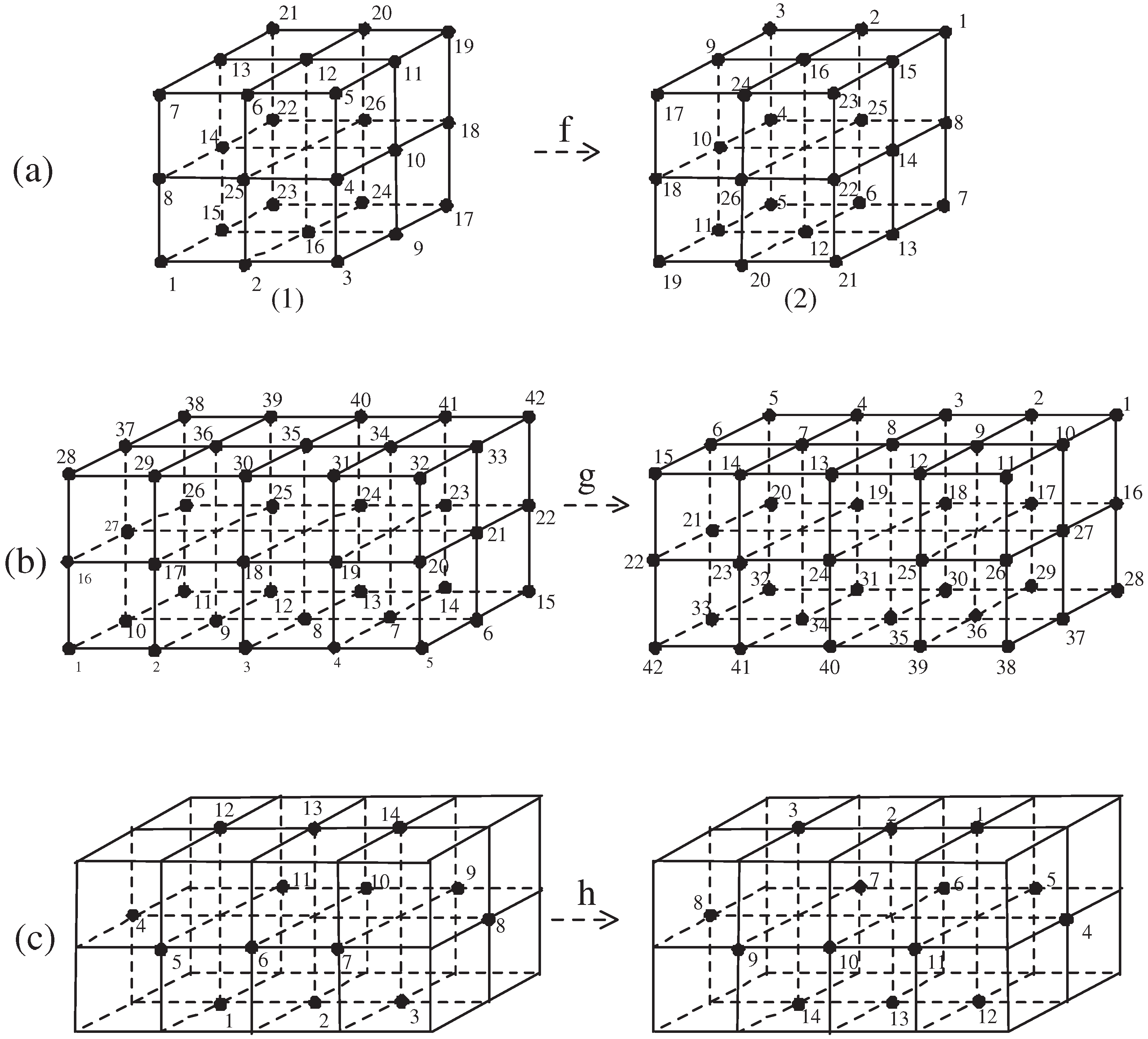
Proof. Consider the set
in
Figure 7a(1). Then, let
f be a self-map of
which is the composite of the three times reflections of
according to the three
-,
-, and
-planes in
(see the image of the map
f on the set
of
Figure 7a(2)). Whereas the map
f of
Figure 7a is obviously a 6-continuous self-bijection of
, it does not support the
AFPP of
. □
Theorem 8. The digital image in the binary picture does not have the .
Before proving the assertion, due to Lemma 1, we recall that uniquely exists up to 6-isomorphism.
Proof. Consider the set
in
Figure 7a(2). Then assume a self-map
g of
which is the composite of the three times reflections of
according to the three
-,
-, and
-planes in
(see the image of the map
g of
in
Figure 7a(2)). Whereas the map
g is obviously a 6-continuous bijection, it does not support the
AFPP of
. □
Corollary 8. Let be assumed as the set formulated via the method suggested in Figure 3b(1). The image in the binary picture does not have the . As a generalization of the non-AFPP of referred to in Theorem 7, we obtain the following:
Theorem 9. The digital image in the binary picture does not have the .
Proof. (Case 1) In case , we observe that . To be specific, by Theorem 7, we obtain does not have the AFPP in DTC.
(Case 2) In case
, let us now prove the non-
AFPP of
. With the hypothesis, by Theorem 4, we see that
has the shape suggested in
Figure 7c (just an example for
in
Figure 7c). Then, let
h be a self-map of
which is the composite of the three times reflections of
according to the
-,
-, and
-planes in
. Whereas the map
h is obviously an 18-continuous map, it does not support the
AFPP of
. □
In order to generalize Theorem 9, we need the following notion which is stronger than the isomorphism of Definition 1.
Definition 8. We say that a closed k-surface in the picture is -isomorphic to in the picture , if
- (1)
is k-isomorphic to and
- (2)
is -isomorphic to .
Remark 11. Comparing the isomorphism of Definition 1 and that of Definition 8, we observe that they are different.
As a generalization of Theorems 8 and 9, and Corollary 8, we obtain the following:
Proposition 4. Consider a (simple) closed k-surface in , with the binary relations of (11). If it is -isomorphic to in the picture and the set X is symmetric according to each of -, -, and -planes of , then does not have the AFPP.
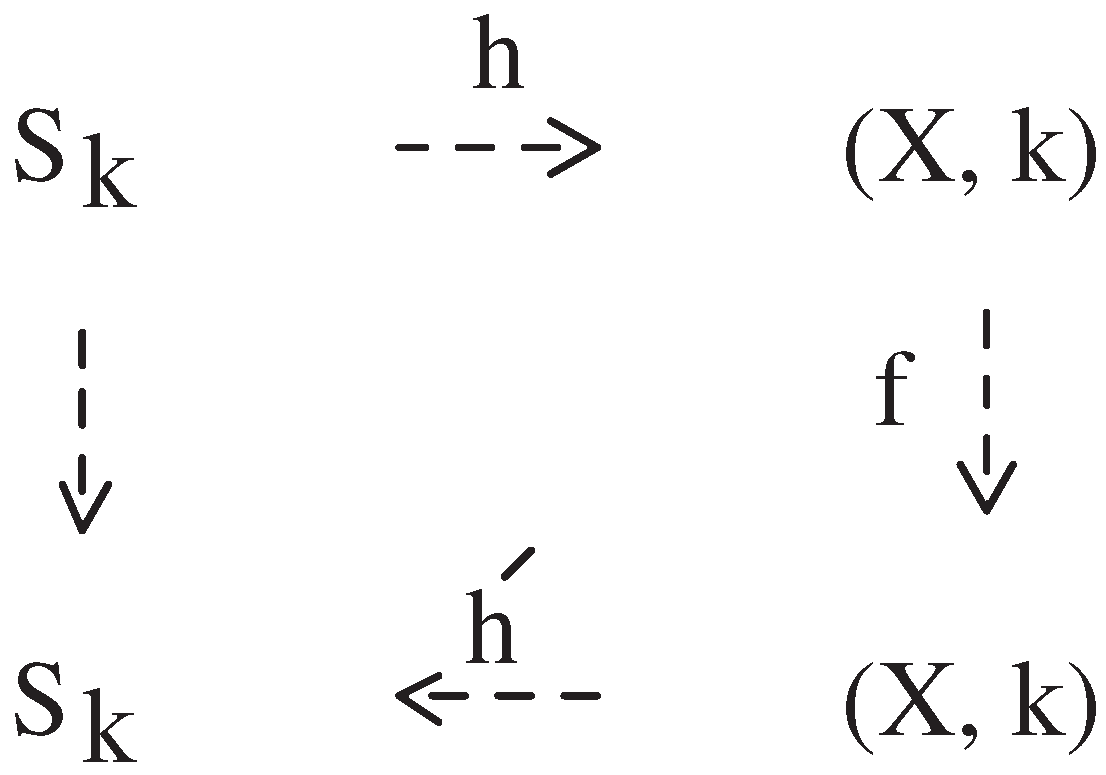
Proof. With the hypothesis, we proceed with the following several steps for proving the assertion. For convenience we may assume for some .
(Step 1) Take a
-isomorphism
h from
to
in the given digital pictures (see
Figure 8), where
. Namely, we may assume a
-isomorphism
defined by
.
(Step 2) Given the set , proceed to the composite of the three times of different reflections of according to the certain -, -, and -planes in which is a k-continuous bijection (or a k-isomorphism). Then we denote the composite with the self-map f of . For convenience, put , and we see .
(Step 3) We denote the digital image being proceeded with (Step 2) with , i.e., . Then we see that the k-isomorphism f supports the non-AFPP (see the proof of Theorem 8). Indeed, although the set is equal to the set X, the subscript of each of all elements is completely changed from to , .
(Step 4) After assigning each element
with
such that
we obtain the set
. Indeed, although
as a set, we see that each element
is changed into another element
. Consider the map
defined by
(Step 5) We finally obtain the composite of
h,
f, and
(see
Figure 8), i.e.,
such that
Finally, we see that the composite is a certain k-continuous bijection (or a k-isomorphism) of which does not support the AFPP of . □
Remark 12. Proposition 4 includes the assertions of Theorems 7, 8, 9, and Lemma 4.
8. Conclusions and Further Work
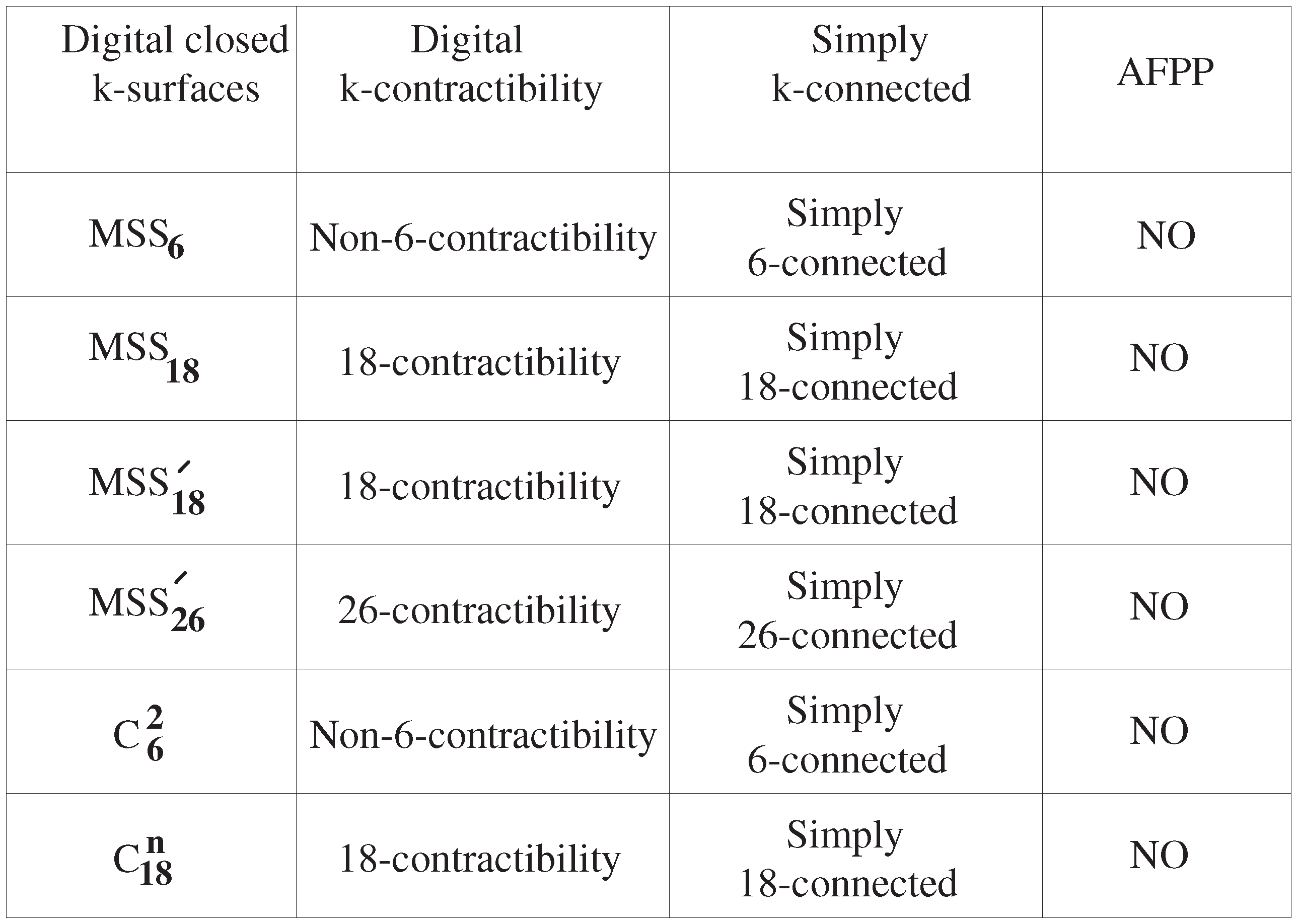
After formulating , , the present paper proved that there are only two types of connected sums up to 18-isomorphism, only one type of up to 6-isomorphism and further, several types of connected sums . Furthermore, it turns out that there are several types of connected sums for . Besides, in case up to 18-isomorphism, we proved that uniquely exists up to 18-isomorphism. In addition, we proved the digital k-contractibility of and further, the simply k-connectedness of , , . Finally, we explored the non-AFPP of each of , and . In view of several homotopic properties of , , , and and further, the non-AFPP of them and their connected sums, we obtain the following:
As a further work, based on Proposition 4, we need to further study the
AFPP of
according to the processes associated with
Figure 3b(2), (3), and (4). As mentioned above, some homotopic features of the models
,
,
,
play important roles in digital topology and digital geometry because each of them can be considered to be the typical sphere-like model in Euclidean topology. Hence, the features referred to in
Figure 9 facilitate studying many objects involving
AFPP for digital images. Furthermore, the notion of digital connected sum also plays a crucial role in digital geometry because it can contribute to formulating another surface from two given surfaces. Besides, using the new topological structures in [
36], we can study the
FPP and
AFPP of
as subspaces of the newly-established topological structures. Finally, considering the geometric realization of a digital
k-surface with an
-structure in [
37], we can deal with them from the viewpoint of computational geometry. In addition, after establishing a certain cone metric on a digital image [
38,
39,
40,
41,
42], we need to further compare the current digital metric spaces using a length of simple
k-path with cone metric spaces.