Abstract
For a graph G without isolated vertices, the inverse degree of a graph G is defined as where is the number of vertices adjacent to the vertex u in G. By replacing by any non-zero real number we obtain zeroth-order general Randić index, i.e., , where . Xu et al. investigated some lower and upper bounds on for a connected graph G in terms of connectivity, chromatic number, number of cut edges, and clique number. In this paper, we extend their results and investigate if the same results hold for . The corresponding extremal graphs have also been identified.
1. Chemical Graph Theory
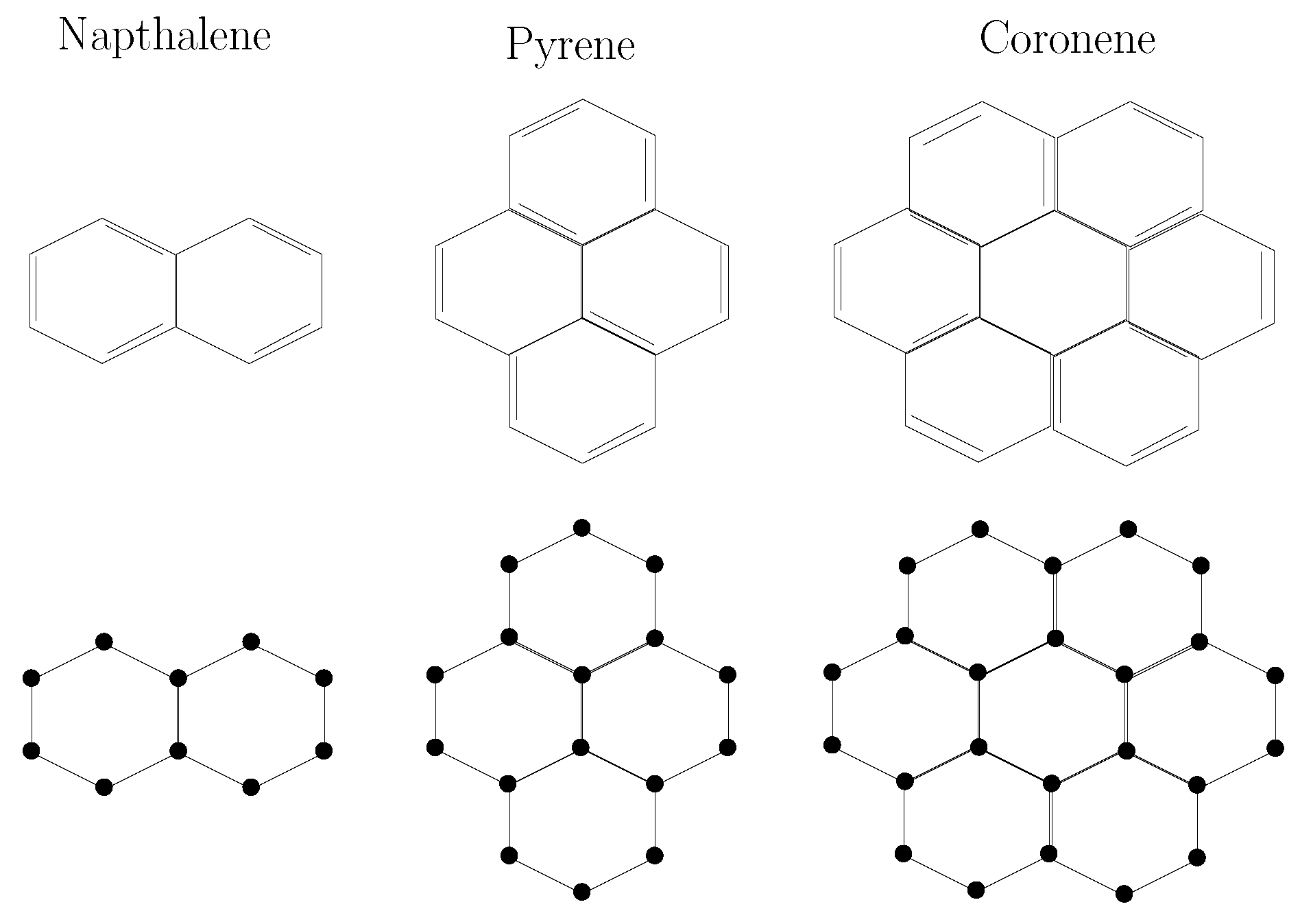
Chemical graph theory is a branch of mathematics that combines graph theory and chemistry. Graph theory is used to mathematically model molecules in order to gain insight into the physical properties of these chemical compounds. A molecular graph of a chemical compound is a graph in which atoms are represented by vertices and edges are the bonds between them. The molecular graphs of napthalene, pyrene, and coronene are shown in Figure 1. A topological index is a number associated to the molecular graph that can help to predict the various chemical or physical properties of the molecule. Topological indices play vital roles in the field of chemical graph theory.
Figure 1.
The molecular graphs of some polycyclic aromatic hydrocarbons.
H. Wiener introduced the first topological index when he was working on the boiling points of the paraffin. In [1,2,3], he showed that there are very good correlations between the Wiener index of the molecular graph of organic compounds and different physico-chemical properties of the molecular compounds. After that a lot of research have been done on the applications of graph theory in chemistry [4,5,6,7,8,9,10,11,12,13,14].
Nowadays, study of behavior of topological indices is an important task.
2. Introduction
Throughout this paper, we only consider finite, connected, and simple graphs and for the terminologies on the graph theory not defined here one can see [15]. Let G be a graph with vertex set and edge set . The number of elements in and are called the order and the size of G, respectively. For a vertex u of G, is the set of vertices adjacent to the vertex u in G and the number of elements in is called the degree of the vertex u in G, denoted by or simply . Additionally, . A vertex u is said to be a pendant vertex if and an edge is said to be a pendant edge if it is incident with a pendant vertex. In a graph G the maximum and minimum degrees are denoted by and , respectively. For subsets and , and are the subgraphs obtained from G by removing the element of S and T, respectively, from G. For two non-adjacent vertices u and v in a graph G, is the graph obtained from G by adding an edge between u and v and is the graph deduced by deleting the edge .
The minimum number of colors required to color a graph G in such a way that no adjacent vertices have the identical color is called the chromatic number of G and is denoted by . A subset of vertices is called a clique if it induces a complete graph. The maximum number of vertices in a clique is called the clique number of G and is denoted by . Let and be two vertex disjoint graphs. is the graph which consists of two components and . The join of and , , is the graph whose vertex set is and the edge set is . A subset of vertices is called an independent set if it induces an empty graph. Two edges in G are said to be independent edges if they are non-adjacent.
A connected graph is called c-connected, for , if either G is a complete graph or else it has at least vertices and has no -vertex cut. On the same lines, a graph G is c-edge-connected if and it does not have any -edge cut. The connectivity, , of G is the maximum value of c such that G is c-connected. The edge-connectivity, is defined analogously. Note that for a graph G of order n we have and and are equivalent.
Throughout this paper, and represent the path, star, cycle, and complete graphs with n vertices.
For a graph G without isolated vertices, Kier et al. [16] proposed the zeroth-order Randić index as:
In 2005, Li et al. [17] introduced the zeroth-order general Randić index by replacing the fraction by any non-zero real number :
In [18], authors investigated some sharp bounds on for unicyclic graphs with n vertices and diameter d. Volkmann [19] presented sufficient conditions for digraphs to be maximally edge connected in terms of the zeroth-order general Randić index. In [20] Yamaguchi obtained the trees with first three largest zeroth-order general Randić indices among all the trees with given order, diameter, or radius. Jamil et al. [21] investigated the extremal graphs of k-generalized quasi trees for zeroth-order general Randić index. For further results we refer to [22,23,24,25,26,27,28,29,30,31,32,33,34,35].
For a graph G without isolated vertices, the inverse degree of G is defined as:
The inverse degree of a graph was initially discussed in [36]. After that a lot of work have been done on inverse degree, for details we refer to [37,38,39,40]. Xu et al. [41] investigated certain bounds on for a connected graph G in terms of clique number, chromatic number, connectivity, or number of cut edges. They also characterized the extremal graphs. In this paper, we extended their work and investigated if the corresponding results hold for zeroth-order general Randić index, their results can be viewed as corollaries of the main theorems.
3. Preliminary Results
First we present some lemmas that will be useful in proving main results. From the definition of zeroth-order general Randić index for we have the following lemma.
Lemma 1.
Let G be a graph such that and are nonadjacent. Then for , we have:
- 1.
- if ;
- 2.
- where x and y are non-isolated vertices in G.
Lemma 2.
For , let G be a graph of order n with such that and where . From G we attain a new graph . If , for we have .
Proof.
From the definition of zeroth-order general Randić index, we have . We deduce that is a strictly increasing function for and . Since we have and this implies that . □
Lemma 3.
For and , the function:
is a strictly increasing function.
Proof.
For given , we obtain . Hence, for given the function is strictly increasing. □
Lemma 4.
Let be integer numbers, and . For and , the function is minimum for and . For and we get .
Proof.
We have , which implies that is a symmetry axis for the graph of this function. Its derivative equals . By the symmetry of f we can only consider the case when . We have and we shall prove that for . This condition is equivalent to:
Since and it follows that But since this is equivalent to and Equation (2) is proved. □
Lemma 5.
Every c-chromatic graph has at least c vertices of degree at least [15].
4. Main Results and Discussion
In this section, we will present our main results.
4.1. Extremal Graphs w.r.t. Zeroth-Order General Randić Index in Terms of Chromatic Number and Clique Number
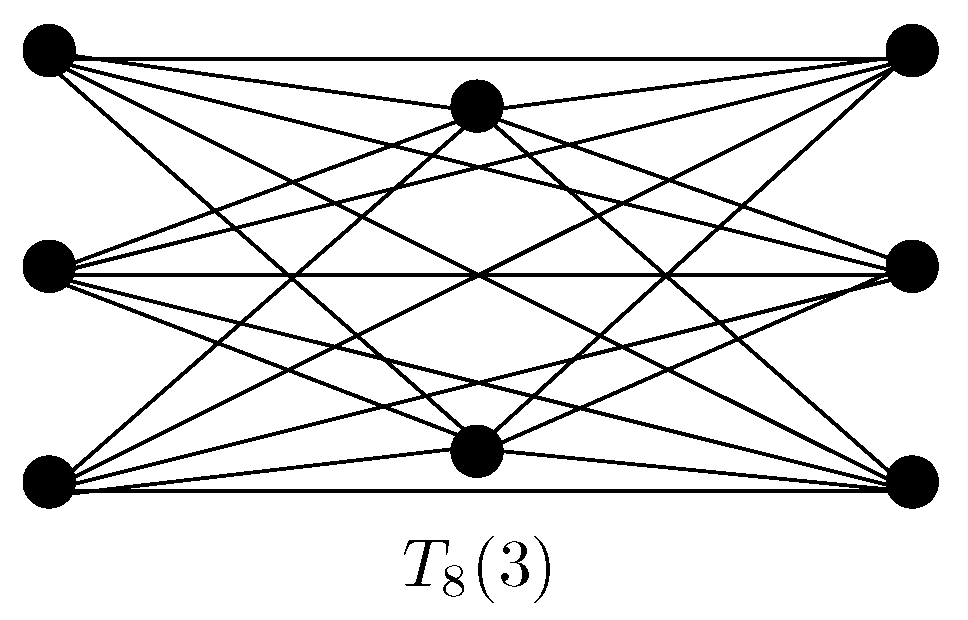
Let denote the set of all connected graphs having order n and chromatic number c and the set of all connected graphs with order n and clique number c. Hereafter, we always consider that are positive integers with . A complete c-partite graph of order n whose partite sets are of size , respectively, is denoted by . is called the Turán graph if for each . The Turán graph with n vertices and c-partite sets is denoted by and such a graph is shown in Figure 2. For and we have and , respectively. Also, , and . Here we will investigate the extremal graphs in and w.r.t. .
Figure 2.
A Turan graph.
Lemma 6.
Suppose that there exist two indices such that , and . Then for we have:
Proof.
Suppose that . From the definition of zeroth-order general Randić index we have:
where and is given by (1). Additionally, we have which implies that and . By Lemma 3 is strictly increasing, which yields:
which completes the proof. □
For this subsection assume that and , where , i.e., .
Theorem 1.
For any graph and , we have:
and lower bound is achieved if and only if .
Proof.
Let such that G has the minimal zeroth-order general Randić index for . From the definition of the chromatic number, G has c color classes and every color class is an independent set. Suppose that each color class contains vertices, where . By Lemma 1 one deduces that G must be a complete c-partite graph and Lemma 6 guarantees that . We have:
which completes the proof. □
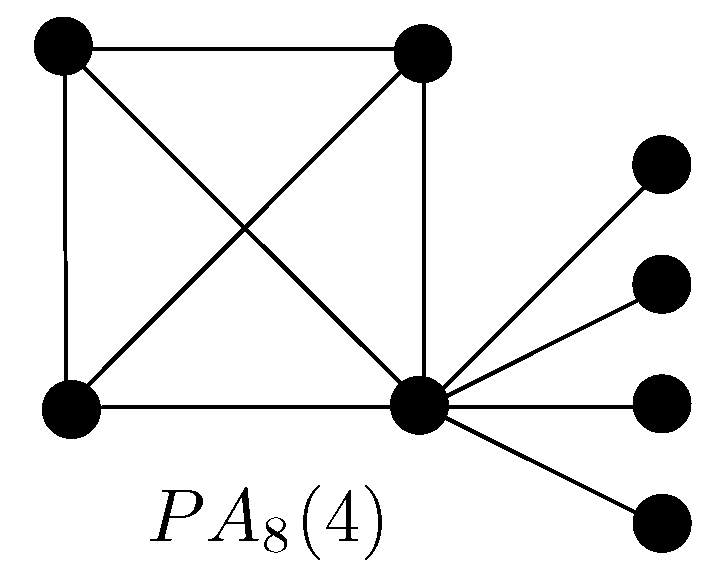
Further, we shall use some notation introduced in [41]. A graph gained by joining pendant vertices to unique vertex of is called a pineapple graph and is denoted by . will denote a connected graph of order n gained by joining pendant vertices to a complete graph , such that pendant vertices are attached to the ith vertex of for . A pineapple graph of order 8 is shown in Figure 3. It follows that . We consider that the vertices in the clique are labeled . From the definition of we have and .
Figure 3.
A pineapple graph.
In the following theorem we give the maximum value of by using the order n and chromatic numbers c of G.
Theorem 2.
Let and , then,
and the equality holds if and only if .
Proof.
Since G is connected it follows that . If then and the theorem is verified directly. It remains to consider the case when . It follows that . Clearly, for G is a connected bipartite graph. Moreover, if (note that the star coincides with and with , then the above equality holds and in this case . Otherwise, G has at least two non-pendant vertices. This implies , because . Hence, G is not maximal if .
Now, we prove the theorem for . Assume that . By Lemma 5, we can consider a set of vertices , such that for . Then we have . If there exists such that , then if and only if . The last inequality is valid since implies , which yields , which holds because .
This shows that for each , where , for a graph having maximum . Since G has chromatic number c it follows that the subgraph of G induced by is . It follows that G is a complete graph with pendant vertices, that is, such that . If we are done. Otherwise, by applying Lemma 2 several times and supposing that , we get:
which completes the proof. □
The following result gives upper and lower bounds on zeroth-order general Randić index in terms of order n and clique number c.
Theorem 3.
For any graph and we have:
The lower bound is attained if and only if and the upper bound if and only if .
Proof.
The main arguments of this proof are similar to those of the proof of Theorem 3.3 from [41].
Upper bound: Let having as large as possible zeroth-order general Randić index. Since has clique number c, we can conclude that have a clique . From Lemma 1 (1), we can see that must be a graph achieved by joining to some tree for . Then the chromatic number of is c, and the result immediately follows from the proof of Theorem 2.
Lower bound: Let be the set of all graphs having order n and clique number less than or equal to c. We shall prove the case below first.
Claim 1. For each graph , we have:
and equality holds if and only if .
Proof of Claim 1.
If , then by Lemma 6 we have:
and equality holds if and only if .
Otherwise, G is not a multipatite complete graph of the form . Let such that u has maximum degree in G. Let and . The clique number of the induced subgraph of G by A, , is at most since . Now we compose a graph on as: is achieved from the subgraph and the subset B by attaching all vertices in A to all vertices of B and removing all possible edges which have both ends in B. One can easily notice that B is an independent set of and . Let ; if we have from the construction of and if we have by the choice of u. This implies that . If is a complete t-partite graph with n vertices, where , then we have .
The inequality follows since has vertex degrees equal to and , which are less than or equal to the vertex degrees of .
Otherwise, repeating the same procedure on by at most times (during this process if is a complete t-partite graph with n vertices, we stop the above process), we gain a string of graphs:
such that
Since G is not a multipatite complete graph of the form , then in the above string of graphs there must occur two successive non-isomorphic graphs and such that: u being a vertex with maximum degree in and denoting and , when we transform to , there must exist a vertex w in A or B such that . Hence,
and the proof of the claim is complete. □
Consequently, we have shown that for each graph , reaches its minimum in , equal to , only for . Note that with and our lower bound was proved. □
4.2. Extremal Graphs w.r.t. Zeroth-Order General Randić Index in Terms of Number of Cut Edges
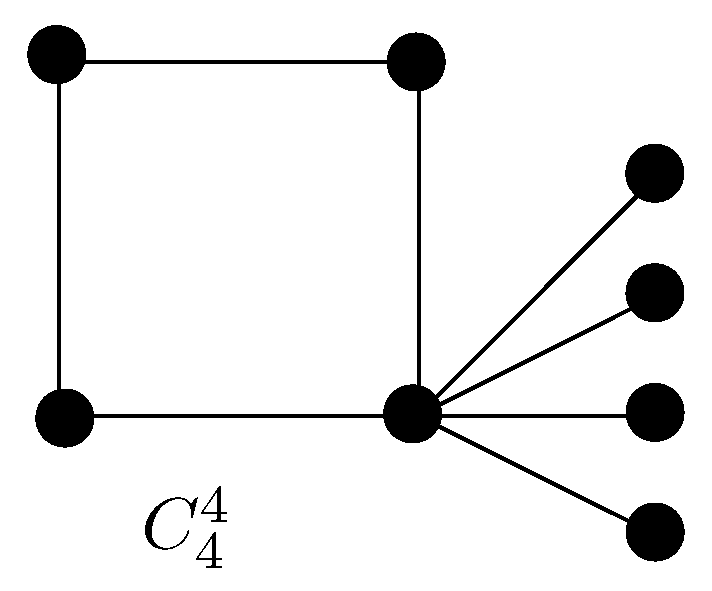
In this subsection, we will investigate the bounds on zeroth-order general Randić index in terms of number of cut edges. We shall also characterize the graphs which will provide the extremal values. Let be the set of connected graphs having n vertices and cut edges. Let be a graph gained by joining c pendant vertices to unique vertex of cycle , as illustrated in Figure 4. It is easy to see that and have the minimal and maximal zeroth-order general Randić index among all connected n-vertex graphs without any cut edge, respectively.
Figure 4.
A graph for and .
Theorem 4.
Let and , then for we have:
and the equality holds if and only if .
Proof.
Suppose that the graph has the maximum zeroth-order general Randić index, for , with cut edge set . To prove the main result we first prove two claims.
Claim 1.
Let , then e must be a pendant edge.
Proof of Claim 1.
On contrary suppose that is a non-pendant edge in G such that . Suppose that . Now we compose a graph:
Clearly, . Since is a cut edge in G, so . Then by Lemma 2 and the case when and are adjacent we have , which opposes the maximality of G. □
Claim 2.
The edges of C have a common vertex.
Proof of Claim 2.
From above all the edges , are pendant. On contrary suppose that and are two distinct edges in G such that for and . By applying Lemma 2 on and , we obtain a new graph such that , which is a contradiction. □
Claim 2 implies that G is a graph attained by joining c pendant vertices to one vertex, say of where is a connected graph without cut edges. Considering that in any vertex has degree greater or equal to 2, we have:
and the equality holds if and only if for each , i.e., . Equivalently, and we are done. □
4.3. Extremal Graphs w.r.t. in Terms of Vertex (Edge) Connectivity
The set of all graphs of order n having connectivity and edge-connectivity equal to is denoted by and , respectively.
Theorem 5.
For any graph with and , we have:
with equality holding if and only if with and for and and for and or .
Proof.
Suppose is a graph with minimal with c-vertex cut . By Lemma 1 (2), the induced subgraph is a complete graph .
For , there is a unique graph in the set , which can be deal as a special case of with . So, in what follows we shall consider .
Claim 1.
has exactly two components.
Proof of Claim 1.
On contrary suppose that has at least three components , , and having for . Then we find , which implies , which contradicts the choice of G. Now we assume that , where and are the components of . From Lemma 1 (2), we conclude that and are cliques and each vertex in S is adjacent to all vertices in . Consequently, we get where .
Without loss of generality, assume that in . We get:
For and , we have for any graph G of the form with and . For or we require the least value of the following function:
where and . □
From Lemma 4 we deduce that the is minimal when and for . Hence attains its minimum value if and only if . □
Let for and , we have: . This implies that is strictly decreasing for . Therefore, we have
for .
Considering that , by Theorem 5 and inequality 3, we have the following result:
Theorem 6.
For any graph with and , we have:
and equality holds if and only if with and for and and for and or .
As we have . We get for but if with . From Theorem 6 we deduce the following corollary:
Corollary 1.
For any graph with and , we have:
and equality holds if and only if .
Again using inequality 3 and the inequalities , we have the following corollary:
Corollary 2.
Let G be a connected graph of order n and minimum degree , then for we have:
and the equality achieved if and only if .
We can see that . From Corollary 1 and inequality (3), we can obtain the subsequent result:
Theorem 7.
For any graph with and , we have:
with equality holding if and only if .
One can notice that for each edge , where (respectively ), also belongs to (respectively ). From [42] we know that has the maximal index among all trees of order n for since the function is strictly increasing for if . So from Lemma 2 (ii) we have the following consequences:
Theorem 8.
For any graph with and , we have:
and the equality holds if and only if .
Theorem 9.
For any graph with and , we have:
and the equality holds if and only if .
5. Conclusions
Finding bounds on any topological index with respect to different graph parameters is an important task. Authors in [41], investigated the upper and lower bounds on inverse degree index, . They investigated the bounds in terms of connectivtiy, chromatic number, number of cut edges, and clique number. We extend their results for zeroth-order general Randić index, , and showed that the same bounds holds when . The extremal graphs for each bounds are also investigated. The results in [41] can be found as corollaries of our main results for .
Author Contributions
Conceptualization, A.J.; Formal analysis, M.I.; Funding acquisition, M.I.; Investigation, M.K.J. and I.T.; Methodology, M.K.J.; Supervision, I.T.; Writing–original draft, A.J.; Writing–review & editing, M.I. and A.J. All authors have read and agreed to the published version of the manuscript.
Funding
This research is supported by the UPAR Grants of United Arab Emirates, Al-Ain, UAE via Grant No. G00002590 and Grant No. G00003271.
Conflicts of Interest
The authors declare no conflict of interest.
References
- Wiener, H. Structural determination of paraffin boiling point. J. Am. Chem. Soc. 1947, 69, 17–20. [Google Scholar] [CrossRef] [PubMed]
- Wiener, H. Vapor pressure-temperature relationships among the branched paraffin hydroarbons. J. Phys. Chem. 1948, 52, 425–430. [Google Scholar] [CrossRef] [PubMed]
- Wiener, H. Correlation of heats of isomerization, and differences in heats of vaporization of isomers, among the paraffin hydrocarbons. J. Am. Chem. Soc. 1944, 69, 2636–2638. [Google Scholar] [CrossRef]
- Amić, D.; Bešlo, D. The vertex-connectivity index revisited. J. Chem. Inf. Comput. Sci. 1998, 38, 819–822. [Google Scholar] [CrossRef]
- Andersen, J.L.; Fagerberg, R.; Flamm, C.; Kianian, R.; Merkle, D.; Stadler, P.F. Towards Mechanistic Prediction of Mass Spectra Using Graph Transformation. MATCH Commun. Math. Comput. Chem. 2018, 80, 705–731. [Google Scholar]
- Andersen, J.L.; Flamm, C.; Merkle, D.; Stadler, P.F. Rule Composition in Graph Transformation Models of Chemical Reactions. MATCH Commun. Math. Comput. Chem. 2018, 80, 661–704. [Google Scholar]
- Dobrowolski, J.C. The Structural Formula Version of Graph Theory. MATCH Commun. Math. Comput. Chem. 2019, 81, 527–555. [Google Scholar]
- Elphick, C.; Wocjan, P. Bounds and power means for the general Randic index. arXiv 2015, arXiv:1508.07950. [Google Scholar]
- Gupta, S.; Singh, M. Application of graph theory: Relationship of eccentric connectivity index and Wiener’s index with anti-inflammatory activity. J. Math. Anal. Appl. 2002, 266, 259–268. [Google Scholar] [CrossRef]
- Gupta, S.; Singh, M.; Madan, A.K. Eccentric distance sum: A novel graph invariant for predicting biological and physical properties. J. Math. Anal. Appl. 2002, 275, 386–401. [Google Scholar] [CrossRef]
- Nikolić, S.; Trinajstić, N. Comparison between the vertex and edge connectivity indices for benzenoid hydrocarbons. J. Chem. Inf. Comput. Sci. 1998, 38, 42–46. [Google Scholar] [CrossRef]
- Randić, M.; Zupan, J. On interpretation of well-known topological indices. J. Chem. Inf. Comput. Sci. 2001, 41, 550–560. [Google Scholar] [CrossRef] [PubMed]
- Stadler, B.M.R.; Stadler, P.F. Reachability, Connectivity, and Proximity in Chemical Spaces. MATCH Commun. Math. Comput. Chem. 2018, 80, 639–659. [Google Scholar]
- Todeschini, R.; Cazar, R.; Collina, E. The chemical meaning of topological indices. Chemom. Intell. Lab. Syst. 1992, 15, 51–59. [Google Scholar] [CrossRef]
- Bondy, J.A.; Murty, U.S.R. Graph Theory with Applications; Macmillan Press: New York, NY, USA, 1976. [Google Scholar]
- Kier, L.B.; Hall, L.H. The meaning of molecular connectivity: A bimolecular accessibility model. Croat. Chem. Acta 2002, 75, 371–382. [Google Scholar]
- Li, X.; Zheng, J. A unified approach to the extremal trees for different indices. MATCH Commun. Math. Comput. Chem. 2005, 54, 195–208. [Google Scholar]
- Pan, X.F.; Liu, H.L.M. Sharp bounds on the zeroth-order general Randić index of unicyclic graphs with given diameter. Appl. Math. Lett. 2011, 24, 687–691. [Google Scholar] [CrossRef][Green Version]
- Volkmann, L. Sufficient conditions on the zeroth-order general Randić index for maximally edge-connected digraphs. Commun. Comb. Opt. 2016, 1, 1–13. [Google Scholar]
- Yamaguchi, S. Zeroth-order general Randić index of trees with given order and distance conditions. MATCH Commun. Math. Comput. Chem. 2009, 62, 171–175. [Google Scholar]
- Jamil, M.K.; Tomescu, I. Zeroth-order general Randić index of k-generalized quasi trees. arXiv 2018, arXiv:1801.03885v1. [Google Scholar]
- Balasubramanian, K.; Ghadimi, S. Zeroth-order (non)-convex stochastic optimization via conditional gradient and gradient updates. In Proceedings of the 32nd International Conference on Neural Information Processing Systems (NIPS 2018), Montréal, QC, Canada, 3–8 December 2018; pp. 3455–3464. [Google Scholar]
- Chen, Z.; Su, G.; Volkmann, L. Sufficient conditions on the zeroth order general Randić index for maximally edge-connected graphs. Discret. Appl. Math. 2017, 218, 64–70. [Google Scholar] [CrossRef]
- Hu, Y.; Li, X.; Shi, Y.; Xu, T. On molecular graphs with smallest and greatest zeroth-order general Randić index. MATCH Commun. Math. Comput. Chem. 2005, 54, 425–434. [Google Scholar]
- Imani, M.; Dougherty, E.R.; Neto, U.B. Boolean Kalman filter and smoother under model uncertainty. Automatica 2020, 111, 108609. [Google Scholar] [CrossRef]
- Li, X.; Shi, Y. (n,m)-Graphs with maximum Zeroth-order general Randić index for α ∈ (−1, 0). MATCH Commun. Math. Comput. Chem. 2009, 62, 163–170. [Google Scholar]
- Su, G.; Meng, M.; Cui, L.; Chen, Z.; Xu, L. The general zeroth-order Randić index of maximal outerplanar graphs and trees with k-maximum degree vertices. Sci. Asia 2017, 43, 387–393. [Google Scholar] [CrossRef]
- Su, G.; Tu, J.; Das, K.C. Graphs with fixed number of pendent vertices and minimal zeroth-order general Randić index. Appl. Math. Comput. 2016, 270, 705–710. [Google Scholar] [CrossRef]
- Su, G.; Xiong, L.; Su, X. Maximally edge-connected graphs and general Zeroth-order Randić index for 0 < α < 1. Discret. Appl. Math. 2014, 167, 261–268. [Google Scholar]
- Su, G.; Xiong, L.; Su, X.; Li, G. Maximally edge-connected graphs and general zeroth-order Randić index α < −1. J. Comb. Optim. 2016, 31, 182–195. [Google Scholar]
- Ye, J.; Yao, Y. A note on the zeroth-order general Randić index of polygonal cacti. Open J. Dis. Appl. Math. 2018, 1, 01–07. [Google Scholar] [CrossRef]
- Zhang, S.; Wang, W.; Cheng, T.C.E. Bicyclic graphs with the first three smallest and largest values of the first general Zagreb index. MATCH Commun. Math. Comput. Chem. 2006, 56, 579–592. [Google Scholar]
- Zhang, H.; Zhang, S. Unicyclic graphs with the first three smallest and largest first general Zagreb index. MATCH Commun. Math. Comput. Chem. 2006, 55, 427–438. [Google Scholar]
- Lin, A.; Luo, R.; Zha, X. On sharp bounds of the zero-order Randić index of certain unicyclic graphs. Appl. Math. Lett. 2009. [Google Scholar] [CrossRef]
- Pavlović, L. Maximal value of the zeroth-order Randić index. Discret. Appl. Math. 2003, 127, 615–626. [Google Scholar] [CrossRef]
- Fajtlowicz, S. On conjectures of graffiti II. Congr. Numer. 1987, 60, 189–197. [Google Scholar]
- Hu, Y.; Li, X.; Shi, Y.; Xu, T. Connected (n,m)-graphs with minimum and maximum zeroth-order general Randić index. Discret. Appl. Math. 2007, 155, 1044–1054. [Google Scholar] [CrossRef]
- Li, X.; Shi, Y. On the diameter and inverse degree. Ars Comb. 2011, 101, 481–487. [Google Scholar]
- Mukwembi, S. On diameter and inverse degree of a graph. Discret. Math. 2010, 310, 940–946. [Google Scholar] [CrossRef][Green Version]
- Zhang, Z.; Zhang, J.; Lu, X. The relation of matching with inverse degree of a graph. Discret. Math. 2005, 301, 243–246. [Google Scholar] [CrossRef]
- Xu, K.; Das, K.C. Some extremal graphs with respect to inverse degree. Discret. Appl. Math. 2016, 203, 171–183. [Google Scholar] [CrossRef]
- Li, X.; Zhao, H. Trees with the first three smallest and largest generalized topological indices. MATCH Commun. Math. Comput. Chem. 2004, 50, 57–62. [Google Scholar]
© 2020 by the authors. Licensee MDPI, Basel, Switzerland. This article is an open access article distributed under the terms and conditions of the Creative Commons Attribution (CC BY) license (http://creativecommons.org/licenses/by/4.0/).