Abstract
In this paper, we investigated the stability criteria like an exponential and weakly exponential stable for random impulsive infinite delay differential systems (RIIDDS). Furthermore, we proved some extended exponential and weakly exponential stability results for RIIDDS by using the Lyapunov function and Razumikhin technique. Unlike other studies, we show that the stability behavior of the random time impulses is faster than the fixed time impulses. Finally, two examples were studied for comparative results of fixed and random time impulses it shows by simulation.
Keywords:
random impulses; delay differential system; Razumikhin technique; Lyapunov function; exponential stability MSC:
37B25; 34A37; 65L07; 93E15
1. Introduction
Impulses occur in a short duration of time which makes a sudden change in the nature or behavior of the differential system; we call this system an impulsive differential system. Most of the impulsive differential equation models deal with the fixed time of occurrence of impulse action. Many authors contributed to analyzing the fixed time impulsive differential systems (IDS) with the finite or infinite delay because this system arises in many fields like science, engineering, biotechnology, neural networks, and control systems—see the monographs [1,2]. The study of qualitative behavior like the stability of impulsive differential systems is also important. Generally, stability behavior for IDS with delays can have two types of results: (i) impulsive perturbation and (ii) impulsive stabilization. For the past several decades, many authors have studied the stability behavior of various types of impulsive systems by using the Lyapunov functions and Razumikhin technique. Moreover, the Lyapunov functional method plays an important role in the stability theory of functional differential systems it used to obtain the minimal class of functional from the corresponding derivative of the Lyapunov functions; for example, in [3,4], the authors proved the exponential stability by using the Lyapunov and Razumikhin technique and the authors in [5,6,7] investigated the Razumikhin-type theorems for weakly exponentially stable and exponentially stable. Recently, the authors in [8] established some new Razumikhin-technique for studying the uniform stability behavior of the systems. However, impulses used to control for the unstable differential systems can be stabilized to the equilibrium point; this is shown in [9,10]. Furthermore, several interesting results have been established in [11,12,13,14,15,16] and the references therein. However, the impulses happen not only in fixed time on the system states, but it is also possible to happen randomly; we know that the real world system states often change randomly. From this point of view, we develop random impulses in differential systems.
Very few attempts are made in the study of the random time occurrence of impulses. This changing nature from a deterministic system to a stochastic system differs from the stochastic differential equation—for example, in [17], the authors investigated the existence, uniqueness and stability results for random IDS. In [18], the author studied the moment exponential stability results and the authors [19] discussed the distribution nature for random IDS and proved the exponential stability. For further study, refer to [20,21,22,23,24,25,26,27,28,29] and references therein. Still, now there was no paper reported on the exponential stability for RIIDDS based on the Lyapunov and Razumikhin approach. Therefore, it is necessary to identify the exponential stability results for RIIDDS.
Inspired by the above discussions in this paper, we construct some new sufficient conditions for exponential stability by employing the random impulses. Furthermore, we discuss the random time impulses are faster than fixed time impulses. Finally, we show the stability behavior of random time impulses and the fixed time impulses. The rest of this paper is as follows: there are some definitions and lemmas in the preliminaries in Section 2. In Section 3, we prove the exponential stability and weakly exponential stability results for RIIDDS by using the Lyapunov and Razumikhin technique. Then, in Section 4, two numerical examples and their simulations are discussed and, finally, in Section 5, conclusions are given.
Notations: Let ℜ denote the set of all real numbers, the set of all non-negative real numbers and the set of all positive integers. Let be the Euclidean space equipped with norm , and be a probability space. We use to denote the set of all piecewise right continuous real valued random variables with the norm is defined by . The symbol denotes a set of all bounded piecewise right continuous real valued random variables . Then, stands for the expectation operator with respect to the given P. Moreover, letting , we define: ; ; .
2. Preliminaries
Let be a sequence of independent exponentially distributed random variables with parameter defined on sample space and be the increasing sequence of random variables. Note that , where is a fixed point and for , where defines the waiting time between two consecutive impulses and provides with probability 1.
Let us consider the delay differential systems with random impulses of the form
where and , , where D is an open set in . For any . For any and for any , there exists such that implies that , where . For any , let , and let , thus . Furthermore, we define and are the right and left limits at .
We assume the existence and uniqueness solution for the initial value problem (1), and denoted as . Since , then is the trivial solution of system (1).
Remark 1.
Define be the increasing sequence of points, where is a value of the corresponding random variable , and is a sequence of points, where are arbitrary values of the random variable . For convenience, we define and , where denotes the value of the waiting time. Then, system (1) becomes
The solution of system (2) depends not only on the initial condition; it also depends on the moments of impulses . That is, the solution depends on the chosen arbitrary values of the random variable . We denote the solution of (2) by and will assume .
Moreover, the collection of all solutions of system (2) is called a sample path solution of system (1). Thus, the sample path solution generates a stochastic process. We will say that it is a solution of system (1), and it is denoted by .
Lemma 1.
From [19,28], when there will be exactly m impulses until the time , and the waiting time between two consecutive impulses follow exponential distribution with parameter γ, then the probability
where the events .
Remark 2.
From [19,28], if is the solution of the random impulsive differential equations, then
where is the impulse moments.
Definition 1.
The function belongs to class if
- (i)
- W is continuous differentiable almost every where function.
- (ii)
- is locally Lipschitzian with respect to y and .
Definition 2.
Letting , for any , the upper right hand Dini derivative of along the solution of system (1) is defined by
Definition 3.
Let be a the solution of (1) through , and . Then, the trivial solution of (1) is said to be
- (i)
- moment weakly exponentially stable, assume is a constant (convergence rate), if for any , there exists such that implies .
- (ii)
- moment exponentially stable, assume is a constant (convergence rate), if for any , there exists such that implies .
3. Main Results
Theorem 1.
Assume that there exist functions and and constants , such that , and the following conditions hold:
- (i)
- (ii)
- For any , if , then , where for any ;
- (iii)
- For all , with ,
- (iv)
- (v)
- The inequality holds.Then, (1) is moment weakly exponentially stable.
Proof.
Condition for .
Let and be strictly non-decreasing continuous functions satisfying , . Thus, we have
For any and , we may choose , such that .
Let be a solution of system (1) through , and it follows a stochastic process. For any , we shall prove that
We will prove (3) with the aid of the sample path solution of (1). Thus, first, it is enough to prove that there are m impulses moments until time ,
For convenience, let , and ,
which implies
We shall prove that there are impulses moments until time ,
First, it is clear that, for ,
Thus, . Assuming , i.e., no impulse moments, then we prove that
Supposing not, then there exists such that . Let
Then, , . In addition, . Since
Note , and , in view of ,
thus define
Thus, , and . Hence, for , considering (7), we have
By , holds for all . Therefore, we obtain
Thus, is non-increasing in t for which gives that . However, this contradicts the fact that . Hence, we have proven . Hence, for ,
Thus, , which gives that .
Considering the condition , we get
Furthermore, we claim that there are impulses moments until time
First, we prove that
Supposing not, then
Thus, either there are impulses moments until time
or there exist some , for which
Case ; considering (6), we have
which gives that
Thus, we obtain
where is the value of the random variable . By , we have
Then, we get
however noting that
where is the value of the random variable . This is a contradiction.
Case , let . Then, , and
which gives that
By , we have
Apply a similar process as in (8), which yields . Therefore, is non increasing in t for . In particular, . However, this is in contradiction to the fact that
Thus, we have proven (10). Next, we need to show that there are impulses moments until time
Supposing not, then there exists some such that
Letting
then , and . Meanwhile, we obtain
in view of the fact that
On the other hand, we note
and
Therefore, we can define
Then, , and .
Thus, considering (11), we have
Hence, by and , a similar process as in (8), we can obtain , which gives that is non-increasing in t for . In particular, . This contradicts the fact that
so (9) holds. Thus, we have, for ,
Thus, , which implies .
Thus, by induction principle, there are m impulses moments until time
Thus, (4) holds. Using assumption , we derive at
Thus, solutions generate a stochastic process that is defined by
Taking expectations on both sides, by using Lemma 1 and Remark 2, then we get
□
Remark 3.
From Theorem 1, we observed that
- 1.
- If and the impulses arrival rate γ does not have any restrictions, then system (1) is the moment weakly exponentially stable.
- 2.
- If and the impulses arrival rate (no impulse arrival), then system (1) is moment weakly exponentially stable.
- 3.
- If and the impulses arrival rate , then system (1) is moment weakly exponentially stable.
Now, particularly, letting in Theorem 1, then we have the next results.
Corollary 1.
Assume that there exist a function and constants , such that and the following conditions hold:
- (i)
- (ii)
- For any , if , then ;
- (iii)
- For all , with ,
- (iv)
Then, (1) is moment exponentially stable.
Proof.
Notice that gives that conditions and in Theorem 1 hold. Finally, there are m impulses moments until time , then we get
Letting , then
Thus, solutions generate a stochastic process that is defined by
Taking expectations on both sides, by using Lemma 1 and Remark 2, then we get
□
Remark 4.
If the condition holds, the derivative of V is non-negative; then, we get the next exponential stability result.
Theorem 2.
Assume that there exist functions and , and constants , such that , and the following conditions hold:
- (i)
- (ii)
- For any , if , then , where for any .
- (iii)
- For all , with ,
- (iv)
- (v)
- The inequality holds.Then, (1) is moment weakly exponentially stable.
Proof.
Let be the solution of system (1) through , and it follows a stochastic process. As in Theorem 1, let , and be the strictly increasing continuous functions satisfying . Thus,
Applying a similar process as in Theorem 1, we assume that (5) holds.
Next, we show that (4) holds . Assuming , i.e., no impulse moments, then we show that
Supposing not, then there exists such that . Letting
then . Furthermore,
In addition, we obtain , due to (5). Note that , and , in the view of . Thus, we define
Thus, , and . Consequently, we obtain
From , holds . Hence, we have
where . Consequently, we have
However,
which is contradiction. Hence, we obtain , which gives that (6) holds . Meanwhile we take for ,
which gives . On the other hand,
we show that (9) holds. Thus, we prove that
Supposing not, then there exists such that
Let
in view of (13). Thus, , and , . In addition, we obtain
by the fact that
Since
and
we therefore define
Then, , and . Thus, we have
Therefore, by the conditions (ii) and (iv), a similar process of (12), we can obtain
where . Consequently, in view of , we have
However, we note that
This is a contradiction. Then, Equation (9) holds. Using an induction hypothesis, there are m impulse moments until time , and we can write
Hence, Equation (4) holds. Using assumption , a similar process in Theorem 1, we finally arrive at
□
In particular, letting in Theorem 2, we then get the next results.
Corollary 2.
Assume that there exists a function and constants , such that , and the following conditions hold:
- (i)
- (ii)
- For any , if , then .
- (iii)
- For all , with .
- (iv)
- Then, (1) is moment exponentially stable.
Theorem 3.
Assume that there exist functions and , and constants , such that , and the following conditions hold:
- (i)
- (ii)
- For any , if , then .
- (iii)
- For all , with
- (iv)
- where .Then, moment is weakly exponentially stable.
Proof.
For any , we may choose , such that . Let be a solution of system (1) and it follows a stochastic nature. Then, we shall prove that
where . From , define the positive constant , where is the value of the random variable . We will prove (14) with the aid of a sample path solution of system (1). Thus, first, we have enough to prove that there are m impulses moments until ,
For convenience, we take , and . Then, we shall prove that there are impulses moments until time ,
It is obvious that then
Thus, . Assuming that i.e., no impulse moments. First, we prove for that
Supposing not, then there exists such that . Note that . We define
Then, , and since
Furthermore, we note that
so we define
Then, and . From (16), we have
From , holds for . Hence, we have
where . Consequently, we have
However, note that
This is a contradiction. Hence, . Meanwhile, we take for
which gives and . We assume that it is true for impulses moments until time ,
which implies
Next, we shall prove that impulses moments until time ,
Supposing not, then there exists some such that
It follows from (19) that . Thus, we define
Then, , and . In addition, from (19), we know that
noting that
and
Furthermore, we define
Then, and . We can deduce that
which gives that
Hence, we can deduce that
where . We have
However, we note that
which is contradiction. Thus, Equation (20) holds. Using the induction method, there are m impulses moments until time ,
Using assumption , we derive at
Thus, solutions generate a stochastic process that is defined by
taking expectations on both side, by using Lemma 1 and Remark 2, then we get
□
Remark 5.
The above all theorems and corollaries work in fixed time impulses.
4. Example
In this part, we shall verify examples to analyze our theorems by using random impulses.
Example 1.
Consider the RIIDDE
where
Let , , , , and impulse arrival rate . Then, we choose the Lyapunov function , suppose , from the Corollary 1, we get . Hence,
where . By condition, we get ; then, we can write . In addition, we have
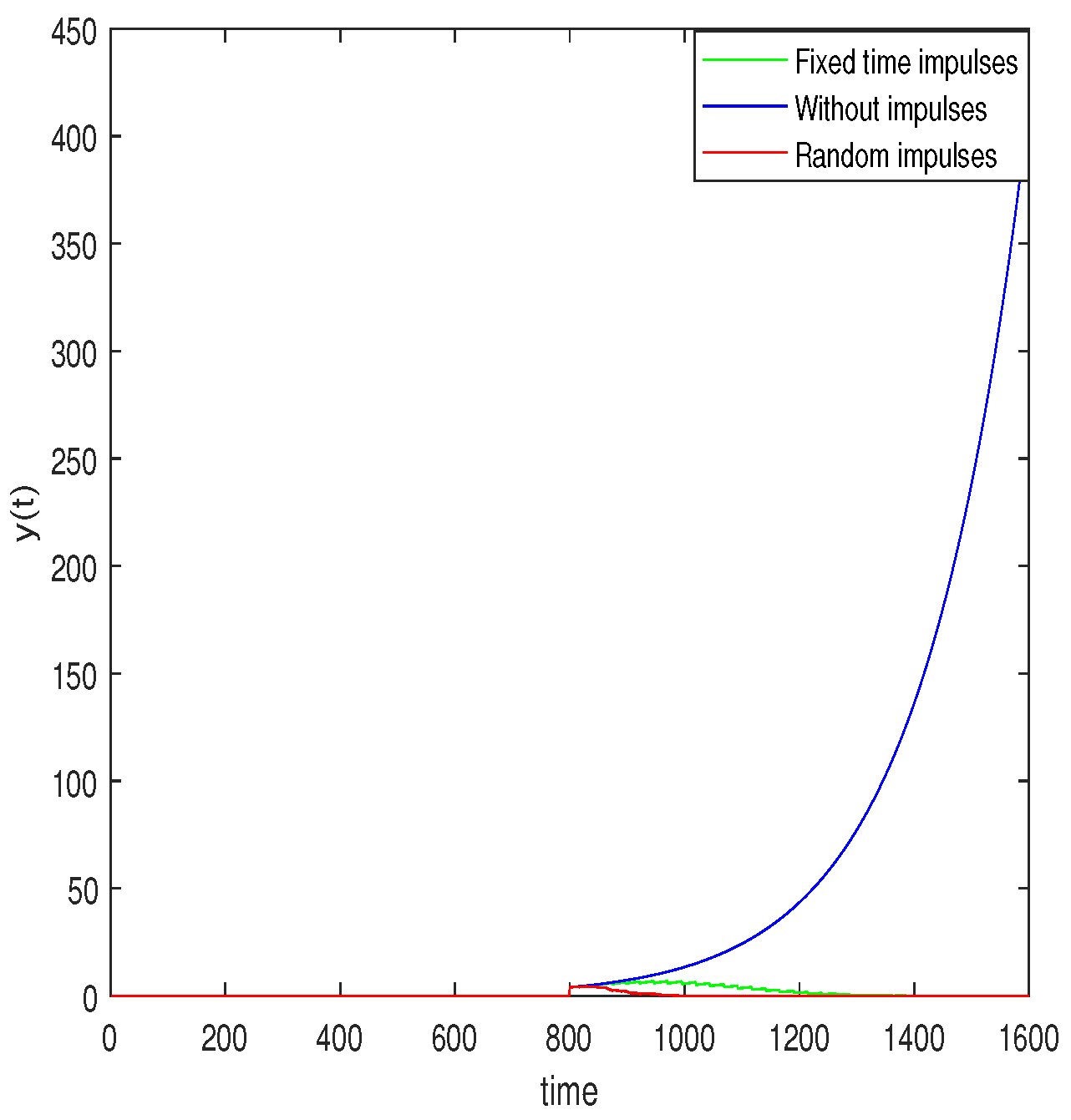
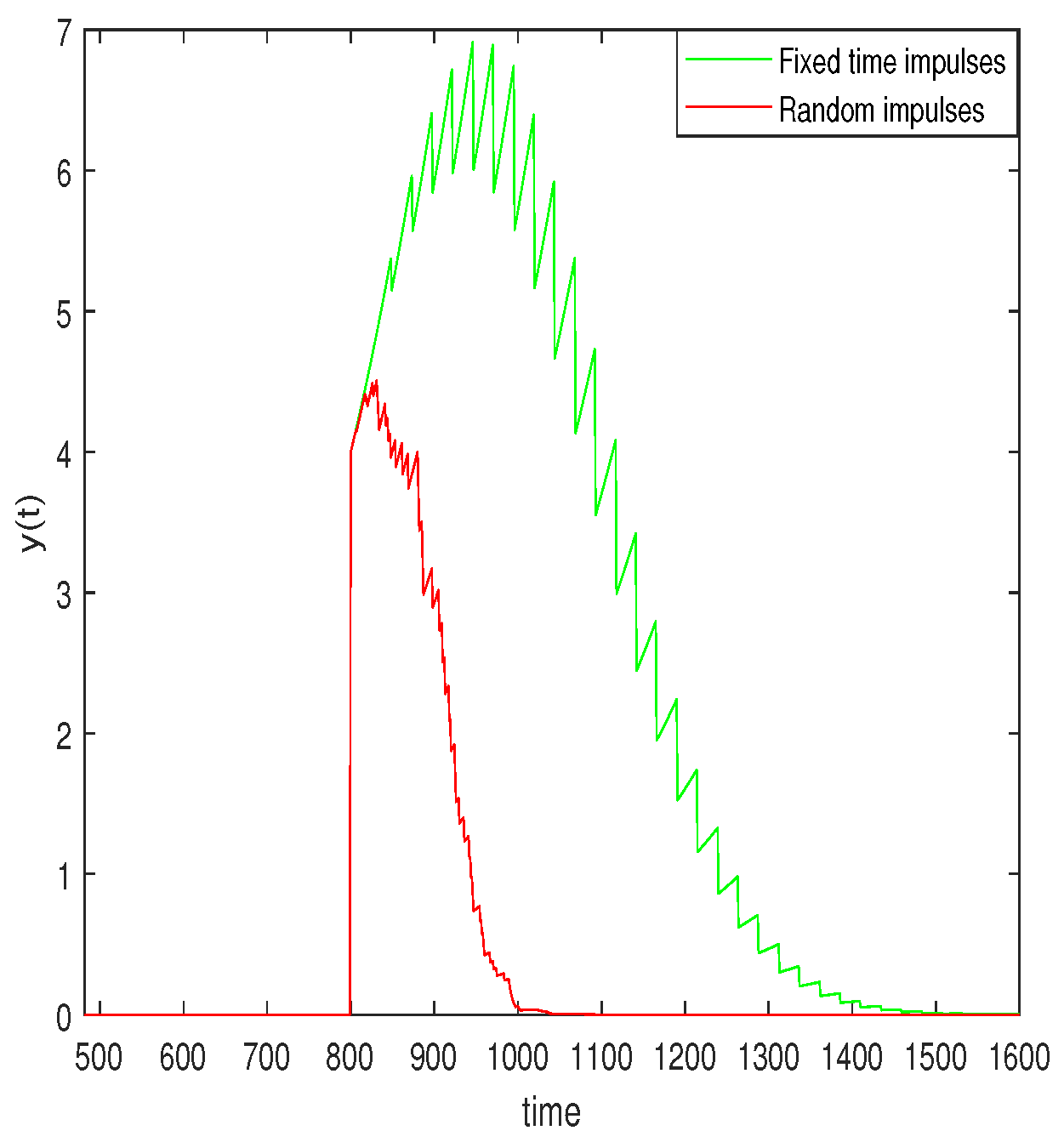
Therefore, system (23) is mean square exponentially stable at the origin by Corollary 1; see the comparative results Figure 1 and Figure 2.
Figure 1.
Shows that fixed impulsive effects, random impulsive effects and without impulsive effects of system (23).
Figure 2.
Comparative results between fixed and random time impulsive effects of system (23).
Example 2.
Consider the RIIDDE
where . Consider , , , and impulse arrival rate . We choose the Lyapunov function , suppose , from the Corollary 2, we get . Hence,
where . By condition, , we get . In addition, we have
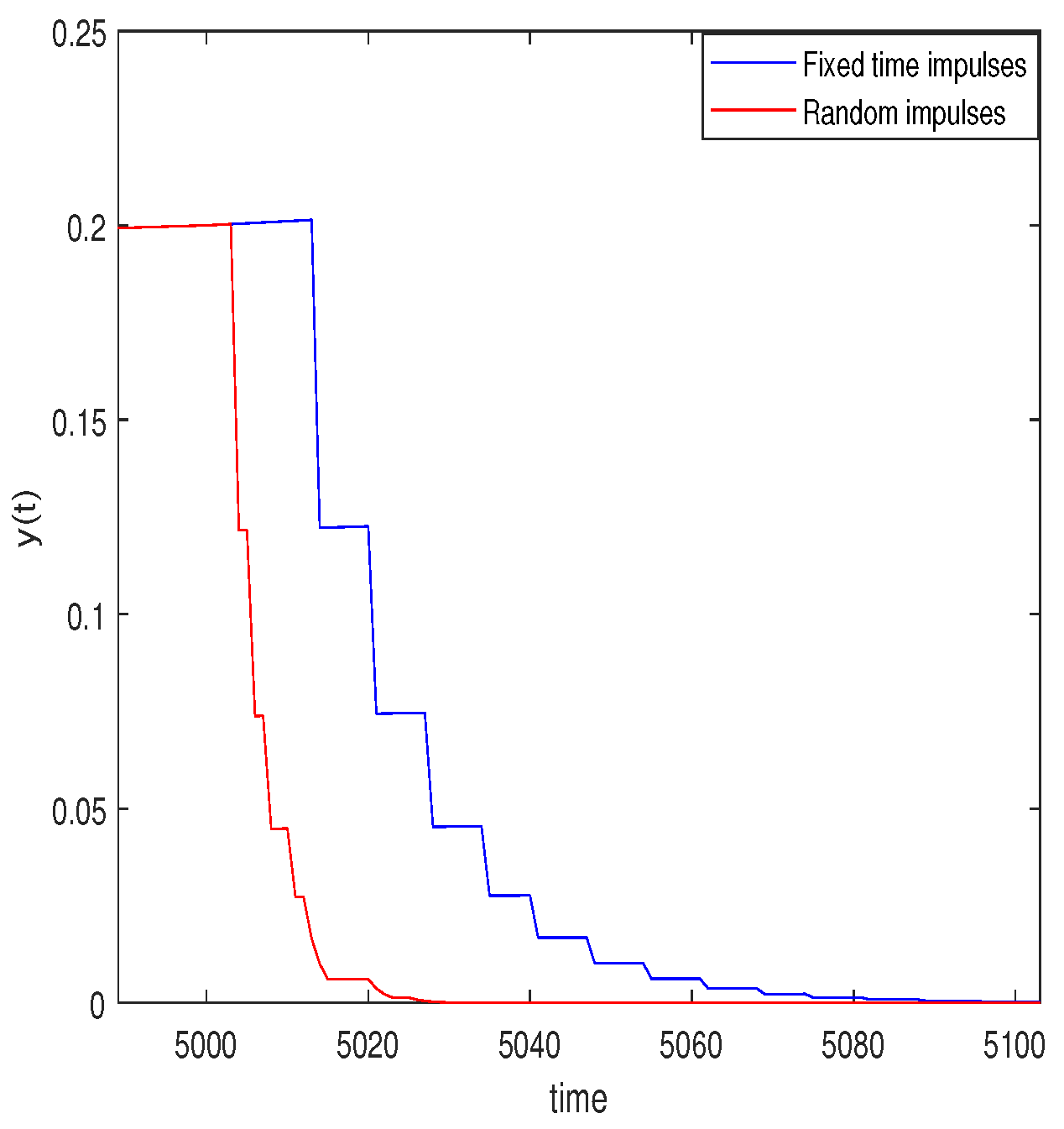
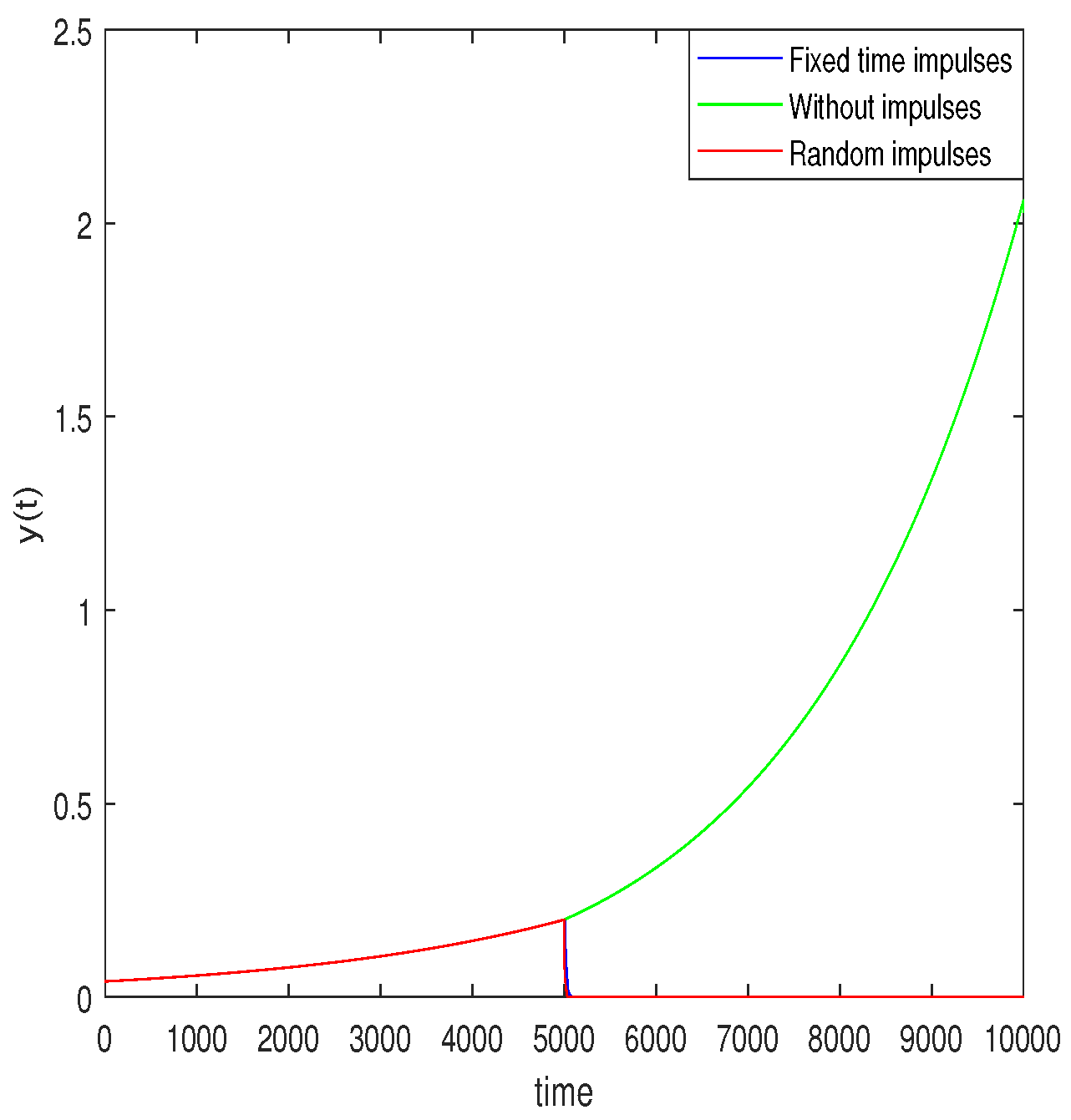
Therefore, system (24) is mean square exponentially stable at the origin by Corollary 2; see the comparative results Figure 3 and Figure 4.
Figure 3.
Shows that fixed impulsive effects, random impulsive effects and without impulsive effects of system (24).
Figure 4.
Comparative results between fixed and random time impulsive effects of system (24).
5. Conclusions
In this paper, we obtained several sufficient conditions for exponential stability and weakly exponential stability of RIIDDS by using the Lyapunov function and Razumikhin technique. Furthermore, we showed that random impulses are fast convergence compared with the fixed time impulses. Thus, we conclude that the random impulses are a better way to stabilize the various unstable differential systems in the future.
Author Contributions
Methodology, A.V. and X.L.; Conceptualization, A.V. and T.S.; Implementation of numerical schemes and Writing of the manuscript was completed by T.S.; Review & Editing by A.V. and X.L.; Supervision by A.V. and X.L. All authors read and approved the final manuscript.
Funding
This work was supported by Science and Engineering Research Board (DST-SERB) project file number: ECR/ 2015/000301 in India, National Natural Science Foundation of China (61673247), and the Research Fund for Distinguished Young Scholars and Excellent Young Scholars of Shandong Province (JQ201719). The APC was funded by National Natural Science Foundation of China (61673247), and the Research Fund for Distinguished Young Scholars and Excellent Young Scholars of Shandong Province (JQ201719).
Acknowledgments
The authors are thankful to the anonymous referees for their invaluable suggestions.
Conflicts of Interest
The authors declare no conflict of interest.
References
- Lakshmikantham, V.; Simeonov, P.S. Theory of Impulsive Differential Equations; World Scientific: Singapore, 1989; Volume 6. [Google Scholar]
- Samoilenko, A.M.; Perestyuk, N. Impulsive Differential Equations; World Scientific: Singapore, 1995. [Google Scholar]
- Liu, B.; Liu, X.; Teo, K.L.; Wang, Q. Razumikhin-type theorems on exponential stability of impulsive delay systems. Ima J. Appl. Math. 2006, 71, 47–61. [Google Scholar] [CrossRef]
- Liu, X.; Wang, Q. The method of lyapunov functionals and exponential stability of impulsive systems with time delay. Nonlinear Anal. Theory Methods Appl. 2007, 66, 1465–1484. [Google Scholar] [CrossRef]
- Yang, D.; Shen, J.; Zhou, Z.; Li, X. State-dependent switching control of delayed switched systems with stable and unstable modes. Math. Methods Appl. Sci. 2018, 41, 6968–6983. [Google Scholar] [CrossRef]
- Yang, X.; Li, X.; Xi, Q.; Duan, P. Review of stability and stabilization for impulsive delayed systems. Math. Biosci. Eng. 2018, 15, 1495–1515. [Google Scholar] [CrossRef] [PubMed]
- Zhang, X.; Han, X.; Li, X. Design of hybrid controller for synchronization control of chen chaotic system. J. Nonlinear Sci. Apl. 2017, 10, 3320–3327. [Google Scholar] [CrossRef][Green Version]
- Li, X.; Shen, J.; Rakkiyappan, R. Persistent impulsive effects on stability of functional differential equations with finite or infinite delay. Appl. Math. Comput. 2018, 329, 14–22. [Google Scholar] [CrossRef]
- Yang, T. Impulsive control. IEEE Trans. Autom. Control. 1999, 44, 1081–1083. [Google Scholar] [CrossRef]
- Yang, Z.; Xu, D. Stability analysis and design of impulsive control systems with time delay. IEEE Trans. Autom. Control. 2007, 52, 1448–1454. [Google Scholar] [CrossRef]
- Kayar, Z.; Zafer, A. Lyapunov-type inequalities for nonlinear impulsive systems with applications. Elec. J. Qual. Theory Differ. Equ. 2016, 27, 1–13. [Google Scholar] [CrossRef]
- Li, X.; Ding, Y. Razumikhin-type theorems for time-delay systems with persistent impulses. Syst. Control. Lett. 2017, 107, 22–27. [Google Scholar] [CrossRef]
- Li, X.; Wu, J. Stability of nonlinear differential systems with state-dependent delayed impulses. Automatica 2016, 64, 63–69. [Google Scholar] [CrossRef]
- Li, X.; Yang, X.; Huang, T. Persistence of delayed cooperative models: Impulsive control method. Appl. Math. Comput. 2019, 342, 130–146. [Google Scholar] [CrossRef]
- Liu, X.; Ballinger, G. Uniform asymptotic stability of impulsive delay differential equations. Comput. Math. Appl. 2001, 41, 903–915. [Google Scholar] [CrossRef]
- Zhang, X.; Li, X.; Song, S. Effect of delayed impulses on input-to-state stability of nonlinear systems. Automatica 2017, 76, 378–382. [Google Scholar]
- Anguraj, A.; Vinodkumar, A. Existence, uniqueness and stability results of random impulsive semilinear differential systems. Nonlinear Anal. Hybrid Syst. 2010, 4, 475–483. [Google Scholar] [CrossRef]
- Wu, S. Exponential stability of random impulsive differential systems. Acta Math. Sci. 2005, 25, 789–798. [Google Scholar]
- Agarwal, R.; Hristova, S.; O’Regan, D. Exponential stability for differential equations with random impulses at random times. Adv. Differ. Equ. 2013, 1, 372. [Google Scholar] [CrossRef]
- Agarwal, R.; Hristova, S.; Kopanov, P.; O’Regan, D. Impulsive differential equations with gamma distributed moments of impulses and p-moment exponential stability. Acta Math. Sci. 2017, 37, 985–997. [Google Scholar] [CrossRef]
- Anguraj, A.; Vinodkumar, A.; Malar, K. Existence and stability results for random impulsive fractional pantograph equations. Filomat 2016, 30, 3839–3854. [Google Scholar] [CrossRef]
- Caraballo, T.; Cortes, J.; Navarro-Quiles, A. Applying the random variable transformation method to solve a class of random linear differential equation with discrete delay. Appl. Math. Comput. 2019, 356, 198–218. [Google Scholar] [CrossRef]
- Gikhman, I.I.; Skorokhod, A.V. Stochastic differential equations. In The Theory of Stochastic Processes III; Springer: Berlin/Heidelberg, Germany, 2007; pp. 113–219. [Google Scholar]
- Gowrisankar, M.; Mohankumar, P.; Vinodkumar, A. Stability results of random impulsive semilinear differential equations. Acta Math. Sci. 2014, 34, 1055–1071. [Google Scholar] [CrossRef]
- Shaikhet, L. Lyapunov Functionals and Stability of Stochastic Functional Differential Equations; Springer Science & Business Media: Berlin/Heidelberg, Germany, 2013. [Google Scholar]
- Vinodkumar, A.; Anguraj, A. Existence of random impulsive abstract neutral non-autonomous differential inclusions with delays. Nonlinear Anal. Hybrid Syst. 2011, 5, 413–426. [Google Scholar] [CrossRef]
- Vinodkumar, A.; Malar, K.; Gowrisankar, M.; Mohankumar, P. Existence, uniqueness and stability of random impulsive fractional differential equations. Acta Math. Sci. 2016, 36, 428–442. [Google Scholar] [CrossRef]
- Vinodkumar, A.; Senthilkumar, T.; Li, X. Robust exponential stability results for uncertain infinite delay differential systems with random impulsive moments. Adv. Differ. Equ. 2018, 1, 39. [Google Scholar] [CrossRef]
- Wu, S.; Guo, X.; Zhou, Y. P-moment stability of functional differential equations with random impulses. Comput. Math. Appl. 2006, 52, 1683–1694. [Google Scholar] [CrossRef]
© 2019 by the authors. Licensee MDPI, Basel, Switzerland. This article is an open access article distributed under the terms and conditions of the Creative Commons Attribution (CC BY) license (http://creativecommons.org/licenses/by/4.0/).