1. Introduction and Preliminaries
Let
denote the class of functions in the following form
where
is analytic in the open unit disk
.
are denoted respectively by the subclasses of
consisting of univalent, starlike, convex functions (for details, see [
1,
2]).
Let denote the class of functions p satisfying and , where .
The function
s is subordinate to
t in
, written by
, if there exists a Schwarz function
, analytic in
with
and
, satisfying
(see [
1]). If the function
t is univalent in
and
, we have the equivalent results as follows,
In 1994, Ma and Minda [
3] introduce a class
of starlike functions defined by subordination,
if and only if
, where
. The corresponding convex class
was defined in a similar way.
For
and
, we denote respectively the subclasses of
by
and
satisfying (see [
4]):
and
It is easy to see that
and
Obviously,
is a starlike function of order
and
is a convex function of order
[
5]. Especially,
and
are well-known starlike functions and convex functions respectively.
In 1959, Sakaguchi [
6] introduced the class
of starlike functions with respect to symmetric points,
if and only if
In 1987, El-Ashwa and Thomas [
7] introduced some classes of starlike functions with respect to conjugate points and symmetric conjugate points satisfying the following conditions
In 1933, Fekete and Szegö [
8] introduced a classical Fekete-Szegö problem for
as follows,
The result is sharp.
In 1994, Ma and Minda [
3] studied the Fekete-Szegö problem of the classes of
and
. Many authors studied the problem of Fekete-Szegö and obtained many results (see [
9,
10,
11]).
A harmonic mapping in
is a complex valued harmonic function, which maps
onto the domain
. The mapping
f has a canonical decomposition
and
h and
g are analytic in
.
h is called the analytic part and
g is called the co-analytic part of
f. Let
denote the class of harmonic mappings with the following form (see [
12,
13])
where
In 1936, Lewy [
14] proved that
f is univalent and sense-preserving in
if and only if
, that is, the second complex dilatation
of
satisfying
in
(see [
12,
13]).
Many authors further investigated various subclasses of
and obtained some important results. In [
15], the authors studied the subclass of
with
. Also, Hotta and Michalski [
16] studied the properties of a subclass of
with
h is starlike and obtained the coefficient estimates, distortion estimates and growth estimates of
g, and Jacobian estimates of
f. Zhu and Huang [
17] studied some subclasses of
with
h is convex, or starlike functions of order
and some sharp estimates of coefficients, distortion, and growth are obtained.
According to the principle of subordination, we introduce the following general subclasses of of harmonic univalent starlike and convex functions with a symmetric conjecture point.
Definition 1. Let . We denote the function f be in the class of harmonic univalent starlike functions with a symmetric conjecture point if and only if and , that isAlso, we denote the function f be in the class of harmonic univalent generalized convex functions with a symmetric conjecture point if and only if and , that iswe know that . Additionally, we define the classes It is clear and Especially, let , , , , , , , .
In order to prove our results, we need the following Lemmas.
Lemma 1. [18] If the function is analytic with in , thenand Lemma 2. Let . (1) If thenwhereSpecially, . The estimate is sharp if(2) If thenwhere is defined by (10). The estimate is sharp ifEspecially, if , we have the following results. (i) If thenThe estimate is sharp if . (ii) If thenThe estimate is sharp if . Proof. Let
, there exists a positive real function
with
, satisfying
Comparing the coefficients of the both sides of the Equation (
14), we have
and
It is easy to verify that
and
Let
, from (18), we have
According to (17)–(19), we can obtain (9).
If , then . Using the results in (1), we can obtain (11) easily. ☐
Lemma 3. Let (1) If then(2) If then Proof. Let
. By definition 1 and the relationship of subordination, we have
where
is analytic in
satisfying
and
.
Comparing the coefficients of the both sides of (22), we obtain
By an application of (8) in Lemma 1, we obtain (20).
The bound is sharp as follows,
or
If
, then
. It is easy to obtain (21) and the bound is sharp as follows,
or
☐
Lemma 4. Let (1) If thenand ([4], Theorem 4 with A = 1 − 2β, B = −1)(2) If then ([19], Theorem 1 with b = 1, A = 1 − 2β, B = −1)and ([19], Theorem 2 with b = 1, A = 1 − 2β, B = −1) Proof. It suffices to establish the estimate of (23). If
, then
that is,
According to (24), it is not difficult to verify the estimate of (23).
Using the same argument as in the proof of Lemma 2 in [
20], we obtain immediately a Lemma as follows. ☐
Lemma 5. If , then . Especially for , we get the results of Lemma 2 in [20]. Lemma 6. If , then .
Lemma 7. Let (1) If then(2) If then Proof. Suppose
, we have
According to Lemmas 4 and 5, we have
By (29) and (30), we can obtain (27).
If
, then
According to Lemmas 4 and 6, we have
By (33), integrating along a radial line
, we obtained immediately,
For the left-hand side of (28), we note first that
is univalent. Let
and let
be the nearest point to the origin. By a rotation we suppose that
Let
be the line segment
and assume that
and
If
is the variable of integration on
L, we have that
on
L. Hence
So we complete the proof of Lemma 7. ☐
2. Main Results
Theorem 1. If then where and satisfy the conditions and
Proof. Let
. According to Definition 1 and Alexander’s Theorem ([
1], p. 43), the function
. Also,
and
Let
, then
It shows that
F is a locally univalent and sense-preserving harmonic function in
. Finally, appealing to ([
15], Corollary 2.3), we conclude that
☐
Corollary 1. If then where and satisfy the conditions and
Next, we give the integral expressions for functions of these classes.
Theorem 2. If , then we havewhereand ω and ν are analytic in satisfying . Proof. Let
. According to Definition 1 and the relationship of subordination, we have
and
where
and
are analytic in
satisfying
. Substituting
z by
in (37), we get
It follows from (37) and (38) that
After integrating the both sides of the equality (39) and calculating it simply, we have
From (37) and (40), we have
Integrating the both sides of the equality (41), we have
By (36) and (41), we can obtain
So, we complete the proof of Theorem 2. ☐
According to Theorem 2 and if and only if , we obtain easily the following result.
Theorem 3. Let , then we havewhere defined by (35), ω and ν are analytic in satisfying . In the following, we will get the coefficient estimates of the classes.
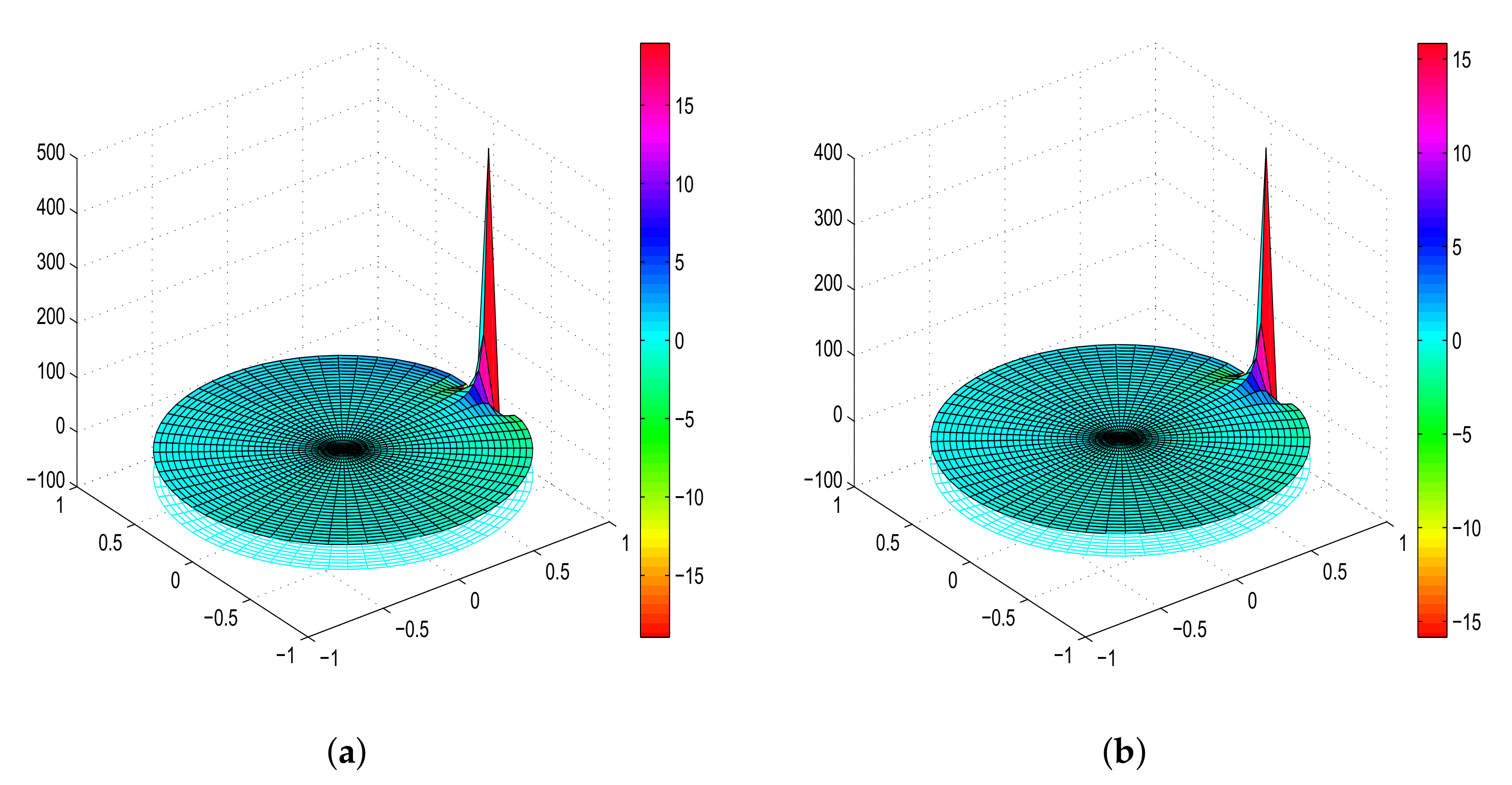
Theorem 4. Let , where h and g are given by (3) and is defined by (10). If thenandThe estimate is sharp and the extremal function isSpecially, if thenThe estimate is sharp and the extremal function isEspecially, let and in (48) respectively, we have (i) If thenThe estimate is sharp and the extremal function is(ii) If thenThe estimate is sharp and the extremal function isIn the following Figure 1, we draw the graph of and respectively. Proof. By using the relation
, where
h and
g are given by (3) and
is analytic in
, we obtain
and
It is easy to show that
and
Since
, it follows that
. By (7), it can easily be verified that
. Therefore,
and
According to Lemma 2, (53) and (54), by simple calculation, we can obtain (44), (45) and (47). We also obtain the extreme function. Thus, the proof is completed. ☐
Using the same methods in Theorem 4, we have the following results.
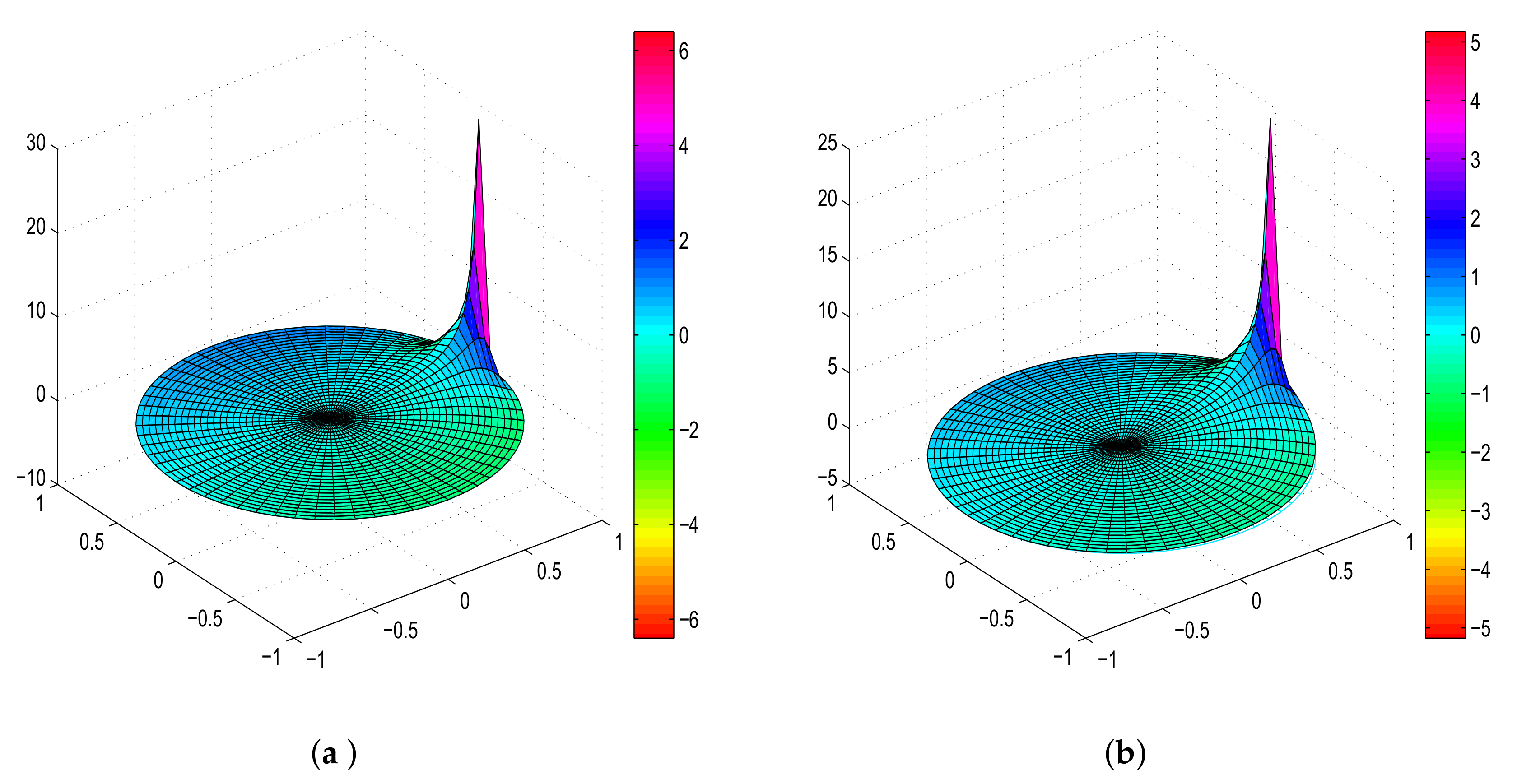
Theorem 5. Let , where h and g are given by (3) and is defined by (10). If , thenandSpecially, if , thenThe estimate is sharp and the extremal function isEspecially, let and respectively, we have (i) If thenand the estimate is sharp and the extremal function is(ii) If , thenand the estimate is sharp and the extremal function isIn the following Figure 2, we draw the graph of and respectively. From Theorems 4 and 5, we have
Corollary 2. Let , where h and g are given by (3) and is defined by (10). (1) If , thenandEspecially, if , then . (2) If , thenandEspecially, if , then . Also, we give the Fekete-Szegö inequality for functions of these classes.
Theorem 6. Let , where h and g are given by (3), for is defined by (10). (1) If , thenand(2) If , thenand Proof. From the relation (49) and (50), we have
and
According to Lemmas 2 and 3, we can compete the proof of Theorem 6.
Especially, we let , we obtain the following results.
Corollary 3. Let , where h and g are given by (3), for . (1) If , thenandEspecially, for given by Theorem 4, we have . And for given by Theorem 4, we have . (2) If , thenEspecially, for given by Theorem 5, we have . And for given by Theorem 5, we have . From Corollary 3, it is easy to obtain the following results.
Corollary 4. Let , where h and g are given by (3). (1) If , then(2) If , then Inspired by Zhu et al. [
17], we obtain the distortion estimates and growth estimate of the co-analytic part
g, Jacobian estimates, growth estimate and covering theorems of the classes of harmonic mapping with symmetric conjecture point defined by subordination as follows.
Theorem 7. Let , (1) If thenEspecially, let , for given by Theorem 4, we have(2) If thenEspecially, let , for given by Theorem 5, we have Proof. According to the relation
, it is easy to see
such that (see [
21]):
that is,
Applying (71) and (27), we get (67). Similarly, applying (71) and (28), we get (68). So the proof is completed. ☐
By using the same method in proof of Lemma 7, it is easy to obtain the following results.
Theorem 8. Let , (1) If thenEspecially, let , for given by Theorem 4, we have(2) If thenEspecially, let , for given by Theorem 5, we have In the following, we can obtain the Jacobian estimates and growth estimates of f.
Theorem 9. Let , (1) If , then(2) If , then Proof. We know that the Jacobian of
is in the following form
where
is the dilatation of
.
Let
, applying (27) and (71) to (74), we obtain
and
Therefore, we complete the proof of (1). Applying (28) and (71) to (74), (2) of Theorem 9 can be proved by the same method in the same way as shown before. ☐
Theorem 10. Let , (1) If then(2) If then Proof. For any point
let
and denote
and then
Hence, there exists
such that
Let
, then
is a well-defined Jordan arc. For
using (27) and (71), we have
Applying (27) and (71) with a simple calculation, we can obtain the right side of (75). The remainder of the argument is analogous to that in (76) and so is omitted. ☐
According to (75) and (76), we have the following covering theorems of f.
Corollary 5. Let . (1) If then where(2) If then where