Abstract
We consider a multidimensional inhomogeneous birth-death process. In this paper, a general situation is studied in which the intensity of birth and death for each coordinate (“each type of particle”) depends on the state vector of the whole process. A one-dimensional projection of this process on one of the coordinate axes is considered. In this case, a non-Markov process is obtained, in which the transitions to neighboring states are possible in small periods of time. For this one-dimensional process, by modifying the method previously developed by the authors of the note, estimates of the rate of convergence in weakly ergodic and null-ergodic cases are obtained. The simplest example of a two-dimensional process of this type is considered.
1. Introduction and Preliminaries
Multidimensional birth-death processes (BDP) were objects of a number of studies in queueing theory and other applied fields. The authors of these papers studied different special classes of homogeneous multidimensional BDPs under some restrictions and considered fluid approximations [1], simulations [2,3,4,5,6], large deviations [7], stability [8,9], and other features. The problem of the product from solutions for such models was considered, for instance, in [10,11] (also, see the references therein). If the process is inhomogeneous and the transition intensities have a more general form, then the problem of computation of any probabilistic characteristics of the queueing model is much more difficult.
In the general case, it is impossible to obtain explicit solutions and their characteristics, as well as to construct any significant characteristics of the processes, as can be seen from the above list of works. This paper fills this gap and proposes a method of research and evaluation allowing one to estimate the rate of convergence for a one-dimensional projection of the multidimensional birth-death process. The approach also makes it possible to evaluate the main characteristics of the projection, as is demonstrated by the simplest example of an inhomogeneous two-dimensional process.
The background of our approach is the method of investigation of inhomogeneous BDP, see the detailed discussion and some preliminary results in [12,13,14,15]. Estimates for the state probabilities of one-dimensional projections of a multidimensional BDP were studied in [16,17]. However, within that methodology, it was impossible to obtain estimates of the rate of convergence, since the logarithmic norm of the operator cannot be applied to the corresponding nonlinear systems.
Here, we substantially modify that approach so that it can be used for estimation and construction of some explicit bounds on the rate of convergence for one-dimensional projection of a multidimensional BDP. Namely, in Section 2, we develop a simple but efficient method for bounding the rate of convergence for an arbitrary (which may be nonlinear, depending on the number of parameters and so on) differential equation in the space of sequences , and in Section 3, we apply this method to bounding the rate of convergence for one-dimensional projections of BDP.
Let be a d-dimensional BDP such that in the interval , the following transitions are possible with order h: birth of a particle of type j, death of a particle of type j.
Let be the corresponding birth rate (from the state to the state ) and let be the corresponding death intensity (from the state to the state ). Denote .
To consider the existence and uniqueness, we renumber the states (only in this section), transforming the process into a one-dimensional one. Now, let the (finite or countable) state space of the vector process under consideration be arranged in a special order, say . Denote by , the corresponding state probabilities, and by , the corresponding column vector of state probabilities. Applying our standard approach (see details in [12,14,15]), we suppose in addition that all intensities are nonnegative functions locally integrable on , and, moreover, in new enumeration,
where are the corresponding transition intensities and all are uniformly in i, that is, , for any .
We suppose that for any j, and almost all .
The probabilistic dynamics of the process is represented by the forward Kolmogorov system:
where is the corresponding infinitesimal (intensity) matrix.
Throughout the paper, we denote the -norm by , i.e., , and for .
Let be the set all stochastic vectors, i.e., -vectors with nonnegative coordinates and unit norm. We have the inequality for almost all . Hence, the operator function from into itself is bounded for almost all and is locally integrable on . Therefore, we can consider (2) as a differential equation in the space with bounded operator.
It is well known, see [18], that the Cauchy problem for differential Equation (2) has unique solution for an arbitrary initial condition, and implies for .
We recall that a Markov chain is called null-ergodic, if all as for any initial condition, and it is called weakly ergodic, if as for any initial condition , see for instance [12,14].
2. Bounds on the Rate of Convergence for a Differential Equation
Consider a general (linear or nonlinear) differential equation
in the space of sequences under the assumption of existence and uniqueness of a solution for any initial condition .
Let , where all depend on some parameters (for instance, on y, ).
We have
Now, if , then
and if , then we also have
Finally, using the continuity of all coordinates of the solution and the absolute convergence of all series, we obtain the estimate
where
Remark 1.
One can see that inequality (4) implies the bound
Moreover, if H is bounded for any t linear operator function from to itself, then is the corresponding logarithmic norm of , see [12,13,14,15].
On the other hand, in a nonlinear situation, yields a generalization of this notion.
3. Bounds on the Rate of Convergence for a Projection of Multidimensional BDP
Again, consider the forward Kolmogorov system (2) in the original vector form. Then, we have
for any .
In this section, we consider the one-dimensional process for a fixed j. Denote . Then, . The process has nonzero jump rates only for unit jumps (), namely, if , then for small positive h only the jumps are possible with positive intensities, say and , respectively. Moreover, (7) implies the equalities
and hence
and
Then, is a (in general, non-Markovian) birth and death process with birth and death intensities and , respectively, (that is, it is a process with possible infinitesimal jumps , the intensities of which depend on t and on the initial condition for the original multidimensional process .)
For any fixed initial distribution and any , the probability distribution is unique. Hence, and uniquely define the system
for the vector of state probabilities of the projection under the given initial condition. Obviously, different initial conditions specify different systems.
Here, is the corresponding three-diagonal “birth-death” transposed intensity matrix such that all off-diagonal elements are nonnegative and all column-wise sums are equal to zero.
Let for all and any
Then, from (10) and (11), we obtain the two-sided bounds
for any k, any t, and any initial conditions.
1. Let the state space of be countable and
Put , , and . Let be a diagonal matrix, .
Note that in this situation, , and as implying null ergodicity of , that is as for any k.
Then,
Then, we have
implying the estimate
and the following statement.
Theorem 1.
Hence,
and as for any .
Remark 2.
It should be noted that the above requirements are imposed only on this one coordinate.
2. Let
We have for any . Set . Then, from (12), we obtain the system
where , , and the corresponding matrix , where for the corresponding elements of the matrix .
For the solutions of system (23), the rate of convergence is determined by the system
where all elements of depend on t and the initial condition of the original process.
Let . Then, the following bound holds:
Note that , see detailed discussion in [15], therefore, if as , then is weakly ergodic.
Thus, we obtain the following statement.
Theorem 2.
Let (22) hold for some j. Then, is weakly ergodic and the following bound holds:
for any and any corresponding initial conditions.
4. Example
Consider a simple two-dimensional BDP with finite state space , , and the following transition intensities:
- (i)
- from to ;
- (ii)
- from to if ;
- (iii)
- from to ;
- (iv)
- from to ;
- (v)
- from to ;
where , , , .
Then, , and Theorem 2 gives bound (27) with .
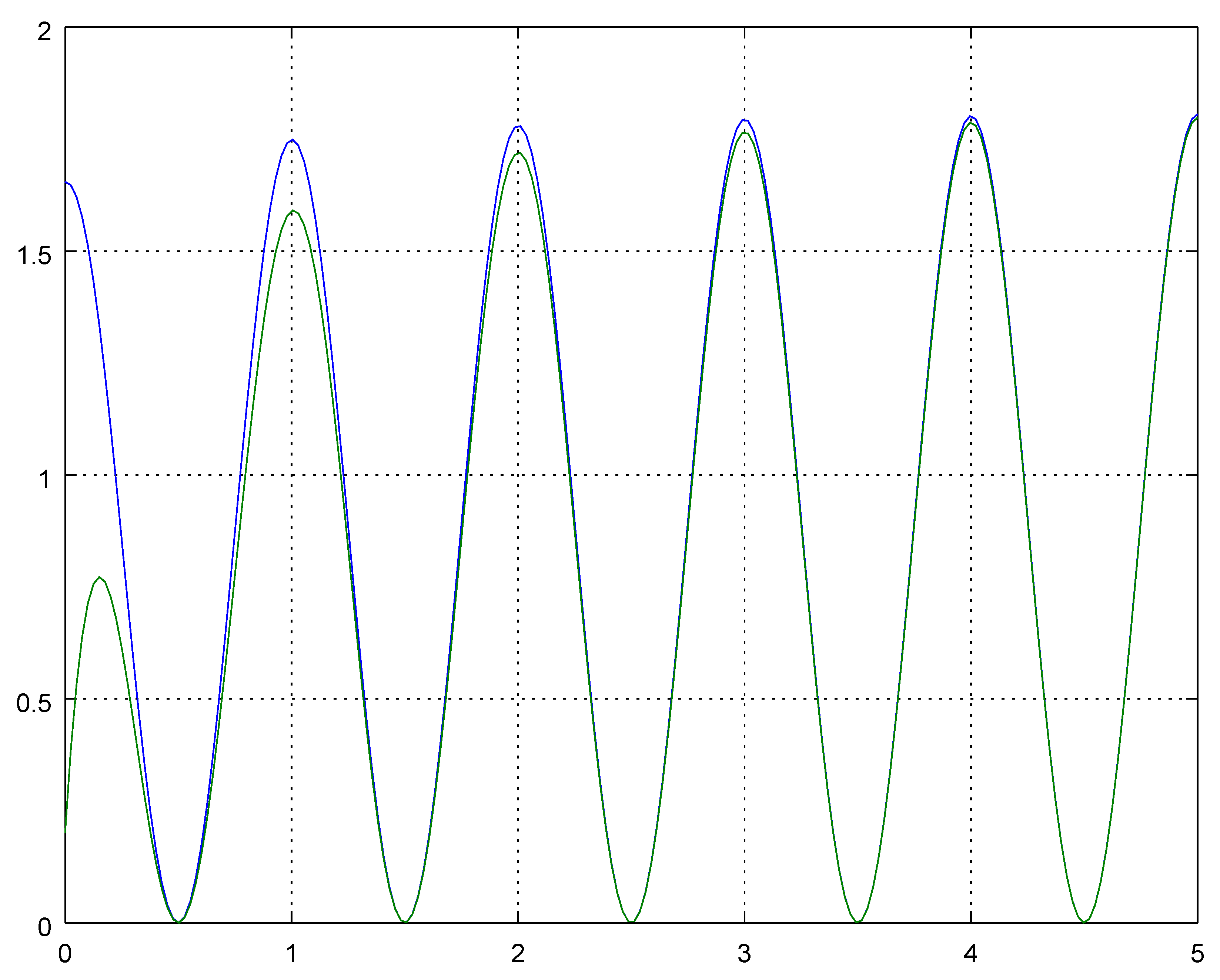
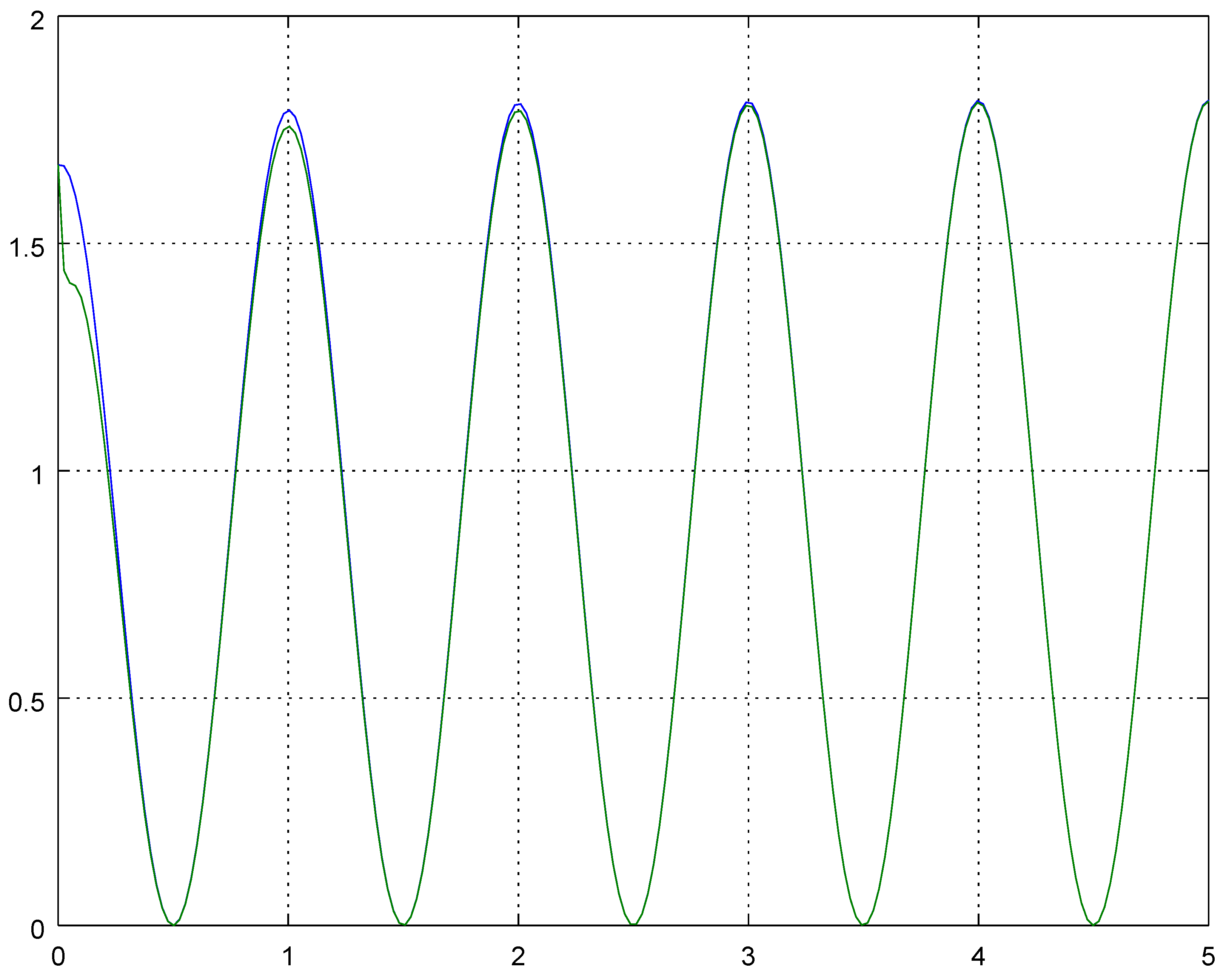
We computed some important characteristics for the original process and its projection , namely:
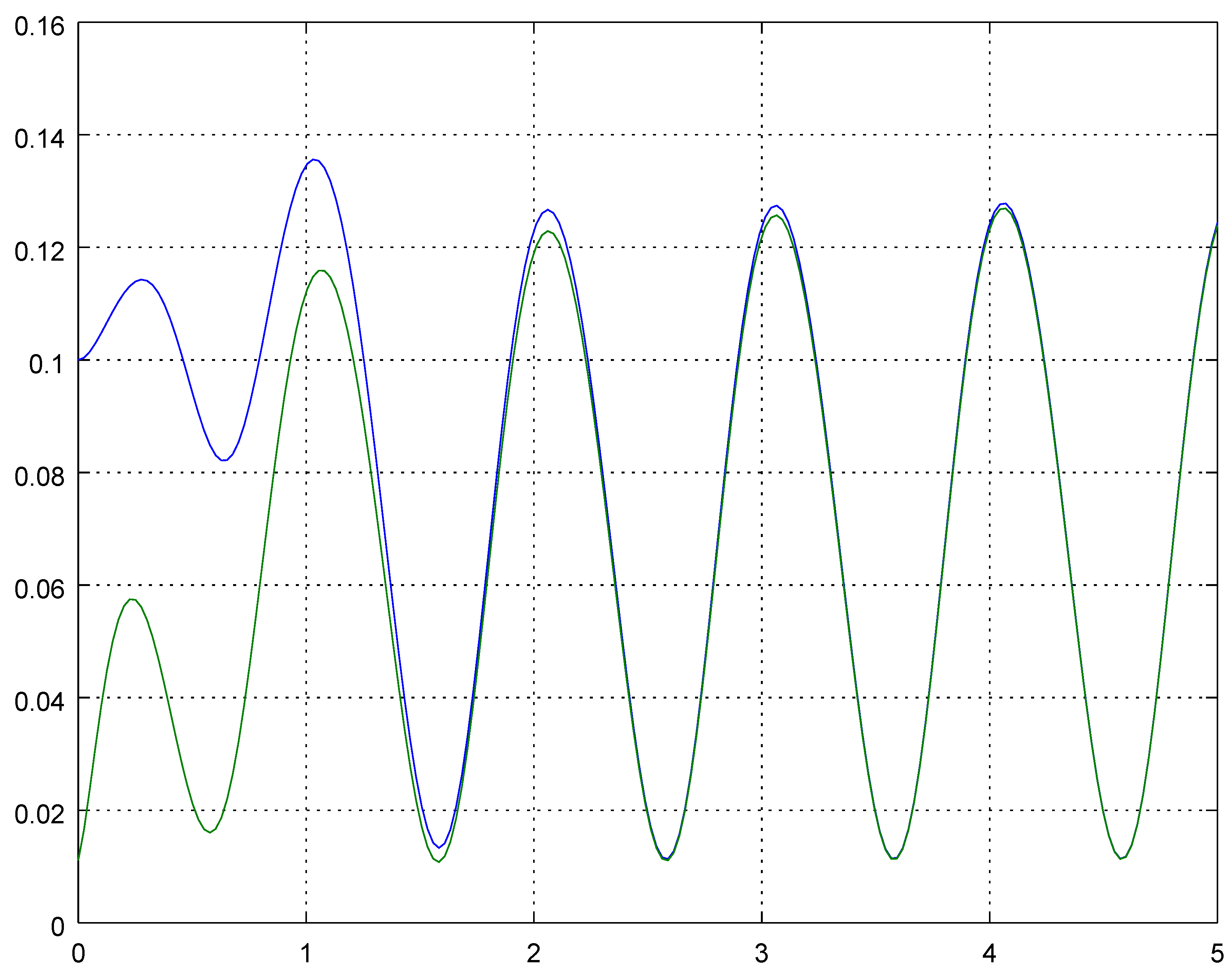
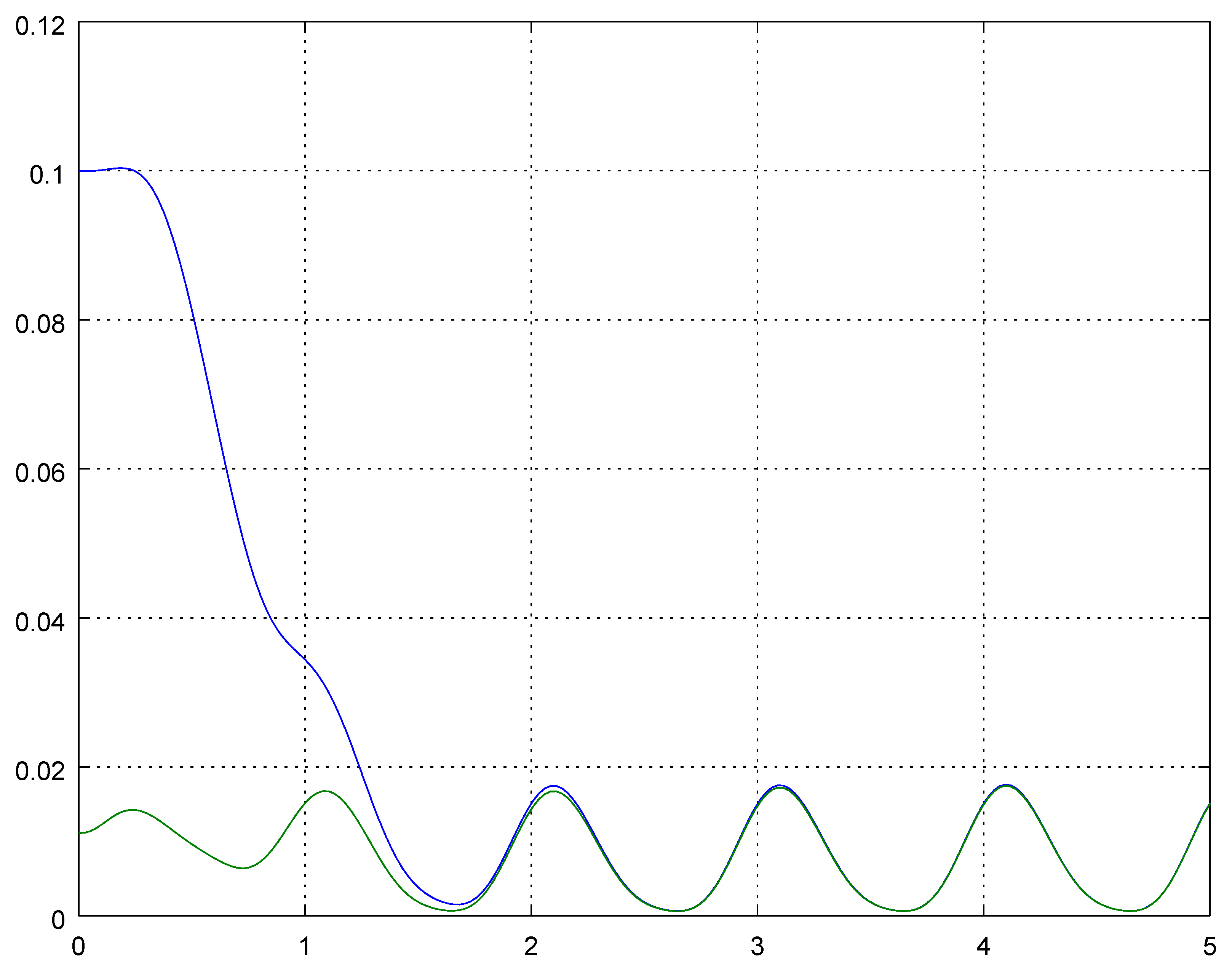
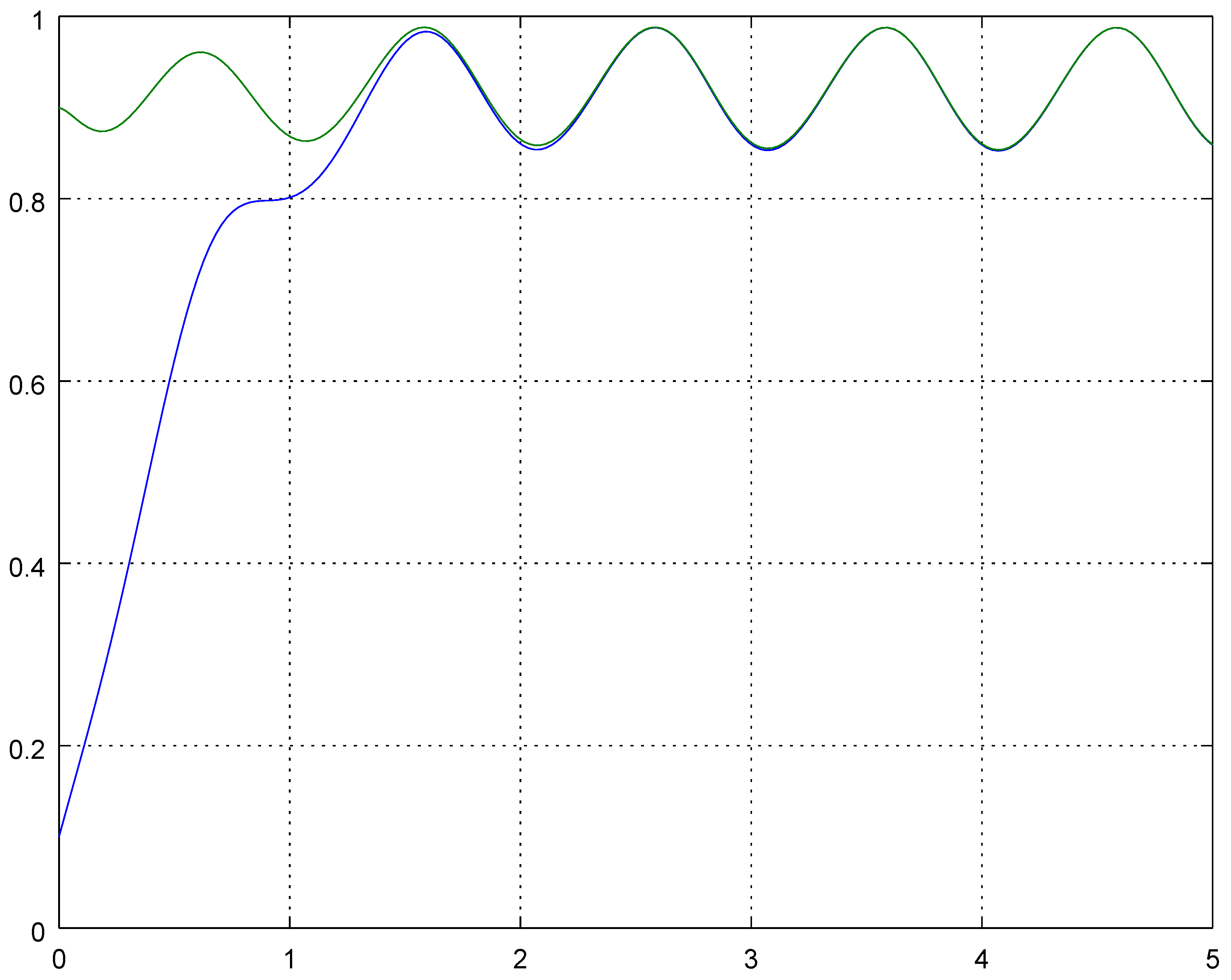
Figure 1, Figure 2 and Figure 3 show the behaviour of the state probabilities for , namely , , and under two initial conditions for the original BDP:
Figure 1.
under initial conditions (i) and (ii).
Figure 2.
under initial conditions (i) and (ii).
Figure 3.
under initial conditions (i) and (ii).
- (i)
- , for any (blue); and
- (ii)
- , , for any such that (green).
Note that the corresponding initial conditions for the projection are , and .
These Figures illustrate the rate of convergence in a weak ergodic situation.
Figure 4.
under initial conditions (i) and (ii).
Figure 5.
under initial conditions (i) and (ii).
Note that all the quantities are found by numerically solving the Cauchy problem for the forward Kolmogorov system (2) and the corresponding system (12) for its projection on the corresponding interval.
As can be seen from Theorem 2 and the figures below, to construct all the characteristics of interest with good accuracy, it suffices to carry out the numerical solution on the interval .
As was already noted, the projection of the original process is not a Markov process, and all probabilistic characteristics depend on the initial conditions of the original process.
It can be seen that these characteristics present comprehensive information concerning the behavior of the projection of the original process.
5. Conclusions
In the paper, some estimates of the rate of convergence were discussed for one-dimensional projections of multidimensional inhomogeneous birth and death processes. Some specific queueing models were considered. The applied approach allows one to use an analogue of the logarithmic norm of an operator function for a nonlinear system of differential equations, as was shown in Section 2. In addition, similar estimates can be obtained for other one-dimensional processes related to the original one. For example, the total number of “particles” of all types can be studied. Moreover, it is possible to study multidimensional processes with possible transformations of particles from one type to another. Such processes play a very important role in stochastic models of epidemics, see, for example, References [19,20] and the references therein.
Author Contributions
Conceptualization, A.Z., Y.S.; Methodology, A.Z., Y.S.; Software, Y.S.; Validation, A.Z., Y.S., K.K., V.K.; Investigation, A.Z., V.K.; Writing—Original Draft Preparation, A.Z., K.K., Y.S., V.K.; Writing—Review and Editing, A.Z., K.K., V.K.; Supervision, A.Z.; Project Administration, K.K.
Funding
The work of A.Z. and V.K. was supported by the Russian Science Foundation under grant 18-11-00155.
Acknowledgments
The authors thank the referees for useful comments that improved the paper.
Conflicts of Interest
The authors declare no conflict of interest.
References
- Michaelides, M.; Hillston, J.; Sanguinetti, G. Geometric fluid approximation for general continuous-time Markov chains. arXiv 2019, arXiv:1901.11417. [Google Scholar]
- Goswami, B.B.; Khouider, B.; Phani, R.; Mukhopadhyay, P.; Majda, A. Improving synoptic and intraseasonal variability in CFSv2 via stochastic representation of organized convection. Geophys. Res. Lett. 2017, 44, 1104–1113. [Google Scholar] [CrossRef]
- Goswami, B.B.; Khouider, B.; Phani, R.; Mukhopadhyay, P.; Majda, A.J. The Stochastic Multi-cloud Model (SMCM) Convective Parameterization in the CFSv2: Scopes and Opportunities. In Current Trends in the Representation of Physical Processes in Weather and Climate Models; Springer: Singapore, 2019; pp. 157–181. [Google Scholar]
- Deng, Q.; Khouider, B.; Majda, A.J. The MJO in a coarse-resolution GCM with a stochastic multicloud parameterization. J. Atmos. Sci. 2015, 72, 55–74. [Google Scholar] [CrossRef]
- Marsan, M.A.; Marano, S.; Mastroianni, C.; Meo, M. Performance analysis of cellular mobile communication networks supporting multimedia services. Mob. Netw. Appl. 2000, 5, 167–177. [Google Scholar] [CrossRef]
- Stevens-Navarro, E.; Mohsenian-Rad, A.H.; Wong, V.W. Connection admission control for multiservice integrated cellular/WLAN system. IEEE Trans. Veh. Technol. 2008, 57, 3789–3800. [Google Scholar] [CrossRef]
- Jonckheere, M.; Lypez, S. Large deviations for the stationary measure of networks under proportional fair allocations. Math. Oper. Res. 2013, 39, 418–431. [Google Scholar] [CrossRef]
- Jonckheere, M.; Shneer, S. Stability of multi-dimensional birth-and-death processes with state-dependent 0-homogeneous jumps. Adv. Appl. Probab. 2014, 46, 59–75. [Google Scholar] [CrossRef][Green Version]
- Lee, C. On moment stability properties for a class of state-dependent stochastic networks. J. Korean Stat. Soc. 2011, 40, 325–336. [Google Scholar] [CrossRef]
- Mather, W.H.; Hasty, J.; Tsimring, L.S.; Williams, R.J. Factorized time-dependent distributions for certain multiclass queueing networks and an application to enzymatic processing networks. Queueing Syst. 2011, 69, 313–328. [Google Scholar] [CrossRef] [PubMed]
- Tsitsiashvili, G.S.; Osipova, M.A.; Koliev, N.V.; Baum, D. A product theorem for Markov chains with application to PF-queueing networks. Ann. Oper. Res. 2002, 113, 141–154. [Google Scholar] [CrossRef]
- Granovsky, B.; Zeifman, A. Nonstationary queues: Estimation of the rate of convergence. Queueing Syst. 2004, 46, 363–388. [Google Scholar] [CrossRef]
- Zeifman, A.I. On the estimation of probabilities for birth and death processes. J. Appl. Probab. 1995, 32, 623–634. [Google Scholar] [CrossRef] [PubMed]
- Zeifman, A.I. Upper and lower bounds on the rate of convergence for nonhomogeneous birth and death processes. Stoch. Proc. Appl. 1995, 59, 157–173. [Google Scholar] [CrossRef]
- Zeifman, A.; Leorato, S.; Orsingher, E.; Satin, Y.; Shilova, G. Some universal limits for nonhomogeneous birth and death processes. Queueing Syst. 2006, 52, 139–151. [Google Scholar] [CrossRef]
- Zeifman, A.; Sipin, A.; Korolev, V.; Bening, V. Estimates of some characteristics of multidimensional birth-and-death processes. Dokl. Math. 2015, 92, 695–697. [Google Scholar] [CrossRef]
- Zeifman, A.I.; Sipin, A.S.; Korotysheva, A.V.; Panfilova, T.L.; Satin, Y.A.; Shilova, G.N.; Korolev, V.Y. Estimation of Probabilities for Multidimensional Birth-Death Processes. J. Math. Sci. 2016, 218, 238–244. [Google Scholar] [CrossRef]
- Daleckij, J.L.; Krein, M.G. Stability of solutions of differential equations in Banach space. Am. Math. Soc. Transl. 2002, 43, 1–386. [Google Scholar]
- Britton, T. Stochastic epidemic models: A survey. Math. Biosci. 2010, 225, 24–35. [Google Scholar] [CrossRef] [PubMed]
- Zeifman, A.I. Processes of birth and death and simple stochastic epidemic models. Autom. Remote Control 1985, 6, 128–135. [Google Scholar]
© 2019 by the authors. Licensee MDPI, Basel, Switzerland. This article is an open access article distributed under the terms and conditions of the Creative Commons Attribution (CC BY) license (http://creativecommons.org/licenses/by/4.0/).