Abstract
In this article, we study a modified viscosity splitting method combined with inertial extrapolation for accretive operators in Banach spaces and then establish a strong convergence theorem for such iterations under some suitable assumptions on the sequences of parameters. As an application, we extend our main results to solve the convex minimization problem. Moreover, the numerical experiments are presented to support the feasibility and efficiency of the proposed method.
MSC:
47H09; 47H10; 47H04
1. Introduction
Throughout this paper, we let E be a real Banach space with norm and be its dual space. The normalized duality mapping J from E into is defined by the following equation:
we denote the generalized duality pairing between E and by and the single-valued duality mapping by j.
The inclusion problem is to find such that
where is an operator and is a set-valued operator. Please note that on the one hand, this problem takes into account some special cases, such as variational inequalities, convex programming, minimization problem, and split feasibility problem [1,2,3]. On the other hand, as an important branch of nonlinear functional analysis and optimization theory, it has been studied numerous times in the literature to solve the real-world problem, such as machine learning, image reconstruction, and signal processing; see [4,5,6,7] and the references therein.
In 2012, Takashashi et al. [8] studied a Halpern-type iterative method for an -inverse strongly monotone mapping A and a maximal monotone operator B in a Hilbert space as follows:
under certain conditions, the algorithm was showed to converge strongly to a solution of . Furthermore, Lopez et al. [9] introduced the following method for accretive operators:
they studied strong convergence theorems for Halpern-type splitting methods in Banach spaces. In 2016, Pholasa et al. [10] extended the above results [8,9] and studied the modified forward-backward splitting methods in Banach spaces:
it was proved that converges strongly to a point under some mild conditions, where Q is the sunny nonexpansive retraction.
Inertial extrapolation is an important technique to speed up the convergence rate [11,12,13,14]. Recently, the fast-iterative algorithms by using inertial extrapolation studied by some authors [15,16,17]. For instance, in 2003, Moudafi et al. [18] studied the following inertial proximal point algorithm of a maximal monotone operator:
If is non-decreasing and is chosen such that
then converges to a zero point of T. In 2015, Lorenz et al. [19] applied inertial extrapolation technique to forward-backward algorithm for monotone operators in Hilbert spaces. They proved that the iterative process defined by
converges weakly to a solution of the inclusion . In 2018, Cholamjiak et al. [20] proposed a Halpern-type inertial iterative method for monotone operators in Hilbert spaces and they proved the strong convergence of the algorithm.
Inspired and motivated by the above-mentioned works, we apply inertial extrapolation algorithms and viscosity approximation to give an extension, and then we study a modified splitting method for accretive operators in Banach spaces. The strong convergence theorems for such iterations are established and some applications including the numerical experiments are presented to support our main theorem.
2. Preliminaries
Recall that a Banach space E is said to be uniformly convex if for any , there exists a such that with , and , then . We denote the modulus of smoothness of E as follows:
for , a Banach space E is said to be q-uniformly smooth if there exists a constant such that . E is said to be uniformly smooth if . It is obvious that q-uniformly smooth Banach space must be uniformly smooth and E is uniformly smooth if and only if the norm of E is uniformly Fréchet differentiable.
Let I be the identity operator. We denote by , the domain and range of an operator , respectively. A is called accretive if for each , there exists such that
An accretive operator A is called -inverse strongly accretive, if for each , there exists such that
It is well-known that an accretive operator A is m-accretive if for all 0. If A is an accretive operator which satisfies the range condition, then, for each , the mapping is defined by , which is called the resolvent operator of A.
Let C be a nonempty, closed and convex subset of E, and let D be a nonempty subset of C. A mapping is called a retraction of C onto D, if for all , there is . We called T is sunny if T has the following property: for each and whenever . It is known that a sunny nonexpansive retraction is a sunny retraction which is also nonexpansive.
The following lemmas are needed to prove our results.
Lemma 1
([21]).Let E be a smooth Banach space. Then the following inequality holds:
Lemma 2
([22]).For any , give and , if
then . In addition, there holds the relation
Lemma 3
([23]).If a Banach space E is uniformly smooth, then the duality mapping J is single valued and norm-to-norm uniformly continuous on each bounded subset of E.
Lemma 4
([21]).Let E be a uniformly smooth Banach space and be a nonexpansive mapping with a fixed point. Let be a contraction with coefficient and , the unique fixed point of the contraction converges strongly as to a fixed point of T. Define a mapping by . Then Q is the unique sunny nonexpansive retract from C onto D.
Lemma 5
([24]).Assume , and be the sequences such that
(i) If ; (ii) ; then .
Lemma 6
([25]).Assume is a sequence of nonnegative real numbers such that
where is a sequence in , is a sequence of nonnegative real numbers and , are real sequences such that
- (i)
- ,
- (ii)
- ,
- (iii)
- implies for any subsequence .
Then .
Lemma 7
([26]).Let A be a single-valued α-isa in a real uniformly convex Banach space with Fréchet differentiable norm. Then, for all and given , there exists a continuous, strictly increasing and convex function with such that
where k is the uniform smoothness coefficient of E.
Lemma 8
([27]).Let E be a uniformly convex Banach space. Then, for all and , there exists a convex continuous and strictly increasing function with such that
3. Main Results
Theorem 1.
Let E be a uniformly convex and uniformly smooth Banach space. Let be an α-inverse-strongly accretive mapping and be an m-accretive operator. Assume that . Let be a contraction with coefficient and , , be real number sequences in and . Define a sequence in E as follows:
for all , where and . Assume that the following conditions hold:
Then the sequence converges strongly to , where Q is the sunny nonexpansive retraction of E onto Ω.
Proof.
Let , . Then, we have
In view of Lemma 2, we have
From the restriction and Lemma 5, we find that is bounded. Hence , are also bounded.
Using the inequality in Lemma 1 and Lemma 8 , we find that
and
In view of Lemmas 7 and 8, we get
We can check that is in , by the condition , we can show that is positive. Then, we have
and
Notice that , we see that . By the boundedness of , and the restriction , implies that .
On the other hand, using Lemma 6, it remains to show that implies , for any subsequence . Let be a subsequence of such that . It follows from the restrictions and the property of , we derive from (8) the following
By the triangle inequality, it turns out that
and moreover, since , there exists , such that for all , in view of the inequality in Lemma 2, we have
It turns out that
Therefore, we can get
Please note that
We get from condition and (9) that
Put for any . Apply Lemma 4, we get . Then we have
This implies that
From (10), (11) we obtain
for some large enough. Since the duality mapping J is norm-to-norm uniformly continuous on bounded sets of E, we see that . Then, we have that
On the other hand, we have
From condition , and (9), we have
This implies that that means by Lemma 6, we get . Hence, we see that . This finishes the proof. □
Corollary 1.
Let E be a uniformly convex and uniformly smooth Banach space. Let be an α-inverse-strongly accretive mapping and be an m-accretive operator. Assume that . Let , , be real number sequences in and . Define a sequence in E as follows:
for all , where and . Assume that the following conditions hold:
Then the sequence converges strongly to , where Q is the sunny nonexpansive retraction of E onto Ω.
Proof.
In this case, the map defined by , is a strict contraction with constant . The proof follows from Theorem 1 above. □
Corollary 2.
Let H be a uniformly convex and uniformly smooth Hilbert space. Let be an α-inverse-strongly monotone operator and be a maximal monotone operator. Assume that . Let be a contraction with coefficient and , , be real number sequences in and . Define a sequence in E as follows:
for all , where and . Assume that the following conditions hold:
Then the sequence converges strongly to , where P is the metric projection of H onto Ω.
Proof.
We only need to replace Banach space E with Hilbert space H in the proof of Theorem 1. □
Corollary 3.
(Convex minimization problem) Let H be a real Hilbert space. Let be a convex and differentiable function with K-Lipschitz continuous gradient and a convex and lower semi-continuous function which attains a minimizer. Let , , be real number sequences in and . Define a sequence in H as follows:
for all , where and . Assume that the following conditions hold:
Then the sequence converges strongly to a minimizer of .
Proof.
We get that gradient is K-Lipschitz continuous, then it is inverse strongly monotone, and g is a convex and lower semi-continuous function, so is maximal monotone. Thus, let and in Theorem 1, the conclusion of Theorem 1 still holds. □
4. Applications and Numerical Experiments
In this section, we give a concrete example of the numerical results to support the main theorem. Furthermore, we give it to compare the efficiency of our proposed algorithm with the algorithm of Pholasa et al. [10]. And we also show the algorithm presented in this paper converges more quickly. The whole codes are written by Matlab R2013b. All the results are carried out by personal computer with Intel(R) Core(TM) i7-4710MQ CPU @ 2.50GHz and RAM 8.00GB.
Example 1.
Let be a uniformly convex and uniformly smooth Banach space, we set and where . We can check that is a -isa, is an m-accretive operator and for all . we take , for all . Let , and be a contraction with coefficient . Starting , and using algorithm (1) in Theorem 1, we obtain the following numerical results.
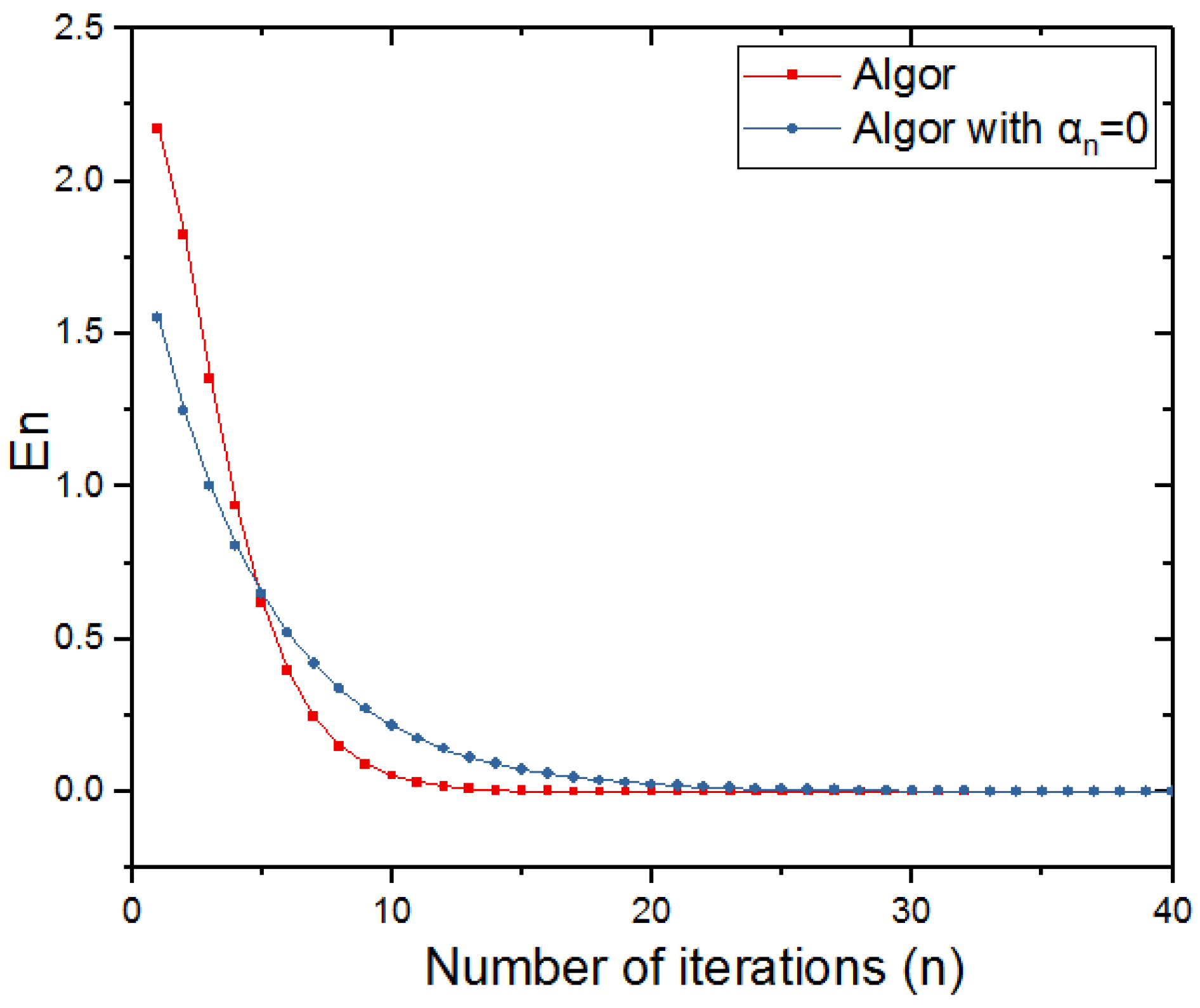
From Table 1 we see that is an approximation of a solution with an error . And we make the same choices for as reported in Table 1. In terms of the number of iterations and the errors, we provide the numerical examples to demonstrate the performance and to compare our proposed algorithm with the iterative algorithm with .
Table 1.
Numerical results of Example 1 for iteration process.
In these 600 experiments, Table 2 shows that the final approximation solution is the same as Table 1. Figure 1 shows that the number of iterations and errors of our algorithm and the algorithm with for the above initial points. We can see that the convergence of our algorithm is faster than the algorithm of Pholasa et al. [10].
Table 2.
Numerical results for iteration process Algorithm (1) with in Example 1.
Figure 1.
Error plotting of .
5. Conclusions
In this paper, we give a modified inertial viscosity splitting algorithm for accretive operators in Banach spaces. The strong convergence theorems are established, and the numerical experiments are presented to support that the inertial extrapolation greatly improves the efficiency of the algorithm. In Theorem 1 and Corollary 1, if and A is an inverse strongly monotone operator in Hilbert space, it is the main results of Cholamjiak et al. [20]. In Theorem 1, if , and E is a uniformly convex and q-uniformly smooth Banach space, it is the main results of Pholasa et al. [10]. Furthermore, some other results are also improved (see [8,9,18,19,26]).
The introduction of the inertial viscosity splitting algorithms sheds new light on inclusion problem. Combined with recent research findings ([4,13,19,20]), Theorem 1 can be further applied to the fixed-point problem, the split feasibility problem and the variational inequality problem. Indeed, it is an important but unsolved problem to choose the optimal inertia parameters in the acceleration algorithm. In the future, more work will be devoted to the wide application of the proposed algorithm and the improvement of its convergence rate.
Author Contributions
Conceptualization, C.P. and Y.W.; methodology, C.P. and Y.W.; software, C.P. and Y.W.; validation, C.P. and Y.W.; formal analysis, C.P. and Y.W.; investigation, C.P. and Y.W.;resources, C.P. and Y.W.; data curation, C.P.; writing–original draft preparation, C.P. and Y.W.; writing–review and editing, C.P. and Y.W.; visualization, C.P. and Y.W.; supervision, Y.W.; project administration, Y.W.
Funding
This research received no external funding.
Acknowledgments
This work was supported by the National Natural Science Foundation of China (Grant no. 11671365) and the Natural Science Foundation of Zhejiang Province (Grant no. LY14A010011).
Conflicts of Interest
The authors declare that they have no competing interests.
References
- Yao, Y.; Shahzad, N. Strong convergence of a proximal point algorithm with general errors. Optim. Lett. 2012, 6, 621–628. [Google Scholar] [CrossRef]
- Zhu, J.H.; University, Y. Approximation of solutions to finite family of variational inclusion and the set of common fixed point for finite family of λ-strict pseudocontraction mapping in Banach spaces. Math. Pract. Theory 2013, 43, 207–217. [Google Scholar]
- Yao, Y.H.; Chen, R.D.; Xu, H.K. Schemes for finding minimum-norm solutions of variational inequalities. Nonlinear Anal. 2010, 72, 3447–3456. [Google Scholar] [CrossRef]
- Attouch, H.; Peypouquet, J.; Redont, P. Backward–forward algorithms for structured monotone inclusions in hilbert spaces. J. Math. Anal. Appl. 2016, 457, 1095–1117. [Google Scholar] [CrossRef]
- Bagarello, F.; Cinà, M.; Gargano, F. Projector operators in clustering. Math. Methods Appl. Sci. 2016, arXiv:1605.03093. [Google Scholar] [CrossRef]
- Zegeye, H.; Shahzad, N.; Yao, Y. Minimum-norm solution of variational inequality and fixed point problem in banach spaces. Optimization 2015, 64, 453–471. [Google Scholar] [CrossRef]
- Czarnecki, M.O.; Noun, N.; Peypouquet, J. Splitting forward-backward penalty scheme for constrained variational problems. arXiv, 2014; arXiv:1408.0974. [Google Scholar]
- Takahashi, W.; Wong, N.C.; Yao, J.C. Two generalized strong convergence theorems of Halpern’s type in Hilbert spaces and applications. Taiwan. J. Math. 2012, 16, 1151–1172. [Google Scholar] [CrossRef]
- López, G.; Martínmárquez, V.; Wang, F.; Xu, H.K. Forward-Backward splitting methods for accretive operators in Banach spaces. Soc. Ind. Appl. Math. 2012, 2012, 933–947. [Google Scholar] [CrossRef]
- Pholasa, N.; Cholamjiak, P.; Cho, Y.J. Modified forward-backward splitting methods for accretive operators in Banach spaces. J. Nonlinear Sci. Appl. 2016, 9, 2766–2778. [Google Scholar] [CrossRef]
- Alvarez, F.; Attouch, H. An inertial proximal method for monotone operators via discretization of a nonlinear oscillator with damping. Set-Valued Anal. 2001, 9, 3–11. [Google Scholar] [CrossRef]
- Bot, R.I.; Csetnek, E.R.; Hendrich, C. Inertial douglas–rachford splitting for monotone inclusion problems. Appl. Math. d Comput. 2015, 256, 472–487. [Google Scholar] [CrossRef]
- Suantai, S.; Pholasa, N.; Cholamjiak, P. The modified inertial relaxed cq algorithm for solving the split feasibility problems. J. Ind. Manag. Optim. 2017, 13, 1–21. [Google Scholar] [CrossRef]
- Chan, R.H.; Ma, S.; Yang, J.F. Inertial proximal ADMM for linearly constrained separable convex optimization. SIAM J. Imaging Sci. 2015, 8, 2239–2267. [Google Scholar] [CrossRef]
- Bot, R.I.; Csetnek, E.R. An inertial alternating direction method of multipliers. Mathematics 2000, arXiv:1404.4582. [Google Scholar]
- Dong, Q.L.; Cho, Y.J.; Zhong, L.L.; Rassias, T.M. Inertial projection and contraction algorithms for variational inequalities. J. Glob. Optim. 2018, 70, 687–704. [Google Scholar] [CrossRef]
- Vong, S.; Liu, D. An inertial mann algorithm for nonexpansive mappings. J. Fixed Point Theory Appl. 2018, 20, 102. [Google Scholar] [CrossRef]
- Moudafi, A.; Oliny, M. Convergence of a splitting inertial proximal method for monotone operators. J. Comput. Appl. Math. 2003, 155, 447–454. [Google Scholar] [CrossRef]
- Lorenz, D.; Pock, T. An inertial forward-backward algorithm for monotone inclusions. J. Math. Imaging Vis. 2015, 51, 311–325. [Google Scholar] [CrossRef]
- Cholamjiak, W.; Cholamjiak, P.; Suantai, S. An inertial forward–backward splitting method for solving inclusion problems in Hilbert spaces. J. Fixed Point Theory Appl. 2018, 20, 42. [Google Scholar] [CrossRef]
- Xu, H.K. Viscosity approximation methods for nonexpansive mappings. J. Math. Anal. Appl. 2004, 298, 279–291. [Google Scholar] [CrossRef]
- Cioranescu, I. Geometry of Banach Spaces, Duality Mappings and Nonlinear Problems; Band 62 von Mathematics and Its Applications; Kluwer Academic Publishers: Dordrecht, The Netherlands, 1990. [Google Scholar]
- Matsushita, S.; Takahashi, W. Weak and strong convergence theorems for relatively nonexpansive mappings in Banach spaces. Fixed Point Theory Appl. 2004, 2004, 829453. [Google Scholar] [CrossRef]
- Wang, Y.H.; Pan, C.J. The modified viscosity implicit rules for uniformly L-Lipschitzian asymptotically pseudocontractive mappings in Banach spaces. J. Nonlinear Sci. Appl. 2017, 10, 1582–1592. [Google Scholar] [CrossRef]
- He, S.; Yang, C. Solving the variational inequality problem defined on intersection of finite level sets. SAbstr. Appl. Anal. 2013, 2013, 942315. [Google Scholar] [CrossRef]
- Shehu, Y.; Cai, G. Strong convergence result of forward-backward splitting methods for accretive operators in banach spaces with applications. Revista de la Real Academia de Ciencias Exactas, Físicas y Naturales. Serie A Matemáticas 2018, 112, 71–87. [Google Scholar] [CrossRef]
- Xu, H.K. Inequalities in Banach spaces with applications. Nonlinear Anal. 1991, 16, 1127–1138. [Google Scholar] [CrossRef]
© 2019 by the authors. Licensee MDPI, Basel, Switzerland. This article is an open access article distributed under the terms and conditions of the Creative Commons Attribution (CC BY) license (http://creativecommons.org/licenses/by/4.0/).