


Abstract
In this paper, according to some numerical computational evidence, we investigate and prove certain identities and properties on the absolute Möbius divisor functions and Euler totient function when they are iterated. Subsequently, the relationship between the absolute Möbius divisor function with Fermat primes has been researched and some results have been obtained.
MSC:
11M36; 11F11; 11F30
1. Introduction and Motivation
Divisor functions, Euler -function, and Möbius -function are widely studied in the field of elementary number theory. The absolute Möbius divisor function is defined by
Here, n is a positive integer and is the Möbius function. It is well known ([1], p. 23) that
where denotes the Euler -function (totient function). If n is a square-free integer, then . The first twenty values of and are given in Table 1.

Table 1.
Values of and .
Let , and , where .
Next, to study the iteration properties of ( resp., ), we say the order (resp., class) of n, m-gonal (resp., -gonal) absolute Möbius ( resp., totient) shape numbers, and shape polygons derived from the sum of absolute Möbius divisor (resp., Euler totient) function are as follows.
Definition 1.
(Order Notion) To study when the positive integer is terminated at one, we consider a notation as follows. The order of a positive integer denoted , which is the least positive integer m when and . The positive integers of order 2 are usually called involutions. Naturally, we define . The first 20 values of and are given by Table 2. See [2].
Table 2.
Values of and .
Remark 1.
Define , and for all . Shapiro [2] defines the class number of n by that integer C such that . Some values of are equal to them of . Shapiro [2] defined . Here, we define and . A similar notation of is in [3].
Definition 2.
(Absolute Möbius m-gonal shape number and totient -gonal shape number) If Ord (resp., , we consider the set (resp., and add . We then put (resp., . Then we find a m-gon (resp., -gon) derived from (resp., ). Here, we call n an absolute Möbius m-gonal shape number (resp., totient -gonal shape number derived from U and (resp., φ and ) except .
Definition 3.
(Convexity and Area) We use same notations, convex, non-convex, and area in [3]. We say that n is an absolute Möbius m-gonal convex (resp., non-convex) shape number with respect to the absolute Möbius divisor function U if is convex (resp., non-convex). Let denote the area of the absolute Möbius m-gon derived from the absolute Möbius m-gonal shape number. Similarly, we define the totient -gonal convex (resp., non-convex) shape number and denote the area of the totient -gon.
Example 1.
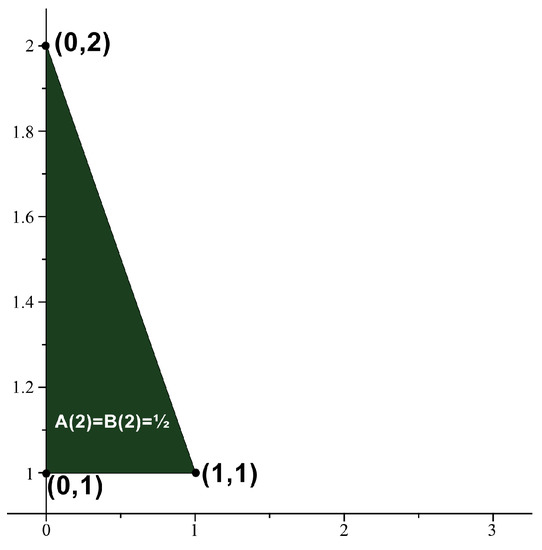
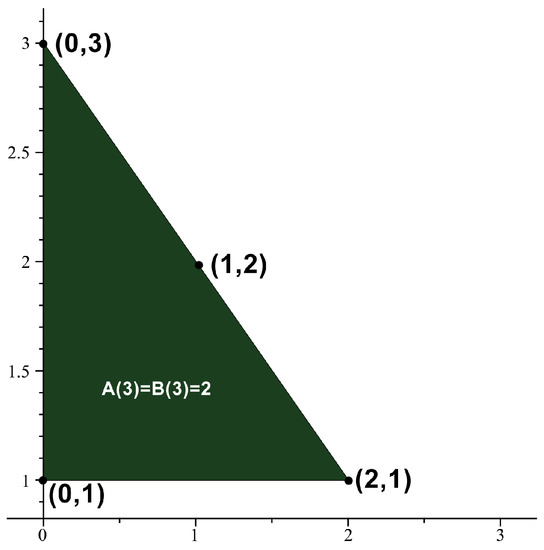
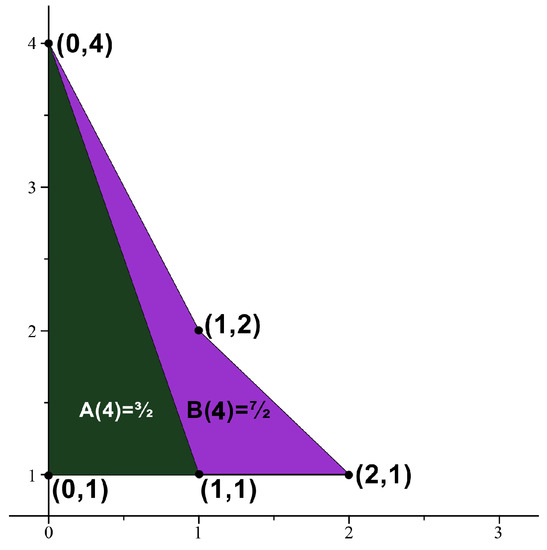
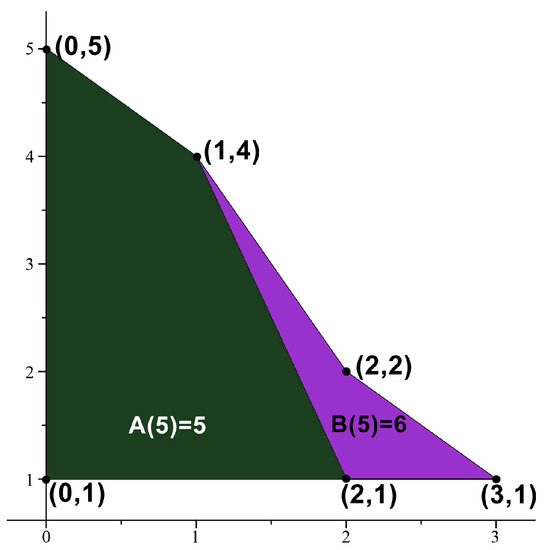
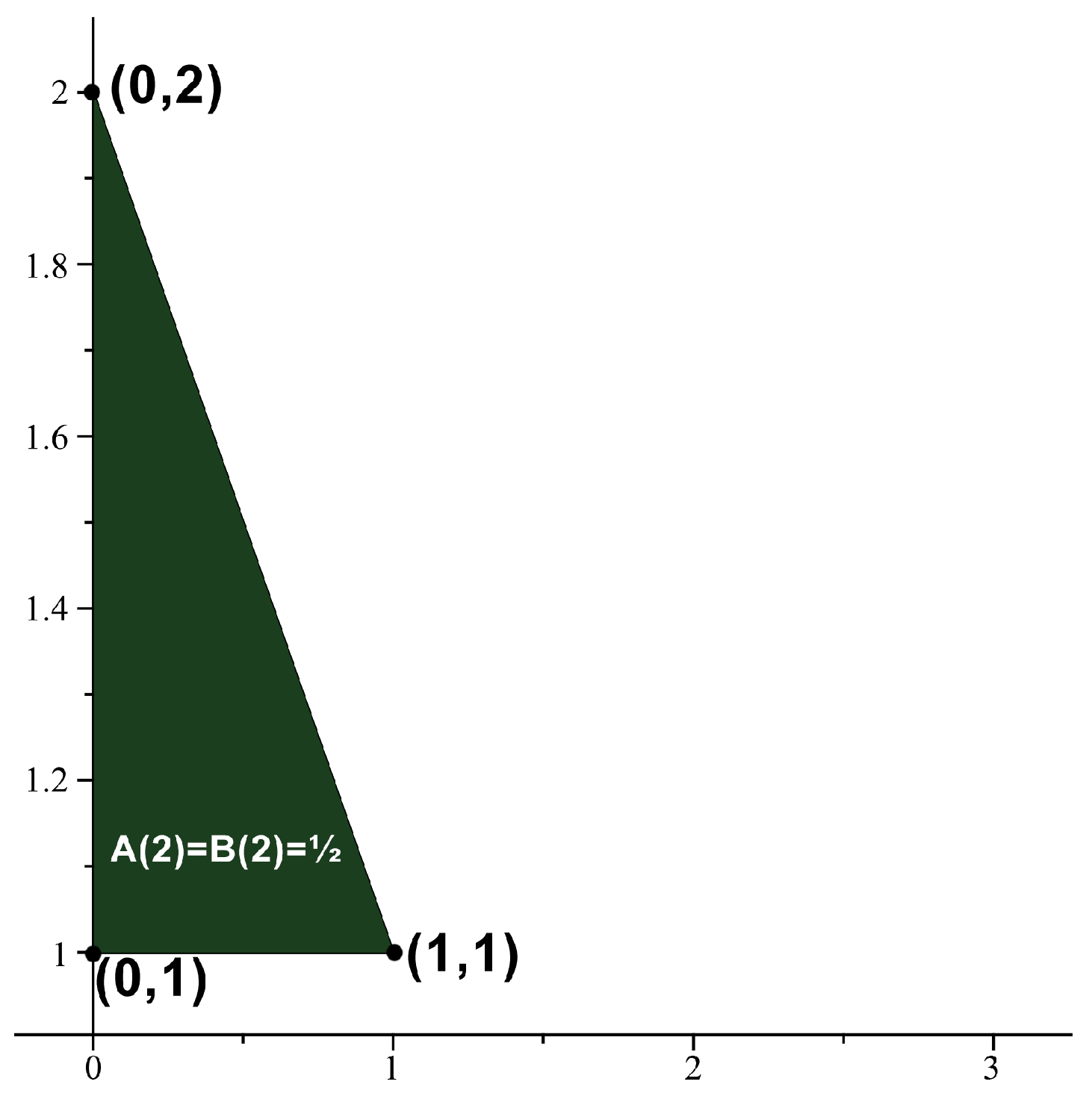
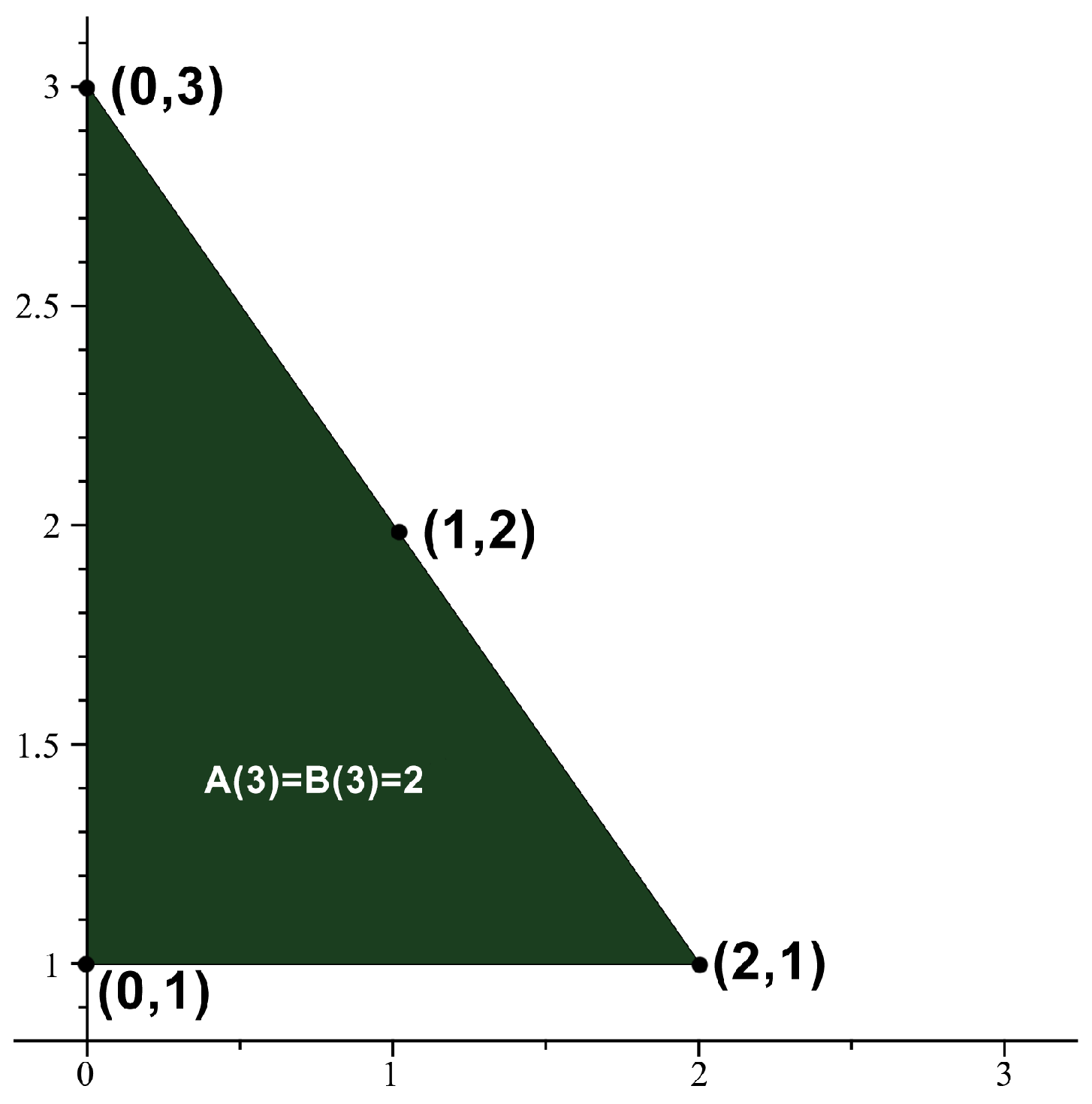
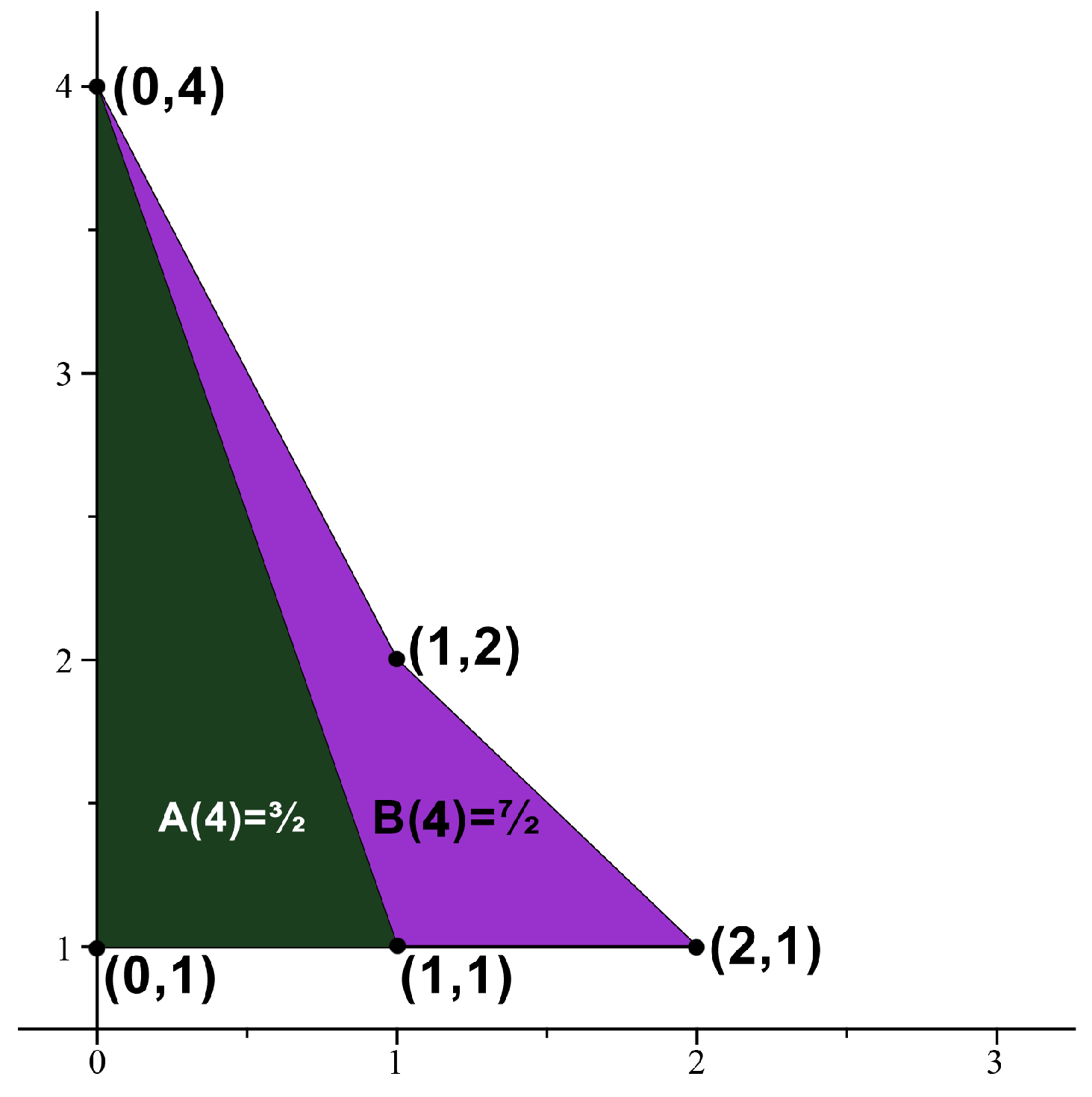
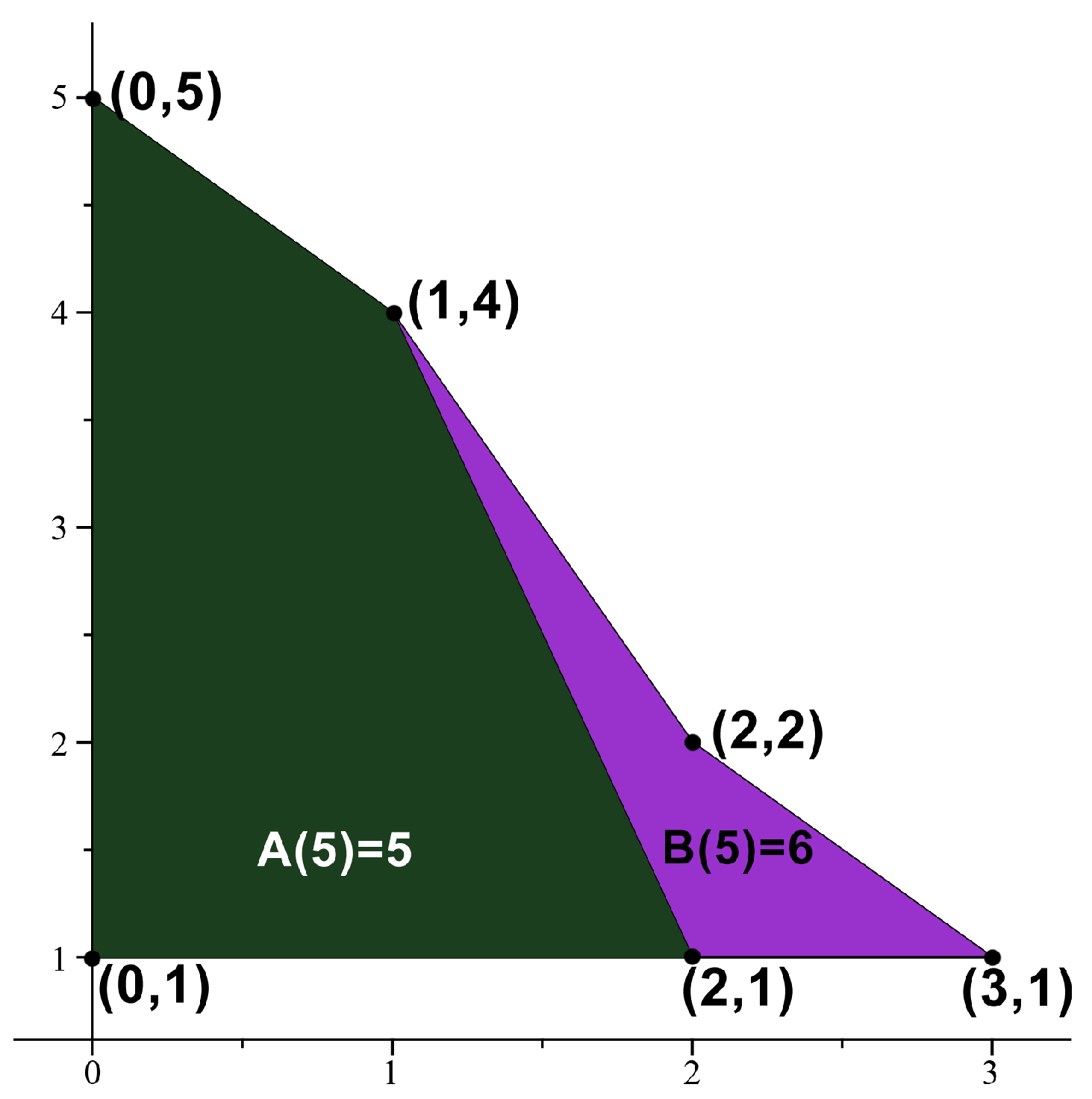
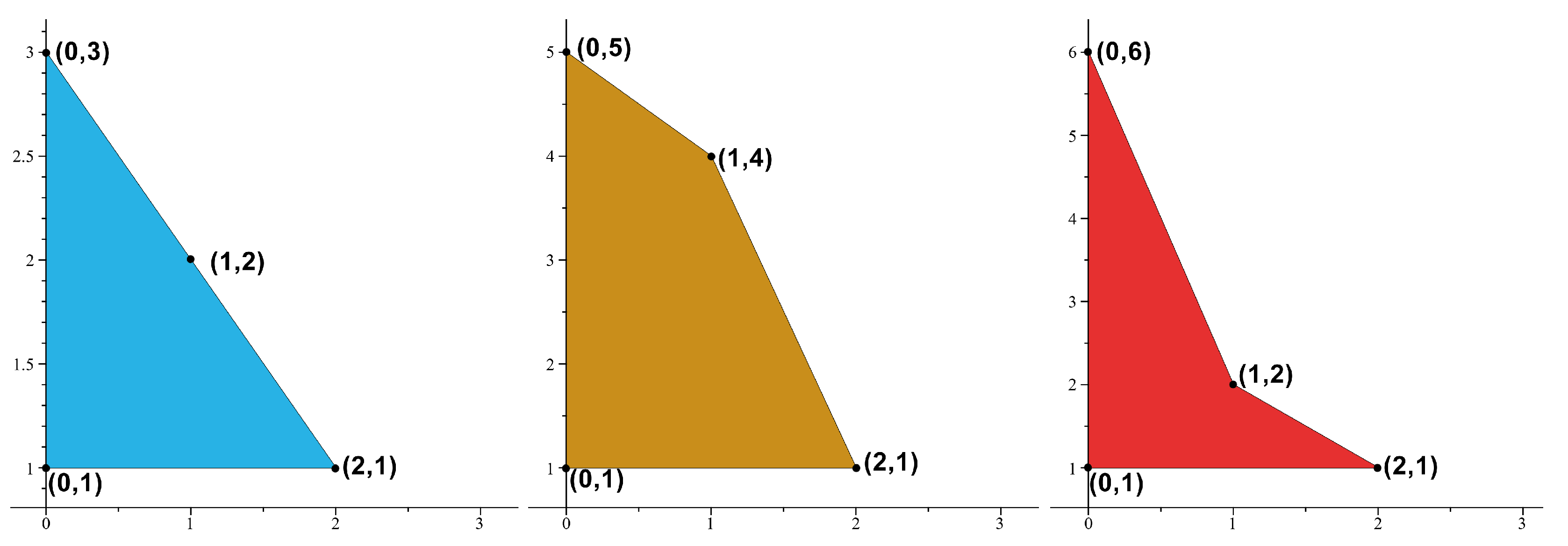
If then we obtain the set of points . Thus, 2 is an absolute Möbius 3-gonal convex number with . See Figure 1. See Figure 2, Figure 3 and Figure 4 for absolute Möbius n-gonal shape numbers and totient n-gonal shape numbers with . The first 19 values of and are given by Table 3.
Figure 1.
.
Figure 2.
.
Figure 3.
and .
Figure 4.
and .
Table 3.
Values of and .
Kim and Bayad [3] considered the iteration of the odd divisor function S, polygon shape, convex, order, etc.
In this article, we considered the iteration of the absolute Möbius divisor function and Euler totient function and polygon types.
Now we state the main result of this article. To do this, let us examine the following theorem. For the proof of this theorem, the definitions and lemmas in the other chapters of this study have been utilized.
Theorem 1.
(Main Theorem) Let be Fermat primes with ,
,
,
.
If or 2 then a positive integer is
Remark 2.
Shapiro [2] computed positive integer m when That is, Let Then
- (1)
- If then m are totient 3-gonal (triangular) numbers.
- (2)
- If then m are totient 4-gonal non-convex numbers.
2. Some Properties of and
It is well known [1,4,5,6,7,8,9,10,11,12,13,14] that Euler -function have several interesting formula. For example, if with two positive integers x and y, then . On the other hand, if x is a multiple of y, then [2]. In this section, we will consider the arithmetic functions and .
Lemma 1.
Let be a factorization of n, where be distinct prime integers and be positive integers. Then,
Proof.
If is an arbitrary integer, then we easily check
This is completed the proof of Lemma 1. □
Corollary 1.
If p is a prime integer and α is a positive integer, then and . In particular, .
Proof.
It is trivial by Lemma 1. □
Corollary 2.
Let be a positive integer and let . Then,
Proof.
It is trivial by Lemma 1. □
Remark 3.
We compare with as follow on Table 4.
Table 4.
and .
Lemma 2.
The function U is multiplicative function. That is, with . Furthermore, if m is a multiple of n, then .
Proof.
Let and be positive integers. Then and are distinct primes. If and also , , , and by Lemma 1, we note that
Let m be a multiple of n. If then . Thus, by Lemma 1, . This is completed the proof of Lemma 2. □
Remark 4.
Two functions and have similar results as follows on Table 5. Here, means that m is a multiple of n.
Table 5.
and .
Theorem 2.
For all , there exists satisfying .
Proof.
Let , where be distinct prime integers with .
We note that by Lemma 1.
If and , then by Corollary 1.
If is an odd positive prime integer, then by Corollary 1.
We note that is an even integer. Then there exist distinct prime integers satisfying
where , and . It is well known that .
Using this technique, we can find l satisfying
with .
By Appendix A (Values of ), we easily find a positive integer v that for . Thus, we get . Therefore, we can find satisfying . □
Corollary 3.
For all , there exists satisfying .
Proof.
It is trivial by Theorem 2. □
Remark 5.
Kim and Bayad [3] considered iterated functions of odd divisor functions and order of n. For order of divisor functions, we do not know or not. But, functions (resp., ), we know by Corollary 3 (resp., [15]).
Theorem 3.
Let be a positive integer. Then if and only if for some .
Proof.
Let . It is easy to see that .
Let be a factorization of n, and all are distinct prime integers. If , then by using Lemma 1 we can note that,
According to all are distinct prime integers, then it is easy to see that there is only exist and that is . Hereby for some .
This is completed the proof of Theorem 3. □
Remark 6.
If then is an absolute Möbius 3-gonal (triangular) shape number with by Theorem 3.
Theorem 4.
Let n, m and be positive integers with greater than 1 and let and . Then, if and only if . Furthermore,
and
Proof.
First, we consider . We find the set . Thus, we have
Similarly, we get (5). These complete the proof of Theorem 4. □
3. Classification of the Absolute Möbius Divisor Function with
In this section, we study integers n when . If , then n has three cases which are 3-gonal (triangular) shape number, 4-gonal convex shape number, and 4-gonal non-convex shape numbers in Figure 5.
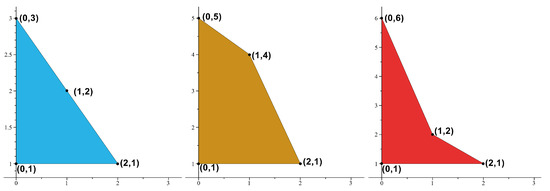
Figure 5.
3-gonal (triangular), 4-gonal convex, 4-gonal non-convex shapes.
Theorem 5.
Let be Fermat primes and be positive integers. If , then .
Proof.
Let
be Fermat primes. By Corollary 1 and Lemma 2 we have
Thus, we can see that and . Therefore, we get Theorem 5. □
The First 32 values of and for are given by Table A2 (see Appendix B).
Remark 7.
Iterations of the odd divisor function , the absolute Möbius divisor function , and Euler totient function have small different properties. Table 6. gives an example of differences of , and with .
Table 6.
, and with .
Lemma 3.
Let be Fermat primes. Then 3 is an absolute Möbius 3-gonal (triangular) shape number and are absolute Möbius 4-gonal convex numbers.
Proof.
The set makes a triangle. Let be a Fermat primes except 3. We get . So, we get
Because of , the set gives a convex shape. This completes the proof Lemma 3. □
Lemma 4.
Let be Fermat primes. Then and are absolute Möbius 4-gonal non-convex shape numbers with positive integers.
Proof.
Let be a Fermat primes. Consider
So, . Thus, are absolute Möbius 4-gonal non-convex shape numbers. Similarly, we get .
Thus, these complete the proof Lemma 4. □
Lemma 5.
Let be Fermat primes. Then are absolute Möbius 4-gonal non-convex shape numbers.
Furthermore, if are positive integers then are absolute Möbius 4-gonal non-convex shape numbers.
Proof.
The proof is similar to Lemma 4. □
Lemma 6.
Let r be a positive integer. Then
Proof.
We note that
Let . Thus . This is completed the proof of Lemma 6. □
Corollary 4.
Let . Then is an absolute Möbius 3-gonal (triangular) shape number.
Proof.
It is trivial by Lemma 6. □
Remark 8.
Fermat first conjectured that all the numbers in the form of are primes [16]. Up-to-date there are only five known Fermat primes. That is, , , , , and .
Though we find a new Fermat prime , 6th Fermat primes, we cannot find a new absolute Möbius 3-gonal (triangular) number by
Lemma 7.
Let be Fermat primes with and . If then are absolute Möbius 4-gonal convex shape numbers.
Proof.
Let be a Fermat prime, where k is a positive integer. We note that and . In a similar way in (7), we obtain
By Theorem 5, . By (8), is an absolute Möbius 4-gonal convex shape number.
This completes the proof of Lemma 7. □
Lemma 8.
Let be Fermat primes with .
Then are absolute Möbius 4-gonal non-convex shape numbers except .
Proof.
Similar to Lemmas 5 and 7. □
Proof of Theorem 1 (Main Theorem).
It is completed by Remark 6, Theorem 5, Lemmas 3 and 4, Corollary 4, Remark 8, Lemmas 7 and 8. □
Remark 9.
If n are absolute Möbius 3-gonal (triangular) or 4-gonal convex shape numbers then n is the regular n-gon by Gauss Theorem.
Example 2.
The set is . Thus, a positive integer 3 is an absolute Möbius 3-gonal convex shape number.
Similarly, 15, 255, 65535, 4294967295 are absolute Möbius 3-gonal convex numbers derived from
,
,
,
.
Remark 10.
Let denote the minimal number of m-gonal number. By using Maple 13 Program, Table 7 shows us minimal numbers about from 3-gonal (triangular) to 14-gonal shape number.
Table 7.
Values of Min(m).
Conjecture 1.
For any positive integer , is a prime integer.
Author Contributions
The definitions, lemmas, theorems and remarks within the paper are contributed by D.K., U.S. and S.I. Also, the introduction, body and conclusion sections are written by D.K., U.S. and S.I. The authors read and approved the final manuscript.
Funding
This work was funded by “Research Base Construction Fund Support Program” Jeonbuk National University in 2019. Supported by Balikesir University Research, G. No: 2017/20.
Conflicts of Interest
The authors declare that there is no conflict of interest.
Appendix A. Values of U(n)
Table A1.
Values of .
Appendix B. Values of n = 2k p1 p 2…pi, U(n), φ(n)
Table A2.
Values of , , with .
References
- Rose, H.E. A Course in Number Theory; Clarendon Press: London, UK, 1994. [Google Scholar]
- Shapiro, H. An analytic function arising from the φ function. Am. Math. Mon. 1943, 50, 18–30. [Google Scholar]
- Kim, D.; Bayad, A. Polygon Numbers Associated with the Sum of Odd Divisors Function. Exp. Math. 2017, 26, 287–297. [Google Scholar] [CrossRef]
- Dickson, L.E. History of the Theory of Numbers. Vol. I: Divisibility and Primality; Chelsea Pub. Co.: New York, NY, USA, 1966. [Google Scholar]
- Erdös, P. Some Remarks on Euler’s ϕ Function and Some Related Problems. Bull. Am. Math. Soc. 1945, 51, 540–544. [Google Scholar] [CrossRef]
- Guy, R.K. Unsolved Problems in Number Theory; Springer: New York, NY, USA, 2004. [Google Scholar]
- Ireland, K.; Rosen, M. A Classical Introduction to Modern Number Theory; GTM 84; Springer-Verlag: New York, NY, USA, 1990. [Google Scholar]
- Moser, L. Some equations involving Eulers totient function. Am. Math. Mon. 1949, 56, 22–23. [Google Scholar] [CrossRef]
- Sierpiński, W. Elementary Theory of Numbers; Polska Akademia Nauk: Warsaw, Poland, 1964. [Google Scholar]
- Kaczorowski, J. On a generalization of the Euler totient function. Monatshefte für Mathematik 2012, 170, 27–48. [Google Scholar] [CrossRef]
- Rassias, M.T. From a cotangent sum to a generalized totient function. Appl. Anal. Discret. Math. 2017, 11, 369–385. [Google Scholar] [CrossRef]
- Shanks, D. Solved and Unsolved Problems in Number Theory; AMS: Providence, RI, USA, 2001. [Google Scholar]
- Iwaniec, H.; Kowalski, E. Analytic Number Theory; American Mathematical Society: Providence, RI, USA, 2004; Volume 53. [Google Scholar]
- Koblitz, N. Introduction to Elliptic Curves and Modular Forms; Springer-Verlag: New York, NY, USA, 1984. [Google Scholar]
- Erdös, P.; Granville, A.; Pomerance, C.; Spiro, C. On the normal behavior of the iterates of some arithmetic functions. In Analytic Number Theory; Birkhäuser: Boston, MA, USA, 1990. [Google Scholar]
- Tsang, C. Fermat Numbers. University of Washington. Available online: http://wstein.org/edu/2010/414/projects/tsang.pdf (accessed on 5 August 2019).
© 2019 by the authors. Licensee MDPI, Basel, Switzerland. This article is an open access article distributed under the terms and conditions of the Creative Commons Attribution (CC BY) license (http://creativecommons.org/licenses/by/4.0/).