


Abstract
The investigation of symmetric/asymmetric structures and their applications in mathematics (in particular in operator theory and functional analysis) is useful and fruitful. A metric space has the property of symmetry. By looking in the same direction and using the -admissibility with regard to and -functions, we demonstrate some existence and uniqueness fixed point theorems. The obtained results extend and generalize the main result of Isik et al. (2019). At the end, some illustrated applications are presented.
JEL Classification:
47H10; 54H25
1. Introduction and Preliminaries
The known work in fixed point theory is the Banach contraction principle which ensured the existence of a fixed point for a contractive self-mapping over a complete metric space. Numerous researchers have built up the existence of fixed points in many directions, see [1,2,3,4,5,6,7,8,9,10,11,12,13].
In 2014, Jleli and Samet [14] presented a new type of contractive mappings, named as -contractions.
Definition 1
([14]). Let T be self-mapping on a complete metric space . Such a T is named as a θ-contraction if there is (0,1) such that
where Θ is the family of functions verifying the following:
- (θ1)
- θ is nondecreasing;
- (θ2)
- for every sequence we have iff
- (θ3)
- there are and such that
Theorem 1
([14]). Let be a complete metric space and be a θ-contraction. Then T admits a unique fixed point Moreover, for each the sequence converges to
Later, Ahmad et al. [15] introduced the following.
Definition 2
([15]). Let Γ be the set of functions verifying:
- (ξ1)
- ξ is nondecreasing,
- (ξ2)
- for a sequence , we have if and only if ,
- (ξ3)
- ξ is continuous on .
Lemma 1
([15]). Let be a complete metric space and . Then is also a complete metric space.
Example 1.
The following functions , , , , and , are elements in Γ.
The concept of -admissibility is given as follows:
Definition 3
([16]). Given and . Such an f is designated α-admissible if with implies .
The notion of -admissibility in regards to a function is given as follows:
Definition 4
([17]). Given and . Such an f is α-admissible with respect to η if with implies .
Many fixed point results using the above notion appeared, see [18,19,20,21,22]. The perception of triangular -admissibility is stated in the following:
Definition 5
([4]). Given and so that
- 1
- if , then and ;
- 2
- if and , then .
Then we designate that the pair is triangular α-admissible, appertaining to the function η.
Example 2
([4]). Let . Define by and . Consider as and . Clearly, the pair is triangular α-admissible regarding η.
Samet et al. [16] initiated the concept of --contractions and they demonstrated the existence and uniqueness of common fixed points. Denote by the family of nondecreasing functions such that for all If then for all
Definition 6
([23]). Let . Any is said to be an altering distance function if
- 1.
- ψ is nondecreasing and continuous;
- 2.
- .
The results presented in [16] can be abstracted as follows.
Theorem 2
([16]). Let be a complete metric space and be an -admissible contraction. Assume that the subsequent conditions are satisfied:
- (i)
- there is such that ;
- (ii)
- either T is continuous, or
- (ii)′
- for each sequence in Υ such that and then for all
Then T admits a fixed point. Furthermore, if in addition we assume that for every , there exists so that and then we have a unique fixed point.
In this paper, we originate a new type of contraction by using the concepts of -admissibility in regards to a function , and -functions. We establish the existence and uniqueness of some common fixed points results. Our obtained results improve and generalize Theorems 1 and 2 and many others in the literature (by taking particular choices of , , and ).
2. Main Results
To begin, we state some principal notations.
Definition 7.
Let be self-mappings on a complete metric space and be given functions. Define as
Then the pair is named an -contraction, if there are and or Θ such that
where
Remark 1.
Let be a metric space. Let be self-mappings. If the pair is an -contraction, then by (2), we deduce
which infers from that
It implies the following:
Theorem 3.
Let be a complete metric space. Let be self-mappings. Suppose that the following assumptions hold:
- (i)
- the pair is α-admissible regarding to the function η;
- (ii)
- is an -contraction;
- (iii)
- there exists so that and ;
- (iv)
- S and T are continuous.
Then S and T have a common fixed point.
Proof.
In view of the condition there is so that Define the sequence in by and for all If there is such that then Thus, S and T have a common fixed point. It completes the proof. Thus, suppose that for all that is,
Since and the pair is -admissible, one writes
Once more, by utilizing the -admissible concept to the function , we have
Repeating this strategy n-times, we deduce
Since is nondecreasing, one writes that
Letting for all and from the over inequality, we infer
Thus, for all we deduce
To demonstrate that is a Cauchy sequence, we take two cases.
Case I: Let us consider condition as it is defined in Definition 1. Then there are and such that
Choose By the conception of limit, there involves so that
Using (7) and the over inequality, we deduce
This infers that
Hence there is so that
Given At that point, utilizing the triangular inequality concept and (10), we deduce
and hence is a Cauchy sequence in
Case II: Let us consider condition as it is defined in Definition 2. We proceed in the beginning of proof as
and
Also, since is non-decreasing, we deduce
for all .
Since is continuous on and by taking the limit as in (12), we have again
Now, we claim that the sequence is Cauchy. Suppose the contrary. Then there exist and two subsequences and of with such that
for all . By utilizing the triangular property,
By taking in (12), we have
Since
we have Essentially, we get that
Then, by the above assumptions, we have
By taking in (16), we have
which is a contradiction since and for all . Therefore, is a Cauchy sequence.
By the completeness of , there is so that as If are continuous, then and The uniqueness of the limit implies that
Assume that there exists another common fixed point z of distinct from u, that is, . At that point, it follows from the above assumptions that
which is a contradiction with respect to and for all . Thus u is the unique common fixed point of S and T. □
The continuity of mappings in Theorem 3 can be replaced by a reasonable condition.
Theorem 4.
Let be a complete metric space and be self-mappings. Assume that the following assumptions hold:
- (i)
- the pair is α-admissible regarding to the function η;
- (ii)
- the pair is an -contraction;
- (iii)
- there exists so that ;
- (iv)
- for every such that and for all then for all
Then S and T have a common fixed point.
Proof.
Let us consider condition as it is defined in Definition 1 and by using the full proof of Theorem 3, define as and for all . Assume that the sequence such that for all , is converging to .
In the case that holds, we have for all If there is so that and , then clearly, So the proof is completed. Hence, there is so that for all Thus, for all Using Remark 1, we get
and so
By carrying the limit as n goes to ∞, we obtain and . Hence,
To demonstrate the uniqueness of the common fixed point, suppose that are two common fixed points of S and T such that Then and by the hypothesis , Regarding Remark 1, we get
which infers that □
Example 3.
Let be endowed with the complete metric ρ defined by
for all Define and by
We have
Firstly, is an -contraction with and Let then with
This means that is an -contraction.
Now, let be such that Here, . Then and so Hence, the pair is α-admissible regarding η. Moreover, there exists so that and
Let be a sequence in Υ so that and for all Then, and so as Thus, .
Finally, all conditions of Theorems 3 and 4 are fulfilled, and so S and T have a unique common fixed point, which is
Furthermore, for we have
For , we have
Also, for and we have
for all Therefore, Theorem 3 can applied to this example.
Corollary 1.
Let be a complete metric space and be self-mappings. Then the pair has a unique common fixed point if the following assumptions hold:
- (i)
- the pair is α-admissible;
- (ii)
- there exists in which and ;
- (iii)
- S and T are continuous;
- (iv)
- there are and or Θ so thatwhere
Proof.
It follows from Theorem 3 by considering via □
Corollary 2.
Let be a complete metric space and be given mappings. Then the pair has a unique common fixed point if the following assumptions hold:
- (i)
- the pair is α-admissible;
- (ii)
- there exists so that and ;
- (iii)
- for every such that and for all then for all
- (iv)
- there are and or Θ so thatwhere
Proof.
The rest of proof follows from Theorem 4 by considering via . □
Corollary 3.
Let be defined on a complete metric space . Assume there are and or Θ such that
Then S has a unique fixed point if:
- (i)
- S is α-admissible;
- (ii)
- there exists so that
- (iii)
- S is continuous.
Proof.
It follows from Corollary 1 by regarding and . □
Corollary 4.
Let be defined on a complete metric space . Assume there are and or Θ such that
where
Then S has a unique fixed point if the following assumptions hold:
- (i)
- S is α-admissible;
- (ii)
- there exists so that
- (iii)
- for every such that and for all then for all
Proof.
It follows from Corollary 2 by regarding and . □
Corollary 5.
Let be defined on a complete metric space . Assume there exist and or Θ such that
Then S has a unique fixed point if the following assumptions hold:
- (i)
- S is α-admissible;
- (ii)
- there is so that
- (iii)
- S is continuous.
Proof.
It follows from Corollary 3 and the fact that □
Corollary 6.
Let be a mapping on a complete metric space . Assume there exist and or Θ so that
Then S has a unique fixed point if the following assumptions hold:
- (i)
- S is α-admissible;
- (ii)
- there exists in order that
- (iii)
- for every such that and for all then for all
Proof.
It comes from Corollary 4 and the fact that □
3. Applications
We start with giving some fixed point results on a metric space endowed with a graph. We also ensure the existence of a solution for a functional equation originating in dynamic programming.
3.1. Graphic Contractions
In view of the paper of Jachymski [24], we consider the following assumptions:
- (a)
- is a metric space;
- (b)
- is the diagonal of the Cartesian product ;
- (c)
- is a graph of the set of its vertices and the set of its edges contains all loops such that each edge of graph represents the distance between two vertices or a loop of the same vertex.
(For more details, see [25,26,27,28]).
Now, we give some notions and definitions related to a metric space endowed with a graph.
Definition 8
([24]). A map is a -contractive map, if T preserves edges of that is,
and T relates with weights of edges of as the subsequent way:
Definition 9
([24]). A map is -continuous if given and a sequence with as and for all , we have as
The -continuity implies the continuity. Whereas generally, the contrary of this explanation is not true.
Definition 10.
Let be a metric space provided with a graph and be self-mappings. Let be defined by
Then the pair is an (α-ξ-ψ)--contraction if there are and or Θ so that
where
Theorem 5.
Let be a complete metric space endowed with a graph and be self-mappings. Suppose that the pair is an (α-ξ-ψ)--contraction. Then S and T have a common fixed point if the following conditions are fulfilled:
- (i)
- S and T preserve the edges of ;
- (ii)
- there exists so that ;
- (iii)
- S and T are -continuous.
Moreover, if for all then the common fixed point is unique.
Proof.
Define by
Let Then and By definition of and that is, Since is an (--)--contraction, we get
then for
we get
where
Therefore,
Now, we demonstrate that is -admissible. Let for all Then By the virtue of we get and hence This proves that the pair is -admissible. Also, it is easy to see that the condition implies the condition of Theorem 3. Thus, since all conditions of Theorem 3 hold, S and T have a common fixed point. Also, we show that S and T have a unique common fixed point. On the contrary, suppose that Then, by the hypothesis and so By Theorem 3, S and T have a unique common fixed point. □
Example 4.

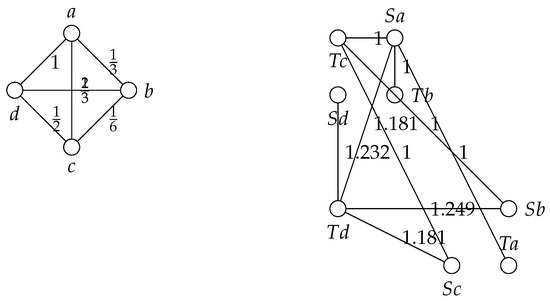
Following Example 2.8 in [28], let be endowed with the usual metric. Let be a graph with and Define by
Now, we demonstrate that are (α,ξ,ψ)--contractive maps with and Note that if and only if and Then, we need to check the subsequent cases:
Case 1.If and we have
Case 2.If and we have
Case 3.If and we have
Now, as we suppose , we can represent these results by the two following matrices (see Table 1 and Table 2) and graphs (see Figure 1):
Table 1.
A metric indicated by distances between vertices.
Table 2.
A metric indicated by distances between images of vertices under -contractions.
Figure 1.
A graph indicated by distances and -contractions of distances between the vertices.
Thus, the pair is an (α-ξ-ψ)--contraction in all possible cases. Also, all conditions of Theorem 5 are satisfied.
3.2. Existence Theorem for a Solution of a Functional Equation
In this subsection, as an application, we utilize the fixed point results proved in Section 3 to demonstrate the existence and uniqueness solutions for some nonlinear integral equations by regarding Corollary 3.
Let denote to the set of all continuous functions specified on the interval . We endow on the metric defined by
for all Here, is a complete metric space. Let ⪯ be a partial order on given as
We consider the following integral equation:
where , and are continuous functions.
Also, we define the operator by
Note that a solution of the integral Equation (23) is identical to that where the operator S has a fixed point.
Consider the following assumptions:
- (A1)
- there exists such that
- (A2)
- for all with , there exists such that
- (A3)
- for all
- (A4)
- S is nondecreasing and continuous on
Theorem 6.
Assume the assumptions – are fulfilled. Then the nonlinear integral Equation (23) has a unique solution.
Proof.
Let be such that . For all , we have
where
This implicates that
By defining () and , we get
where . Therefore, by Corollary 3 (by endowing on the function , the partial order on ), S has a unique fixed point. Hence, the nonlinear integral Equation (23) has a unique solution. □
Author Contributions
H.Q. analyzed and prepared/edited the manuscript, M.S.N. analyzed and prepared/edited the manuscript, H.A. analyzed and prepared/edited the manuscript, W.S. analyzed and prepared the manuscript. All authors read and approved the final manuscript.
Funding
This research received no external funding.
Acknowledgments
This work has been financially supported by UKM Grant DIP-2017-011 and FRGS/1/2017/STG06/UKM/01/1.
Conflicts of Interest
The authors declare that they have no competing interests regarding the publication of this paper.
References
- Abbas, M.; Ali, B.; Vetro, C. A Suzuki type fixed point theorem for a generalized multivalued mapping on partial Hausdorff metric spaces. Topol. Appl. 2013, 160, 553–563. [Google Scholar] [CrossRef]
- Aydi, H.; Abbas, M.; Vetro, C. Common Fixed points for multivalued generalized contractions on partial metric spaces. Revista de la Real Academia de Ciencias Exactas Fisicas y Naturales Serie A Matematicas 2014, 108, 483–501. [Google Scholar] [CrossRef]
- Bojor, F. Fixed point theorems for Reich type contractions on metric spaces with a graph. Nonlinear Anal. 2012, 75, 3895–3901. [Google Scholar] [CrossRef]
- Qawaqneh, H.; Noorani, M.S.M.; Shatanawi, W.; Alsamir, H. Common fixed points for pairs of triangular (α)-admissible mappings. J. Nonlinear Sci. Appl. 2017, 10, 6192–6204. [Google Scholar] [CrossRef]
- Qawaqneh, H.; Noorani, M.S.M.; Shatanawi, W.; Abodayeh, K.; Alsamir, H. Fixed point for mappings under contractive condition based on simulation functions and cyclic (α,β)-admissibility. J. Math. Anal. 2018, 9, 38–51. [Google Scholar]
- Qawaqneh, H.; Noorani, M.S.M.; Shatanawi, W. Fixed Point Results for Geraghty Type Generalized F-expansive for Weak alpha-admissible Mapping in Metric-like Spaces. Eur. J. Pure Appl. Math. 2018, 11, 702–716. [Google Scholar] [CrossRef]
- Qawaqneh, H.; Noorani, M.S.M.; Shatanawi, W. Common fixed point theorems for generalized Geraghty (α,ψ,ϕ)-quasi contractive type mapping in partially ordered metric-like spaces. Axioms 2018, 7, 74. [Google Scholar] [CrossRef]
- Qawaqneh, H.; Noorani, M.S.M.; Shatanawi, W. Fixed Point Theorems for (α,k,θ)-Contractive Multi-Valued Mapping in b-Metric Space and Applications. Int. J. Math. Comput. Sci. 2018, 14, 263–283. [Google Scholar]
- Qawaqneh, H.; Noorani, M.S.M.; Shatanawi, W.; Aydi, H.; Alsamir, H. Fixed Point Results for Multi-Valued Contractions in b-Metric Spaces and an Application. Mathematics 2018, 7, 132. [Google Scholar] [CrossRef]
- Vetro, F. F-contractions of Hardy-Rogers type and application to multistage decision processes. Nonlinear Anal. Model. Control 2016, 21, 531–546. [Google Scholar] [CrossRef]
- Petruşel, A. Local fixed point results for graphic contractions. J. Nonlinear Variat. Anal. 2019, 3, 141–148. [Google Scholar]
- Zaslavski, A.J. Two fixed point results for a class of mappings of contractive type. J. Nonlinear Variat. Anal. 2018, 2, 113–119. [Google Scholar]
- Reich, S.; Zaslavski, A.J. Monotone contractive mappings. J. Nonlinear Variat. Anal. 2017, 1, 391–401. [Google Scholar]
- Jleli, M.; Samet, B. A new generalization of the Banach contractive principle. J. Inequal. Appl. 2014, 2014, 38. [Google Scholar] [CrossRef]
- Ahmad, J.; Al-Mazrooei, A.E.; Cho, Y.J.; Yang, Y.-O. Fixed point results for generalized θ^-contractions. J. Nonlinear Sci. Appl. 2017, 10, 2350–2358. [Google Scholar] [CrossRef]
- Samet, B.; Vetro, C.; Vetro, P. Fixed point theorems for α-ψ-contractive type mappings. Nonlinear Anal. 2012, 75, 2154–2165. [Google Scholar] [CrossRef]
- Salimi, P.; Latif, A.; Hussain, N. Modified α-ψ-contractive mappings with applications. Fixed Point Theory Appl. 2013, 2013, 151. [Google Scholar] [CrossRef]
- Karapınar, E.; Czerwik, S.; Aydi, H. (α,ψ)-Meir-Keeler contractive mappings in generalized b-metric spaces. J. Funct. Spaces 2018, 2018, 3264620. [Google Scholar]
- Afshari, H.; Atapour, M.; Aydi, H. Generalized α-ψ-Geraghty multivalued mappings on b-metric spaces provided with a graph. TWMS J. Appl. Eng. Math. 2017, 7, 248–260. [Google Scholar]
- Aydi, H. α-implicit contractive pair of mappings on quasi b-metric spaces and an application to integral equations. J. Nonlinear Convex Anal. 2016, 17, 2417–2433. [Google Scholar]
- Aydi, H.; Felhi, A.; Sahmim, S. On common fixed points for (α,ψ)-contractions and generalized cyclic contractions in b-metric-like spaces and consequences. J. Nonlinear Sci. Appl. 2016, 9, 2492–2510. [Google Scholar] [CrossRef]
- Aydi, H.; Karapınar, E.; Samet, B. Fixed points for generalized (α,ψ)-contractions on generalized metric spaces. J. Inequalities Appl. 2014, 2014, 229. [Google Scholar] [CrossRef]
- Khan, M.S.; Swaleh, M.; Sessa, S. Fixed point theorems by altering distances between the points. Bull. Austral. Math. Soc. 1984, 30, 1–9. [Google Scholar] [CrossRef]
- Jachymski, J. The contractive principle for mappings on a metric space with a graph. Proc. Am. Math. Soc. 2008, 136, 1359–1373. [Google Scholar] [CrossRef]
- Aydi, H.; Felhi, A.; Karapinar, E.; Sahmim, S. A Nadler-type fixed point theorem in dislocated spaces and applications. Miscolc. Math. Notes 2018, 19, 111–124. [Google Scholar] [CrossRef]
- Abbas, M.; Nazir, T. Common fixed point of a power graphic contractive pair in partial metric spaces provided with a graph. Fixed Point Theory Appl. 2013. [Google Scholar] [CrossRef]
- Beg, I.; Butt, A.R.; Radenović, S. The contractive principle for set valued mappings on a metric space with a graph. Comput. Math. Appl. 2010, 60, 1214–1219. [Google Scholar] [CrossRef]
- Gopal, D.; Vetro, C.; Abbas, M.; Patel, D.K. Some coincidence and periodic points results in a metric space endowed with a graph and applications. Banach J. Math. Anal. 2015, 9, 128–140. [Google Scholar] [CrossRef]
© 2019 by the authors. Licensee MDPI, Basel, Switzerland. This article is an open access article distributed under the terms and conditions of the Creative Commons Attribution (CC BY) license (http://creativecommons.org/licenses/by/4.0/).