Abstract
This study deals with the numerical solution of the non-linear differential equations (DEs) arising in the study of hydrodynamics and hydro-magnetic stability problems using a new cubic B-spline scheme (CBS). The main idea is that we have modified the boundary value problems (BVPs) to produce a new system of linear equations. The algorithm developed here is not only for the approximation solutions of the 10th order BVPs but also estimate from 1st derivative to 10th derivative of the exact solution as well. Some examples are illustrated to show the feasibility and competence of the proposed scheme.
Keywords:
non-linear differential equation; cubic B-spline; central finite difference approximations; absolute errors MSC:
34K10; 34K28; 42A10; 65D05; 65D07
1. Introduction
Recent research in the field of hydrodynamic and hydromagnetics stability have found the presence of a family of problems in differential equations (DEs) of a high order, and which have real mathematical interest. There are various approximate (numerical) methods in the literature that have been used for the solution of boundary value problems (BVPs). The existence and uniqueness to finding the solution of higher order BVPs are systematically examined in [1]. The BVPs of higher order DEs have been examined due to their significance and the potential for applications in applied sciences. To find the analytical solutions of such BVPs analytically is very tough and are available in very few cases. Very few researchers have tried the numerical solution of 10th order BVPs. Some of the approximate techniques have been established over the years to the numerical solution for these kinds of BVPs. In [2,3], the authors has solved 10th and 12th order BVPs using the Adomian decomposition method (ADM) involving Green’s function. The homotopy perturbation approach was utilized in [4] to solve BVPs of 10th order. When a uniform magnetic field is applied across the fluid in the direction of gravity, the instability sets now as ordinary convection and it is modeled by 10th order BVPs as discussed in [5]. In [6], established approximate techniques for solving the 10th order non-linear BVPs occurring in thermal instability.
Numerical methods for the solution of non-linear BVPs of order 2 m were found in [7]. An effective numerical procedure DTM for solving some linear and non-linear BVPs of 10th order is discussed in [8]. In [9,10], the BVPs of 9th and 10th order are considered by adopting homotopy perturbation technique and the modified-variational iteration technique. Also the variational iterative technique was adopted in [11] for solving the 10th order BVPs. Wazwaz [12,13,14,15] proposed modified form of ADM for solving 6th, 8th, 10th and 12th order.
The study of non-polynomial spline [16] of 11th degree is a key element to solve 10th order BVPs. In [17], it is depicted that the DEs that describe the 10th order model to incorporate a 3rd order model of enlistment machine, two equations for dynamic power control, two equations for receptive power control, and three equations for edge pitch control. A 10th order nonlinear dynamic model was developed in [18] to turn mobile robots that incorporate slip between the driven wheels and the ground. Based on binary six-point and eight-point approximating subdivision scheme, two collocation algorithms are constructed by [19,20] to find the solution of BVPs. The 4th order linear BVPs using a new cubic B-spline were solved in [21]. Authors explained the 10th and 12th order BVPs by using the Galerkin weighted residual technique in [22]. The 5th, 6th and 8th order linear and non-linear BVPs by using the cubic B-spline scheme (CBS) method were solved in [23,24,25]. The higher (10th and 11th) degree splines were tested in [26,27] for solving 10th order BVPs. In [28] they practiced 2nd order finite difference schemes for the mathematical solutions of the 8th, 10th and 12th order Eigen-value problems. Galerkin method with septic B-spline and quintic B-spline was adopted in [29,30] for solving 10th order BVPs. Quintic B-spline and septic-B spline collocation methods was discussed in [31,32] to find solution of a 10th order BVPs.
For discrete methods, e.g., Adomian decomposition, shooting, homotopy perturbation, finite differences and variational-iterative technique, only give discrete approximate values of the unknown . For fitting curve to data we require further data processing methods. To overcome these disadvantages, we introduced a new CBS scheme for the solution of 10th order BVPs. The algorithm developed here is not only for the approximation solutions of the 10th order boundary value problems(BVPs) employing CBS but also estimate derivatives of 1st order to 10th order (where boundary conditions (BCs) are defined) of the exact solution as well.
The rest of the paper is organized as follows. The construction of CBS is presented in Section 2. In Section 3, the CBS scheme is utilized as an interpolating function in the solution of 10th order nonlinear BVPs. The results and discussion are presented in Section 4. Also some problems are considered in this section to show the efficiency of the CBS scheme. Finally, the concluding remarks are given in the final section.
2. The Construction of CBS
In this section, we construct the CBS basis functions for solving numerically the non-linear equations arising in the study of hydrodynamics and hydro-magnetic stability problems. To find the approximate solution at nodal points defined in the region . For an interval = , we divide it into n sub-intervals = by the equidistant knots. For this range, we select equidistant points such that
such that
i.e., and .
Assume such that converted to to cubic-polynomial on separately sub interval . The basis function is defined as
for . Considering one and all is also a piece-wise cubic with knots at , simultaneously .
Assume be linearly independent and let Thus is dimensional and = . Let be the cubic-B spline function interpolating at the nodal points and . Then can be written as
Consequently now for a function , there happened to be a distinctive cubic-B spline , satisfying the interpolating conditions:
for .
The values of , and its derivatives , at nodal points are required and these derivatives are tabulated in Table 1.
Table 1.
Values of and its derivatives.
Assume and then from
may be used to determine numerical-difference formulas for such that , for such that , for , such that and , such that like so the errors can be obtained by using Taylor-series
Similarly (see [31]),
3. The 10th Order Nonlinear BVPs
In this section, we consider the 10th order nonlinear BVPs arising in the study of hydrodynamics stability and visco-elastic flows.
with BCs
where , , , , and , , , , are given real constants, and f is continuous in interval .
The Taylor, series for at the preferred collocation points alongside central difference (see [31]), we have
Equation (9) can be written as
Since so, Equation (14) becomes
After some simplifications the above equation becomes
Let be the accurate solution of non-linear 10th order BVPs
Equation (18) we will produce a new system consisting of linear equations with unknowns where , therefore ten further equations are required. From given BCs at , we have five equations:
similarly from there will be other five equations
4. Convergence Analysis
Let be the exact solution of the Equations (10)–(12) and also be the CBS approximation to . Therefore, we have
where
Also, we have assume that be the computed cubic B spline approximation to , namely
To approximate the error we have to estimate error and seperately
The system of matrix can be written as:
Then, we have
and
Now, by subtracting Equations (22) and (23), we obtain
where B is an -dimensional band matrix,
and
where T denoting transpose.
We can write
Taking the infinity norm from Equation (24), we obtain
The B-spline = satisfy the following property
Using [24]
5. Results and Discussions
To test the accuracy of CBS method, three problems are discussed and compared with the existing methods in this section.
5.1. Problem 1
We consider the following DEs arising in viscoelastic flows and hydrodynamic stability problems as given in [29,31]
subject to BCs;
the exact solution of given equation is . The values of fifteen unknowns from the Equations (18)–(20) are
| = 0.10849167, | = −0.12456626, | = −0.13626667, | ||
| = 0.05166667, | = −0.15061957, | = −0.08666667, | ||
| = −0.00083333, | = −0.16684713, | = −0.0066667, | ||
| = −0.04833333, | = −0.17169449, | = 0.11333333, | ||
| = −0.09000833, | = −0.16277005, | = 0.28773333. |
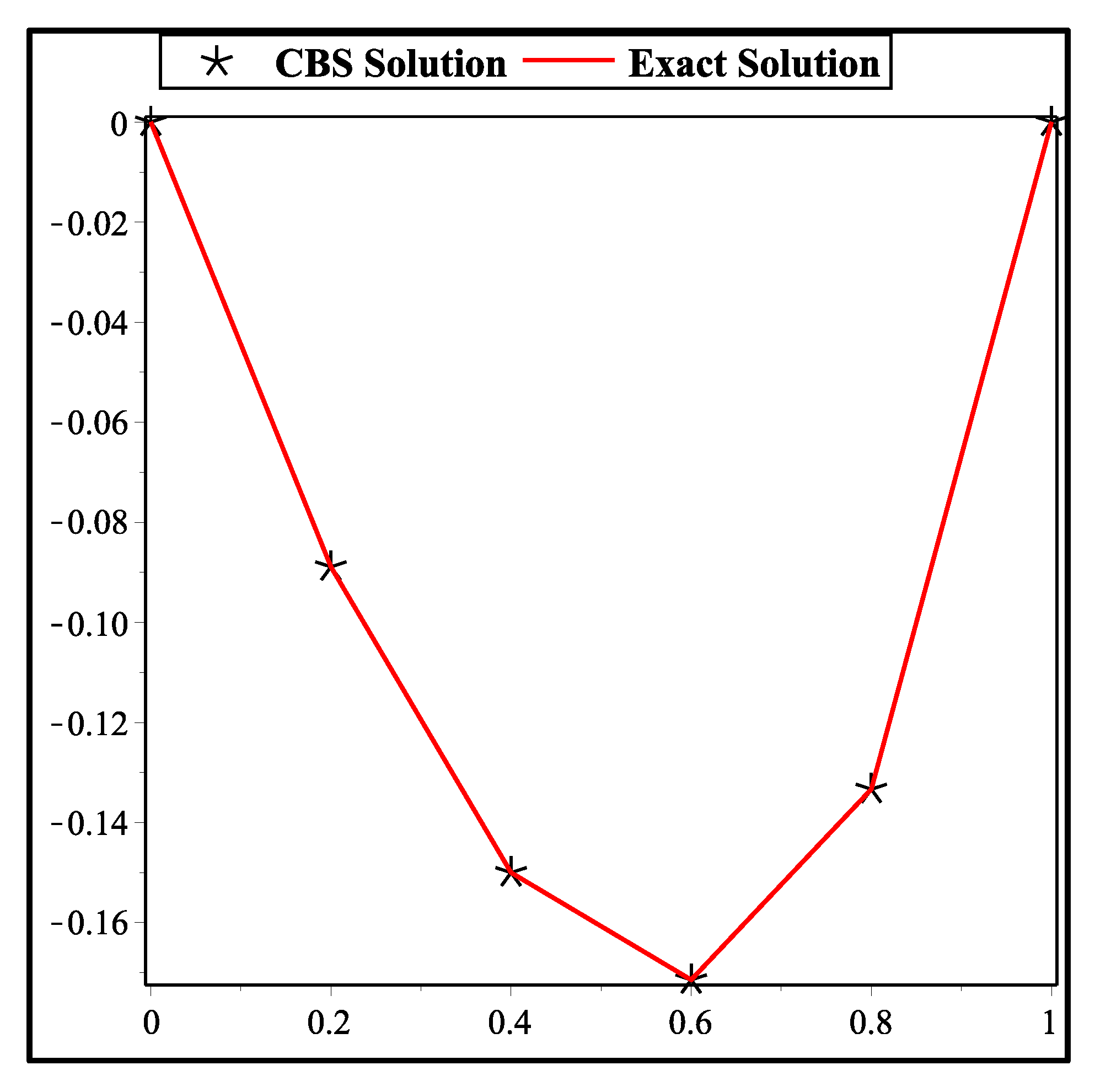
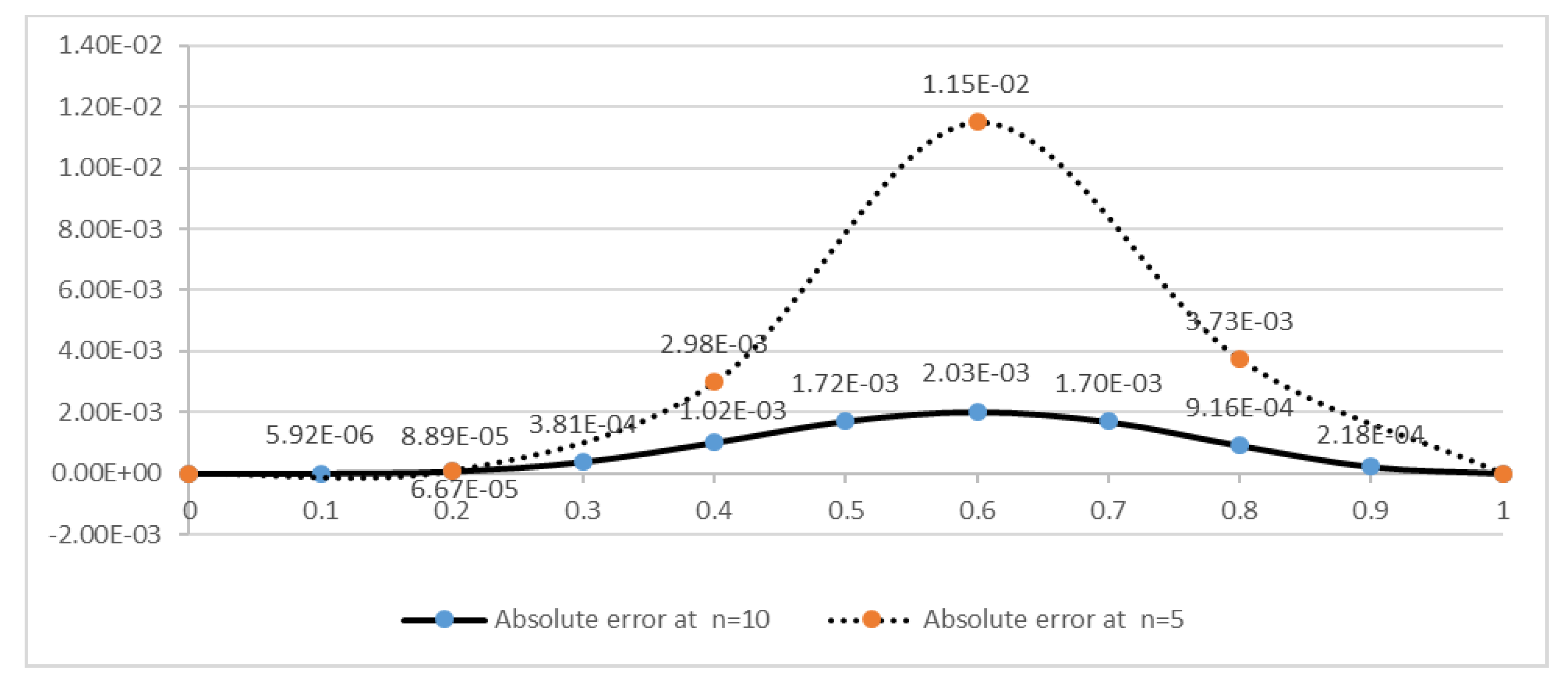
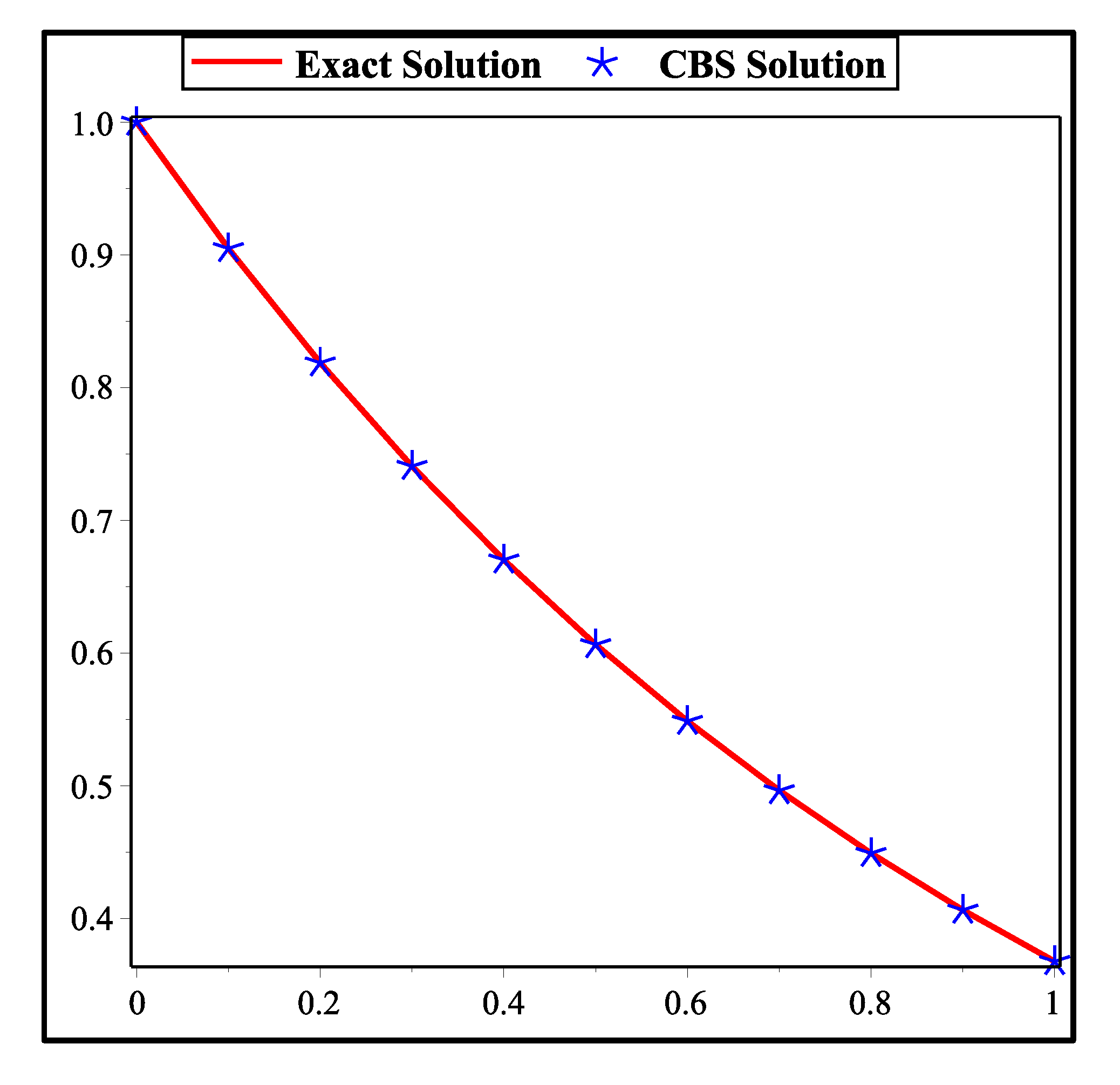
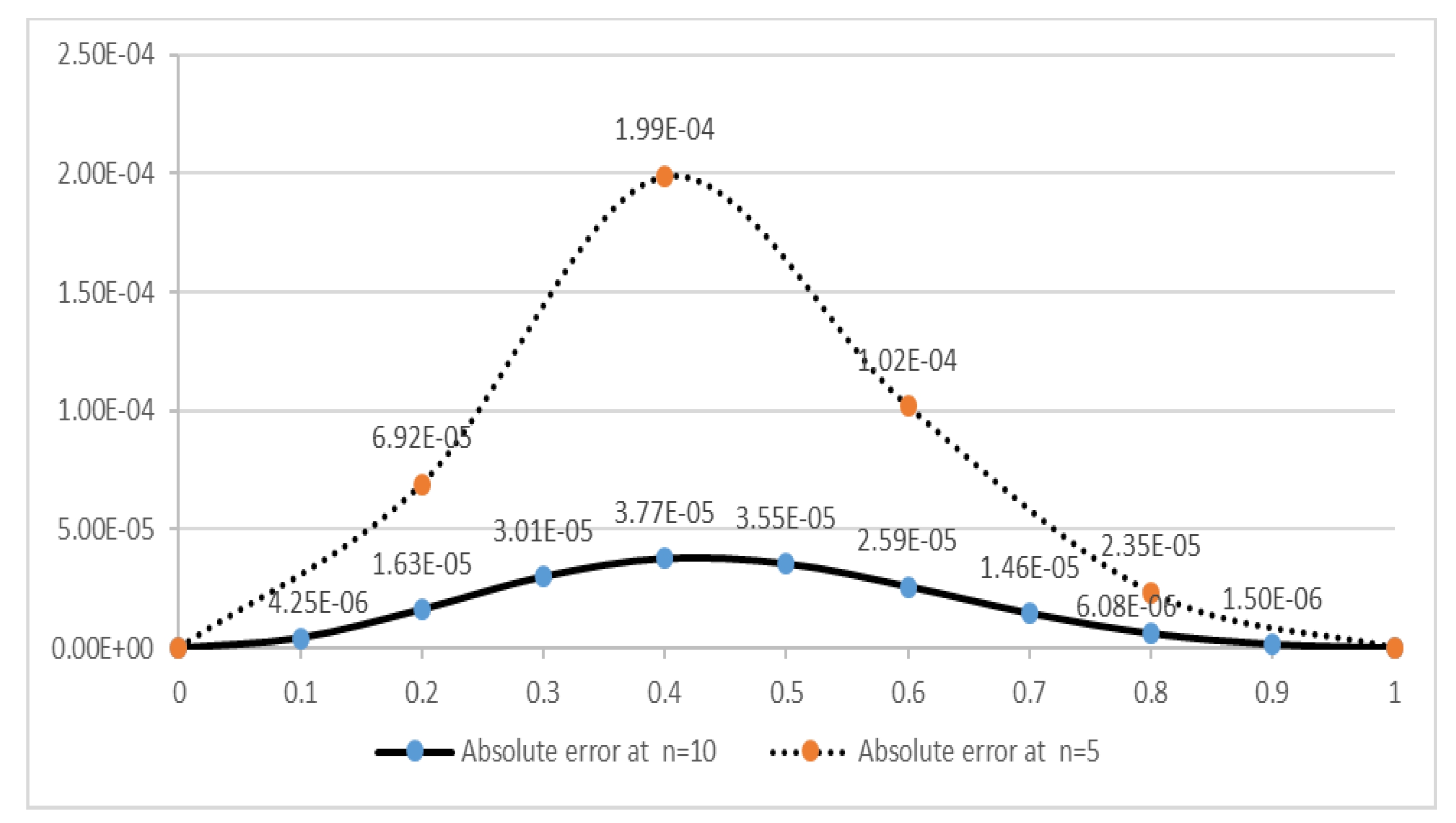
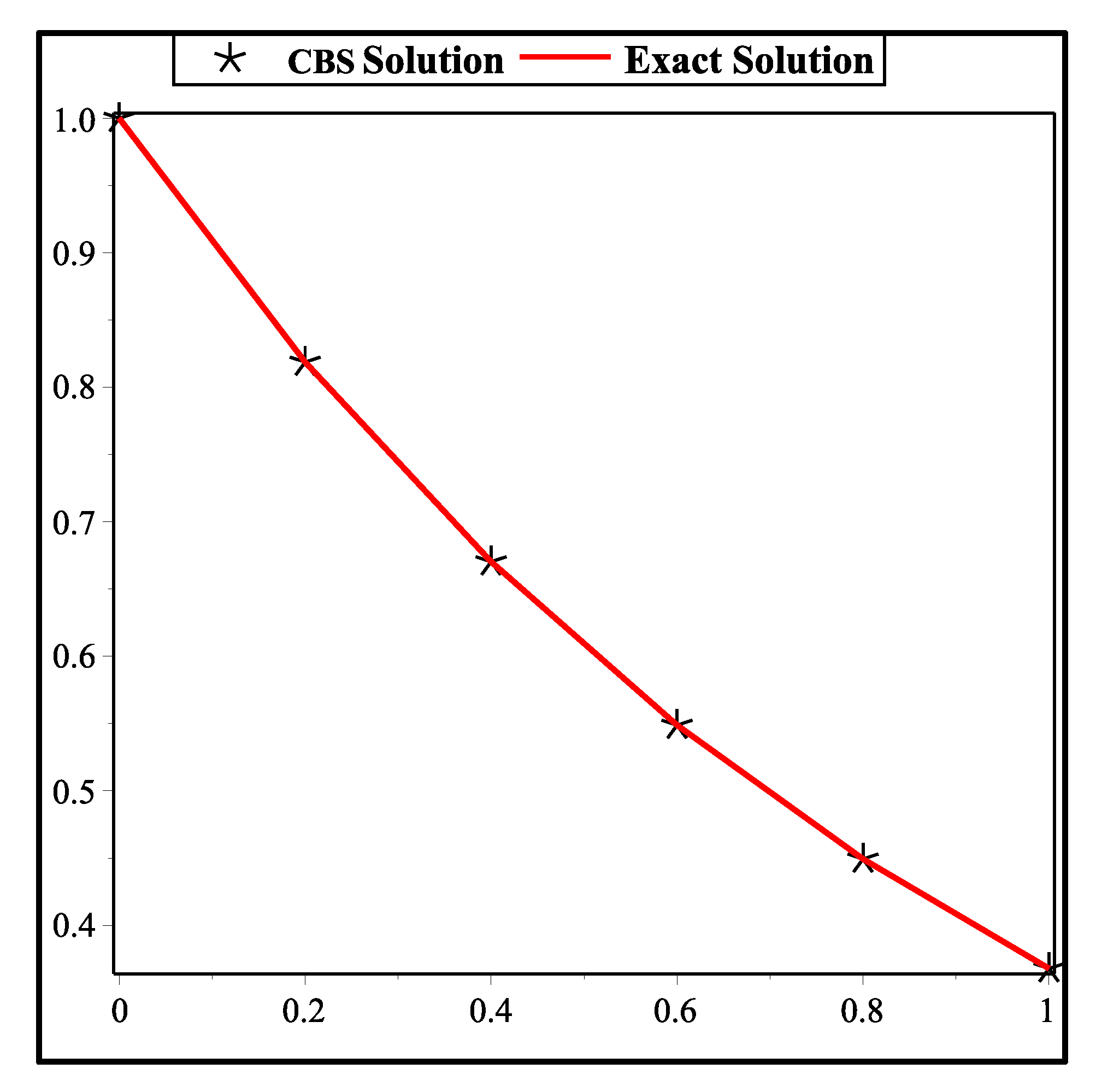
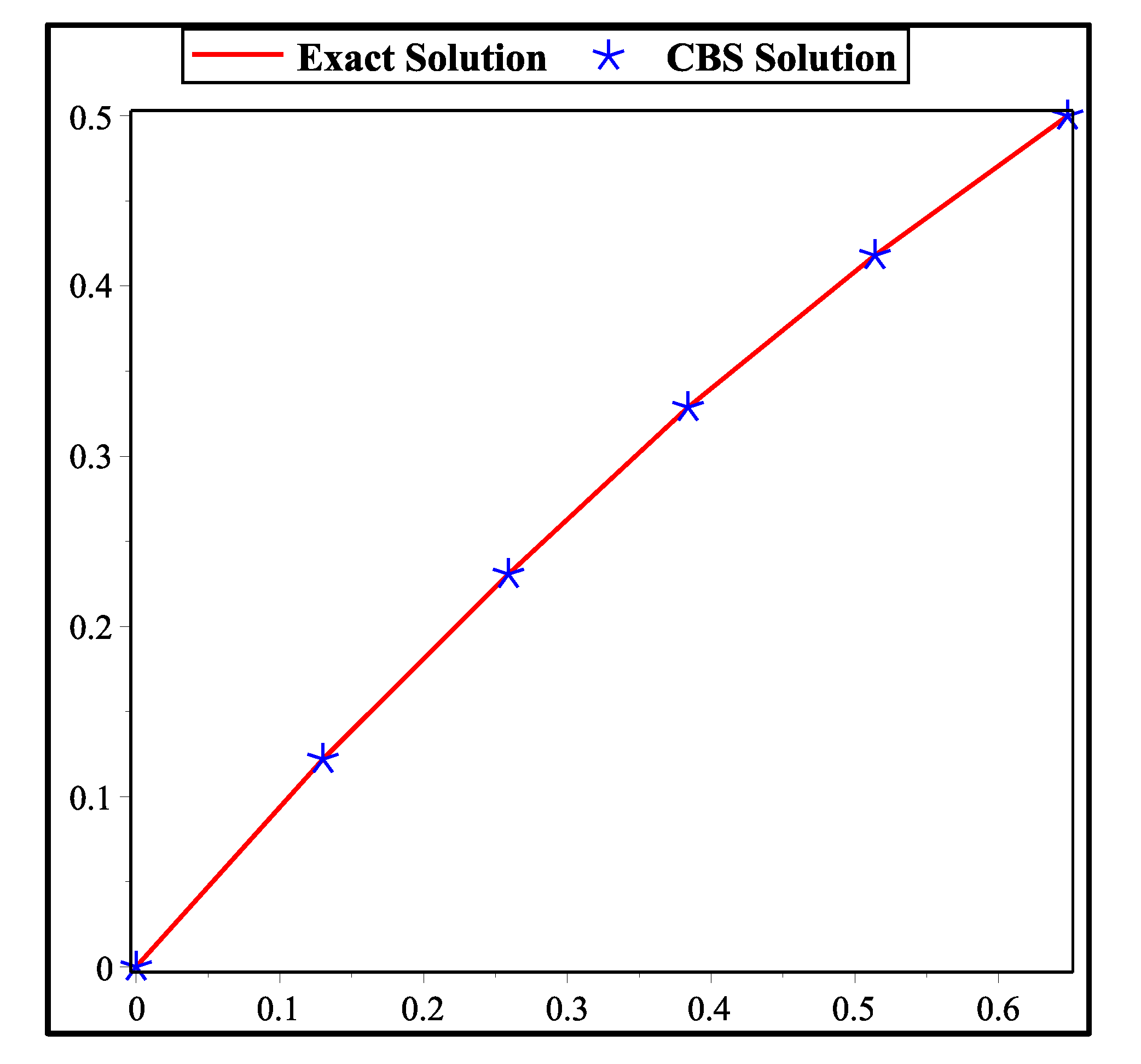
Table 2 and Table 3 analyzed the exact solution and cubic B-spline scheme (CBS) solution of problem 1 at and respectively. Figure 1, Figure 2 and Figure 3 analyze the exact solution with cubic B-spline scheme (CBS) solution of problem 1 at and graphically. Table 4 analyze the errors at those derivatives where boundary conditions (BCs) are defined in problem 1 at .
Table 2.
Analyzing exact solution and cubic B-spline scheme (CBS) solution of problem 1 at .
Table 3.
Analyzing exact solution and CBS solution of problem 1 at .
Figure 1.
Problem 1 at .
Figure 2.
Problem 1 at .
Figure 3.
Problem 1 at and .
Table 4.
Errors at derivatives where boundary conditions (BCs) are defined in problem 1 at .
5.2. Problem 2
We consider the following problem as given in [16]
subject to BCs;
the exact solution of a given equation is where the domain [0, ] for .
The values of fifteen unknowns from Equations (18)–(20) are
| = −0.13805879, | = 0.1782805, | = 0.4183388, | ||
| = −0.0662749, | = 0.2311044, | = 0.4601370, | ||
| = 0.0007014, | = 0.2812925, | = 0.5002580, | ||
| = 0.0634693, | = 0.3290924, | = 0.5388309, | ||
| = 0.1225218, | = 0.3747130, | = 0.57597018. |
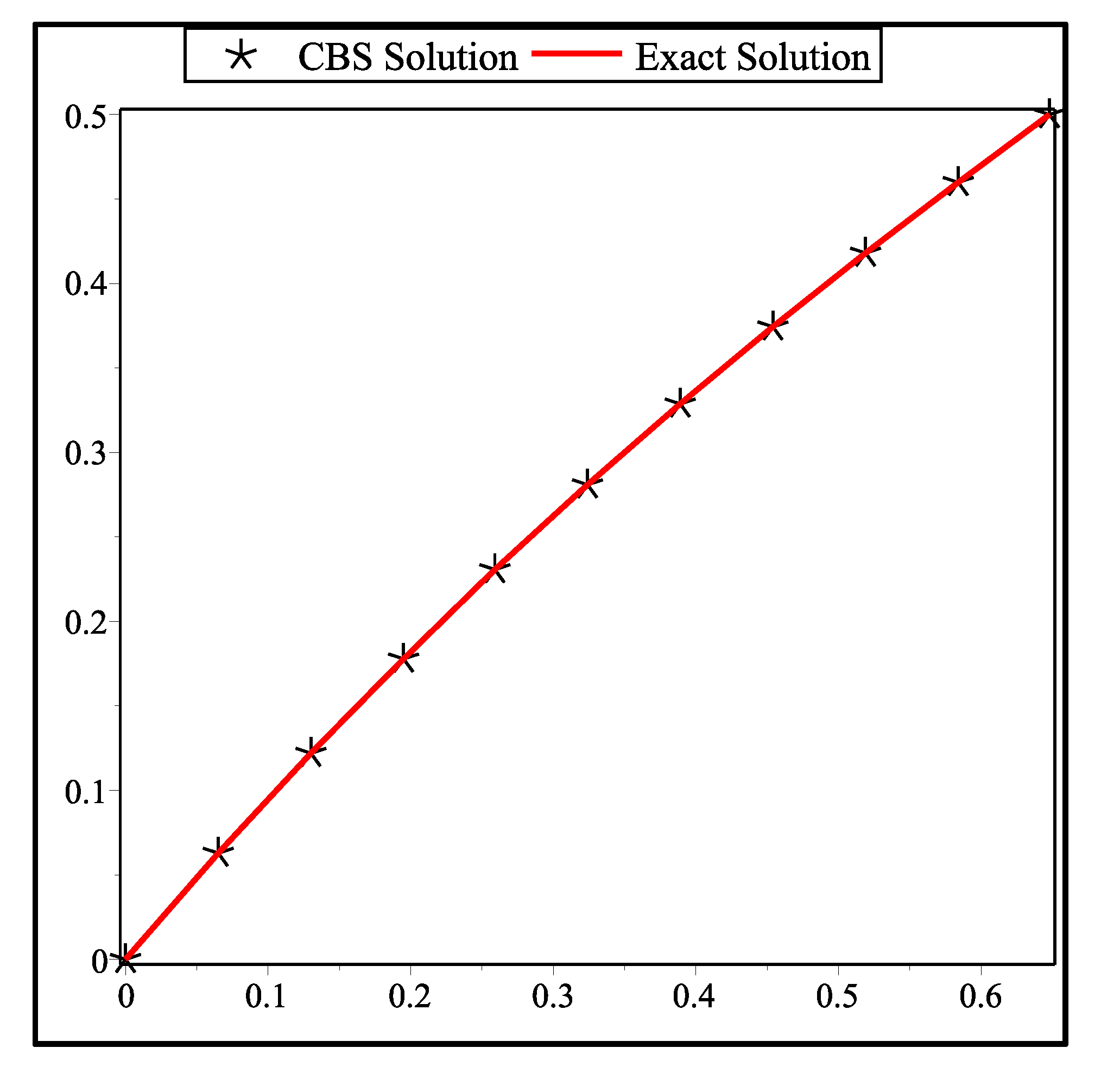
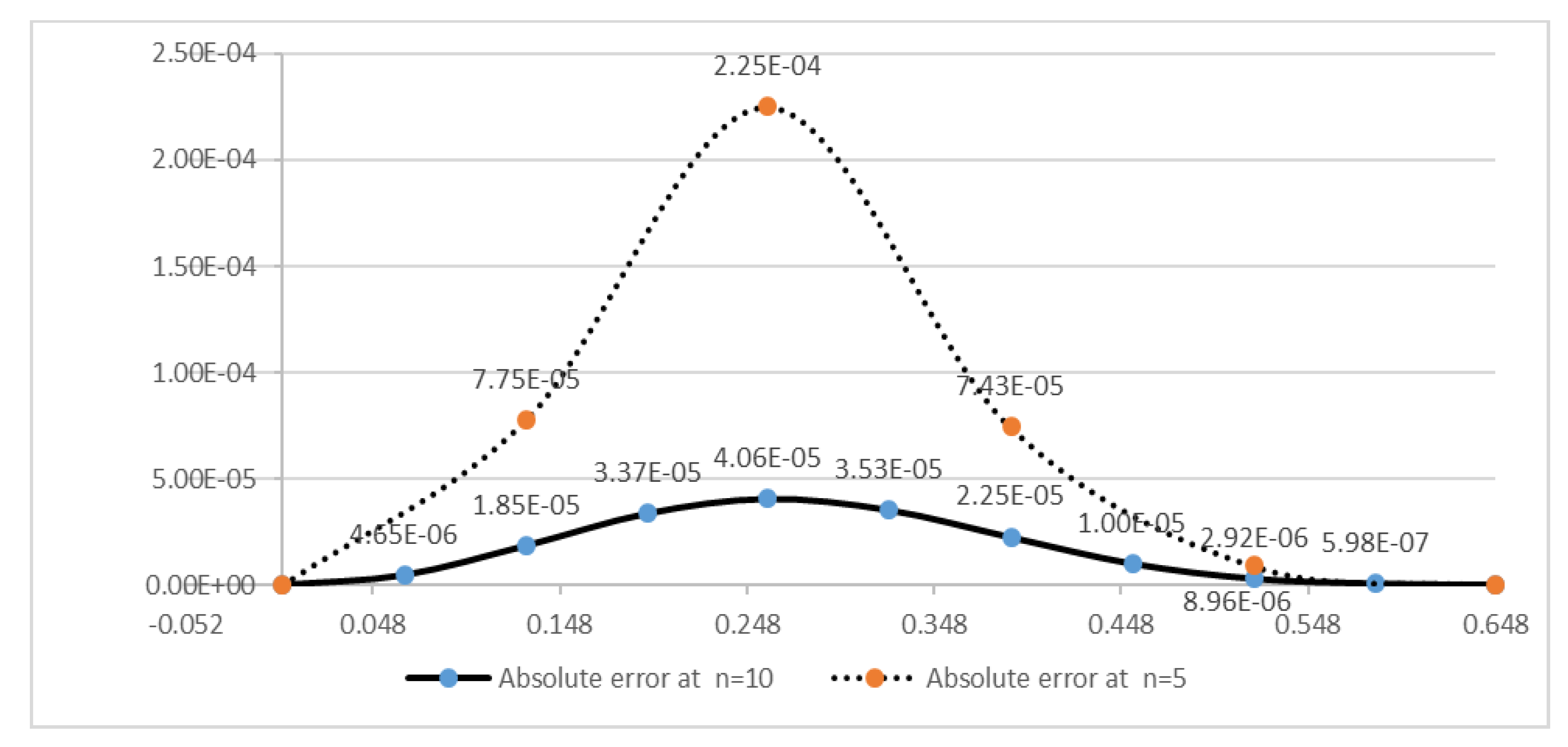
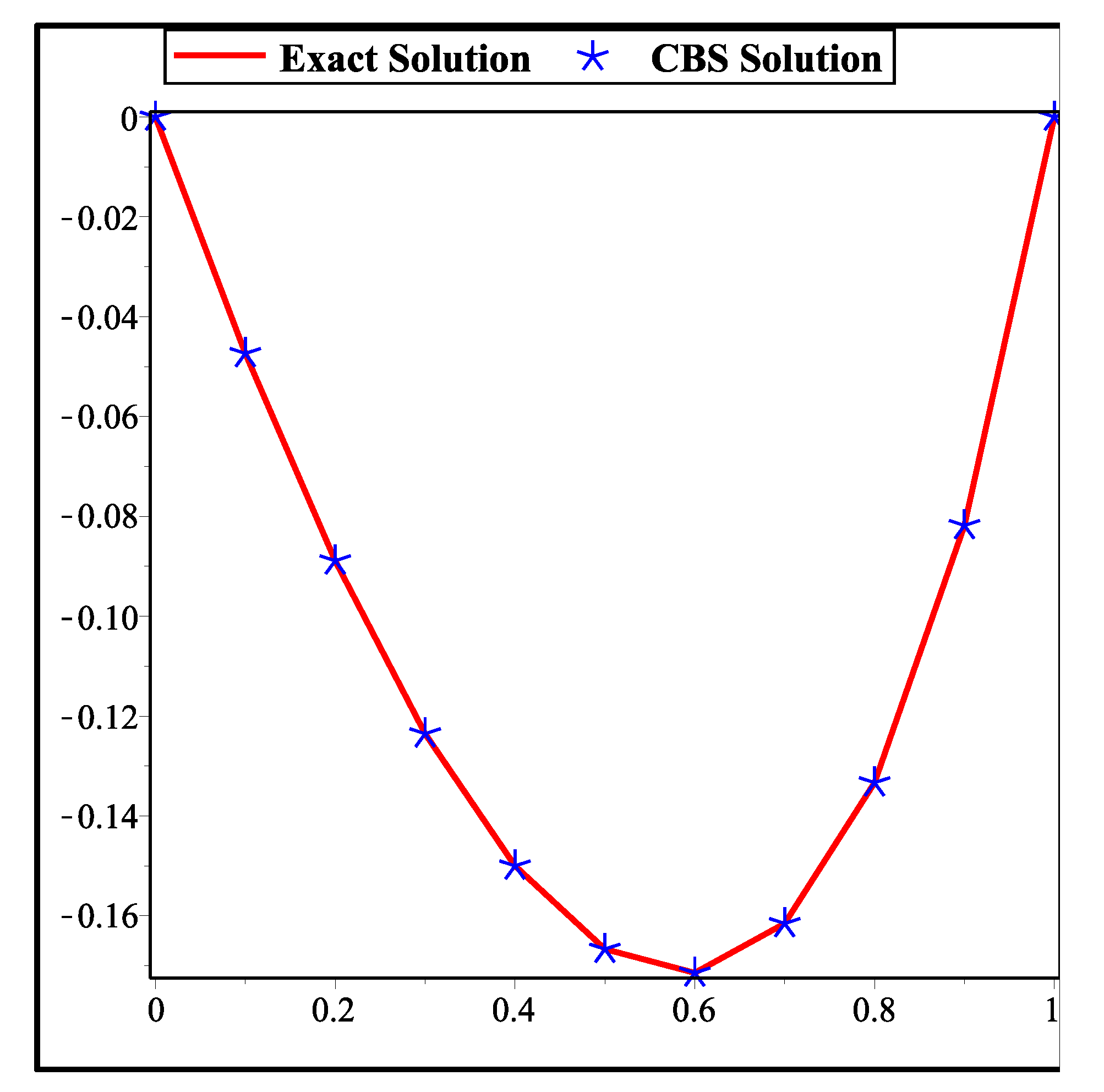
Table 5 and Table 6 analyzed the exact solution and cubic B-spline scheme (CBS) solution of problem 2 at and respectively. Figure 4, Figure 5 and Figure 6 analyze the exact solution with cubic B-spline scheme (CBS) solution of problem 2 at and graphically. Table 7 analyze the errors at those derivatives where boundary conditions (BCs) are defined in problem 2 at .
Table 5.
Analyzing exact solution and CBS-solution of problem 2 at .
Table 6.
Analyzing the exact solution and CBS solution of problem 2 at .
Figure 4.
Problem 1 at .
Figure 5.
Problem 2 at and .
Figure 6.
Problem 1 at .
Table 7.
Errors at derivatives where BCs are defined in problem 2 at .
5.3. Problem 3
We consider the following equation as given in [29,33]
subject to BCs;
the exact solution of given equation is . The values of fifteen unknowns the Equations (18)–(20) are
| = 1.21938333, | = −0.73961579, | = −0.44858605, | ||
| = 1.10333333, | = −0.66924328, | = 0.405893650, | ||
| = 0.99833333, | = 0.605557470, | = 0.36726630, | ||
| = −0.9033333, | = 0.547923909, | = 0.33231776, | ||
| = −0.5333053, | = 0.495772367, | = 0.30069852. |
Table 8 and Table 9 analyzed the exact solution and cubic B-spline scheme (CBS) solution of problem 3 at and respectively. Figure 7, Figure 8 and Figure 9 analyze the exact solution with cubic B-spline scheme (CBS) solution of problem 3 at and graphically. Table 10 analyze the errors at those derivatives where boundary conditions (BCs) are defined in problem 3 at .
Table 8.
Analyzing exact solution and CBS solution of problem 3 at .
Table 9.
Analyzing exact solution and CBS solution of problem 3 at .
Figure 7.
Problem 1 at .
Figure 8.
Problem 3 at and .
Figure 9.
Problem 1 at and .
Table 10.
Errors at derivatives where BCs are defined in problem 3 at .
6. Conclusions
In this study, we present new scheme using CBS of some non-linear differential equations arising in visco-elastic flows and hydrodynamic stability problems. The proper selection for the choice of the scheme and an appropriate of adjustment BCs may cause elasticity for the betterment of the results. The new CBS scheme proposed in this study is very simple to apply in solving the non-linear DEs compared with some existing schemes. An advantage of using the CBS scheme is that it gives a spline function on each new time line which can be applied to achieve the numerical solutions at any stage in the space direction.
Author Contributions
Conceptualization, A.T., A.G. and A.K.; methodology, A.T., A.K. and M.N.N.; software, A.T., A.K., F.K. and K.S.N; formal analysis, S.A.A.K., K.S.N. and F.K.; writing-original draft preparation, A.K., A.G. and S.A.A.K.; writing-review and editing, A.T., K.S.N. and A.G.; visualization, F.K., M.N.N. and A.G.; supervision, M.N.N. and S.A.A.K.; funding acquisition, A.T.
Funding
This research is funded by Deanship of Scientific Research at Majmaah University, Project Number (R-1441-25).
Acknowledgments
The first author Asifa Tassaddiq (A.T) would like to thank Deanship of Scientific Research at Majmaah University, for supporting this work under Project Number (R-1441-25).
Conflicts of Interest
The authors declare no conflict of interest.
References
- Agarwal, R.P. Boundary Value Problems from Higher Order Differential Equations; World Scientific Singapore: Singapore, 1986. [Google Scholar]
- Al-Hayani, W. Adomian decomposition method with green’s function for solving tenth-order boundary value problems. Appl. Math. 2014, 5, 1437. [Google Scholar] [CrossRef][Green Version]
- Al-Hayani, W. Adomian decomposition method with green’s function for solving twelfth-order boundary value problems. Appl. Math. Sci. 2015, 9, 353–368. [Google Scholar] [CrossRef]
- Barari, A.; Omidvar, M.; Najafi, T.; Ghotbi, A.R. Homotopy perturbation method for solving tenth order boundary value problems. Int. J. Math. Comput. 2009, 3, 15–27. [Google Scholar]
- Chandrasekhar, S. Hydrodynamic and Hydromagnetic Stability; Oxford University Press: London, UK, 1961. [Google Scholar]
- Burns, W.W.; Owen, H.A.; Wilson, T.G.; Rodriguez, G.E.; Paulkovich, J. A digital computer simulation and study of a direct-energy-transfer power-conditioning system. In Proceedings of the IEEE Power Electronics Specialists Conference, Culver City, CA, USA, 9–11 June 1975; pp. 138–149. [Google Scholar]
- Djidjeli, K.; Twizell, E.; Boutayeb, A. Numerical methods for special nonlinear boundary-value problems of order 2 m. J. Comput. Appl. Math. 1993, 47, 35–45. [Google Scholar] [CrossRef]
- Erturk, V.S.; Momani, S. A reliable algorithm for solving tenth-order boundary value problems. Numer. Algorithms 2007, 44, 147–158. [Google Scholar] [CrossRef]
- Mohyud-Din, S.T.; Yildirim, A. Solution of tenth and ninth-order boundary value problems by homotopy perturbation method. J. Korean Soc. Ind. Appl. Math. 2010, 14, 17–27. [Google Scholar]
- Mohyud-Din, S.T.; Yildirim, A. Solutions of tenth and ninth-order boundary value problems by modified variational iteration method. Appl. Appl. Math. 2010, 5, 11–25. [Google Scholar]
- Noor, M.A.; Al-Said, E.; Mohyud-Din, S.T. A reliable algorithm for solving tenth-order boundary value problems. Appl. Math. 2012, 6, 103–107. [Google Scholar]
- Wazwaz, A.-M. Approximate solutions to boundary value problems of higher order by the modified decomposition method. Comput. Math. Appl. 2000, 40, 679–691. [Google Scholar] [CrossRef]
- Wazwaz, A.-M. The modified adomian decomposition method for solving linear and nonlinear boundary value problems of tenth-order and twelfth-order. Int. J. Nonlinear Sci. Numer. Simul. 2000, 1, 17–24. [Google Scholar] [CrossRef]
- Wazwaz, A.-M. The numerical solution of special eighth-order boundary value problems by the modified decomposition method. Neural Parallel Sci. Comput. 2000, 8, 133–146. [Google Scholar]
- Wazwaz, A.-M. The numerical solution of sixth-order boundary value problems by the modified decomposition method. Appl. Math. Comput. 2001, 118, 311–325. [Google Scholar] [CrossRef]
- Taiwo, O.A.; Ogunlaran, O.M. A non-polynomial spline method for solving linear fourth-order boundary-value problems. Int. J. Phys. Sci. 2011, 13, 3246–3254. [Google Scholar]
- Hamdy, A.; Badreddin, E. Dynamic modeling of a wheeled mobile robot for identification, navigation and control. In IMACS Conference on Modeling and Control of Technological Systems; IMAS: Lille, France, 1992; pp. 119–128. [Google Scholar]
- Hughes, J.T. Type-C Wind Turbine Model Order Reduction and Parameter Identification. Master’s Thesis, University of Illinois at Urbana-Champaign, Champaign, IL, USA, 2013. [Google Scholar]
- Kanwal, G.; Ghaffar, A.; Hafeezullah, M.M.; Manan, S.A.; Rizwan, M.; Rahman, G. Numerical solution of 2-point boundary value problem by subdivision scheme. Commun. Math. Appl. 2019, 10, 1–11. [Google Scholar]
- Manan, S.A.; Ghaffar, A.; Rizwan, M.; Rahman, G.; Kanwal, G. A subdivision approach to the approximate solution of 3rd order boundary value problem. Commun. Math. Appl. 2018, 9, 499–512. [Google Scholar]
- Gupta, Y.; Kumar, M. B-spline method for solution of linear fourth order boundary value problem. System 2011, 1, 4. [Google Scholar]
- Islam, M.S.; Hossain, M.B.; Rahman, M.A. Numerical approaches for tenth and twelfth order linear and nonlinear differential equations. Br. J. Math. Comput. Sci. 2015, 5, 637. [Google Scholar] [CrossRef]
- Khalid, A.; Naeem, M.N. Cubic B-spline solution of nonlinear sixth order boundary value problems. J. Math. 2018, 50, 91–103. [Google Scholar]
- Khalid, A.; Naeem, M.N.; Ullah, Z.; Ghaffar, A.; Baleanu, D.; Nisar, K.S.; Al-Qurashi, M.M. Numerical solution of the boundary value problems arising in magnetic fields and cylindrical shells. Mathematics 2019, 7, 508. [Google Scholar] [CrossRef]
- Lang, F.-G.; Xu, X.-P. A new CBS method for linear fifth order boundary value problems. J. Appl. Math. Comput. 2011, 36, 101–116. [Google Scholar] [CrossRef]
- Siddiqi, S.S.; Akram, G. Solution of 10th-order boundary value problems using non-polynomial spline technique. Appl. Math. Comput. 2007, 190, 641–651. [Google Scholar] [CrossRef]
- Siddiqi, S.S.; Akram, G. Solutions of tenth-order boundary value problems using eleventh degree spline. Appl. Math. Comput. 2007, 185, 115–127. [Google Scholar] [CrossRef]
- Twizell, E.H.; Boutayeb, A.; Djidjeli, K. Numerical methods for eighth-, tenth-and twelfth-order eigenvalue problems arising in thermal instability. Adv. Comput. Math. 1994, 2, 407–436. [Google Scholar] [CrossRef]
- Kasi Viswanadham, K.N.S.; Ballem, S. Numerical solution of tenth order boundary value problems by galerkin method with quintic B-splines. Int. J. Innov. Sci. Math. 2014, 2, 288–294. [Google Scholar]
- Kasi Viswanadham, K.N.S.; Ballem, S. Numerical solution of tenth order boundary value problems by galerkin method with septic B-spline. Int. J. Appl. Sci. Eng. 2015, 13, 247–260. [Google Scholar]
- Kasi Viswanadham, K.N.S.; Raju, Y.S. Quintic B-spline collocation method for tenth order boundary value problems. Bound. Value Probl. 2012, 51, 7–13. [Google Scholar]
- Kasi Viswanadham, K.N.S.; Raju, Y.S. Sextic B-spline collocation method for eighth order boundary value problems. Int. J. Appl. Sci. Eng. 2014, 12, 43–57. [Google Scholar]
- Kasi Viswanadham, K.N.S.; Ballem, S. Numerical solution of eighth order boundary value problems by galerkin method with septic B-splines. Procedia Eng. 2015, 127, 1370–1377. [Google Scholar]
© 2019 by the authors. Licensee MDPI, Basel, Switzerland. This article is an open access article distributed under the terms and conditions of the Creative Commons Attribution (CC BY) license (http://creativecommons.org/licenses/by/4.0/).