1. Introduction
Let
be a Banach Space and
the dual space.
denotes the normalized duality mapping from
to
and is defined by
Let be a nonempty set of . A mapping is contractive, if , , . A mapping is nonexpansive, if , . Let denote the fixed point set of .
is called accretive operator, if there exists
such that
, for any
. If
,
, then
is called
-accretive operator.
is called the resolvent of
-accretive operator
and defined by
,
. It is well known that
is nonexpansive mapping and
, where
and
is the fixed point set of
. So fixed point theory of nonexpansive mappings has been applied to zero point problem of accretive operator, see [
1,
2,
3,
4,
5,
6] and the references therein.
The implicit midpoint rule is one of the powerful methods for solving ordinary differential equations; see [
7,
8,
9,
10,
11,
12] and the references therein. Moreover, viscosity iterative algorithms for finding common fixed points for nonlinear operators and solutions of variational inequality problems have been researched by many authors.
In 2009, Chang et al. [
1] proposed a viscosity iterative algorithm for accretive operator and nonexpansive mapping:
In 2010, Jung [
13] proposed a composite iterative algorithm by viscosity method for finding the zero point of an accretive operator:
In 2016, Jung [
14] extended the related results and proposed an iterative algorithm for finding common point of zero of accretive operator and fixed point of nonexpansive mapping:
In 2017, Li [
15] introduced a new iterative algorithm in a real reflexive Banach space
with the uniformly
differentiable norm and
is a nonempty closed convex subset of
which has the normal structure:
In 2015, Xu et al. [
16] used viscosity iterative algorithm to implicit midpoint rule for nonexpansive mapping in Hilbert space and proposed viscosity implicit midpoint rule:
was generated by the following
Under some conditions on , they obtained that strongly converged to , and was the solution of variational inequality , .
In 2017, Luo et al. [
17] extended the results of Xu et al. [
16] from Hilbert space to uniformly smooth Banach space:
was generated by the following
Under some conditions, they obtained that strongly converged to , and was the solution of variational inequality , .
Motivated and inspired by the above papers, this paper uses the viscosity implicit midpoint rule to find common points of the fixed point set of a nonexpansive mapping and the zero point set of an accretive operator in Banach space and obtains the strong convergence results and improves the previous results. Finally, this paper gives numerical examples to support the main results.
3. Main Results
Theorem 1. Letbe a reflexive and uniformly convex Banach space which has uniformlydifferentiable norm andbe a nonempty closed convex subset ofwhich has normal structure. Letbe a contractive mapping with,be a-accretive operator inandbe a nonexpansive mapping with. For anyand,is generated bywhereandsatisfy the following conditions: (i),,; (ii); (iii),.
Thenandconverge strongly to, whereis the unique solution of the variational inequality,.
Proof. The proof is split into eleven steps.
Step 1: Show that and are bounded.
Take
, then we have
and then we get
Then and are bounded. So , , , , and are also bounded.
Step 2: Show that .
Put (4) and (5) into (3), we get
It follows that
where
and
.
Take , then . From , so .
Take , then . From , so .
Take . From , then . From and , so .
From Lemma 2, we get .
Step 3: Show that .
Because
is convex function and (1), so we have
If , so from and the boundedness of , we get .
If
, so
Then .
So we get
and then
.
From the property of , so we get .
Then from step 2, we get .
Step 4: Show that
.
From steps 2 and 3, and the boundedness of and , we get .
Step 5: Show that
.
From steps 2 and 4, we get .
Step 6: Show that
.
From steps 3 and 5, we get .
Step 7: Show that
.
From steps 4 and 5, we get .
Step 8: Show that
.
From step 6 and , we get .
Step 9: Show that
.
From steps 5 and 8, we get .
Step 10: Show that .
Let be defined by . From Lemma 3, we have that converges strongly to , which is also the unique solution of the variational inequality , .
It follows that . From step 7, we get .
Step 11: Show that .
Take
. From
, we have
From , we get .
Take
, then we have
From and step 10, we get .
Take , then we get .
From Lemma 2, we get . This completes the proof. □
The results of Theorem 1 improve the related results in [
13,
14,
16,
17]. For example, this paper uses the viscosity implicit midpoint rule to find common points of the fixed point set of a nonexpansive mapping and the zero point set of an accretive operator and the results improve the related results in [
13,
14]; If
, the results of Theorem 1 can obtain the related results in [
16,
17].
Corollary 1. Letbe a reflexive and uniformly convex Banach space which has uniformlydifferentiable norm andbe a nonempty closed convex subset ofwhich has normal structure. Letbe a contractive mapping with,be a m-accretive operator inandbe a nonexpansive mapping with. For anyand,is generated bywhere,andsatisfy the following conditions: - (i)
,,;
- (ii)
;
- (iii)
,;
- (iv)
.
Thenandconverge strongly to, whereis the unique solution of the variational inequality,.
Proof. Take , then . From , we get .
Take , then . From , we get .
Take , then we get .
From Lemma 2, we get . From Theorem 1, we have and converge strongly to , where is the unique solution of the variational inequality , . So and also converge strongly to . This completes the proof. □
The results of Corollary 1 improve the related results in [
14,
16,
17].
Theorem 2. Letbe a reflexive and uniformly convex Banach space which has uniformlydifferentiable norm andbe a nonempty closed convex subset ofwhich has normal structure. Letbe a contractive mapping with,be a m-accretive operator inandbe a nonexpansive mapping with. For anyand,is generated bywhere,andsatisfy the following conditions: - (i)
,,;
- (ii)
;
- (iii)
,;
- (iv)
.
Thenandconverge strongly to, whereis the unique solution of the variational inequality,.
Proof. The proof is split into eleven steps.
Step 1: Show that and are bounded.
Take
, then we have
and then we get
Then and are bounded. So , , , , and are also bounded.
Step 2: Show that .
Put (8) and (9) into (7), we get
Take , then . From , so .
Take , then . From , so .
Take
then
.
From , , and , so .
From Lemma 2, we get .
Step 3: Show that .
Because
is convex function and (1), so we have
If , so from , step 1 and , we get .
If
, so
So we get
and then
.
From the property of , so we get .
Then from step 2 and , we get .
Step 4: Show that
.
From step 1, step 2, step 3, and , we get .
Step 5: Show that
.
From step1, step 2, step 4 and , we get .
Step 6: Show that
.
From steps 3 and 5, we get .
Step 7: Show that
.
From steps 4 and 5, we get .
Step 8: Show that
.
From step 6 and , we get .
Step 9: Show that
.
From steps 5 and 8, we get .
Step 10: Show that .
From Theorem 1, we have that converges strongly to , which is also the unique solution of the variational inequality , .
It follows that . From step 1 and step 7, we get .
Step 11: Show that .
Take
. From
, we have
From , we get .
Take
, then we have
From and step 10, we get .
Take
, then
From and , we get , and then . From , we get .
From Lemma 2, we get . This completes the proof. □
The results of Theorem 2 improve the related results in [
15,
16,
17]. For example, the results of Theorem 2 is can obtain the related results in [
15,
16,
17]; the rate of convergence and computational accuracy is better than their in [
15,
16,
17].
4. Numerical Examples
We give four numerical examples to support the main results.
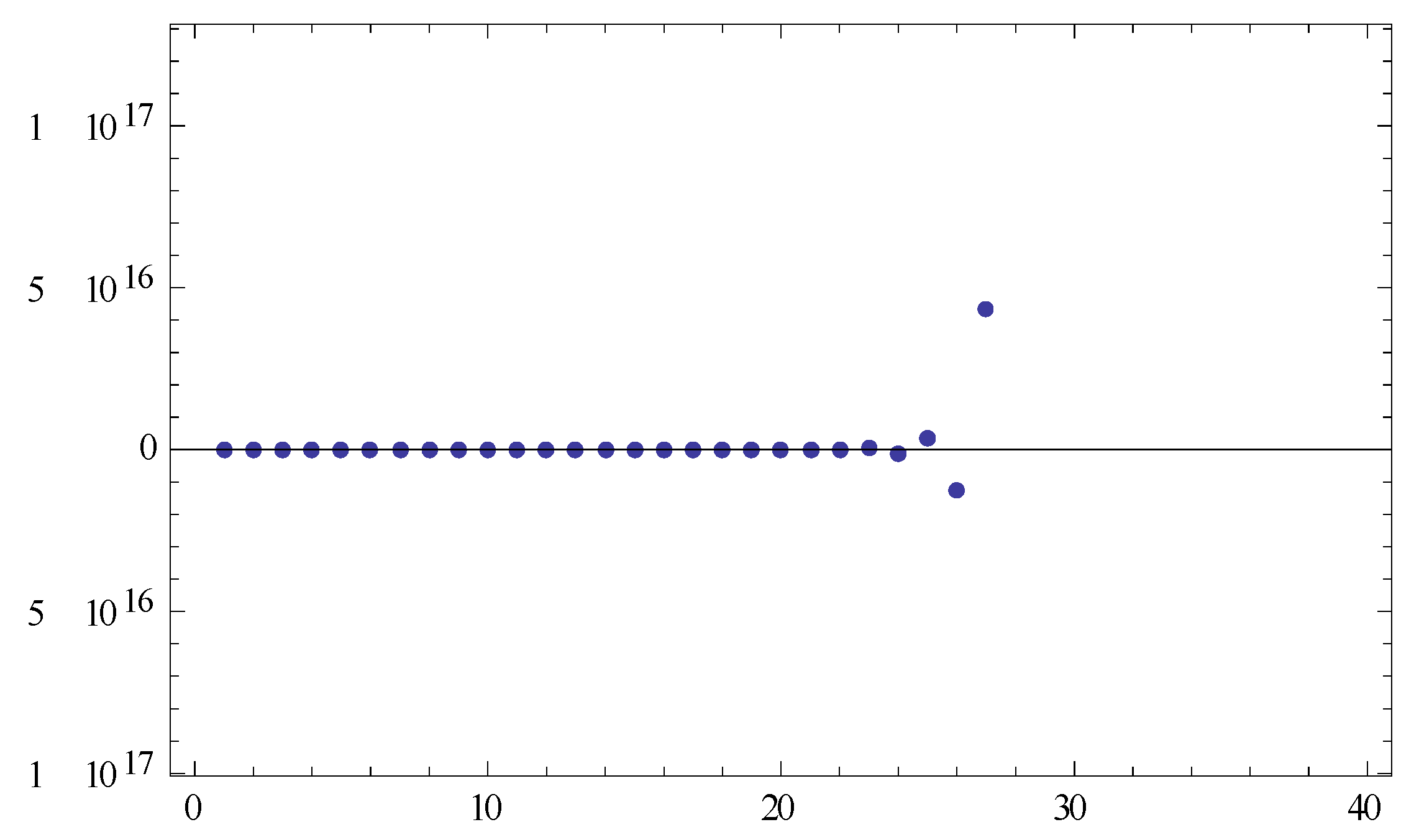
Example 1. Letbe the real line with Euclidean norm,be defined by,be defined byand. So. Let,and, then they satisfy the conditions of Theorem 1.is generated by (2). From Theorem 1, we can obtainconverges strongly to 0.
Next, we simplify the form of (2) and get
Next, we take
into (10). Finally, we get the following numerical results in
Figure 1.
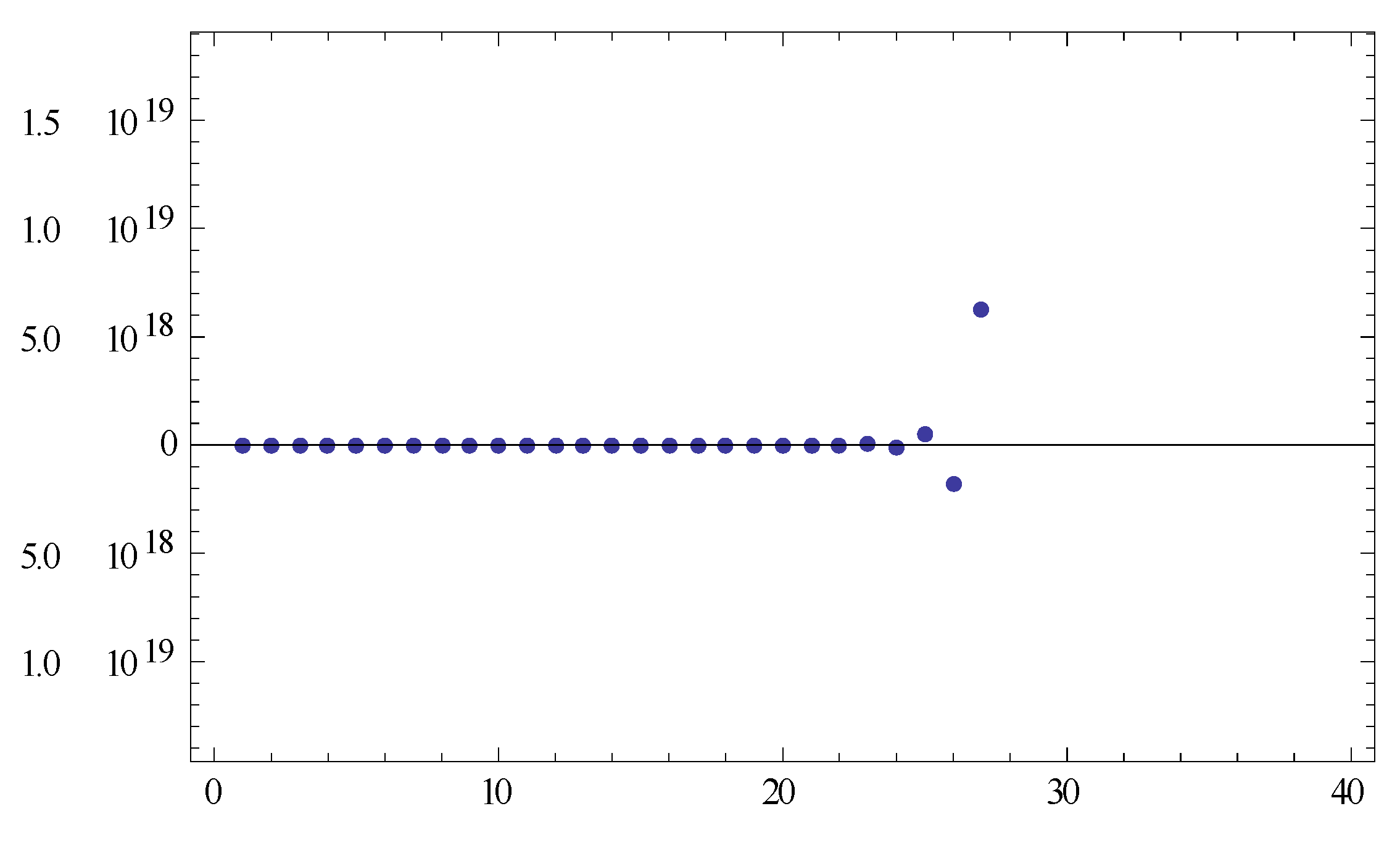
Example 2. Letbe the real line with Euclidean norm,be defined by,be defined byand. So. Let,,and, then they satisfy the conditions of Theorem 2.is generated by (6). From Theorem 2, we can obtainconverges strongly to 0.
Next, we simplify the form of (6) and get
Next, we take
into (11). Finally, we get the following numerical results in
Figure 2.
Example 3. Letbe the inner product and defined by Letbe the usual norm and defined byfor any.
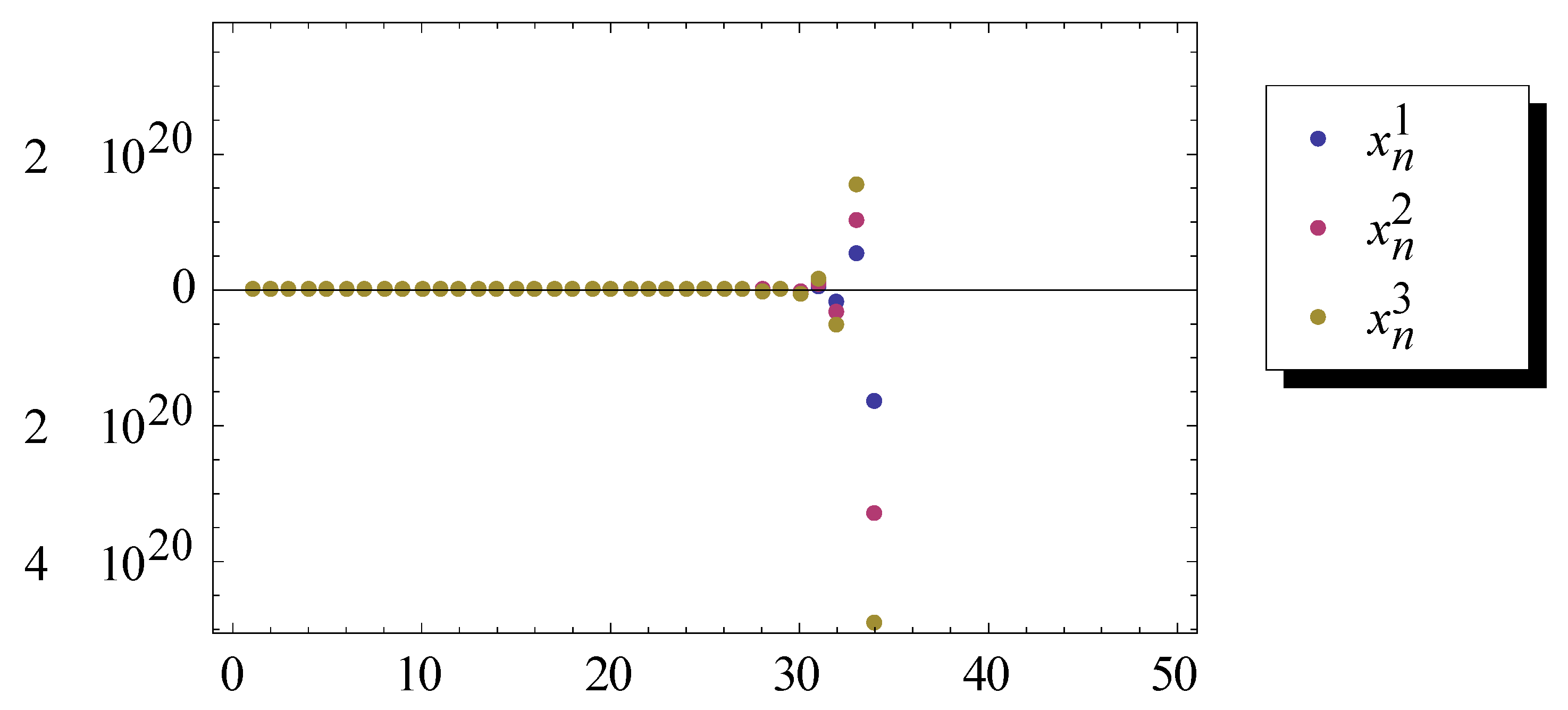
For any, letbe defined by,be defined byand. So. Let,and, then they satisfy the conditions of Theorem 1.is generated by (2). From Theorem 1, we can obtainconverges strongly to 0.
Next, we simplify the form of (2) and get
Next, we take
into (12). Finally, we get the following numerical results in
Figure 3.
Example 4. Letbe the inner product and defined by Letbe the usual norm and defined byfor any.
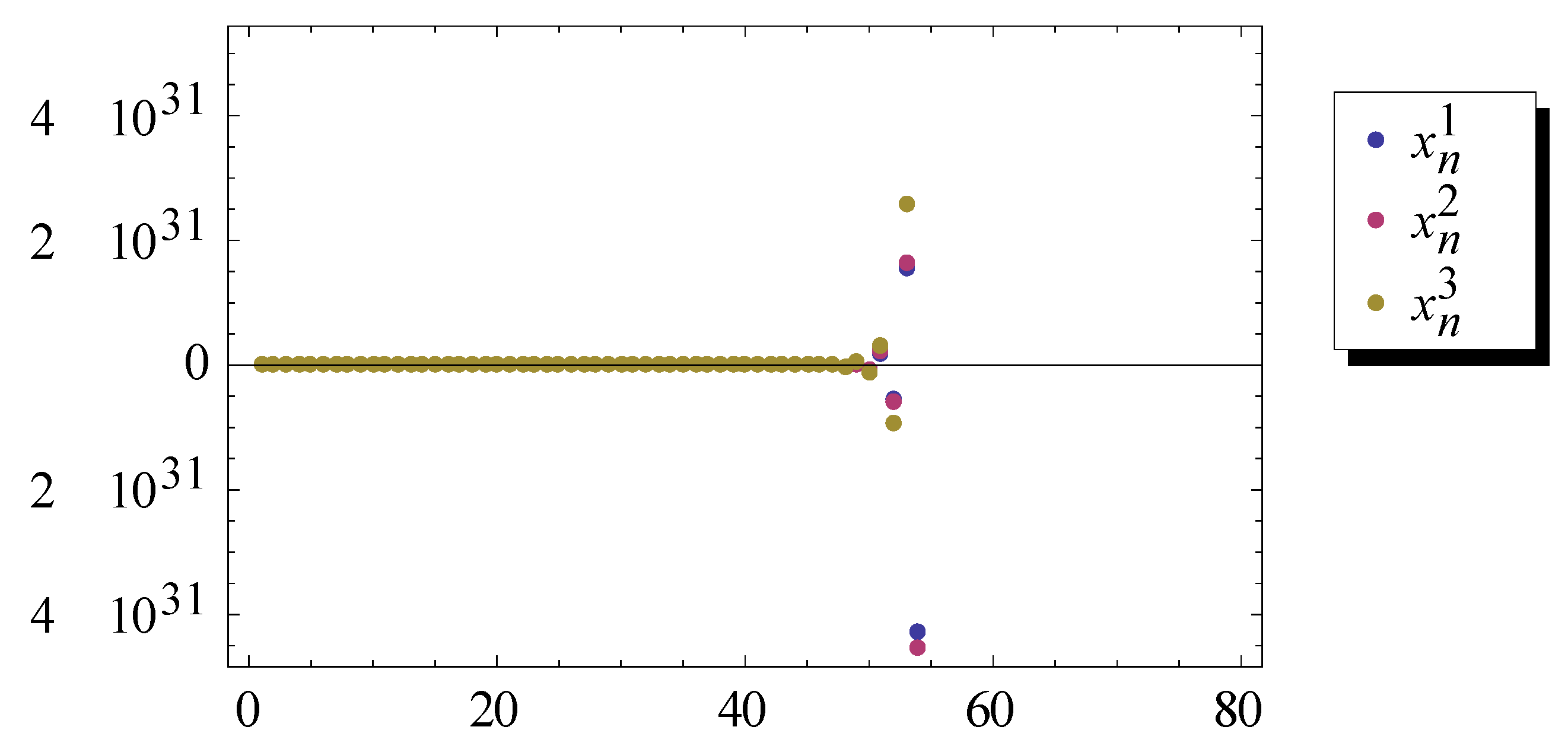
For any, letbe defined by,be defined byand. So. Let,,and, then they satisfy the conditions of Theorem 2.is generated by (6). From Theorem 2, we can obtainconverges strongly to 0.
Next, we simplify the form of (6) and get
Next, we take
into (13). Finally, we get the following numerical results in
Figure 4.