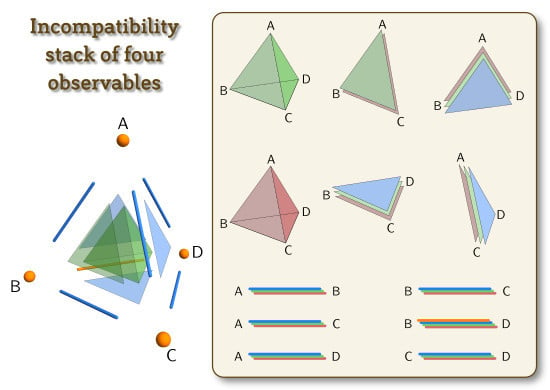
Abstract
We study the compatibility (or joint measurability) of quantum observables in a setting where the experimenter has access to multiple copies of a given quantum system, rather than performing the experiments on each individual copy separately. We introduce the index of incompatibility as a quantifier of incompatibility in this multi-copy setting, as well as the notion of the compatibility stack representing various compatibility relations present in a given set of observables. We then prove a general structure theorem for multi-copy joint observables and use it to prove that all abstract compatibility stacks with three vertices have realizations in terms of quantum observables.
Keywords:
quantum incompatibility; collective measurements; joint measurability hypergraphs; noisy spin observables PACS:
03.65.Ta; 03.65.Ud
1. Introduction
The laws of quantum physics dictate that there are certain tasks that are mutually exclusive, meaning that they cannot be performed simultaneously with a single device. This quantum incompatibility is usually encountered in the context of mutually-exclusive measurements: one cannot measure two orthogonal spin directions and with a single measurement setup. From the modern quantum information point of view, incompatibility has been identified as a genuine resource gained from switching from classical to quantum protocols. As such, it is at the heart of many typically quantum applications, such as secure quantum key distributions or the possibility to steer remote quantum systems. Due to its importance in these applications, as well as its status as a fundamental quantum feature, it is essential to gain a deeper understanding of quantum incompatibility.
Even though quantum theory gives predictions of outcomes in statistical experiments, the essence of incompatibility is manifested on the level of single experimental runs. More specifically, for compatible observables, it is possible to find a single measurement setup, such that on each experimental run, the reading of the measurement outcome allows one to assign the values of the outcomes for the compatible observables. The prototypical example of this is the joint measurement of a pair of compatible observables and : if and are the outcome sets for and , respectively, then a joint observable will have the outcome set . The measurement outcome in each experimental run is therefore a pair of numbers , from which we assign the values a and b as the outcomes of and . By repeating this procedure multiple times, the resulting distributions should then correspond to those obtained from the separate statistical experiments of and . This should highlight the distinction between the joint measurement of a pair of observables and any scenario where the outcome distributions are reconstructed from the full distribution of a third measurement.
In this paper, we take a step away from this usual framework and study joint measurements of observables in a setting where the experimenter has access to multiple copies of a given quantum system, rather than performing the experiments on each individual copy separately. At first sight, it may seem that the whole phenomenon of incompatibility is lost in such an approach: if two copies of the same system are available, then by measuring on one system and on the other, one has in a sense measured these incompatible observables jointly. However, things change drastically when one looks at more than two observables. In fact, by including also a third spin direction, , one gets a triple of incompatible observables, which cannot be jointly measured even with two copies of the same system.
This approach leads to a new way of treating and quantifying the incompatibility of larger sets of observables, by looking at the minimal number of system copies needed to be able to measure all of them with a single collective measurement. We will define this number to be the index of incompatibility of the set. On a more detailed level, we define the compatibility stack of a set of observables as a list of hypergraphs expressing various multi-copy compatibility relations between the observables. This definition naturally generalizes the joint measurability hypergraphs introduced in [1]. After these general treatments, we focus on the qubit case, where we prove the results for the multi-copy joint measurability of triples of noisy qubit observables. In particular, we demonstrate that all compatibility stacks of order three have a quantum realization.
The paper is organized as follows. In Section 2, we recall the definition of a quantum observable. Section 3 presents the notion of k-compatibility. The definition is then expanded in Section 4 to define the compatibility stack, a mathematical way of describing k-compatibility relations within a given set of observables. Section 5 goes deeper into the notion of k-compatibility and provides a necessary and sufficient condition for the k-compatibility of n observables. The general content of the previous parts is then exemplified in Section 6 in the case of three qubit observables. The conclusion and future outlooks are given in Section 7.
2. Quantum Observables
We start by recalling the definition of a quantum observable as a positive operator valued measure. In this paper, we will restrict our investigation to observables with a finite number of measurement outcomes. We refer to [2] for an exhaustive presentation of the properties of quantum observables.
The quantum mechanical description of a physical system is based on a complex Hilbert space , which we assume to be finite dimensional throughout the paper. We denote by the vector space of linear operators on , in which we let be the identity operator.
Definition 1.
Let Ω be a finite set. A map is an -valued observable on Ω if:
- (i)
- for all ;
- (ii)
- .
The states of the system are represented by positive trace one operators on , and for a state ϱ, the number is the probability of obtaining an outcome x in a measurement of .
As an example, consider the x-component of the spin of a spin- system. The corresponding observable is then the map defined on the two-outcome set and having as its values the two orthogonal projections:
We can add white noise to this observable, and this results in a noisy spin observable : defined as:
where the parameter is the noise intensity. The y- and z-components of the spin are of course treated in the same manner giving rise to the corresponding observables and and their noisy versions and .
It is occasionally convenient to view an observable as a map on the power set rather than the set Ω. For any , we denote , so that:
- (i′)
- for all ;
- (ii′)
- ;
- (iii′)
- for all , such that .
The two definitions are clearly equivalent, and we will switch between them whenever it is convenient.
3. k-Compatibility of Observables
3.1. Definition
Let be -valued observables with outcome sets . The compatibility of these observables means that we can simultaneously implement their measurements, even if only one input state is available. Generalizing the usual formulation of joint measurements, we assume that we have access to k copies of the initial state. We can hence make a collective measurement on a state (for any , we use the notation for the k-fold tensor product , and we set and ). This measurement should give a measurement outcome for each observable , so we are looking for an -valued observable on the product set . In order for to serve as a joint measurement, it is required that if we ignore other than the i-th component of a measurement outcome , the probability must agree with the probability of getting in a measurement of .
For this reason, we introduce the i-th marginal of . For all , is the observable given by:
where : is the projection . This definition of a marginal can also be written in an equivalent form as:
required to hold for all .
Definition 2.
-valued observables on the outcome sets , respectively, are k-compatible if there exists an -valued observable on the product set , such that:
for all , and all states ϱ. The observable is called a k-copy joint observable of .
If in Definition 2, we have the usual definition of compatibility, also called joint measurability [3].
3.2. Basic Properties
Let us observe some basic properties of the k-compatibility relation. Firstly, for observables , we can define:
and this -valued observable clearly satisfies (1) for . We thus conclude that:
- Any collection of n observables is n-compatible.
- Any subset of a k-compatible set of observables is k-compatible.
- Any collection of k-compatible observables is -compatible for all .
Proposition 1.
Let be a finite collection of observables and for two nonempty subsets and . If is -compatible and is -compatible, then is -compatible.
Proof.
First, if for some i, then the claim is trivial. Hence, we assume that for all . We denote . As is a subset of , it is -compatible. The set is a disjoint union of and , and we can label the observables, so that and . We denote by and the - and -copy joint observables of and , respectively, and then define:
This observable is a -copy joint observable of . ☐
3.3. Index of Incompatibility
For any set of n observables, the smallest integer , such that the collection is k-compatible, is well defined and can be used to determine the “strength” of incompatibility; the more copies of the system you need on the input to measure the given set of observables, the more incompatible they are. This leads to the following notion.
Definition 3.
The index of incompatibility is the minimal number of copies that is needed in order to make a given set of observables compatible. Hence, for a set of observables , the index of incompatibility is:
The usual compatibility corresponds to 1-compatibility; hence, the index of incompatibility of a compatible set of observables is 1. The index of incompatibility can be taken as an integer valued quantification of the incompatibility of a given set. Our earlier observations and Proposition 1 imply the following.
- (i)
- ;
- (ii)
- if , then ;
- (iii)
- ;
- (iv)
- if and only if is compatible.
It is not clear from this definition whether for each integer there exists a set of n observables, such that the index has the maximal value n. In Section 6, we will show that there exists a triplet of observables whose index of incompatibility is 3.
4. Compatibility Stack
4.1. Definition
Although the index of incompatibility gives a simple quantification of the incompatibility of a set of observables, it does not take into account the finer compatibility structures present in the set. This calls for a more refined description of the various compatibility relations between the observables. In the usual single copy scenario, this can be conveniently done in terms of joint measurability hypergraphs [1].
In general, a hypergraph is a pair consisting of a set V and a set E of non-empty subsets of V. The elements of V are called vertices, and the elements of E are edges (when subsets of more than two vertices are involved, these are actually hyperedges). Following [1], we say that a hypergraph is a joint measurability hypergraph (or compatibility hypergraph) if all non-empty subsets of edges are also edges, i.e.,
Every set of observables gives rise to a joint measurability hypergraph where the vertices represent the observables, and the edges linking some particular vertices represent the compatibility of the corresponding observables. The above condition then states that the compatibility of some set of observables implies the compatibility of any subset of these observables. Furthermore, it was shown in [1] that every abstract joint measurability hypergraph where all of the singleton sets are edges has such a realization in terms of quantum observables.
The generalization of this approach to the case of k-compatibility is given by the following notion.
Definition 4.
Let V be a finite set with n elements, and let be a set of non-empty subsets of V for . We denote . The list of hypergraphs is a compatibility stack if:
- (S1)
- each is a joint measurability hypergraph,
- (S2)
- contains all singleton sets and and
- (S3)
- if and , then .
The motivation for the previous definition is that any finite set of observables gives rise to a compatibility stack. Namely, let be a finite set of observables. We take these observables as vertices, and a set of edges is defined in a way that a subset belongs to if is k-compatible. Conditions (S1)–(S3) hold by our earlier discussion; these are necessary conditions for the k-compatibility relations of any set V of observables. First, every subset of a k-compatible set of observables is also k-compatible; hence, is a joint measurability hypergraph. Second, each set made of one observable is 1-compatible; hence, contains all singleton sets. The condition follows from the facts that any set of n observables is n-compatible and any subset of n-compatible observables is also n-compatible. Finally, Proposition 1 is reflected in Condition (S3).
Proposition 2.
For a compatibility stack , the following hold:
- (1)
- ;
- (2)
- For each , the set contains all subsets of V of order k.
Proof.
(1) Fix . Suppose , and pick . We have by (S2). Then, , and hence, by (S3). Therefore, .
(2) This follows by induction. Indeed, by (S2), the claim is true for . If is an order subset of V and , then by the inductive hypothesis; hence, by (S3). ☐
Item (1) abstractly reflects the understanding that if a set of observables is k-compatible, it is -compatible, as well. Item (2) is, on the other hand, saying that any collection of k observables is k-compatible.
For a compatibility stack consisting of hypergraphs , we say that the index of a non-empty subset is the smallest integer j, such that . If the compatibility stack represents the k-compatibility relations of a set of observables, then the index of is exactly the index of incompatibility as given by Definition 3. It is clear that the normalization, monotonicity and subadditivity Properties (i)–(iii) of the index of incompatibility are still retained in this abstract setting.
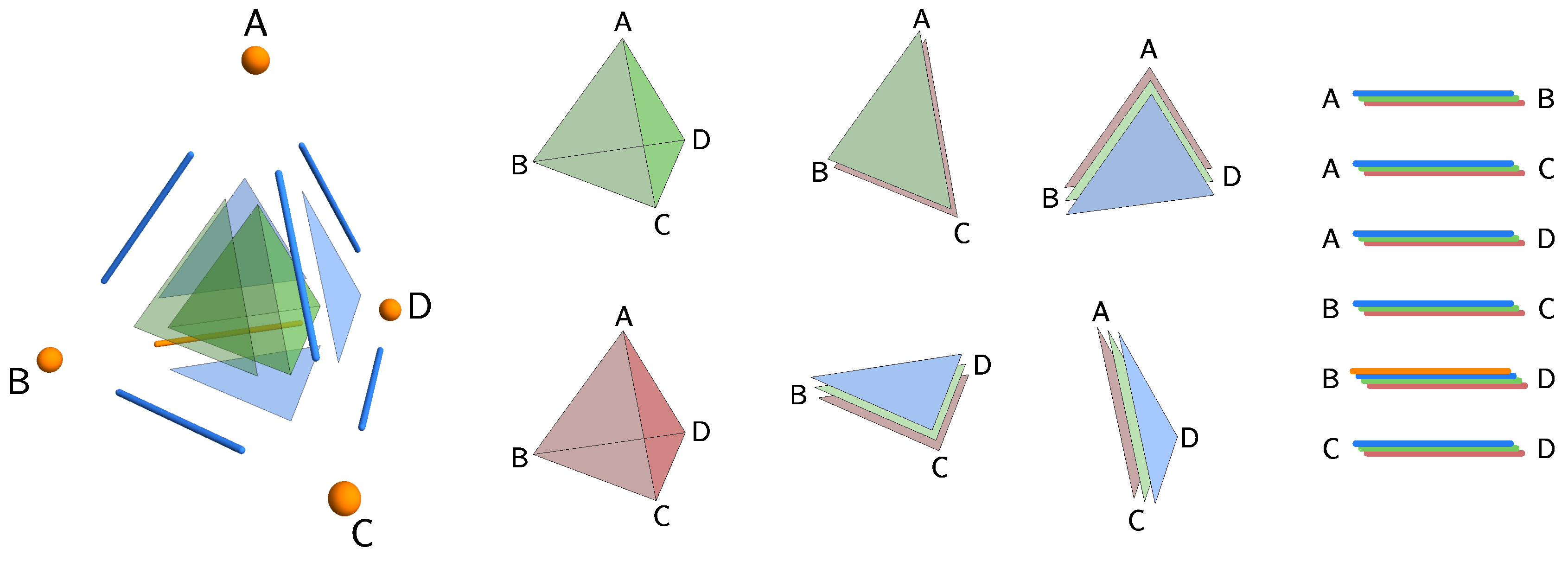
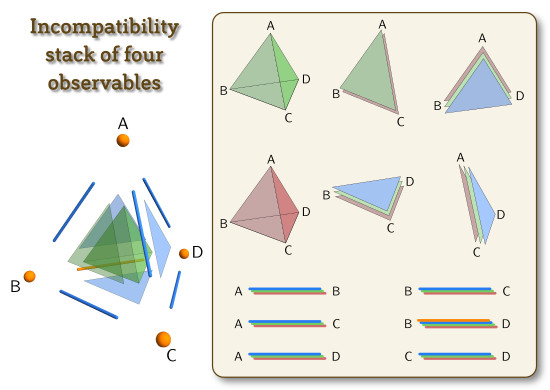
For , a compatibility stack can be visually represented as an n-dimensional object with different colors assigned to different hypergraphs . This is exemplified in Figure 1 for and the set of vertices (i.e., observables) . A compact version (left) shows only indexes of given subsets, while on the right, all elements are shown. Different hypergraphs are represented by the same color; e.g., is determined by the set of all (hyper-)edges , which is composed of all blue elements from the figure. These elements visually show for the exemplified case that 2-compatible are not only all pairs of observables from V, but also all triples from V, except for .
Figure 1.
Visualization of an incompatibility stack for four observables , , and . On the left is a compact representation in terms of indexes, i.e., the smallest possible k-compatibility for a given subset of observables. On the right is the same stack in terms of hypergraphs , where each hypergraph is represented by different color ( is orange; is blue; is green; and is red).
The visualization also follows Item (1) of Proposition 2, which states that, if there is an element with some color (e.g., blue), then the same element must be present also with colors “below” it (i.e., green, red). For this reason, it is better to use just the index of a given subset of observables, as this allows the neater visualization on the left side of Figure 1. Item (2) of the proposition just means that the color corresponding to some k will mark all subsets with k elements. For example, in the figure, blue corresponds to , and thus, all pairs of observables will have a representation via a blue element.
4.2. Compatibility Stacks with Three Vertices
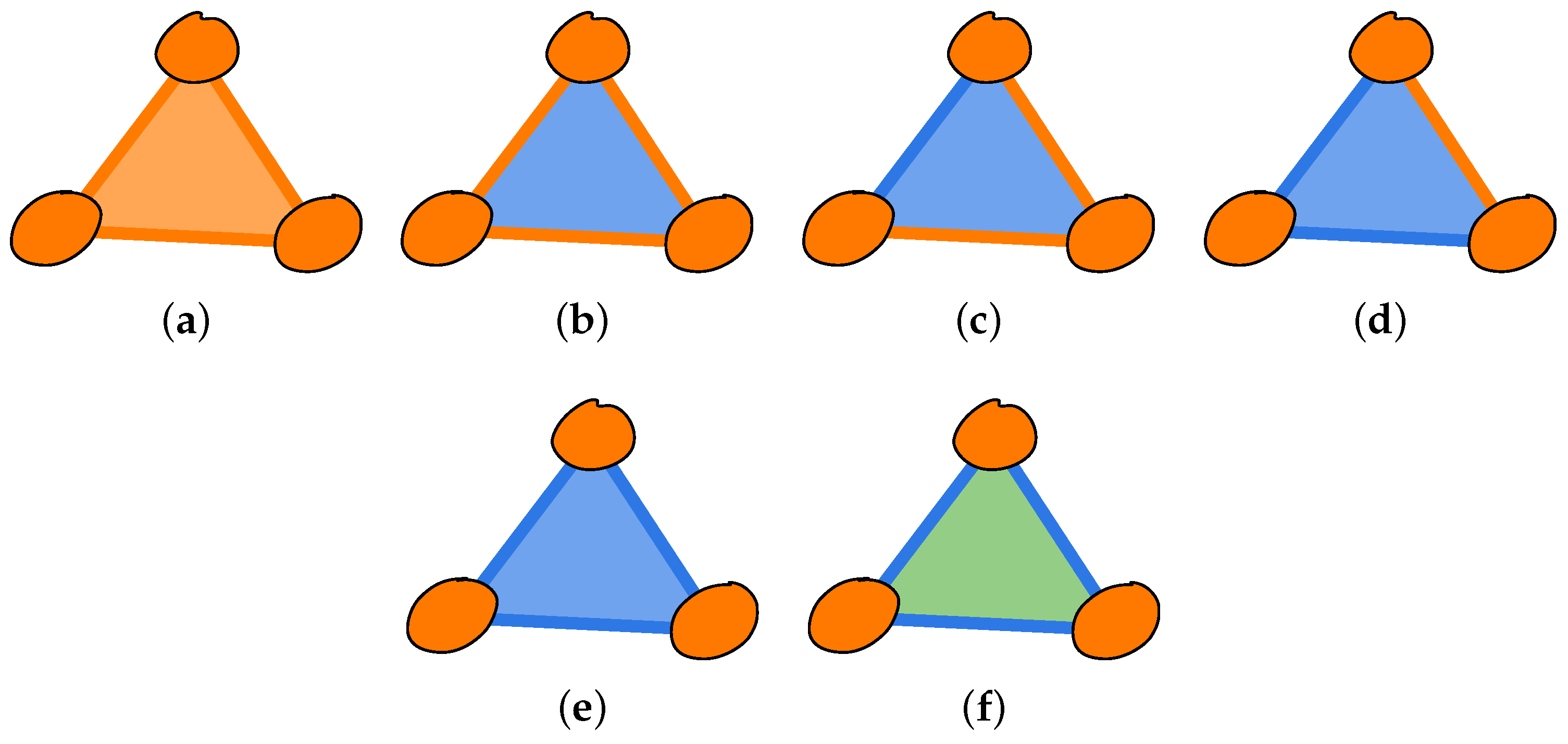
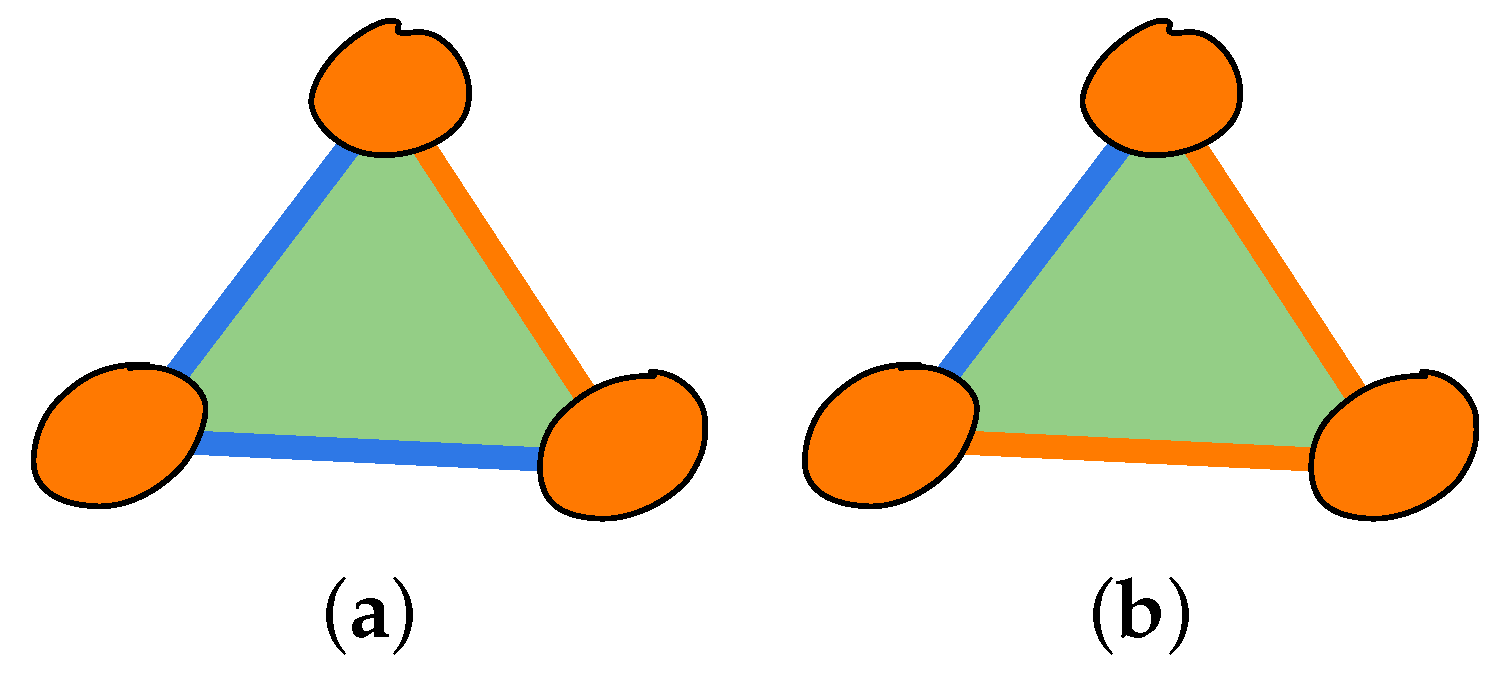
The simplest (non-trivial) example of a compatibility stack is the case of three vertices , , . A graphical representation of a compatibility stack is a triangle, where the edges and the area can be colored according to the corresponding index. The situation is depicted in Figure 2 for all possible compatibility stacks and in Figure 3 for some impossible cases.
Figure 2.
All possible compatibility stacks with three vertices. The orange color marks index 1; blue marks index 2; and green marks index 3. Whereas (a) depicts the most compatible case, when all of the measurements can be performed on a single copy of a state; (f) depicts the worst case where for each measurement, we need an extra copy of the state. The cases (b)–(e) represent all the intermediate possibilities.
Figure 3.
Figures (a) and (b) depict two examples of impossible k-compatibility relations for three observables. The orange color marks index 1; blue marks index 2; and green marks index 3.
For example, in the case (a) of Figure 2, the compatibility stack is given by with being the set of vertices. For the cases (b)–(e), we still have , but for , its set has fewer and fewer elements. In the case (e), becomes simply . Finally, in the case (f), the compatibility stack is given as:
The case (a) of Figure 3 is on first sight representable by a stack:
However, its impossibility comes from the fact that contains both and , which by (S3) would require to contain the set , which is not the case. A similar discussion is valid also for the case (b).
The fact that some collections of hypergraphs are not compatibility stacks comes from the fact that Definition 4 puts limitations on the indexes of the hypergraph edges. In particular, Condition (S3) reduces the number of possible compatibility stacks more than Proposition 2 alone. We shall make this clear in the discussion of four vertices below.
4.3. Compatibility Stacks with Four Vertices
Having four vertices increases the number of possible compatibility stacks considerably. Let the four vertices be denoted as , , and . For any pair of these vertices, the remaining pair will be called reciprocal, e.g., is reciprocal to .
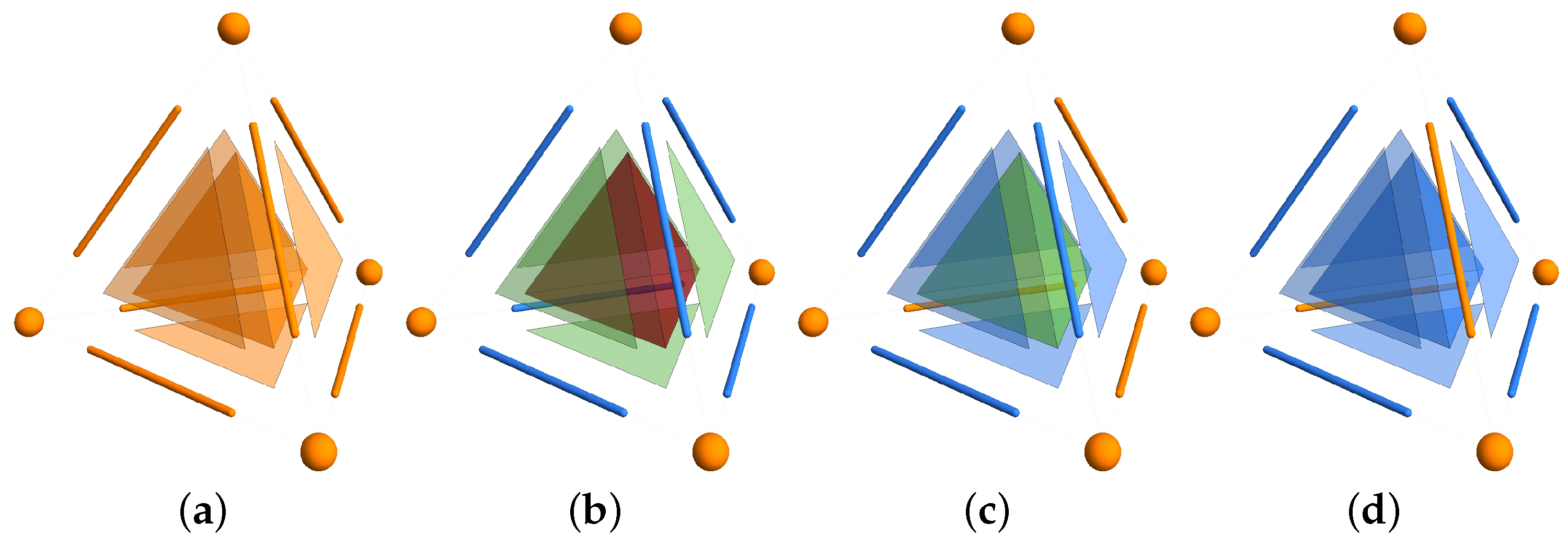
The four vertices can be illustrated as the vertices of a tetrahedron. In this representation, different types of graph (hyper-)edges correspond to different elements of the tetrahedron (vertices, edges, sides and bulk), with each of these possibly having a different index (in this section, edges of the graph will be always denoted as graph edges, while the physical edges of the tetrahedron will be just edges). We will abuse the language a bit by saying that particular elements of the tetrahedron are k-compatible, meaning that the corresponding graph edges have index .
The coarsest classification of compatibility stacks is by the index of the bulk. The case of index 1 bulk is possible only when also all sides and edges have index 1 (Figure 4a), since from Item (1) of Proposition 2, we have , implying the equality of all of the sets . On the other hand, the bulk can have index 4 only when all sides have index 3 and edges have index 2 (Figure 4b). Indeed, if on the contrary, some edge would have index 1, then, by 2-compatibility of its reciprocal edge, the bulk would be 3-compatible by (S3). A similar consideration holds for the side indexes.
Figure 4.
Compatibility stacks with four vertices can be represented by colored tetrahedrons. As before, orange color marks index 1; blue marks index 2; and green marks index 3. In addition, index 4 is marked by red color. The case (a) represents the most compatible case, where we need only a single copy of a state to measure all four observables; whereas the case (b) is in this respect the worst one, as we need a new copy of a state for each measurement. The cases (c) and (d) show some intermediate possibilities of compatibility stacks.
The cases in between (as, e.g., Figure 4c,d) are more populated, and their number is reduced by the compatibility stack condition (S3). Particularly useful is the following consequence of the subadditivity of the index.
- If two sets composed of reciprocal pairs have index 1, then the set of all four vertices has index ≤ 2.
Visually on the tetrahedron, this means that if two opposing edges are compatible, then the bulk is 2-compatible (see, e.g., Figure 4d). This observation is also easily intuitively grasped, as, if we have two pairs of compatible observables, let us say and , then there exist corresponding joint observables and , respectively. These two observables are always 2-compatible, and hence, also the four observables , , and are 2-compatible.
Definition 4 of the compatibility stack and Proposition 2 lead to the possibilities enumerated in Table 1. The existence of a given compatibility stack is, however, just necessary for such a combination of compatibility indexes. As we do not have a systematic way of finding realizations for the compatibility stacks yet, it is an open question whether all of them may be associated with sets of quantum observables.
Table 1.
All possible compatibility stacks enumerated by their bulk index (number of copies of a system required to measure all four observables; colors in parentheses represent indexes from previous figures) and the number of edges with index 2 (how many pairs of observables are not 1-compatible). Altogether, 34 different stacks (up to trivial permutations) are possible.
5. Structure of k-Copy Joint Observables
In this section, we show that, in order to find the index of incompatibility of any collection of observables , it is enough to characterize all symmetric k-copy joint observables of . In particular, we prove that the k-compatibility of is equivalent to the usual compatibility of their symmetrized versions in . This reduces the k-compatibility problem to a standard compatibility problem on an enlarged quantum system.
5.1. Symmetric Product
The symmetric group acts in a natural way on the tensor product of k copies of : if is any permutation, its action on a decomposable element is defined as:
The map is a unitary representation of on .
Using this unitary representation, we then define the symmetrizer channel on (in the Heisenberg picture) as:
This map is completely positive and unital; hence, it is a quantum channel. On decomposable operators , we have:
hence is an idempotent projection onto the linear subspace of the k-symmetric tensor operators in . It becomes an orthogonal projection by endowing with the Hilbert–Schmidt inner product .
The symmetric product of two operators and is the operator with:
The symmetric product is associative and commutative.
We will constantly use the following, easily verifiable, formula: if , then:
5.2. Structure Theorem
It is immediate to verify that is a k-copy joint observable of the n observables if and only if its symmetric version is such. Hence, for a k-compatible set of observables, the set of k-copy joint observables always contains a symmetric element. The following theorem will tell us even more and show that the k-compatibility of is equivalent to the usual compatibility of some -valued symmetric observables derived from .
Theorem 1.
The -valued observables on are k-compatible if and only if there exists a -valued observable on , such that:
In this case, we can choose , such that for all .
Proof.
Sufficiency is easy, because any observable as in (3) satisfies:
which is (1).
Conversely, suppose that (1) holds for , and let . Then, is an observable on , which is such that for all . Denote . We have:
by (1). Choosing the state , where and with , the last equation gives:
Comparing the coefficients of the same degree in t, we obtain the system of equations:
which must hold for all with and . Now, take a set of operators such that , and for all , and write for . Then, (6) yields:
for all . This equality holds for all ; hence, the coefficient of any monomial must vanish. Since the operators:
constitute an orthonormal basis of , it follows that:
where and is a trace zero self-adjoint operator. By (4),
and, by (5),
The last equation holds for all trace zero self-adjoint operators Δ; hence, . In conclusion,
which is (3). ☐
Equation (3) should be compared with the usual compatibility, which requires that:
There is one essential difference. While in the case of compatibility, every joint observable satisfies (7), in the case of k-compatibility, not every joint observable satisfies (3), but there is always at least one that does.
Corollary 1.
The -valued observables are k-compatible if and only if the -valued observables are compatible, where:
Example 1.
Let us consider two two-outcome observables and defined by positive operators and , respectively. That is, , and for . These are always 2-compatible, and a possible choice for their 2-copy joint observable is given by (2). By Theorem 1, one can also find a -valued symmetric joint observable on . Indeed, if , is defined by:
6. Three Qubit Observables
In this section, we concentrate on the case of three observables. Up to the permutation of observables, there are six different compatibility stacks, depicted in Figure 2. We will now show that all compatibility stacks in Figure 2 have a realization in terms of qubit observables.
6.1. 2-Copy Joint Observables from Mixing
Let , and be the three sharp spin- observables on , with outcome spaces . We further denote for , and similarly, and for . These are considered as noisy (unsharp) versions of the sharp observables , and , with noise intensities and , respectively.
Furthermore, let us define three observables:
These observables, parametrized by the angles α, β and γ, will be useful in constructing joint observables later.
We recall the following results on joint measurability of noisy spin- observables [4].
Theorem 2.
The following facts hold.
- (1)
- and are compatible if and only if .
- (2)
- , and are compatible if and only if .
In particular, we see that the marginals of the observables , and are noisy versions of the couples , and , respectively, with noise intensities attaining the upper bound of Item (1) of Theorem 2.
From these results, we already find realizations of the cases (a)–(d) in Figure 2. For instance, with the following choices of the parameters a, b and c, we get suitable triples of observables:
- (a)
- , with joint observablefor the triple , and ;
- (b)
- , with joint observables , and for the corresponding pairs of observables;
- (c)
- and , with joint observable (having and ) for observables and and joint observable (having and ) for observables and ;
- (d)
- , and , with joint observable (having and ) for observables and .
The cases (e) and (f) are more involved, and the rest of the section is dedicated to them; let us see how far we can get by mixing joint observables of two observables. The method is as follows. We choose randomly either , or , measure the chosen observable, say , on the first system and then an optimal joint observable of the noisy versions of the remaining observables and on the second system. This gives the following sufficient condition for 2-compatibility.
Proposition 3.
(Sufficient condition for 2-compatibility) , and are 2-compatible if there are numbers and , such that:
and:
Proof.
We choose randomly either , or , measure the chosen observable, say , on the first system and then the optimal joint observables of the noisy versions of the remaining observables and on the second system. The total procedure leads to an observable:
where represent the probabilities for the choice of the measurement , respectively. It is easy to check that is a 2-copy joint observable of the three observables , and , with a, b and c attaining the upper bounds from (8). ☐
6.2. Optimal 2-Copy Joint Observable
To find a realization of the compatibility stack depicted in Figure 2f, we need to show that , , are not 2-compatible for some values of noise intensities . The fact that these kind of parameters exist follows from the next theorem.
Theorem 3.
, and are 2-compatible if and only if .
By Theorem 1, the observables , and are 2-compatible if and only if the observables , and have a symmetric joint observable , where:
and similarly for and . We will now show that can be chosen to be covariant with respect to the transitive action of a suitable group on the joint outcome space of the three observables , and . Covariance will then drastically decrease the freedom in the choice of , actually reducing it to only fixing two parameters. To exploit covariance, we start from the following simple fact.
Proposition 4.
Suppose G is a finite group, Ω is a G-space and U is a unitary representation of G in the Hilbert space . Let be a collection of subsets of Ω, such that:
Then, for any observable : satisfying the relation:
the observable : given by:
is such that:
- (i)
- for all and ;
- (ii)
- for all .
Proof.
Direct verification. ☐
According to (10), we call the observable the U-covariant version of .
The choice of the covariance group G and its action on the outcomes Ω for a joint observable of , and is prescribed by the covariance properties of , and . Namely, the set of effects is invariant for the rotations in the octahedron subgroup . Moreover, O acts transitively on this set. We therefore expect that the proper covariance group for our problem is . We now explain this statement in more detail.
The octahedron group O is the order 24 group of the 90° rotations around the three coordinate axes , together with the 120° rotations around the axes and the 180° rotations around , and . It preserves the set and acts transitively on it. Moreover, the stabilizer subgroup of any is just the subgroup of the three 120° rotations around .
The octahedron group also acts on the spin- Hilbert space by restriction of the usual two-valued -representation of . This gives an ordinary representation of O on the 2-copy Hilbert space , where is any of the two elements of corresponding to the rotation .
Finally, let : be the projection onto the i-th component () and define the collection of subsets:
Clearly, the collection is O-invariant. Moreover, if : is any symmetric joint observable of , and , then:
The covariance properties of the observables , and then imply that for all and . Hence, by Proposition 4, the U-covariant version of defined in (10) yields the same margins , and . Since the representations U of O and σ of commute, the joint observable is both U-covariant and symmetric.
In summary, in order to find the maximal value of a for which the observables , and are 2-compatible, we are led to classify the family of symmetric U-covariant observables on Ω. This is done in the next proposition.
Proposition 5.
A map is a symmetric and U-covariant observable if and only if there exist real numbers α and β with , and , such that:
for all .
Proof.
We will proceed in several steps.
(I) Since the action of O on Ω is transitive, a U-covariant observable is completely determined by its value at by the relation:
This equation implies that must commute with the representation U restricted to the stabilizer of . This happens if and only if is in the commutant of the operator , where . The eigenvalues of are and with multiplicity one, and 1 with multiplicity two. Hence, . A linear basis of is made up of the self-adjoint operators:
Among them, , , and are symmetric, and and are antisymmetric. Thus, is symmetric only if is a real linear combination of , , , . This is also a sufficient condition for the symmetry of by (12) and the symmetry of the ’s.
(II) It is easy to check that the operators , , and all commute among themselves. Moreover,
Thus, the four self-adjoint operators:
are mutually commuting orthogonal projections summing up to the identity of . It follows that , , , are rank-one mutually orthogonal projections. Since they span the same linear space as , we can rewrite:
where:
by the positivity condition . This is also a sufficient condition for the positivity of by (12).
(III) By taking the trace of the normalization condition:
and observing that , we obtain:
Moreover, the operators and commute with the representation U, hence so does the rank-one projection . Multiplying both the sides of (15) by and taking again the trace, we then get:
Inserting (13) into (16) and (17) yields the conditions:
The positivity requirement (14) thus translates into:
and (13) is rewritten as:
We have already seen that commutes with for all . Therefore, the formula (11) follows from the previous equation by the relation (12). We still need to check that given by (11) is normalized, and this easily follows from:
☐
Remark 1.
The choice of the covariance group and its natural action on the joint outcome space Ω is the minimal possible in order to construct a transitive action of G on Ω preserving the set of effects . Transitivity is needed in order to label all of the covariant joint observables by means of the single operator as in (12) and, thus, reduce the many free parameters of the problem to the only choice of such an operator.
Now, we need to take the three margins of the most general U-covariant observable found in Proposition 5 and compare it with the observables , and . By the covariance property, it is sufficient to consider only the first margin . We have:
and hence:
Comparing this formula with (9) yields:
By the positivity conditions , and , we thus see that the maximal value of a is . This completes the proof of Theorem 3.
As a result, the case (f) of Figure 2 can now be achieved for example by setting:
- (f)
- ,
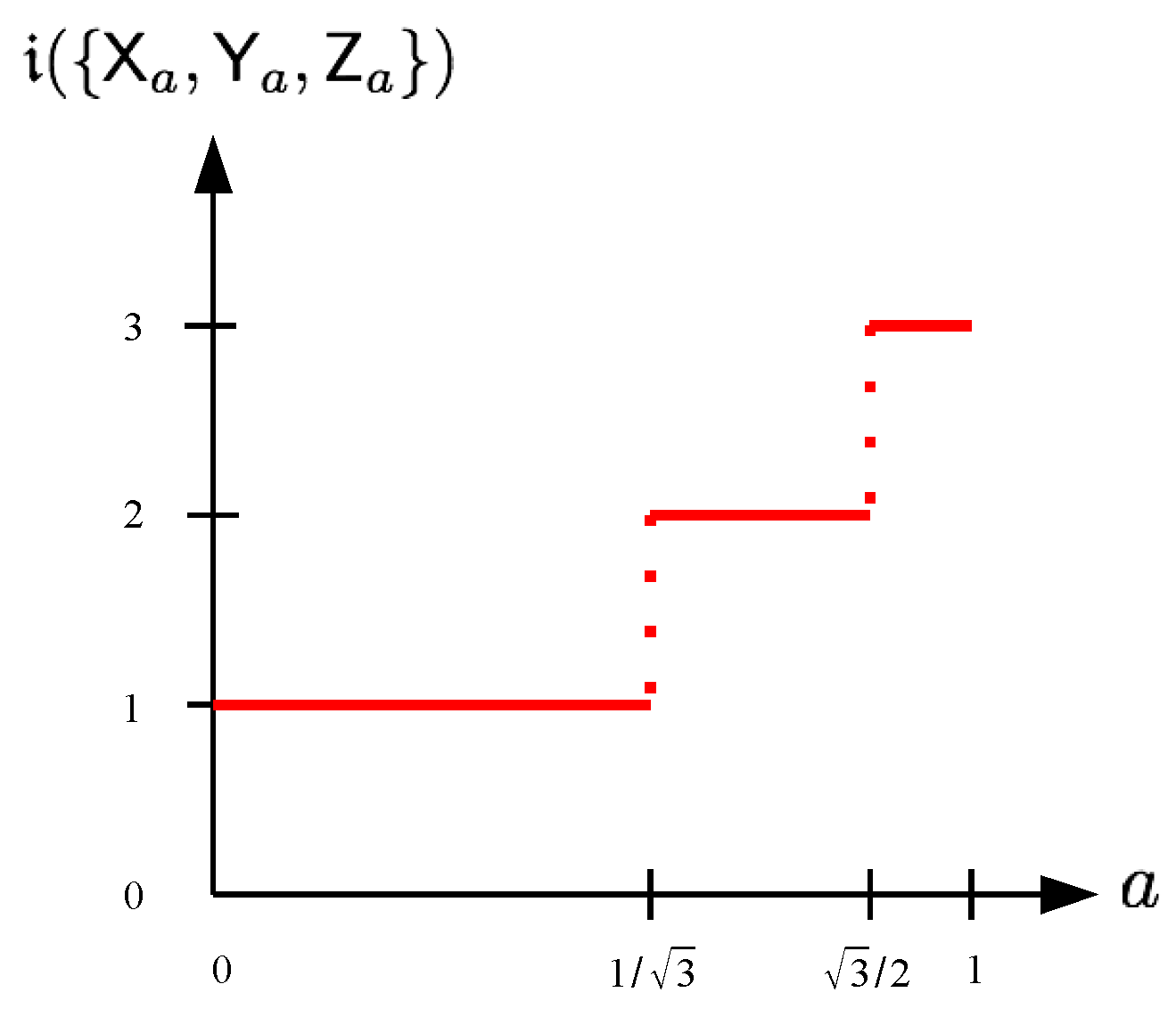
By combining the result of Theorem 3 with that of Theorem 2 in the case , we get a complete characterization of the index of incompatibility for three equally noisy orthogonal qubit observables , and . In Figure 5, the index of incompatibility is plotted as a function of the noise parameter a.

Figure 5.
The index of incompatibility as a function of the noise parameter a for three noisy orthogonal qubit observables.
7. Conclusions
The incompatibility of quantum observables can be evaluated and measured in various ways. In this paper, we introduce a measure of incompatibility based on the number of system copies needed to be able to measure given observables simultaneously. We call this number the index of incompatibility. It quantifies the incompatibility of a set of observables as a whole, but leaves out the finer details regarding the various compatibility relations between the observables.
In [1], it was shown that every conceivable joint measurability combination of a set of observables is realizable. Such combinations are representable by joint measurability hypergraphs where the vertices are observables and edges mark the compatibility relations. By translating this approach to our multi-copy setting, we have analogously defined the notion of the compatibility stack that represents the potential multi-copy compatibility relations present in a set of observables. Namely, whereas in [1] the hypergraph was binary (the presence of graph edges represented compatibility between the observables of the corresponding subsets), here, we have such a graph for each possible compatibility index. We demonstrate that every compatibility stack with three vertices has a realization in terms of quantum observables. However, it remains an open question if all compatibility stacks have such a realization.
Supplementary Materials
The following are available online at www.mdpi.com/2227-7390/4/3/54/s1: Mathematica code together with .cdf files allowing for a visualization of the possible compatibility stacks with four vertices.
Acknowledgments
A.T. acknowledges financial support from the Italian Ministry of Education, University and Research (FIRBProject RBFR10COAQ). D.R. acknowledges support from the Slovak Research and Development Agency Grant APVV-14-0878 QETWORK, VEGAGrant QWIN 2/0151/15 and program SASPRO QWIN 0055/01/01.
Author Contributions
All of the authors provided equal contributions to the paper.
Conflicts of Interest
The authors declare no conflict of interest.
References
- Kunjwal, R.; Heunen, C.; Fritzi, T. Quantum realization of arbitrary joint measurability structures. Phys. Rev. A 2014, 89, 052126. [Google Scholar] [CrossRef]
- Busch, P.; Grabowski, M.; Lahti, P. Operational Quantum Physics, 2nd ed.; Springer-Verlag: Berlin, Germany, 1997. [Google Scholar]
- Lahti, P. Coexistence and joint measurability in quantum mechanics. Int. J. Theor. Phys. 2003, 42, 893–906. [Google Scholar] [CrossRef]
- Busch, P. Unsharp reality and joint measurements for spin observables. Phys. Rev. D 1986, 33, 2253–2261. [Google Scholar] [CrossRef]
© 2016 by the authors; licensee MDPI, Basel, Switzerland. This article is an open access article distributed under the terms and conditions of the Creative Commons Attribution (CC-BY) license (http://creativecommons.org/licenses/by/4.0/).