1. Introduction
Functional equations often arise when one requires that a quantity associated with ratios behaves consistently under multiplicative composition. Such consistency principles appear naturally in many contexts, including the theory of functional equations [
1,
2,
3,
4,
5], information geometric theory involving multiplicative models, and models of ratio-based costs.
The classical d’Alembert functional equation
is one of the central equations in the theory of functional equations. The origin goes back to d’Alembert’s derivation of the parallelogram law of forces [
6]. Poisson [
7] gave a rigorous treatment of solutions, and Picard [
8] studied its relation with non-Euclidean geometry. Its continuous solutions are the cosine-type functions
and
(see [
1,
5,
9]). Many nonlinear functional relations reduce to this equation after suitable transformations.
In [
10], a rigidity result for
is obtained. Assuming the polynomial composition law
together with the curvature calibration
the function
F is uniquely determined. The unique solution is the canonical reciprocal cost
This raises a natural structural question. Is the composition law (
1) merely a modeling assumption, as it appears in various contexts in the literature (see, e.g., [
9,
11]), or is it forced by more general consistency requirements?
In this paper, we study functional relations of the form
where
P is a polynomial combiner. We investigate which polynomial laws admit nontrivial continuous solutions.
In applications, one often interprets
as a cost or penalty associated with a ratio
. The normalization
reflects that the identity element carries zero deviation. It does not restrict generality, since any solution can be reduced to this case by subtracting a constant, with a corresponding translation of the variables in
P. More precisely, if
, then
and
Thus, the assumption
is without loss of generality. This condition determines the boundary identities
which restrict the form of the polynomial combiner. Requiring compatibility with multiplicative composition then leads to a d’Alembert-type functional equation on
.
We assume that
is continuous and nonconstant, and that
is a symmetric polynomial, where
denotes the ring of polynomials in two variables with real coefficients. Symmetry is natural since the roles of
x and
y in the left-hand side of (
2) are interchangeable. Under symmetry of
P, we derive reciprocity
.
Our first result treats the case of higher-degree polynomial combiners. We show that symmetric polynomial combiners of degree
are incompatible with the functional Equation (
2). More precisely, if
is symmetric, satisfies
, and its leading term does not cancel on the diagonal, then Equation (
2) admits no continuous nonconstant solution
with
. Consequently, only polynomial combiners of degree at most two can admit nontrivial continuous solutions. This reduction to the quadratic case is the main structural step of the paper.
Our main structural result shows that in the quadratic case the composition law is completely determined. If
is continuous and nonconstant and the combiner
P is a symmetric polynomial of degree at most two, then necessarily
Under the normalization
, the functional equation therefore reduces to
Passing to logarithmic coordinates reduces this relation to the classical d’Alembert equation
whose continuous solutions are well known [
1,
5,
9,
11,
12,
13,
14]. All continuous solutions of the original equation can therefore be described explicitly.
Convexity and nonnegativity select the hyperbolic branch (Corollary 8), while a curvature normalization determines the distinguished value
. In this case, the canonical reciprocal cost
appears as a structurally determined solution [
10].
Finally, we extend the analysis to functions on
. In the multidimensional case, passing to logarithmic coordinates reduces the problem to a functional equation on
involving sums and differences. Such equations are known to exhibit a collapse to one-dimensional dependence, as in the classical case (see, e.g., [
9,
11]). We show that, for
, solutions depend on
only through the scalar quantity
, where
denotes a vector variable, and
is a vector of weights. Thus, the effective dependence remains one-dimensional.
The paper is organized as follows. In
Section 2, we study structural consequences of the polynomial composition law. In particular, we prove reciprocity of
F under symmetry of the combiner and derive the boundary identities that restrict the polynomial
P.
Section 3 contains the classification of admissible polynomial combiners. We show that symmetric combiners of degree at least three do not admit nonconstant continuous solutions under a natural non-cancellation assumption. In the quadratic case, we obtain the bilinear form of the combiner. In Section Reduction to Classical D’Alembert, we pass to logarithmic coordinates and reduce the equation to the classical d’Alembert functional equation. Using the known classification of its continuous solutions, we obtain the corresponding families of functions
F.
In
Section 4, we consider the multidimensional case. We show that for
, every solution depends only on the scalar quantity
. Thus, even in dimension
n, the effective dependence is one-dimensional through the quantity
. We give an explicit 16-dimensional example (Example 2) illustrating the collapse to a single logarithmic direction.
In
Section 5, we introduce a normalization based on the log-curvature
We show that this calibration fixes the parameter of the bilinear composition law. For convex nonnegative solutions with
, the parameter is uniquely determined by
, which yields the canonical reciprocal cost.
- (i)
We show that symmetric polynomial combiners of degree do not admit nonconstant continuous solutions under a natural non-cancellation assumption.
- (ii)
We prove that in the case , the polynomial combiner is of bilinear d’Alembert type, namely .
- (iii)
We reduce the functional equation to the classical d’Alembert equation and give a complete classification: all continuous solutions form three families: the hyperbolic branch , the trigonometric branch (for ), and the quadratic-logarithm family (for ).
- (iv)
We extend the result to the n-dimensional case and show that every solution depends only on a single linear combination of the logarithmic variables.
The main difficulty lies in the analysis of the equation with a general polynomial combiner, where a degree-based argument and a non-cancellation condition are used to exclude higher-degree cases.
3. Polynomial Classification
In this section, we classify the possible polynomial combiners P.
Using the factorization (
6) from Lemma 4, together with the symmetry of
P and the boundary conditions from Section Structural Properties, we conclude that the polynomial
R is symmetric. Indeed, the term
is already symmetric in
, and therefore, the symmetry of
P forces
R in (
6) to be symmetric as well.
At this point, the degree of
R is not restricted. If
R has high degree, then the functional equation becomes structurally more complex. Using (
6), Equation (
5) becomes
Assume that
G is smooth in a neighborhood of 0. Then both sides of the above equation admit Taylor expansions at
in the form of convergent power series
By uniqueness of power series expansions, we obtain
for all
. This yields an infinite system of algebraic relations between the derivatives of
G at 0 and the coefficients of the polynomial
R. Consequently, without imposing a bound on the degree of
P, the classification problem leads to an infinite system of compatibility conditions.
For this reason, we restrict our attention to polynomial combiners of total degree at most two. Since
already has degree two, it follows that
R in (
6) must be constant.
Assumption 1. The combiner P has total degree at most two.
Theorem 1. Let be a symmetric polynomial of degree with , and let . Assume that , where the index y indicates the variable with respect to which the degree is taken, and that no cancellation occurs in the leading term, so thatThen there is no continuous nonconstant function with satisfying the polynomial composition lawIn particular, the explicit degree-three combiner treated in Example 1 is excluded. Proof. Set
, so that
and the functional equation becomes
Since
and
P is symmetric, the factored form
holds for some symmetric polynomial
R of degree
.
We observe that, for each integer
, the quantity
can be expressed as a polynomial function of
. Setting
and
, the composition law (
7) gives
Setting
in (
7), we obtain
Setting
in (
7), we obtain
Setting
in (
7), we obtain the identity
Proceeding inductively, each
is obtained from
y by finitely many polynomial substitutions involving
P. Therefore, for each fixed
n,
is a polynomial in
. □
We will now analyze this identity as a polynomial relation in .
Lemma 5. Let be a symmetric polynomial of degree with , and let . Let and be the polynomials in obtained in the proof of Theorem 1. Then
- (i)
.
- (ii)
, with equality under the non-cancellation assumption of Theorem 1.
- (iii)
If and equality holds in (ii), then the degree difference is for all .
Proof. (i) Since and , we obtain
- (ii)
From the identities above, we have
Write
The highest-degree contribution in
comes from
Since the degree of
R in the variable
u is at most
, and
, we have
Therefore
Hence
Equality holds if the leading coefficient of
(as a polynomial in
y) is nonzero. This can be verified explicitly in the degree-three case.
Now consider the right-hand side of (
8). Its terms are of the form
The degree of such a term is
Using the bound for
, we obtain
and the maximum is achieved at
. Hence
Under the non-cancellation assumption of Theorem 1, this is the degree of the right-hand side.
- (iii)
By parts (i) and (ii), in the equality case, the degree difference is
Since
, all three factors are positive, and therefore
□
Final Step of the Proof of Theorem 1. Since
G is continuous and nonconstant, its range
contains a non-degenerate interval
. From (
8), we have
By substituting
, and using the previous part of the proof, the quantities
,
, and
are polynomials in
y. Therefore, the left-hand side and the right-hand side of (
8) can be written as polynomial functions of
y. More explicitly,
belong to
, are independent of
s, and (
8) becomes
Since
contains the interval
I, it follows that
The polynomial
is a polynomial in one variable. A polynomial that vanishes on a non-degenerate interval must vanish identically. Therefore
However, by Lemma 5, the two sides have different degrees, which is impossible. Hence, no continuous nonconstant function
with
satisfies the polynomial composition law for a symmetric polynomial
P of degree
. □
In Theorem 1, we assume that no cancellation occurs in the leading term. We now make this assumption precise.
Remark 3. Let be symmetric of degree and let . We assume thatandThis ensures that the leading term is preserved under composition. Equivalently, there is no cancellation of the highest-degree contribution on the diagonal . It guarantees that the right-hand side attains the maximal degree required for the degree mismatch argument. Remark 4. The diagonal polynomial may have degree if the highest-degree terms of P vanish on . For example,has degree 4, while . For the combiner considered in Example 1, we have ; hence, . Thus, the possible degeneration does not occur in the explicit case considered here.
The following corollary follows directly from Theorem 1 under the assumptions clarified above.
Corollary 3. Let be continuous and nonconstant, and assume thatwhere is symmetric and . Assume the non-cancellation assumption of Theorem 1. Then Consequently, by Theorem 3,is the unique polynomial composition law admitting nonconstant continuous solutions. Proof. If , Theorem 1 shows no continuous nonconstant F with can exist. Hence, . Then Theorem 3 implies . □
Example 1. Consider the polynomialwhich has degree 3 and satisfies . ThenLet . Using the identities derived in the proof of Theorem 1, we obtainThe identityrequires the equality of two polynomials in y. We haveThus, the degrees do not match, so the identity cannot hold identically. Under Assumption 1,
P can be written in the general quadratic form
Lemma 6. If P is symmetric, i.e., , then and . Consequently, Proof. The symmetry implies equality of coefficients after interchanging
u and
v in (
9). Comparing the coefficients of
u and
v gives
, and comparing those of
and
gives
. □
We now determine the relations among the coefficients imposed by the functional equation.
Theorem 2. Let be continuous and nonconstant satisfyingwhere P is a symmetric quadratic polynomial of the formThen , and Proof. By Lemma 3, we have
for all
Substituting
in the given form of
P, we obtain
Since this identity holds for all
, we have
Eliminating
from the last two equations gives
□
We now consider the effect of the normalization at .
Corollary 4. According to the assumptions of Theorem 2, if , thenand hence Proof. By Theorem 2, from the relations and , substituting gives and . □
Thus, in the case of
, the composition law reduces to
This equation will be analyzed in Section Reduction to Classical D’Alembert, where we make explicit its connection with the classical d’Alembert functional equation.
Theorem 3 (d’Alembert Inevitability Theorem)
. Let be continuous and nonconstant satisfying a polynomial composition law with a symmetric combiner of degree at most two. Then P must be of the formwith , where . If, moreover, , thenand F satisfies Equation (
11)
. Proof. By Lemma 6, the polynomial
P has the form
By Theorem 2, we have
; hence
Renaming
, we obtain
. The relation
follows directly from Theorem 2.
If
, Corollary 4 gives
and
; hence
□
Corollary 5. Let be continuous and nonconstant. If two polynomials satisfythen . Proof. The identity implies for all . Since F is continuous and nonconstant, its range contains a nondegenerate interval. Hence, on a set containing a rectangle in . Therefore, the polynomial is identically zero, and thus on . □
Remark 5. Let be continuous and nonconstant, with . If F satisfies (
4)
with a symmetric combiner of total degree at most one, then , and the composition law coincides with (
11)
at . Consequently, the degree-one case is not a separate family; it is included in Theorem 3 for . Thus, degree two is the minimal degree for which a free parameter appears (namely c). If, in addition, F is convex, then is a global minimum of F. In this case, the normalization corresponds to shifting the minimum to zero.
Lemma 7. Let be continuous and nonconstant, and supposewhere is symmetric. Assume, in addition, that F is convex. Then is a global minimum of F, i.e., Proof. Since
P is symmetric and
F is continuous and nonconstant, we have
Suppose there exists
such that
. Then, also,
.
Since 1 lies between
and
, there exists
such that
By convexity,
a contradiction. □
Remark 6. For every real value of c, the bilinear Equation (
11)
reduces, to a d’Alembert Equation (
13)
(by using Lemma 9). The parameter c parametrizes the family but does not create new solution types. Reduction to Classical D’Alembert
In this part, we show that the bilinear family (
11) reduces, after a change of variables, to the classical d’Alembert equation.
Lemma 8. Assume (
11)
and define G by (
3).
Then for all , Proof. Let
and
in (
11). Using
and
and
gives (
12). □
Lemma 9. Assume (
12)
for some constant . - (i)
If andthen H satisfies the classical d’Alembert equation - (ii)
If , then (
12)
reduces to
Proof. (i) If
, substituting
into (
13) one obtains
From (
12), we have
On the other hand, we have
so (
13) holds.
- (ii)
If
, (
12) reduces directly to (
14).
□
We now determine the solutions in both cases.
- (i)
Case
. The function
satisfies (
13). If
F is continuous, then
H is continuous. Since
,
H is even and
.
Under standard regularity assumptions, (see [
1,
9,
11,
13,
16]), all even solutions of (
13) with
are
for some
. Equivalently,
with
. Substituting this into the definition of
F, we obtain
- (ii)
If
, then (
12) reduces to
with
G even and
.
Theorem 4 ([
13])
. Suppose satisfiesIf G is continuous, or continuous at a point, bounded on for some , bounded on a set of positive measure, or measurable, then Combining both cases yields the full classification.
Theorem 5. The continuous solutions ofare given as follows: Proof. Set
and
for
. By Lemma 9(i), the function
H satisfies the classical d’Alembert equation with
H continuous, even, and
. By the standard classification [
1,
5,
9,
11,
13,
14,
16], the solutions are
giving the two branches.
If , the equation reduces to Lemma 9(ii), and the result follows from Theorem 4. □
Proposition 1. For the hyperbolic branch in Theorem 5(i), we have for all if and only if .
Proof. Since
for all
t,
is nonnegative for all
t if and only if
, that is,
. □
We now express the hyperbolic branch in x-coordinates and identify the parameter regime in which the solution admits a natural interpretation as a reciprocal cost function.
Corollary 6. Let and consider the hyperbolic branchThen, in x-coordinates,Moreover: - (i)
for all ;
- (ii)
;
- (iii)
;
- (iv)
if , then if and only if .
In particular, for and , F defines a reciprocal cost function on .
Corollary 7. For every , the equationadmits a continuous nonconstant solution satisfying and . Proof. The explicit solutions given in Theorem 5 provide such functions for each . □
Corollary 8. Under the assumptions of Lemma 7, assume in addition that F is convex and that in (
11)
. Then , and only the hyperbolic branch is admissible, i.e.,Moreover, . Proof. By Lemma 7,
is a global minimum. Since
, we have
for all
. Because
, Theorem 5(i) holds. The cosine branch
is not convex on
, since
changes sign. Hence,
also changes sign, so
F cannot be convex. Therefore, only the hyperbolic branch remains
Since
for all
, Proposition 1 implies
. Further, we write
and set
. Then
and
Convexity of
F on
means
for all
, i.e.,
Since
, we may assume without loss of generality that
. (If
, then
, contradicting nonconstancy; if
, replace
by
since cosh is even.) Dividing by
, we obtain
For
, it is equivalent to
Since
as
, the above inequality implies
. For
: since
and
, the inequality
holds trivially. For
, both sides vanish. Hence, the condition
is both necessary and sufficient for all
.
Conversely, if
, then
because
for every finite
t. Hence,
is both necessary and sufficient for global convexity. □
4. D’Alembert Inevitability for n-Dimensional Cost
In this part, we extend the inevitability result to functions defined on
. Let
and
be elements of
, with
We also write
and, for
, use the notation
Definition 2. A function satisfies an n-dimensional polynomial composition law if there exists a polynomial such that for all , The algebraic classification of the polynomial combiner P depends only on the functional equation and on the nondegeneracy of the range of F, and therefore it is independent of the dimension n.
Theorem 6. Let be continuous and nontrivial, with , where , and suppose (
16)
holds with a symmetric polynomial combiner P of total degree at most two. Then there exists such that Proof. Since
P is symmetric, from (
16), we get
By substituting
, we obtain the reciprocity
for all
.
Now set
in (
16). Using
and reciprocity, we obtain
Since
F is continuous and nontrivial with
, its range contains a nondegenerate interval
I with
. Hence, the polynomial
vanishes on
I, so
By symmetry, also
for all
.
Let us write a general symmetric quadratic polynomial
Then
so
,
, and
. Therefore
This completes the proof. □
We now classify the corresponding solutions. In logarithmic coordinates
, define
We treat
as a column vector. If
, then
G is even,
Assume first that
and define
Then
H is continuous and satisfies the
n-dimensional d’Alembert equation
with
and
H even.
In the following theorem, we will classify the solutions.
Theorem 7. All continuous solutions ofare as follows: - (i)
If , then there exists such that eitheror - (ii)
If , thenfor some symmetric matrix .
Proof. (i) Case
. Since
F is continuous,
and
are continuous with
. A direct computation shows that
H satisfies
Thus,
H satisfies the classical d’Alembert functional equation on
in the vector notation used in this section. By the known classification of continuous solutions of the
n-dimensional d’Alembert equation on
(see [
1,
9,
13]), there exists
such that
If
H is real-valued for all
, then
must be either real or purely imaginary. Indeed, if
has both nonzero real and imaginary parts, then
cannot remain real for all
. Writing
or
gives the two real branches
Since
and
, we obtain
or
- (ii)
Case
. Then the equation for
G reduces to
This is a Jensen-type quadratic functional equation on
. (see [
11,
13]). By the standard classification of continuous solutions of the quadratic Jensen-type equation on
(see [
11,
13]), every solution has the form
where
is a symmetric matrix. Finally, for
, we have
which completes the proof.
□
Remark 7. For F to serve as a cost function (non-negative with only at ) [10], the matrix must be positive definite. Remark 8. In the case , the cosh branch with and satisfies with equality if and only if . Hence, this branch is compatible with the interpretation of F as a cost function.
When
, Equation (
16) is very restrictive. By Theorem 7, the function
F depends on
only through the expression
Thus, even in dimension
n, the effective dependence is one-dimensional.
In applications, cost functions on
are assumed to be additively separable, reflecting independent contributions of different coordinates. It is therefore natural to ask whether such separable forms are compatible with the composition law (
17).
Suppose that
F has a form
If each
satisfies the composition law in one variable, then
However,
contains additional mixed terms of the form
which cannot vanish unless at most one component is nontrivial. This indicates that
F given by (
18) is incompatible with the composition law (
17) when
.
More precisely, the following statement holds.
Theorem 8. Let and . If satisfiesthen F cannot be written in the form (
18)
with two or more nonconstant components. Proof. In logarithmic coordinates
We denote by
the zero vector. For the hyperbolic branch,
, and for the trigonometric branch,
. In either case, a direct computation gives
where the sign + corresponds to the hyperbolic branch and the sign − to the trigonometric branch.
If , then , and therefore all mixed partial derivatives vanish. Hence, for all . Thus, at most one component of is nonzero. Consequently, F depends on at most one coordinate, so a decomposition with two nonconstant components is impossible. □
Corollary 9. For , no additively separable cost with at least two nonconstant coordinate components is compatible with the bilinear combiner.
In the following example, we provide a realization of the multidimensional rigidity result. We construct a 16-dimensional system depending on two parameters and show that the induced reciprocal cost depends only on a single scalar aggregate.
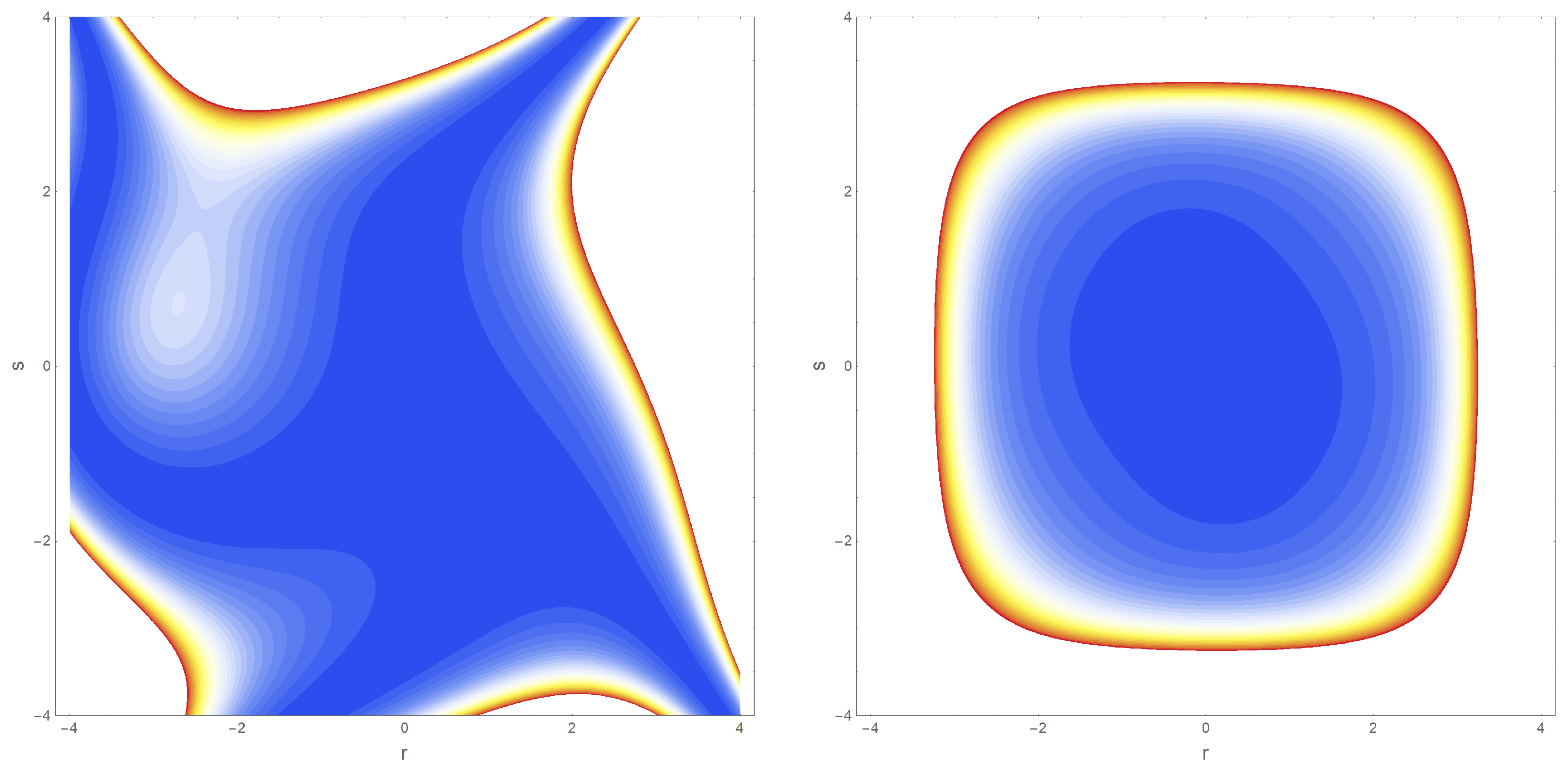
Example 2. Let and definebyLet and setDefineThenThe reciprocal cost on is given byUnder the above parametrization, this becomesThe reciprocal cost depends only on the single scalar quantityBy Theorem 7, the system collapses to a logarithmic direction for . In the case , the function depends only on the scalar quantity . Hence, for any two points and such that , we have . Therefore, F is constant along the level sets of S, and the dependence on reduces effectively to one dimension. Here, the level sets of S are the setsThe collapse and no-collapse regimes are illustrated in Figure 1. Remark 9. If we consider a different combiner in each coordinate,where only the k-th component is modified, then necessarilyfor each k. The case reduces to the consideration above. The compatibility of unequal parameters remains open. 5. Canonical Coefficient Selection
The previous sections establish that symmetry and the polynomial composition law uniquely force the one-parameter bilinear family (
11) for some real constant
.
We now show that a natural local normalization selects one distinguished member of this family.
Definition 3. Let . The log-curvature of F, denoted , is defined asprovided this limit exists. When the limit exists, is the quadratic scaling coefficient of at . This does not assume a priori that F is . The existence of the limit provides the required regularity.
By the change of variables
, the limit exists if and only if
exists, and in that case, the two limits coincide.
Assume that the limit
exists. Then necessarily
, since otherwise the quotient
diverges as
. Set
. If
G is twice differentiable at 0, then
The calibration condition
means
We now determine how this calibration constrains the parameter c.
Theorem 9. Let F be a continuous nonconstant solution of (
11)
with . Assume that F belongs to the hyperbolic branch described in Theorem 5, that is,If , then . Proof. Let
. For
, define
By Lemma 9(i),
H satisfies the classical d’Alembert Equation (
13). By assumption, we are in the hyperbolic branch, so
Hence
Using the Taylor expansion at
,
we compute
Therefore, the calibration condition
implies
. □
We now combine the d’Alembert Inevitability Theorem 3 with the solution classification in Theorem 5 and the calibration condition.
Theorem 10. Assume:
- (i)
F is continuous and nonconstant;
- (ii)
F satisfies the bilinear composition law (
11)
; - (iii)
F is convex and nonnegative on ;
- (iv)
.
Then F belongs to the hyperbolic familyand Proof. Passing to logarithmic coordinates
and applying Lemma 9, Equation (
11) reduces to the classical d’Alembert equation. By Theorem 5, all continuous solutions are either hyperbolic or trigonometric.
Since
F is convex and nonnegative on
,
F must belong to the hyperbolic branch, so that
The log-curvature is
Using
gives
Substituting this relation into the expression for
F yields
Finally, global convexity of
F on
is equivalent to
by Corollary 8. □
The parameter
reflects a multiplicative rescaling of the logarithmic coordinate. The representation (
20) can be written equivalently as
Thus,
does not introduce a new structural type of solution; it corresponds only to a rescaling of the coordinate
. Without loss of generality, we may therefore assume
.
Corollary 10. Under the assumption of Theorem 10, after normalization of the multiplicative coordinate, the canonical representative is Proof. If we set
in (
19), we have
and
Returning to multiplicative coordinates
yields
□
Remark 10. If , then the composition law (
11)
reduces to the additive branch, and the classification yieldsIn this case,so the normalization forces , givingThis provides a unit-curvature solution in the additive regime, which lies outside the bilinear () family. 6. Conclusions
In this paper, we studied continuous nonconstant functions
satisfying a symmetric polynomial composition law
We first considered the case of higher-degree polynomial combiners. Theorem 1 shows that symmetric combiners with are incompatible with the functional equation under a non-cancellation condition. In particular, the cubic case in Example 1 admits no nonconstant continuous solutions. Consequently, only polynomial combiners of degree at most two can admit nontrivial continuous solutions.
In the quadratic case, the combiner
P is necessarily of the form
We also showed that symmetry of P is equivalent to reciprocity , and that the normalization implies and . For a given continuous nonconstant solution F, the combiner is unique.
Passing to logarithmic coordinates reduces the composition law to the classical d’Alembert functional equation. This gives a complete classification of continuous solutions: the hyperbolic and trigonometric branches, and the quadratic logarithmic case when .
In the n-dimensional case, we showed that the classification of P remains unchanged. For , every solution depends only on a single scalar combination . As a consequence, additive separability is impossible for .
Finally, we introduced the log-curvature calibration
and proved that, for nonnegative convex solutions with
and
, the solutions belong to the family
After normalization
, this gives the canonical reciprocal cost
Thus, the canonical reciprocal cost is uniquely determined by the structural constraints.
Several natural questions remain open for further investigation. These include the classification of asymmetric polynomial combiners, the stability of the polynomial composition law in the Hyers–Ulam sense, and the multidimensional case with distinct coordinate parameters.