Article

Drift Estimation for Stochastic Partial Differential Equation Driven by Fractional Brownian Motion

1
Department of Mathematics, College of Science, Donghua University, 2999 North Renmin Rd., Shanghai 201620, China
2
Department of Mathematics, College of Science, Bengbu University, 1866 Caoshan Rd., Bengbu 233030, China
*
Authors to whom correspondence should be addressed.
Mathematics 2026, 14(8), 1318; https://doi.org/10.3390/math14081318
Submission received: 11 March 2026 / Revised: 10 April 2026 / Accepted: 14 April 2026 / Published: 15 April 2026

Abstract

This paper presents a systematic asymptotic analysis of the least squares estimator (LSE) for the drift parameter in a fractional stochastic heat equation driven by fractional Brownian motion. Fractional Brownian motion, capable of capturing stylized features in financial markets such as long memory, has become an important modeling tool in financial econometrics and risk management. Based on continuous-time observations of the Fourier coefficients of the solution, we first establish the strong consistency and asymptotic normality of the estimator. We then construct an alternative estimator based on the LSE and analyze its asymptotic behavior. This study provides new asymptotic inference tools for stochastic systems with long-memory properties and extends the theoretical framework for parameter estimation in fractional stochastic partial differential equations.

1. Introduction

Fractional Brownian motion (fBm), denoted as B H = { B t H } t 0 , is a centered Gaussian process that generalizes standard Brownian motion by relaxing the assumption of independent increments. Its covariance structure, governed by the Hurst parameter H ( 0 , 1 ) , introduces two fundamental properties into the modeling of stochastic systems: long-range dependence (or memory) and self-similarity. The value of H critically determines the memory characteristics of a process driven by fBm. When H = 0.5 , the process reduces to the classical Brownian motion with independent increments, implying no memory. For H > 0.5 , the increments are positively correlated, resulting in long memory (persistence), where past trends tend to reinforce future behavior—a phenomenon often linked to momentum effects in time series. Conversely, for H < 0.5 , the increments display negative correlation, manifesting as anti-persistence or mean reversion, where deviations from the mean tend to be corrected over time.
The ability of fBm to capture these persistent or anti-persistent dependencies makes it particularly valuable in financial econometrics, where many empirical phenomena challenge traditional frameworks. A canonical example is the Black-Scholes model, which assumes asset prices follow a geometric Brownian motion (corresponding to H = 0.5 ). However, substantial empirical evidence—across exchange rates, commodity prices, and equity indices—consistently reveals long memory in return series (with H > 0.5 ). This discrepancy motivates the use of fBm to develop more realistic models that can replicate such stylized facts, thereby enhancing the accuracy of option pricing, risk measurement (e.g., Value-at-Risk), and the specification of stochastic volatility models, which themselves exhibit pronounced long memory.
The integration of fBm into financial theory was pioneered by Mandelbrot [1], who introduced fractal geometry and the “Fractal Market Hypothesis” to explain pervasive market features such as heavy tails and volatility clustering, thereby contesting the traditional efficient-market paradigm. From a mathematical finance perspective, a foundational breakthrough was achieved by Hu and Øksendal [2], who developed a fractional Itô calculus based on the Wick product, leading to a tractable fractional Black–Scholes model for option pricing. More recently, empirical refinements—such as combining fBm with regime-switching mechanisms, as in Li and Xue [3] for SSE 50ETF options—have demonstrated improved fitting of the volatility smile, a well-documented market anomaly. Collectively, these advances underscore the importance of fBm in financial modeling and stimulate continued research into the statistical inference for stochastic systems driven by fBm.
In this paper, we contribute to this line of inquiry by conducting a rigorous asymptotic analysis of the least squares estimator for the drift parameter in a fractional stochastic heat equation on a spatial domain, driven by an additive fractional Brownian motion. While the motivating examples often come from financial mathematics, our focus here is on the foundational SPDE setting, which serves as a canonical model for understanding long-memory effects in spatially extended stochastic systems. Our objective is to establish precise asymptotic properties (e.g., strong consistency, asymptotic normality) of the estimator. Compared to the extensive literature on parameter estimation for finite-dimensional fractional diffusions (e.g., fractional Ornstein–Uhlenbeck processes), our work extends the statistical framework to the infinite-dimensional SPDE context. Specifically, we handle the technical challenges arising from the spectral decomposition and the interaction of the spatial operator with the temporal memory characterized by the Hurst index H. Furthermore, we propose and analyze an alternative estimator. This study provides new asymptotic inference tools for stochastic systems with long-memory properties and extends the theoretical framework for parameter estimation in fractional stochastic partial differential equations.

2. Problem Formulation and Mathematical Framework

Consider a stochastic basis Ω , F , F t t 0 , P , and let B j H , j 1 } denote a family of independent fractional Brownian motions defined on this basis. Let G R d be a bounded, smooth domain, and let Δ represent the Laplace operator on G subject to homogeneous Dirichlet boundary conditions. The associated Sobolev spaces (for s R ) are denoted by H s ( G ) , abbreviated as H s when context is clear. A classical result (see [4]) establishes two key properties: (i) the eigenfunctions h k k N of Δ constitute a complete orthonormal system in L 2 ( G ) ; and (ii) the eigenvalues ν k k N (ordered as 0 < v 1 v 2 ) satisfy the asymptotic relation
lim k v k k 2 / d = ϖ ,
for some positive constant ϖ . Hereafter, we introduce the notation λ k : = v k for k N , and define Λ = Δ . For two real sequences a k k N and b k k N , we say a k b k , if there exists a non-zero finite constant c such that lim k a k / b k = c , and a k b k , if lim k a k / b k = 1 .
We analyze the following stochastic partial differential equation (SPDE):
d U ( t , x ) + θ ( δ ) β U ( t , x ) d t = σ k N λ k γ h k ( x ) d B k H ( t ) , t [ 0 , T ] , x G , U ( 0 , x ) = U 0 , x G
where the parameters satisfy θ > 0 , β > 0 , γ 0 , σ > 0 , and the initial condition U 0 H s ( G ) .
By applying well-established techniques (see [5,6,7]), one can show that if 2 ( γ s ) d > 1 , then Equation (1) admits a unique solution U: this solution is weakly defined in the sense of partial differential equations (PDEs) and strongly defined in the probabilistic sense. Moreover, the solution satisfies
U L 2 Ω × [ 0 , T ] ; H s + β L 2 Ω ; C ( 0 , T ) ; H s .
Hereafter, we assume s 0 and 2 γ > d . In general, these conditions can be relaxed, provided that the solution lies in L 2 Ω ; C ( 0 , T ) ; H 0 ; in such cases, the Fourier coefficients of the solution can be measured either continuously or discretely over time. For k N , let u k denote the Fourier coefficient of U ( t ) with respect to h k , i.e., u k ( t ) = U ( t ) , h k 0 . Let H N L 2 ( G ) be the finite dimensional subspace spanned by h k k = 1 N , and let P N : L 2 ( G ) H N be the orthogonal projection operator. Define U N = P N U , which is equivalent to U N : = u 1 , , u N . Evidently, the Fourier mode u k (for k N ) evolves according to the stochastic differential equation:
d u k = θ λ k 2 β u k d t + σ λ k γ d B k H ( t ) , u k ( 0 ) = U 0 , h k , t 0 .
Motivated by the work of Hu and Nualart [8], the LSE can be given by minimizing
k = 1 N 0 T λ k γ u ˙ k ( t ) + θ λ k 2 β ( λ k γ u k ( t ) ) 2 d t .
Consequently, the LSE θ ^ N , T of θ is as follows:
θ ^ N , T : = k = 1 N λ k 2 β + 2 γ 0 T u k ( t ) d u k ( t ) k = 1 N λ k 4 β + 2 γ 0 T u k 2 ( t ) d t , N N , T > 0 .
where 0 T u k ( t ) d u k ( t ) is a divergence-type integral. Substituting (2) into (3) yields
θ ^ N , T θ = σ k = 1 N λ k 2 β + γ 0 T u k ( t ) d B k H ( t ) k = 1 N λ k 4 β + 2 γ 0 T u k 2 ( t ) d t .
It is worth noting that if we interpret the above integral 0 T u k ( t ) d u k ( t ) as a Riemann–Stieltjes integral, then the estimator is not consistent. We shall show this fact later.

3. Preliminaries

This section provides a concise overview of foundational concepts in stochastic calculus for fractional Brownian motion. A more comprehensive treatment can be found in the monographs by Hu [9], Mishura [10], Nourdin [11], Nualart [12] and Tudor [13].
Let the Hurst parameter H ( 0 , 1 ) . A fBm B H = { B t H , t R } is defined as a centered Gaussian process whose covariance function is given by
E B t H B s H = R H ( t , s ) = 1 2 t 2 H + s 2 H | t s | 2 H .
The process B H is constructed on a complete probability space ( Ω , F , P ) , where the σ -algebra F is taken to be the one generated by B H . In the special case where H = 1 2 , the the process B H reduces to the classical standard Brownian motion, denoted here by B. For H 1 2 , the process B H lacks both the semimartingale and the Markov properties. Consequently, the extensive toolbox of Itô calculus, which is central to the analysis of standard Brownian motion, cannot be directly applied to B H . The Gaussian nature of B H permits the development of a stochastic calculus of variations (Malliavin calculus) for this process. we can construct the stochastic calculus of variations with respect to B H .
Let E consist of all indicator functions 1 [ 0 , t ] for t [ 0 , T ] , and define H as the real separable Hilbert space obtained by taking the closure of E under the inner product
1 [ 0 , t ] , 1 [ 0 , s ] H = R H ( t , s )
for all s , t [ 0 , T ] . When 1 2 < H < 1 , the space H can be equivalently characterized as
H = φ : [ 0 , T ] R φ H 2 = H ( 2 H 1 ) 0 T 0 T φ ( t ) φ ( s ) t s 2 H 2 d s d t < .
The mapping
E φ B H ( φ ) : = 0 T φ ( s ) d B s H
is an isometry from E into the Gaussian space associated with B H , and admits a unique extension to the entire space H . In the special case H = 1 2 , it holds that H = L 2 ( [ 0 , T ] ) . For H > 1 2 , the space L 1 H ( [ 0 , T ] ) is contained in H . For any φ , ψ L 1 H ( [ 0 , T ] ) , their inner product in H is defined as
φ , ψ H = α H 0 T 0 T φ ( t ) ψ ( s ) | t s | 2 H 2 d s d t
with α H = H ( 2 H 1 ) .
Let S denote the class of smooth functionals expressible as
F = f B H φ 1 , , B H φ n ,
where f C b R n (i.e., f and all its partial derivatives are bounded) and φ i H . For such F, its Malliavin derivative—an H -valued randomriable—is defined by
D F = i = 1 n f x i B H φ 1 , , B H φ n φ i .
Iterating the derivative operator yields the m-th order derivative D m F , which belongs to the space L 2 Ω ; H m for all integers m 2 . For each m 1 , the space D m , 2 is defined as the closure of S under the norm
F m , 2 2 = E | F | 2 + i = 1 m E D i F H i 2 .
The divergence operator δ is defined as the adjoint of the Malliavin derivative D. A random element u in L 2 ( Ω , H ) belongs to the domain of operator δ , denoted Dom ( δ ) , provided that
E D F , u H c F L 2 ,
for every F D 1 , 2 . If u Dom ( δ ) , then δ ( u ) is uniquely determined via the duality relation
E ( F δ ( u ) ) = E D F , u H ,
for every u D 1 , 2 . The divergence operator δ —also known as the Skorokhod integral—reduces to the anticipative stochastic integral defined by Skorokhod in [14] when the underlying process is a standard Brownian motion. It is established that D 1 , 2 Dom ( δ ) , and for all u D 1 , 2 , the following identity holds:
E | δ ( u ) | 2 = α H 0 T 0 T E [ u s u t ] | s t | 2 H 2 d s d r + α H 2 0 T 0 T E ( D x u s ) ( D y u t ) | s t | 2 H 2 | t x | 2 H 2 d s d t d x d y .
We adopt the notation
δ ( u ) = 0 T u t d B t H
to denote the Skorokhod integral of the process u. Furthermore, the indefinite Skorokhod integral is defined by 0 t u s d B s H = δ ( u 1 [ 0 , t ] ) .
One may also define the multiple Skorokhod integral of order n 1 with respect to the fBm B H as
I n ( f ) = [ 0 , T ] n f ( t 1 , t 2 , . . . , t n ) d B t 1 H d B t 2 H · · · d B t n H
for f H n . For all positive integers m and n, the isometry property of multiple integrals takes the form:
E [ I m ( f ) I n ( g ) ] = n ! f , g H n , m = n , 0 , m n .
In the following sections, we will employ the fourth moment theorem (see [15,16]).
Theorem 1.
Suppose I p ( f n ) , n 1 is a sequence of multiple Skorokhod integrals of order p 2 , satisfying
lim n E I p 2 ( f n ) = lim n p ! f n H p 2 = σ 2 > 0 .
Then the following two conditions are equienient:
(i)
The sequence I p ( f n ) converges in distribution to a centered Gaussian random variable N ( 0 , σ 2 ) as n tends to infinity.
(ii)
The sequence D I p ( f n ) H 2 conerges in L 2 ( Ω ) to p σ 2 , as n tends to infinity.

4. Asymptotics of the Fourier Modes

To simplify the analysis, we impose U 0 = 0 , which implies u k ( 0 ) = 0 for all k 1 . The solution of Equation (1) is given by
u k ( t ) = σ λ k γ 0 t e θ λ k 2 β ( t s ) d B k H ( s ) , k 1 ,
where the stochastic integral reduces to an Itô integral when H = 1 2 , and becomes a pathwise Riemann–Stieltjes integral for H > 1 2 .
The subsequent lemma offers an equivalent representation of the LSE θ ^ N , T .
Lemma 1.
Let H > 1 2 . Then
θ ^ N , T = k = 1 N λ k 2 β + 2 γ u k 2 ( T ) 2 k = 1 N λ k 4 β + 2 γ 0 T u k 2 ( t ) d t + σ 2 α H k = 1 N λ k 2 β 0 T 0 t y 2 H 2 e θ λ k 2 β y d y d t k = 1 N λ k 4 β + 2 γ 0 T u k 2 ( t ) d t .
Proof. 
By exploiting the connection between the divergence integral and the pathwise Riemann–Stieltjes integral (see [17]), we obtain
0 T u k ( t ) d B k H ( t ) = 0 T u k ( t ) d B k H ( t ) + α H 0 T 0 t D s u k ( t ) ( t s ) 2 H 2 d s d t = 0 T u k ( t ) d B k H ( t ) + σ α H λ k γ 0 T 0 t e θ λ k 2 β ( t s ) ( t s ) 2 H 2 d s d t = 0 T u k ( t ) d B k H ( t ) + σ α H λ k γ 0 T 0 t y 2 H 2 e θ λ k 2 β y d y d t .
Denote
Φ N , T = k = 1 N λ k 4 β + 2 γ 0 T u k 2 ( t ) d t .
As a consequence, we obtain
θ ^ N , T = θ σ k = 1 N λ k 2 β + γ 0 T u k ( t ) d B k H ( t ) Φ N , T + σ 2 α H k = 1 N λ k 2 β 0 T 0 t y 2 H 2 e θ λ k 2 β y d y d t Φ N , T .
On the other hand, by (2),
σ d B k H ( t ) = λ k γ d u k + θ λ k 2 β + γ u k d t ,
so
σ 0 T u k ( t ) d B k H ( t ) = λ k γ 0 T u k ( t ) d u k ( t ) + θ λ k 2 β + γ 0 T u k 2 ( t ) d t = 1 2 λ k γ u k 2 ( T ) + θ λ k 2 β + γ 0 T u k 2 ( t ) d t .
Substituting (13) into (11) yields (10). □
Theorem 2.
If H > 1 2 , the estimator θ ^ N , T is strongly consistent, i.e.
θ ^ N , T θ ,
almost surely and in L 2 , as T tends to infinity.
The proof of this theorem employs the following technical result.
Lemma 2.
Let 1 2 H < 1 . It follows that
1 T λ k 4 β H + 2 γ 0 T u k 2 ( t ) d t σ 2 θ 2 H H Γ ( 2 H ) ,
almost surely and in L 2 as T .
Proof. 
For each t 0 , we define
Y k ( t ) = σ λ k γ t e θ λ k 2 β ( t s ) d B k H ( s ) = u k ( t ) + λ k γ e θ λ k 2 β t ξ ,
where ξ = : σ 0 e θ λ k 2 β s d B k H ( s ) . The process { Y k ( t ) , t 0 } is Gaussian, stationary and ergodic. This property is classical for H = 1 2 , while for H > 1 2 it has been established in [18]. Consequently, by the ergodic theorem, we have
1 T 0 T Y k 2 ( t ) d t E ( Y k 2 ( 0 ) ) ,
almost surely and in L 2 , as T tends to infinity. This yields
1 T 0 T u k 2 ( t ) d t E ( Y k 2 ( 0 ) ) ,
almost surely and in L 2 , as T tends to infinity. When H = 1 2 , it holds that
E ( Y k 2 ( 0 ) ) = σ 2 λ k 2 γ 0 e θ λ k 2 β s d s = σ 2 2 θ λ k ( 2 β + 2 γ ) ,
which implies (15). If H > 1 2 , by (6) and Lemma A1 yields
E ( Y k 2 ( 0 ) ) = λ k 2 γ E ( ξ 2 ) = λ k 2 γ σ 2 H ( 2 H 1 ) 0 0 e θ λ k 2 β ( s + r ) | s r | 2 H 2 d s d r = σ 2 λ k ( 4 β H + 2 γ ) θ 2 H H Γ ( 2 H ) .
The proof of Lemma 2 is now complete. □
We proceed to establish Theorem 2.
Proof of Theorem 2.
In the case H = 1 2 , the process
k = 1 N λ k 2 β + γ 0 T u k ( t ) d B k ( t ) , t 0
is a martingale with quadratic variation k = 1 N λ k 4 β + 2 γ 0 T u k 2 ( t ) d t . Consequently, θ ^ T θ almost surely, as T tends to infinity.
For H > 1 2 , Lemma A2 implies that, almost surely,
lim T λ k 2 γ u k 2 ( T ) T = 0 .
Moreover, this convergence is also valid in L 2 . By Lemma 2, we obtain
Φ N , T T = k = 1 N λ k 4 β + 2 γ λ k ( 4 β H + 2 γ ) 1 T λ k 4 β H + 2 γ 0 T u k 2 ( t ) d t σ 2 θ 2 H H Γ ( 2 H ) k = 1 N λ k 4 β ( 1 H ) ,
almost surely and in L 2 , as T tends to infinity. In addition, we have
lim T 1 T λ k 2 β ( 1 2 H ) 0 T 0 t y 2 H 2 e θ λ k 2 β y d y d t = θ 1 2 H Γ ( 2 H 1 ) .
Therefore, by (10) and (17)–(19), we get
θ ^ N , T = k = 1 N λ k 2 β + 2 γ u k 2 ( T ) T · T 2 Φ N , T + σ 2 α H k = 1 N λ k 2 β 0 T 0 t y 2 H 2 e θ λ k 2 β y d y d t T · T Φ N , T T σ 2 α H θ 1 2 H Γ ( 2 H 1 ) k = 1 N λ k 4 β ( 1 H ) · 1 σ 2 θ 2 H H Γ ( 2 H ) k = 1 N λ k 4 β ( 1 H ) = θ .
This completes the proof of the Theorem. □
The following theorem establishes the convergence in distribution to a Gaussian law of the fluctuations associated with the almost sure convergence given in (14).
Theorem 3.
Assume 1 2 H < 3 4 . Suppose that the processes u k ( t ) , t [ 0 , T ] are defined as in (9); then
T θ ^ N , T θ L N 0 , θ σ H 2 k = 1 N λ k 2 β ( 3 4 H ) k = 1 N λ k 4 β ( 1 H ) 2 ,
as T tends to infinity, where
σ H 2 = ( 4 H 1 ) 1 + Γ ( 3 4 H ) Γ ( 4 H 1 ) Γ ( 2 2 H ) Γ ( 2 H ) .
Proof. 
We have
θ ^ N , T θ = σ k = 1 N λ k 2 β + γ 0 T u k ( t ) d B k H ( t ) Φ N , T = σ 2 k = 1 N λ k 2 β 0 T 0 t e θ λ k 2 β ( t s ) d B k H ( s ) d B k H ( t ) Φ N , T = σ 2 k = 1 N λ k 2 β 0 T 0 T e θ λ k 2 β | t s | d B k H ( s ) d B k H ( t ) 2 Φ N , T = T F N , T Φ N , T ,
where
F N , T = k = 1 N λ k 2 β F ˜ k , T ,
and F ˜ k , T is the double stochastic integral
F ˜ k , T = σ 2 2 T I 2 ( k ) e θ λ k 2 β | t s | .
As established in (18), we know that 1 T Φ N , T converges almost surely and in L 2 to σ 2 θ 2 H H Γ ( 2 H ) k = 1 N λ k 4 β ( 1 H ) as T . Consequently, by Slutsky’s theorem, it suffices to demonstrate that F N , T converges in distribution to a centered normal law as T . Specifically,
F N , T N ( 0 , σ 4 θ 1 4 H δ H k = 1 N λ k 2 β ( 3 4 H ) ) ,
where
δ H = H 2 ( 4 H 1 ) Γ ( 2 H ) 2 + Γ ( 2 H ) Γ ( 3 4 H ) Γ ( 4 H 1 ) Γ ( 2 2 H ) .
To establish convergence (22), we apply Theorem 1 to the sequence of random variables F N , T n in the second Wiener chaos, where T n as n . For simplicity, we take T N + . By Theorem 1, it suffices to verify the following two conditions:
(i)
E F N , T 2 converges to σ 4 θ 1 4 H δ H k = 1 N λ k 2 β ( 3 4 H ) , as T tends to infinity.
(ii)
D F N , T H 2 converges in L 2 to 2 σ 4 θ 1 4 H δ H k = 1 N λ k 2 β ( 3 4 H ) , as T tends to infinity.
Step 1. Proof of (i). Based on the independence of { B k H , k 1 } , we have
E ( F N , T 2 ) = E k = 1 N λ k 4 β F ˜ k , T 2 + 2 i < j λ i 2 β λ j 2 β F ˜ i , T F ˜ j , T = k = 1 N λ k 4 β E F ˜ k , T 2 .
Consider first the case H = 1 2 . Under this assumption, by the Itô isometry, we obtain
E F ˜ k , T 2 = σ 4 T 0 T 0 t e 2 θ λ k 2 β ( t s ) d s d t = σ 4 T T 2 θ λ k 2 β + e 2 θ λ k 2 β T 1 4 θ 2 λ k 4 β ,
which implies that
lim T E F N , T 2 = k = 1 N λ k 4 β lim T E F ˜ k , T 2 = σ 4 2 θ k = 1 N λ k 2 β .
This yields the desired conclusion since δ 1 2 = 1 2 .
Consider now H 1 2 , 3 4 . By the isometry of the double stochastic integral I 2 , the variance of F ˜ k , T is expressed as
E F ˜ k , T 2 = σ 4 α H 2 2 T I k , T ,
where
I k , T = [ 0 , T ] 4 e θ λ k 2 β s 2 t 2 θ λ k 2 β s 1 t 1 s 2 s 1 2 H 2 t 2 t 1 2 H 2 d u d s .
According to Lemma A3 in the Appendix A,
lim T I k , T T = ( λ k 2 β θ ) 1 4 H γ H .
Therefore, by (23) we get
lim T E ( F N , T 2 ) = k = 1 N λ k 4 β lim T E F ˜ k , T 2 = k = 1 N λ k 4 β σ 4 α H 2 2 T I k , T = σ 4 θ 1 4 H δ H k = 1 N λ k 2 β ( 3 4 H ) .
Step 2. Proof of (ii). For s T ,
D s F ˜ k , T = σ 2 T 0 s e θ λ k 2 β ( s v ) d B v H + σ 2 T s T e θ λ k 2 β ( t s ) d B t H = σ λ k γ u k ( s ) T + σ 2 T s T e θ λ k 2 β ( t s ) d B t H .
First, assume H = 1 2 . Then,
D F ˜ k , T H 2 = σ 2 T 0 T λ k 2 γ u k 2 ( s ) + 2 σ λ k γ u k ( s ) s T e θ λ k 2 β ( t s ) d B t + σ 2 s T e θ λ k 2 β ( t s ) d B t 2 d s = A T ( 1 ) + A T ( 2 ) + A T ( 3 ) .
As shown in (15), A T ( 1 ) converges in L 2 to σ 4 2 θ λ k 2 β as T . The third term admits the representation
A T ( 3 ) = σ 4 T 0 T s T e θ λ k 2 β ( t s ) d B t 2 d s = σ 4 T 0 T 0 t e θ λ k 2 β ( t s ) d B s 2 d t = σ 2 T 0 T λ k 2 γ u k 2 ( t ) 2 d t ,
and thus also converges in L 2 to σ 4 2 θ λ k β as T . Finally, we establish that
lim T E A T ( 2 ) 2 = 0 .
Indeed,
E A T ( 2 ) 2 = 8 σ 6 T 2 { s < v T } E u k ( s ) u k ( v ) s T e θ λ k 2 β ( t s ) d B t v T e θ λ k 2 β ( t v ) d B t d s d v = 8 σ 8 λ k 2 γ T 2 { s < v T } 0 s e θ λ k 2 β ( s + v 2 r ) d r v T e θ λ k 2 β ( 2 t s u ) d t d s d v = 8 σ 8 λ k 4 β 2 γ 4 θ 2 T 2 { s < v T } e 2 θ λ k 2 β s 1 e 2 θ λ k 2 β u e 2 θ λ k 2 β T d s d v ,
which evidently vanishes as T . Consequently, D F k , T H 2 converges to σ 4 2 θ λ k β in L 2 .
Suppose now that H > 1 2 . From (6) we have
D F ˜ k , T H 2 = α H σ 2 T 0 T 0 T λ k γ u k ( t ) + σ s T e θ λ k 2 β ( t s ) d B k H ( t ) × λ k γ u k ( v ) + σ v T e θ λ k 2 β ( t v ) d B k H ( t ) · | v s | 2 H 2 d u d s .
It remains to show that D F k , T H 2 converges in L 2 to a finite constant as T . Indeed,
D F ˜ k , T H 2 = α H σ 2 T 0 T 0 T λ k 2 γ u k ( t ) u k ( v ) + 2 σ λ k γ u k ( v ) s T e θ λ k 2 β ( t s ) d B k H ( t ) + σ 2 s T e θ λ k 2 β ( t s ) d B k H ( t ) v T e θ λ k 2 β ( t v ) d B k H ( t ) | v s | 2 H 2 d v d s = α H σ 2 T C T ( 1 ) + C T ( 2 ) + C T ( 3 ) .
Next, we establish that
1 T C T ( i ) E C T ( i ) 0 , i = 1 , 2 , 3
in L 2 as T , provided that 1 2 < H < 3 4 . Regarding the first term, since u k ( t ) follows a Gaussian distribution, we have
1 T 2 E C T ( 1 ) E C T ( 1 ) 2 = 1 T 2 E C T ( 1 ) 2 E C T ( 1 ) 2 = 2 T 2 [ 0 , T ] 4 E u k ( s ) u k ( t ) E u k ( r ) u k ( v ) | r s | 2 H 2 | v t | 2 H 2 d r d v d s d t 2 T 2 σ 4 λ k 4 γ C θ , λ k , H 2 [ 0 , T ] 4 | s t | 2 H 2 | r v | 2 H 2 | s r | 2 H 2 | v t | 2 H 2 d r d v d s d t ,
for any T > 0 , by Lemma A4. Evidently,
1 T 2 [ 0 , T ] 4 | s t | 2 H 2 | r v | 2 H 2 | s r | 2 H 2 | v t | 2 H 2 d r d v d s d t = 1 T 6 8 H [ 0 , 1 ] 4 | x 1 x 2 | 2 H 2 | x 3 x 4 | 2 H 2 | x 3 x 1 | 2 H 2 | x 4 x 2 | 2 H 2 d x 1 d x 2 d x 3 d x 4 0 ,
for all 1 2 < H < 3 4 , as T . Hence, consequently, we have demonstrated that (24) is satisfied for i = 1 . Analogously, one can verify that (24) also holds for i = 2 , 3 . By the triangle inequality, we see that
E D F ˜ k , T H 2 E D F ˜ k , T H 2 2 = E C T ( 1 ) + C T ( 2 ) + C T ( 3 ) E C T ( 1 ) + C T ( 2 ) + C T ( 3 ) 2 3 i = 1 3 E C T ( i ) E C T ( i ) 2 0 ,
as T tends to infinity. That is to say, D F ˜ k , T H 2 converges in L 2 to a constant as T . Recall that
D F k , T H 2 = k = 1 N λ k 2 β D F ˜ k , T H 2 N k = 1 N λ k 4 β D F ˜ k , T H 2 .
Therefore, for N finite, D F k , T H 2 also converges in L 2 to a constant as T . Noting that
lim T E D F k , T H 2 = 2 lim T E F k , T 2 ,
we complete the proof of (ii). The theorem is thus fully established. □
Replacing the Itô type integral in (3) with the pathwise Riemann–Stieltjes integral yields the estimator
θ ^ N , T : = k = 1 N λ k 2 β + 2 γ 0 T u k ( t ) d u k ( t ) k = 1 N λ k 4 β + 2 γ 0 T u k 2 ( t ) d t = k = 1 N λ k 2 β + 2 γ u k 2 ( T ) 2 k = 1 N λ k 4 β + 2 γ 0 T u k 2 ( t ) d t , N N , T > 0 ,
which, by Lemma 2 and (17), converges to zero in L 2 as T .

5. An Alternative Estimator

In this section, we assume H > 1 2 . We define the estimator
θ ˜ N , T : = σ 2 H Γ ( 2 H ) T · k = 1 N λ k 4 β ( 1 H ) k = 1 N λ k 4 β + 2 γ 0 T u k 2 d t 1 2 H .
As established in Lemma 2, θ ˜ N , T converges to θ almost surely as N , T . Theorem 3 further enables us to determine the rate at which θ ˜ N , T approximates θ .
Theorem 4.
Assume 1 2 H < 3 4 . Then, as T ,
T θ ˜ N , T θ L N 0 , θ ( 2 H ) 2 σ H 2 k = 1 N λ k 2 β ( 3 4 H ) k = 1 N λ k 4 β ( 1 H ) 2 ,
where σ H is defined in (21).
Proof. 
For 1 2 < H < 3 4 , from Equation (10), we have
1 k = 1 N λ k 4 β + 2 γ 0 T u k 2 d t = θ ^ N , T σ 2 α H k = 1 N λ k 2 β 0 T 0 t y 2 H 2 e θ λ k 2 β y d y d t λ k 2 β + 2 γ u k 2 ( T ) / 2 .
Thus,
T θ ˜ N , T θ = T σ 2 H Γ ( 2 H ) k = 1 N λ k 4 β ( 1 H ) k = 1 N σ 2 α H 1 T λ k 2 β 0 T 0 t y 2 H 2 e θ λ k 2 β y d y d t λ k 2 β + 2 γ u k 2 ( T ) 2 T 1 2 H θ ^ N , T 1 2 H θ .
From Lemma A2 it follows that
σ 2 α H λ k 2 β 1 T 0 T 0 t y 2 H 2 e θ λ k 2 β y d y d t λ k 2 β + 2 γ u k 2 ( T ) 2 T = λ k 2 β σ 2 H Γ ( 2 H ) ( λ k 2 β θ ) 1 2 H + o 1 T = λ k 4 β ( 1 H ) σ 2 H Γ ( 2 H ) θ 1 2 H + o 1 T ,
where o 1 T represents a random variable H T satisfying T H T a . s . 0 as T . Therefore,
σ 2 H Γ ( 2 H ) k = 1 N λ k 4 β ( 1 H ) k = 1 N σ 2 α H 1 T λ k 2 β 0 T 0 t y 2 H 2 e θ λ k 2 β y d y d t λ k 2 β + 2 γ u k 2 ( T ) 2 T 1 2 H = 1 θ 1 2 H + o 1 T 1 2 H = θ 1 1 2 H + o 1 T .
On the other hand, by the mean value theorem, we can write
T θ ^ N , T 1 2 H θ 1 2 H = T 1 2 H θ 1 2 H 1 θ ^ N , T θ + 1 2 H 8 H 2 θ ^ N , T θ 2 ( θ ) 1 2 H 2 ,
where θ is a random value between θ and θ ^ N , T . By Theorem 3, the following convergence in law holds as T :
T θ ^ N , T 1 2 H θ 1 2 H N 0 , 1 ( 2 H ) 2 θ 1 H 1 σ H 2 k = 1 N λ k 2 β ( 3 4 H ) k = 1 N λ k 4 β ( 1 H ) 2 .
Finally, from the decomposition
T θ ˜ N , T θ = T H Γ ( 2 H ) α H 1 T 0 T 0 t ξ 2 H 2 e θ ξ d ξ d t X T 2 2 T 1 2 H θ 1 1 2 H θ ^ N , T 1 2 H + T θ 1 1 2 H θ ^ N , T 1 2 H θ 1 2 H ,
and using (26) and (27), we deduce the desired convergence.
When H = 1 2 , it follows from [19] that the conclusion remains valid. □

6. Numerical Results

This section investigates the asymptotic properties of the estimator θ ˜ N , T for θ defined in Equation (25) via simulation studies. In the experiments, we set σ = 1 and perform Monte Carlo simulations using MATLAB (R2024b).
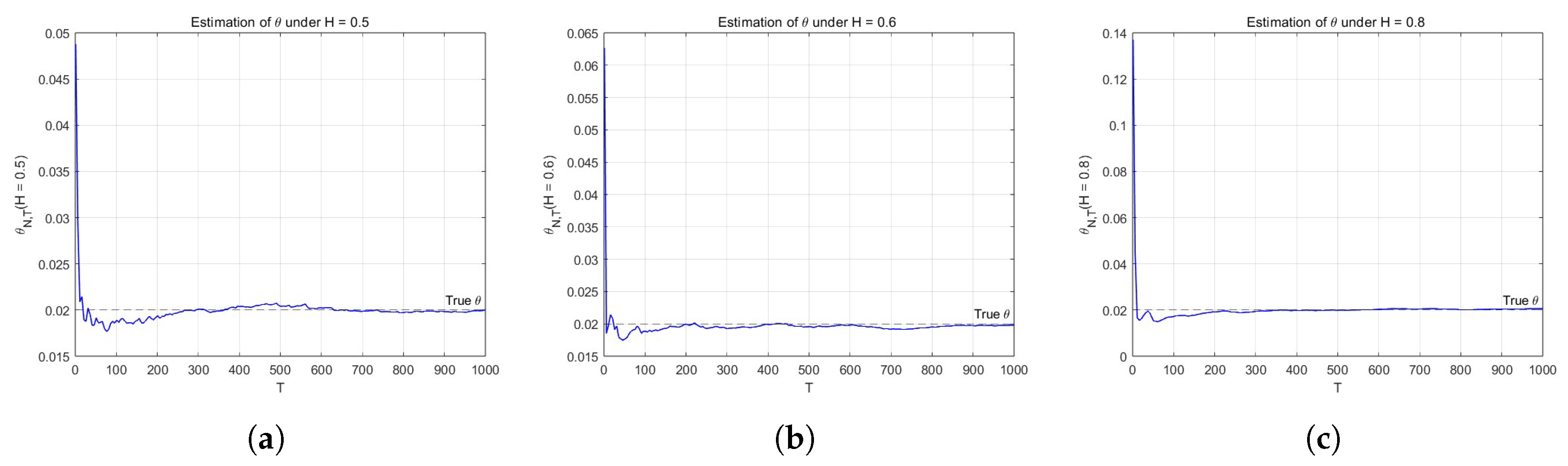
We first take the true parameter θ = 0.02 . For Hurst index values H = 0.5 , 0.6 , and 0.8 , a single sample path is generated for each, and the estimate θ ˜ N , T is computed along that trajectory. Figure 1 displays the estimates for T = 1000 . It can be observed that as T grows, the estimator θ ˜ N , T gradually stabilizes and eventually converges toward the true value θ = 0.02 . This result demonstrates that the proposed estimation method performs well in terms of convergence under different Hurst index settings, confirming its robustness and reliability.
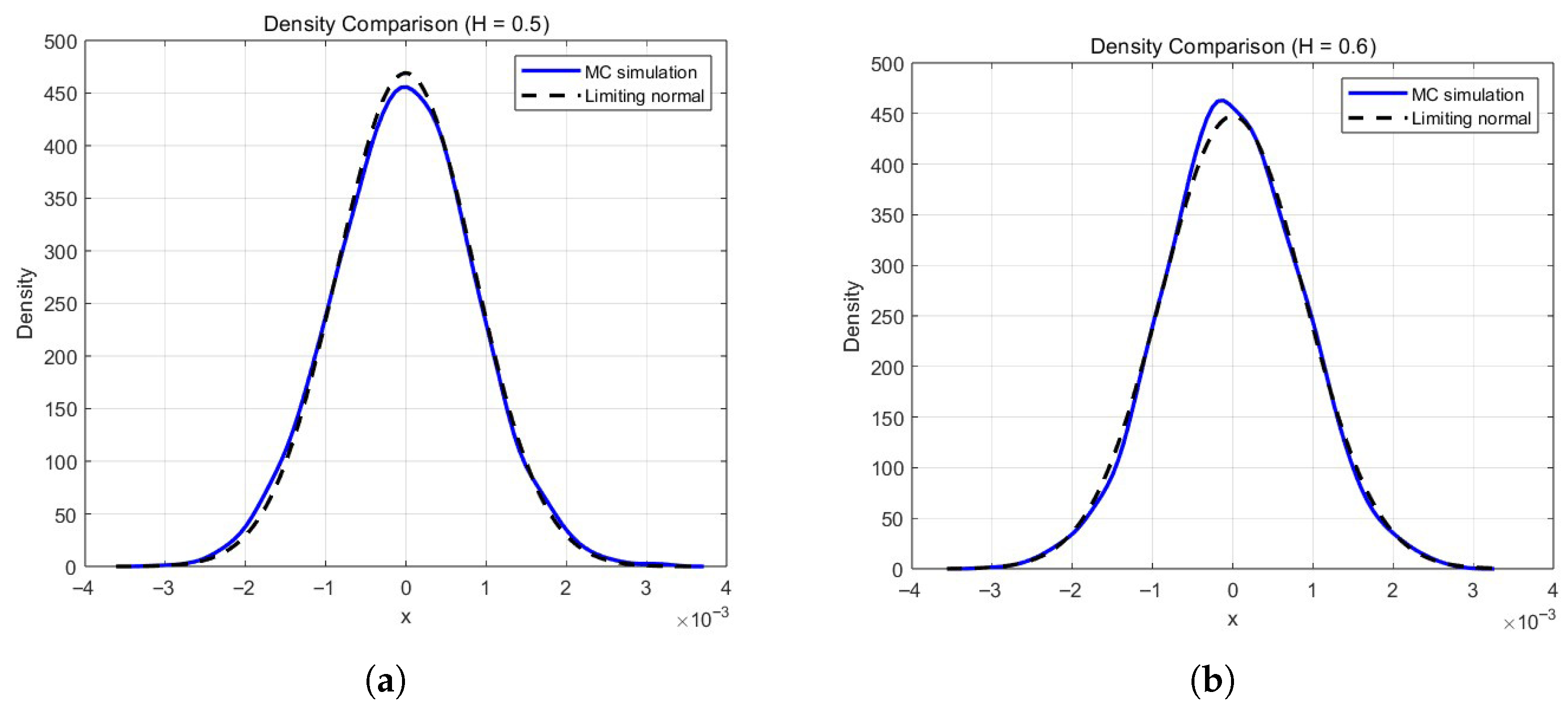
Next, we set θ = 0.5 . In the cases of H = 0.5 and H = 0.6 , 5000 Monte Carlo simulations are carried out, with each simulation generating a sample path. The estimator θ ˜ N , T is then computed for each trajectory. Based on the resulting 5000 estimates, a density plot is constructed and presented in Figure 2.
A key observation from Figure 2 is that, for both H = 0.5 and H = 0.6 , the empirically obtained density aligns remarkably well with the theoretical asymptotic density kernel of the limiting distribution for θ ˜ N , T . The close match is evident not only in the location of the distribution modes, but also in the overall shape and spread. This strong agreement between simulation and theory suggests that the asymptotic approximation is accurate even for the finite sample sizes used in our study. Furthermore, the consistent behavior observed across two different dependency structures ( H = 0.5 for memoryless noise and H = 0.6 for positively correlated noise) provides encouraging evidence for the robustness of the estimation procedure.

7. Conclusions

In this paper, we have studied the problem of estimating the drift parameter in a fractional stochastic heat equation driven by an additive fractional Brownian motion. By employing a spectral decomposition approach, the original SPDE was reduced to a system of fractional Ornstein–Uhlenbeck equations, allowing us to derive the least squares estimator θ ^ N , T and its variant θ ˜ N , T based on continuous-time observations of the Fourier coefficients. We have established the strong consistency and asymptotic normality of the two estimators. Numerical simulations further validate the theoretical findings, demonstrating the convergence of the estimators under different Hurst index settings. To the best of our knowledge, this is the first work to apply the least squares method to drift estimation for this class of fractional SPDEs. The results provide new asymptotic inference tools for stochastic systems with long-range dependence and extend the statistical framework for parameter estimation in fractional stochastic partial differential equations.
The present study is confined to the case of a finite number of spectral modes N and Hurst index H > 1 / 2 (with some parts requiring 1 / 2 < H < 3 / 4 ). Future research may consider the theoretical challenges when H ( 0 , 1 ) and when both N and T tend to infinity, as well as extensions to settings with discrete-time observations or multiplicative noise structures.


Author Contributions

Methodology, H.Q.; writing—original draft, H.Q.; writing—review and editing, L.G.; writing—review and editing, L.Y.; supervision, L.Y.; and funding acquisition, L.Y. All authors have read and agreed to the published version of the manuscript.

Funding

This research was funded by the National Natural Science Foundation of China (Grant No. 12301174), Key Natural Science Foundation of Anhui Education Commission (No. KJ2020A0751, No. KJ2021A1128, No. 2024AH051180) and the Natural Science Foundation of Shanghai (Grant No. 24ZR1402900).

Data Availability Statement

No new data were created or analyzed in this study.

Conflicts of Interest

The authors declare no conflicts of interest.

Appendix A

Lemma A1
(Hu and Nualart [8]). For any H ( 1 2 , 1 ) ,
( 2 H 1 ) 0 0 e ( s + r ) | s r | 2 H 2 d s d r = Γ ( 2 H ) .
Lemma A2.
Suppose Y k ( t ) is a stationary Gaussian process as defined in Equation (16), with Hurst exponent H > 1 2 . Then, for any α > 0 , process λ k γ Y k ( T ) T α converges to zero almost surely as T .
Proof. 
Using Lemma A1, we get the covariance of the process Y k ( t ) ,
Cov λ k γ Y k ( 0 ) , λ k γ Y k ( t ) = λ k 2 γ E ( Y k ( 0 ) Y k ( t ) ) = λ k 2 γ E λ k γ ξ u k ( t ) + λ k γ e θ λ k 2 β t ξ = e θ λ k 2 β t E ξ λ k γ e θ λ k 2 β t u k ( t ) + ξ = e θ λ k 2 β t E ξ ξ + σ 0 t e θ λ k 2 β u d B u H = e θ λ k 2 β t Var ( ξ ) + σ 2 α H 0 t 0 e θ λ k 2 β ( u + v ) | u v | 2 H 2 d u d v = e θ λ k 2 β t σ 2 λ k 4 β H θ 2 H H Γ ( 2 H ) + σ 2 α H 0 t v e θ λ k 2 β x + 2 θ λ k 2 β v x 2 H 2 d x d v .
By the proof of Lemma 5.2 in Hu and Nuarlart [8], we get
α H 0 t v e θ λ k 2 β x + 2 θ λ k 2 β v x 2 H 2 d x d v = ( λ k 2 β θ ) 1 2 H H Γ ( 2 H ) t 1 2 t 2 H + o t 2 H .
Therefore,
Cov λ k γ Y k ( 0 ) , λ k γ Y k ( t ) = e θ λ k 2 β t σ 2 λ k 4 β H θ 2 H H Γ ( 2 H ) + σ 2 λ k 2 β 4 β H θ 1 2 H H Γ ( 2 H ) t 1 2 t 2 H + o ( t 2 H ) = σ 2 λ k 4 β H θ 2 H H Γ ( 2 H ) 1 λ k 4 β H θ 2 H Γ ( 2 H + 1 ) t 2 H + o ( t 2 H ) .
The assertion of this lemma is a direct consequence of Theorem 3.1 in Pickands [20]. □
Lemma A3
(Hu and Nualart [8]). When 1 2 < H < 3 4 , we have
lim T I T T = θ 1 4 H γ H
where
I T = [ 0 , T ] 4 e θ s 2 t 2 θ s 1 t 1 s 2 s 1 2 H 2 t 2 t 1 2 H 2 d t d s ,
and
γ H = ( 8 H 2 ) Γ ( 2 H 1 ) 2 + ( 16 H 4 ) Γ ( 2 H 1 ) Γ ( 3 4 H ) Γ ( 4 H 2 ) Γ ( 2 2 H ) .
Lemma A4
(Hu and Nualart [8]). Let X t = σ 0 t e θ ( t s ) d B s H . Then,
E s T e θ ( ξ s ) d B ξ H t T e θ ( η t ) d B η H C θ , H | t s | 2 H 2 ,
and
E X t X s σ 2 C θ , H | t s | 2 H 2 ,
for some constant C θ , H > 0 .

References

  1. Mandelbrot, B.B. Fractals and Scaling in Finance: Discontinuity, Concentration, Risk. Selected Works of Benoit B. Mandelbrot; Springer: New York, NY, USA, 1997. [Google Scholar]
  2. Hu, Y.; Øksendal, B. Fractional white noise calculus and applications to finance. Infin. Dimens. Anal. Quantum Probab. Relat. Top. 2003, 6, 1–32. [Google Scholar] [CrossRef]
  3. Li, Y.; Xue, H. European option pricing model with regime switching in the fractional Brownian motion. Basic Sci. J. Text. Univ. 2021, 34, 95–101. [Google Scholar]
  4. Shubin, M.A. Pseudodifferential Operators and Spectral Theory, 2nd ed.; Springer: Berlin/Heidelberg, Germany, 2001. [Google Scholar]
  5. Lototsky, S.V. Statistical inference for stochastic parabolic equations: A spectral approach. Publ. Mat. 2009, 53, 3–45. [Google Scholar] [CrossRef]
  6. Chow, P. Stochastic Partial Differential Equations; Applied Mathematics and Nonlinear Science Series; Chapman & Hall: Boca Raton, FL, USA, 2007. [Google Scholar]
  7. Lototsky, S.V.; Rozovsky, B.L. Stochastic Partial Differential Equations; Springer: New York, NY, USA, 2017. [Google Scholar]
  8. Hu, Y.; Nualart, D. Parameter estimation for fractional Ornstein-Uhlenbeck processes. Stat. Probab. Lett. 2010, 80, 1030–1038. [Google Scholar] [CrossRef]
  9. Hu, Y. Integral Transformations and Anticipative Calculus for Fractional Brownian Motions; Memoirs of the American Mathematical Society; American Mathematical Society: Providence, RI, USA, 2005; Volume 175, p. 825. [Google Scholar]
  10. Mishura, Y.S. Stochastic Calculus for Fractional Brownian Motion and Related Processes; Lecture Notes in Mathematics; Springer: Berlin/Heidelberg, Germany, 2008; Volume 1929. [Google Scholar]
  11. Nourdin, I. Selected Aspects of Fractional Brownian Motion; Bocconi & Springer Series; Springer: Milan, Italy, 2012. [Google Scholar]
  12. Nualart, D. The Malliavin Calculus and Related Topics, 2nd ed.; Probability and Its Applications; Springer: New York, NY, USA, 2006. [Google Scholar]
  13. Tudor, C.A. Analysis of Variations for Self-Similar Processes; Probability and Its Applications; Springer: New York, NY, USA, 2013. [Google Scholar]
  14. Skorohod, A.V. On a generalization of a stochastic integral. Theory Probab. Appl. 1975, 20, 219–233. [Google Scholar] [CrossRef]
  15. Nualart, D.; Ortiz-Latorre, S. Central limit theorems for multiple stochastic integrals and Malliavin calculus. Stoch. Process. Appl. 2008, 118, 614–628. [Google Scholar] [CrossRef]
  16. Nualart, D.; Peccati, G. Central limit theorems for sequences of multiple stochastic integrals. Ann. Probab. 2005, 33, 177–193. [Google Scholar] [CrossRef]
  17. Duncan, T.E.; Hu, Y.; Pasik-Duncan, B. Stochastic calculus for fractional Brownian motion. I. Theory. SIAM J. Control Optim. 2000, 38, 582–612. [Google Scholar] [CrossRef]
  18. Cheridito, P.; Kawaguchi, H.; Maejima, M. Fractional Ornstein-Uhlenbeck processes. Electron. J. Probab. 2003, 8, 1–14. [Google Scholar] [CrossRef]
  19. Hu, Y.; Nualart, D.; Zhou, H. Parameter estimation for fractional Ornstein-Uhlenbeck processes of general Hurst parameter. Stat. Inference Stoch. Process. 2019, 22, 101–119. [Google Scholar] [CrossRef]
  20. Pickands, J. Asymptotic properties of the maximum in a stationary Gaussian process. Trans. Am. Math. Soc. 1969, 145, 75–86. [Google Scholar] [PubMed]
Figure 1. (a) One-trajectory simulation result of θ ˜ N , T for H = 0.5 ; (b) one-trajectory simulation result for H = 0.6 ; (c) one-trajectory simulation result for H = 0.8 .
Mathematics 14 01318 g001
Figure 2. (a) Density plots of the simulation results for θ ^ N , T and its limiting distribution under H = 0.5 ; (b) density plots under H = 0.6 .
Mathematics 14 01318 g002
Disclaimer/Publisher’s Note: The statements, opinions and data contained in all publications are solely those of the individual author(s) and contributor(s) and not of MDPI and/or the editor(s). MDPI and/or the editor(s) disclaim responsibility for any injury to people or property resulting from any ideas, methods, instructions or products referred to in the content.